A Problem of Resistance

Posted in Cute Problems with tags , on November 29, 2020 by telescoper

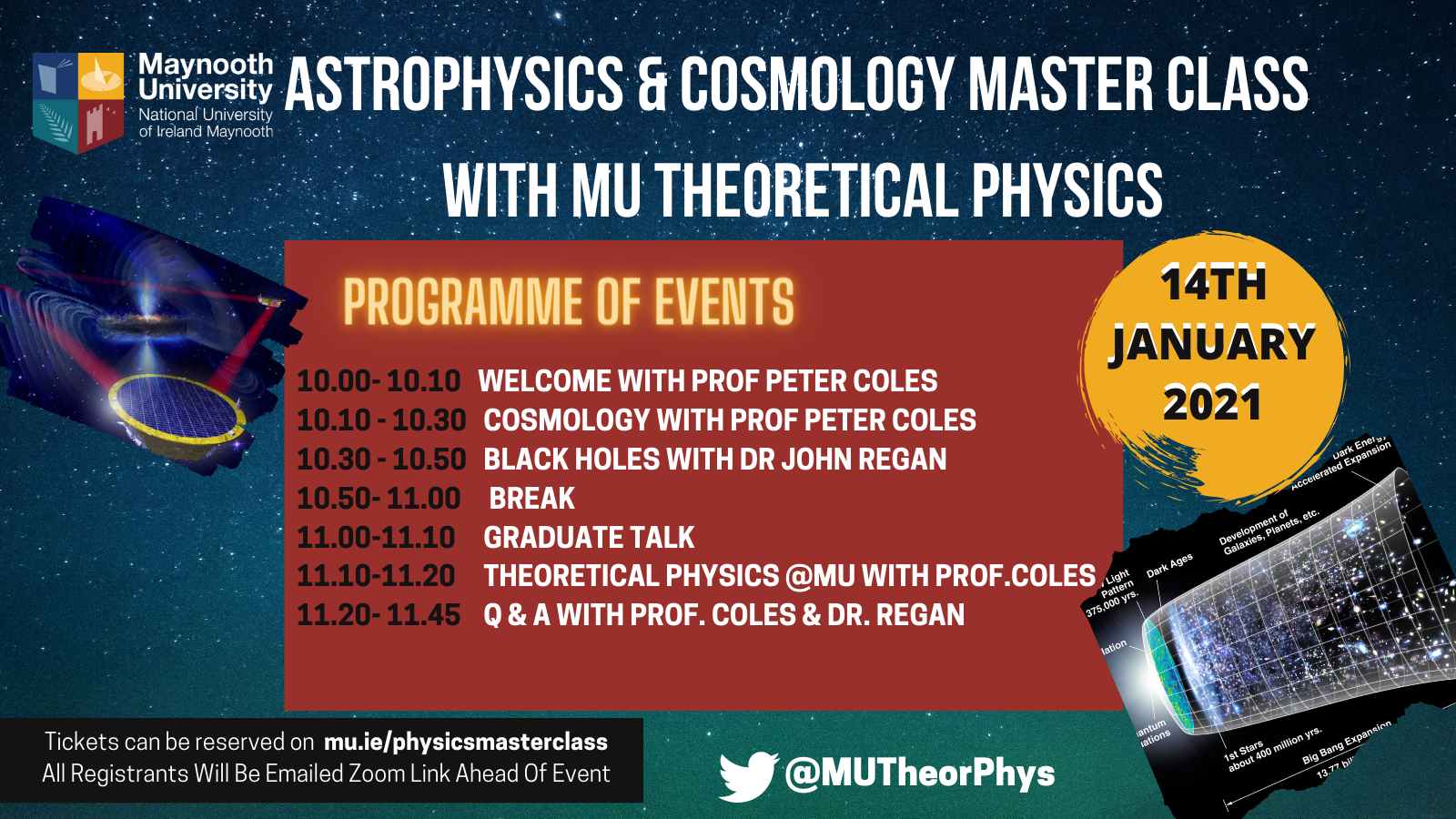
Bizarrely, last night I dreamt of this physics problem. This mean that I’ve seen it before somewhere, but if that’s the case then I’ve forgotten where. In the dream the problem of electrical resistance was muddled up with the problem of how to calculate the Euler Characteristic of a structure defined on a grid*, which is something I have used in the past. Anyway, with apologies for the poor quality of the drawing, here is the set up.

Twelve identical resistors R are arranged in four squares with common edges thus:

Yes, they’re meant to be identical squares!

What would be the effective resistance of this circuit measured between A and B?

Please post your answers through the comments box, with appropriate explanations. Bonus marks for elegant (i.e. short) solutions.

(In my dream this problem came up in contrast with the case where the four internal resistors and their connecting wires were absent, so the circuit was just a ring.  The Euler Characteristic of the original connected set of squares is 1 while that of the ring is 0, not that it’s relevant to the problem in hand!)


Et in Arcadia…

Posted in Art with tags , on November 28, 2020 by telescoper

“It says ‘Top Shop’…”

I doubt if anyone will get the joke without a hint.

Virtually Open Saturday at Maynooth

Posted in Education, Maynooth on November 28, 2020 by telescoper

Today is the second of two consecutive Virtual Open Days here at Maynooth University so here I am sitting in front of my computer at home on a Saturday morning answering questions from prospective students about Theoretical Physics courses. The first day was more about clubs and societies and other aspects of student life at Maynooth so I wasn’t involved so much in that. Today is about courses of study so I’m here fielding questions for my Department.

With about an hour gone since we opened at 10am it’s been quite busy, but at least I’ve either known, or had access to, the information needed to be able to answer the questions asked! So far. If questions keep coming at the same rate for the next three hours I’m going to need quite a lot of coffee to keep me going!

At least I can do this from the comfort of my own home. It’s a rather cold and miserable day outside. The weather turned much colder a couple of days ago, and the temperature was below freezing last night. There was a hard frost covering my garden when I got up this morning. Winter draws on.

Anyway, I’ll be online until 2pm, which fortunately will give me plenty of time to do some things I need to do before watching the Semi-final of the All Ireland Senior Hurling Championship between Waterford and Kilkenny, which starts at 6pm…

UPDATE: It was a remarkable game of hurling, Waterford looking dead and buried at half time but turning it around in amazing fashion  in the second half to win 2-27 to 2-23. Greatest comeback since Lazarus.

Swinging on the Säckpipa

Posted in Jazz with tags , , on November 27, 2020 by telescoper

And now for something completely different.

This is Swedish musician Gunhild Carling out front of a swinging big band on the open-air stage at Central Park, New York, tearing it up on the bagpipes*.

You’re welcome.


(*to  be precise these are a kind of traditional Swedish bagpipes known as the säckpipa).


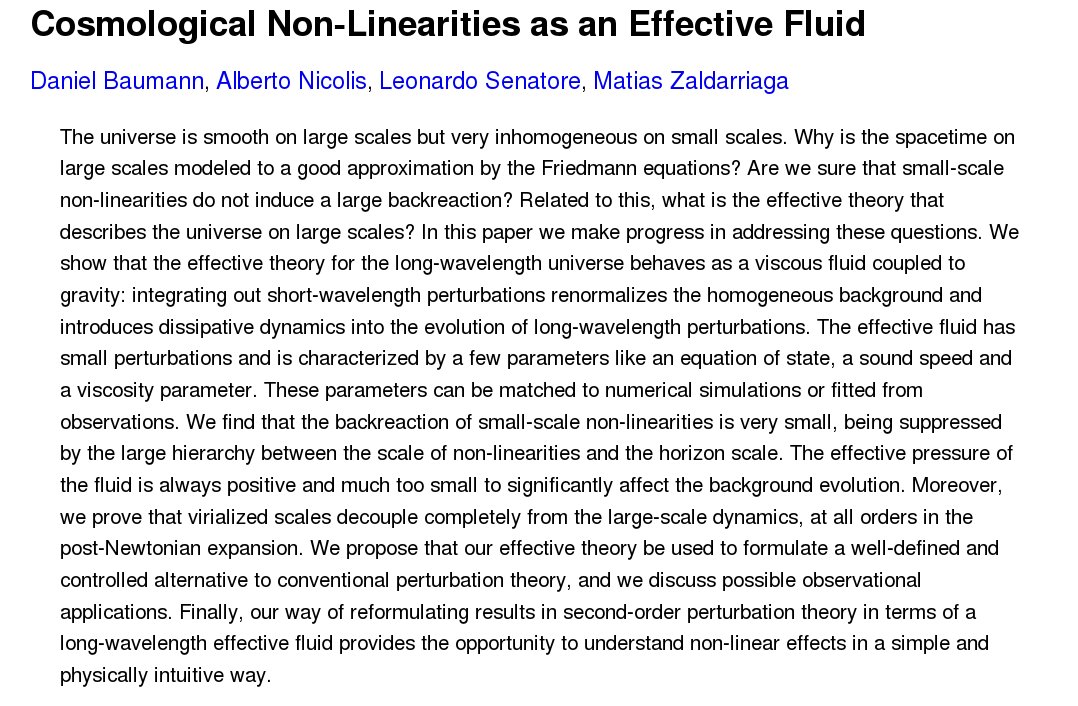
Cosmological Non-Linearities as an Effective Fluid

Posted in The Universe and Stuff with tags , , , , , , , on November 27, 2020 by telescoper

We know our Universe is inhomogeneous, comprising regions of high density (galaxies and clusters of galaxies) as well as regions of much lower density (e.g. cosmic voids). Our standard cosmological models are based on exact solutions of Einstein’s equations of general relativity that assume homogeneity and isotropy. The general assumption is that if we confine ourselves to large enough scales the effect of the clumpiness of matter can either be disregarded or treated using perturbation theory. As far as we can tell, that approach works reasonably well but we know it must fail on smaller scales where the structure is in the non-linear regiome where it can’t be described accurately using perturbation theory because the fluctuations are so large.

From time to time I’ve idly wondered whether it might be possible to understand the effect of these non-linearities in general relativity by treating them as a kind of fluid with an energy-momentum tensor that acts as a correction to that of the perfect fluid form of the background cosmological model. This would have to be done via some sort of averaging so it would be an effective, coarse-grained description rather than an exact treatment. It is clear though that non-linearities would generate departures from the perfect fluid form, particularly resulting in off-diagonal terms in the energy-momentum tensor corresponding to anisotropic stresses (e.g. viscosity terms).

Anyway, a recent exchange on Twitter relating to a new paper that has just appeared revealed that far cleverer people than me had looked at this in quite a lot of detail a decade ago:

You can find the full paper here.

There are quite a lot of subtleties in this – how to do the spatial averaging, how to do the time-slicing, etc – which I don’t fully understand but at least I’m reassured that it isn’t a daft idea to try thinking of things this way!

P.S. The relativistic simulations reported in this paper could in principle be used to estimate the parameters mentioned in the abstract above, if that hasn’t been done before!


John & Diego

Posted in Poetry, The Universe and Stuff with tags , , on November 26, 2020 by telescoper

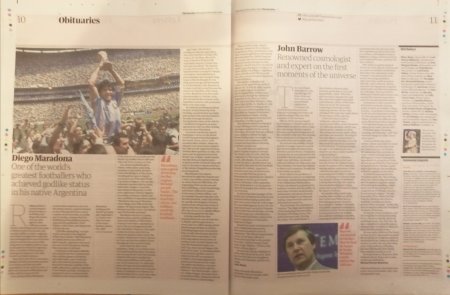
The Guardian obituary of John Barrow (written by Michael Rowan-Robinson) has finally appeared in today’s print edition*, alongside that of footballer Diego Maradona who passed away yesterday.

As a lifelong football fan I think John would have been amused by the coincidence, especially because John’s first book (co-written with Joe Silk) was called The Left Hand of Creation:

*I don’t usually buy foreign newspapers, but I managed to find a copy of today’s Grauniad in Maynooth.

Maynooth University Open Days!

Posted in Education, Maynooth with tags , , on November 26, 2020 by telescoper

It’s almost time once again for our autumn open days at Maynooth University. This autumn the two days are virtual events but also differ in that the first day is devoted to clubs, societies and other wider aspects of student life while the second is dedicated to information about the academic side, i.e. courses of study.

I’ve recorded some video material that will be used on the second day and I’m also going to be online on Saturday from 10am to 2pm to answer questions from prospective students. In order to experience these and other delights you have to register, which you can do here.

Here is a video tour of the Maynooth University campus, filmed in better weather!

You will see that it includes an artist’s impression of the new building on the North Campus which isn’t actually finished yet, but which is coming along nicely.

And here is a gratuitous picture of our star attraction:

Out of the REF

Posted in Biographical, Cardiff, Maynooth with tags , , , , on November 25, 2020 by telescoper

I was talking over Zoom with some former colleagues from the United Kingdom last week, and was surprised to learn that, despite the Covid-19 pandemic, the 2021 Research Excellence Framework is ploughing ahead next year, only slightly delayed. There’s no stopping bureaucratic juggernauts once they get going…

One of the major plusses of being in Ireland is that, outside the UK academic system, there is no REF. One can avoid the enormous workload and stress generated by this exercise in bean-counting My memories of the last REF in 2014 when I was Head of School at Sussex are quite painful, as it went badly for us then. I hope that the long-term investments we made then will pay off, though, and I hope things turn out better for Sussex this time especially for the Department of Physics & Astronomy for which the impact and environment components of the assessment dragged the overall score down.

The census period for the new REF is 1st August 2013 to 31st July 2020. Not being involved personally in the REF this time round I haven’t really paid much attention to the changes that have been adopted since 2014. One I knew about is that the rules make it harder for institutions to leave staff out of their REF return. Some universities played the system in 2014 by being very selective about whom they put in. Only staff with papers considered likely to be rated top-notch were submitted.

Having a quick glance at the documents I see two other significant differences.

One is that in 2014, with very few exceptions, all staff had to submit four research outputs (i.e. papers) to be graded. in 2021 the system is more flexible: the total number of outputs must equal 2.5 times the summed FTE (full-time equivalent) of the unit’s submitted staff, with no individual submitting more than 5 and none fewer than 1 (except in special cases related to Covid-19). Overall, then there will be fewer outputs than before, the multiplier of FTE being 2.5 (2021) instead of 4 (2014). There will still be a lot, of course, so the panels will have a great deal of reading to do. If that’s what they do with the papers. They’ll probably just look up citations…

The other difference relates to staff who have left an institution during the census period. In 2014 the institution to which a researcher moved got all the credit for the publications, while the institution they left got nothing. In 2021, institutions “may return the outputs of staff previously employed as eligible where the output was first made publicly available during the period of eligible employment, within the set number of outputs required.” I suppose this is to prevent the departure of a staff member causing too much damage to the institution they left.

I was wondering about this last point when chatting with friends the other day. I moved institutions twice during the relevant census period, from Sussex to Cardiff and then from Cardiff to Maynooth. In principle, therefore, both former employees could submit my outputs I published while I was there to the 2021 REF. I only published a dozen or so papers while I was at Sussex – the impact of being Head of School on my research productivity was considerable – and none of them are particularly highly cited so I don’t think that Sussex will want to submit any of them, but they could if they wanted to. They don’t have to ask my permission!

I doubt if Cardiff will be worried about my papers. Among other things they have a stack of gravitational wave papers that should all be 4*.

Anyway, thinking about the REF an amusing thought occurred to me about Research Assessment. My idea was to set up a sort of anti-REF (perhaps the Research Inferiority Framework) based not on the best outputs produced by an institutions researchers but on the worst. The institutions producing the highest number of inferior papers could receive financial penalties and get relegated in the league tables for encouraging staff to write too many papers that nobody ever reads or are just plain wrong. My guess is that papers published in Nature might figure even more prominently in this
Astrophysics & Cosmology Masterclass at Maynooth

Posted in Education, Maynooth, The Universe and Stuff with tags , , on November 24, 2020 by telescoper

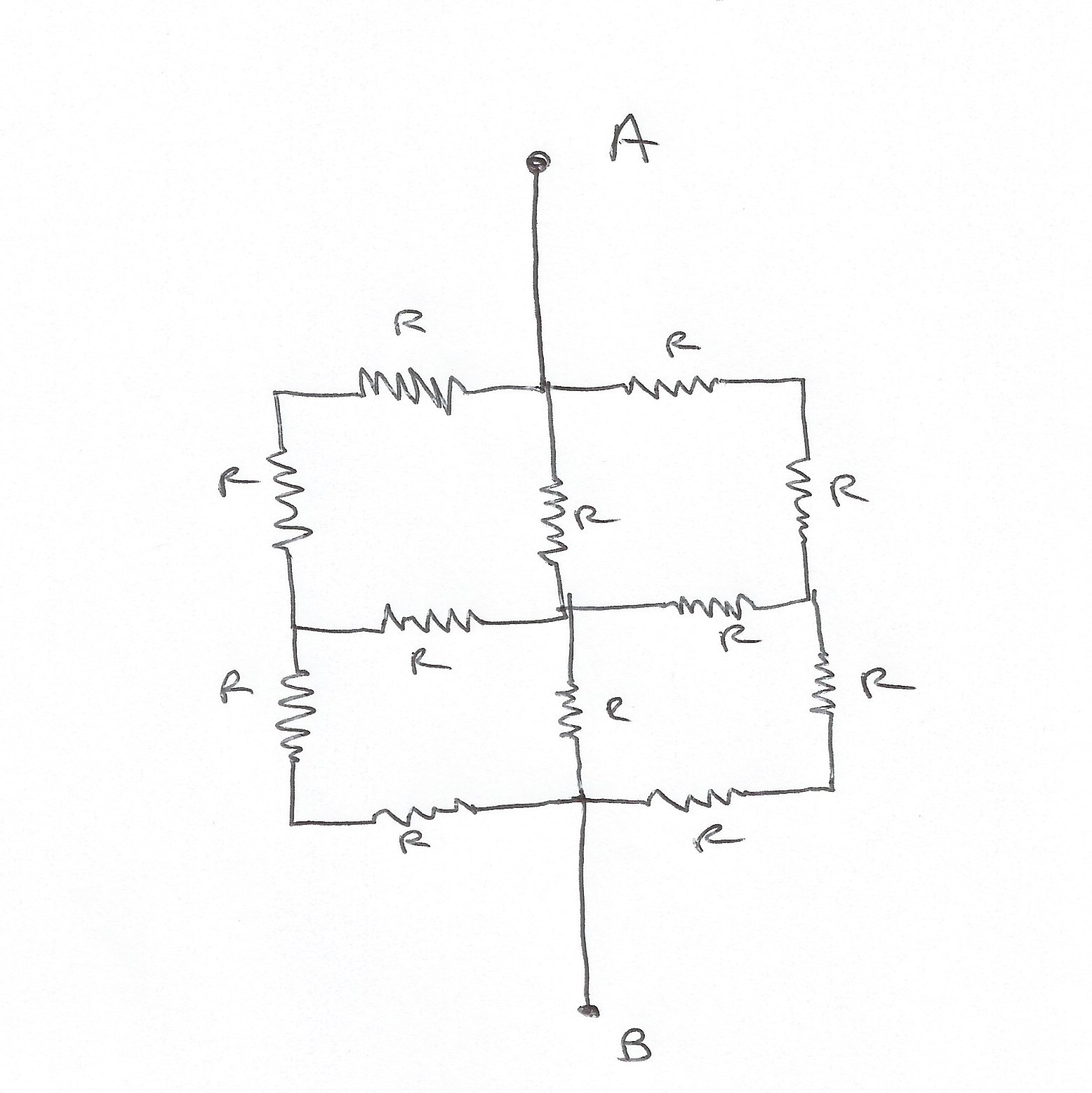
Stealing the idea from our long-running Particle Physics Master Class (which sadly had to be cancelled this year for Covid-19 related reasons, but will resume in 2021), the Department of Theoretical Physics at Maynooth University has decided to launch a Masterclass in Astrophysics & Cosmology. The first one will be on January 14th 2021.

This will be a half-day virtual event via Zoom. It’s meant for school students in their 5th or 6th year of the Irish system, but there might be a few of them or their teachers who see this blog so I thought I’d share the news here. You can find more information, including instructions on how to book a place, here.

Here is the official poster and the programme:

I’ll be talking about cosmology early on, while John Regan will talk about black holes. After the coffee break one of our PhD students will talk about why they wanted to study astrophysics. Then I’ll say something about our degree programmes for those students who might be interested in studying astrophysics and/or cosmology as part of a science course. We’ll finish with questions either about the science or the study!

Four Weeks To Go

Posted in Biographical, Covid-19, Education, Maynooth with tags , , , , , on November 23, 2020 by telescoper

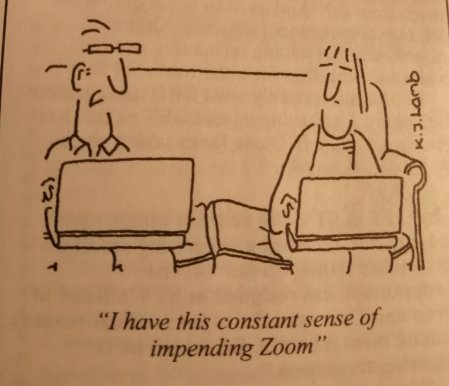
As I await another Zoom meeting I remembered this cartoon from last week’s Private Eye, which sums up the prevalent mood amongst academics these days (and no doubt people in other kinds of job too).

At the start of this morning’s Panopto lecture I realised that there are still 4 weeks left of this Semester before the Christmas break. I was a bit surprised by that as this term seems to have lasted a decade already. The time certainly hasn’t zoomed by. Still, at least I’ve more-or-less kept up with my planned schedule of lectures in both of my modules without slipping. I may even be able to finish lectures to my 2nd year Vector Calculus in time to do a bit of revision in the final week.

That’s not to say other things haven’t slipped. The greatly increased time for teaching needed to move everything online hasn’t left much time for research or anything else. I keep meaning to work in the evenings to deal with outstanding things but mostly I find once I’ve done the necessary admin and teaching stuff all I can do is sleep. It seems that I’ll have to work over Christmas to finish off the backlog. Given that I didn’t have a holiday this summer that’s not ideal, but it’s unlikely I’ll be going anywhere over the “festive” season owing to Coronavirus restrictions so I might as well make the best of it.

We don’t have much idea how things will work out next Semester. The politicians seem to be wanting universities to have more on-campus teaching in the New Year. They also want to end the current restrictions to end before Christmas. In fact the current regime is suppose to end on December 2nd, which is next week, and cases are still running around 400 per day. I don’t think they can do both of these and for the Covid-19 situation to remain under any semblance of control. I think the likeliest scenario is that cases surge over the next few weeks and the Christmas break and we have to go back into full restrictions in January or February.

There is however the prospect of a vaccine or vaccines being available fairly early next year so maybe the end of this is in sight. I really hope we can get back to campus normality at some point in 2021. I do feel very sad about the effect all these restrictions has been having on the students. It’s not just having to have remote lectures. I think having a lecturer in the same room is an advantage, but the loss of it is not the worst issue. We encourage our students to work with each other in their learning, and I’m sure students learn at least as much from each other as they do from the lecturer. Peer group learning is more difficult when your peers are sitting in separate locations most of the time.

Earlier today I found myself using the phrase “getting back to normal” in connection with plans for next teaching year. Then I realise that we staff know what we mean by “normal” but our first-year students don’t. I have a feeling that may might find it more difficult to adjust to the old normal than they did to the new one.

And in any case many of our students in all years did not take up accommodation in Maynooth at the start of this year because of the remote teaching. Even if we did on campus lectures or tutorials next term, I suspect many will stay at home anyway to avoid substantial cost of rented accommodation. We will therefore have to continue making material available online whatever happens.

Anyway, what may or may not happen next Semester is to a large extent out of my hands so I won’t be making any firm decisions on what approach I will be taking until much closer to the start of Semester 2 In the meantime the goal is to fight the exhaustion and try get through to the end of term in one piece.