A Test of the Cosmological Principle using Quasars

Posted in The Universe and Stuff with tags , , , , on October 8, 2020 by telescoper

I’m not getting much time these days to even think about cosmology but Subir Sarkar drew my attention to an intriguing paper by his team so I thought I’d share it here. Here is the abstract and author list:
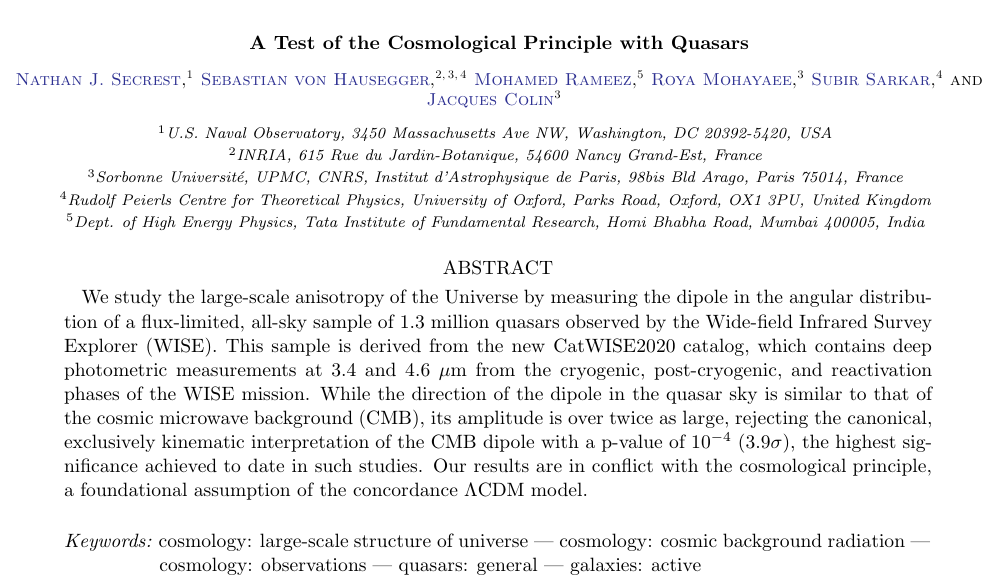
I find this an intriguing result because I’ve often wondered about the dipole anisotropy of the cosmic microwave background might not be exclusively kinematic in origin and whether they might also be a primordial contribution. The dipole (180°) variation corresponds to a ΔT/T of order 10-3, which a hundred times larger than the variation on any other angular scale. This is what it looks like:

This is usually interpreted as being due to the motion of the observer through a frame in which the cosmic microwave background is completely isotropic. A simple calculation then gives the speed of this motion using ΔT/T ≈ v/c. This motion is assumed to be generated by gravitational interaction with local density fluctuations rather than being due to anything truly cosmological (i.e. of primordial origin).

The features in the cosmic microwave background temperature pattern on smaller angular scales (the quadrupole, octopole, etc…) , which have ΔT/T of order 10-5 are different in that they are dominated by primordial density fluctuations. There should be a primordial dipole at some level, but the fact that these other harmonic modes have such low amplitudes and the assumption that the primordial dipole should be of the same order, combined with the fact that the CMB dipole does indeed roughly line up with the dipole expected to be generated by local inhomogeneities, has led to the widespread belief that this intrinsic dipole is negligible. This analysis suggests that it might not be.

What the authors have done is study the anisotropy of a large sample of quasars (going out to redshifts of order three) finding the dipole to be larger than that of the CMB. Note however that the sample does not cover the whole sky because of a mask to remove regions wherein AGN are hard to observe:
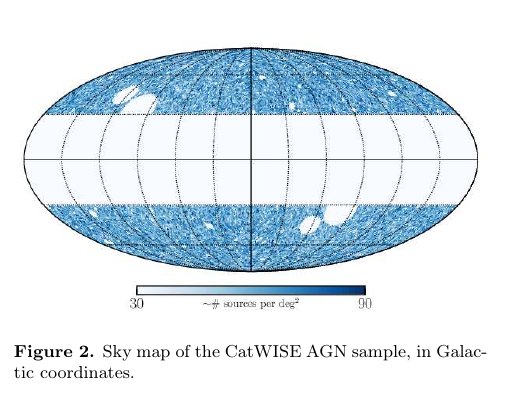
As well as the mask there are other possible systematics that might be at play, which I am sure will be interrogated when the paper is peer-reviewed which, as far as I know, is not yet the case.

P.S. I might just quibble a little bit about the last sentence of the abstract. We know that the Universe violates the cosmological principle even in the standard model: with scale-invariant perturbations there is no scale at which the Universe is completely homogeneous. The question is really how much and in what way it is violated. We seem to be happy with 10-5 but not with 10-3

Update: On 23rd October Subir will be giving a talk about this an participating in a debate. For more details, see here.

Lecture Streaming

Posted in Education, Maynooth with tags , , , on October 7, 2020 by telescoper

When we were told, at the start of this term, to move all our teaching online my initial intention was to record most of the lectures in my office for the students to watch at their leisure rather than streaming them live.
The system we’re using, Panopto, allows for both webcast (i.e. live streaming) and pre-recorded (offline) videos. I thought that only very few students would want to watch the broadcast version. I have however changed my mind about this and am now streaming all my lectures (as well as recording them for later viewing). It also meant that I could record the lectures in advance at my without being constrained by the timetable.

Last week my office wasn’t usable for recording videos because of noise from building work so I had to find somewhere else to record the videos so I decided to go to the lecture theatre at the scheduled time primarily because I knew the room would be available at that time. When I started the first lecture I thought I might as well webcast it as well, thinking only a few students would tune in. In fact, out of my class of 45 or so second-year students, about 39 were online while I did the lecture. Since then I’ve done all the lectures live and plan to do so until further notice.

A handful of students even turn up in person to the lectures. I see no problem with this. The restrictions are designed to minimize as far as possible the number of students coming to campus, but if they are here anyway because of labs (which can’t be done virtually) then why shouldn’t they come to the lectures? (Provided, of course, that they follow the public health guidance, wear masks, wash their hands, practice social distancing, etc). I find their presence very helpful, actually. Talking to an audience is far easier than talking only to a camera. You do have to remember to look at the camera though!

It is possible to edit the webcast recording before sharing it with the students. That way you can get rid of all the mistakes, hesitations and other defective bits. Starting with a 50 minute lecture that usually means you end up with about 10 minutes of good material.

Having settled on this approach I was dismayed on Monday to find the Panopto system wasn’t working in either webcast or offline recording mode. I assumed at first that I was doing something wrong but it turns out it was a major outage affecting all of Europe that went on all day. Twitter was full of comments from academics complaining about! Panopto uses cloud storage with very little being held locally so when the connectivity fails the user is helpless. I did the lecture by Teams instead, but had lost some time faffing around trying to get Panopto to work.

Yesterday morning Panopto was back working and my office was quiet so I reran the lecture using the blackboard in my office and recorded it as an offline video. That way the students now have the lecture in the right space on the Moodle page. After that I did two more lectures as webcasts using Moodle – Tuesday is a busy teaching day this term – and everything worked fine.

I think there are two morals to be drawn from this. The first is not to assume that you know what students will find useful. The second is wherever possible to have a backup plan. Putting all your eggs in the basket marked Panopto is risky.

Astronomy Look-alikes No. 101

Posted in Astronomy Lookalikes, Television, The Universe and Stuff with tags , , , , , on October 6, 2020 by telescoper

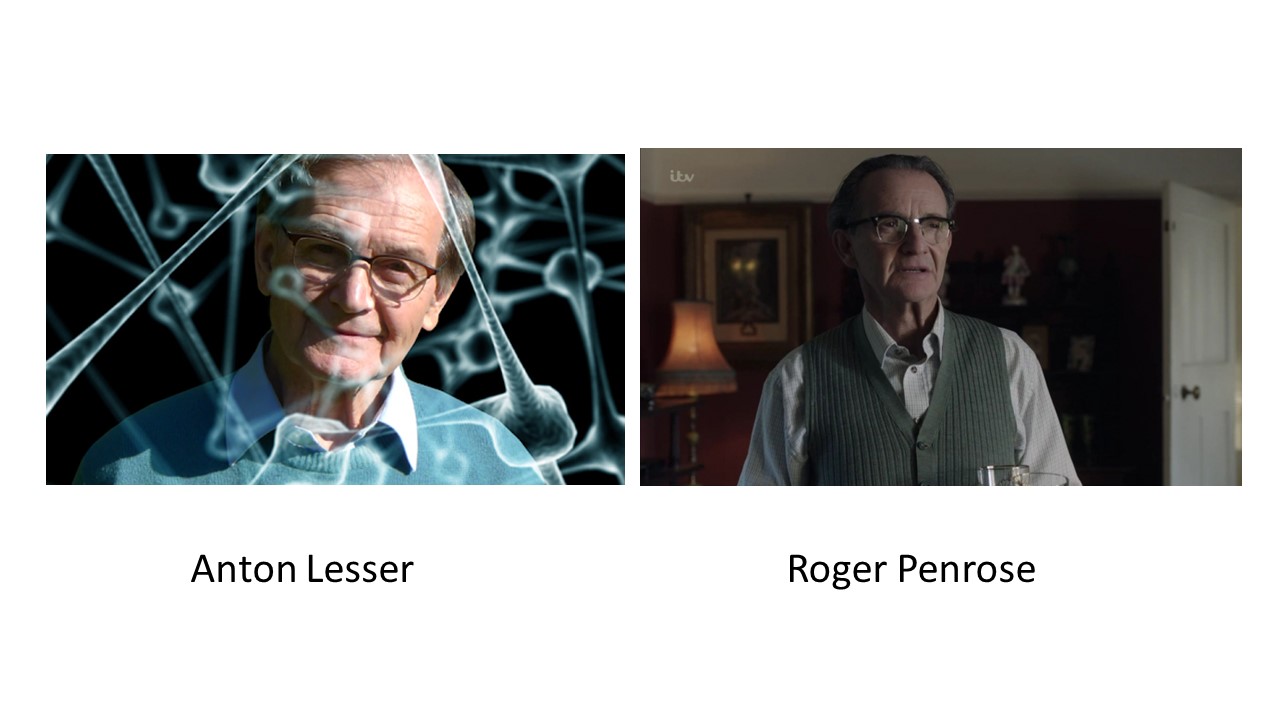
One winner of the 2020 Nobel Prize for Physics, Roger Penrose, is based in Oxford where he also plays Chief Superintendent Bright in the popular TV detective series Endeavour

The 2020 Nobel Prize for Physics

Posted in The Universe and Stuff with tags , , , on October 6, 2020 by telescoper

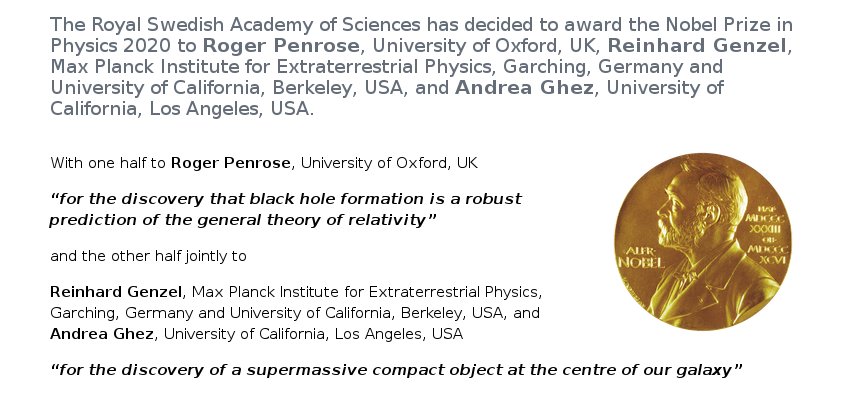
I don’t know about you but I was a bit surprised by this year’s announcement of the Physics Nobel Prize but that’s largely because it went to something cosmic last year and not because I disapprove in any way. Roger Penrose’s work in the 1960s on the black hole singularity theorems is rightly famous and the observational discovery of the supermassive black hole in the centre of the Milky Way is also more than worthy of recognition.

Congratulations to Roger Penrose, Reinhard Genzel and Andrea Ghez!

Lost and Found!

Posted in Biographical, Maynooth on October 5, 2020 by telescoper

Here’s another post that demonstrates that I’m getting even more absent-minded in my old age.

On Friday I lost my phone. I was pretty sure I had it with me when I went to work but couldn’t find it when I was getting ready to leave for home. I hadn’t actually used it while I was at work on Friday so I convinced myself that I’d left it at home. I was wrong.

I was a bit worried that the delivery people on Saturday might assume I wasn’t in when they couldn’t contact me by the number I gave them, but they did turn up and all was well.

As soon as I got back to work this morning, I tried to retrace all the steps I’d taken on Friday in the hope of finding the missing item, but without joy. Just before leaving the office to give my lecture at 11am, increasingly worried, I emailed security to ask if anyone had handed in a phone. It was I thought a last resort.

When I got back to the office I found to my great relief an emailed reply saying that a phone matching the description I’d given had indeed been handed into them. It had been found by a cleaner in the John Hume Building (in which I gave a lecture on Friday).

I went straight over to the security lodge and proved that it was my phone, which was easy because it has fingerprint recognition. When I’d done that I was asked to sign for it and was reunited with my phone (which was undamaged). As I turned to leave I asked where it had been found. The answer left me a bit. shocked. It was found in the lecture theatre I’d been teaching in… in the waste bin!

I gave a lecture on Friday in the John Hume building but can’t really understand how my phone ended up in the bin. I remember seeing a bin near the desk at the front, so I guess I must have accidentally knocked it off the bench while trying to set up the camera.

Above all though I realised just how lucky I had been. I reckon 99 times out of 100 the cleaner would have just emptied the bin without further thought. This time, though, perhaps because there was nothing else in the in it (as the lecture theatres are largely empty these days), the cleaner spotted it and did the right thing. Had the bin been full of other rubbish it would probably not have been seen.

Losing my phone would have been hugely inconvenient on top of all the other causes of stress these days so I’m very glad I’ve got it back.

All’s well that ends well.

To Level Five?

Posted in Covid-19, Maynooth, Politics with tags , , on October 4, 2020 by telescoper

When I saw that 613 new cases of Covid-19 were recorded in Ireland on Saturday (3rd October) it seemed obvious that the situation in Ireland was getting out of control:

Note that on this graph the new cases have been growing in a roughly linear fashion for at least a month. Since the y-axis is logarithmic this means the growth of the pandemic is roughly exponential. The  7-day moving average up to and including Saturday was 448, with no sign of an end to the upward trend.

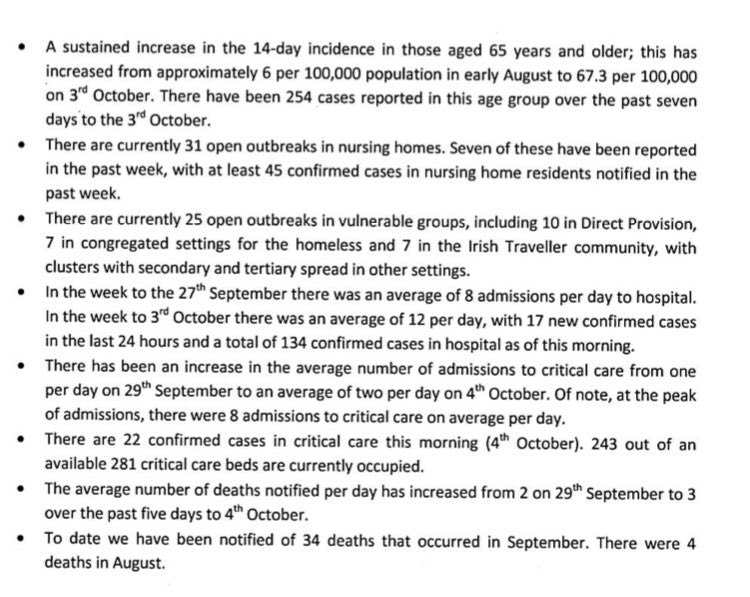
After a meeting yesterday, the National Public Health Emergency Team (NPHET) reviewed the following statistical developments:

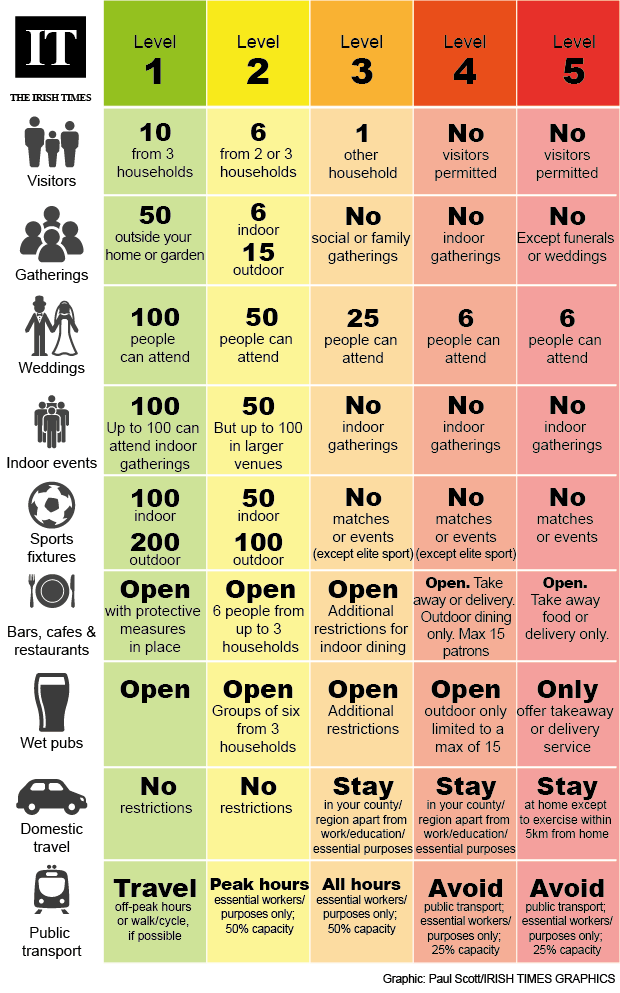
In the light of these it decided to recommend an immediate jump to the highest level of restrictions, Level 5, for the entire country:

Level Five isn’t quite the same as what happened in March, largely because Schools and Colleges are intended to remain open, but it means the same widespread shutdown of the private sector. This escalation is supposed to last at least 4 weeks.

This is of course a recommendation. The imposition of these measures is up to the Government, which has to balance public health measures against economic damage. Presumably will make a decision sometime this week. Will they have the guts to stand up against the hospitality industry?

The problem is that the Government announcing restrictions and people actually abiding by them are not the same thing at all. It only takes a few people to flout the rules for the pandemic to take hold once more, and while many people are behaving sensibly, there is ample evidence of people not doing so.

What this means for us at Maynooth University remains to be seen.


UPDATE: The Government this afternoon rejected the advice of NPHET and instead moved the country to Level 3. I hope they know what they’re doing.

Week Ending

Posted in Biographical, Covid-19, Maynooth on October 3, 2020 by telescoper

It’s the Saturday after a very tough week. At least I’ve got an excuse for lounging about at home because I’m waiting for a new bed to be delivered. Since I moved into my new house I’ve been sleeping in a single bed, in what will be the spare room, but when the bigger bed arrives I’ll be able to move into the main bedroom.

Last week was a tough one at work. Switching teaching online at short notice was only part of it. The building work that started late still isn’t finished so I’ve got more disruption from that to look forward to when I return to the Department on Monday.

I did at least get through the first week of online teaching. The newly installed Panopto system (which we used when I was in Cardiff) works very well, although the cameras are a bit limited. This system can webcast a lecture as well as recording it to be viewed later. I always assumed most students would watch the lectures after the event but as it turned out a majority actually viewed them live.

The sudden switch to online teaching was designed to restrict the number of students travelling to and from the University but nobody seems to have thought very much about those actually living on campus. In the case of Maynooth University that includes a sizeable fraction of first-year students whose first experience of university life is much poorer than in a normal year. I feel very sorry for this cohort but I suppose circumstances made this inevitable.

The official University line, as explained in an email (inevitably) sent out to Department Heads on Friday evening), is that teaching will be online at least until Study Week ( the week beginning 26th October). I think it’s overwhelmingly probable that we teach like this for the entire semester and there is a good chance that it will be the entire academic year. I think it would benefit us all, staff and students, if this decision were made now. There is no end in sight to Covid-19 and there is no point in pretending otherwise.

Update: the bed arrived this afternoon. It required “some self assembly”: though not on the scale of IKEA furniture that was quite hard work because the frame parts are very heavy. It’s done now though and I’m looking forward to sleeping in it tonight.

R.I.P. Derek Mahon (1941-2020)

Posted in Covid-19, Poetry with tags , , , , on October 2, 2020 by telescoper

The poet Derek Mahon has died, so it seems apt to pay tribute by posting some examples of his poetry.

This poem, Everything is going to be all right, was read on the main news on RTÉ television when the national lockdown was announced back in March, sounding a note of optimism to a worried nation. I’m not sure everything is going to be all right, but it’s an excellent poem:

How should I not be glad to contemplate
the clouds clearing beyond the dormer window
and a high tide reflected on the ceiling?
There will be dying, there will be dying,
but there is no need to go into that.
The poems flow from the hand unbidden
and the hidden source is the watchful heart.
The sun rises in spite of everything
and the far cities are beautiful and bright.
I lie here in a riot of sunlight
watching the day break and the clouds flying.
Everything is going to be all right.

Sadly he didn’t live to see the end of the pandemic. Over the years I have posted a few poems by Derek Mahon. Here are two more. This one is called The Thunder Shower

A blink of lightning, then
a rumor, a grumble of white rain
growing in volume, rustling over the ground,
drenching the gravel in a wash of sound.
Drops tap like timpani or shine
like quavers on a line.

It rings on exposed tin,
a suite for water, wind and bin,
plinky Poulenc or strongly groaning Brahms’
rain-strings, a whole string section that describes
the very shapes of thought in warm
self-referential vibes

and spreading ripples. Soon
the whispering roar is a recital.
Jostling rain-crowds, clamorous and vital,
struggle in runnels through the afternoon.
The rhythm becomes a regular beat;
steam rises, body heat—

and now there’s city noise,
bits of recorded pop and rock,
the drums, the strident electronic shock,
a vast polyphony, the dense refrain
of wailing siren, truck and train
and incoherent cries.

All human life is there
in the unconfined, continuous crash
whose slow, diffused implosions gather up
car radios and alarms, the honk and beep,
and tiny voices in a crèche
piercing the muggy air.

Squalor and decadence,
the rackety global-franchise rush,
oil wars and water wars, the diatonic
crescendo of a cascading world economy
are audible in the hectic thrash
of this luxurious cadence.

The voice of Baal explodes,
raging and rumbling round the clouds,
frantic to crush the self-sufficient spaces
and re-impose his failed hegemony
in Canaan before moving on
to other simpler places.

At length the twining chords
run thin, a watery sun shines out,
the deluge slowly ceases, the guttural chant
subsides; a thrush sings, and discordant thirds
diminish like an exhausted concert
on the subdominant.

The angry downpour swarms
growling to far-flung fields and farms.
The drains are still alive with trickling water,
a few last drops drip from a broken gutter;
but the storm that created so much fuss
has lost interest in us.

And this one, about the noble self-sacrifice of Captain Lawrence Oates,  is called Antarctica

‘I am just going outside and may be some time.’
The others nod, pretending not to know.
At the heart of the ridiculous, the sublime.
He leaves them reading and begins to climb,
Goading his ghost into the howling snow;
He is just going outside and may be some time.
The tent recedes beneath its crust of rime
And frostbite is replaced by vertigo:
At the heart of the ridiculous, the sublime.
Need we consider it some sort of crime,
This numb self-sacrifice of the weakest? No,
He is just going outside and may be some time
In fact, for ever. Solitary enzyme,
Though the night yield no glimmer there will glow,
At the heart of the ridiculous, the sublime.

Rest in Peace Derek Mahon (1941-2020)

New Publication at the Open Journal of Astrophysics!

Posted in OJAp Papers, Open Access, The Universe and Stuff with tags , , , , , , on October 2, 2020 by telescoper

Time to announce another new paper in the Open Journal of Astrophysics. The latest publication is by Amy Louca and Elena Sellentin, both of the Sterrewacht Leiden in the The Netherlands, and is entitled The impact of signal-to-noise, redshift, and angular range on the bias of weak lensing 2-point functions. This is another one for the Cosmology and Nongalactic Astrophysics folder.

Here is a screen grab of the overlay:

You can click on the image to make it larger should you wish to do so. You can find the arXiv version of the paper here.

We actually published this one a few days ago but there was a slight delay registering the metadata and also I was very busy, so this post is a little late. With this paper, we have published as many papers so far in 2020 as we did in 2019 so with several more in the pipeline this looks like being our busiest year

17 Postdoctoral Positions in Astronomy all at the same Institution!

Posted in The Universe and Stuff with tags , , on October 1, 2020 by telescoper

I know how difficult it is for budding astronomers to find postdoctoral positions, so when I saw that there are no fewer than 17 such positions have become available at the same time at the same institution – Instituto de Astrofísica de Canarias (IAC) on Tenerife (Spain) – I couldn’t resist sharing. Postdoc positions are a bit like buses: you can wait ages for one,  and then seventeen come along all at the same time!

Below you will find links these positions, most of which have deadlines at the end of October (except one with has 15th October, and one at the end of November). Applicants must have their PhD by the time of the application deadline.

The Galaxias 2020 post is in Johan Knapen’s group, and can be to work on deep imaging from LSST.

You will see that 12 of the 17 positions are for 4-year ‘Advanced Fellow’ positions, several of which are in the area of formation and evolution of galaxies. Other areas are Solar physics, exoplanets, stellar and interstellar physics, Milky Way and Local Group, and cosmology & astroparticles.

Other galaxies-related positions are the HARMONI and the ‘Estallidos’ ones; EUROCC is for supercomputing support.

– 12 contratos PS-2020-040 Advanced -Fellows SO 2020 (deadline: 31/10/20)
https://www.iac.es/en/employment/doce-contratos-postdoctorales-advanced-fellows-so-2020twelve-postdoctoral-contracts-advanced-fellows-so-2020-ps

– 1 contrato PS-2020-041 Galaxias 2020 (deadline: 31/10/20)
https://www.iac.es/en/employment/un-contrato-postdoctoral-galaxias-2020one-postdoctoral-contract-galaxias-2020-ps-2020-041

– 1 contrato PS-2020-043 HARMONI 2020 (deadline: 31/10/20)
https://www.iac.es/en/employment/un-contrato-postdoctoral-harmoni-2020one-postdoctoral-contract-harmoni-2020-ps-2020-043

– 1 contrato PS-2020-044 Astroparticulas-MAGIC 2020 (deadline 30/11/20)
https://www.iac.es/en/employment/un-contrato-postdoctoral-astroparticulas-magicone-postdoctoral-contract-astroparticulas-magic-2020-ps-2020-044

– 1 contrato PS-2020-045) EUROCC 2020 (deadline: 31/10/20)
https://www.iac.es/en/employment/un-contrato-postdoctoral-eurocc-2020one-postdoctoral-contract-eurocc-2020-ps-2020-045

– 1 contrato PS-2020-049 Estallidos 2020 (deadline: 15/10/20)
https://www.iac.es/en/employment/un-contrato-postdoctoral-estallidos-2020one-postdoctoral-contract-estallidos-2020-ps-2020-049