A Memorial to Reverend Professor Callan

Posted in History with tags , , , , , on April 14, 2020 by telescoper

I chose a different route for today’s post-prandial exercise around Maynooth University’s South Campus, and thus came across this attractive little tree-lined path:

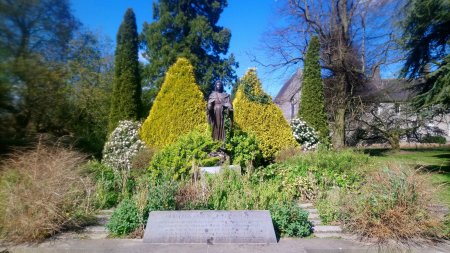
At the other end lies the historic cemetery of Maynooth College where, among many other things, I found this memorial:

This gives me an excuse to rehash an old one about the person whose memorial it is.

Father Nicholas Joseph Callan (or, more formally, The Reverend Professor Nicholas Joseph Callan) was born in County Louth in 1799 went to the seminary of St Patrick’s College, Maynooth, in 1816 on order to train as a priest. During his time as a seminarian Callan studied ‘Natural Philosophy’ and became interested in experiments involving electricity. In 1823 Callan was ordained as a priest, and went to Rome in 1826 to obtain his doctorate in Divinity. At the time Italy was a centre for research into electricity and here Callan became familiar with the work of the Italian physicist Alessandro Volta who had developed the world’s first battery. Callan returned to Maynooth where he was made chair of Natural Philosophy, a post he would hold until his death in 1864.

Callan is most famous for inventing the induction coil (in 1836). By connecting two copper wire coils to a battery and electromagnet and then interrupting the current he was able to generate much larger voltages than could be obtained from batteries alone. His 1837 version that used a clock mechanism to interrupt the current 20 times a second is estimated to have produced 60,000 volts – the largest artificially generated charge at that time. It is said that his induction coil could produce sparks 15″ long, which must have been fun to watch.

Callan’s biggest induction coil, unfinished at the time of his death, can be found in the National Science Museum of Ireland (which is in Maynooth). This was one of the largest in the world at the time. The iron core is 109 cm long. The secondary windings are 53 cm in diameter and consist of about 50 km of iron wire insulated with beeswax. They were made in three separate rings separated by air gaps, so wires carrying large voltage differences would not lie adjacent to each other, reducing the risk of the insulation breaking down. At the left end is a vibrating mercury ‘contact breaker’ in the primary circuit, actuated by the magnetic field in the primary, which interrupted the primary current to generate potentials of over 200,000 volts.

Sadly Callan’s work was forgotten for quite a period after his death – experimental electromagnetism was not a priority for St Patrick’s College at this time – for which reason the invention of the induction coil has often been attributed to Heinrich Ruhmkorff who made his first device (independently) about 15 years after Callan. More recently, however, Callan’s achievements have been more widely recognized and in 2000 the Irish government issued a stamp in his honour.

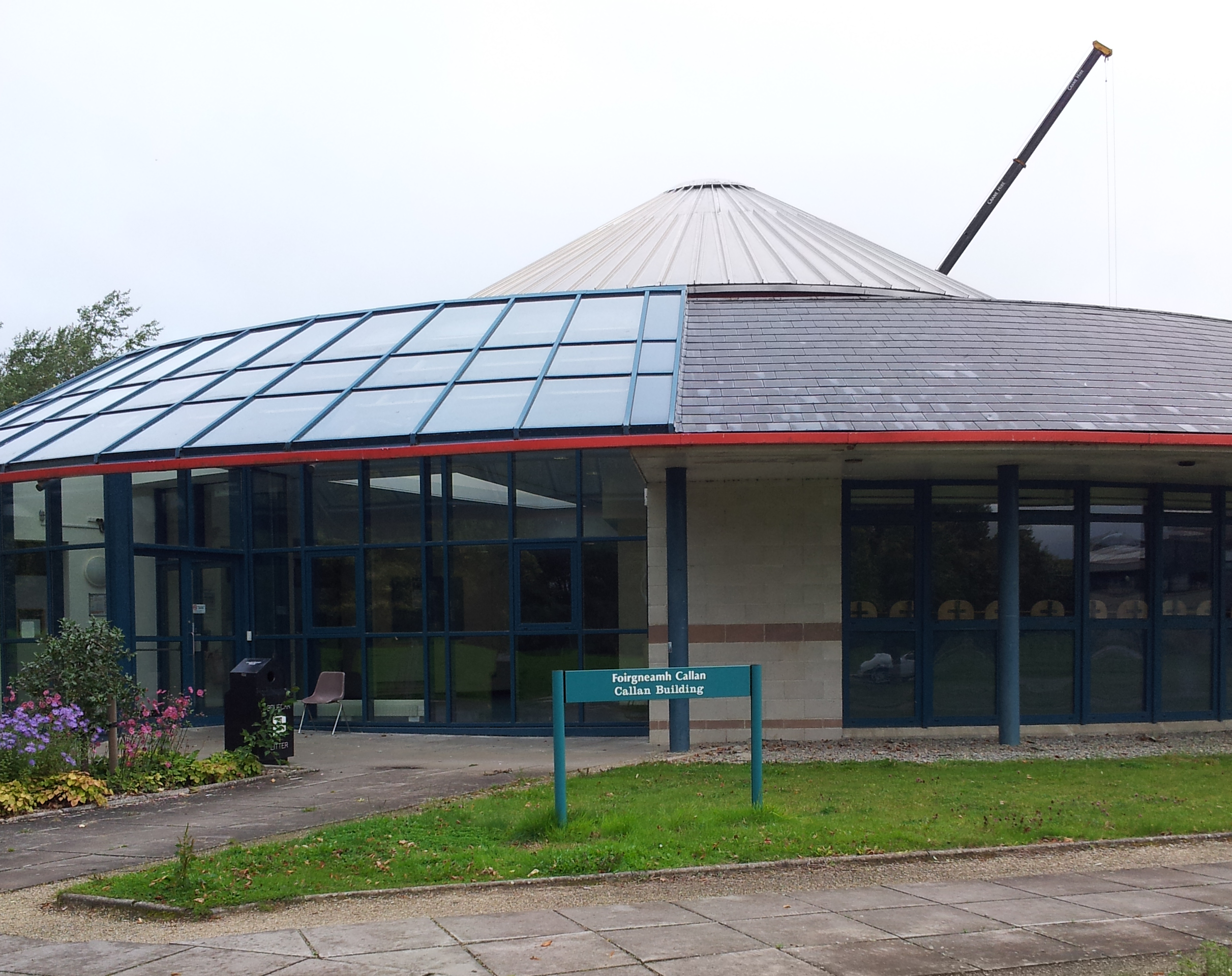
The Callan Building

Nicholas Callan was laid to rest in the College Cemetery at Maynooth in 1864. The Callan Building (above) on the North Campus of the present-day Maynooth University is named in his honour, as of course is Callan Hall, on the South Campus.

P.S. The first interment in the Cemetery took place in 1817, 200 years before I started work in Maynooth.

A Virus Testing Probability Puzzle

Posted in Cute Problems, mathematics with tags , on April 13, 2020 by telescoper

Here is a topical puzzle for you.

A test is designed to show whether or not a person is carrying a particular virus.

The test has only two possible outcomes, positive or negative.

If the person is carrying the virus the test has a 95% probability of giving a positive result.

If the person is not carrying the virus the test has a 95% probability of giving a negative result.

A given individual, selected at random, is tested and obtains a positive result. What is the probability that they are carrying the virus?

Update 1: the comments so far have correctly established that the answer is not what you might naively think (ie 95%) and that it depends on the fraction of people in the population actually carrying the virus. Suppose this is f. Now what is the answer?

Update 2: OK so we now have the probability for a fixed value of f. Suppose we know nothing about f in advance. Can we still answer the question?

Answers and/or comments through the comments box please.

R.I.P. Tim Brooke-Taylor (1940-2020)

Posted in Television with tags , , on April 13, 2020 by telescoper

More sad news arrived yesterday: comedy legend Tim Brooke-Taylor passed away with Covid-19 at the age of 79.

Together with Graeme Garden and Bill Oddie, Tim Brooke-Taylor starred an The Goodies, a TV programme I loved and watched religiously as a kid. I remember when my whole class at came down with Gibbon-Mania when the trio reached Number One in the Hit Parade with The Funky Gibbon.

Later on I discovered the radio series I’m Sorry I Haven’t A Clue and was immediately hooked. Chaired by the incomparable Humphrey Lyttelton (front left in the picture) , the original four panellists given silly things to do were Tim Brooke-Taylor (behind Humph) , Barry Cryer (centre), Willie Rushton (front right) and Graeme Garden (right) . I listened regularly to that show until Humph passed away in 2008. It never seemed the same after that. Now only two of the original team are still with us; Willie Rushton died in 1996.

It seems this cruel virus is targeting an entire generation, cutting short so many lives of so many people who meant so much to us.

Sad days.

Rest in peace, Tim Brooke-Taylor (1940-2020)

R. I. P. John Conway (1937-2020)

Posted in Biographical, mathematics with tags , , , on April 12, 2020 by telescoper

I’ve just heard the sad news that that mathematician John Horton Conway has passed away at the age of 82.

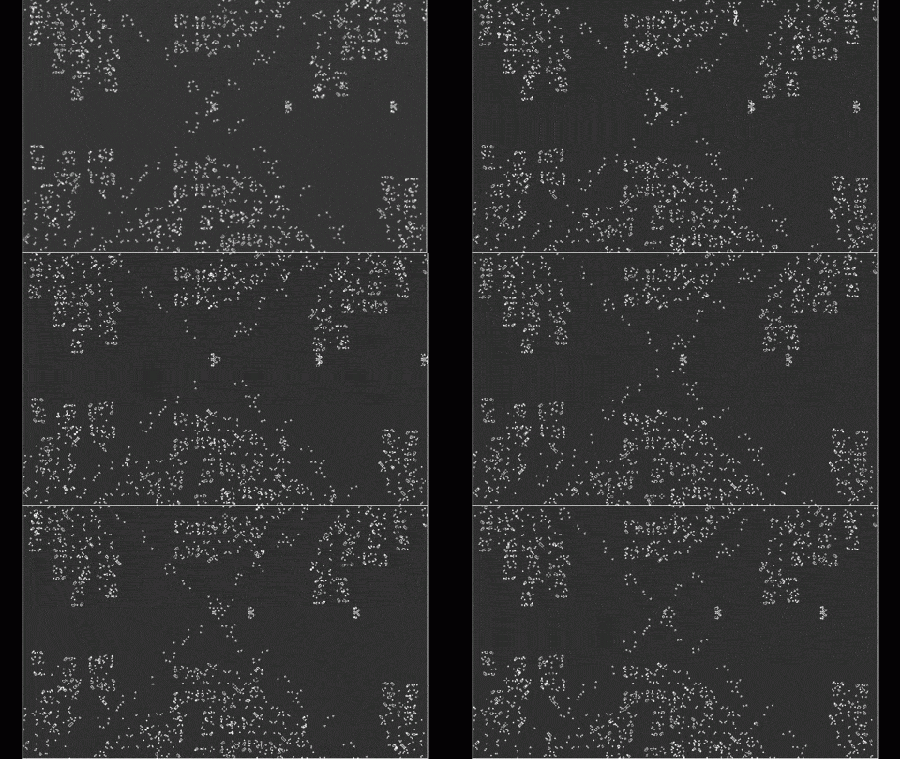
John Conway made very distinguished contributions to many areas of mathematics, especially topology and knot theory, but to many of us he’ll be remembered as the inventor of the Game Of Life. I’ll remember him for that because one of the very first computer programs I ever wrote (in BASIC) was an implementation of that game.

It’s a great illustration of how simple rules can lead to complex structures and it paved the way to a huge increase in interest in cellular automata.

I think he got a bit fed up with people just associating him with a computer game and neglecting his deeper work, but he deserves great credit for directly or indirectly inspiring future scientists.

Rest in peace John Conway (1937-2020).

Testing Times

Posted in Biographical, Covid-19 with tags , , on April 12, 2020 by telescoper

Today is April 12th which means, astonishingly, that it’s just one month since Ireland went into the first stage of its current lockdown. I say “astonishingly” because it seems much longer ago than that!

I know I’m not the only person who is finding it difficult these days to keep track of the passage of time. The lack of a regular routine seems to be the reason. The solution, I imagine, is to try to impose a timetable on yourself rather than have it imposed upon you by someone else. I’ve only been partially successful in that, probably because I lack the necessary self-discipline. Still, somewhat to my surprise, I am not having any significant problems sleeping.

Anyway talking about testing times, I wanted to make a quick comment on the Covid-19 situation in Ireland. I’ve been keeping track of the statistics on my page here, which I shall continue to update as things develop. The latest plot is as follows.

The last two points in the orange curve show a bit of a spike. That is because they include the results from a batch of about 6000 swabs sent for testing to Germany. These should be apportioned to earlier dates but lacking the information needed to do this in a sensible way I’ve just plotted them when the results were received (Friday and Saturday). This also means that the slight inflection in the blue curve is not real, but it doesn’t change the general picture significantly.

This is a manifestation of a major difficulty that the authorities in Ireland are facing, which is the capacity to do coronavirus testing in sufficient numbers and sufficiently rapidly to enable contact tracing in real time which is needed to further control the spread of this disease. At present only around two thousand tests per day are being done, which is inadequate.

Although the recent upward blip is an artefact, the fact remains that there is no evidence that the number of new cases is reducing sufficiently quickly for the relaxation of the rules to be considered feasible. There is a real danger that if the number of new cases does not stop falling soon, the number of patients needing intensive care will exceed the resources available.

Anyway, I reckon things will stay as they are until June at the earliest, so we’ll just have to get used to it!

College Walk

Posted in Maynooth on April 11, 2020 by telescoper

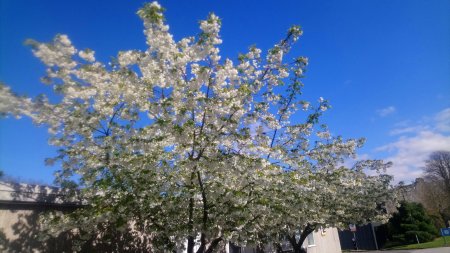
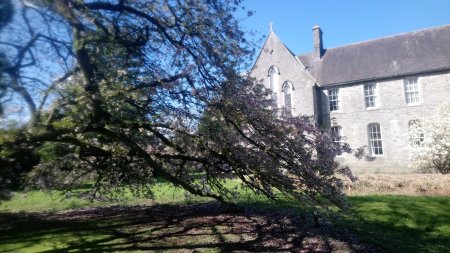
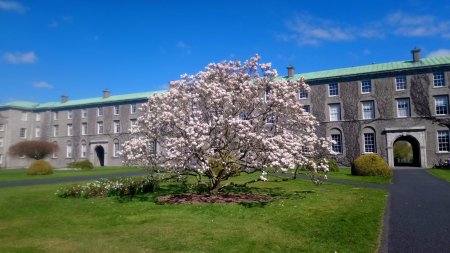
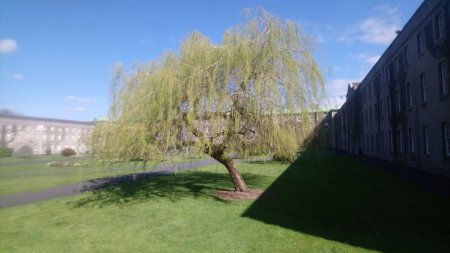
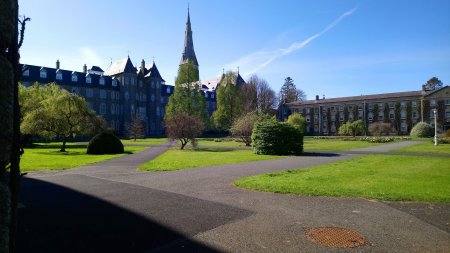
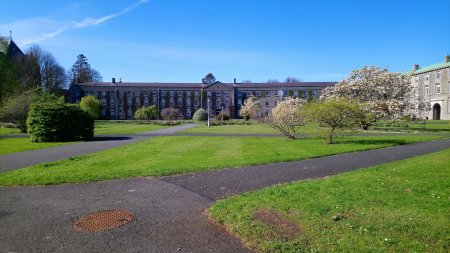
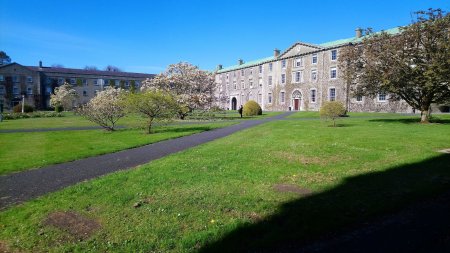
By way of a distraction from everything that’s going on in the wider world I thought I’d share a few pictures I took walking around Maynooth University’s South Campus for some exercise the other day. The Spring weather was lovely and the blossom was emerging on various trees and shrubs.

It all reminded me of those famous lines by the poet A. E. Housebound:

Loveliest of trees, the cherry now
Is hung with blossom along the bough.
I’d like to do a woodland ride,
But sadly I am stuck inside.

My favourite picture is the last one, in which the shadow of the building picks up the line of the roof to produce an interesting composition.

Here are a few more, taken today (Saturday)

Lockdown Prolonged, Leaving Certificate Postponed

Posted in Education, Politics with tags , , , on April 10, 2020 by telescoper

I’ve just listened to the latest update on the Covid-19 situation in Ireland. One entirely predictable announcement made this afternoon was that the current restrictions on movement will continue until Tuesday May 5th at the earliest. Monday May 4th is a Bank Holiday in Ireland.

I would personally be surprised if the measures now in place were eased before June, actually, but it seems sensible to wait and see if the situation improves before making a decision on further extensions.

(Incidentally, I am keeping track of the Covid-19 numbers in Ireland on a page here.)

Another announcement made today is likely to be more controversial: that this year’s School Leaving Certificate examinations, due to start on June 3rd, will postponed until “late July or early August”.

Among many other things, this will cause those of us involved in University teaching quite a few problems to solve. A lot of thinking caps will be getting dusted off right now!

On the normal cycle, Leaving Certificate results are available in mid-August and successful students begin their University courses in mid-September.

Assuming that there is a delay of two months in sitting the exams and no time can be made up in the marking and moderation process, we’re looking at students not being able to start their courses until mid-November, just a few weeks before the normal end of the First Semester. I have heard suggestions that new students could start in October but these have not included any explanation of how to speed up the process enough to make this possible.

It seems possible to me that, because starting in November would create more problems than it would solve, new students might actually have to defer entry until January, which means in turn that their Second Semester would have to take place during the period June-August. That, in turn, will require staff to abandon any plans for summer research activity and, for some science disciplines, will involve labs being kept open when they are usually closed for upgrades.

Presumably the proposal will be that returning students will follow the usual academic year timetable, but there’s a problem there too if students have to repeat modules from the 1st year which are to be taught on a different calendar.

I’m sure that none of these problems are insoluble but I’m equally sure that the powers that be haven’t really thought about them. Ireland’s current Government does not give the impression of being that interested in universities or the staff who work in them. In recent weeks lecturers have worked exceptionally hard to switch to online teaching and assessment only to have these efforts conspicuously ignored in a recent statement by the Minister for Higher Education Mary Mitchell O’connor. No doubt the Government will again just take it for granted that we’ll sort things out on their behalf.

Astronomy Look-alikes No. 99

Posted in Astronomy Lookalikes with tags , on April 10, 2020 by telescoper

I’m aware that it has been some time since I posted one of my Astronomy Look-alikes but I received the following suggestion by email from an anonymous correspondent following a post earlier this week.

The email reads:

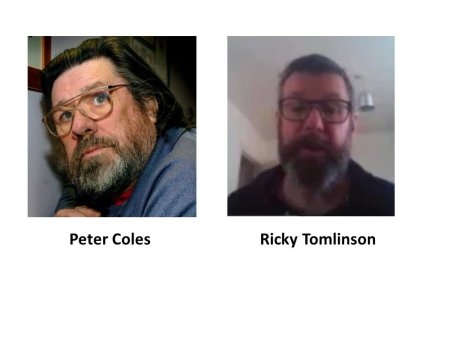
Have you noticed the striking resemblance between the well known blogger and observational cosmologist Ricky Tomlinson and the acclaimed actor and icon of working class manhood, Peter Coles?

Disturbingly, the latter has been seen recently impersonating Tomlinson in an on-line Maynooth University Computational Physics lecture.

My correspondent has obviously let social isolation get the better of him, because everyone knows that Ricky Tomlinson is a theoretical rather than observational cosmologist. Moreover, although he does look a little bit like me, I obviously look nothing like him.

Anyways, if you’ve got nothing better to do please feel free to send me further suggestions for the Astronomy Look-alikes folder!

Is the Expansion of the Universe Isotropic?

Posted in Astrohype, The Universe and Stuff with tags , , , , , on April 9, 2020 by telescoper

There’s a new paper out that has been making a few waves in cosmology. Here’s the title and abstract:

It’s published in Astronomy & Astrophysics but you can find it on the arXiv here.

Here’s a gratuitous pretty picture showing the distribution of the X-ray clusters used in the analysis.

The discussion in the paper focuses on two possibilities: (i) that the clusters are participating in a large-scale correlated motion; and (ii) that the Expansion of the Universe is not occurring isotropically. The latter option is the one that has attracted the most media attention (presumably because it has the most far-reaching implications). This seems to me to be a very unlikely explanation, however, because anisotropic expansion of the magnitude implied would leave a ~10% signal in the Cosmic Microwave Background which is not observed.

There is, however, a third possibility (admittedly duller than the other two) which is that there is some unknown systematic error in the observations…

What works with Online Teaching?

Posted in Covid-19, Education, Maynooth with tags , on April 8, 2020 by telescoper

Since the cancellation of in-person lectures and tutorials at Maynooth University a few weeks ago, we’ve all been trying – mostly without much a priori knowledge – how to teach students using exclusively online methods.

In the Department of Theoretical Physics we’re all trying different things and trying our best to learn from student feedback how to improve.

Maynooth University recently launched a survey of students that was completed by about 3000 in 24 hours, which is a very good response.

The results are very interesting. When asked what works best for them the responses were:

  1. 39% prefer PowerPoint with sound;
  2. 27.2% prefer recorded video or screencast;
  3. 18.6% prefer text materials (Word/Pwpt); and
  4. 12.2% prefer live video or screen cast.

I’m sure that there is no single “best” way of doing this. What works will depend a lot on the discipline (and the kind of material to be presented) and on the lecturer (and how comfortable they are with different approaches), as well as on the student.

I’ve always felt that students being different individuals all learn in different ways so the best approach is to offer as broad a mixture of approaches as possible in order to try to offer something for everyone.

For my part what I’m doing is making a PDF of the lectures available for the students to study in their own time, but also record short (15-minute) recorded video explainers of the key concepts using a piece of software called Screencast-o-matic.

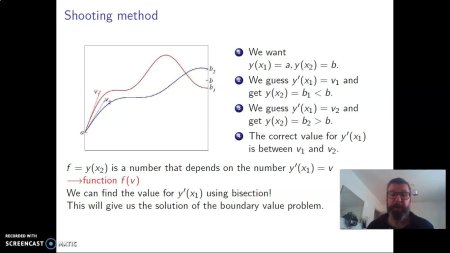
Here’s a still from one of my Computational Physics videos:

You see they get the notes with a pointer moving about on it as I talk, but also have to endure an encapsulated video of me waving my hands and blabbering on, for that authentic lecture experience.

The video and audio is not ideal because of lighting and background sound issues in my flat which is why I felt keeping the recordings short would be useful.

I recorded the one shown above (and several others) before I figured that it works better to use the natural light coming in through the window than electric lighting. That means that I now do my recordings in the morning, when I can face the sunlight in my sitting room.

I should add that we also have a laboratory for this course. The students are given a script to work through then some (Python) coding exercises to complete. They have to do these at home but myself and a demonstrator are online via Microsoft Teams to assist the students who can share screens and output files to help us diagnose any bugs.

Anyway, what works for you?