Shopping Mad

Posted in Biographical, Covid-19, Maynooth with tags , , , , on March 22, 2020 by telescoper

Empty shelves in Asda, Swansea

I don’t know how widespread scenes like that pictured above actually are, but there seems to be a lot of panic buying and/or stockpiling going on.

Worse still are scenes like this:

Social distancing doesn’t seem to be a priority among these people.

It all seems a bit ironic to see this demonstrable lack of public-spiritedness alongside the usual rhetoric about the “Dunkirk Spirit”. With the latter in mind I’ve updated Winston Churchill’s famous wartime peroration from 1940 in a manner more suitable for the 2020s:

We shall fight in Tesco, we shall fight in Aldi and Asda, we shall fight with growing panic and growing stupidity in the aisles, we shall defend our toilet rolls, whatever the cost may be. We shall fight for the pasta, we shall fight for the hand-wash…(continued, page 94)

Anyway for what it’s worth I still haven’t noticed any shortages of food or household goods where I’m living. It may be different elsewhere of course but Maynooth is doing fine in that regard.

This is not to say I haven’t changed my shopping habits at all. I’ve never been in the habit of doing big shopping trips. I live alone, don’t have a freezer and my fridge is quite small. I tend therefore to buy bits and pieces as I need them. I prefer fresh food and, usually eating lunch in the College when I’m at work, I don’t need a main meal in the evening.

Now I’m having lunch at home every day I need to buy a bit more, which is one change. Mindful that a stricter lock down might be coming soon, I have also begun buying a few things I wouldn’t normally buy. To my usual shopping I’ve added the odd item of tinned food but never more than a can or two at a time. I also bought some powdered milk in case fresh milk becomes unavailable.

I haven’t eaten any of the tinned goods I’ve bought yet: I am still eating fresh things as they seem to be readily available. Who knows when or if that will change.

I realise my personal situation makes coping with this social distancing malarkey rather easier than most but I think certain individuals are making it even more difficult for the others with their selfish behaviour. I suppose there will always be some.

Anyway, do feel free to share your own experiences of shortages or lack thereof through the comments box.

The Shell House Raid

Posted in Uncategorized on March 21, 2020 by telescoper

Almost forgot that the grim events described in this old post took place in Copenhagen 75 years ago today…

telescoper's avatarIn the Dark

An early morning walk around Copenhagen this morning reminded me of a longer visit I made here about 25 years ago, during which I rented a room in a nice large apartment on Frederiksberg Allé, which is in a rather posh part of the city called Frederiskberg. The landlord, who also lived on the premises, was a Mr Vagn Jul Pedersen, a nice old man who had lived in that part of the city all his life. One evening we sat talking over a beer or two and he told me of a terrible thing that he had seen during the latter stages of the Second World War when he was a young man, and I thought some of you might be interested to learn about it.

In March 1945, the British decided to carry out a low-level bombing attack on a target in Copenhagen, which was under German…

View original post 1,328 more words

#WorldPoetryDay: ‘Nuns fret not..’, by William Wordsworth

Posted in Poetry with tags , , , on March 21, 2020 by telescoper

My sixth and final poem for World Poetry Day returns, in a way, to the theme of the first. It is a sonnet by William Wordsworth.

Nuns fret not at their convent’s narrow room;
And hermits are contented with their cells;
And students with their pensive citadels;
Maids at the wheel, the weaver at his loom,
Sit blithe and happy; bees that soar for bloom,
High as the highest Peak of Furness-fells,
Will murmur by the hour in foxglove bells:
In truth the prison, into which we doom
Ourselves, no prison is: and hence for me,
In sundry moods, ’twas pastime to be bound
Within the Sonnet’s scanty plot of ground;
Pleased if some Souls (for such there needs must be)
Who have felt the weight of too much liberty,
Should find brief solace there, as I have found.

by William Wordsworth (1770-1850)

#WorldPoetryDay: ‘The more loving one’, by W.H. Auden

Posted in Poetry with tags , , , on March 21, 2020 by telescoper

My fifth poem for World Poetry Day is by the great W.H. Auden.

Looking up at the stars, I know quite well
That, for all they care, I can go to hell,
But on earth indifference is the least
We have to dread from man or beast.

How should we like it were stars to burn
With a passion for us we could not return?
If equal affection cannot be,
Let the more loving one be me.

Admirer as I think I am
Of stars that do not give a damn,
I cannot, now I see them, say
I missed one terribly all day.

Were all stars to disappear or die,
I should learn to look at an empty sky
And feel its total dark sublime,
Though this might take me a little time.

by W.H. Auden (1907-1973)

#WorldPoetryDay: ‘Children’s Song’, by R.S. Thomas

Posted in Poetry with tags , , , on March 21, 2020 by telescoper

My fourth poem for World Poetry Day is by the great R.S. Thomas

We live in our own world,
A world that is too small
For you to stoop and enter
Even on hands and knees,
The adult subterfuge.
And though you probe and pry
With analytic eye,
And eavesdrop all our talk
With an amused look,
You cannot find the centre
Where we dance, where we play,
Where life is still asleep
Under the closed flower,
Under the smooth shell
Of eggs in the cupped nest
That mock the faded blue
Of your remoter heaven.

by R.S. Thomas (1913-2000)

#WorldPoetryDay: ‘Black March’, by Stevie Smith

Posted in Poetry with tags , , , on March 21, 2020 by telescoper

My third choice for World Poetry Day is by Stevie Smith and is called  Black March.

I have a friend
At the end
Of the world.
His name is a breath

Of fresh air.
He is dressed in
Grey chiffon. At least
I think it is chiffon.
It has a
Peculiar look, like smoke.

It wraps him round
It blows out of place
It conceals him
I have not seen his face.

But I have seen his eyes, they are
As pretty and bright
As raindrops on black twigs
In March, and heard him say:

I am a breath
Of fresh air for you, a change
By and by.

Black March I call him
Because of his eyes
Being like March raindrops
On black twigs.

(Such a pretty time when the sky
Behind black twigs can be seen
Stretched out in one
Uninterrupted
Cambridge blue as cold as snow.)

But this friend
Whatever new names I give him
Is an old friend. He says:

Whatever names you give me
I am
A breath of fresh air,
A change for you.

by Stevie Smith (1902-1971)


#WorldPoetryDay: “Hope” is the thing with feathers, by Emily Dickinson

Posted in Poetry with tags , , , , , on March 21, 2020 by telescoper

My second poem for  United Nations World Poetry Day is by Emily Dickinson:

“Hope” is the thing with feathers –
That perches in the soul –
And sings the tune without the words –
And never stops – at all –

And sweetest – in the Gale – is heard –
And sore must be the storm –
That could abash the little Bird
That kept so many warm –

I’ve heard it in the chillest land –
And on the strangest Sea –
Yet – never – in Extremity,
It asked a crumb – of me.

by Emily Dickinson (1830-1886)


#WorldPoetryDay: `Solitude’ by Lord Byron

Posted in Poetry with tags , , , , , , on March 21, 2020 by telescoper

Today (Saturday 21st March 2020) is United Nations World Poetry Day. As I think we need poetry now more than ever I thought I’d post some poems to celebrate. There will be five altogether, spread throughout the day. My first choice is by Lord Byron:

To sit on rocks, to muse o’er flood and fell,
To slowly trace the forest’s shady scene,
Where things that own not man’s dominion dwell,
And mortal foot hath ne’er or rarely been;
To climb the trackless mountain all unseen,
With the wild flock that never needs a fold;
Alone o’er steeps and foaming falls to lean;
This is not solitude, ’tis but to hold
Converse with Nature’s charms, and view her stores unrolled.

But midst the crowd, the hurry, the shock of men,
To hear, to see, to feel and to possess,
And roam alone, the world’s tired denizen,
With none who bless us, none whom we can bless;
Minions of splendour shrinking from distress!
None that, with kindred consciousness endued,
If we were not, would seem to smile the less
Of all the flattered, followed, sought and sued;
This is to be alone; this, this is solitude!

by Lord Byron (1788-1824)


Farewell to Flybe

Posted in Biographical, Covid-19, Finance on March 20, 2020 by telescoper

Just for the record, I today received a full refund for the cost of my Flybe tickets via the Chargeback scheme. Thanks to AIB for processing this so quickly!

The collapse of Flybe happened on 5th March 2020, just over two weeks ago. Can it really have been so recent? It seems like ages ago.

telescoper's avatarIn the Dark

It had been on the cards for some time, but last night the airline Flybe collapsed and has now gone into administration. Let me just leave this Twitter announcement made in January by Transport Secretary Grant Shapps here:

It seems that Flybe has gone the inevitable way of every Tory promise.

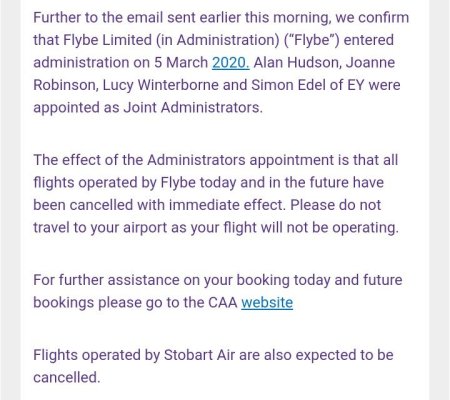
I had bought a ticket to fly from Dublin to Cardiff at the end of next week as the following week is a study break that includes the St Patrick’s Day holiday. As a result I got this email this morning.

Obviously it’s an inconvenience for me as I’ll have to find another way to get to Cardiff, but I’ll probably get my money refunded by the Chargeback scheme so it’s not such a big deal. The same can’t be said of the 2000 people who worked for Flybe who have now lost their jobs, nor the many…

View original post 181 more words

The Vernal Equinox 2020

Posted in History, Maynooth with tags , , , , on March 20, 2020 by telescoper

With everything else going on I quite forgot that the Vernal Equinox or Spring Equinox (in the Northern hemisphere) took place today (Friday 20th March) at 3.49am (Irish Time). This is in fact the earliest Spring Equinox for 124 years, the fact that 2020 is a leap year moving it a day earlier in our calendar. It’s a lovely day in Maynooth too!

People sometimes ask me how one can define the `equinox’ so precisely when surely it just refers to a day on which day and night are of equal length, implying that it’s a day not a specific time?

The answer is that the equinox is defined by a specific event, the event in question being when the plane defined by Earth’s equator passes through the centre of the Sun’s disk (or, if you prefer, when the centre of the Sun passes through the plane defined by Earth’s equator). Day and night are not necessarily exactly equal on the equinox, but they’re the closest they get. From now until the Autumnal Equinox days in the Northern hemisphere will be longer than nights, and they’ll get longer until the Summer Solstice before beginning to shorten again.

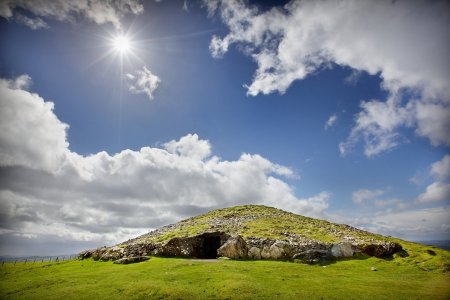
Loughcrew (County Meath), near Newgrange, an ancient burial site and a traditional place to observe the sunrise at the Equinox

Here in Ireland we celebrated Saint Patrick’s day on March 17th, the reputed date of his death in 461 AD. Nobody really knows where St Patrick was born, though, so it would be surprising if the when were any better known.

In any case, it wasn’t until the 17th Century that Saint Patrick’s feast day was placed on the universal liturgical calendar in the Catholic Church. In the thousand years that passed any memory of the actual date was probably lost, so the Equinox was perhaps rebranded for the purpose.

The early Christian church in Ireland incorporated many pre-Christian traditions that survived until roughly the 12th century, including the ancient festival of Ēostre (or Ostara), the goddess of spring associated with the spring equinox after whom Easter is named. During this festival, eggs were used a symbol of rebirth and the beginning of new life and a hare or rabbit was the symbol of the goddess and fertility. In turn the Celtic people of Ireland probably adapted their own beliefs to absorb much older influences dating back to the stone age.

St Patrick’s Day and Easter therefore probably both have their roots in prehistoric traditions around the Spring Equinox, although the direct connection has long been lost.