The Case for Irish Membership of CERN

Posted in Politics, The Universe and Stuff with tags , , , , on November 16, 2019 by telescoper

In the news here in Ireland this week is a new report from a Committee of the Houses of the Oireachtas making the case for Ireland to join CERN. You can download the report here (PDF) and you’ll find this rather striking graphic therein:
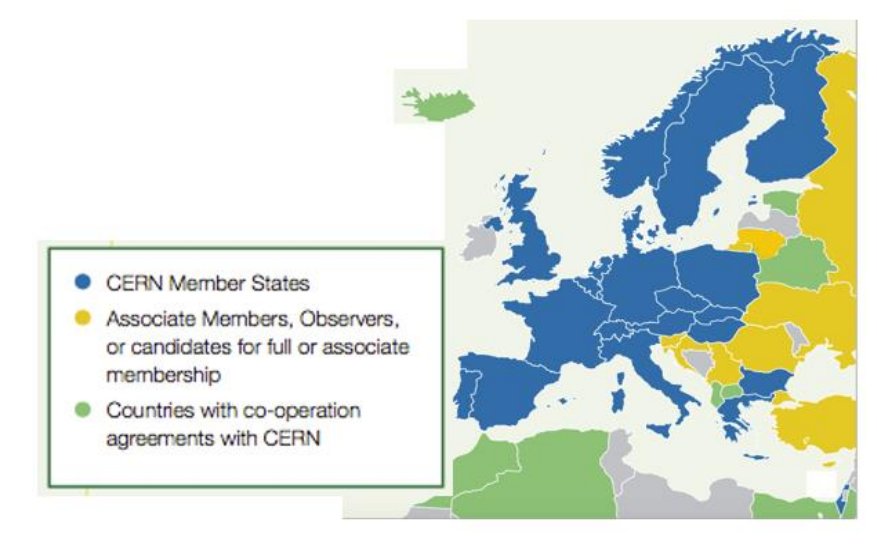
You will see that there are only three European countries that don’t have any form of membership or other agreement with CERN: Latvia, Bosnia-Herzegovina and Ireland. The fact that almost everyone else is in is not in itself necessarily a good argument for Ireland to join, but it does make one wonder why so many other countries have found it to join or have an agreement with CERN while Ireland has not.

As the document explains, if the Irish government  were to decide to take Ireland into CERN then  it would first have to become an Associate Member, which would cost around €1.2 million per year. That’s small potatoes really, and  the financial returns to Irish industry and universities are likely to far exceed that, so the report strongly recommends this step be taken. This Associate member stage would last up to 5 years, and then to acquire full membership a joining fee of around €15.6 million would have to be paid, which is obviously a much greater commitment but in my view still worthwhile.

While I strongly support the idea of Ireland joining CERN I do have a couple of concerns.

One is that I’m very sad that the actual science done at CERN is downplayed in the Oireachtas report. Most of it is about return to industry, training opportunities, etc. These are important, of course, but it must not be forgotten that big science projects like those carried out at CERN are above all else science projects. The quest for knowledge does have collateral benefits, but it a worthy activity in its own right and we shouldn’t lose sight of that.

My other (related) concern is that joining CERN is one thing, but in order to reap the scientific reward the government has to invest in the resources needed to exploit the access to facilities membership would provide. Without a related increase in research grant funding for basic science the opportunity to raise the level of scientific activity in Ireland would be lost.

Ireland recently joined the European Southern Observatory (ESO), a decision which gave Irish astronomers access to some amazing telescopes. However, there is no sign at all of Irish funding agencies responding to this opportunity by increasing funding for academic time, postdocs and graduate students needed to do the actual science.

Although astronomy is clearly much more interesting than particle physics (😉) in one respect the case of ESO is very like the case of CERN – the facilities do not themselves do the science. We need people to do that.

That was the Science Week that was..

Posted in Books, Talks and Reviews, The Universe and Stuff with tags , , , on November 15, 2019 by telescoper


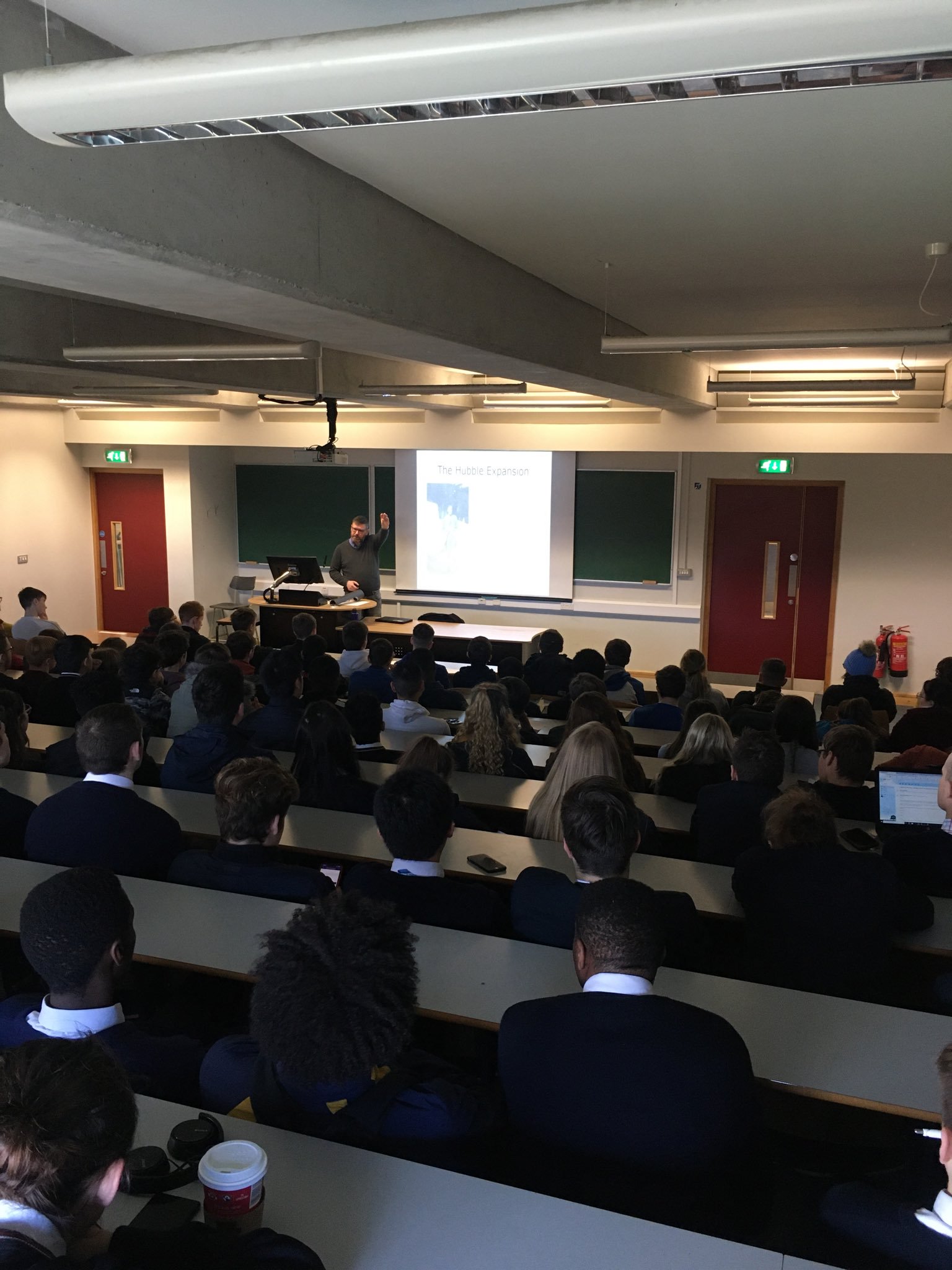
So, as advertised, this morning I gave a talk mainly to school students as part of Science Week Ireland on the subject of the cosmic web. This was a similar talk to the one I gave at DIAS a couple of weeks ago.


There was a slight confusion about rooms but we did eventually get everyone into the right lecture theatre and weren’t too late getting started. The audience was about 140, so the room was very full and most of them didn’t fall asleep. I had a nice chat afterwards with a group of them and they seemed to have enjoyed it. Anyway, in case anyone is interested here are my slides. Most of them are recycled from previous versions of this talk.

Following this morning’s exertions we had lovely seminar after lunch by Wyn Evans of Cambridge about the stellar dynamics of the Milky Way and the wonders of Gaia and soon will be going to dinner.

Searching for Synge

Posted in History, mathematics, Television with tags , , on November 14, 2019 by telescoper

John Lighton Synge (above; 1897-1995), who was an expert on geometrical approaches to general relativity, was regarded by many as the most eminent Irish mathematician and physicist since Sir William Rowan Hamilton. Synge (whose uncle was the famous playwright John Millington Synge) was born in Dublin and had spells at Trinity College Dublin, the University of Toronto and various universities in the USA before taking up a position as Senior Professor at Dublin Institute for Advanced Studies (DIAS) in 1948 from which he retired in 1972.

I have been asked by a friend to find out if there are any video recordings of Synge talking or lecturing. A quick google search turns up nothing, so I thought I would put this request out into the blogosphere to see if anyone is aware of anything.

Given the dates it seems likely that any recordings of him would be originally on film (or perhaps television) which would have to be transferred to digital format. Perhaps there is archive material at Trinity College or DIAS that could be suitable?

Irish Regional Accents – Niall Tóibín

Posted in Maynooth, Television with tags , , on November 14, 2019 by telescoper

I heard yesterday that renowned actor and comedian Niall Tóibín passed away yesterday at the age of 89. I knew him best from his role as the priest Frank MacAnally in Ballykissangel which I watched occasionally in the 1990s. This morning I heard a tribute to him on the radio and discovered that he was a bit of an expert on Irish regional accents, so I thought I’d share a clip here.

Living and working in Maynooth, which is not far from Dublin, the accents I hear most frequently are those of the Greater Dublin area. I say “accents” rather than “accent” because, as the clip demonstrates, there is quite a wide variety even in this region. At Maynooth we do have students from as far afield as the North of County Donegal and the South of County Cork (where Niall Tóibín came from). I’m better at identifying accents from the North than the South, and can at least tell the difference between Belfast and elsewhere in Ulster, but other than that although I can spot different accents I’m hopeless at identifying where they come from.

One final thing. Niall Tóibín mentions in this clip that the Cork accent sounds a bit like a Welsh accent. This is not the first time I’ve heard someone say that but I have to admit I can’t hear any resemblance myself!

Upcoming conference in Ireland on the history of physics

Posted in History, The Universe and Stuff on November 13, 2019 by telescoper

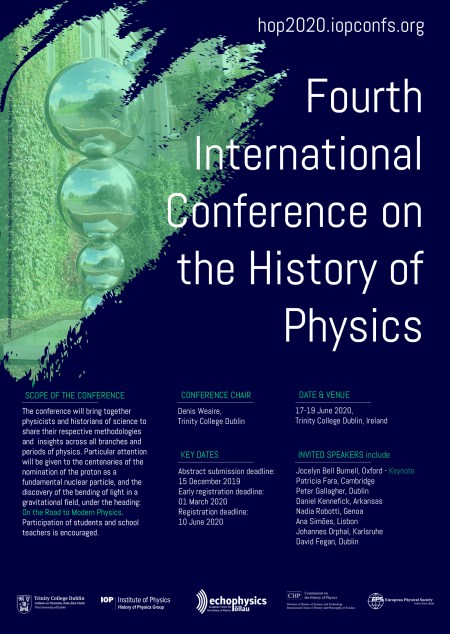
Much as I dislike the word “upcoming”, it is my pleasure to reblog this announcement about a conference to be held at Trinity College next summer (June 17th to 19th). In particular the deadline for abstracts is only a month away (December 15th) so if you would like to contribute a talk you have until then to submit an abstract!

cormac's avatarAntimatter

Just a quick post to highlight the fact that December 15th marks the deadline for submission of abstracts for the 4th International Conference on the History of Physics. The conference marks the fourth in a biennial series of meetings supported by the UK Institute of Physics and the European Physical Society that aim to bring together historians of science and physicists with an interest in the history of their subject and will take place at Trinity College Dublin on June 17th-19th. The website for the conference is here and previous iterations of the conference can be found here.

fiop-poster05112019

I have attended all three of the previous meetings of this conference series and they were most interesting. As the conference takes place in Ireland this time around, I have been heavily involved in the preparations, from chairing the scientific programming committee to attending regular meetings of the organizing committee…

View original post 79 more words

Newton’s Laws in Translation

Posted in History, Maynooth, The Universe and Stuff with tags , , on November 13, 2019 by telescoper

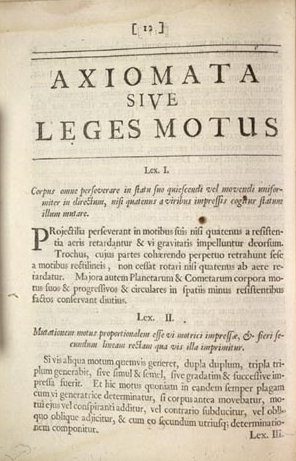
I’m about to do some lectures about Newton’s Laws of Motion to my first-year Mathematical Physics class so I thought I’d put up a quick post about how these laws have been expressed through the years. The original versions in the Principia (frontispiece above, first published in 1687) are of course in Latin. I did five years of Latin at school, but found most of the Principia impenetrable when I tried to read it in the original


The laws of motion are however fairly clear, perhaps because they are familiar in English:

Lex I: Corpus omne perseverare in statu suo quiescendi vel movendi uniformiter in directum, nisi quatenus illud a viribus impressis cogitur statum suum mutare.

Lex II: Mutationem motus proportionalem esse vi motrici impressæ, & fieri secundum lineam rectam qua vis illa imprimitur.

Lex III: Actioni contrariam semper & æqualem esse reactionem: sive corporum duorum actiones in se mutuo semper esse æqualeset in partes contrarias dirigi.

As I am teaching in a room in the old college here in Maynooth (which was founded in 1795), I looked for a contemporary English translation. This is from 1792:

Law I: Every body perseveres in a state of being at rest or of moving uniformly straight forward except insofar as it is compelled to change its state by forces impressed.

Law II: The alteration of motion is ever proportional to the motive force impressed; and is made in the direction of the right line in which that force is impressed.

Law III: To every action there is always opposed an equal reaction: or the mutual action of two bodies upon each other are always equal, and directed to contrary parts.

And finally here’s the modern version I was taught at School:

First Law: Every body continues in a state of rest or uniform motion in a straight line unless it is acted upon by an external (unbalanced) force.

Second Law: The rate of change of momentum of a body is proportional to the impressed force, and is in the direction in which this force acts.

Third Law: To every action there is always an equal and opposite reaction,

an alternative form of the Third Law being:

Third Law: If Body A exerts a force on Body B then Body B exerts a force on Body A which is equal in magnitude and opposite in direction.

Going back to the 1792 English translation, the exposition of the second law continues:

If a force generates a motion, a double force will generate double the motion, a triple force triple the motion, whether that force be impressed altogether and at once, or gradually and successively. And this motion (being always directed the same way with the generating force), if the body moved before, is added to or subtracted from the former motion, according as they directly conspire with or are directly contrary to each other; or obliquely joined, when they are oblique, so as to produce a new motion compounded from the determination of both.

If only Newton had known vector notation!


More Cosmic Tension?

Posted in The Universe and Stuff with tags , , , , , , , , , on November 12, 2019 by telescoper

Quite a lot of fuss was being made in cosmological circles while I was away last week concerning a paper that had just been published in Nature Astronomy by Eleonora Di Valentino, Alessandro Melchiorri and Joe Silk that claims evidence from the Planck Cosmic Microwave background and other data that the Universe might be closed (or at least have positive spatial curvature) in contrast to the standard cosmological model in which the spatial geometry is Euclidean. Nature Astronomy is behind a paywall but the paper is available for free on the arXiv here. The abstract reads:

The recent Planck Legacy 2018 release has confirmed the presence of an enhanced lensing amplitude in CMB power spectra compared to that predicted in the standard ΛCDM model. A closed universe can provide a physical explanation for this effect, with the Planck CMB spectra now preferring a positive curvature at more than 99% C.L. Here we further investigate the evidence for a closed universe from Planck, showing that positive curvature naturally explains the anomalous lensing amplitude and demonstrating that it also removes a well-known tension within the Planck data set concerning the values of cosmological parameters derived at different angular scales. We show that since the Planck power spectra prefer a closed universe, discordances higher than generally estimated arise for most of the local cosmological observables, including BAO. The assumption of a flat universe could, therefore, mask a cosmological crisis where disparate observed properties of the Universe appear to be mutually inconsistent. Future measurements are needed to clarify whether the observed discordances are due to undetected systematics, or to new physics, or simply are a statistical fluctuation.

I think the important point to take from this study is that estimates of cosmological parameters obtained from Planck are relatively indirect, in that they involve the simultaneous determination of several parameters some of which are almost degenerate. For example, the `anomalous’ lensing amplitude discussed in this paper is degenerate with the curvature so that changing one could mimic the effect on observables of changing the other; see Figure 2 in the paper.

It’s worth mentioning another (and, in my opinion, better argued) paper on a similar topic by Will Handley of Cambridge which is on the arXiv here. The abstract of this one reads:

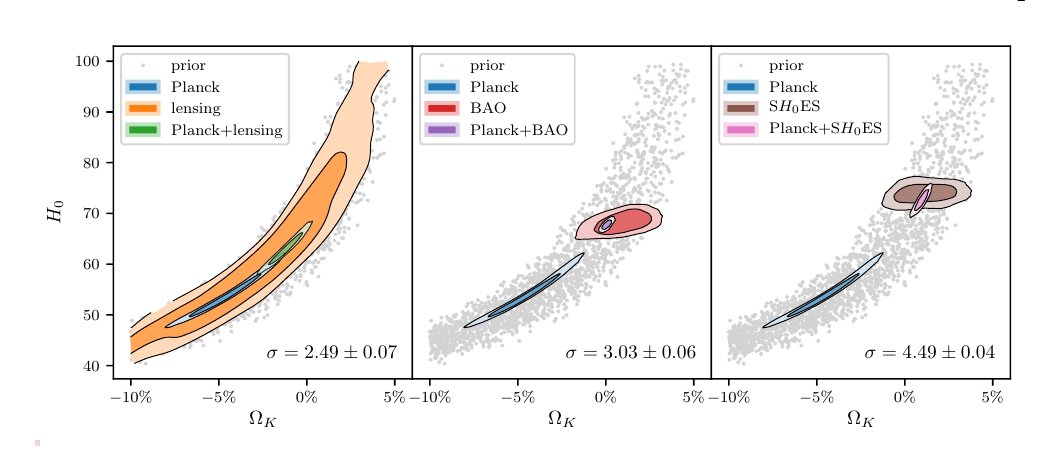
The curvature parameter tension between Planck 2018, cosmic microwave background lensing, and baryon acoustic oscillation data is measured using the suspiciousness statistic to be 2.5 to 3σ. Conclusions regarding the spatial curvature of the universe which stem from the combination of these data should therefore be viewed with suspicion. Without CMB lensing or BAO, Planck 2018 has a moderate preference for closed universes, with Bayesian betting odds of over 50:1 against a flat universe, and over 2000:1 against an open universe.

Figure 1 makes a rather neat point that the combination of Planck and Baryon Acoustic Oscillations does not separately give consistent values for the Hubble constant and the curvature and neither does the combination of Planck and direct Hubble constant estimates:

I don’t know what the resolution of these tensions is, but I think it is a bit dangerous to dismiss them simply as statistical flukes. They might be that, of course, but they also might not be. By shrugging one’s shoulders and ignoring such indications one might miss something very fundamental. On the other hand, in my opinion, there is nothing here that definitely points the finger at spatial curvature either: it is possible that there is something else missing from the standard model that, if included, would resolve these tensions. But what is the missing link?

Answers on a postcard, or through the comments box.

Cosmology Job Opportunity at Maynooth!

Posted in Maynooth with tags , on November 11, 2019 by telescoper

With everything else going on I completely forgot to mention on here that there is a job opportunity for a senior research position in cosmology here in the Department of Theoretical Physics here in Maynooth that may
lead to a permanent position subject to satisfactory performance. The position was advertised some time ago through the usual channels (including jobs.ac.uk and the Times Higher job site) as well as on the Maynooth University jobs site.

The details can be found here, at which site you can also apply.

You will have to hurry, though, as the deadline is Wednesday 13th November 2020 – about 48 hours from now!

Because I could not stop for Death

Posted in Poetry with tags , , , on November 10, 2019 by telescoper

Because I could not stop for Death,
He kindly stopped for me;
The carriage held but just ourselves
And Immortality.

We slowly drove, he knew no haste,
And I had put away
My labor, and my leisure too,
For his civility.

We passed the school, where children strove
At recess, in the ring;
We passed the fields of gazing grain,
We passed the setting sun.

Or rather, he passed us;
The dews grew quivering and chill,
For only gossamer my gown,
My tippet only tulle.

We paused before a house that seemed
A swelling of the ground;
The roof was scarcely visible,
The cornice but a mound.

Since then ’tis centuries, and yet each
Feels shorter than the day
I first surmised the horses’ heads
Were toward eternity.

by Emily Dickinson (1830-1886)


No More Poppies

Posted in Biographical, History, Politics with tags , , , , on November 9, 2019 by telescoper

Over the years I have written quite a few pieces on this blog, around the time of Remembrance Sunday, about the wearing of a poppy, the last being in 2016. I have worn a poppy at this time of year for most of my adult life, but in 2017 I decided to stop.

For one thing, there is no pressure to wear a poppy here in Ireland. Indeed, many Irish people see the poppy mainly as a symbol of British militarism and colonial oppression. At a concert to mark the Armistice last year I saw only a few audience members wearing a poppy, and most of them were the shamrock version commemorating the sacrifice of Irish soldiers during the Great War.

But I don’t think I’ve ever really been that susceptible to peer pressure, so that’s not the main reason for my not wearing a poppy. The main reason is that over the past couple of years the poppy has been appropriated by the likes of racist thug, career criminal and founder-member of the EDL, Stephen Yaxley-Lennon (also known as Tommy Robinson):

I simply cannot bring myself to wear the same badge as this horrible racist gobshite, nor can I stand the hypocrisy of those politicians who make a show of wearing it while happily encouraging the rise of nationalism that caused all the suffering just a century ago. The message of the poppy is supposed to be `Lest We Forget’. I’m afraid far too many have already forgotten.

I have a lecture on Monday 11th November at 11am, when the traditional two minutes’ silence to mark the 1918 armistice is observed. Fortunately, lectures at Maynooth run from five past the hour until five to, so I will be able to observe this on my own before I start the lecture. But I won’t be wearing a poppy.

Is it disrespectful to the war dead to refuse to wear a poppy? No, of course it isn’t. What is disrespectful to them is to seek to reoeat the mistakes that led to wars in the first place.