New Publication at the Open Journal of Astrophysics!

Posted in OJAp Papers, Open Access, The Universe and Stuff with tags , , , , , , on November 24, 2019 by telescoper

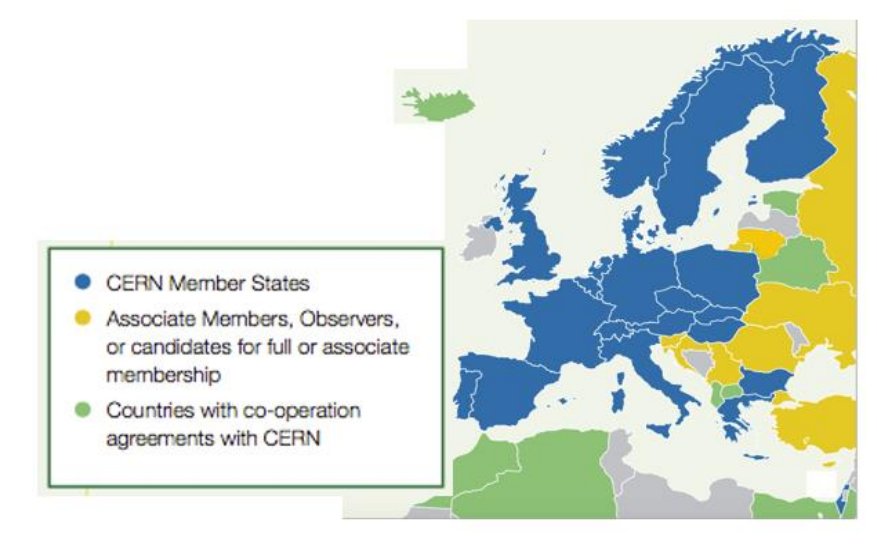
Yesterday we published another new paper at The Open Journal of Astrophysics. Here is a grab of the overlay:

The authors are Katarina MarKovic (now of JPL in California), Benjamin Bose (of the University of Geneva) and Alkistis Pourtsidou (Queen Mary, University of London).

You can find the accepted version on the arXiv here. This version was accepted after modifications requested by the referee and editor. Because this is an overlay journal the authors have to submit the accepted version to the arXiv (which we then check against the copy submitted to us) before publishing; version 2 on the arXiv is the accepted version.

I’d like to apologize to the authors for a delay in publishing this paper. It was ready to go a couple of weeks ago, but we had some trouble with an extension to the platform provided by Scholastica which was intended to register Digital Object Identifiers automatically and thus speed up the process. Unfortunately we found some bugs in, and other problems with, the new software and in the end have given up and reverted to the old manual registration process. Hopefully Scholastica will be able to offer a working system for DOI registration before too long.

Anyway, you will see that this is one for the `Cosmology and Nongalactic Astrophysics’ folder. We would be happy to get more submissions from other areas, especially Stellar and Planetary astrophysics. Hint! Hint!

P.S. Just a reminder that we now have an Open Journal of Astrophysics Facebook page where you can follow updates from the Journal should you so wish..

With the Cosmic Web in Mind..

Posted in The Universe and Stuff, Astronomy Lookalikes with tags , , , , , on November 23, 2019 by telescoper

Some time ago I posted one of my Astronomy Look-alikes about the remarkable similarity between the structure of the human brain and that revealed by computer simulations of the large-scale structure of the Universe:

I wonder whether this means that the Cosmic Web is really just all in the mind?

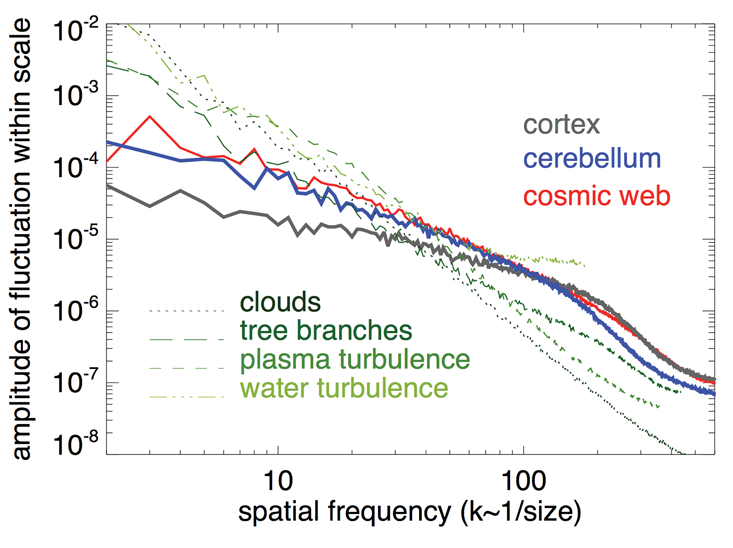
Anyway I just came across an article by Franco Vazza and Alberto Fenetti that takes the comparison between brain cells (among other things) and the Cosmic Web a bit further, including a look at the corresponding power spectra:

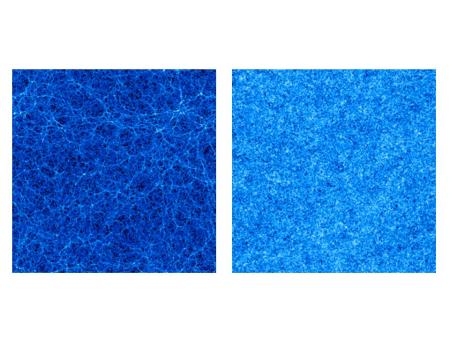
The main point to take from this picture is that many naturally occurring patterns have approximately power-law power spectra, at least over a limited range of scales. However, as I have pointed out before on this blog, the power spectrum on its own does not really quantify pattern in any meaningful way. Here for example are two patterns with exactly the same power spectrum:

The point is that the power spectrum does not contain any information about the phase correlations of the Fourier modes, which are important in quantifying localised features. For further discussion of this issue, see here.

The Theoretical Physics Equipment Store

Posted in Education, The Universe and Stuff with tags , on November 22, 2019 by telescoper

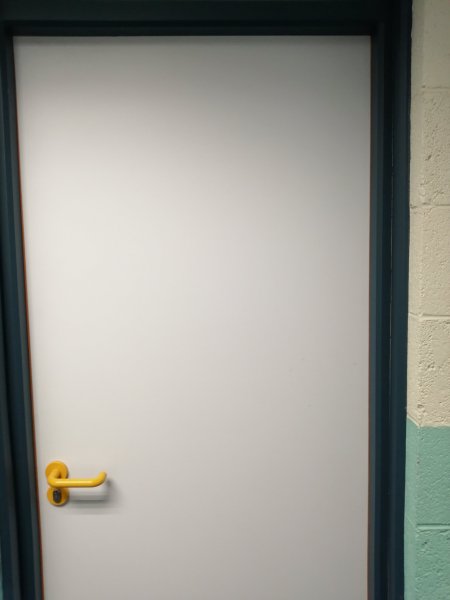
This door, deep in the bowels of the Department of Theoretical Physics at Maynooth University, leads to a cupboard in which we keep all the equipment used in our Theoretical Physics lectures:

The door is not numbered as a security precaution because of the high value of the items contained in the cupboard. This is foolproof measure because it is the only door in the Department without a number on it, and is therefore impossible to identify. It is here that you will find, among other things, some items I used in my first-year Mechanics lectures:

  • a supply of light inelastic string;
  • frictionless pulleys (various sizes);
  • rigid rods of various lengths;
  • a large array of point masses;
  • smooth inclined planes at various angles;
  • a collection of perfectly elastic spheres;
  • bottles containing a variety of incompressible fluids of negligible viscosity;
  • jars of ideal gas.

I’m mindful, however, that we may lack some items that are in regular use in Theoretical Physics departments elsewhere, perhaps for more advanced topics,  so if anyone has ideas for things to be added to this store please suggest them through the comments box so I can ensure that we have them in stock for next semester.


Astronomical Archaeology and the 1919 Eclipse Expeditions

Posted in History with tags , , , on November 21, 2019 by telescoper

Regular readers of this blog (Sid and Doris Bonkers) will know that in the past year I’ve written some articles and given some talks this year about the total solar eclipse on May 29 1919 at which an experiment was performed to test Einstein’s theory of general relativity.

I recently found out about another artefact of that expedition which has turned up in Denmark. More specifically it was discovered in the basement under the Niels Bohr Institute building on Juliane Maries Vej in Copenhagen. In the archive that is situated there they found records of astronomical observations that go more than 120 years back in time recorded on thin glass photographic plates. You can read more about these discoveries here.

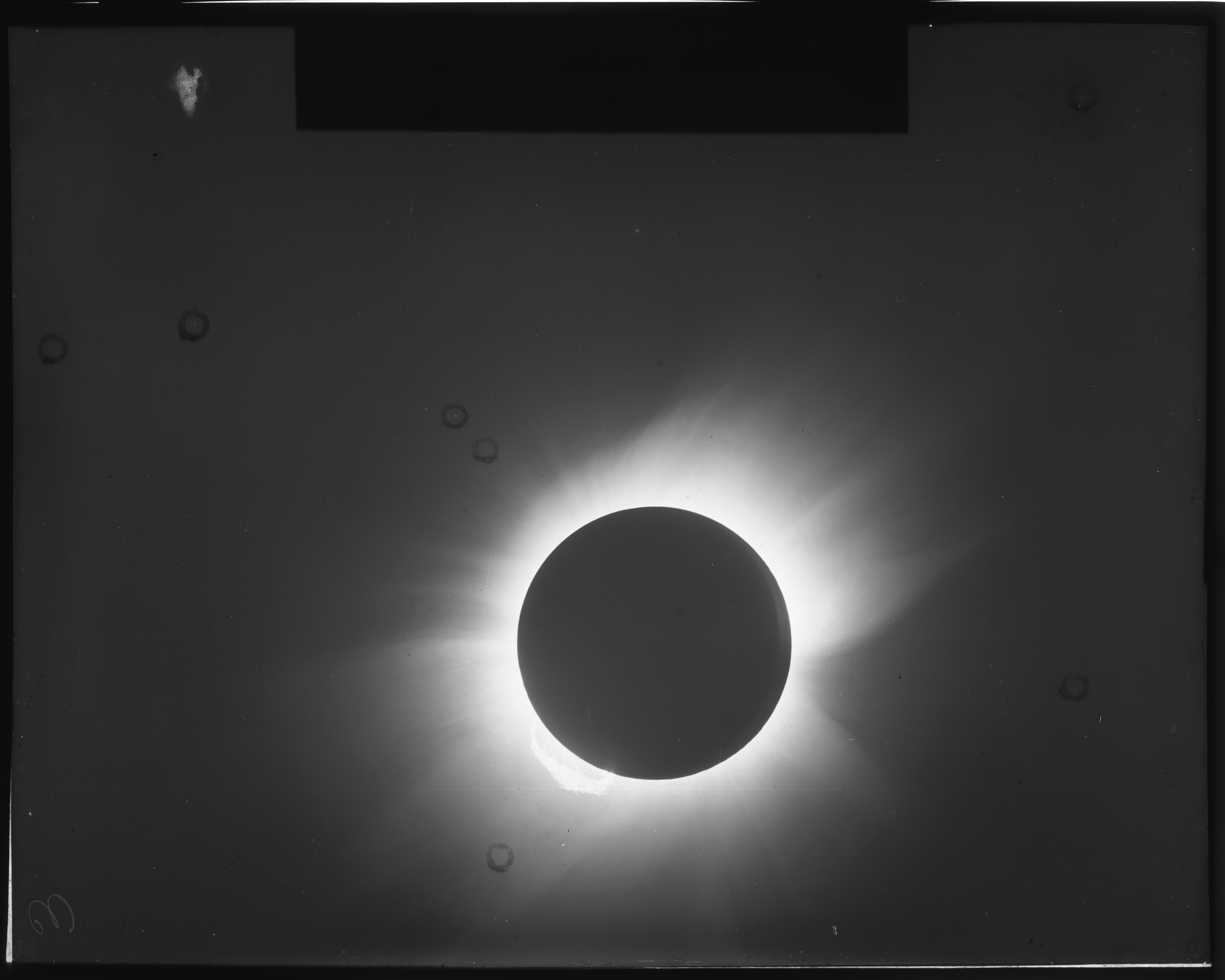
Anyway, one of the plates that turned up in Copenhagen shows this image:

A copy of one of the Sobral Eclipse plates

This image is a low-resolution version from a high-resolution scan of the plate (kindly sent to me by Johan Fynbo) concerned which I believe to be a contact copy (rather than an original) of one of the plates made by Andrew Crommelin’s team in Sobral in 1919. I know that a number of such copies were made in the aftermath of the experiment and similar plates have turned up in several locations.

If you look carefully you can see a number of dark rings (one of them quite clear because of the contrast with the solar corona).  These rings surround the stars used to measure the gravitational deflection of light by the sun; you can see the others more clearly if you click on the image to make it larger.

I think this plate illustrates one of the difficulties of this measurement: the gravitational deflection is larger for lines of sight close to the Sun, but the corona is likely to be in the way precisely for those same stars.


Mission (Almost) Accomplished

Posted in Biographical with tags , on November 20, 2019 by telescoper

Well, it’s been a fairly intense couple of days in Munich with not much time for anything other than work but I think we’ve finished everything we were supposed to do. The authorities will shortly evict us from the offices up in which we have been cooped and I’ll have to take a short walk to the Terminal Building at Munich airport in order to catch my flight back to Dublin. This may take me through the Christmas Market which has appeared at Munich Airport, complete with skating rink:


I anticipate falling asleep on the flight back as I’m more than a little knackered.

UPDATE: My flight back from Munich with Aer Lingus was due back in Dublin at 21.50 last night so I should have missed the last airport hopper bus to Maynooth (which departs at 21.50). Fortunately the flight was 30 minutes ahead of schedule, so I got the bus I should have missed and was able to get home and to bed at a reasonable hour!


Somewhere near Munich..

Posted in Biographical with tags , , on November 19, 2019 by telescoper

There’s an episode of the old television series Auf Wiedersehen, Pet (about Geordie migrant labourers working on building site in Germany) in which the character Oz (played by Jimmy Nail) comes across a German person wanting directions to München. Oz says that he doesn’t know where München is exactly but believes it is somewhere near Munich

Anyway, here I am somewhere near Munich myself. I’m not on a building site, though, but in a hotel near the airport which is some distance from the old city. I arrived last night on a flight from Dublin, using my Irish identity and travel documents.

I’ve just had a nice breakfast and am about to embark on two days of meetings as part of a secret mission on behalf of an intergovernmental organization. I and the other secret agents will be held here incommunicado in the environs of the airport until we are released tomorrow (Wednesday) evening.

It’s a shame that we won’t get to see the real Munich, which is a great city that I’ve visited on a number of occasions. To make up for it, here’s a picture of Marienplatz in the historic centre of Munich:

Still, the hotel isn’t bad – as airport hotels go – and everything seems reasonably well organized so far. I don’t think I’ll time to post anything substantial until tomorrow morning so until then, Auf Wiedersehen.

R. I. P. John Brown (1947-2019)

Posted in The Universe and Stuff with tags on November 18, 2019 by telescoper

It’s a very sad way to start the week but I have to convey the news that the Astronomer Royal for Scotland, John Brown, passed away suddenly on Saturday 16th November.

John (pictured above just after he received the Gold Medal of the Royal Astronomical Society in 2012) was an expert on the physics of solar and stellar plasmas. He was also an enthusiastic and dedicated teacher and advocate for science, giving memorably ebullient public talks to a diverse range of audiences in which he often included conjuring tricks (of which he was a skilled exponent). He was awarded an OBE in 2016 for services to science and outreach.

Above all else he was a very kindly and affable character who was universally liked, was great fun to be around, and who will be greatly missed within the astronomical community and beyond.

I send my heartfelt condolences to his family, friends and colleagues at the University of Glasgow on the loss of a much loved and irreplaceable character.

Rest in peace, John Campbell Brown (1947-2019).

The Bechet-Lyttelton Session

Posted in History, Jazz with tags , on November 17, 2019 by telescoper

Every now and again on this blog I like to mark significant anniversaries, so I’m quite annoyed that I’ve missed one by a few days. It’s perhaps not very well known that the great Sidney Bechet came to England in 1949 and did a concert and a recording session with Humphrey Lyttelton’s band while he was here. That recording session took place just over 70 years ago, on 13th November 1949.

What’s also not very well known is how controversial this session was at the time, because in the immediate post-war years the Musician’s Union had persuaded the UK government to ban American artists from performing over here. Humph was having none of it, thank goodness, and here we have the legacy. Here is the unmistakable Sidney Bechet on soprano sax, playing a traditional blues called I told you once, I told you twice with Humph on trumpet, Wally Fawkes on clarinet and, stealing the show, the superb (and, to my ears, rather modern-sounding) Keith Christie on trombone.

According to Humph’s memoirs, after the concert they played together, Bechet summoned Humph to his dressing room in order to deliver a kind of end-of-term report on the band in which he pointed out little criticisms of their playing. Bechet was a forceful character and often a harsh critic but when he got to Keith Christie he expressed nothing but unqualified admiration. There’s not much higher praise than that in the world of jazz…

The Necessity for De-Anglicising Irish Universities

Posted in Education, History with tags , , , , on November 17, 2019 by telescoper

Way back in 1892 Douglas Ross Hyde (who later became the First President of Ireland) delivered a famous speech to the Irish National Literary Society in Dublin on the subject of The Necessity for De-Anglicising Ireland. You can find the text of the speech here, and it’s well worth reading because much of what Hyde says is still relevant to the state of independent Ireland. It’s by no means a xenophobic anti-English rant, by the way, if that’s what you are tempted to infer it is based on the title.

I was struck by a theme which comes up repeatedly in Hyde’s speech. Here, for example:

It has always been very curious to me how Irish sentiment sticks in this half-way house –how it continues to apparently hate the English, and at the same time continues to imitate them; how it continues to clamour for recognition as a distinct nationality, and at the same time throws away with both hands what would make it so.

Having moved to Ireland to take up a position in an Irish university relatively recently I have been particularly struck by the tendency of those in charge of higher education in Ireland to copy slavishly the actions of the English government. I say `English’ specifically because higher education is devolved within the UK and there are different policies in Wales, Scotland and Northern Ireland. While it is true that we haven’t got a REF or a TEF yet or ridiculously high tuition fees, but that is probably just because of inertia. I wouldn’t be at all surprised if any or all of these were introduced before too long.

(As things stand students at Irish universities do not have to pay tuition fees as such but they do have to pay a `student contribution’ of up to €3000, which is a fee in all but name. There is more state help for disadvantaged students in Ireland than in England too. In most respects the situation here is similar to the regime that held in England prior to 2012, when £9000 year fees were brought in following the Browne Review. The question is whether England will cut university fees before Ireland gets round to increasing them. )

The current Irish government – which is of neoliberal hue – is presiding over a worsening situation in Irish universities, with funding for Irish undergraduate students failing to keep up with increasing numbers. It is hard to resist the feeling that starving the system of state funding is a precursor to increasing student fees to levels seen in England. At the moment English universities have the highest tuition fees in Europe. After Brexit it will be Ireland that takes that dubious honour within the EU.

The situation is even worse at postgraduate level, about which there seems to have been no thought whatsoever at government levels. In contrast to most European countries there is very little state funding for Masters courses in Ireland, so those wanting to do postgraduate degrees generally have to fund their own fees (over €6K per annum in physics) and living expenses. When final-year undergraduate students ask for advice about doing a Masters one is morally obliged to point out to them that they can do a high-quality course in, e.g., Germany or The Netherlands essentially for free, and that’s what many very able students do. Some might return, and bring their skills and knowledge back to Ireland but many won’t. The landscape of higher-education in Ireland does not encourage them to come back.

So what’s the answer to these woes? Well, it won’t solve everything, but a good start would be to stop looking at England for a way to run higher education and look instead at continental models. In this respect Brexit could prove to be an excellent opportunity for Ireland to reinvent itself as a fully European country. Over the years, largely driven by its membership of the European Union, Ireland has steadily reduced its economic dependency on trade with the United Kingdom and increased its connections with mainland Europe. Brexit will probably accelerate that trend.

I think that Ireland now needs to re-examine other sectors and stop the slavish copying of the idiotic policies of English politicians. It could do worse than to start with higher education.
The Case for Irish Membership of CERN

Posted in Politics, The Universe and Stuff with tags , , , , on November 16, 2019 by telescoper

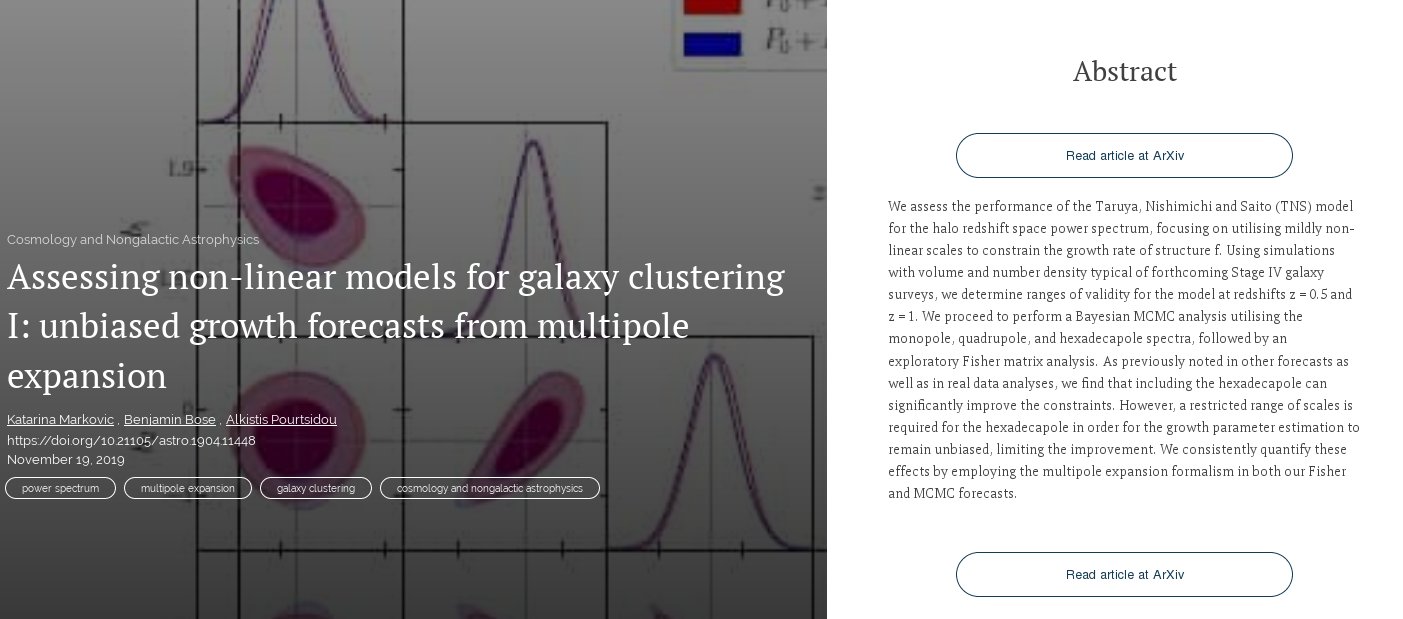
In the news here in Ireland this week is a new report from a Committee of the Houses of the Oireachtas making the case for Ireland to join CERN. You can download the report here (PDF) and you’ll find this rather striking graphic therein:

You will see that there are only three European countries that don’t have any form of membership or other agreement with CERN: Latvia, Bosnia-Herzegovina and Ireland. The fact that almost everyone else is in is not in itself necessarily a good argument for Ireland to join, but it does make one wonder why so many other countries have found it to join or have an agreement with CERN while Ireland has not.

As the document explains, if the Irish government  were to decide to take Ireland into CERN then  it would first have to become an Associate Member, which would cost around €1.2 million per year. That’s small potatoes really, and  the financial returns to Irish industry and universities are likely to far exceed that, so the report strongly recommends this step be taken. This Associate member stage would last up to 5 years, and then to acquire full membership a joining fee of around €15.6 million would have to be paid, which is obviously a much greater commitment but in my view still worthwhile.

While I strongly support the idea of Ireland joining CERN I do have a couple of concerns.

One is that I’m very sad that the actual science done at CERN is downplayed in the Oireachtas report. Most of it is about return to industry, training opportunities, etc. These are important, of course, but it must not be forgotten that big science projects like those carried out at CERN are above all else science projects. The quest for knowledge does have collateral benefits, but it a worthy activity in its own right and we shouldn’t lose sight of that.

My other (related) concern is that joining CERN is one thing, but in order to reap the scientific reward the government has to invest in the resources needed to exploit the access to facilities membership would provide. Without a related increase in research grant funding for basic science the opportunity to raise the level of scientific activity in Ireland would be lost.

Ireland recently joined the European Southern Observatory (ESO), a decision which gave Irish astronomers access to some amazing telescopes. However, there is no sign at all of Irish funding agencies responding to this opportunity by increasing funding for academic time, postdocs and graduate students needed to do the actual science.

Although astronomy is clearly much more interesting than particle physics (😉) in one respect the case of ESO is very like the case of CERN – the facilities do not themselves do the science. We need people to do that.