Middle of the Road Cat

Posted in Maynooth with tags on July 24, 2019 by telescoper

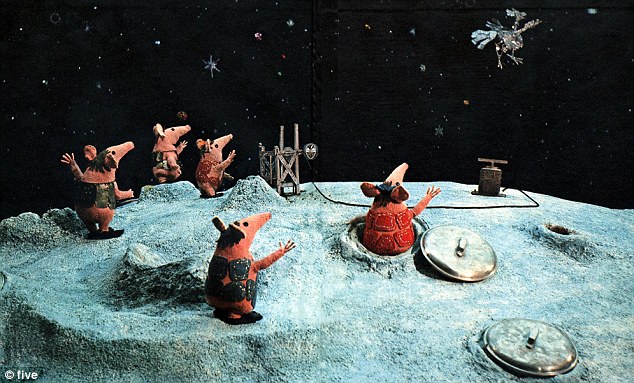
In the summer season, there being fewer people around, Maynooth University Library Cat has descended from his usual position by the bridge to ground level in order more effectively to intercept passing humans for food and fuss.

Just as I was about to take the picture he started to wash his tummy. Still, it could have been worse…

The Last Prime Minister of the United Kingdom?

Posted in Biographical, Politics with tags , on July 23, 2019 by telescoper

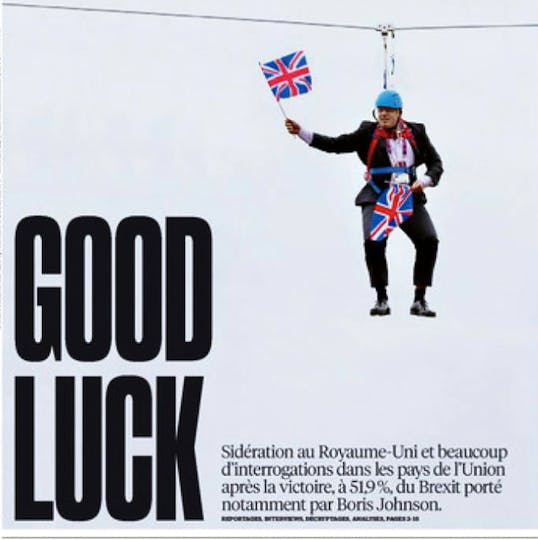
The front page shown above is three years old but is now even more apt than ever. Having won the Tory Party Leadership election, Boris Johnson will soon be installed as Prime Minister. The fact of his being a lazy dishonest blustering charlatan who is totally unsuited to any form of public office seems not to matter to the 90-odd thousand members of the Conservative Party who voted for him. I’ve never felt happier that I escaped…

It was always likely that Brexit would propel the dregs of UK politics to the forefront, and now the bottom of the barrel is in charge. It will take more than luck for the UK to get through this abysmal episode intact. The only question to me now is whether it will be Scotland or Northern Ireland that leaves first.

What do you think?


The Selecter – On My Radio

Posted in Biographical, Music with tags , , on July 23, 2019 by telescoper

This record came out when I was just sixteen. How can that possibly have been 40 years ago?On My Radiowas one of the first records produced by the 2 Tone label. Although the label only existed fora few years, the diverse and inclusive nature of the music that came out on 2 Tone made a big impression on me and left a lasting legacy. The Selecter (which is still going) was an awesome band to see and hear live. Oh, and how I adored Pauline Black!

The Last Resting Place of the Hubble Parameter?

Posted in Uncategorized with tags , , , on July 22, 2019 by telescoper

Last week was rather busy on the blog, with a run of posts about the Hubble constant (or, more precisely, the  present value of the Hubble parameter) attracting the most traffic. Somehow during all the excitement I allowed myself to be persuaded to write a piece for RTÉ Brainstorm about this issue. My brief is to write a detailed account of the current controversy in language accessible to a lay reader in not more than 800 words. That’s quite a challenge. Better get on with it.

Perhaps after that I’ll be able to lay the Hubble parameter to rest, at least for a while:

The original photograph (and joke) may be found here.

Also Sprach Zarathrustra: Einleitung, oder Sonnenaufgang

Posted in History, Music, The Universe and Stuff with tags , , on July 21, 2019 by telescoper

Here is a short video of the historic first manned landing on the Moon. I don’t know about you but I find the ghostly images are extremely affecting.

If there’s one piece of music indelibly associated with the Apollo missions, it’s the piece accompanying that clip: the introduction (or `Dawn’) from the orchestral tone poem Also Sprach Zarathrustra by Richard Strauss. Amazingly it was only a couple of years ago that I heard this piece performed live for the first time. I vividly remember how  the percussionists were clearly enjoying themselves during that performance. Not many orchestral pieces start with the percussion section front and centre. Whenever I’ve heard the piece since then I can’t help thinking how much I’d love to have a bash at the timpani part!

Anyway, here’s a clip from the Proms a few years ago to give you some idea of the tremendous impact this piece can have when you hear it in a concert hall.


Memories of the First Moon Landing

Posted in Biographical, Television, The Universe and Stuff with tags , , on July 20, 2019 by telescoper

Today is the 50th anniversary of the first moon landing, and I’m feeling very nostalgic as I recall my childhood memories of that historic event:

As a matter of fact I was six years old at the time which is easily old enough to have been aware of what was going on, but I don’t remember seeing anything to do with Apollo 11 and the Moon landings on 20th July 1969. I do recall bits and pieces of later Apollo missions but, unlike many colleagues of roughly my age who went into astronomy astrophysics or space science, I can’t really say that it was these events that inspired me to become a scientist. What did was something quite different!

But just because I wasn’t very aware of the significance of Apollo 11 at the time, doesn’t mean that I don’t think it was a spectacular achievement that is well worth commemorating fifty years on. Happy memories to all those who remember it, and enjoy the celebrations!

P. S. Interesting actuarial factoid: of all the people who were alive on 20th July 1969, only about 20% have not died yet.

New Publication at the Open Journal of Astrophysics!

Posted in OJAp Papers, Uncategorized with tags , , , , , , , on July 19, 2019 by telescoper

I was a bit busy yesterday doing a number of things, including publishing a new paper at The Open Journal of Astrophysics, but I didn’t get time to write a post about it until now. Anyway, here is how the new paper looks on the site:

The authors are Tom Kitching, Paniez Paykari and Mark Cropper of the Mullard Space Sciences Laboratory (of University College London) and Henk Hoekstra of Leiden Observatory.

You can find the accepted version on the arXiv here. This version was accepted after modifications requested by the referee and editor. Because this is an overlay journal the authors have to submit the accepted version to the arXiv (which we then check against the copy submitted to us) before publishing. We actually have a bunch of papers that we have accepted but are awaiting the appearance of the final version on the arXiv so we can validate it.

Anyway, this is another one for the `Cosmology and Nongalactic Astrophysics’ folder. We would be happy to get more submissions from other areas of astrophysics. Hint! Hint!

P.S. Just a reminder that we now have an Open Journal of Astrophysics Facebook page where you can follow updates from the Journal should you wish..

Thoughts on Cosmological Distances

Posted in The Universe and Stuff with tags , , , , , on July 18, 2019 by telescoper

At the risk of giving the impression that I’m obsessed with the issue of the Hubble constant, I thought I’d do a quick post about something vaguely related to that which I happened to be thinking about the other night.

It has been remarked that the two allegedly discrepant sets of measures of the cosmological distance scale seen, for example, in the diagram below differ in that the low values are global measures (based on observations at high redshift) while the high values of are local (based on direct determinations using local sources, specifically stars of various types).

The above Figure is taken from the paper I blogged about a few days ago here.

That is basically true. There is, however, another difference in the two types of determination: the high values of the Hubble constant are generally related to interpretations of the measured brightness of observed sources (i.e. they are luminosity distances) while the lower values are generally based on trigonometry (specifically they are angular diameter distances). Observations of the cosmic microwave background temperature pattern, baryon acoustic oscillations in the matter power-spectum, and gravitational lensing studies all involve angular-diameter distances rather than luminosity distances.

Before going on let me point out that the global (cosmological) determinations of the Hubble constant are indirect in that they involve the simultaneous determination of a set of parameters based on a detailed model. The Hubble constant is not one of the basic parameters inferred from cosmological observations, it is derived from the others. One does not therefore derive the global estimates in the same way as the local ones, so I’m simplifying things a lot in the following discussion which I am not therefore claiming to be a resolution of the alleged discrepancy. I’m just thinking out loud, so to speak.

With that caveat in mind, and setting aside the possibility (or indeed probability) of observational systematics in some or all of the measurements, let us suppose that we did find that there was a real discrepancy between distances inferred using angular diameters and distances using luminosities in the framework of the standard cosmological model. What could we infer?

Well, if the Universe is described by a space-time with the Robertson-Walker Metric (which is the case if the Cosmological Principle applies in the framework of General Relativity) then angular diameter distances and luminosity distances differ only by a factor of (1+z)2 where z is the redshift: DL=DA(1+z)2.

I’ve included here some slides from undergraduate course notes to add more detail to this if you’re interested:

The result DL=DA(1+z)2 is an example of Etherington’s Reciprocity Theorem. If we did find that somehow this theorem were violated, how could we modify our cosmological theory to explain it?

Well, one thing we couldn’t do is change the evolutionary history of the scale factor a(t) within a Friedman model. The redshift just depends on the scale factor when light is emitted and the scale factor when it is received, not how it evolves in between. And because the evolution of the scale factor is determined by the Friedman equation that relates it to the energy contents of the Universe, changing the latter won’t help either no matter how exotic the stuff you introduce (as long as it only interacts with light rays via gravity).

In the light of the caveat I introduced above, I should say that changing the energy contents of the Universe might well shift the allowed parameter region which may reconcile the cosmological determination of the Hubble constant from cosmology with local values. I am just talking about a hypothetical simpler case.

In order to violate the reciprocity theorem one would have to tinker with something else. An obvious possibility is to abandon the Robertson-Walker metric. We know that the Universe is not exactly homogeneous and isotropic, so one could appeal to the gravitational lensing effect of lumpiness as the origin of the discrepancy. This must happen to some extent, but understanding it fully is very hard because we have far from perfect understanding of globally inhomogeneous cosmological models.

Etherington’s theorem requires light rays to be described by null geodesics which would not be the case if photons had mass, so introducing massive photons that’s another way out. It also requires photon numbers to be conserved, so some mysterious way of making photons disappear might do the trick, so adding some exotic field that interacts with light in a peculiar way is another possibility.

Anyway, my main point here is that if one could pin down the Hubble constant tension as a discrepancy between angular-diameter and luminosity based distances then the most obvious place to look for a resolution is in departures of the metric from the Robertson-Walker form.

Addendum: just to clarify one point, the reciprocity theorem applies to any GR-based metric theory, i.e. just about anything without torsion in the metric, so it applies to inhomogeneous cosmologies based on GR too. However, in such theories there is no way of defining a global scale factor a(t) so the reciprocity relation applies only locally, in a different form for each source and observer.

Remembering Billie Holiday

Posted in Jazz with tags , , on July 17, 2019 by telescoper

I was reminded by the radio this morning that today is the 60th anniversary of the death of the great Billie Holiday, who passed away on 17th July 1959. A consummate vocal artist who was in my book the greatest jazz singer there has ever been, Billie was only 44 years old when she died and, according to reports, her bank account contained only 70 cents. She lived a short and very hard life but still managed to leave a priceless legacy of wonderful music. She definitely paid her dues, so I couldn’t resist marking this sad anniversary with an example of her art from what I think was her best period, the 1930s, before alcoholism and drug addiction took such a heavy toll on her voice and she became a little mannered and self-conscious.

I’m not sure it’s possible for any record to be perfect, but there are definitely some that I can’t imagine being improved in any way. I can think of a number of Jazz records that fall into that category, including this version of When You’re Smiling made in 1938. It features Billie Holiday and Lester Young along a number of members of the Count Basie Orchestra (apart from the Count himself, who is replaced by Teddy Wilson on piano).

That this is a favourite record of mine is a bit of a paradox, because I don’t really like the song very much. However, in jazz, the tune is just the starting point. In her early recording career, Billie Holliday wasn’t very well known so she was often given relatively unpromising songs to sing. She turned out to be brilliant at turning that sort of base metal into gold and became probably the best ever singer of a bad song.

In this track it’s not just the way Billie Holiday’s voice floats ethereally across the beat as she takes outrageous liberties with both melody and rhythm. Nor is the way she manages to express everything there is about life and love and heartache through the rather banal lyrics, investing the song with a deep sense of tragic irony. Nor is it Lester Young’s superbly constructed tenor saxophone solo near the end, which one of the very greatest by one of the very greatest. Nor is it that lightly swinging rhythm section of Freddie Green, Walter Page and Jo Jones who push the whole thing along on gossamer wings, just as they did with the Baside Band, making most of their rivals sound like clodhoppers. Listen in particular how Jo Jones accentuates Lester Young’s solo here and there with telepathic rimshots.

All the component parts of this performance are magnificent, but the whole is even greater than their sum. It’s a timeless jazz masterpiece, three minutes of solid gold, and I hope a fitting tribute to a great artist.

Rest in Peace, Lady Day.

Bullying at ETH Zürich leads to a dismissal

Posted in Uncategorized with tags , , , , on July 17, 2019 by telescoper

I was wondering why this old post from 2017 (which was my busiest post of the year back then) has been experiencing a resurgence in traffic over the last few days, and I’ve only just found out the reason.

According to this article, Eidgenössische Technische Hochschule (ETH) Zürich has taken formal action to dismiss a professor from the former Institute for Astronomy. This follows a scandal about bullying in the Institute of Astronomy, which led to the Institute being closed down. The Professor against whom the allegations of bullying have been made is Marcella Carollo, who is not named in the article I linked to above but is named in this more complete account (in German).

This would be the first time in the history of the ETH that a Professor has actually been dismissed.

It has taken quite a while to get this far with this very sorry case – it would have been far better had the complaints about Prof. Carollo been dealt with sooner, but if there is any good to emerge it will be that ETH puts in place better processes for the supervision of early career researchers generally, and particularly for dealing with allegations of bullying.