Stonewall, Fifty Years On

Posted in Biographical, LGBTQ+ with tags , , , , , on June 28, 2019 by telescoper

Well, it’s 28th June 2019 which means that it is exactly 50 years to the day since the Stonewall Riots, the event commemorated each year by the annual Pride celebrations. The Dublin Pride Parade is tomorrow, actually. My Facebook and twitter feeds have been filled with rainbows all week, and it is nice to to see so many people, straight and gay, celebrating diversity and equality. I’m a bit more cynical about the number of businesses that have tried to cash in on  Pride but even that is acceptance of a sort. It remains to be seen how many of them are fair weather friends. I’m sure I’m not the only person who sees the dark clouds of bigotry threatening the fragile and precious rainbow.


It’s all very different from the first Pride March I went on, way back in 1986. That was a much smaller scale event than yesterday’s, and politicians were – with very few exceptions – notable by their absence.

It was in the early hours of the morning of Saturday June 28th 1969 that the Stonewall Riots took place in the Greenwich Village area of New York City. There are few photographs and no film footage of what happened which, together with some conflicting eyewitness accounts, has contrbuted to the almost mythical status of these demonstations, which were centred on the Stonewall Inn (which, incidentally, still exists).  What is, I think, clear is that they were the spontaneous manifestation of the anger of a community that had simply had enough of the way it was being treated by the police. Although it wasn’t the first such protest in the USA, I still think it is also the case that Stonewall was a defining moment in the history of the movement for LGBT equality.

One of the myths that has grown up around Stonewall is that the Stonewall Inn was a place primarily frequented by drag queens and it was the drag queens who began the fight back against intolerable  police harassment. That was the standard version, but the truth is much more complicated and uncertain that that. Nevertheless, it is clear that it was the attempted arrest of four people – three male (cross-dressers) and one female – that ignited the protest. Whether they led it or not, there’s no doubt that drag queens played a major role in the birth of the gay liberation movement. Indeed, to this day, it remains the case that the “T” part of the LGBT spectrum (which I interpret to include Transgender and Transvestite) is often neglected by the rest of the rainbow.

I have my own reasons for being grateful for drag queens. When I was a youngster (still at School) I occasionally visited a gay bar in Newcastle called the Courtyard. I was under age for drinking alcohol let alone anything else – the age of consent was 21 in those days – but I got a kick out of the attention I received and flirted outrageously without ever taking things any further. I never had to buy my own drinks, let’s put it that way.

Anyway, one evening I left the pub to get the bus home – the bus station was adjacent to the pub – but was immediately confronted by a young bloke who grabbed hold of me and asked if I was a “poof”. Before I could answer, a figure loomed up behind him and shouted “Leave him alone!”. My assailant let go of me and turned round to face my guardian angel, or rather guardian drag queen. No ordinary drag queen either. This one, at least in my memory, was enormous: about six foot six and built like a docker, but looking even taller because of the big hair and high heels. The yob laughed sneeringly whereupon he received the immediate response of a powerful right jab to the point of the chin, like something out of boxing manual. His head snapped back and hit the glass wall of a bus shelter. Blood spurted from his mouth as he slumped to the ground.

I honestly thought he was dead, and so apparently did my rescuer who told me in no uncertain terms to get the hell away. Apart from everything else, the pub would have got into trouble if they’d known I had even been in there. I ran to the next stop where I got a bus straightaway. I was frightened there would be something on the news about a violent death in the town centre, but that never happened. It turns out the “gentleman” concerned had bitten his tongue when the back of his head hit the bus shelter. Must have been painful, but not life-threatening. My sympathy remains limited.

I think there’s a moral to this story, but I’ll leave it up to you to decide what it is.

Anyway, back to Pride. In a post a few days ago I referred to the view that since we now, for example, ave equal marriage then it’s basically all done, isn’t it? There’s now no discrimination. You can stop talking about LGBT+ matters and `just be a scientist’.

That, I’m afraid, is bollocks. We may have equal marriage but, though welcome, by no means represents some sort of utopia. Society is still basically a patriarchy, configured in a way that is profoundly unfair to many groups of people, so there are still many challenges to be fought. Hate crimes against LGBT+ – especially transgender – people have rocketed. The rise of fascism around the world is encouraging bigots to target minorities and other vulnerable groups with their agenda of hate. Unless we keep pushing for a truly inclusive society there is a real danger that the rights we have won could easily be rolled back. In fact, you could really say that it’s really just the start. We still need to stand up for ourselves just like the heroes of 1969.

Summertime – Henry “Red” Allen & Coleman Hawkins

Posted in Jazz with tags , , , on June 27, 2019 by telescoper

Summer seems to have made it to Ireland at last so here’s an appropriate piece of music. It’s George Gershwin’s Summertime, played in 1958 by a band led by trumpeter Henry “Red”Allen that included the great Coleman Hawkins on tenor sax. This record came from a session that Henry Allen said near the end of his life that he regarded as his best work, and indeed his playing on this is absolutely beautiful (as is that of Coleman Hawkins). Other musicians on this track are Earl Warren (clarinet), Marty Napoleon (piano), Chubby Jackson (bass) and George Wettling (drums). Enjoy!

The Senior Academic Leadership Initiative

Posted in Education, Maynooth, Politics with tags , , , , , on June 27, 2019 by telescoper

I’ve been so busy over the last week or so that I forgot to mention that on Friday (21st June) the Minister of State for Higher Education Mary Mitchell O’Connor announced a new scheme to improve the gender balance in senior academic roles in Irish universities.

While women make up more than half of university lecturers here in Ireland, just 24% are professors, and the new scheme plans to tackle that under-representation at senior levels by creating up to 45 academic leadership positions specifically for women over the next three years.

The Senior Academic Leadership Initiative (SALI) is funded by the Department of Education and Skills and managed by the Higher Education Authority. More details of the scheme can be found here and the call for applications can be found here.

In summary: new and additional senior academic leadership posts will be funded in areas where

  • there is clear evidence of significant gender under-representation
  • where this appointment will have significant impact within the HEI and the relevant faculty/department/functional unit
  • where they would be a proportionate and effective means to achieve accelerated and sustainable change within an institution

Predictably there has been a bit of a backlash to this announcement from some quarters, but I think it’s an excellent idea and it has my full support. Note further that Legal advice from the Attorney General has confirmed that this policy approach is consistent with EU and national employment and equality law.

I hope a significant number of these positions go to outstanding female academics in STEM disciplines, where the under-representation is indeed significant – and hope we can also attract some here to Maynooth! We don’t have any female academics in the Department of Theoretical Physics….

It’s important, however, to bear in mind that this scheme addresses only one of the issues relating to gender discrimination in Irish higher education and there are many others, especially in STEM disciplines (such as recruitment of early-career level) which will require separate actions.


Exploring the workplace for LGBT+ Physical Scientists

Posted in LGBTQ+ with tags , , , , , on June 26, 2019 by telescoper

Had things gone to plan, today I would have been at the premises of the Royal Society of Chemistry in Burlington House in London for the launch of Exploring the workplace for LGBT+ physical scientists a report by the Institute of Physics, Royal Astronomical Society and the Royal Society of Chemistry resulting from a survey that I blogged about last year. Unfortunately I’ve been too busy here in Maynooth to fly to London and back for the launch so I’ll have to restrict myself to thanking these organizations for undertaking this project and pointing out that you can download, and perhaps even read, the resulting report here.

This report demonstrates that, while we have come a long way, we still have to do a lot more to make sure that LBGT+ people feel welcome and valued in the physical sciences.

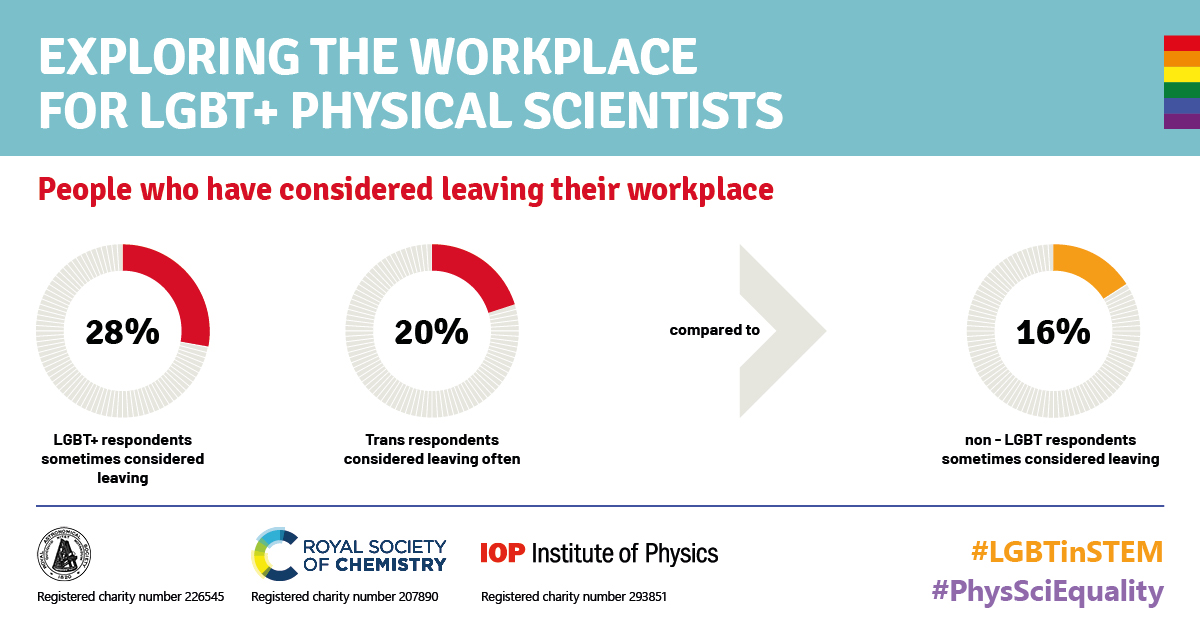
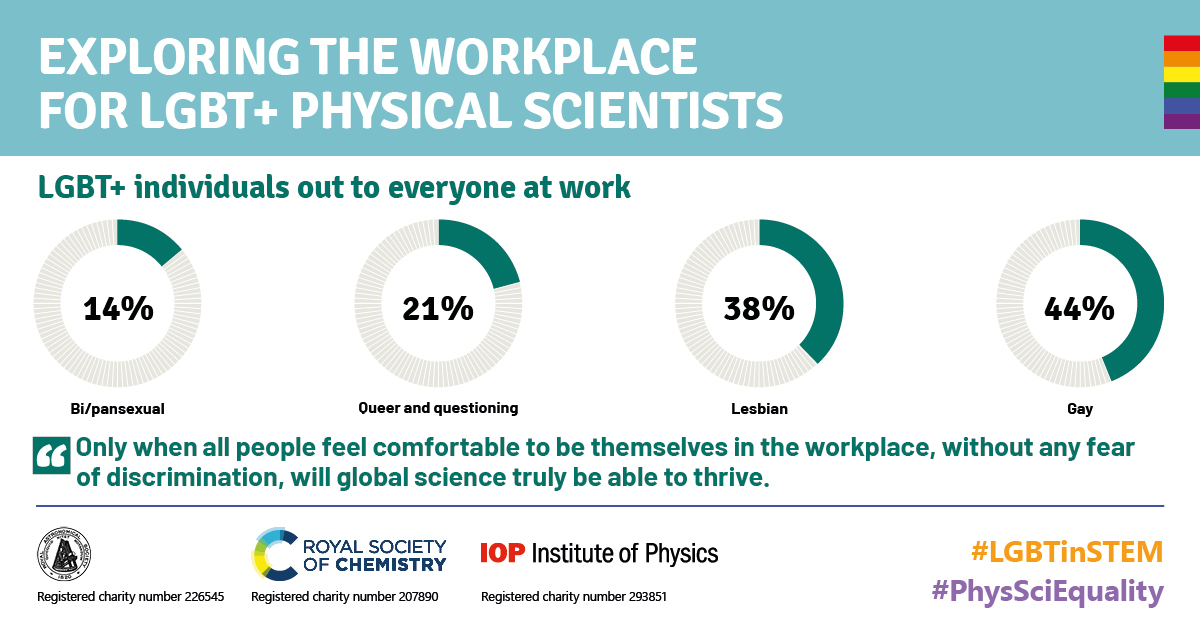
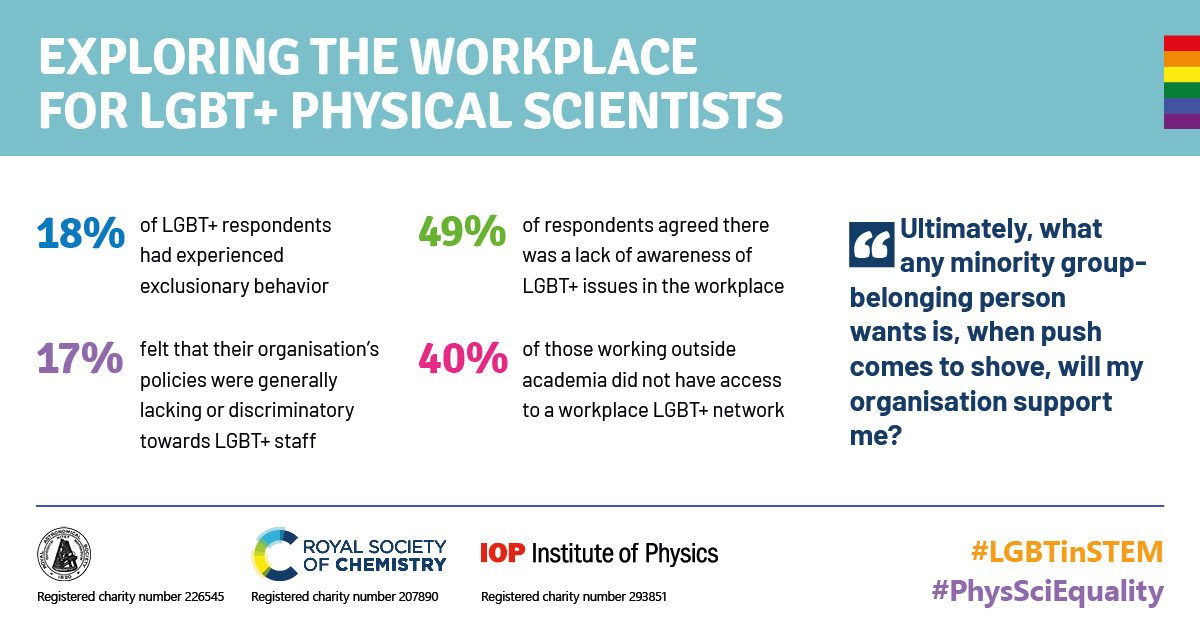
A majority (70%) of the survey respondents believed that the working environment was improving for LBGT+ members of the physical science community but as many as 25% had at some point considered leaving the physical sciences due to discrimination.

I have also taken the liberty of including below a few infographics summarizing some of the main findings of the report.

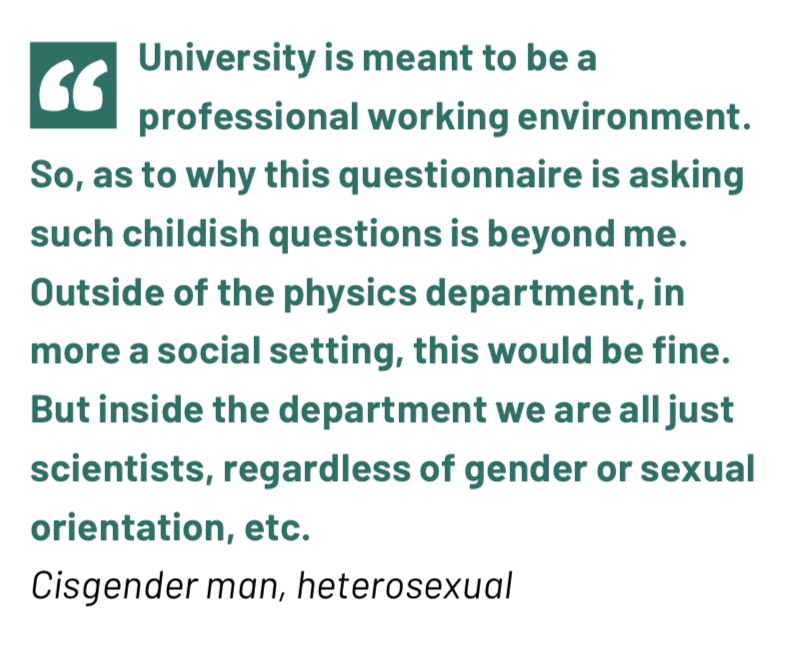
One of the responses to the survey reads

I doubt this view is uncommon among heterosexual scientists but I disagree with it. The idea that no scientist has any identity at all in the workplace other than `scientist’ is quite ridiculous. Scientists are human beings, and humans are extremely diverse. I doubt if anyone likes to be defined by a single characteristic – we are all complex individuals subject to a whole host of different influences – but, to create an inclusive environment where the best scientists can flourish and the best science can be done, we need to make sure everyone feels comfortable. If we can do that it won’t just benefit our LGBT+ colleagues, but everyone in our workplaces.

Do read the report!

New Publication at the Open Journal of Astrophysics!

Posted in OJAp Papers, Open Access, The Universe and Stuff with tags , , , , , , on June 26, 2019 by telescoper

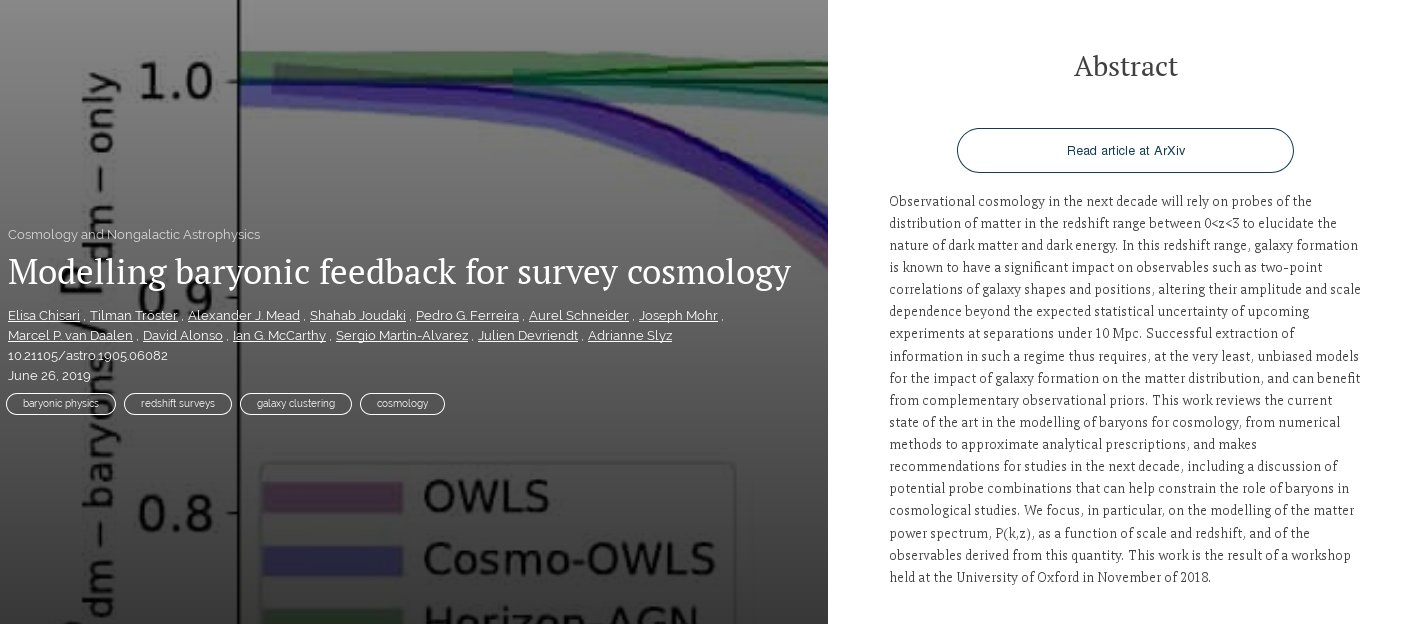
In a blog I posted just a couple of day ago I mentioned that there were a number of papers about to be published by the Open Journal of Astrophysics and, to show that I wasn’t making that up, the first of the latest batch has just appeared. Here is how it looks on the site!

There are thirteen authors altogether (from Oxford, Liverpool, Edinburgh, Leiden, British Columbia, Zurich and Munich); the lead other is Elisa

You can find the accepted version on the arXiv here. This version was accepted after modifications requested by the referee and editor.

This is another one for the `Cosmology and Nongalactic Astrophysics’ folder. We would be happy to get more submissions from other areas of astrophysics. Hint! Hint!

A few people have asked why the Open Journal of Astrophysics is not yet listed in the Directory of Open Access Journals. The answer to that is simple: to qualify for listing a journal must publish a minimum of five papers in a calendar year. Since OJA underwent a failure long hiatus after publishing its first batch of papers we haven’t yet qualified. However, this new one means that we have now published five papers so have reached the qualifying level.  I’ll put in the application as soon as I can, but will probably wait a little because we have a bunch of other papers coming out very soon to add to that number.

P.S. Please note that we now have an Open Journal of Astrophysics Facebook page where you can follow updates from the Journal should you wish..

Synthesis – Con Moto

Posted in Biographical, Jazz with tags , , , , , on June 25, 2019 by telescoper

You will have to be of a certain age to remember this piece of music, the second movement (Con Moto) of a four-part work called Synthesis by Laurie Johnson who was a renowned composer of TV themes. This piece, however, written for Jazz Big Band and Symphony Orchestra, was used for many years as the intro theme Sounds of Jazz, a BBC2 Radio 2 programme presented on Sunday evenings by Peter Clayton. I always used to switch over from John Peel when Sounds of Jazz started, but we never got to hear more than the first minute or so so here’s the whole piece.

There are some exceptional British musicians on this track, including Kenny Wheeler (trumpet), Tubby Hayes and Tony Coe on reeds, and the great Stan Tracey on piano. It’s the London Jazz Orchestra, in fact, with the London Philharmonic Orchestra.

Now, for bonus marks, can anyone remember what was the music used to close this show?

Institutes, Acronyms and the Letter H

Posted in Education, Maynooth with tags , , , , , on June 25, 2019 by telescoper

Here’s a rambling and inconsequential post emanating from a coffee-room discussion yesterday.

The latest round of guff about University Rankings, in which Massachusetts Institute of Technology (MIT) came top and Irish universities didn’t  prompted a strange letter to the Irish Times about the status of the Irish Institutes of Technology some of which have merged, or are planning to merge, to form Technological Universities.

Among the list of Irish Institutes of Technology, I found that sadly there isn’t an MIT in Ireland (Mullingar would be a good place for it!) but there are, for example:

Cork Institute of Technology (CIT)

Waterford Institute of Technology (WIT)

Limerick Institute of Technology (LIT)

Athlone Institute of Technology (AIT)

and so on, as well as..

Institute of Technology Tralee….(:-)

I wondered whether there might be some other potentially unfortunate acronyms  to be had, I hoped for example for a South Howth Institute of Technology but sadly there isn’t one; nor is there a Sligo Higher Institute of Technology. There’s no Galway Institute of Technology either.

In the course of that exercise in silliness I discovered how few towns and villages there are in Ireland whose names begin with the letter H. Moreover all of those listed on the Wikipedia page are in the Sacs-Bhéarla (English language) rather than genuinely Irish names.

I’m sure Irish speakers will correct me on this, but I guess this lack of Irish proper names beginning with H may be connected with the use of h in denoting lenition. When used in this way the `h’ always appears after the consonant being modified and so never forms the initial letter. There are plenty of words in Irish beginning with H, though, so this is either a red herring or something specific to place names.

Comments and corrections are welcome through the box below!


UPDATE: I’m reliably informed (via Twitter) that all words in modern Irish beginning with H are borrowings from other languages, and the h was only introduced into Irish words for the reason mentioned above,

Plan S and the Open Journal of Astrophysics

Posted in Open Access with tags , , , , on June 24, 2019 by telescoper

Things have been a little quiet on this side of the Open Journal of Astrophysics but rest assured it has been very busy behind the scenes, with a sizeable batch of papers going through peer review and a number of those are very near the finishing post.

My target was to build up to an average of about one submission a week by the end of 2019, and I think we’re on track to reach that comfortably by the end of summer.

I’ll report more on new publications as they are published, but before that I thought I’d report on a couple of bits of news to do with Plan S, following the issuance last month of revised guidelines.

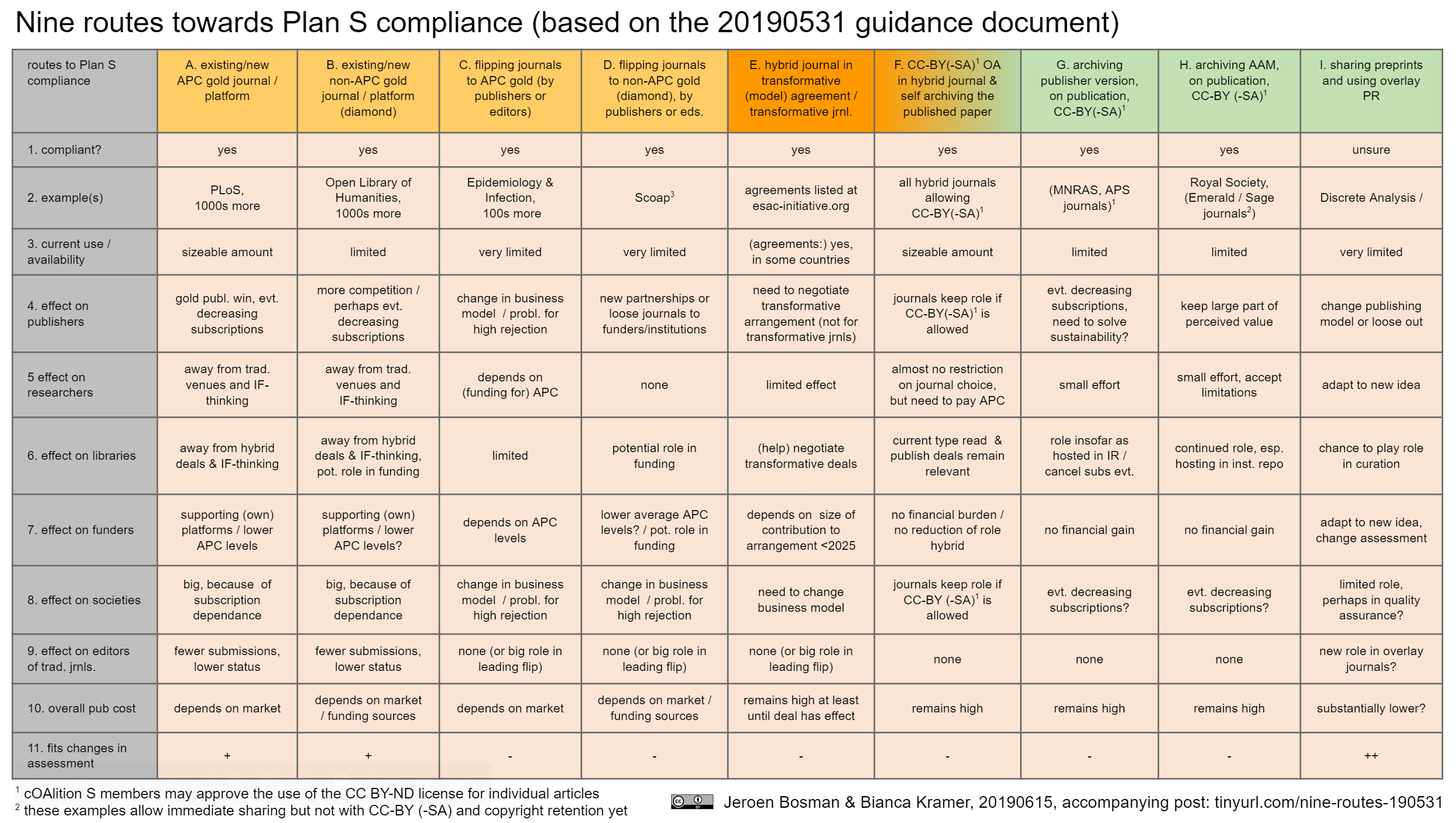
First, here is a nice summary (taken from this article) of the different ways in principle one could deliver Open Access publishing in a manner consistent with Plan S:

You can click on the image to make it bigger.

The important thing is that the Open Journal of Astrophysics belongs in the column on the far right of the table. I draw your attention to the various comments, especially the one at the end that says the cost of overlay journals is substantially lower. It is, as I explain here.

the authors of this post think it is unclear whether these are compliant with Plan S. That’s a fair comment, but it can be clarified into a definite yes with very few tweaks. It is very encouraging on this point that the CEO of Scholastica (who provide our platform) has written a blog in which he describes the steps being taken to ensure that all Scholastica journals are indeed compliant with Plan S.

Over the coming months, we will announce new functionality that supports complying with Plan S guidelines, and we’re committed to updating our software to meet changes to the Plan S implementation rules as they come out.

I was very happy to read this plan as it includes adding a number of things to the Scholastica system that we currently have to do ourselves (e.g. registering DOIs with CrossRef).

Anyway, another notification from Scholastica has just come in so that will have to be that for now.


More Vain Human Fake (Cosmology) Science

Posted in The Universe and Stuff with tags , on June 24, 2019 by telescoper

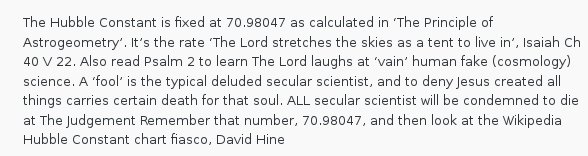
I haven’t mucked out my spam folder for a while and when I did so just now I found that a long-term irritant of mine, a certain Mr David Hine, had attempted to post another comment:

I have to admit that I’m not well up on the biblical references so I looked them up. Isaiah Chapter 40 Verse 22

He sits enthroned above the circle of the earth, and its people are like grasshoppers. He stretches out the heavens like a canopy, and spreads them out like a tent to live in.

I don’t see any mention of the Hubble constant, nor indeed any statement that the stretching of the heavens follows a linear relation (Hubble’s Law).

As for Psalm 2, in the New International Version, Verse 1 reads:

Why do the nations conspire
    and the peoples plot in vain?

I have only just now realized that the second part of this verse refers to the construction of graphs. Personally, I never plot in vain. I normally use python.

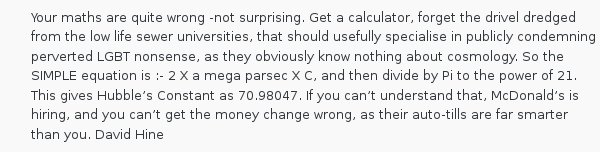
UPDATE: I have now received further information of the derivation of the Hubble constant straight from the horse’s arse mouth:


Unfortunately I am so lacking in mental equipment I can’t really understand this equation. It’s not even an equation actually because it doesn’t equate anything with anything.

Anyway, let’s look at the expression given in the above comment. A Megaparsec has the units of length. The speed of light has units of length/time, so  whatever the formula calculates has units of length2 time-1, which is dimensionally incorrect for the Hubble constant, which has units of time-1.

Moreover, if I put values for c, π, 21 and 2 into the equation I don’t even get anything like 70.98047:

π21 ≈ 2.75 × 10¹⁰ (dimensionless).

2 × `a Mpc’ × c ≈ 2 × 3.086 ×1022 m × 3 × 108 m s-1 ≈ 1.83 × 1031 m2 s-1.

Thus the full expression has a value approximately 6.66 × 1020 m2 s-1.

The correct value for the Hubble constant is about 2.2 × 10⁻¹⁸ s−1.

Completely wrong value and completely wrong dimensions. The first three figures of the answer may be significant however.

Here’s some reasoned criticism:


I’ve checked the above calculation and don’t see any mistakes. Perhaps I forgot to take away the number I first thought of…


Birds of Play

Posted in Biographical, Maynooth with tags , , on June 23, 2019 by telescoper

As if it weren’t enough to have a celebrity cat, Maynooth University now also has a celebrity bird. Or birds. I’m not absolutely sure that it’s the same Jackdaw that is a frequent visitor to offices on the South Campus, as they are so many around, but here are a few pictures taken from Twitter which may or may not be the same critter:

I’ll assume for the purpose of this blog that it is the same bird, but I don’t know whether it’s male or female so I’ll just say call it `it’. As you can see, it is very trusting of humans.

Jackdaws are extremely characterful, intelligent and inquisitive birds. These traits are not unrelated. In fact this is true in general of the family Corvidae which includes the genus Corvus (crows, rooks, ravens, and jackdaws) as well as magpies, jays, nutcrackers and a number of other species: this family has about the same ratio of brain to body weight as the great apes and cetaceans.

One of the characteristics of this family is their propensity to indulge in various forms of play. I imagine most people know that magpies and other Corvidae like to steal and hoard shiny things, but they also engage in even stranger behaviour. I saw some crows sliding down a roof on campus during the winter snows, which is one of their favourite games. They also like to hang upside down from branches, washing lines and telephone wires. Another thing I’ve seen groups of campus jackdaws do is collect sticks and arrange them in patterns on the ground. I’m not at all sure of the rules of the game they were playing, but they seemed to be taking it very seriously, which made it all the funnier to watch.

I’ve heard various reports of what the Jackdaw above gets up to when visiting staff offices. Most of its activities cause considerable chaos. It seems to be fascinated by string, elastic bands and tissue paper which it pulls out of any container that it can and scatters about. It also has a particular interest in pencils, a fascination which may be related to the stick game I mentioned in the previous paragraph, and it delights in pulling them out of containers to play with.

I’m not aware of any jackdaws coming into offices on the North Campus (where my office is situated), which is a shame because they provide a great deal of amusement.I imagine it took quite a long time to build up a sufficient level of trust for this one to feel comfortable indoors because, outside, they seem rather wary of humans.

I can add one personal anecdote though. Some weeks ago I went for a walk along the canal and at one point sat down on a bench on the towpath. I wasn’t there long until a Jackdaw appeared on the ground and began tugging at the shoelaces on my left foot. I assumed it thought they were something edible such as worms or perhaps spaghetti so just watched in amusement as it tugged more and more frantically. It was only then that I realized that there another Jackdaw had appeared to my right hand side on the bench and was busy trying to get into my bag. This was clearly an attempted distraction theft, but I refrained from calling the Gardaí..

P.S. Here’s a hooded crow trying much the same trick.