Bridget Riley at the Hayward Gallery

Posted in Art with tags , on November 8, 2019 by telescoper

Circumstances require me to travel back to Dublin via London today, so I took the opportunity to spend an hour or so at the wonderful Bridget Riley retrospective at the Hayward Gallery. The exhibition is on until January 26th and I recommend it very enthusiastically.

I took a few pictures, but none of them give an adequate impression of the experience of seeing them in the flesh.

These three deceptively simple compositions made from coloured stripes play with the eye’s colour perception, seeming to change in texture and hue as the observer changes position or viewing angle.

The “rhomboid” pictures like this one November use changes in colour to disrupt the brain’s interpretation of the two-dimensional nature of the painting. The rhombi seem to rise and fall, the surface buckling as a result.

From the black and white collection this is Movement in Squares which uses simple changes in shape to imply depth, but also creates a visual instalibity to the perception is not of a static image.

This (Drift 2) generates a twisting effect on that makes you feel quite dizzy!

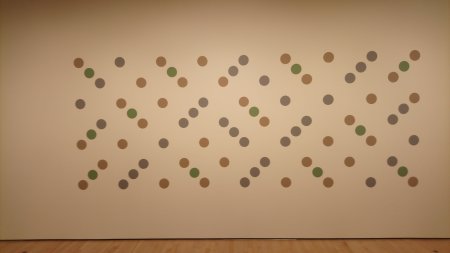
This one from 2017 is untitled and is simultaneously the least successful to be photographed and one of the most successful to view in person. It is very large – about 4 metres by 2 metres – and the circles filled with colour seem to jump about in your field of vision with every slight change of eyeline!
There are many more treats to experience in this exhibition which is highly recommended.
A Musical Memory: Mabel’s Dream

Posted in Biographical, Jazz with tags , , , , , on November 7, 2019 by telescoper

So that’s that. The funeral is over. We all said our goodbyes, and there many tears.

My Mam chose the music for her funeral a long time ago, and the piece that was playing as we arrived in the West Chapel of the West Road Crematorium was one that I wrote about about a decade ago, so I thought I’d indulge myself by posting here the version we heard today.

Years ago my Mam told me that she heard the tune Mabel’s Dream played on the piano by a friend of the family by the name of Johnny Handle. Best known as a folk musician (and founder member of a well-known band called The High Level Ranters) he is also a music teacher and musicologist with a wide range of interests in music. I read somewhere that this lovely tune was originally written by Jelly Roll Morton and performed by him on solo piano, but by far the most famous recording of Mabel’s Dream was made by King Oliver and his Creole Jazz Band in Chicago in 1923. This was the band that the young Louis Armstrong belonged to before going on to make the classic Hot Fives and Hot Sevens, one of which I posted a bit ago. It’s interesting how different the earlier band sounds: with two cornets (King Oliver and Louis Armstrong), clarinet (Johnny Dodds), and trombone (Honore Dutrey) playing together virtually all the time except for short improvised solo breaks. King Oliver usually played lead cornet, at least in their earlier recordings, with Louis Armstrong playing a decorative counterpoint around him rather like a clarinettist might. Later on, they swapped leads freely and completely intuitively producing a sound that was entirely unique.

The ensemble playing is intricate, but the band had no written music, preferring to work exclusively from “head” arrangements. Their music is consistently delightful to listen to, with a succession of marchy themes that makes it impossible not to want to tap your feet when you listen to them.

Over time, this classic type of polyphonic Jazz- derived from its New Orleans roots – gradually morphed into musical form dominated by much simpler arrangements and a succession of virtuoso solos. This change was also reflected in the differing fortunes of Louis Armstrong and King Oliver. The former went on to become an international celebrity, while the latter lost all his savings when his bank went bust during the Wall Street Crash.

Considering the relatively brief time that they played together, King Oliver and Louis Armstrong made an astonishingly large number of astonishingly beautiful records, including this one which I’m posting here to show that as well as many other things my Mam had great taste in Jazz.

The University Strikes are Back!

Posted in Education, The Universe and Stuff with tags , , , , on November 6, 2019 by telescoper

I noticed that a recent ballot of members of the University and College Union (UCU) has delivered a mandate for industrial action across 60 UK universities. Eight days of strikes will start later this month: they will last from November 25th until December 4th. The cause of the dispute is twofold: (1) the long-running saga of the Universities pension scheme (about which there were strikes in 2018); and (2) over pay, equality, workloads and the ever-increasing casualisation of lecturing and other work.

Among the institutions to have voted for strike action are my previous employers Cardiff, Sussex and Nottingham.
It seems to have taken a long time to count the votes in the case of Sussex UCU, but the result was a large majority in favour of action. It remains to be seen what the impact of these strikes will be, but they could affect a very large number of students. Nobody likes going on strike but the UK higher education system is a very poor state right now, and many of my former colleagues feel that they have no alternative.

Anyway, the real purpose of this short post is simply to express solidarity with those taking industrial action. It it set to be a big struggle, but I wish everyone taking part all the best on the picket lines!

The Cosmic Web in Maynooth

Posted in Books, Talks and Reviews, Talks and Reviews, The Universe and Stuff with tags , , on November 5, 2019 by telescoper

Next week (10th to 17th November) in Ireland is Science Week and this will be celebrated by a number of events here in Maynooth, among which is a talk by yours truly on 15th November:

Here is a short description:

How can we map the distribution of galaxies over thousands of millions of light years? What does the Universe look like on these scales? How did get to look like that? And how do we know?This talk will explain how astronomers and cosmologists have come together over the past couple of decades to make huge surveys of the Universe, revealing the existence of a complex but beautiful `Cosmic Web’ with vast chains of galaxies strung out around immense dark voids. These observational breakthroughs have been mirrored by advances in theory and computer simulation that allow us to understand how this amazing structure was born 14 billion years ago in the Big Bang and has been growing and evolving ever since. Free and open to TY, 5th and 6th year students, this talk will be of particular interest in those interested astronomy, space, physics and the Universe itself!

It is on in the morning to make it possible for school students to attend and the talk is adapted to this audience, so it won’t be the same as the one I gave in Dublin last week. The timing seems to have worked because the lecture theatre has over 200 seats in it but is already almost full. There are still a few places available so if you’re in the area you can book here.


First Light at the Dark Energy Spectroscopic Instrument

Posted in The Universe and Stuff with tags , , , , , , on November 4, 2019 by telescoper

While I was away last week there was quite a lot of press coverage (e.g. here) about the new Dark Energy Spectroscopic Instrument, which has just seen first light. I didn’t have time to mention this until now, and in any case  I have little to add to the coverage that has already appeared, but it does give me the excuse to post this nice video – which features quite a few people I actually know! – to describe  the huge galaxy survey that DESI will perform. It’s hard to believe that when I started in the field in 1985 the largest such survey, which took several years to compile, had only a few thousand galaxies in it. The DESI instrument will be able to determine spectra of more sources than that in a single pointing of the telescope that lasts about 20 minutes. Overall it should determine redshifts of over 35 million galaxies! Vorsprung durch Technik.


Sometimes I Feel Like A Motherless Child – Archie Shepp & Horace Parlan

Posted in Jazz with tags , on November 3, 2019 by telescoper


In Memoriam

Posted in Biographical on November 2, 2019 by telescoper

This is going to be a very short post, but also a very difficult one to write. My Mam has passed away, having lost her struggle against Alzheimer’s Disease. Mercifully at least the end was peaceful and she’s now at rest. Ar dheis Dé go raibh a hanam.

This is a picture of us in happier times taken just outside the Brighton Centre just after I received my doctorate from Sussex University in 1989.

Can that really have been 30 years ago?

The first I knew about her final illness was at the end of 2015 when I visited for Christmas and noticed how much her memory and behavior had changed. Shortly after that came the official diagnosis. Her condition deteriorated rapidly thereafter as dementia cruelly took hold and about eighteen months ago, being virtually completely incapacitated, she had to move into a care home. Fortunately she seemed relatively happy there. In the end it was pneumonia that took her, but at least she slipped away gently.

During the years of her illness I have never written about it here because I couldn’t find the words. Now I have to admit that when I heard the news that Mam had died my first reaction was a sort of relief that her torments were over. That was quickly overtaken by a sense of guilt (a) that I had felt like that and (b) that I hadn’t been there enough or done enough to help. Now I just feel numb, unable really to take it in. I keep hoping for some sort of catharsis, but it doesn’t happen.

My Mam’s illness was one of the causes of stress that led to my decision to step down from my role as Head of the School of Mathematical and Physical Sciences at Sussex University back in 2016. I had a notion that moving to a part-time job I might be able to help look after Mam, but I found the whole situation too painful and other things got in the way. I wasn’t strong enough to contribute anything significant and the burden fell on the shoulders of others. Now I’ll never be able to put that right.

I have to reorganize quite a few things next week so I can attend the funeral in Newcastle, so I’ll occupy myself doing that.

The Cosmic Web at DIAS

Posted in Books, Talks and Reviews, The Universe and Stuff with tags , , on November 1, 2019 by telescoper

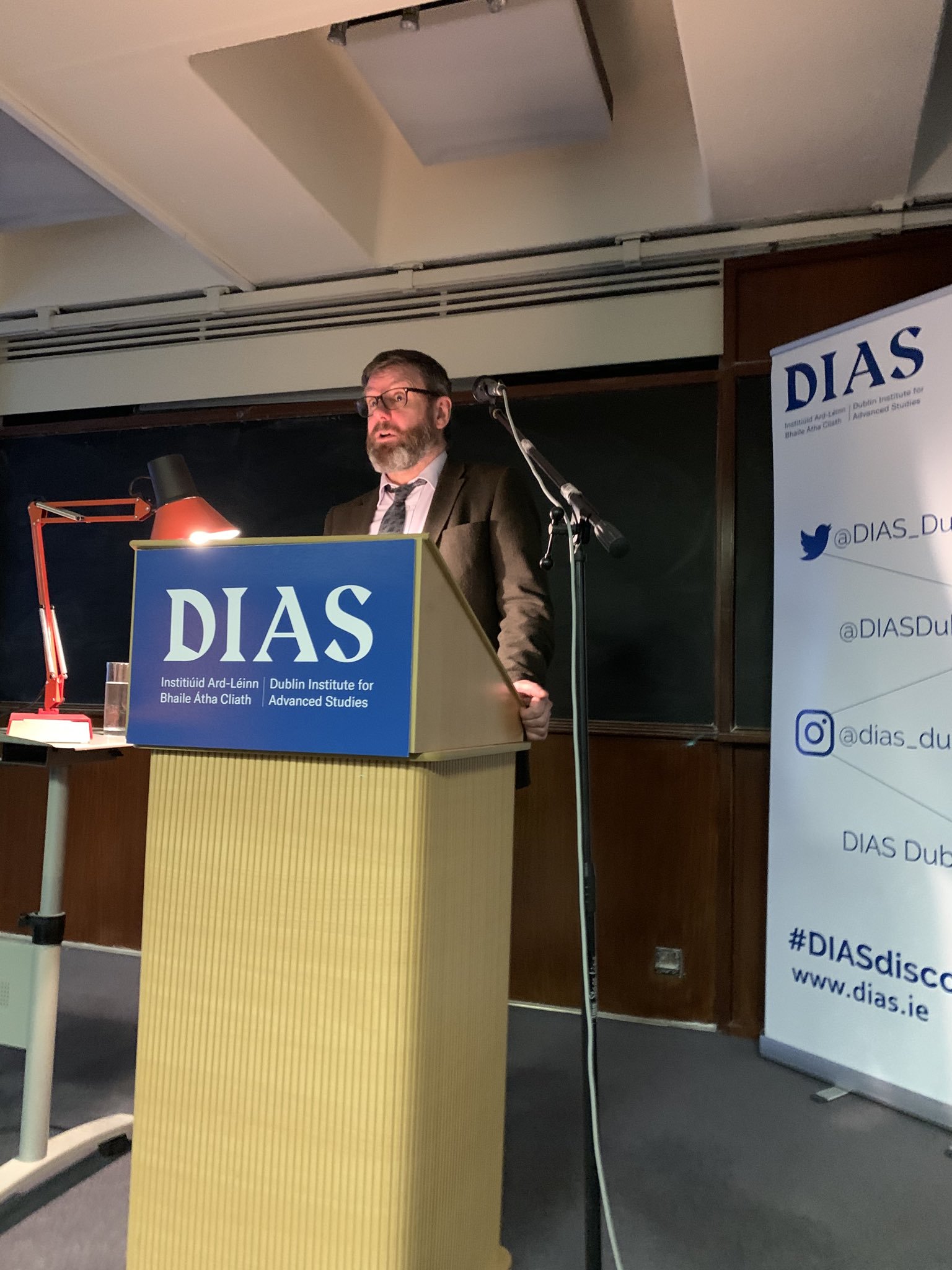
Yesterday evening found me at the Dublin Institute for Advanced Studies, complete with scary Hallowe’en beard, to give a talk.

Picture Credit: Prof. Luke Drury

It was a nice friendly audience and we had a lot of interesting discussions afterwards. As usual on such occasions I’ve put up the slides in case anyone wants to see them:

After the talk I headed back to Maynooth. It was a very rainy night, but at least some of the fireworks were going off despite the potential for damp squibs.

Halloween in the Dark Again

Posted in Biographical, Talks and Reviews with tags , on October 31, 2019 by telescoper

Although it’s still Study Week here in Maynooth I am back at work for the morning and then I’m attending a conferring ceremony this afternoon and later on I have to go into Dublin to give a talk at the Institute of Advanced Study. It’s Hallowe’en, of course, so no doubt there are quite a few weirdly dressed scary-looking people about, but one gets used to that working in a Physics Department. I just hope this evening’s talk isn’t an unintentionally horrible experience.

Anyway, it’s more than a decade since I posted my first blog about the real horror of Hallowe’en so, despite popular demand, I’ll take the excuse of a busy day to repeat it here.

–o–

We never had Hallowe’en when I was a kid. I mean it existed. People mentioned it. There were programmes on the telly. But we never celebrated it. At least not in my house, when I was a kid. It just wasn’t thought of as a big occasion. Or, worse, it was “American” (meaning that it was tacky, synthetic and commercialised). So there were no parties, no costumes, no horror masks, no pumpkins and definitely no trick-or-treat.

Having never done trick-or-treat myself I never acquired any knowledge of what it was about. I assumed “Trick or Treat?” was a rhetorical question or merely a greeting like “How do you do?”. My first direct experience of it didn’t happen until I was in my mid-thirties and had moved to a suburban house in Beeston, just outside Nottingham. I was sitting at home one October 31st, watching the TV and – probably, though I can’t remember for sure – drinking a glass of wine, when the front door bell rang. I didn’t really want to, but I got up and answered it.

When I opened the door, I saw in front of me two small girls in witches’ costumes. Behind them, near my front gate, was an adult guardian, presumably a parent, keeping a watchful eye on them.

“Trick or Treat?” the two girls shouted.

Trying my best to get into the spirit but not knowing what I was actually supposed to do, I answered “Great! I’d like a treat please”.

They stared at me as if I was mad, turned round and retreated towards their minder who was clearly making a mental note to avoid this house in future. Off they went and I, embarrassed at being exposed yet again as a social inadequate, retired to my house in shame.

Ever since then I’ve tried to ensure that I never again have to endure such Halloween horrors. Every October 31st, when night falls, I switch off the TV, radio and lights and sit soundlessly in the dark so the trick-or-treaters think there’s nobody at home.

That way I can be sure I won’t be made to feel uncomfortable.

The Royal Society really needs to work on its history of the telescope

Posted in History, The Universe and Stuff with tags , , , on October 30, 2019 by telescoper

An important corrective to frequently repeated fallacies about the history of telescopes in astronomy. The Royal Society really shouldn’t be making mistakes like this!

thonyc's avatarThe Renaissance Mathematicus

One would think that the Royal Society being one of the eldest, but not the eldest as they like to claim, scientific societies in Europe when presenting themselves as purveyors of the history of science, would take the trouble to get their facts right. If, however, one thought this, one would be wrong. Last week on the Internet the Royal Society was pushing a slide show, under their own name, on Google Arts and Culture on the history of the telescope in astronomy that in terms of historical accuracy is less than one, as a historian of science, nay of the telescope, might hope or indeed wish for.

The slide show in question is titled, Silent Harmony: astronomy at the Royal Society: Discover how innovation in telescopes and other optical instruments changed the way we see the universe. Following the title slide we have another general blurb slide…

View original post 835 more words