Back to Sunny Ireland

Posted in Biographical, Cardiff, Maynooth with tags , , , , , on April 22, 2019 by telescoper

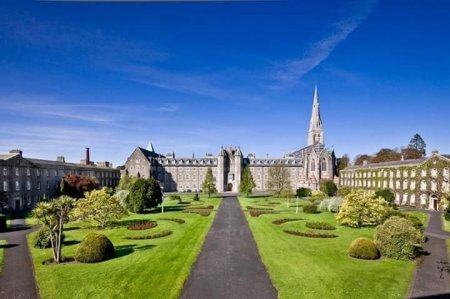
Well here I am, back in Maynooth, after a week’s restful leave in Cardiff. The weather here is just as nice as it was in Wales when I left yesterday: sunny and about 20 degrees. I’m enjoying the warm weather very much indeed, as my arthritis seems to have eased off considerably.

I was planning to return to Ireland today (Monday) but the flights were far cheaper yesterday. The plane I took yesterday (Sunday) less than half full. Incidentally, after their recent rescue and restructuring FlyBe have announced that after this summer they will no longer operate jets from Cardiff. Flights to Dublin will therefore be by their smaller Bombardier turboprops rather than the Embraer aircraft that I took yesterday.

Today is a Bank holiday in Ireland, as it is in the UK, but after that the Easter break is over; I’m officially back to work tomorrow. This semester will have been divided into three pieces, firstly by the half-term study week (around St Patrick’s Day) and now by a one-week Easter break. Last year these two breaks were contiguous, but Easter is quite late this year so they are separate this time.

Anyway, we now have three weeks of teaching left followed by the May examination period and, of course, the inevitable Marking of the Scripts.

The three remaining weeks include two Bank Holiday Mondays including today, Easter Monday, and the May Day Holiday on 6th May). I have lectures on Mondays I will miss two sessions, leaving only seven lectures remaining for Engineering Mathematics. I’d better make sure that in the short time remaining I cover everything that is in the examination!

Anyway, although it’s a holiday I’ve got to get my lecture together for tomorrow morning so I’d better get to work. It’s a shame not to be out and about in the sunshine but there you go. That is the price you pay for having a week off. No doubt there is a ton of emails to reply to as well; I’ve tried not to look at my inbox while I’ve been off. I’ve made that a rule for holidays now: put the out of office message on and leave the email alone!

The Book of Relegations

Posted in Football with tags , , , , , , , on April 21, 2019 by telescoper

At this time of year it seems appropriate to do a post, as the thoughts of good folk around the world turn to the important issue of the season … ie who will get relegated from the Premiership.

Yesterday evening’s win by Newcastle United over Southampton left the lower reaches of the table looking like this:

Huddersfield and Fulham having already been doomed, the only question is who will join them.

The bookies clearly think Cardiff City are odds-on to take the third relegation spot: the best odds I could get are 1/6 on them going down, implying only a probability of 14% or so survival. Brighton and Hove Albion are 9/2. Southampton are 150/1, Burnley 250/1 and Newcastle 750/1.

I’m not so sure the odds on Cardiff City are fair: they do play Liverpool later today but after that seem to have two winnable games (against Fulham and Crystal Palace). Brighton are three points ahead of Cardiff, but that’s away against Spurs and they’ll do well to get anything out of that fixture, and after that they have games against Newcastle United, Arsenal and Manchester City. Despite yesterday’s 0-0 draw against Wolves they don’t look like a team strong on form and confidence.In short I think that 9/2 is worth a bet.

Let me say that I don’t want to see either Brighton or Cardiff go down. I’ve got ties to both places. I’m just talking about what seems probable not what I think is desirable.

Southampton seem to have extremely long odds too, but they do seem to have a much easier run in than Brighton.

We’ll see. I’d expect these odds to change quite a bit if Cardiff beat Liverpool this afternoon. If they lose, however, then Newcastle are mathematically safe from relegation…

UPDATE: Cardiff City lost 2-0 at home to Liverpool this afternoon. The odds on them get relegated have shortened a bit (around 1/8 is as good as you can get) but there’s no great change in the odds, presumably because bookies did not really expect Cardiff to get any points from that game. Brighton have now moved to 13/2 against.

Cardiff City are now on 31 points with three games left. That means the maximum total they can reach is 40, so Newcastle United are safe from relegation.

The Second Coming

Posted in Poetry with tags , , , on April 19, 2019 by telescoper

Turning and turning in the widening gyre
The falcon cannot hear the falconer;
Things fall apart; the centre cannot hold;
Mere anarchy is loosed upon the world,
The blood-dimmed tide is loosed, and everywhere
The ceremony of innocence is drowned;
The best lack all conviction, while the worst
Are full of passionate intensity.

Surely some revelation is at hand;
Surely the Second Coming is at hand.
The Second Coming! Hardly are those words out
When a vast image out of Spiritus Mundi
Troubles my sight: somewhere in sands of the desert
A shape with lion body and the head of a man,
A gaze blank and pitiless as the sun,
Is moving its slow thighs, while all about it
Reel shadows of the indignant desert birds.
The darkness drops again; but now I know
That twenty centuries of stony sleep
Were vexed to nightmare by a rocking cradle,
And what rough beast, its hour come round at last,
Slouches towards Bethlehem to be born?

by William Butler Yeats (1865-1939): this poem was written in 1919.

On the Fellowship of Roy Kerr

Posted in The Universe and Stuff with tags , , , , , , , on April 18, 2019 by telescoper

Among the new Fellows of the Royal Society announced this week, I was astonished to see the name of Roy Kerr, the man who gave his name to the Kerr Metric an exact solution of Einstein’s equations of general relativity which describes the geometry of space-time around a rotating black hole.

When I say “astonished” I don’t mean that Kerr does not deserve this recognition. Far from it. I’m astonished because it has taken so long:the Kerr solution was published way back in 1963.

Anyway, better late than never, and heartiest congratulations to him!

While I’m on about Roy Kerr I’ll also say that I now think there is a very strong case for him to be awarded a Nobel Prize. The reasons are twofold.

One is that all the black hole binary systems whose coalescences produced gravitational waves detected by LIGO have involved Kerr black holes. Without Kerr’s work it would not have been possible to construct the template waveforms needed to extract signals from the LIGO data.

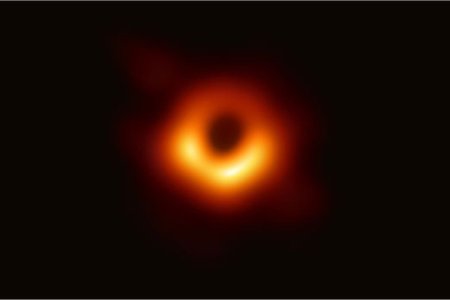
Second, and even more topically, the black hole in M87 recently imaged (above) by the Event Horizon Telescope is also described by the Kerr geometry. Without Kerr’s work the modelling of light paths around this object would not have been possible either.

The Multiverse – Andrew Wynn Owen

Posted in Poetry, The Universe and Stuff with tags , , on April 18, 2019 by telescoper

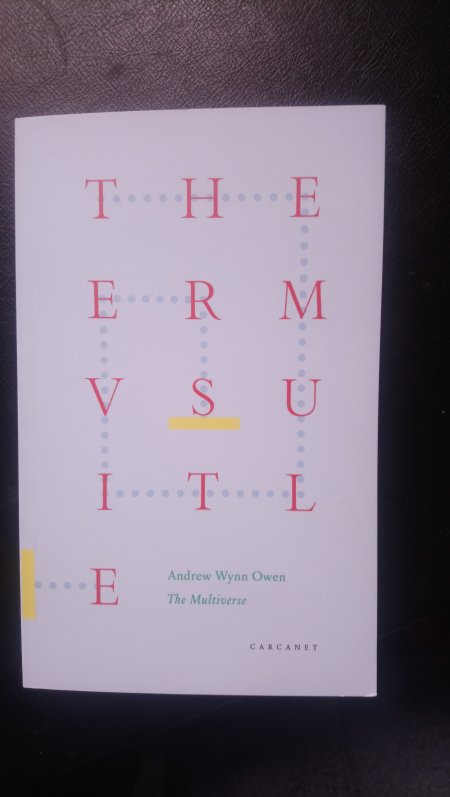
The Multiverse is Andrew Wynn Owen‘s first book of poems. It was published last year by Carcanet Press, but I only found out about it a week or two ago, from a review in a recent edition of the Times Literary Supplement. I had £10 in book tokens left over from a crossword prize so decided to spend them on this exuberant and diverse collection (which cost £9.99).

There are two particularly interesting things about this book. One is its thematic range, which is centred on science and philosophy but spreads out very widely across many fields. It’s actually not unusual for poets to be interested in science, though perhaps it is rather rarer for scientists to be interested in poetry…

The other particularly interesting aspect of these poems is their stylistic range. All of them are written in very precise forms, including the various types of sonnet, each with a strict metre but differing radically in structure from one to the other. As you might expect there are clear echoes of poetry from other eras, including nods in the direction of the metaphysical poets such as George Herbert.

You might infer from what I’ve said that these poems are merely imitative of other works, but that’s not the case. Although they are often very witty, these poems are not just parodies. I think the poet’s intention was to demonstrate how much can still be said that’s relevant to the modern world using established forms. I think he succeeds brilliantly, and he shows such mastery of so many different styles that it’s hard to believe this is a debut collection.

The title The Multiverse plays both on the aspects I described above, the scientific and philosophical themes, and the plurality of verse forms contained in this collection. As a physicist, though I’m not a proponent of the ‘scientific’ Multiverse, I recommend the poetic version very highly!

Nature Piece Plug

Posted in History, The Universe and Stuff with tags , , on April 17, 2019 by telescoper

Just a quick post to advertise that a short piece what I wrote is now published online on the journal Nature. It will appear in the print edition published tomorrow.

I think the title is fairly self-explanatory – it’s basically a triple book review, but with some additional scientific background thrown in.

Should you wish to do so, you can download a PDF version of the article here.

There’s a SharedIt link too.

Failing A-levels

Posted in Education with tags , , on April 17, 2019 by telescoper

As it is tangentially related to yesterday’s post I thought I’d comment on an article in The Times with the headline

University grades: firsts for quarter of students with lowest A levels

The piece (which you probably won’t read as it is behind a paywall) goes on to imply that the success at degree level of students who got poor A-levels results is the result of ‘grade inflation’.

My take on this is somewhat different. To me it just confirms what I’ve thought for years, namely that A-levels are virtually useless, either as a preparation for undergraduate study or as an indicator of academic potential. If they are are a guide to anything at all, it is to the quality of the school the student was lucky enough to attend.

It’s not only a shame that UK universities rely on A-levels so heavily for student recruitment but also a disgrace that institutions are punished in league tables whenever they take on students with low results. And if they do a good job educating such students to high levels of achievement they get attacked in churlish articles accusing them of lowering standards.

The assumption behind this is that there should be a near-perfect correlation between entry and exit qualifications. That is not the case at all, and why on earth should it be?

Look at this the other way round. Oxbridge only accepts students with the highest A-levels results, so why do these Universities not award more first-class degrees? Dare I suggest that perhaps not all the students they select have the aptitude their school qualifications suggest?

I noticed this the other day. It’s a list of skills needed for the job market in 2020.

Strangely, ‘rote learning’, ‘uncritical regurgitation of factoids’, and ‘ability to perform formulaic tasks’ are not on the list. They’re not much use as a preparation for university study either. So why does the UK school education system place such an emphasis on precisely these useless activities, to the exclusion of actually useful things?

Answers on a postcard please.

In Praise of Omnibus Science

Posted in Education, Maynooth with tags , , , on April 16, 2019 by telescoper

I’m taking a few days off at the moment so this morning I had a bit of time to catch up on various things. One news item I stumbled across points out that first-choice applications to study at Maynooth University are the highest ever. Within the overall increase of about 7% there is a growth of 17% in Science subjects, which is very good news for the Department of Theoretical Physics as well as the other Departments in the Faculty of Science and Engineering.

Anyway, this spurred me to comment on what I think is one of the strengths of Maynooth University: the Omnibus Science programme.

Currently, most students doing Science subjects here enter on the Omnibus programme, a four-year science course that involves doing four subjects in the first year, but becoming increasingly specialised thereafter. That’s not unlike the Natural Sciences course I did at Cambridge, except that students at Maynooth can do both Theoretical Physics and Experimental Physics in the first year as separate choices. Other possibilities include Chemistry, Computer Science, Biology, etc.

In Year 1 students do four subjects (one of which is Mathematics). That is narrowed down to three in Year 2 and two in Year 3. In their final year, students can stick with two subjects for a Joint Honours degree, or specialise in one, for Single Honours.

I like this programme because it does not force the students to choose a specialism before they have had a taste of the subject, and that it is flexible enough to accommodate Joint Honours qualifications in, e.g., Theoretical Physics and Mathematics. It also allows us to enrol students onto Physics degrees who have not done Physics as part of the Leaving Certificate.

I think it’s a strength that students take such a broad first year rather than locking themselves into one discipline from the start. Part of the reason is that I went to do my own degree at Cambridge expecting to end up specialising in Chemistry, but enjoyed the physics far more, eventually specialising in Theoretical Physics. I’m sure there were others who went the other way too!

One problem with the Omnibus Science programme is that the range of possible final qualifications is perhaps not as clearly advertised as it could be, so some clearer signposting would do no harm.

Our Lady of Paris

Posted in Architecture, History with tags , , , , on April 15, 2019 by telescoper

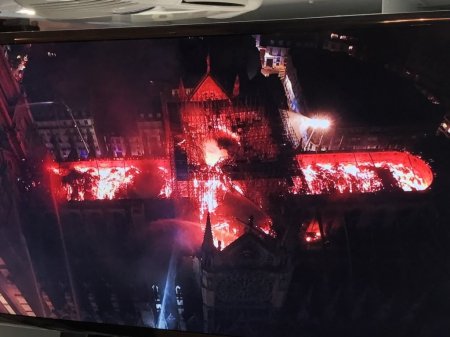
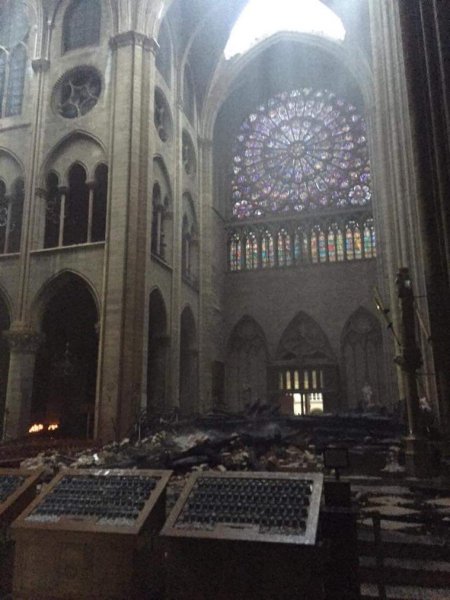
As I write, a catastrophic fire is raging in the Cathedral of Notre-Dame de Paris. Having started on the roof (or perhaps in a space underneath it), the flames spread rapidly through the mediaeval timbers of the building, bringing down the ceiling onto the nave, and causing the spire to collapse.

Restoration work on the roof started just four days ago and the area where the fire began was surrounded by scaffolding. Though nobody yet knows for sure what caused the fire, it seems likely to have been something to do with the ongoing repairs.

Watching the video streamed live from the scene with increasing horror, it seemed to me that the firemen were helpless to halt the advancing inferno. They just couldn’t get enough water onto the top of the huge structure quickly enough to contain the blaze. It was heartbreaking viewing. I fear very little will be left standing and most of the interior will have been completely destroyed, as this drone picture suggests:

At least there seem to have been no fatalities, although one brave fireman is reported to be seriously injured.

The loss of an iconic building like Notre Dame is shattering event for anyone who has been there, as I have on several occasions. Nobody who has seen the splendour of the 13th Century Rose Windows, for example, will ever forget the experience, so the destruction feels like losing a part of one’s own life. But above all it is a terrible loss for the people of Paris, as Notre Dame is the embodiment of so much of that beautiful and ancient city’s history.

Nobody put this better than Victor Hugo in Notre-Dame de Paris:

Notre Dame de Paris, in particular, is a curious specimen of this variety. Every surface, every stone of this venerable pile, is a page of the history not only of the country, but of science and of art. Thus—to mention here only a few of the chief details—whereas the small Porte Rouge almost touches the limits of fifteenth century Gothic delicacy, the pillars of the nave, by their massiveness and great girth, reach back to the Carlovingian Abbey of Saint-Germain-des-Prés. One would imagine that six centuries lay between that door and those pillars. Not even the Hermetics fail to find in the symbols of the grand doorway a satisfactory compendium of their science, of which the Church of Saint-Jacques-de-la-Boucherie was so complete a hieroglyph. Thus the Roman Abbey—the Church of the Mystics—Gothic art—Saxon art—the ponderous round pillar reminiscent of Gregory VII, the alchemistic symbolism by which Nicolas Flamel paved the way for Luther—papal unity—schism—Saint-Germain-des-Prés—Saint-Jacques-de-la-Boucherie—all are blended, combined, amalgamated in Notre Dame. This generative Mother-Church is, among the other ancient churches of Paris, a sort of Chimera: she has the head of one, the limbs of another, the body of a third—something of all.

I’m sure Parisians will be in a state of shock tonight and that will turn to something very close to grief. Mere words from me won’t help much, but let me in any case express my profound sadness and sympathy to my French friends and colleagues in Paris and around the world.

But if I know them at all, the French will soon set about the task of rebuilding, probably creating something majestic and extraordinary to replace what has been lost.

UPDATE: the morning after, it seems the fire was brought under control quickly enough to save the walls and towers, and at least one of the Rose Windows.

That this has been achieved owes everything to the courage and skill of the Pompiers, 500 of whom fought the blaze last night. Magnifique.

Grubb Parsons: the Irish Connection

Posted in History, The Universe and Stuff with tags , , , , , , , , on April 15, 2019 by telescoper

The other day I stumbled across an interesting article that discusses, among other things, the famous telescope and optical instrument manufacturing company, Grubb Parsons. The piece is a few years old but I didn’t see it when it came out. It’s well worth a read.

Grubb Parsons was still a famous company when I was at school, but it closed down in 1985. The main works were in Heaton, in Newcastle Upon Tyne, not far from where I was born; my father went to Heaton Grammar School.

Grubb Parsons made a huge number of extremely important astronomical telescopes, including the Isaac Newton Telescope, pictured above at the works in Heaton.

Interestingly, the names ‘Grubb’ and ‘Parsons’ both have strong Irish connections.

Howard Grubb was born in Dublin in 1844 and in 1864 he joined the optical instruments company set up there by his father Thomas Grubb. When his father died in 1878 Howard Grubb took over the Grubb Telescope Company and consolidated its reputation for manufacturing high quality optical components and devices. He was knighted in 1887.

Back in 1845 Thomas Grubb had helped build the famous ‘Leviathan‘ telescope for William Parsons, 3rd Earl of Rosse at Birr Castle in County Offaly.

Charles Algernon Parsons, who took over the Grubb Telescope Company after it was liquidated in 1925, and relocated it to Tyneside, was the youngest son of William Parsons ( just as Howard Grubb was the youngest son of Thomas). He no doubt kept the name Grubb in the company name because of its associated reputation.

Parsons had a wide range of business interests besides telescopes, mainly in the marine heavy engineering sector, especially steam turbines. When I was a lad, ‘C A Parsons & Company’ was still one of the biggest employers on Tyneside. It still exists but as part of Siemens and is a much smaller operation than in its heyday.

One final connection is that Sir Howard Grubb and Sir Charles Algernon Parsons both passed away in the same year, 1931.