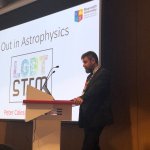
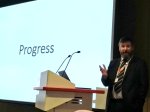
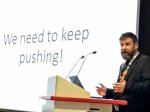
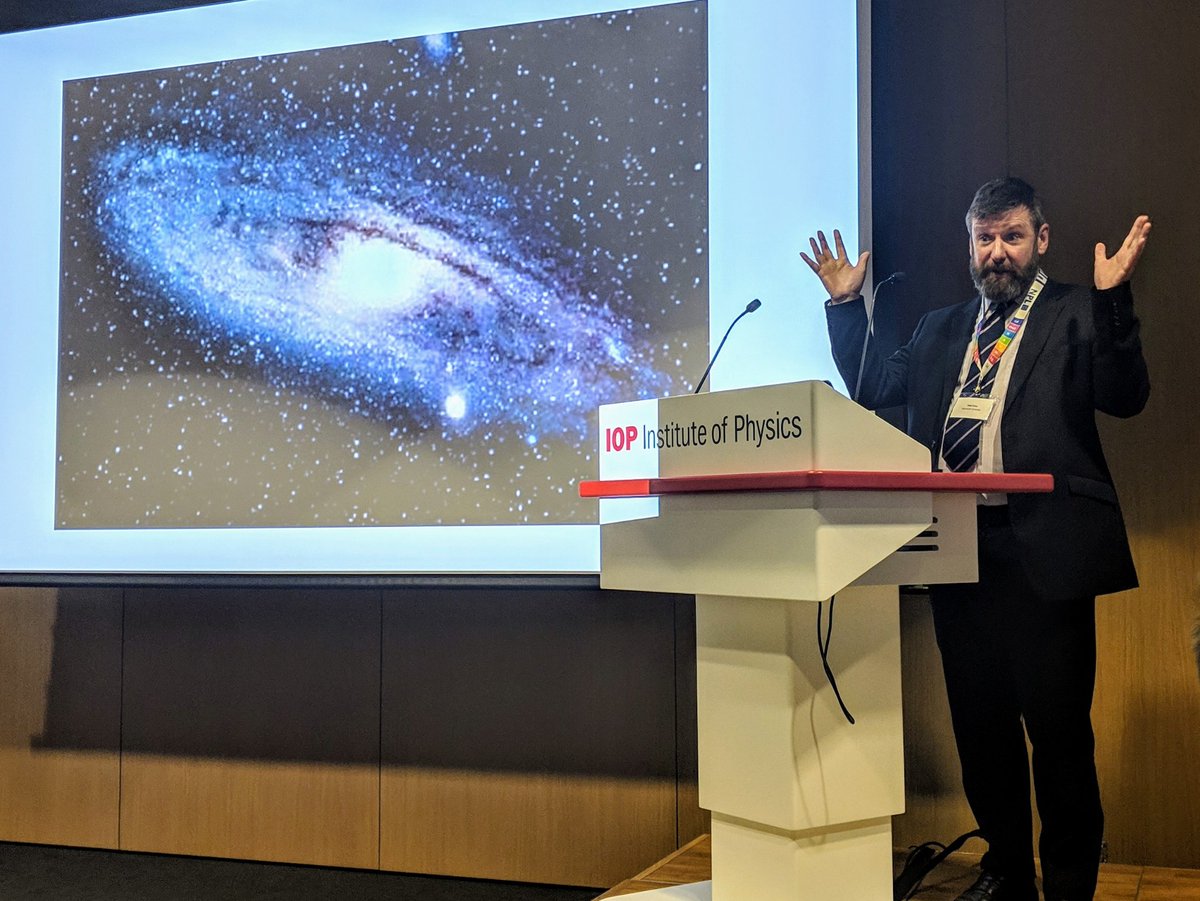
The official photographer at last week’s LGBT STEMinar took these pictures of me while I was delivering my keynote talk, and I thought you might find it amusing to see them. Actually quite a few of them could serve as subjects for a caption competition!
Follow @telescoperLGBT STEMinar Gallery
Posted in Biographical, LGBTQ+, The Universe and Stuff on January 17, 2019 by telescoperThe Best Men Can Be Unshaven
Posted in Beards, Biographical, Television with tags Gillette, Shaving, The Best Men Can Be on January 16, 2019 by telescoperThis advertisement by the Gillette company (purveyors of razors and other shaving products) has been causing a social media meltdown among the male snowflake fraternity:
It seems that the message conveyed in this short film – that men could do more to tackle bullying and harassment – is proving unpopular with certain men. I think it’s a reasonable inference that those men who feel the need to rant about this commercial actually think that they should be entitled by virtue of their gonads to engage in the kind of behaviour challenged therein and indeed threatened by any suggestion that they should not behave like prats. in my opinion the fact that there has been such a reaction demonstrates beyond any doubt how important the message is that toxic masculinity is a problem.
As a recent winner of Beard of the Year I feel it is important to point out that because I have a full beard, I never use Gillette (or any other shaving) products. My continuing not to use Gillette products should therefore not be interpreted as opposition to the message contained in this particular advertisement nor should my refusal to be upset by a commercial be interpreted as an endorsement of Gillette products. If, on the other hand, the Gillette company were to find it within their capacity to introduce a range of beard care products then, in return for receipt of an appropriately generous free supply of said products, I would be willing to advertise them on this site. Indeed, given the ever-increasing numbers of men preferring to be unshaven, it would seem to be a good idea from purely business grounds to diversify its range in order to cater for the hirsute market. I hope this clarifies the situation.
P.S. Another idea would be for Gillette to develop a range of toxic shaving products, specifically for those men who think toxic masculinity is just fine….
Follow @telescoperWhat are we going to do now?
Posted in Politics, Television with tags BrExit, Spike Milligan on January 16, 2019 by telescoperAfter another tumultuous day in British politics, this blog is once again proud to be able to show exclusive behind-the-scenes footage of the Cabinet discussions at Number 10 Downing Street:
Follow @telescoperMeaningful Betting
Posted in Biographical, mathematics, Politics with tags Betfair, Betting Exchange, BrExit, Meaningful Vote, Withdrawal Agreement on January 15, 2019 by telescoperI’ve now finished my first batch of marking (Astrophysics & Cosmology) and I now have a few days to do other things until the next (larger) set of scripts arrives from Vector Calculus and Fourier Series which takes place on Saturday.
Before going home I turned my attention to the news of tonight’s “Meaningful Vote” in the House of Common’s about whether or not to accept the Withdrawal Agreement negotiated between PM Theresa May and the European Union. The Government is widely expected to lose the vote but it’s not clear by what margin. Interested to see what the betting markets think I had a look just now at the Betfair exchange and found this, on the basic question of whether the vote will pass or not:
(You might want to click on the image to make it clearer.) You can find the live odds here.
You will see that this is quite an active market – with over €700K being wagered. Odds of greater than 40 to 1 against a `yes’ vote but most of the action is on `no’. Note that quite a few punters are laying on this outcome, with odds of about 25-1 on. (The way odds are shown in the second row is that 1.04 means you with 4p for every £1 staked).
Clearly, therefore, the markets think the vote will fail. What is less clear is how many MPs will vote in favour of the Government. Here is the corresponding Betfair market:
The shortest odds are for the first option, i.e. for 199 or fewer voting with the Government, but there is activity across the whole range of possibilities. The press are talking about a defeat by 225 votes, but for what it’s worth I don’t think it will be such a large margin. I’m not going to bet on it, but I expect it to be defeated by less than 150 votes.
UPDATE: Not for the first time I was wrong. The vote was Ayes 202 Noes 432, a majority of 230 against. That means there were no abstentions.
Follow @telescoperModified Gravity: Evidence from Cavendish Experiments?
Posted in The Universe and Stuff with tags Cavendish Experiments, Gravity, modified gravity, Modified Newtonian Dynamics, Newton's Gravitational Constant, Norbert Klein on January 15, 2019 by telescoperA paper by Norbert Klein caught my eye as I tried to catch up on my arXiv reading after a couple of days away last week. It’s called Evidence for Modified Newtonian Dynamics from Cavendish-type gravitational constant experiments and the abstract reads:
Recent experimental results for the gravitational constant G from Cavendish-type experiments were analysed in the framework of MOND (Modified Newtonian Dynamics). The basic assumption for the analysis is that MOND corrections apply only to the component of the gravitational field which leads to an accelerated motion of the pendulum body according to Newtons second law. The analysis is based on numerical solutions of the MOND corrected differential equation for a linear pendulum at small acceleration magnitudes of the order of Milgroms fundamental acceleration parameter a0 = 10-10m s-2 for the case of a mixed gravitational and electromagnetic pendulum restoring force. The results from the pendulum simulations were employed to fit experimental data from recent Cavendish-type experiments with reported discrepancies between G values determined by different measurement methods for a similar experimental setup, namely time of swing, angular acceleration feedback, electrostatic servo and static deflection methods. The analysis revealed that the reported discrepancies can be explained by MOND corrections with one single fit parameter. The MOND corrected results were found to be consistent with a value of G = 6.6742 x 10⁻¹¹ m3 kg-1 s-2 within a standard deviation of 14 ppm.
I have edited the abstract slightly for formatting and added the link to an explanation of MOND. You can find a PDF of the paper here.
I blogged about the discrepancies between different determinations of Newton’s Gravitational Constant G a few years ago here, where you can find this figure:

The claim that Modified Newtonian Dynamics can resolve these `discrepancies’ is very bold and I’m very skeptical of the arguments presented in this paper. It seems to me far more likely that the divergence in experimental measurements is due to systematics. If anyone else has different views, however, please feel free to share them through the comments box.
Follow @telescoperBernard Schutz wins the 2019 Eddington Medal
Posted in Cardiff, The Universe and Stuff with tags Bernard Schutz, gravitational waves, Hubble constant, Neutron Stars on January 14, 2019 by telescoperI wasn’t able to get to the Ordinary Meeting of the Royal Astronomical Society on Friday 11th January as I was otherwise engaged. In case you didn’t know, these meetings happen on the second Friday of every month and consist of short talks, longer set-piece prize lectures and Society business. The January meeting is when the annual awards are announced, so I missed the 2019 crop of medals and other prizes. When I got to the Athenaeum for dinner I was delighted to be informed that one of these – the prestigious Eddington Medal – had been awarded to my erstwhile Cardiff colleague Bernard Schutz (with whom I worked in the Data Innovation Research Institute and the School of Physics & Astronomy).
Here is a short video of the man himself talking about the work that led to this award:
The citation for Bernard’s award focuses on his invention of a method of measuring the Hubble constant using coalescing binary neutron stars. The idea was first published in September 1986 in a Letter to Nature. Here is the first paragraph:
I report here how gravitational wave observations can be used to determine the Hubble constant, H 0. The nearly monochromatic gravitational waves emitted by the decaying orbit of an ultra–compact, two–neutron–star binary system just before the stars coalesce are very likely to be detected by the kilometre–sized interferometric gravitational wave antennas now being designed1–4. The signal is easily identified and contains enough information to determine the absolute distance to the binary, independently of any assumptions about the masses of the stars. Ten events out to 100 Mpc may suffice to measure the Hubble constant to 3% accuracy.
In this paper, Bernard points out that a binary coalescence — such as the merger of two neutron stars — is a self calibrating `standard candle’, which means that it is possible to infer directly the distance without using the cosmic distance ladder. The key insight is that the rate at which the binary’s frequency changes is directly related to the amplitude of the gravitational waves it produces, i.e. how `loud’ the GW signal is. Just as the observed brightness of a star depends on both its intrinsic luminosity and how far away it is, the strength of the gravitational waves received at LIGO depends on both the intrinsic loudness of the source and how far away it is. By observing the waves with detectors like LIGO and Virgo, we can determine both the intrinsic loudness of the gravitational waves as well as their loudness at the Earth. This allows us to directly determine distance to the source.
It may have taken 31 years to get a measurement, but hopefully it won’t be long before there are enough detections to provide greater precision – and hopefully accuracy! – than the current methods can manage!
Congratulations to Bernard on his thoroughly well-deserved Eddington Medal!
Follow @telescoper
Out and Back
Posted in Biographical, LGBTQ+, Maynooth on January 13, 2019 by telescoper
So here I am, back home in Maynooth, after a very enjoyable day and a bit in London during which I learnt a huge amount and met so many lovely people. If only all science conferences were so much fun!
Incidentally, next year’s LGBT+ STEMinar will take place in Birmingham (2020), and the one after that in Oxford (2021). I’m told the first such event had about 40 participants but it’s now struggling to find big enough venues. The attendance at this year’s event was strictly limited by the capacity of the lecture room in the new IOP building. Hopefully the next will have a bigger theatre to enable even more people to come.
As well as being my first LGBT+ STEMinar this was also the first time I’ve ever flown on Aer Lingus. I was quite impressed, with flights in both directions being ahead of schedule. In fact I got back in such good time yesterday afternoon that I was able to get a much earlier bus than I had thought possible and found myself at home well before 7pm.
This trip gave me the chance for the first time to use the newer and swankier Terminal 2 in Dublin, which is a lot comfier than Terminal 1 (from which FlyBe and other budget airlines operate). It was Terminal 2 at Heathrow too, which is where I had awful problems with Eurowings earlier this year, but there were no problems this time. Both Dublin and Heathrow airports were very quiet. There is probably a post-Christmas lull in air travel at this time of year.
I did quite a lot of walking around London on Friday and Saturday, including walking to the Athenaeum from King’s Cross for the RAS Club. It’s hard to believe I lived in London for quite a long time (1990-98) as I am obviously a total stranger there now. I did however recognise the wonderfully cosmopolitan vibe as I walked through the West End towards Piccadilly. I was almost late for dinner as there were so many people about it was sometimes hard to make progress through the crowds. I’m also, of course, not as fast a walker as I used to be…
Anyway now that I’m back the main job for the next day or two is going to be marking examinations, no doubt preceded by numerous displacement activities..
Follow @telescoperLGBT+ STEMinar – Notes on my Keynote
Posted in Biographical, LGBTQ+, The Universe and Stuff with tags Institute of Physics, lgbt, LGBT+STEMinar, Section 28 on January 12, 2019 by telescoperI’m in a hotel near King’s Cross having had my Full English and with an hour or so before I have to check out and trek to Heathrow for my flight back to Dublin.
First things first. I promised a few people yesterday at the LGBT STEMinar that I would post the slides I used in my Keynote talk yesterday so here you go:
And here are a few pictures of me in action. I got all these from Twitter so apologize for not giving due credit to the photographers. My timeline was very crowded yesterday!
What I tried to do in the talk was to discuss the theme of progress over the last thirty years, both in my area of research (cosmology, specifically the large-scale structure of the Universe) and in the area of LGBT+ rights.
I started with my time as a graduate student at Sussex. One of the first things I did during `Freshers Week’ at when I started there was to join the GaySoc (as it was called) and I gradually became more involved in it as time went on. Over the five years I was at Sussex, `Gaysoc’ became `Lesbian and Gay Soc’ but a move to recognize bisexual people in the title was voted down, by quite a large margin. Inclusivity was (and still isn’t) a given even among marginalized groups. Biphobia and transphobia are still very much around.
Initially I kept my sexual orientation separate from my academic life and wasn’t really all that open in the Department in which I worked. My decision to change that was largely because of things going on in the outside world that convinced me that there was a need to stand up and be counted.
One of these was the AIDS `panic’ exacerbated by the Thatcher Government’s awful advertising campaign, an example of which you can see above. It was a very frightening time to be gay, not only because of the fear of contracting AIDS oneself but also because of the hostility that arose as a reaction to the `gay plague’. I’m convinced that this campaign led directly to a great deal of the violence that was inflicted on gay people during this time, including myself.
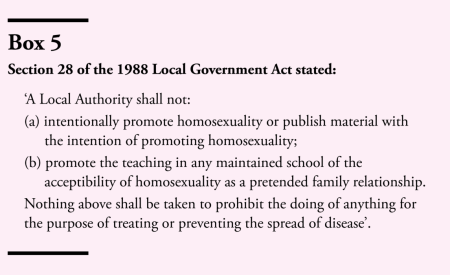
The second thing that made me want to come out was the Local Government Act (1988), which included the now infamous Section 28 (above). This was the subject of the first political demonstrations I ever attended. We failed to stop it becoming law, which was what we had wanted to do, but one positive that came out of this was that it did galvanize a lot of people into action, and the law was eventually repealed.
Anyway, I just got fed up of hearing people making ill-informed generalisations during this time. Rather than make a big public statement about being gay, I just resolved to not let such comments pass. I think it only took a few intercessions in the tea room or Falmer Bar for it to become widely known in the Department that I was gay. That was how I came out in astrophysics, and thereafter almost everyone just seemed to know.
So that was the eighties. If somebody had told me then that in thirty years the United Kingdom would have legalized same-sex marriage I would just have laughed. That wasn’t even really being discussed by the LGBT+ community then.
Anyway, back to the talk. What I then tried to do – actually for most of the presentation – was to outline the progress that has been made over the last thirty years in cosmology. When I started in 1985 there was hardly any data. There were some small redshift surveys of the order of a thousand galaxies, but my thesis was supposed to be about the pattern of fluctuations in the cosmic microwave background and there were no relevant measurements back then. I had to rely on simulations, as I mentioned here a few days ago.
Over the years there has been tremendous progress, especially with the accumulation of data enabled by improvements in observational technology. Theory has moved on to the extent that we now have a standard model of cosmology that accounts for most of this data (at least in a broad-brush sense) with just six free parameters. That’s a great success.
This rapid progress has led some to suggest that cosmology is now basically over in the sense that we have done virtually everything that we’ll ever do. I disagree with this entirely. The standard model contains a number of assumptions (general relativity, cold dark matter, a cosmological constant, and so on) all of which should be questioned. In science every answer leads to new questions and all progress to new challenges. If we ever rest on our laurels the field will stagnate and die. Success should never lead to complacency.
So then in the talk I returned to LGBT+ rights. Some (straight) people have said to me that now that we have equal marriage then it’s basically all done, isn’t it? There’s now no discrimination. You can stop talking about LGBT+ matters and `just be a scientist’.
That, I’m afraid, is bollocks. We have equal marriage but, though welcome, by no means represents some sort of utopia. Society is still basically a patriarchy, configured in a way that is profoundly unfair to many groups of people, so there are still many challenges to be fought. Unless we keep pushing for a truly inclusive society there is a real danger that the rights we have won could easily be rolled back. This is no more over than cosmology is over. In fact, you could really say that it’s really just the start.
Follow @telescoperThe 2019 LGBT+STEMinar
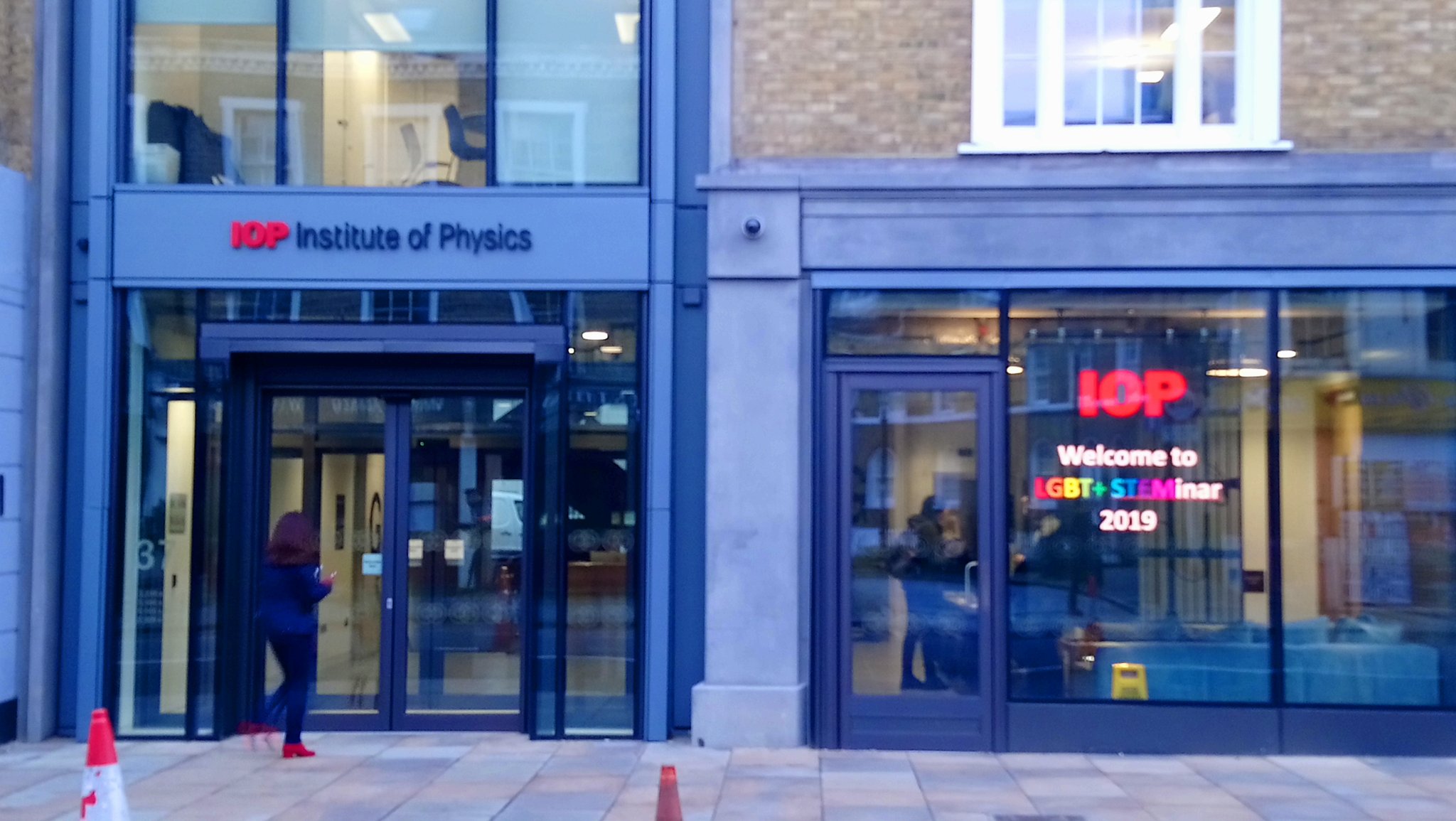
Posted in Biographical, LGBTQ+, The Universe and Stuff with tags Institute of Physics, LGBT+STEMinar on January 11, 2019 by telescoperI’m just back in my hotel after an evening at the Royal Astronomical Society Club Dinner which I went to straight from today’s LGBT+STEMinar at the very nice new Institute of Physics building on Caledonian Road near King’s Cross. This is what it looked like when I arrived this morning:
I enjoyed the LGBT+ STEMinar very much indeed. There was a huge range of talks by a wonderfully diverse crowd of speakers, on topics ranging from nuclear waste, parasites in wood mice, glaciology, quantum optics, the evolution of island finches, bacterial pathogenesis, gamma-ray bursts and machine learning in astrophysics.
I particular enjoyed the talk by Niamh Kavanagh from the Tyndall Institute in Cork who handed out home-made filters to give herself a rainbow effect:
I was delighted and relieved that my keynote talk and the end of the day seemed to go down quite well, at least judging by the comments I found in my Twitter feed just now. Here’s a picture I found there!
I’ll post the slides from my talk and perhaps a few other comments about it tomorrow, after I’ve had a good night’s sleep. But I won’t delay in thanking the organisers, especially Angela Townsend, for making this such a special day.
Follow @telescoperReflections on the Examination Period
Posted in Biographical, Education, Maynooth with tags Examinations, The Prelude, William Wordsworth on January 10, 2019 by telescoperTomorrow (11th January) is the start of our mid-year examination period here at Maynooth University. It’s therefore a good opportunity to send a hearty “good luck” message to all students about to take examinations, especially those who are further on in their courses for whom these papers have greater importance. In particular I’d like to send my best wishes to students on my fourth-year module on Astrology Astrophysics and Cosmetics Cosmology, whose paper is at 9.30 tomorrow morning.
I’m a bit too busy for anything particularly profound today, as I’m off to the airport after lunch to get a flight to London for an event at the IOP tomorrow, so I thought I’d just rehash an excerpt from something I posted a while ago on the subject of examinations.
My feelings about examinations agree pretty much with William Wordsworth, who studied at the same University as me, as expressed in this quotation from The Prelude:
Of College labours, of the Lecturer’s room
All studded round, as thick as chairs could stand,
With loyal students, faithful to their books,
Half-and-half idlers, hardy recusants,
And honest dunces–of important days,
Examinations, when the man was weighed
As in a balance! of excessive hopes,
Tremblings withal and commendable fears,
Small jealousies, and triumphs good or bad–
Let others that know more speak as they know.
Such glory was but little sought by me,
And little won.
It seems to me a great a pity that our system of education – both at School and University – places such a great emphasis on examination and assessment to the detriment of real learning. In particular, the biggest problem with physics education in many institutions is the way modular degrees have been implemented.
I’m not at all opposed to modularization in principle. I just think the way we teach modules often fails to develop any understanding of the interconnection between different aspects of the subject. That’s an educational disaster because what is most exciting and compelling about physics is its essential unity. Splitting it into little boxes, taught on their own with no relationship to the other boxes, provides us with no scope to nurture the kind of lateral thinking that is key to the way physicists attempt to solve problems. The small size of each module makes the syllabus very “bitty” and fragmented. No sooner have you started to explore something at a proper level than the module is over. More advanced modules, following perhaps the following year, have to recap a large fraction of the earlier modules so there isn’t time to go as deep as one would like even over the whole curriculum.
Students in Maynooth take 60 “credits” in a year, split into two semesters. These are usually split into 5-credit modules with an examination at the end of each semester. Projects, and other continuously-assessed work do not involve a written examination, but the system means that a typical student will have at least 5 written examination papers in January and at least another 5 in May. Each paper is usually of two hours’ duration.
Incidentally, one big difference between our examinations in Theoretical Physics in Maynooth and those at other institutions I’ve taught at in the UK is that the papers offer no choice of questions to be answered. A typical format for a two-hour paper is that there are two long questions (broken up into bits), each of which counts for 50 marks. Elsewhere one normally finds students have a choice of two or three questions from four. The advantage of our system is that it makes it much harder for students to question-spot in the hope that they can get a good grade by only revising a fraction of the syllabus.
But I digress.
One consequence of the way modularization has been implemented throughout the sector is that the ratio of assessment to education has risen sharply over the last decades with a negative effect on real understanding. The system encourages students to think of modules as little bite-sized bits of education to be consumed and then forgotten. Instead of learning to rely on their brains to solve problems, students tend to approach learning by memorizing chunks of their notes and regurgitating them in the exam. I find it very sad when students ask me what derivations they should memorize to prepare for examinations. A brain is so much more than a memory device. What we should be doing is giving students the confidence to think for themselves and use their intellect to its full potential rather than encouraging rote learning.
You can contrast this diet of examinations with the regime when I was an undergraduate. My entire degree result was based on six three-hour written examinations taken at the end of my final year, rather than something like 30 examinations taken over 3 years. Moreover, my finals were all in a three-day period: morning and afternoon exams for three consecutive days is an ordeal I wouldn’t wish on anyone, so I’m not saying the old days were better, but I do think we’ve gone far too far to the opposite extreme. The one good thing about the system I went through was that there was no possibility of passing examinations on memory alone. Since they were so close together there was no way of mugging up anything in between them. I only got through by figuring things out in the exam room.
I don’t want to denigrate the achievements of students who are successful under the current system. What I’m saying is that I don’t think the education we provide does justice to their talents. That’s our fault, not theirs…
Follow @telescoper