With Strings Attached?

Posted in Biographical, The Universe and Stuff with tags , on May 6, 2019 by telescoper

Image Credit: Flickr user Trailfan.

I was flicking through various posts on the interwebs this morning while I was having my breakfast and came across one that nearly made me choke on my muesli. What it’s like to be a theoretical physicist is a piece in Stanford University news. In it I found the following quote:

String theory feels like a little superpower that I have, this physical intuition that enables me to make connections and have insights into things that by rights I should not be able to say anything interesting about.

I’ve tried many times to read that in a way that doesn’t come across as arrogant, but I’m afraid I’ve failed – especially because (speaking as a physicist) I don’t think string theory has so far given us any profound insights into physics at all.

Now I’m mindful of the fact that many mathematicians think string theory is great. I’ve had it pointed out to me that it has a really big influence on for example geometry, especially non-commutative geometry, and even some number theory research in the past 30 years. It has even inspired work that has led to Fields medals. That’s all very well and good, but it’s not physics. It’s mathematics.

Of course physicists have long relied on mathematics for the formulation of theoretical ideas. Riemannian geometry was `just’ mathematics before its ideas began to be used in the formulation of the general theory of relativity, a theory that has since been subjected to numerous experimental tests. It may be the case that string theory will at some point provide us with predictions that enable it to be tested in the way that general relativity did. But it hasn’t done that yet and until it does it is not a scientifically valid physical theory.

I remember a quote from Alfred North Whitehead that I put in my PhD DPhil thesis many years ago. I wasn’t thinking of string theory at the time, but it seems relevant:

There is no more common error that to assume that, because prolonged and accurate mathematical calculations have been made, the application of the result to some fact of nature is absolutely certain.

My problem is not with string theory itself but with the fact that so many string theorists have become so attached to it that it has become a universe in its own right, with very little to do with the natural universe which is – or at least used to be – the subject of theoretical physics. I find it quite alarming, actually, that in the world outside academia you will find many people who think theoretical physics and string theory are more-or-less synonymous.

The most disturbing manifestation of this tendency is the lack of interest shown by some exponents of string theory in the issue of whether or not it is testable. By this I don’t mean whether we have the technology at the moment to test it (which we clearly don’t). Many predictions of the standard model of particle physics had to wait decades before accelerators got big enough to reach the required energies. The question is whether string theory can be testable in principle, and surely this is something any physicist worthy of the name should consider to be of fundamental importance?

P.S. This rant reminded me of the time I got severely told off by a very senior British physicist (who shall remain nameless) when I was quoted in Physics World as saying that I thought that in a hundred years time string theory would be of more interest to sociologists than physicists…

Maynooth University Library Cat Update

Posted in Maynooth with tags on May 5, 2019 by telescoper

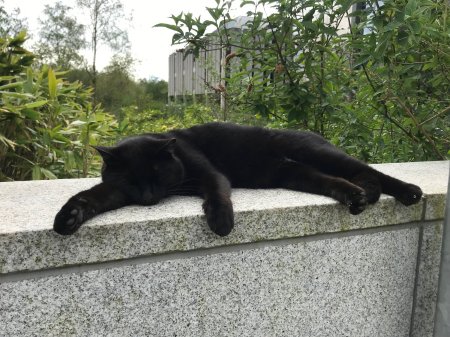
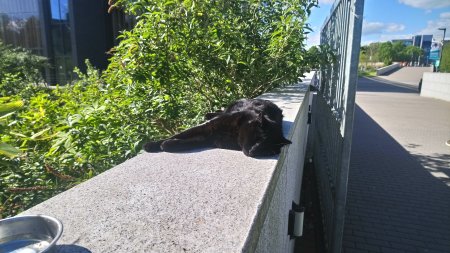
This Bank Holiday Weekend Maynooth University Library Cat is mainly operating in horizontal mode. I don’t blame him. Life must be exhausting for a feline celebrity.

The Astronomer and The Hat

Posted in Television with tags , , , , on May 4, 2019 by telescoper

There’s been a lot of activity recently on social media, and perhaps even between real people, relating to Game of Thrones (which is, apparently, a television fantasy drama series of some sort). I don’t have a television at home so I haven’t seen any of this series at all. I do have a laptop with a DVD player so I suppose I could watch it that way but I suspect I’d find it rather childish. Being more interested in serious programmes I have instead in recent evenings been watching a selection of episodes from my complete boxed set of Ivor the Engine, a gritty documentary series about life on and around the Merioneth and Llantisilly Railway Traction Company Limited, which operates in the `top left-hand corner of Wales’.

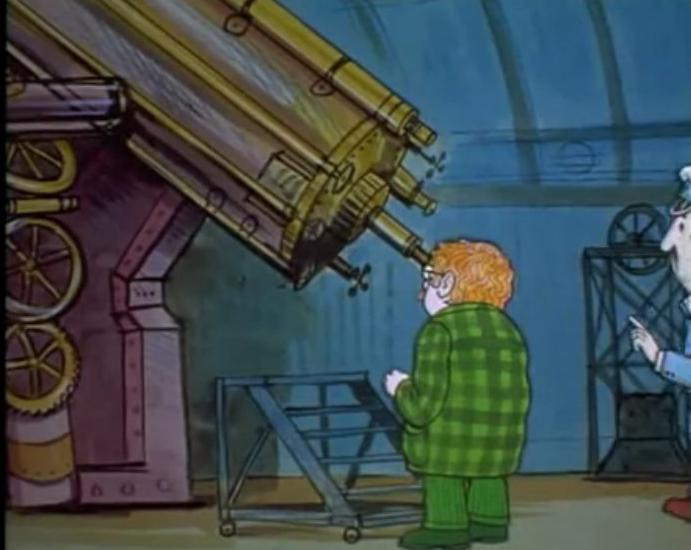
Not many people seem to know that there is an astronomical connection with Ivor the Engine, seen above in the form of Professor D. Longfellow. He lives in Observatory Villa, Llaniog, has his own personal telescope and is sometimes consulted for answers to various problems. He thus provides an excellent illustration of the wider impact of astronomy in everyday life. In the screen grab above he is being interrupted by Dai Station who needs to know the location of the nearest volcano as he has found some dragon eggs that need to be kept warm.

Professor Longfellow makes an extended appearance in the following Episode, entitled The Hat, the central character of which is Mrs Porty, who is rich – so rich, in fact, that she has new hats sent to her all the way from London. At the risk of upsetting people with a plot spoiler, Mrs Porty goes around with a telescope cover on her head because she collected the wrong box from the railway station thinking it was a new hat.

P.S. If anyone knows where I can buy an outfit like Professor Longfellow’s please let me know. I feel I could
advance my career in astronomy even further if I wore more appropriate clothing.

Local Election News

Posted in Maynooth, Politics with tags , , , on May 3, 2019 by telescoper

As results come in from the local elections held in the Disunited Kingdom yesterday, I see that the results have been so bad for the Conservative Party that one Tory MP has been reduced to tears. You’d have to have a heart of stone not to burst out laughing. It’s also rather hilarious to see various factions (including the BBC news) spin the big gains of the Liberal Democrats as a message to `get on with Brexit’, but at the same time it’s also sad to see a country so gripped by madness that it is reduced to such a state.

UPDATE: With 218 out of 248 English Councils having been counted, the Conservative Party has lost an impressive 1072 councillors, but not to Labour who have lost 110. The big winners are the Liberal Democrats (+582), the Greens (+152) and Independents (+505). UKIP are also down by 99 to just 29 councillors. Both Labour and Tories are still claiming that this sends a message to get on with Brexit. Bizarre. I wonder what they think a message to stop Brexit would look like?

Anyway there were no local elections in Wales yesterday so I didn’t vote. I am still eligible to do so, of course, as I pay Council Tax on my house in Cardiff. I would have had a tricky problem deciding what to do if I had. As a lifelong Labour voter (and member until recently) I can no longer support them because of their `policy’ on Brexit, so probably would have voted for Plaid Cymru. That’s who I would vote for in the European Parliament elections.

I am eligible to vote in both the United Kingdom (Wales) and Ireland for the forthcoming European Parliament elections (assuming they go ahead), but one is supposed to vote in one or the other rather than both so I’ve decided to vote here as this is the country in which I am `normally resident’. The European Parliament elections take place here in Ireland on Friday 24th May (three weeks from today) at the same time as the local council elections here.

Kildare County Council will have 40 councillors of which five are elected in Maynooth. For the purpose of the European Parliament elections, Ireland is divided into three multi-member constituencies: Dublin, Ireland South and Midlands North-West. Maynooth is in the last of these, which stretches from Kildare across to Galway and up to Donegal. It will elect four MEPs. The same voting method is used in both elections: the single transferable vote.

(The UK has multi-member constituencies for the European Parliament elections too, but uses the D’Hondt system in which one votes for a party list rather than an individual.)

I’m a relative newcomer to Irish politics, and am yet to decide who to vote for in these elections. I certainly won’t vote for either of the two leading neoliberal/conservative parties, Fine Gael or Fianna Fáil. Sinn Féin will probably be top of my list of preferences in both ballots. On the other extreme, tax-dodger, racist gobshite and failed Presidential candidate Peter Casey is sure to be bottom of my list for the MEP elections: he’s unfit for any kind of public office, in my opinion.

Apart from the different voting system(s) and dates, there is another noticeable difference between the UK and Ireland at election time:

Posters like this pop up everywhere on lampposts during election (and referendum) campaigns in Ireland, as opposed to the larger billboard-type posters that seem to be favoured in Britain. At least these show you what your candidates look like, which is not the case if you vote for a party list. Such posters are specifically permitted by law but most be taken down within a certain time after the election, otherwise the party responsible is fined.

Blog Feedback Questionnaire

Posted in Education with tags , on May 2, 2019 by telescoper

It’s that time of year – near the end of teaching term – when we start to get feedback on our lecturing from students in the form of completed module questionnaires. I always get very nervous when these evaluation questionnaires come back, especially when they’re for a module I’m doing for the first time. I do work quite hard on my teaching and I do care about it a lot, but that’s not enough to guarantee that the students respond positively.

This time I’m not only relieved but delighted with the returns from my Engineering Maths returns. The students have been very kind – and some of the write-in comments are actually rather lovely. Of course there are criticisms too but it’s all useful feedback, so I’m grateful for the students who bothered to fill them in and especially to those who wrote detailed textual comments.

Anyway, in the light of the students’ response to the quality of my lecturing I thought I’d try to gather similar feedback on the quality of my blogging. Please complete the following survey. Textual comments may be provided in the form of textual comments through the textual comment box below.

Bealtaine and a Vicennial

Posted in Biographical, Music with tags , , , on May 1, 2019 by telescoper

This morning I found that today is called Beltane (Lá Bealtaine in Irish) an old Celtic festival that marks the mid-point between the Spring Equinox and the Summer Solstice. According to my calculations that should be May 6th, but that’s close enough I suppose. Anyway, let me offer a hearty `Lá Bealtaine sona daoibh‘!

Today is also the twentieth anniversary of the first broadcast by RTE Lyric FM which first went on air on May 1st 1999. Since I moved to Ireland in 2017 I’ve been a regular listener to Lyric FM in the mornings and evenings. I particularly enjoy the eclectic mix of music played by John Kelly on Mystery Train followed by Bernard Clarke on The Blue of the Night during the week. Both are very knowledgeable presenters who are happy to play rare and unusual music and to respond to inquiries about the music played. Bernard Clarke has even played a couple of requests of mine, both of them jazz records. During the late evenings at the weekend I listen to Ellen Cranitch whose show Vespertine is `a night-time voyage, crossing time and space to share a selection of classical, jazz, roots and contemporary music’. You never quite know what’s coming up next on any of these programmes.

Anyway, there’s a big gala concert happening tonight at the National Concert Hall in Dublin by way of a vicennial celebration. I didn’t get my act together to buy a ticket, but I’ll be listening on my wireless at home. Possibly with a glass or several of wine.

When Lyric FM was launched on 1st May 1999 I had recently moved out of London to Nottingham where I had my first Professorship. Since then I moved to Cardiff, then to Sussex, back to Cardiff, and then to Maynooth. I bet quite a lot has happened to the radio station too!

The Great Science Publishing Scandal

Posted in Open Access with tags , , , , on May 1, 2019 by telescoper

There was a programme broadcast on BBC Radio 4 yesterday called The Great Science Publishing Scandal. It is now available on the interwebs here, which is how I listened to it this morning.

Here’s the blurb that goes with the programme:

Matthew Cobb, Professor of Zoology at the University of Manchester, explores the hidden world of prestige, profits and piracy that lurks behind scientific journals.

Each year, hundreds of thousands of articles on the findings on research are published, forming the official record of science. This has been going on since the 17th century, but recently a kind of war has broken out over the cost of journals to the universities and research institutions where scientists work, and to anyone else who wants to access the research, such as policy makers, patient support groups and the general public.

Traditionally journals charge their readers a subscription, but since the start of the 21st century there’s been a move to what’s called open access, where the authors pay to get their articles published but anyone can read them, without charge. In Europe Plan S has called for all research funded by the public purse to be open access, by 2020. If and when this is implemented it could have downsides on learned societies who depend on income from journal subscriptions to support young researchers and on scientists in the less developed world.

Some universities, and even countries, have recently refused to pay the subscriptions charged by some of the big science publishers. This has lead to some scientists using a service run by a Russian hacker, which has effectively stolen the whole of the scientific literature and gives it away, free, on the internet.

Matthew Cobb looks back at how the scientific publishing industry got to its current state and asks how it could change. He argues that scientists themselves need to break their addiction to wanting their articles to appear in a few well known journals, and instead concentrate on the quality of their research.

I think this programme is well worth listening to as it makes many of the right criticisms of the status quo. I did, however, find it very frustrating in that it doesn’t really even touch on any of the viable alternative ways of disseminating peer-reviewed scientific research. I didn’t expect a mention for the Open Journal of Astrophysics specifically, but this is one model that at least tries to challenge the status quo. I’m assuming that at least part of the reason for this is the presenter Matthew Cobb works in Zoology, and that is a field that perhaps does not have the established practice of sharing papers via repositories that we have in physics and astronomy via the arXiv. Anyway, it felt to me like he missed an open goal…

Flamenco Sketches for International Jazz Day

Posted in Jazz with tags , , , , , on April 30, 2019 by telescoper

I discovered only this morning that today, April 30, is International Jazz Day 2019 so I thought I’d post a track to mark the occasion. This is from the all-time classic album Kind of Blue featuring the Miles Davis Sextet and it was recorded on April 22, 1959 – just over 60 years ago! This album appears very frequently in lists of top jazz records, but it’s so good I don’t think there’s any risk of getting bored with it no matter how often you hear it.

Flamenco Sketches involves a series of solos each improvised on a set of five scales; it’s the fourth section that hints at the Spanish influence alluded to in the title. The tempo is very slow, which contributes the air of solemnity as does the absolute perfection of the solos. In that respect it has clear parallels with some of Duke Ellington’s work. Miles Davis, who opens and closes the track on muted trumpet, and Bill Evans on piano are absolutely faultless but I particularly enjoy John Coltrane’s playing on tenor saxophone: his tone is as bleak and austere as an Arctic sunrise, and just as wonderful and he conjures up an absolutely beautiful improvised melody. Other members of the band are Cannonball Adderley (as), Paul Chambers (b) and Jimmy Cobb (d).

Enjoy! And a Happy International Jazz Day to you all!

Job in Theoretical Physics at Maynooth!

Posted in Maynooth with tags , on April 30, 2019 by telescoper

Just a short post passing on the information that we have a fixed-term job available in the Department of Theoretical Physics at Maynooth University. You can find the details here.

The position is for 5 months, starting in September 2019, and it to basically to provide teaching cover for Dr Jonivar Skullerud who will be on sabbatical for a Semester. I know it is a short appointment, but it seems to me that it would provide a good opportunity for an early-career academic, perhaps someone straight out of a PhD, to gain some teaching experience.

The deadline for applications is 23.30 on Sunday May 26th, i.e. about 4 weeks away, and you should apply through the jobs portal here.

If you’d like to know any more please feel free to contact me privately.

Oh, and please feel free to pass this on to anyone who may be interested!

Redshift and Distance in Cosmology

Posted in The Universe and Stuff with tags , , , , , on April 29, 2019 by telescoper

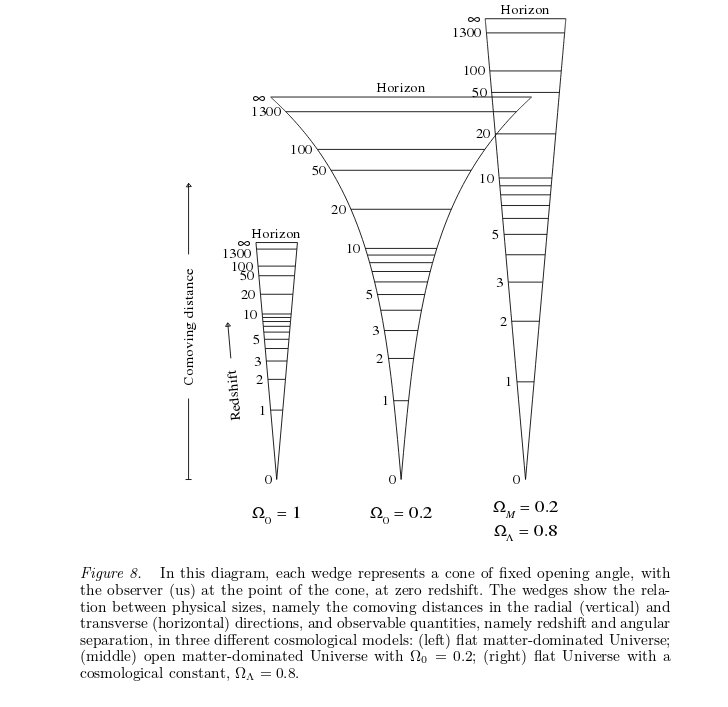
I was looking for a copy of this this picture this morning and when I found it I thought I’d share it here. It was made by Andy Hamilton and appears in this paper. I used it (with permission) in the textbook I wrote with Francesco Lucchin which was published in 2003.

I think this is a nice simple illustration of the effect of the density parameter Ω and the cosmological constant Λ on the relationship between redshift and (comoving) distance in the standard cosmological models based on the Friedman Equations.

On the left there is the old standard model (from when I was a lad) in which space is Euclidean and there is a critical density of matter; this is called the Einstein de Sitter model in which Λ=0. On the right you can see something much closer to the current standard model of cosmology, with a lower density of matter but with the addition of a cosmological constant. Notice that in the latter case the distance to an object at a given redshift is far larger than in the former. This is, for example, why supernovae at high redshift look much fainter in the latter model than in the former, and why these measurements are so sensitive to the presence of a cosmological constant.

In the middle there is a model with no cosmological constant but a low density of matter; this is an open Universe. Because it decelerates much more slowly than in the Einstein de Sitter model, the distance out to a given redshift is larger (but not quite as large as the case on the right, which is an accelerating model), but the main property of interest in the open model is that the space is not Euclidean, but curved. The effect of this is that an object of fixed physical size at a given redshift subtends a much smaller angle than in the cases either side. That shows why observations of the pattern of variations in the temperature of the cosmic microwave background across the sky yield so much information about the spatial geometry.

It’s a very instructive picture, I think!