Glamorgan v Northants: Day 3

Posted in Cardiff, Cricket with tags , , , on June 27, 2018 by telescoper

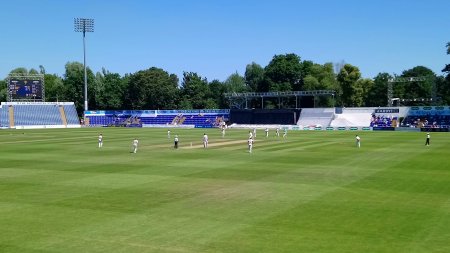
For the record, I thought I’d post a short update on today’s play at Sophia Gardens.

I only attended the morning session today. I forgot to take my phone so there’s no picture. It was a good morning’s play actually, with Glamorgan’s bowlers doing better. The huge opening partnership of 208 was eventually broken when Procter fell, soon followed by Duckett. How often it happens that both batsmen involved in a big stand get out in quick succession. Another three wickets fell for the addition of 90 runs. However at 259 for 5, with the Northants lead at 289, at lunch I reckoned the game was already beyond Glamorgan, and instead of returning to the ground after lunch I took a stroll around sunny Bute Park and went into the Data Innovation Research Institute office to attend to a few things.

Northamptonshire progressed to a total of 406 and declared when their 9th wicket fell. Tea was taken at that point. In the last session, Glamorgan slumped to 121 for 4, the first innings hero Khawaja among the fallen.

Glamorgan need to score 313 tomorrow to win. More relevantly, Northants need to take 6 wickets. I wouldn’t bet against the game finishing before lunch, actually.

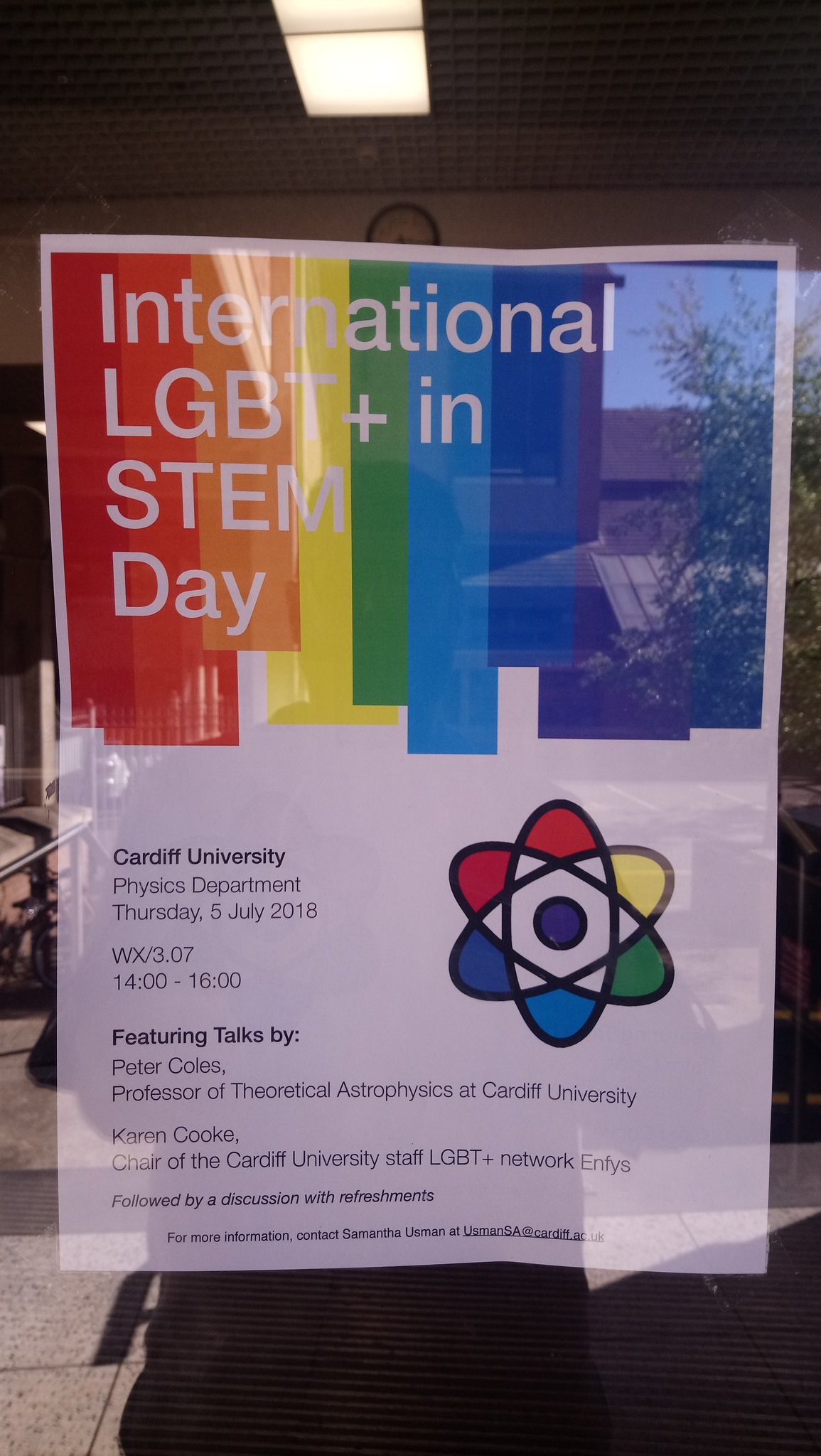
International LGBT+ in STEM Day

Posted in Cardiff, LGBTQ+ with tags , , on June 27, 2018 by telescoper

Tired by the heat and by watching Glamorgan losing at cricket, and despite being on annual leave, I popped in to the relative cool of the office of the Data Innovation Research Institute at Cardiff University to tidy up a few things. I noticed the above poster on the main entrance to the School of Physics & Astronomy, which reminded me to post a quick plug for the first ever LGBTSTEM Day, which takes place next Thursday (5th July). I agreed some time ago to give a short talk at the School of Physics & Astronomy at Cardiff University about this and am looking forward to returning from Maynooth next week to do so.

Many universities and other organizations (including the Royal Astronomical Society) are involved in supporting events on 5th July. If you want to keep up with what’s happening try having a look a the twitter hashtag #LGBTSTEMDay.

It’s not too late to put your own event together either! You can find a handy toolkit to help you do it here.

Glamorgan v Northants: Day 2

Posted in Cricket on June 26, 2018 by telescoper

As I settled into my seat, checked the scorecard, and applied yet more sun lotion before today’s play I was as struck by the weakness of Glamorgan’s batting order, especially the very long tail, as I was by the lack of a quality third seamer in the bowling attack yesterday. A lot would depend on Khawaja, Carlson and Cooke, I thought. As it turned out, only one of those three made a decent contribution, Usman Khawaja, who was last man out, for 103, with the Glamorgan total 254. He had got Glamorgan within 27 runs of Northamptonshire when that looked very unlikely. He also became the first player ever to score hundreds in each of his first three County games for Glamorgan.

Earlier on, Glamorgan’s top three batsmen got into the twenties and then got out, taking them to lunch at 115 for 3. I went home for lunch again and, as it was so hot, I had a siesta. Returning to the ground, I found Carlson, Cooke and Salter had all fallen, and saw Smith and Sisodiya follow them. At this point Khawaja was on 67 and, sensing he was about to run out of partners he decided to go up a gear. A flurry of sixes and fours followed to take him to his hundred. He was out the next ball.

Still, with a deficit of only 27, some quick wickets would swing the balance in Glamorgan’s favour. Sadly for them, that emphatically did not happen. Northants openers Procter and Duckett had started the first innings very cautiously but, with the wicket still offering quite a lot to the bowlers they decided to be more aggressive and try put the pressure on the bowlers. It worked.

Glamorgan’s bowling attack became ragged as Duckett in particular took the bull by the horns. The lack of a decent third seamer was again exposed. Marchant De Lange is missing with a hamstring injury and Lucas Carey wasn’t picked, leaving Ruaidhri Smith to do the honours as first change. He bowled poorly, as did the more experienced off-spinner Andrew Salter.

As the runs piled on, the body language of the fielding team showed they knew the game was slipping away.

At stumps, Northamptonshire were 169 without loss, a lead of 196, with Duckett not out on 111 and Procter not out 50. I have to say that Glamorgan bowled too many bad balls at this pair, but you still have to take advantage of your opportunitues as a batsman, and they did so very well indeed.

Northants are well ahead with two days remaining. The likeliest scenario now is that they will amass a huge total tomorrow, bat Glamorgan out of the game, and wrap up victory on the last day.

It’s hard to tell if the pitch is getting easier or harder. After two full days under the grill you might expect it to wear, but there was no sign of that in the batting this evening. On the other hand, the umpires did have a look at the pitch a couple of times, as if they were worried by its state. Whatever happens to the pitch, it certainly doesn’t look like the weather will save Glamorgan!

Now, I need a drink.

Glamorgan v Northants: Day 1

Posted in Biographical, Cardiff, Cricket, Uncategorized with tags , , , on June 25, 2018 by telescoper

Here I am, back in Cardiff and officially still employed at Cardiff University, but now taking up the annual leave I am owed before I depart.

The plan for this week’s leave, or at least four days of it, is to watch Glamorgan play Northamptonshire in Division Two of the County Championship at Sophia Gardens.

I arrived at the ground just before the start of play, with hardly a cloud in the sky. It was already hot at 11am so I covered myself liberally in sun lotion, which I clearly managed to get on the camera lens:

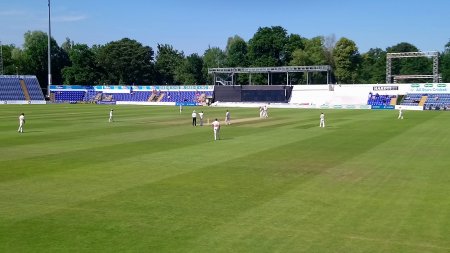
Here’s another one I took in the afternoon after I realised what had happened:

It proved to be an absorbing day’s cricket. Northants won the toss and, unsurprisingly, decided to bat first.

Glamorgan had an early breakthrough from Hogan and Smith but Northamptonshire reached lunch at 87 for 2, with Wakely and Vasconcelos looking settled. The latter fell soon after lunch, but Wakely and Levi then took Northants to tea without further loss.

The pair went on to share a stand of 118 until Smith (who was expensive but troubled all the batsmen) got Wakely caught in the slips by Khawaja for a fine 82.

Soon Northants were five down for 231 after Rossington departed for 7, but Crook and the combative but slightly portly figure of Levi took the score on to 275 for 5. At that point a decent score for Northants still looked likely.

Then Glamorgan took the new ball and Tim van der Gugten steamed in. Levi had an awful waft at the first ball and was caught: 275 for 6.

At that point all the wickets to fall had been caught behind the wicket, either by the wicket-keeper or in the slip cordon. What had troubled the batsmen had been bounce rather than lateral movement, which is a fairly typical Sophia Gardens wicket.

Anyway, two balls after Levi departed new batsman Prasanna tried to play some kind of shot (I know not what shot) and succeeded only in spooning up a dolly catch to mid on: 275 for 7.

Next over Hogan brought one back into Crook who was adjudged lbw (though if truth be told it looked a little high to me): 279 for 8.

Then it was van der Gugten’s turn again, getting one to lift at Hutton (no, not Len). The ball flashed into the slips and looked to have gone past Khawaja but somehow he plucked it out of the air for one of the best catches I have ever seen: 281 for 9.

Last man for Northants, Sanderson, walked to the wicket in the manner of a condemned man approaching the scaffold and when he got there he was clean bowled first ball by van der Gugten. Northants all out for 281, their last five wickets falling in the space of three overs. Quite a turnaround in the final session: Northants were 199 for 3 at tea.

Northamptonshire’s rapid demise left Glamorgan seven overs to bat before the close; openers Selman and Murphy negotiated them safely to end the day on 21 without loss.

It was a very absorbing day’s cricket on a very warm day indeed. I’m glad I had plenty of suncream on, as there were many in the crowd looking distinctly frazzled.

I don’t normally criticise umpires because they do a very hard job, but I feel I should mention one major lapse. Fortunately I don’t which it was so I can’t mention him by name. During the Northants innings, a batsman (Kevin, I think) played a shot to the mid-off area and set off for a quick single. The fielder threw and hit the stumps at the non-striker’s end with the batsman apparently short of his ground. Unfortunately the umpire, who was moving to get out of the way, had turned his back to the action and couldn’t give the decision. There being no third umpire in County Cricket, that meant it was ‘not out’. I thought that was poor: umpires should keep their eyes on the play all the time. I would have thought a first class umpire would have done so.

Anyway, I’m looking forward to the second day to see if Glamorgan can capitalise on Northamptonshire’s collapse. I’ve followed Glamorgan long enough to know not to take anything for granted!

A Lamentation of Swans

Posted in Uncategorized on June 24, 2018 by telescoper

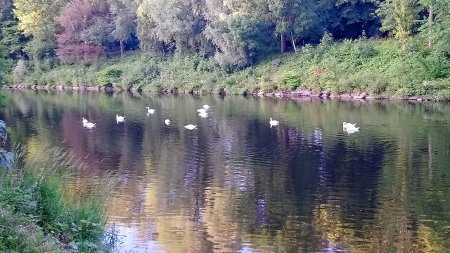
Walking to my Cardiff residence from the bus stop after travelling from the airport this evening, I saw this collection of swans on the Taff. I don’t know know how many there should be to justify invoking the proper collective noun, Lamentation, but they certainly looked nice.

In Maynooth you are more likely to come across a Murder of Crows than a Lamentation of Swans but if you’re interested in other terms of venery see here.

I wonder what the collective noun is for a collection of collective nouns?

Chaotic Clouds on Jupiter

Posted in The Universe and Stuff with tags , , on June 23, 2018 by telescoper

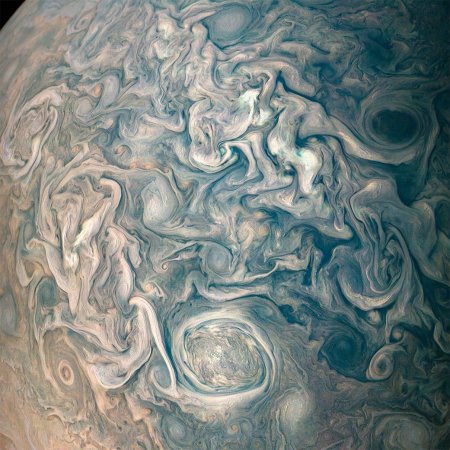
I’ve been too busy today with Open Day business to do a proper post so I thought I’d just share this marvellous image from NASA’s Juno Mission.

The picture is like an extraordinary work

of abstract art, but it’s scientifically fascinating too:

The region seen here is somewhat chaotic and turbulent, given the various swirling cloud formations. In general, the darker cloud material is deeper in Jupiter’s atmosphere, while bright cloud material is high. The bright clouds are most likely ammonia or ammonia and water, mixed with a sprinkling of unknown chemical ingredients.

Summer Open Day in Maynooth

Posted in Education, Maynooth with tags , on June 22, 2018 by telescoper

It seems I have volunteered to represent the Department of Theoretical Physics at Maynooth University’s Open Day tomorrow, so I’ll be giving a talk as well as answering questions, handing out leaflets etc on the Theoretical Physics stall (with the aid of some current students). It’s a bit of a flashback to Sussex days, actually, when I used to have to do this sort of thing quite regularly on Saturdays throughout the year. At least the weather looks like it’s going to be nice, even if the post-solstitial nights are now drawing in.

If you’re planning to come tomorrow, the event starts at 10.30 am and the first talk is at 11.15, but I’m not on until 13.35. Lots of information is available here. Please come and say hello if you’ve read this here blog post!

Anyway, Maynooth University has made a nice little video about the Open Day so I thought I’d share it here, mainly to give readers a look at the lovely campus, which is bathed in sunshine as I write this!

Music for the Solstice

Posted in Music with tags , on June 21, 2018 by telescoper

Well, in case you didn’t realize, the summer solstice (when the Sun reaches its most northerly point in the sky and is directly overhead on the Tropic of Cancer) occurred at 10.07 UT (11.07  British Summer Time Daylight Saving Time in Ireland) today. I guess that means it’s all downhill from here. Anyway, this gives me some sort of excuse for me posting a piece of music I’ve loved ever since I was a young child for its energy and wit. It’s the Overture to a Midsummer Night’s Dream,  by Felix Mendelssohn which he started to compose when he was just 16 years old, but didn’t complete until later so it’s his Opus 21. This performance is by the Leipzig Genwandhausorchester conducted by Kurt Mazur. Enjoy!

Incidentally, I listed to a very nice performance of Shakespeare’s A Midsummer Night’s Dream on BBC Radio 3 on Sunday evening when I was still in Cardiff. It reminded me of when we performed that play whhen I was at school, and by Bottom received a warm hand.

Big News for Big Data in Cardiff

Posted in Biographical with tags , , , , on June 20, 2018 by telescoper

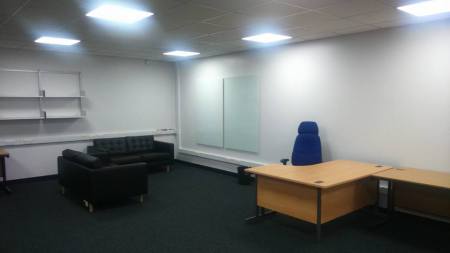
I know I’m currently in Maynooth, but I am still employed part-time by Cardiff University, and specifically by the Data Innovation Research Institute there. When I started there a couple of years ago, I moved into a big empty office that looked like this:

Over the last two years the DIRI office has gradually filled up. It is now home to an Administrative Officer (Clare), two Research Software Engineers (Ian & Unai),  Ben and Owain from Supercomputing Wales,and the newest arrival, a Manager for the Centre for Doctoral Training in Data-Intensive Physics (Rosemary). That doesn’t include, myself, the Director of DIRI (Steve Fairhurst), DIRI Board member Bernard Schutz and a number of occasional users of various `hot desks’. And there’s another Research Software Engineer on the way.

Now the latest news is of a huge injection of cash (£3.5M) for a new Data Innovation Accelerator, funded by the Welsh Government and the European Regional Development Fund. The Welsh Government has joined forces with Cardiff University to develop the project, which has the aim of transferring data science and analytics knowledge from Cardiff University to Small to Medium Sized Enterprises (SMEs) in Wales so they can develop and grow their businesses. The funding will enable researchers to work on collaborative projects with companies specialising in things like cyber security, advanced materials, energy and eco-innovation. For more information, see here.

Among other things this project will involve the recruitment of no less than eight data scientists to kick-start the project, which will probably launch in November 2018. With another eight people to be based in the Data Innovation Research Institute by the end of the year, the office promises to be a really crowded place. My departure next month will release one desk space, but it will still be a crush! That’s what you call being a victim of your own success.

Anyway, it’s exciting times for Data Science at Cardiff University and it has been nice to have played a small part in building up the DIRI activity over the last two years. I’m sure it will go on developing and expanding for a very long time indeed.

Why the Universe is extremely overrated.

Posted in Television, The Universe and Stuff with tags , , , , , , on June 19, 2018 by telescoper

A few weeks I read an article in Physics Today which prompted me to revise and resubmit an old post I cobbled together in response to the BBC television series Wonders of the Universe in which I argued that the title of that programme suggests that the Universe is wonder-ful, or even, in a word which has cropped up in the series a few times, `awesome’.  When you think about it the Universe is not really `awesome at all’. In fact it’s extremely overrated.

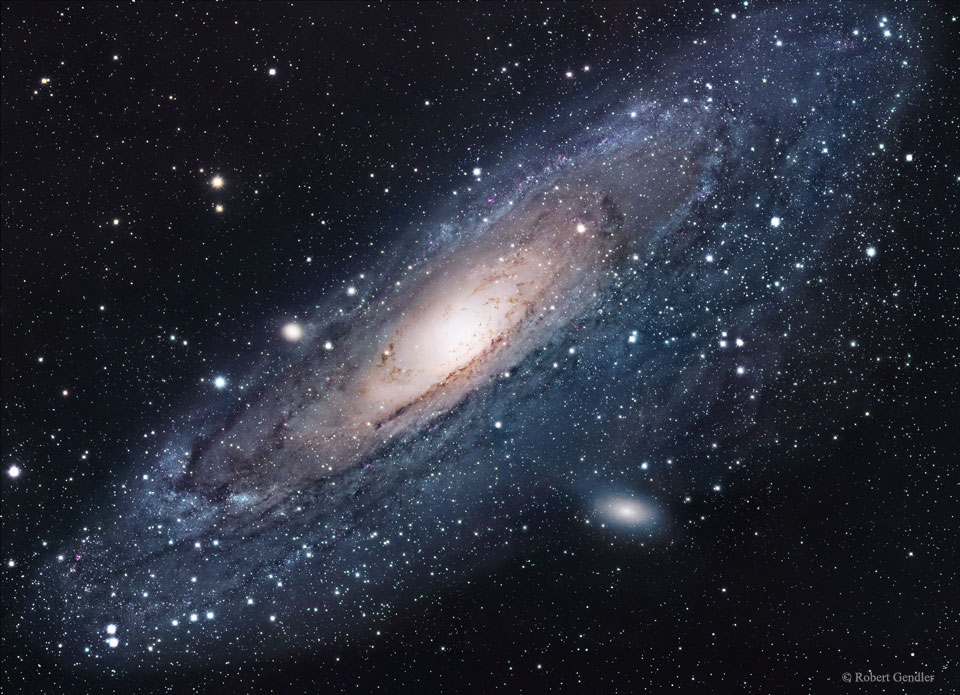
Take this thing, for example:
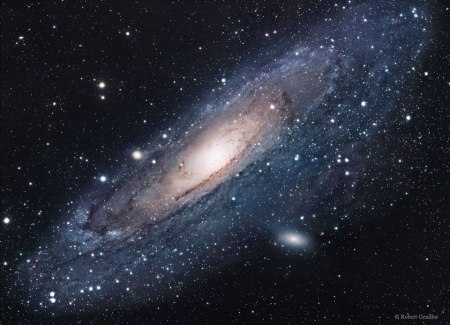
 

This is an example of a galaxy (the Andromeda Nebula, M31, to be precise). We live in a similar object. Of course it looks quite pretty on the surface but, when you look at it with a physicist’s eye, such a galaxy is really not as great as it’s cracked up to be, as I shall now explain.

We live in a relatively crowded part of our galaxy on a small planet orbiting a fairly insignificant star called the Sun. Now you’ve got me started on the Sun. I know it supplies the Earth with all its energy, but it does the job pretty badly, all things considered because the Sun only radiates a fraction of a milliwatt per kilogram. By comparison a human being radiates more than one watt per kilogram. Pound for pound, that’s more than a thousand times as much energy as a star.

So,  in reality, stars are bloated, wasteful, inefficient and not even slightly awesome. They’re only noticeable because they’re big. And we all know that size shouldn’t really matter. In short, stars are extremely overrated.

But even in what purports to be an interesting neighbourhood of our Galaxy, the nearest star is 4.5 light years from the Sun. To get that in perspective, imagine the Sun is the size of a golfball. On the same scale, where is the nearest star?

The answer to that will probably surprise you, as it does my students when I give this example in lectures. The answer is, in fact, on the order of a thousand kilometres away. That’s the distance from Cardiff to, say, Munich. What a dull landscape our Galaxy possesses. In between one little golf ball in Wales and another one in Germany there’s nothing of any interest at all, just a featureless incomprehensible void not worthy of the most perfunctory second thought.

So galaxies aren’t dazzlingly beautiful jewels of the heavens. They’re flimsy, insubstantial things more like the cheap tat you can find on QVC. What’s worse is that they’re also full of a grubby mixture of soot and dust. Indeed, some are so filthy that you can hardly see any stars at all. Somebody needs to give the Universe a good clean. I suppose you just can’t get the help these days.

And then to the Physics Today piece I mentioned at the start of this article. I quote:

Star formation is stupendously inefficient. Take the Milky Way. Our galaxy contains about a billion solar masses of fresh gas available to form stars—and yet it produces only one solar mass of new stars a year.

Hopeless! What a waste of space a galaxy is! As well as being oversized, vacuous and rather dirty, one is also pretty useless at making the very things it is supposed to be good at! What galaxies clearly need is some sort of a productivity drive or perhaps a complete redesign using more efficient technology.

So stars are overrated and galaxies are overrated, but surely the Universe as a whole is impressive?

No. Think about the Big Bang. Well, I don’t need to go on about that because I’ve already posted about it. Suffice to say that the Big Bang wasn’t anywhere near as Big as you’ve been led to believe: the volume was between about 115 and 120 decibels. Quite loud, to be sure, but many rock concerts are louder. To be honest it’s a bit of an anti-climax. If I’d been in charge (and given sufficient funding) I would have put on something much more spectacular.

In any case the Big Bang happened a very long time ago. Since then the Universe has been expanding, the space between galaxies getting emptier and emptier so there’s now less than one atom per cubic metre, and cooling down to the point where its temperature is lower than three degrees above absolute zero.

The Universe is a cold, desolate and very empty place, lit by a few feeble stars and warmed only by the fading glow of the heat left over from when it was all so much younger and more exciting. Here and there amid the cosmic void a few galaxies are dotted about, like cheap and rather tatty ornaments. It’s as if we inhabit a shabby downmarket retirement home, warmed only by the feeble radiation given off by a puny electric fire as we occupy ourselves as best we can until Armageddon comes.

In my opinion the Universe would have worked out better had it been entirely empty, instead of being contaminated with such detritus. I agree with Tennessee Williams:

BRICK: “Well, they say nature hates a vacuum, Big Daddy.
BIG DADDY: “That’s what they say, but sometimes I think that a vacuum is a hell of a lot better than some of the stuff that nature replaces it with.”

So no, the Universe isn’t wonderful. Not at all. In fact, it’s basically a bit rubbish. Again, it’s only superficially impressive because it’s quite large, and it doesn’t do to be impressed by things just because they are large. That would be vulgar.

Digression: I just remembered a story about a loudmouthed Texan who owned a big ranch and who was visiting the English countryside on holiday. Chatting to locals in the village pub he boasted that it took him several days to drive around his ranch. A farmer replied “Yes. I used to have a car like that.”

Ultimately, however, the fact is that whatever we think about the Universe and how badly constructed it it, we’re stuck with it. Just like the trains, the government and the weather. There’s nothing we can do about it, so we might as grin and bear it.

It’s being so cheerful that helps keep me going.