I was reminded this weekend that today (9th April 2018) is the 90th birthday of American musician, singer-songwriter, satirist, and mathematician Tom Lehrer. Although he has retired from theatres of both musical and lecture variety, his songs (and especially the one I’ve selected) remains topical to this day. I’m about to retreat into a bunker to finish marking a batch of coursework so please enjoy the following short tribute and wish Tom Lehrer a very happy 90th birthday!
Follow @telescoperTom Lehrer at 90!
Posted in mathematics, Music with tags Tom Lehrer, We will all go together when we go on April 9, 2018 by telescoperMetrics for `Academic Reputation’
Posted in Bad Statistics, Science Politics with tags citations, PageRank, Science, Science Politics on April 9, 2018 by telescoperThis weekend I came across a provocative paper on the arXiv with the title Measuring the academic reputation through citation records via PageRank. Here is the abstract:
The objective assessment of the prestige of an academic institution is a difficult and hotly debated task. In the last few years, different types of University Rankings have been proposed to quantify the excellence of different research institutions in the world. Albeit met with criticism in some cases, the relevance of university rankings is being increasingly acknowledged: indeed, rankings are having a major impact on the design of research policies, both at the institutional and governmental level. Yet, the debate on what rankings are exactly measuring is enduring. Here, we address the issue by measuring a quantitative and reliable proxy of the academic reputation of a given institution and by evaluating its correlation with different university rankings. Specifically, we study citation patterns among universities in five different Web of Science Subject Categories and use the PageRank algorithm on the five resulting citation networks. The rationale behind our work is that scientific citations are driven by the reputation of the reference so that the PageRank algorithm is expected to yield a rank which reflects the reputation of an academic institution in a specific field. Our results allow to quantifying the prestige of a set of institutions in a certain research field based only on hard bibliometric data. Given the volume of the data analysed, our findings are statistically robust and less prone to bias, at odds with ad hoc surveys often employed by ranking bodies in order to attain similar results. Because our findings are found to correlate extremely well with the ARWU Subject rankings, the approach we propose in our paper may open the door to new, Academic Ranking methodologies that go beyond current methods by reconciling the qualitative evaluation of Academic Prestige with its quantitative measurements via publication impact.
(The link to the description of the PageRank algorithm was added by me; I also corrected a few spelling mistakes in the abstract). You can find the full paper here (PDF).
For what it’s worth, I think the paper contains some interesting ideas (e.g. treating citations as a `tree’ rather than a simple `list’) but the authors make some assumptions that I find deeply questionable (e.g. that being cited among a short reference listed is somehow of higher value than in a long list). The danger is that using such information in a metric could form an incentive to further bad behaviour (such as citation cartels).
I have blogged quite a few times about the uses and abuses of citations (see tag here) , and I won’t rehearse these arguments here. I will say, however, that I do agree with the idea of sharing citations among the authors of the paper rather than giving each and every author credit for the total. Many astronomers disagree with this point of view, but surely it is perverse to argue that the 100th author of a paper with 51 citations deserves more credit than the sole author of paper with 49?
Above all, though, the problem with constructing a metric for `Academic Reputation’ is that the concept is so difficult to define in the first place…
Follow @telescoperAngela Hewitt at St David’s Hall – The Goldberg Variations
Posted in Music with tags Angela Hewitt, Goldberg Variations, J.S. Bach, Johan Sebastian Bach, music, St David's Hall on April 8, 2018 by telescoper
Angela Hewitt (picture credit: St David’s Hall website )
This afternoon I had the great pleasure of attending a solo piano concert at St David’s Hall in Cardiff featuring star pianist Angela Hewitt (pictured above). The programme consisted of one work – but what a work! – the monumental Goldberg Variations by Johann Sebastian Bach.
I’ve been looking forward to this concert for weeks, not only because it was a rare opportunity to hear Angela Hewitt play, but also because although it’s a very special piece to me I’ve never heard the entire work played live before today.
The fact that I love this work so much is probably connected with my love of Jazz. Although ostensibly totally different idioms, the basic idea of ‘theme and variation’ unites these forms. Not much is known about Bach’s approach to the composition of this particular work but it wouldn’t surprise me if he improvised at least some of the variations. Above all, though, it’s when those walking bass lines for the left hand appear (e.g. near the end of the Aria) that Bach really swings; I always imagine Percy Heath or Ray Brown accompanying those passages on the double bass.
The sense of anticipation for this concert probably explains why I arrived earlier than usual:
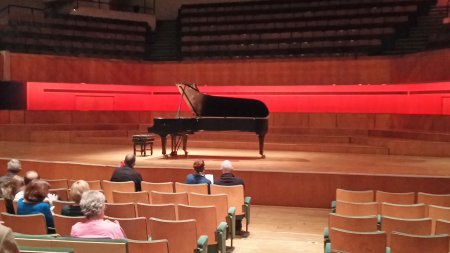
I have eight different versions of the Goldberg Variations on CD, including one by Angela Hewitt and the two extraordinary (and extraordinarily different) recordings by fellow Canadian Glenn Gould. If I had to pick my favourite, however, it would probably be one by Andras Schiff, but I find much to enjoy in all of them. I think the great thing about Bach’s music is that it’s so beautifully constructed that it can be played in a huge variety of ways and still be exquisite.
I’ve heard some people describe Angela Hewitt’s way of playing Bach as ‘affected and punctilious’ and others ‘elegant and crisply articulated’. They’re probably all describing the same thing, but some people like it and some don’t, it’s just a matter of taste.
Recordings are not the same as a live experience, and today underlined to me just how much more I enjoy live concerts. The concert lasted about 80 minutes (without an interval) – there are 30 variations altogether – and I don’t think I’ve ever seen an audience at St David’s with such rapt attention. For me the time went so quickly that I was quite startled when I heard the start of penultimate section (‘Quodlibet’) signalling that we were near the end. After the final note of the closing recapitulation of the opening Aria had subsided, the soloist kept her face down over the keyboard as if daring anyone to break the spell. Eventually she raised her head, smiled, and the applause began, followed by a standing ovation. The St David’s audience is usually rather reticent so that tells you how good this was. What better way can there be to spend a Sunday afternoon?
P.S. Angela Hewitt walked on and off stage with the aid of a metal crutch, suggesting some form of leg injury. On the unlikely event that she reads this, let me wish her a speedy recovery from whatever it is!
Follow @telescoperPictures from a Mediaeval Bestiary, No. 57 – The Oyster
Posted in Uncategorized on April 7, 2018 by telescoper
On the Eighth Amendment Referendum
Posted in Maynooth, Politics with tags Abortion, Dáil, Eighth Amendment, ICBR, Referendum on April 6, 2018 by telescoperWhen I was walking to lunch yesterday I saw that there was some sort of demonstration on the road (the R148) that divides the North and South Campuses at Maynooth University:

It was all a bit confusing as it seemed to be a protest and a counter-protest all in the same place. It turned out after asking a few people that the original demonstration was by a group calling itself the Irish Centre for Bioethical Reform (ICBR), which is a fringe anti-abortion group that specialises in putting up gory images to make their point. They have been pulling a series of stunts in the area ahead of the forthcoming Referendum on the Repeal of the Eighth Amendment of the Constitution of Ireland, which will take place on 25th May 2018.
The Eighth Amendment introduced Article 40.3.3 into the constitution. This was subsequently amended twice (following referendums) and now reads:
The State acknowledges the right to life of the unborn and, with due regard to the equal right to life of the mother, guarantees in its laws to respect, and, as far as practicable, by its laws to defend and vindicate that right.
This subsection shall not limit freedom to travel between the State and another state.
This subsection shall not limit freedom to obtain or make available, in the State, subject to such conditions as may be laid down by law, information relating to services lawfully available in another state.
The counter-demonstration (which seemed to involve more people) deployed the simple device of standing in front of the the ICBR demonstration so their lurid images were hard to see. This is why I couldn’t quite see what was going on as I walked past.
Anyway, for the record, I’ll state that I support the campaign to repeal the Eight Amendment, which effectively prohibits abortion in Ireland. I realise that abortion is an emotive ethical issue for many people, but it strikes me as a new arrival in Ireland that the fundamental thing is that Eight Amendment is basically a muddle, and that it really does not belong in the Constitution anyway. In my opinion it is regrettable that it was ever passed (which it was, after another referendum campaign, in 1983). If the repeal side wins the referendum then the existing Eight Amendment (which is Article 40.3.3) will be replaced with
Provision may be made by law for the regulation of termination of pregnancy.
(Incidentally, that would be the 36th Amendment of the Constitution of Ireland. It is in the drafting and amending of any such provisions that emerge when the ethical issues should be debated. The matter for the referendum is (or should be) simpler than this: it’s just about whether the existing Article should be scrapped.
Incidentally, a number of people have asked me if UK citizens resident in Ireland can vote in this referendum, as Irish citizens resident in the UK could in the Brexit referendum in 2016. The answer to that question is `no’: British citizens in Ireland can vote in local elections, elections to the Dáil, and European Elections (although presumably that will change if the UK leaves the European Union); they cannot vote in any referendum or in the election of the President (which will take place later this year). Irish citizens can vote in every election and referendum.
Follow @telescoper‘Stephen Hawking RIP’ by Ella Baron
Posted in Art, The Universe and Stuff with tags Ella Baron, Stephen Hawking, Times Literary Supplement on April 5, 2018 by telescoper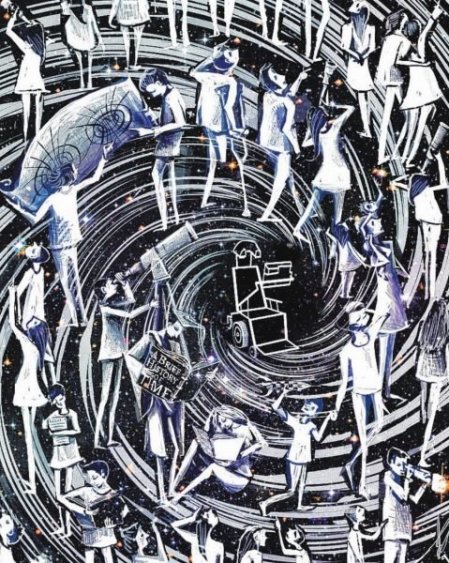
I just saw this lovely illustration (by Ella Baron) and thought I would share it here.
It appears in the March 23 of the Times Literary Supplement which arrived in Maynooth while I was away and I’ve just found time to read it. I subscribe to the TLS primarily because I like the crossword..
The ‘cartoon’ is accompanied by an excerpt from A Brief History of Time:
Follow @telescoperIf a pulse of light is emitted… then as time goes on it will spread out… like ripples on the surface of a pond when a stone is thrown in…
Spring comes to Maynooth
Posted in Biographical, Cardiff, Maynooth with tags Computational Physics, pensions, UCU Strike on April 5, 2018 by telescoper
After a good night’s sleep last night I was up early this morning to give my usual Thursday 9am lecture on Computational Physics. It was a bright sunny morning, though there was overnight frost and a distinct chill in the air, as I made my way to Physics Hall. Once there, for the first time this year, I had to close the blinds because the Sun was shining too bright for the projector screen. It has hitherto always been too gloomy outside for this to happen. The picture above (of St Joseph’s Square, on the South Campus) was taken as I left St Patrick’s House after a very nice lunch of roast lamb in Pugin Hall. By this time of day it was pleasantly warm.
Here’s a nice picture of the Library circulated by the Maynooth social media folk earlier today.

Anyway, this mornings’s lecture was an introduction numerical solutions of ordinary differential equations, beginning with Euler’s method applied to initial value problems. Further studies of this topic – which is very important for bidding computational physics – will take up the rest of the lectures as we explore the delights of, e.g. Runge-Kutta codes and boundary value problems. This morning’s lecture was followed this afternoon by a two-hour lab session in which the students had to write their own ODE solver.
Among the advantages (for me) of teaching this module is that I’m actually becoming reasonably competent at Python. At any rate I’ve difficult improved my ability to spot bugs in codes written by other people. In fact, it is traditional for the exam in this module to include a question that involves finding 10 mistakes in a piece of Python code. That’s a fun challenge, the only real problem for me being to write a bit of code with only 10 mistakes in it in the first place…
Talking of exams, the timetables for my two current employers are now out. Computational Physics in Maynooth is on Friday 11th May while Physics of the Early Universe in Cardiff is almost a fortnight later, on Thursday 24th May. The Easter recess is shorter here in Maynooth than in Cardiff, where lectures do not resume until April 16th (assuming the UCU strike does not continue), which is why the exams in Maynooth are earlier. I’m grateful there isn’t a clash. I should have ample time to mark the Maynooth ones before the Cardiff ones are due. After the first week or so of May I won’t have to teach in both institutions, so my somewhat hectic schedule should become a little more relaxed from then onwards.
I mentioned the UCU strike above in passing. The UCU leadership has decided that there will be an online ballot on whether to accept the `offer’ recently made by the management organisation UUK. The ballot will be open until April 13th. If the vote goes against acceptance then Cardiff staff will be back on strike from 16th April, and there will be further industrial action over the examination period. I can’t predict what the result of the ballot will be. Although the UCU leadership is recommending acceptance I don’t know anyone personally who intends to vote for it, but there’s a probably a big selection effect there! There is a distinct possibility that examinations will be badly disrupted not only in Cardiff but all over the UK. It’s a very sad state of affairs but all those on strike (and the majority of students) consider the UUK side to be to blame…
Follow @telescoperEWASS in Liverpool
Posted in Football, The Universe and Stuff with tags astronomy, EWASS, EWASS2018, Liverpool, National Astronomy Meeting, Royal Astronomical Society on April 4, 2018 by telescoperI’m back in Maynooth with teaching to do after the Easter recess. The Flybe schedule having just changed for the summer, I took a 7am flight from Cardiff to Dublin this morning, which meant getting up at stupid o’clock, but I got here safely enough to Maynooth at about 9.40am.
Anyway, had I not known that I would be here in Ireland I would probably have planned to visit the English Midlands in order to attend EWASS (European Week of Astronomy and Space Science) which takes place this week in Liverpool. This meeting, which is in a different country each year, this time incorporates the Royal Astronomical Society’s annual National Astronomy Meeting making it one of the biggest astronomy conferences ever held in the UK.
Sadly my teaching commitments meant I couldn’t attend EWASS2018, but I thought I’d take this opportunity to wish everyone there all the best for an enjoyable and productive week.
I’ll also mention that various short videos of press briefings etc are coming out on Youtube with little snippets from the conference, including this one about Ariel (which I blogged about recently):
You can find other videos by searching for EWASS on Youtube. I’m sure more will emerge over the next couple of days!
P.S. The event in Liverpool has clearly been planned with football fans in mind: Liverpool play Manchester City tonight, in Liverpool, in the UEFA Champions League..(UPDATE: the match finished 3-0 to Liverpool, which presumably pleased the locals).
Follow @telescoperDark Slender Boy – Liam O’Flynn
Posted in Music with tags Liam O'Flynn, Uilleann Pipes on April 4, 2018 by telescoperI’m by no means an expert on the Uilleann pipes, but the sad death of Liam O’Flynn (after a long struggle with cancer) a few weeks ago gave me occasion to hear some recordings of his, and I was captivated by the amazing sounds coming from this instrument.
The Uilleann pipes look a bit like a much larger version of the Northumbrian smallpipes I am familiar with from the region of my birth, in that the bag is inflated using an elbow pump, but they have a much wider range – two octaves – and can play sharps and flats. A master such as Liam O’Flynn could also generate a range of other effects, by bending notes in much the same way as a jazz or blues musician would, and also achieving subtle changes of tone and volume. Here’s a lovely example of his art, a solo performance of a tune called Dark Slender Boy on which he conjures up a world of musical possibilities.
Follow @telescoperBurgundy Passports For Life!
Posted in Uncategorized on April 3, 2018 by telescoperIt being my first day back after the Easter break I’ve been too busy to write a proper post but I do have time to pass on a piece of important news about passports. Those of you UK citizens worried having to trade your lovely burgundy passport for a nasty blue one need fret no more.
According to the BBC news, you can carry on using your current passport until you expire:

I hope this clarifies the situation.
P. S. My own expiry date has been helpfully provided by the Irish government on my recently provided PPS card:


 In the Dark