Dawn over the Moscow River

Posted in Opera with tags , , , , on September 22, 2017 by telescoper

If the world doesn’t come to an end tomorrow, around 7pm I hope to be in my seat at the Wales Millennium Centre in Cardiff Bay for the start of Khovanschina performed by Welsh National Opera, it being the first night of their new season.

Khovanschina, composed by Modest Mussorgsky, is not a particular well-known opera but the lovely Prelude to Act I is performed fairly often as a concert piece with the title Dawn Over the Moscow River. Here it is, played in 1991 by the Orchestra of the Mariinsky Theatre conducted by Valery Gergiev:

The Autumnal Equinox

Posted in Biographical, Cricket with tags , , , , , on September 22, 2017 by telescoper

So here we are then. The Autumnal Equinox (in the Northern hemisphere) takes place this evening, at 21.02 BST (20.02 GMT) at which point the plane of Earth’s equator passes through the centre of the Sun’s disk. This is traditionally taken to be the end of summer. It was a lovely morning in Cardiff, sunny and warm. Looking back over the posts I’ve written at this time of year since I started blogging in 2008, it’s notable how many times we’ve had a period of good weather around the autumnal equinox. The local traditional name for this is the `Little Summer of St Michael’. Anyway, here’s am excerpt from the post I wrote in 2008 on this:

The weather is unsettling. It’s warm, but somehow the warmth doesn’t quite fill the air; somewhere inside it there’s a chill that reminds you that autumn is not far away.

I find this kind of weather a bit spooky because it always takes me back to the time when I left home to go to University, as thousands of fledgling students are about to do this year in their turn.

This morning I had some business to attend to near my home. In fact it was in an office in Temple Court on Cathedral Road. I hadn’t been there before and it was only when I got there that I realised that the building used to be a synagogue. Opened in 1897 this was built at the same time as the grand houses on Cathedral Road. It hasn’t been used as a synagogue for some time, and the building has been substantially extended at the rear, but it is still a Grade II listed building.

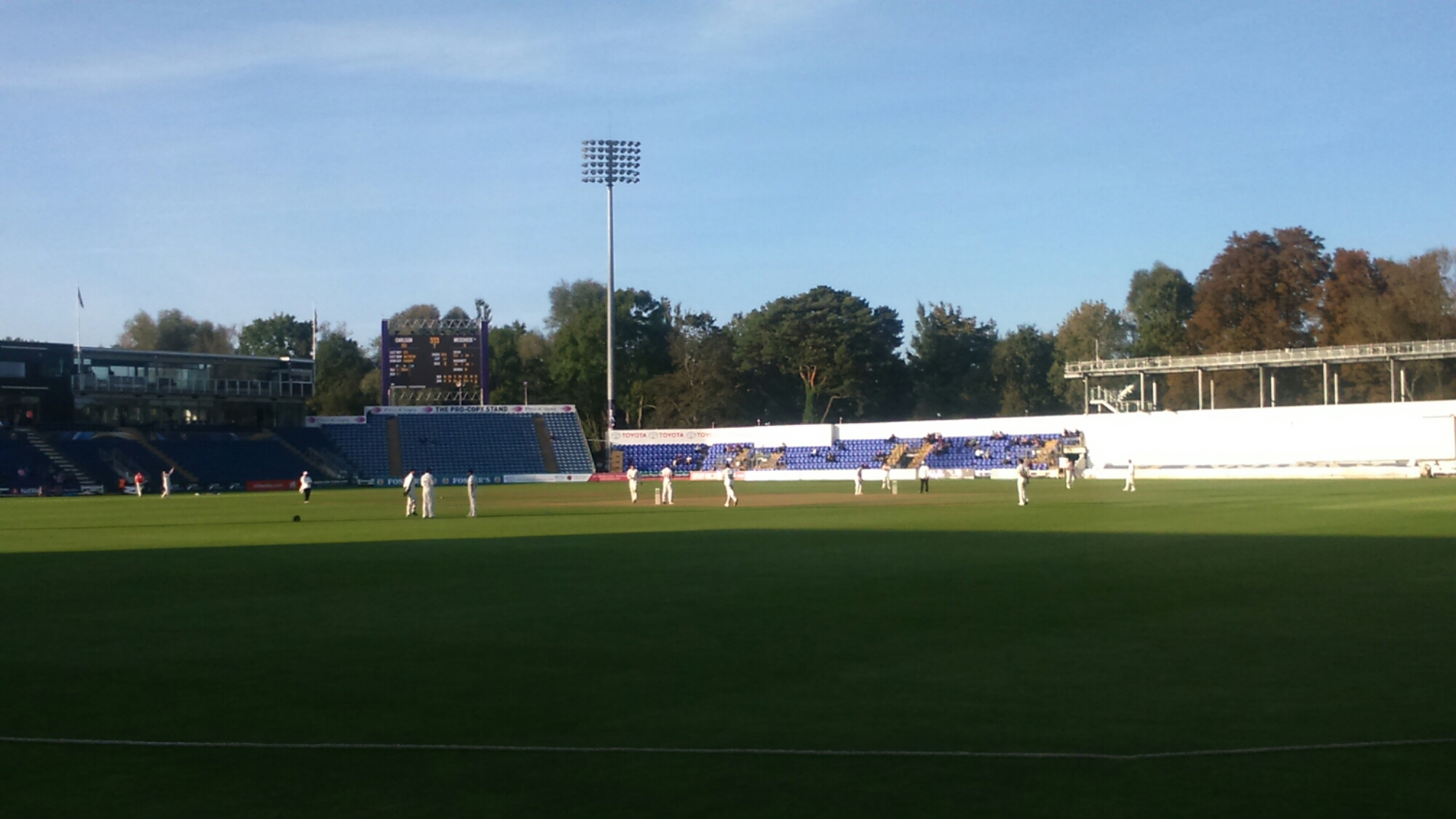
My little errand completed I decided to make the most of the weather by watching the morning’s play on the last day of the County Championship match between Glamorgan and Gloucestershire at the SSE Swalec Stadium in Sophia Gardens. Some playing was lost yesterday because of rain; the forecast had suggested a complete washout, but the rain cleared much earlier than predicted. Glamorgan had been all out for 442 in their first innings. Gloucestershire found batting pretty comfortable but lost a flurry of wickets on Thursday afternoon and ended up declaring on 399 for 8 after 110 overs to have a go at Glamorgan for 15 overs late on. They had an early success with the ball, removing Brown for 13, with the score on 15, but opener Nick Selman and Andrew Salter, promoted to No. 3, took them to the close. I watched them bat together all the way to lunch, as Glamorgan proceeded serenely to 154 for 1.

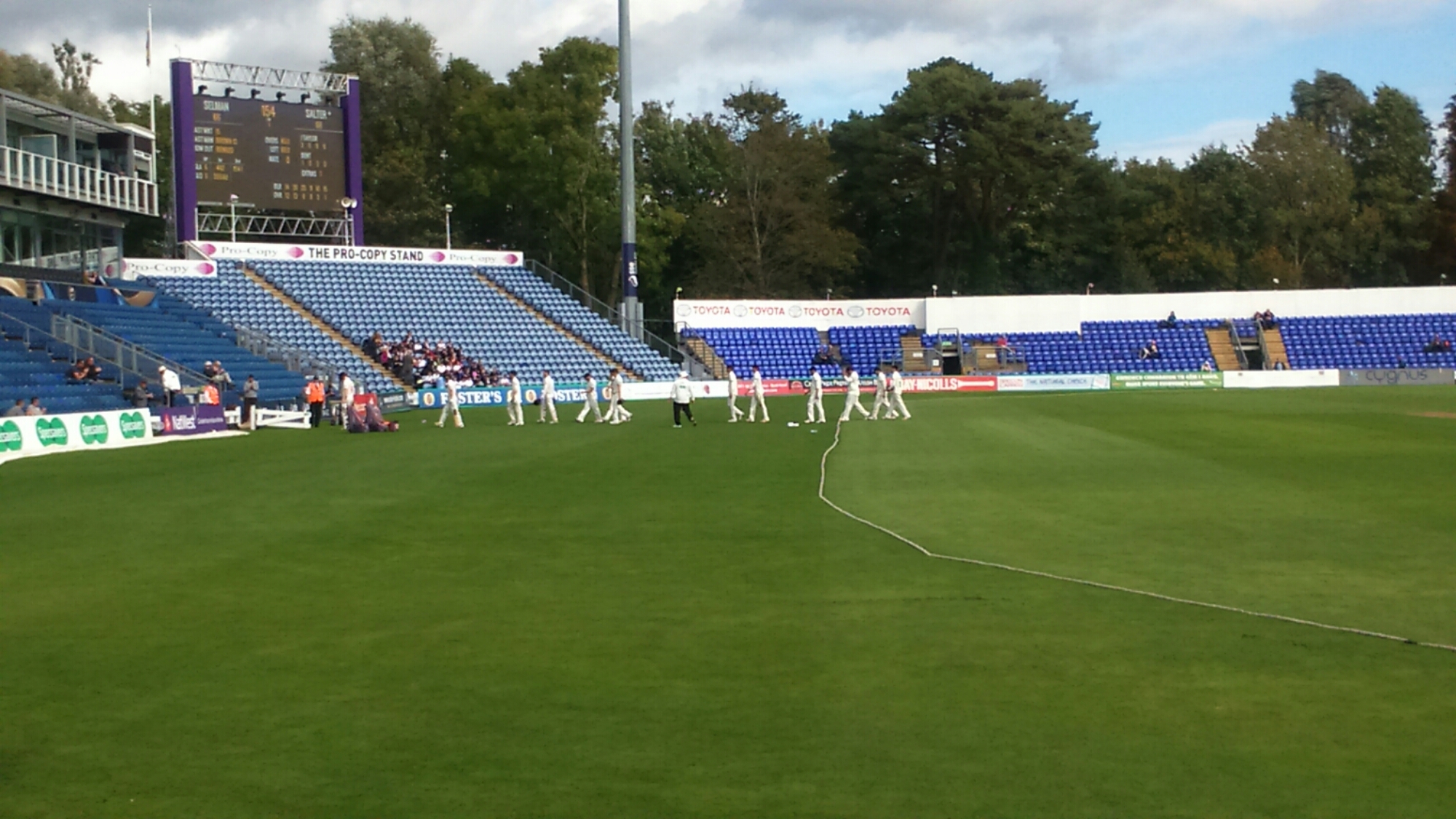
Here are the players going off for lunch:

The game seems to be drifting to a draw, the likelihood of which is increased even further by the fact that rain is forecast this afternoon, so it wasn’t the most exciting cricket I’ve ever watched, but it’s good to end the season with Glamorgan doing well. A sudden declaration with 40-50 overs left might give Glamorgan the chance of a win, but the pitch is very flat and I can’t see a result being forced. I’m pretty sure the plan is to give Glamorgan’s batsmen a chance to build up a bit of confidence for next season. I just checked the score, in fact, to find that Nick Selman has scored a century, which will do him a power of good!

Our new students arrive for `induction’ next week – including the new PhD students involved with our Centre for Doctoral Training who will be attending a Launch Event that starts on Sunday afternoon. I have a few last-minute jobs to do connected with that this afternoon so I’d better get on with them if I want to get finished so I can enjoy the first Amser Jazz Time of the new season!

Knitted Omnibus

Posted in Uncategorized with tags , , on September 21, 2017 by telescoper

The inestimable Miss Lemon, who occasionally operates under the pseudonym Dorothy Lamb, has sent me a picture of her latest knitting exploits, i.e. two buses in the livery of the Brighon & Hove Bus Company!

They add a whole new meaning to the term `bendy bus’!

To find out what inspired these contributions please see related the University of Sussex news item here.

Free Will in the Theory of Everything

Posted in The Universe and Stuff with tags , , on September 21, 2017 by telescoper

There’s a very thoughtful and provocative paper on the arXiv by Gerard tHooft, who (jointly) won the Nobel Prize for Physics in 1999. It’s well worth reading, even if you decide you don’t agree with him!

From what is known today about the elementary particles of matter, and the forces that control their behavior, it may be observed that still a host of obstacles must be overcome that are standing in the way of further progress of our understanding. Most researchers conclude that drastically new concepts must be investigated, new starting points are needed, older structures and theories, in spite of their successes, will have to be overthrown, and new, superintelligent questions will have to be asked and investigated. In short, they say that we shall need new physics. Here, we argue in a different manner. Today, no prototype, or toy model, of any so-called Theory of Everything exists, because the demands required of such a theory appear to be conflicting. The demands that we propose include locality, special and general relativity, together with a fundamental finiteness not only of the forces and amplitudes, but also of the set of Nature’s dynamical variables. We claim that the two remaining ingredients that we have today, Quantum Field Theory and General Relativity, indeed are coming a long way towards satisfying such elementary requirements. Putting everything together in a Grand Synthesis is like solving a gigantic puzzle. We argue that we need the correct analytical tools to solve this puzzle. Finally, it seems to be obvious that this solution will give room neither for “Divine Intervention”, nor for “Free Will”, an observation that, all by itself, can be used as a clue. We claim that this reflects on our understanding of the deeper logic underlying quantum mechanics.

The full paper can be downloaded here.

Song of Creation

Posted in Poetry with tags , on September 20, 2017 by telescoper

Then there was neither Aught nor Nought, no air nor sky beyond.
What covered all? Where rested all? In watery gulf profound?
Nor death was then, nor deathlessness, nor change of night and day.
That One breathed calmly, self-sustained; nought else beyond it lay.

Gloom hid in gloom existed first – one sea, eluding view.
That One, a void in chaos wrapt, by inward fervour grew.
Within it first arose desire, the primal germ of mind,
Which nothing with existence links, as sages searching find.

The kindling ray that shot across the dark and drear abyss-
Was it beneath? or high aloft? What bard can answer this?
There fecundating powers were found, and mighty forces strove-
A self-supporting mass beneath, and energy above.

Who knows, who ever told, from whence this vast creation rose?
No gods had then been born – who then can e’er the truth disclose?
Whence sprang this world, and whether framed by hand divine or no-
Its lord in heaven alone can tell, if even he can show.

Translated by John Muir from the original (anonymous) Sanskrit text of a hymn.

September at Sophia Gardens

Posted in Cricket, Uncategorized on September 19, 2017 by telescoper

Since it was a fine evening I popped in at the SSE SWALEC Stadium in Sophia Gardens on the way home from work to catch the last few overs of Day 1 of the County Championship match between Glamorgan and Gloucestershire.

For a change, and despite  losing two quick wickets while I watched,  Glamorgan are in a reasonably strong position at 342 for 7 off 96 overs at the end of Day 1, with young Kiran Carlson unbeaten on 137. That’s not bad considering that, having been put in to bat, they had been 63 for 4 at one stage.

It’s been a disappointing season in the County Championship for Glamorgan, who have only won two games out of 12 so far, and there’s not much at stake in this game, but I hope they can get a good result in this, their last game of the season in Cardiff.

A Fellow’s Diary 

Posted in Uncategorized with tags , on September 19, 2017 by telescoper

Yet another sign that Autumn is on the way arrived yesterday in the form of my new Royal Astronomical Society diary, which comes with the subscription. This runs from October to October so each year’s new edition usually comes in September. I say `usually’ because mine didn’t come at all last year. It probably got lost in a muddle when I changed address back to Cardiff from Sussex. Each year’s version is usually a different colour from the previous one too. This time it’s a sort of bottle green.

Anyway, although many of my colleagues seem not to use them, I like old-fashioned diaries like this. I do run an electronic calendar for work-related events, meetings etc, but I use the paper one to scribble down extra-curricular activities such as concerts and cricket fixtures, as I find the smartphone version of my electronic calendar a bit fiddly.

Anyway, I’m interested to know the extent to which I am an old fogey so here’s a little poll on the subject of diaries:

R.I.P Leon Mestel (1927-2017)

Posted in Biographical with tags , , on September 18, 2017 by telescoper

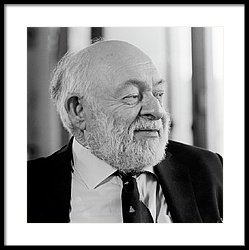
Leon Mestel FRS, photographed by Lucinda Douglas-Menzies

I heard this weekend the very sad news that on Friday 15th September 2017, we lost one of our great astrophysicists. Professor Leon Mestel FRS, pictured abvove, passsed away, peacefully in his sleep, at Addenbrooke’s Hospital. He was 90 years old.

Leon Mestel was a scientist of the highest distinction. Elected a Fellow of the Royal Society in 1977, his research interests were very broad, encompassing, but not restricted to, the areas of star formation and structure, especially stellar magnetism and astrophysical magnetohydrodynamics. Among his contributions in other areas were important papers on gravitational collapse and equilibrium in the context of galaxy dynamics, of which the classic `Mestel Disk’ is just one example. He has been awarded both the Eddington Medal (1993) and the Gold Medal (2002) of the Royal Astronomical Society. He had great physical insight which was backed up with prodigious mathematical skill and an encyclopedic knowledge of astrophysics. He also had great powers of concentration and the determination to tackle the kind of extremely challenging problems that scared off lesser intellects. Leon  was an ‘old school’ theoretical astrophysicist who was held in very high regard across the astrophysics community, and he will be greatly missed.

Others more expert than me will be able to pay proper tribute to his scientific work, so I’ll restrict myself here to a few personal reminiscences.

Leon Mestel was Professor in the Astronomy Centre at the University of Sussex when I joined it to start my DPhil in 1985. We new postgraduate research research students were required to take four courses on various aspects of astronomy, and pass oral examinations on them, before being allowed to progress beyond the first year. One of these courses was a course on Stellar Structure, taught by Leon Mestel. His lectures were pretty intense – and, I have to say, not made any easier to understand by his truly terrible handwriting on the blackboard! – but I learned a huge amount from them. I still have the lecture notes I took, in fact.

I had a root around in my old files this morning and found this evidence that I once knew something about stars!


All of us found Leon very scary to start with. He was intellectually quite intimidating and seemed to be a rather fierce and irascible character. That opinion changed when, a few weeks into term, he invited us to his house in Lewes for a social evening. We were all a bit nervous on the way there, unsure of what to expect, but as it turns out Leon was a marvellously entertaining and avuncular host. He had a wicked sense of humour and a seemingly inexhaustible stream of jokes, across a spectrum from groan-worthy puns to very risqué stories, including a  liberal measure of archetypal Jewish humour.  Leon’s father was a Rabbi, actually.  That evening broke the ice and we all realised that the was one of the good guys. That he came across as grumpy sometimes was because he was concentrating very hard, but it was rather easy to make him laugh and bring that twinkle to his eye that we will all remember.

His sharp brain and very broad knowledge meant that Leon could spot bullshit at a  considerable distance and, while he often seemed to be snoozing through  our weekly seminar,  he invariably woke up at the end and asked a penetrating question. Since one of his main interests was the role of magnetic fields in astrophysics, a subject that sends many astrophysicists screaming from the room, he would often choose something about magnetism as a question. When I was there his main focus was on the fiendishly difficult problem of building a self-consistent model of the pulsar magnetosphere. He was, however, genuinely interested in all branches of astrophysics and always recognised good work when he saw it, especially from younger scientists.

During my time as a PhD student I had some problems that required me to take quite a lot of time off. Leon was extremely kind and supportive during this period, and he even bent the rules a bit to avoid putting me through the formal process of interrupting my studies. When I was back at work and just about finishing my thesis in 1988 it was Leon who came to see me in person, with a big smile on his face, and offered me a postdoctoral position at Sussex to follow my graduate studies. I nearly fell off my chair with surprise and gratitude.

After I joined the staff later in 1988, it became a bit of a ritual for us to visit the Senior Common Room (which was situated in what is now Bramber House) for lunch, followed by coffee. It turned out that Leon liked to do the Times crossword with his post-lunch coffee. He wasn’t at all averse to a collaborative effort on tricky research problems, and it was thus with crosswords too. We both preferred the Guardian puzzle, actually, but he saved that one for after work and did the Times one because the paper was provided free in the SCR. There was also a Chambers dictionary.

I left Sussex in 1990 and Leon retired in 1992. I didn’t see as much of him after that, except for the occasion when he and my former DPhil supervisor John Barrow organized a meeting in 2004 about Eddington at which I was honoured to be asked to give a talk about the 1919 eclipse expeditions. That was a very nice occasion at which Leon was in sparkling form. Thereafter I saw him occasionally at the RAS Club, but in recent years he didn’t come so often as he found it increasingly difficult to get around.

Leon Mestel was not only a great astrophysicist but also a great character.  I’m so very sorry I can’t attend his funeral (which is being held tomorrow), but I send heartfelt condolences to his family, friends and colleagues.

Rest in Peace Leon Mestel FRS (1917-2017)
 

Football Round Up

Posted in Football with tags , , , on September 17, 2017 by telescoper

Since autumn is coming, and the football season is well under way,  bringing with it that terrifying existential void that opens up on Saturdays between the end of Final Score and the start of Match Of The Day,  I thought I would just mention that, after a good win on Saturday against Stoke City,  Newcastle United are now in  4th place in the Premiership:

I’ve posted that simply to enjoy it while it lasts. I don’t think they’ll be so high at the end of the season, but they’ve recovered well, winning three consecutive games after losing their first two.

In a strange quirk of something or other, Newcastle United now find themselves immediately above the two teams to which they have lost.

Incidentally, when I was a student at Cambridge, in 1984, Chelsea finished in first place in the old Second Division, securing promotion to the First Division. Newcastle finished third that season and also got promoted. Manchester City finished fourth. How times change.

It’s a funny old game.

A Sign of Supercomputing Wales

Posted in Uncategorized on September 16, 2017 by telescoper

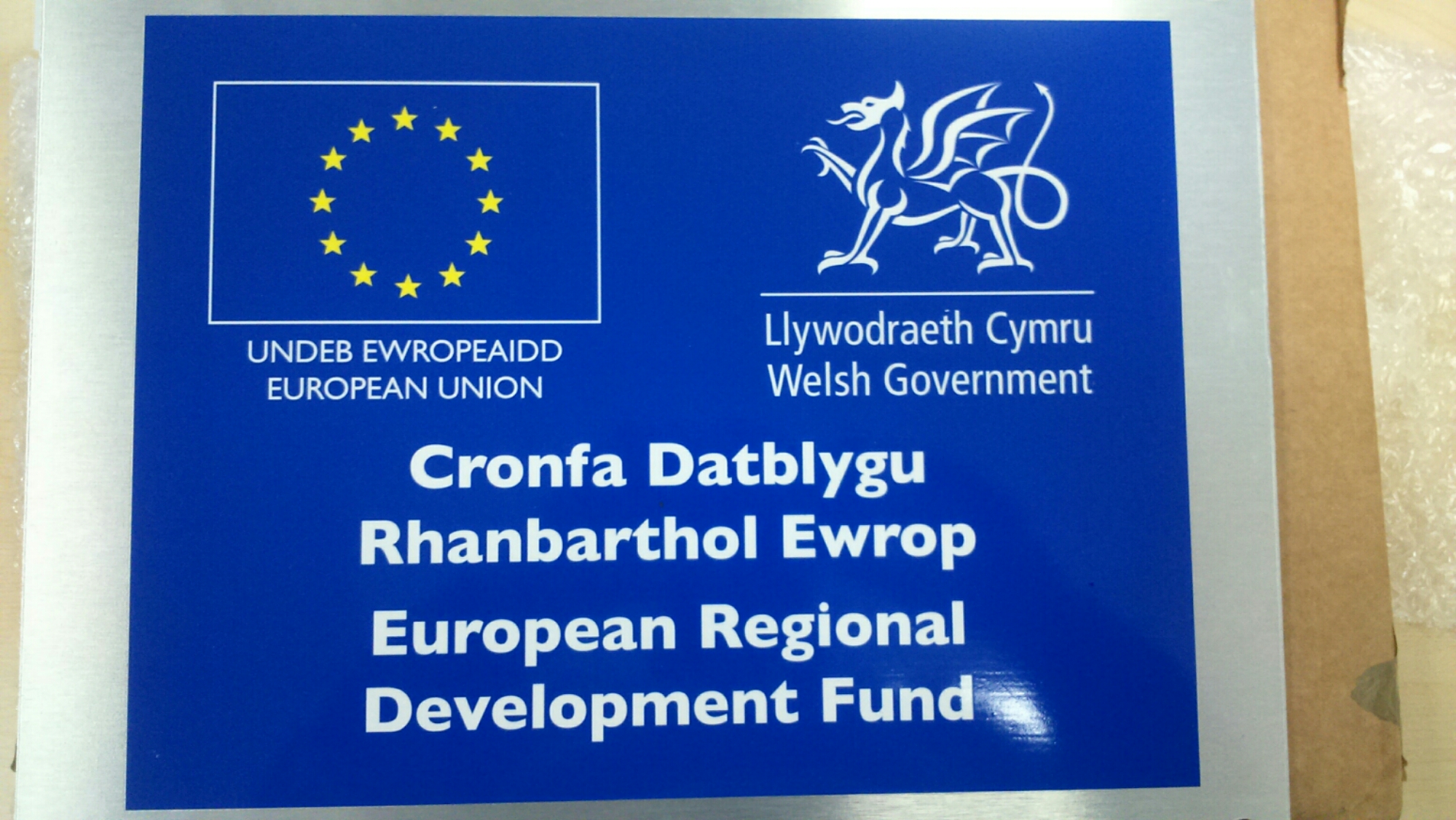
A new sign has arrived at the Data Innovation Research Institute courtesy of our colleagues from Supercomputing Wales, a new initiative that started this spring. 

Two people associated with this project are now working from the DII office where I am currently based. It also employs six research software engineers around Cardiff University as well as others elsewhere in Wales.