A Blueprint for a Quantum Computer

Posted in The Universe and Stuff with tags , , , , on February 16, 2017 by telescoper

I’m a little bit late blogging about this topic, as it relates to a paper published on 1st February 2017, but it’s a pleasure to be able to draw your attention to an important paper by a group led by a former colleague of mine from the University of Sussex, Prof. Winfried Hensinger, known to his friends as “Winni”. In essence they have constructed a practical way to build a working quantum computer.

Here is the abstract of the latest paper which explains the significance of the work:

The availability of a universal quantum computer may have a fundamental impact on a vast number of research fields and on society as a whole. An increasingly large scientific and industrial community is working toward the realization of such a device. An arbitrarily large quantum computer may best be constructed using a modular approach. We present a blueprint for a trapped ion–based scalable quantum computer module, making it possible to create a scalable quantum computer architecture based on long-wavelength radiation quantum gates. The modules control all operations as stand-alone units, are constructed using silicon microfabrication techniques, and are within reach of current technology. To perform the required quantum computations, the modules make use of long-wavelength radiation–based quantum gate technology. To scale this microwave quantum computer architecture to a large size, we present a fully scalable design that makes use of ion transport between different modules, thereby allowing arbitrarily many modules to be connected to construct a large-scale device. A high error–threshold surface error correction code can be implemented in the proposed architecture to execute fault-tolerant operations. With appropriate adjustments, the proposed modules are also suitable for alternative trapped ion quantum computer architectures, such as schemes using photonic interconnects.

Here’s a short video explaining the setup

This result has generated a lot of good publicity for the group at Sussex, including a piece in the Financial Times and a personal appearance by Winni himself on Sky News.

It’s great to see the  Ion Quantum Technology group continuing to do really well and I’m sure the investments made in physics research at the University of Sussex over the last few years will bring even more exciting developments in the near future!


How Time Passes

Posted in Jazz with tags , , , on February 15, 2017 by telescoper

I don’t seem to have had much time recently to post any lengthy pieces about music, and today is no exception, but I couldn’t resist sharing this fascinating title track from the album How Time Passes which was recorded in New York City in October 1960. It features Don Ellis on trumpet and  Jaki Byard on piano (with Ellis doubling on piano sometimes to allow Byard to play saxophones) along with Ron Carter on bass and Charlie Persip on drums. The album is a fascinating collection of modern jazz performances informed by  contemporary classical music, a blend that came to be known as Third Stream. This track is particularly unusual because of its elastic approach to tempo – it is constantly speeding up and slowing down in a way that makes you wonder how the band stays together – but it also features some beautiful work on trumpet by Don Ellis.


P.S. As well as being a superb jazz musician, Don Ellis was also a fine composer. Among other things he wrote the theme music for the film The French Connection. Not a lot of people know that.


Cosmological Parameters from pre-Planck CMB Measurements: a 2017 Update [CEA]

Posted in The Universe and Stuff on February 15, 2017 by telescoper

Via arXiver, here’s a nice summary of the (strong) constraints on cosmological parameters that can be achieved from Cosmic Microwave Background experiments other than Planck. This is an important thing to do for a number of reasons, including that it might reveal interesting systematic differences between pre- and post-Planck data which merit further study.

The first author of this paper, Erminia Calabrese, will be joining us on the staff of the School of Physics & Astronomy at Cardiff University in May 2017!

arxiver's avatararXiver

http://arxiv.org/abs/1702.03272

We present cosmological constraints from the combination of the full mission 9-year WMAP release and small-scale temperature data from the pre-Planck ACT and SPT generation of instruments. This is an update of the analysis presented in Calabrese et al. 2013 and highlights the impact on $Lambda$CDM cosmology of a 0.06 eV massive neutrino – which was assumed in the Planck analysis but not in the ACT/SPT analyses – and a Planck-cleaned measurement of the optical depth to reionization. We show that cosmological constraints are now strong enough that small differences in assumptions about reionization and neutrino mass give systematic differences which are clearly detectable in the data. We recommend that these updated results be used when comparing cosmological constraints from WMAP, ACT and SPT with other surveys or with current and future full-mission Planck cosmology. Cosmological parameter chains are publicly available on the NASA’s LAMBDA data archive.

Read this…

View original post 32 more words

Mending Wall

Posted in Poetry with tags , , , on February 14, 2017 by telescoper

Something there is that doesn’t love a wall,
That sends the frozen-ground-swell under it,
And spills the upper boulders in the sun;
And makes gaps even two can pass abreast.
The work of hunters is another thing:
I have come after them and made repair
Where they have left not one stone on stone,
But they would have the rabbit out of hiding,
To please the yelping dogs. The gaps I mean,
No one has seen them made or heard them made,
But at spring mending-time we find them there.
I let my neighbor know beyond the hill;
And on a day we meet to walk the line
And set the wall between us once again.
We keep the wall between us as we go.
To each the boulders that have fallen to each.
And some are loaves and some so nearly balls
We have to use a spell to make them balance:
“Stay where you are until our backs are turned!”
We wear our fingers rough with handling them.
Oh, just another kind of outdoor game,
One on a side. It comes to little more:
He is all pine and I am apple-orchard.
My apple trees will never get across
And eat the cones under his pines, I tell him.
He only says, “Good fences make good neighbors.”
Spring is the mischief in me, and I wonder
If I could put a notion in his head:
“Why do they make good neighbors? Isn’t it
Where there are cows? But here there are no cows.
Before I built a wall I’d ask to know
What I was walling in or walling out,
And to whom I was like to give offence.
Something there is that doesn’t love a wall,
That wants it down!” I could say “Elves” to him,
But it’s not elves exactly, and I’d rather
He said it for himself. I see him there,
Bringing a stone grasped firmly by the top
In each hand, like an old-stone savage armed.
He moves in darkness as it seems to me,
Not of woods only and the shade of trees.
He will not go behind his father’s saying,
And he likes having thought of it so well
He says again, “Good fences make good neighbors.”

by Robert Frost (1874-1963)


Haydn and the Herschels

Posted in History, Music, The Universe and Stuff with tags , , , , , on February 14, 2017 by telescoper

Last night I was listening to a broadcast of a concert performance of Haydn’s “Creation” on BBC Radio 3, featuring the London Philharmonic under the direction of Sir Roger Norrington. During the interval (between Parts I and II) the presenter Sara Mohr-Pietsch cast doubt in the story (which I’ve heard quite often), that Joseph Haydn was at least partly inspired to write The Creation by a trip he took during a stay in England to see the observatory of astronomer William Herschel. This story is repeated in a number of places around the web, including here, from which source I quote:

On 15 June 1792. Joseph Haydn visited William Herschel – basoonist, composer, astronomer – at his observatory near Slough. Herschel introduced Haydn to the Milky Way and, quite possibly, the planet Uranus, which he’d discovered ten years earlier. Some say Haydn took this glimpse of the infinite as the inspiration for his oratorio The Creation. Seems plausible.

It does indeed seem plausible. It is a matter of record that Haydn did  visit the Observatory House in Slough on 15th June 1792, which is where William Herschel lived with his sister Caroline at the time. (Interestingly, the day before this visit Haydn was at Ascot watching the horse-racing.)

However, according to William Herschel’s own records he wasn’t at the Observatory House on this day. In fact he had been away since May 1792 visiting various locations in England and Wales, before eventually arriving in Glasgow to receive an honorary degree. The notion that Herschel provided Haydn with the inspiration to write The Creation is therefore false.

Or is it?

William Herschel may not have been at home when Haydn called on 15th June 1792, but Caroline certainly was: Haydn’s name is recorded in her visitor’s book on that date. In his diary Haydn makes a note of the dimensions of the telescope (40ft) but does not mention actually looking through it, which is not surprising if he was there during the day.  There’s no other record of this visit of which I’m aware that says for sure what happened on that day, but Caroline certainly could have described what she had observed during her career as an astronomer, both on her own and with William, and also shown Haydn drawings, catalogues and star charts. Caroline Herschel was an extremely accomplished astronomer in her own right, so who’s to say it was not she rather than her brother who provided Haydn with the inspiration for his oratorio?

So it could well be that it was Herschel that inspired The Creation after all, but Caroline rather than William…

Signs of the Data Innovation Institute

Posted in Biographical with tags on February 13, 2017 by telescoper

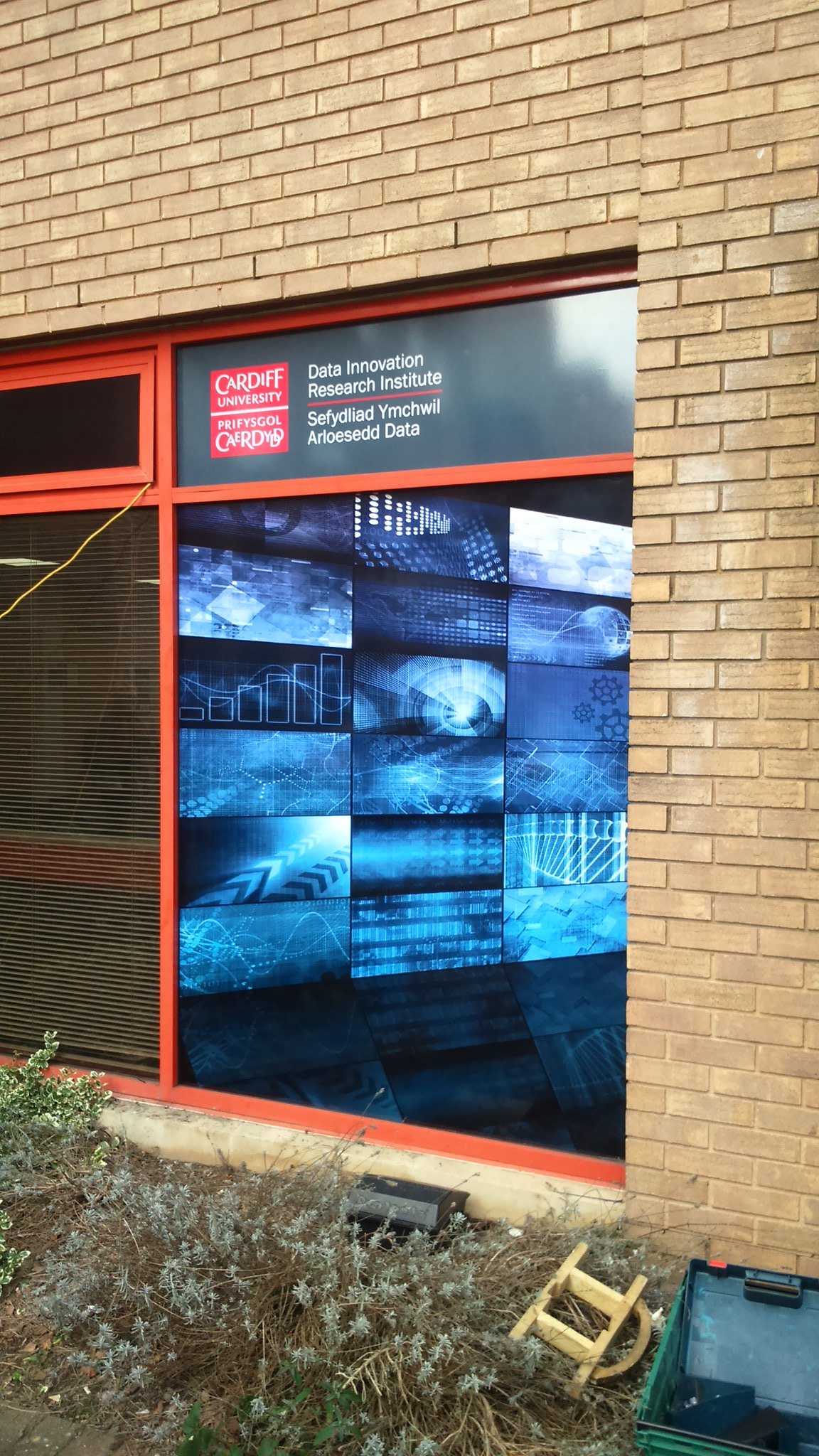
I’ve only been in my new office in the Data Innovation Research Institute for 5 months so it came as a big surprise to see that they’ve already started putting up the signs telling people where we are. In fact a couple of chaps came this  morning to do the necessary, and now we look very professional. It’s hard to tell that this used to be a chip shop.

dii_out

Please don’t tell the Health & Safety people about the power cable trailing through the window!

And here’s me answering the door to strangers…

dii_2

Thanks to Dan Read for taking that second one.

R.I.P. Nicolai Gedda (1925-2017)

Posted in Opera with tags , , , on February 13, 2017 by telescoper

I only heard yesterday the very sad news that the fine Swedish operatic tenor Nicolai Gedda passed away on 8th January 2017 at the age of 91.  The news wasn’t announced by his family until February 9th, which explains part of the reason I am so late to post a little tribute. This is from the first recording I ever heard of die Zauberflöte by Wolfgang Amadeus Mozart (made in 1964, conducted by Otto Klemperer) in which Gedda sings Tamino alongside the equally wonderful Gundula Janowitz as Pamina.  This CD played a huge role in getting me interested in Opera, so it is with special sadness but also special admiration that I say farewell to Nicolai Gedda.

R.I.P. Nicolai Gedda (1925-2017)


Cosmological perturbation effects on gravitational-wave luminosity distance estimates [CL]

Posted in The Universe and Stuff on February 13, 2017 by telescoper

Interesting paper about the effect of cosmological inhomogeneity on gravitational wave propagation. The effect could be import for the more distant sources likely to be detected with future experiments.

arxiver's avatararXiver

http://arxiv.org/abs/1702.01750

Waveforms of gravitational waves provide information about a variety of parameters for the binary system merging. However, standard calculations have been performed assuming a FLRW universe with no perturbations. In reality this assumption should be dropped: we show that the inclusion of cosmological perturbations translates into corrections to the estimate of astrophysical parameters derived for the merging binary systems. We compute corrections to the estimate of the luminosity distance due to velocity, volume, lensing and gravitational potential effects. Our results show that the amplitude of the corrections will be negligible for current instruments, mildly important for experiments like the planned DECIGO, and very important for future ones such as the Big Bang Observer.

Read this paper on arXiv…

D. Bertacca, A. Raccanelli, N. Bartolo, et. al.
Wed, 8 Feb 17
18/65

Comments: 16 pages, 3 figures

View original post

The View from the Castle Keep

Posted in Uncategorized on February 12, 2017 by telescoper

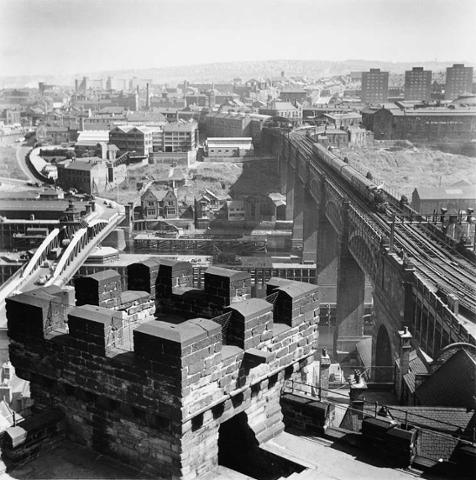
I couldn’t resist sharing this wonderful photograph, taken in 1957 by Jimmy Forsyth from the top of the Castle Keep in Newcastle upon Tyne, looking South across the Tyne towards the Midlands.

The two historic bridges in view are the Swing Bridge (left; completed in 1876) and the High Level Bridge (right; completed in 1849). The more famous Tyne Bridge is just out of shot to the left of the frame.

The picture was posted by the Twitter account of  Tyne & Wear Archives a few days ago.

Llŷr Williams plays more Beethoven

Posted in Music with tags , , , , , , , on February 10, 2017 by telescoper

Still determined to enjoy civilisation as much as I can while we still have it, last night I went to a splendid concert at the Royal Welsh College of Music and Drama in Cardiff featuring acclaimed Welsh pianist Llŷr Williams in the eighth (and penultimate) concert in a three-year series in which he is playing all the solo piano compositions of Ludwig van Beethoven.

The first half of last night’s recital comprised two very contrasting works united by the fact that both were dedicated to pupils of Beethoven. The first, the “Grande Sonata” No. 4 in E-flat major (Opus 7) dedicated to Anna Louise Barbara Keglevich (also known as Babette). This is an early work, in four movements in a relatively conventional classical style, and you can hear the influence of both Haydn and Mozart in it.

The second piece, much later and more famous, was the Opus 78 “a Therese“, dedicated to the Countess von Brunswick. This is a radically different piece, in just two movements, with a very brief slow introduction of just a few bars after which it is all at a sprightly tempo. It’s quite a odd work, really, and probably quite hard to play with flurries of notes coming thick and fast.


After the interval we heard two more sonatas, the connection between them being that both have nicknames: Sonata No. 15 (Opus 28) “Pastoral” and Sonata No. 26 (Opus 81a) “Les Adieux”. The nicknames given to some of these works are usually not by the composer and are sometimes rather misleading. The name “Pastoral” was attached by a music publisher not by Beethoven himself, but it does describe the mood of at least some of this piece, which does evoke the countryside. It’s a lovely work, actually, one of my favourites from the entire repertoire.

‘Les Adieux’ is a work in three movements describing respectively the farewell, absence and return of the Archduke Rudolf as he was forced to leave Vienna when it was attacked by Napoleon’s army in 1809.  The second movement’s moving expression of loss and loneliness, is followed by a jubilant finale marking Rudolf’s return.

That was the end of the advertised programme, but not quite the end of the concert because after very warm applause, Llŷr Williams returned to play a rather substantial encore – the 32 Variations in C Minor (also by Beethoven). It’s not quite as substantial as it seems, though, as each variation is only 10-15 seconds long.

Anyway, this was another  hugely enjoyable evening of piano music. I’m just sorry I came to the series rather late and there’s now only one left (in May 2017). Still, he happened to mention that the entire set is being released as an 11 CD Box set later this year…