I have been off sick today, but felt a whole lot sicker when I saw that the government had unveiled its plans for UK research spending over the next few years.
At first sight the picture looks encouraging. For example, the Science and Technology Facilities Council (STFC) sees a modest increase on cash terms from 16/17 to the end of the budget period. However that picture soon changes when you note that the allocation to STFC this year (15/16) was £400M. The allocation for (16/17) is £388M, so there’s an immediate reduction of £12M in available resource corresponding to a 3% cash cut.
This is a truly terrible result for the STFC community. It may not seem like a big cut, but so much of the STFC budget is locked up in subscriptions that cash cuts have a disproportionately damaging effect. I fear for grant funding in particular; that’s always what takes the hit when immediate savings are needed.
It seems clear to me that a deliberate decision was made in BIS to exclude the current year’s figures from their document in a cynical attempt to present a misleading picture of the settlement. It’s a shocking betrayal.
The unwillingness of our own government to fund scientific research property demonstrates how vitally important it is for us to have access to European Union funding and will strengthen the determination of UK scientists to keep us in the EU.
It seems I am an invited speaker at MaxEnt 2016, the 36th Workshop on Bayesian Inference and Maximum Entropy Methods:
As well as talking about some of my own research I’ve been asked to include a bit of a review in my presentation. I haven’t quite decided what background stuff to include so thought a bit of crowdsourcing was called for. Anyone got any suggestions for important Bayesian/Maximum Entropy developments in cosmology?
If so, please offer them through the comments box!
Only time for a short post today. I was at a lunchtime meeting involving both staff and students in the School of Mathematical and Physical Sciences this lunchtime, and one item on the agenda was the University of Sussex student-led teaching awards scheme, which is run jointly by the University and the Student Union.
This reminded me of an article in last week’s Times Higher which argues that such awards are “divisive” and leave staff who don’t win such awards “demoralised”.
I suppose such awards are “divisive” in the sense that they divide staff into two categories: those that win and those that don’t. The same is true of any award. You might equally well argue that we shouldn’t award degrees to students on the grounds that some students get them and others don’t.
The negative feelings expressed about these awards seem to me to be more to do with sour grapes than with any genuine concern about the effect (or lack of effect) they might have on teaching quality. Staff who are upset that they don’t win an award would be better advised to learn from their more popular colleagues than expressing resentment towards them.
Another thing that annoys me about this criticism is that it assumes that it questions the motivations for students nominating lecturers; in particular that students pick lecturers who are “showy” or “entertaining” or who set easy examinations. In my opinion this assumption does a great disservice to students. Last year several staff in my School won such awards and it was quite clear that the students picked the staff concerned because they appreciated their approach to teaching, not that their courses were easier or for any other trivial reason. It’s more than a little arrogant for staff to assume that students aren’t qualified to comment on what teaching they like.
It’s over thirty years since I finished my undergraduate degree. In the intervening time the way students study at school and university has changed, partly because of new technology. I hear far too many lecturers demanding that students should learn the way they did when they were younger. We should always be looking for better ways of helping students learn, and I think student awards are one way of identifying examples of good practice.
A gravitational-wave transient was identified in data recorded by the Advanced LIGO detectors on 2015 September 14. The event candidate, initially designated G184098 and later given the name GW150914, is described in detail elsewhere. By prior arrangement, preliminary estimates of the time, significance, and sky location of the event were shared with 63 teams of observers covering radio, optical, near-infrared, X-ray, and gamma-ray wavelengths with ground- and space-based facilities. In this Letter we describe the low-latency analysis of the gravitational wave data and present the sky localization of the first observed compact binary merger. We summarize the follow-up observations reported by 25 teams via private Gamma-ray Coordinates Network Circulars, giving an overview of the participating facilities, the gravitational wave sky localization coverage, the timeline and depth of the observations. As this event turned out to be a binary black hole merger, there is little expectation of a detectable electromagnetic signature. Nevertheless, this first broadband campaign to search for a counterpart of an Advanced LIGO source represents a milestone and highlights the broad capabilities of the transient astronomy community and the observing strategies that have been developed to pursue neutron star binary merger events. Detailed investigations of the electromagnetic data and results of the electromagnetic follow-up campaign will be disseminated in the papers of the individual teams.
This is interesting not so much for the result – there wasn’t really any expectation of finding an electromagnetic counterpart of a binary black-hole merger – but that it’s the first example of the kind of mass mobilisation of astronomers that will be needed when gravitational-wave astronomy gets going in earnest. Astronomers working on transient sources such as gamma-ray bursts are already used to this kind of operation, but there’s going to be a lot more of it in the future!
Posted in Open Access on March 1, 2016 by telescoper
I’m reblogging this to congratulate Tim Gowers on the launch of his new arXiv overlay journal, Discrete Mathematics. I wish this venture every success!
The Open Journal of Astrophysics won’t be far behind, and hopefully this will be the start of a real change to “the absurdly expensive and anachronistic system of academic publishing” that Tim Gowers describes in his post!
As you may remember from an earlier post on this blog, Discrete Analysis is a new mathematics journal that runs just like any other journal except in one respect: the articles we publish live on the arXiv. This is supposed to highlight the fact that in the internet age, and in particular in an age when it is becoming routine for mathematicians to deposit their articles on the arXiv before they submit them to journals, the only important function left for journals is organizing peer review. Since this is done through the voluntary work of academics, it should in principle be possible to run a journal for almost nothing. The legacy publishers (as they are sometimes called) frequently call people naive for suggesting this, so it is important to have actual examples to prove it, and Discrete Analysis is set up to be one such example. Its website goes…
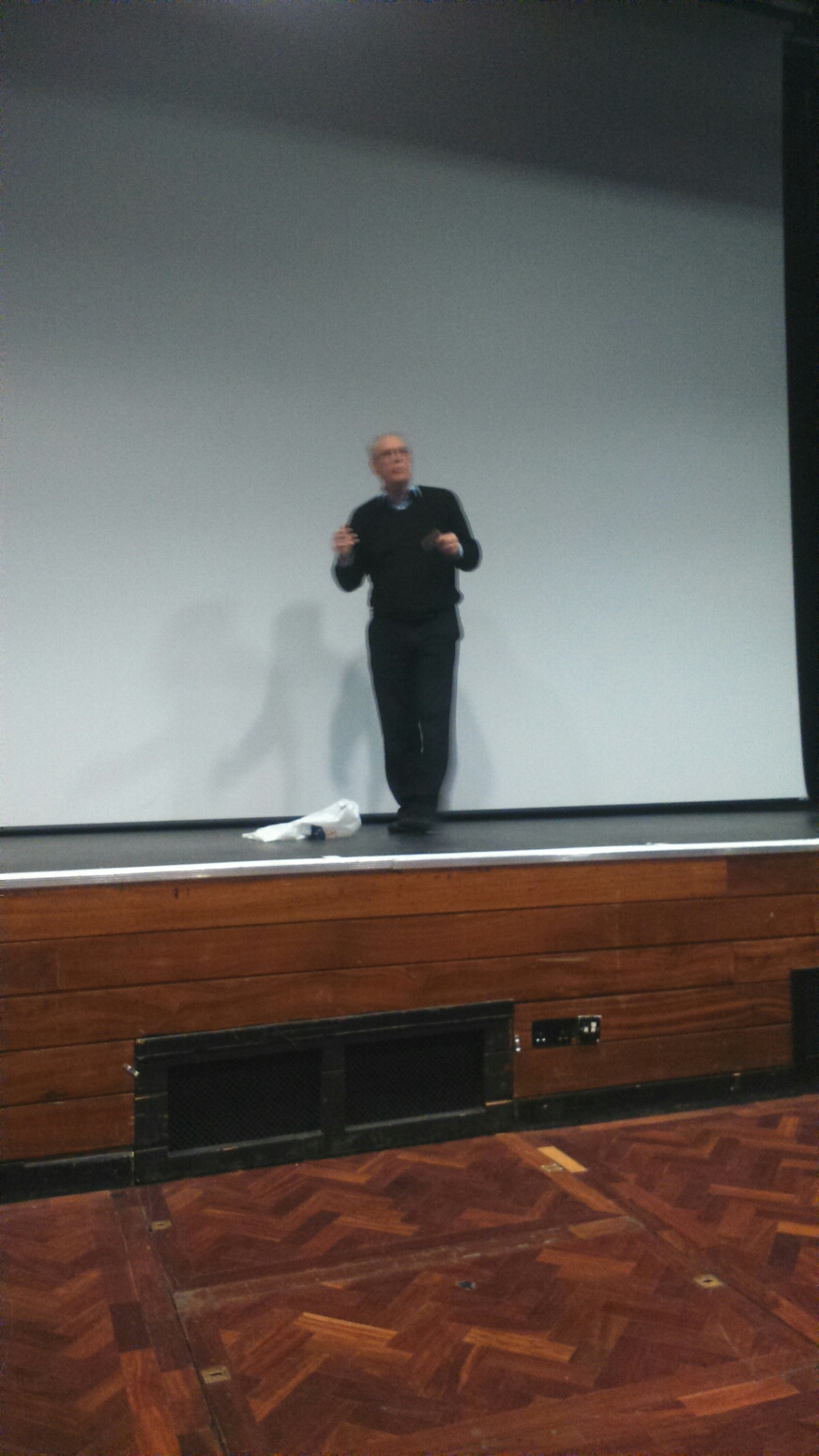
As promised I did my turn at the Brighton Science Festival yesterday. The Sallis Benney Theatre wasn’t quite full but there was a decent crowd, which was mildly surprising because the event I was involved in hadn’t really been advertised very well. If you want to know how my talk went then you should ask someone who was in the audience because I wasn’t really paying attention. However, I was preceded by John Haigh (seen below in mid-talk) whose presentation included a nice puzzle for the “Cute Problems” file:
Imagine you have three cards. One is blue on both sides. One is pink on both sides. One is pink on one side and blue on the other. Other than the colours the cards are identical. For the demonstration John glued playing cards together, but they don’t have to be playing cards. Anyway, you put the three cards into a bag (seen on the stage in the picture), pull out one card “at random” and look at the colour of one side but not the other. If the colour you see is blue, what is the probability that the other side is also blue?
Try to answer this without googling. I’ll post the solution when there have been enough responses to the poll:
OK. Over a hundred people responded so I have now closed the voting.
As always seems to be the case with this sort of problem, the majority went for the “obvious” answer, which turns out to be wrong!
SOLUTION: If the card is blue on one side then it must be either the blue-blue or blue-pink one. I think most people voted for 1/2 because there are two possible cards. But the relevant consideration is that there are three possible sides: side 1 of the blue-blue card; side 2 of the blue-blue card; and the blue side of the blue-pink card. Each of these is equally likely and two of them result in the other side being blue. The correct answer is therefore 2/3; it is twice as likely for the other side to be blue as it is to be pink.
I’m very grateful to Anton for sending me a link to this wonderful bit of history – the first time the singing of “Land Of My Fathers” before an international rugby match was captured on a newsreel. The venue for the Wales-Scotland match was Cardiff Arms Park, which still exists, but the international games are now played at the recently-renamed Principality Stadium which is directly adjacent to the old venue. The skyline around the Arms Park is still mostly recognizable. The opening panning shot is looking North towards Bute Park, but as it moves right you can see the old Palace and Hippodrome, on Westgate Street, which is now the site of a Wetherspoon’s pub; only the facade is intact as the interior was completely gutted and rebuilt.
It seems that some sort of mechanical fault meant that the roof of the Principality Stadium was left open for last night’s match between Wales and France (which Wales won 19-10). That would have meant that the singing of Land of my Fathers could have been heard throughout the city. I remember once spending a Saturday afternoon in my garden in Pontcanna, and could hear the noise from the stadium very clearly. There’s something very special about the singing of the Welsh National Anthem on such occasions – it always sends a shiver down my spine.
I’m going to be incommunicado for yet another “Awayday” today so I thought I’d post this to tide the blog over until Saturday when I’ll be back on campus for yet another Applicant Visit Day.
I heard this piece on Radio 3 a while ago and was intrigued enough to describe it on Twitter as “weird but groovy”. The presenter, Mr James Jolly, mentioned that comment live on air so I briefly felt like a celebrity. The Boléro sur un thème de Charles Racquet is a piece for organ and percussion that was actually improvised in its first performance by renowned organist and composer Pierre Cochereau in 1973, and transcribed by his son, Jean-Marc Cochereau. I think it’s a remarkably original piece of music.
Just a quick post to update you all on the Open Journal of Astrophysics project. The journal was opened to submissions just before Christmas 2015 and we’ve been putting papers through our editorial processes since then. We did plan to go live in January, but we have not yet done so because we haven’t had enough publishable articles. It has taken a bit longer than we expected partly because of the relatively low numbers of papers submitted – presumably because authors are understandably nervous about submitting to a new journal – but also because editors and referees are still learning how to use the system, which has slowed us down a bit. However the submissions we have had have allowed us to test the platform and do a bit of tinkering behind the scenes. We also fixed a bug that caused a problem when the site was viewed using Safari (rather than a proper browser).
I’m always delighted when I see something like this on the daily arXiv listing:
That and several other papers are already in the system but we could do with a few more to join the first batch of half-a-dozen or so we intend to publish soon. For that reason I’m appending below some information I’ve already circulated about the philosophy of the project and the practicalities of how to submit a paper.
–0–
We no longer need traditional academics journals to disseminate research in astrophysics and cosmology. We all post our research to the arXiv and read other papers there too. It’s been years since I last accessed a paper in a journal. The only useful function that journals provide is peer review, and we in the research community do that (usually for free) anyway. We only need journals for peer review, although we also like the prestige that is associated with them. But traditional journals have an unnecessarily slow and expensive editorial process, along with a nasty habit of placing the articles they publish behind a paywall.
The Open Journal does things differently, because we are not a publisher in the traditional sense. Instead, we are a peer-review platform, piggybacking on the arXiv for all the “publishing.” The Open Journal provides peer review for arXiv articles, making the process as fast and easy as we can. Once peer review for a particular article is successfully completed, we mark that article as accepted and send that information to the arXiv. Accepted articles will receive a DOI, and citations to them will get picked up through the CrossRef system just as they would in any other journal — but in a fraction of the time, and at a fraction of the cost. In fact, the service is provided free of charge both for authors and readers. There is no Article Processing Charge, no submission fee and no subscription is payable. The Open Journal is a service to the academic community, not a profit-making venture.
Moreover, articles published by the Open Journal are open, in that all articles are released under a Creative Commons Attribution license. The infrastructure is open too – the code running the Open Journal is available under an MIT license. The reviewer comments can be made open too, with the agreement of both the authors and reviewer(s). In the long run I hope that the community will embrace the spirit of open reviewing so anonymous confidential reviews will become the exception rather than the rule, but we’ll see how that goes just for now.
Any paper that’s suitable for the astro-ph section of the arXiv can be subvmitted to the Open Journal of Astrophysics. We will consider any “traditional” papers as well as others which may find it difficult to get into other journals, such as papers on astrophysics education or outreach or technical papers relating to instrumentation, mission proposals, and other documents.
Now, to business. The best way to get an idea of how the Open Journal works is by watching the following video (which was made using a beta version of the site, but nothing much has changed except for a few layout issues being changed):
Note that the site is currently just called the Open Journal, which is so that it can be used with minimal modification to create similar journals in other fields.
If you don’t want to watch the whole thing here’s a quick summary of the steps you have to take to submit to the Open Journal.
Write your paper. There is latex style file you can use here, although it is not compulsory to use this and we will allow anything that produces a PDF that can be viewed easily using our mark-up tool. Single-column is strongly preferred.
Submit your paper to the arXiv. You have to be registered in order to do this. Note also that you have to be prepared to submit your paper to the arXiv before it is reviewed. There is an enormous advantage in doing this, actually, as you may get more comments and suggestions than our refereeing system will generate.
Go to the submit tab on the left hand side of the screen.
Type in the arXiv reference of your paper (you can do this in various ways)
Our software will assign the paper to an editor, who will then select referee(s). Each referee makes comments by marking “issues” on the PDF, each of which needs a reply from the author. When all issues are resolved the paper is accepted. If revision is required a new version can be submitted to the arXiv which will be picked up by the software.
When it us ready our software will automatically assign a DOI and write it to the appropriate field in the arXiv.
That’s it! The paper is published and can be accessed either directly on the arXiv or through the Open Journal website.
Go and have a beer.
One other thing is worth mentioning. Because this service is provided free we do not have the effort required to undertake extensive copy-editing or rewriting of papers that are very poorly written. If the editor or referee deems a paper to be unfit for review then we will refer the author to a professional writing and editing service who will charge a fee depending on the length and complexity of the task.
As well as submissions we are also looking for new editors. At the moment our Editorial Board is dominated by cosmologists but as word gets round we will probably need expertise in other areas of astrophysics. If you’d like to volunteer please send me an email or use the comment box below.
Well, that’s about it. I just remains for me to thank all the people without whom this project would never have got off the ground, chiefly Chris Lintott, Arfon Smith and Adam Becker, developers Stuart Lynn and Marc Rohloff, and of course the good folk of the wonderful arXiv!
Just time for a spot of self-publicity. This Sunday, 28th February, is going to be Big Science Sundayat the Brighton Science Festival. This event is part of Big Science Weekend. The other part is called Big Science Saturday. On Big Science Saturday I’ll actually be working on campus at the University of Sussex for an Applicant Visit Day for prospective students, so the only part of Big Science Weekend I can participate in will be Big Science Sunday. I hope that clarifies the situation with respect to Big Science Saturday, Big Science Sunday and indeed Big Science Weekend as a whole… (Get On With It, Ed)
Anyway the reason for mentioning all this is that I will be taking part (on Big Science Sunday) in an event called Speaker’s Corner, which has been organized in collaboration with Oxford University Press, who no doubt hope that it will lead to some flogging of books. Here’s the blurb from the website:
(Actually it will start at 2pm, in the Sallis Benney Theatre on Grand Parade so make sure you get the time right if you want to be sure that you miss my contribution).
John and I settled the batting order in an appropriate fashion, via the tossing of a coin, and have agreed that we will both do our turns without any fancy graphics or computer malarky, in the manner of a couple of ageing buskers. I hope people attending this event will feel free to ask questions as we go along to make it as informal and interactive as possible.
So if you’re in the Brighton area on Big Science Sunday as opposed to Big Science Saturday do come along!
P.S. A new edition of Cosmology: A Very Short Introduction will be out later this year so we’ll be flogging off copies of the old edition at a heavily discounted price…
The views presented here are personal and not necessarily those of my employer (or anyone else for that matter).
Feel free to comment on any of the posts on this blog but comments may be moderated; anonymous comments and any considered by me to be vexatious and/or abusive and/or defamatory will not be accepted. I do not necessarily endorse, support, sanction, encourage, verify or agree with the opinions or statements of any information or other content in the comments on this site and do not in any way guarantee their accuracy or reliability.





 In the Dark