Although it won’t be launched for a few years yet, the communications team behind the James Webb Space Telescope project, or JSWST for short, is already gearing up. Here’s a nice video they’ve made which I came across the other day and thought I would share on here..
Follow @telescoperThe Great Photon Escape
Posted in The Universe and Stuff with tags Cosmology, James Webb Space Telescope on March 14, 2016 by telescoperFar Out
Posted in Poetry with tags Far Out, Philip Larkin, Poetry on March 14, 2016 by telescoperBeyond the dark cartoons
Are darker spaces where
Small cloudy nests of stars
Seem to float on air.
These have no proper names:
Men out alone at night
Never look up at them
For guidance or delight,
For such evasive dust
Can make so little clear:
Much less is known than not,
More far than near.
by Philip Larkin (1922-85)
Follow @telescoper
“British physics” – A Lesson from History
Posted in History, Politics, Science Politics, The Universe and Stuff with tags Ampere, Biot, Cauchy, D'Alembert, Einstein, Euler, Gauss, Hamilton, History, Lagrange, Laplace, Lorentz, Newton, Physics, Poisson, Riemann, Savart on March 13, 2016 by telescoperThe other day I came across the following tweet
Scientists for Britain on #bbcnews – we had Newton therefore we don’t want to be in Europe. Time for this again: https://t.co/UJtg4cgYmA
— Rebekah Higgitt (@beckyfh) March 10, 2016
The link is to an excellent piece about the history of European science which I recommend reading; as I do with this one.
I won’t pretend to be a historian but I can’t resist a comment from my perspective as a physicist. I am currently teaching a course module called Theoretical Physics which brings together some fairly advanced mathematical techniques and applies them to (mainly classical) physics problems. It’s not a course on the history of physics, but thenever I mention a new method or theorem I always try to say something about the person who gave it its name. In the course of teaching this module, therefore, I have compiled a set of short biographical notes about the people behind the rise of theoretical physics (mainly in the 19th Century). I won’t include them here – it would take too long – but a list makes the point well enough: Laplace, Poisson, Lagrange, Hamilton, Euler, Cauchy, Riemann, Biot, Savart, d’Alembert, Ampère, Einstein, Lorentz, Helmholtz, Gauss, etc etc.
There are a few British names too including the Englishmen Newton and Faraday and the Scot Maxwell. Hamilton, by the way, was Irish. Another Englishman, George Green, crops up quite prominently too, for reasons which I will expand upon below.
Sir Isaac Newton is undoubtedly one of the great figures in the History of Science, and it is hard to imagine how physics might have developed without him, but the fact of the matter is that for a hundred years after his death in 1727 the vast majority of significant developments in physics took place not in Britain but in Continental Europe. It’s no exaggeration to say that British physics was moribund during this period and it took the remarkable self-taught mathematician George Green to breath new life into it.
I quote from History of the Theories of the Aether and Electricity (Whittaker, 1951) :
The century which elapsed between the death of Newton and the scientific activity of Green was the darkest in the history of (Cambridge) University. It is true that (Henry) Cavendish and (Thomas) Young were educated at Cambridge; but they, after taking their undergraduate courses, removed to London. In the entire period the only natural philosopher of distinction was (John) Michell; and for some reason which at this distance of time it is difficult to understand fully, Michell’s researches seem to have attracted little or no attention among his collegiate contemporaries and successors, who silently acquiesced when his discoveries were attributed to others, and allowed his name to perish entirely from the Cambridge tradition.
I wasn’t aware of this analysis previously, but it re-iterates something I have posted about before. It stresses the enormous historical importance of British mathematician and physicist George Green, who lived from 1793 until 1841, and who left a substantial legacy for modern theoretical physicists, in Green’s theorems and Green’s functions; he is also credited as being the first person to use the word “potential” in electrostatics.
Green was the son of a Nottingham miller who, amazingly, taught himself mathematics and did most of his best work, especially his remarkable Essay on the Application of mathematical Analysis to the theories of Electricity and Magnetism (1828) before starting his studies as an undergraduate at the University of Cambridge ,which he did at the age of 30. Lacking independent finance, Green could not go to University until his father died, whereupon he leased out the mill he inherited to pay for his studies.
Extremely unusually for English mathematicians of his time, Green taught himself from books that were published in France. This gave him a huge advantage over his national contemporaries in that he learned the form of differential calculus that originated with Leibniz, which was far more elegant than that devised by Isaac Newton (which was called the method of fluxions). Whittaker remarks upon this:
Green undoubtedly received his own early inspiration from . . . (the great French analysts), chiefly from Poisson; but in clearness of physical insight and conciseness of exposition he far excelled his masters; and the slight volume of his collected papers has to this day a charm which is wanting in their voluminous writings.
Great scientist though he was, Newton’s influence on the development of physics in Britain was not entirely positive, as the above quote makes clear. Newton was held in such awe, especially in Cambridge, that his inferior mathematical approach was deemed to be the “right” way to do calculus and generations of scholars were forced to use it. This held back British science until the use of fluxions was phased out. Green himself was forced to learn fluxions when he went as an undergraduate to Cambridge despite having already learned the better method.
Unfortunately, Green’s great pre-Cambridge work on mathematical physics didn’t reach wide circulation in the United Kingdom until after his death. William Thomson, later Lord Kelvin, found a copy of Green’s Essay in 1845 and promoted it widely as a work of fundamental importance. This contributed to the eventual emergence of British theoretical physics from the shadow cast by Isaac Newton. This renaissance reached one of its heights just a few years later with the publication of a fully unified theory of electricity and magnetism by James Clerk Maxwell.
In a very real sense it was Green’s work that led to the resurgence of British physics during the later stages of the 19th Century, and it was the fact that he taught himself from French books that enabled him to bypass the insular attitudes of British physicists of the time. No physicist who has taken even a casual look at the history of their subject could possibly deny the immense importance of mainland Europe in providing its theoretical foundations.
Of course science has changed in the last two hundred years, but I believe that we can still learn an important lesson from this particular bit of history. Science moves forward when scientists engage with ideas and information from as wide a range of sources as possible, and it stagnates when it retreats into blinkered insularity. The European Union provides all scientific disciplines with a framework within which scientists can move freely and form transnational collaborations for the mutual benefit of all. We need more of this, not less. And not just in science.
Follow @telescoperAkhnaten at ENO
Posted in Opera with tags Akhnaten, Anthony Roth Costanzo, Emma Carrington, English National Opera, Juggling, Nefertiti, Philip Glass, Queen Tye, Rebecca Bottone on March 12, 2016 by telescoperHaving had a very stressful time at work over the last few days I decided on the spur of the moment to treat myself to a night at the Opera. The hottest tickets in London right now are for English National Opera’s new production of Akhnaten, by Philip Glass, but I managed to get one for Thursday night’s performance. I’m so glad I did, as it really lived up to the the reviews.
The Opera Akhnaten, which had its world premiere in 1983, is based on a real historical figure, Akhenaten, who ruled Egypt over 3300 years ago. Act I begins with the funeral rites of his father Amenhotep III, his son’s installation as Pharaoh Amenhotep IV and the beginning of his 17-year reign alongside his wife Nefertiti.
Roughly five years into his rule, however, Amenhotep IV changed his name to Akhenaten and set up a new, monotheistic religion, in which the Aten (the disk of the Sun) represented the supreme divine influence. Not content with that, he decided to up sticks from the city of Thebes (modern-day Luxor) and found a new city called Amarna in the desert. Act II is set in the Amarna period. It seems that, although Akhnaten had revolutionary ideas about religion, the costs of establishing this new way of life, and the resentment it caused among advocates of the old order, put strain on the kingdom of Egypt. In Act III we find Akhnaten and his family in a state of total detachment from the reality of the disintegration of his empire. Ailing and beset by hostile forces, Akhnaten eventually dies.
After Akhnaten’s death the Amarna project was abandoned, as was the new religion, and the 18th Dynasty resumed with the enthronment of Akhnaten’s son, a young boy by the name of Tutankhamun. Very little remains of the City of Amarna and there seems to have been a systematic attempt to eradicate Akhnaten from historical memory. One suspects that the priests of the old religion played a not inconsiderable role in these developments.
But Glass’s Akhnaten is more of a reflection or meditation on this extraordinary period than an attempt to depict it via a traditional historical narrative. His minimalist score also challenges the conventions of grand opera. The music develops only incrementally and the actors move in a correspondingly stylised fashion. Each act consists of a set of dreamlike tableaux mixing up the archaeological elements of the story with references to the modern world. In the first Act, for example, the funerary rites of Amenhotep IV involve characters in both ancient and modern dress to emphasize that death has been, and remains, a mystery for all cultures and civilisations.
It’s obviously an enormous challenge to bring such a work to the stage, but this production (developed in conjunction with the theatre company Improbable) rose to that challenge with great imagination. To counter the sense of stasis generated by the music, for example, there was a liberal influsion of brilliantly executed and extremely kinetic juggling. I knew there was going to be juggling before the performance and had worried that it might be distracting, or even just a gimmick. In fact I think the juggling worked extremely well not only in the context of the opera but also in the context of history; some of the earliest depictions of juggling are from ancient Egypt. The costumes and lighting add even more to the spectacular visual experience.
I don’t like all of Philip Glass’s music but I do think that Akhnaten is a masterpiece of minimalism. It’s full of subtle and interesting ideas but also extremely accessible, and it creates a strange hypnotic atmosphere which goes perfectly with this staging. The orchestra played the music well, though I felt the brass section could have played with a bit more “bite”, especially in the first Act. The ENO chorus was in excellent voice, as were all the principals: soprano Rebecca Bottone as Queen Tye (Akhnaten’s mother) and mezzo Emma Carrington as Nefertiti (Akhnaten’s wife) both sang extremely their demanding parts with great poise.
But I have to make special mention of Anthony Roth Costanzo as Akhnaten. He makes his first appearance on stage in Act I completely naked, walking slowly as if in a trance across a gallery and down the stairs in centre stage, and is then dressed in the garb of a Pharoah. His appearance then – slim, athletic, definitely masculine, and I have to say not inconsiderably sexy – contrasts with his increasingly androgynous appearance later on. But it is his stage presence and the truly remarkable quality of his singing that I will remember.

Akhnaten attempts to commune with the Aten. Picture credit: Guardian
Despite all I have written about the juggling and other aspects of the staging, for me the most powerful scene of the Opera is the last scene of Act II which is effective primarily for its simplicity. Here Akhnaten sings a longish aria in the form of Hymn to the Aten, which is based on an ancient text but bearing striking resemblance to Psalm 104 (a point underlined when the chorus sings Psalm 104, in Biblical Hebrew, offstage afterwards).This is the only part of the text sung in English; the rest is in a mixture of Aramaic, Akkadian and Hebrew. Constanzo’s rendition of the Hymn was stunningly beautiful, the clarity of his voice giving it a childlike sense of wonder. Akhnaten then walks slowly up a staircase in front of a representation of the Aten (above), then turns towards it and reaches out with both arms in an attempt to touch it, but he can’t reach it. He turns to face the audience, a desolate expression on his face, and the curtain falls on Act II.
That moment is so poignant because it spells out the universal nature of Akhnaten’s tragedy. His downfall seems inevitable from that point. He tries, as we all do in one way or another, and at some time or another, to commune with something beyond human existence. Inevitably, he fails, and his obsession costs him not only his kingdom, but also his life.
Follow @telescoper
A Potential Problem with a Sphere
Posted in Cute Problems with tags Electrostatiscs, Laplace's Equation, spherical harmonics on March 9, 2016 by telescoperBusy busy busy again today so I thought I’d post a quick entry to the cute problems folder. I set this as a problem to my second-year Theoretical Physics students recently, which is appropriate because I encountered it when I was a second-year student at Cambridge many moons ago!

HINT: You can solve this by finding the general solution for the potential at any point inside the sphere, but that isn’t the smart way to do it!
FURTHER HINT: The question asks for the Electric Field at the origin. What terms in the solution for the potential can contribute to this?
Answers through the comments box please!
OUTLINE SOLUTION: A numerically correct answer has now been posted so I’ll give an outline solution. The potential V inside the sphere is governed by Laplace’s equation, the general solution of which is a series expansion in powers of r and Legendre polynomials, i.e. rn Pn(θ). The coefficients of this expansion can be determined for the given boundary conditions (V=V0 at r=a for θ = +1, V=0 for cos θ = -1). However this is a lot more work than necessary. The question asks for the electric field, i.e. the gradient of the potential, and if you look at the form of the potential there is only one term that can possibly contribute to the field at r=0, namely the one involving rP1(cosθ) =rcos θ (which is actually z). Any higher power of r would give a derivative that vanishes at the origin. Hence we just have to determine the coefficient of one term. Using the orthogonality properties of the Legendre polynomials this can easily be seen to be 3V0/4a. The electric field is thus -3V0/4a in the z-direction, i.e. vertically downwards from the top of the sphere.
Follow @telescoperWomen Printers
Posted in Uncategorized on March 8, 2016 by telescoperFascinating piece from my old college…

To celebrate International Women’s Day 2016 on the blog, we are showcasing the work of female printers of the 17th century in the Pepys Library.
In early modern England, the printing industry was not altogether a male preserve: between 1550 and 1650, it is estimated that 130 women in Britain were working actively in the printing trade. It was common for women printers to work alongside men in the printing houses of convents or with family members and spouses, and it was usual for them to marry within the trade. Amongst the books in Magdalene’s historic libraries, one can find the names of women printers on the imprints of title pages. Some are referred to by their marital status, such as ‘Widow Sayle’ ‘Widow of J. Blageart’ and the ‘widowe of Richarde Iugge’, others, by their full names such as Alice Norton, Elizabeth Purslowe, Mary Clark and Hannah Allen.
It…
View original post 412 more words
All of Me – Billie Holiday & Lester Young
Posted in Jazz with tags All of Me, Billie Holiday, Jazz, Lester Young on March 8, 2016 by telescoperAfter an even more stressful day than usual I decided to have a quick look at Youtube before going home. That’s how I found this rare and priceless gem. It’s a wonderful performance of All of Me featuring one of the greatest combinations of musical talent in Jazz history, Billie Holiday and Lester Young, but it’s a discarded track that was never released on record. “Why would anyone discard such a masterpiece?”, I hear you ask. Well, that’s simply because it ran over the three minutes that could fit onto an old-style 78rpm disk. The reason it is too long is that there’s more than the usual ration of Lester Young’s tenor saxophone, in the form of a superb extended solo that is so beautiful it brought tears to my eyes. This is as perfect a performance as you could hope to hear, but it is brought back down to Earth at the end by the recording engineer whose only comment from the box when the exquisite music subsides is “It’s a bit long”…
Follow @telescoper
If Dick van Dyke tried a Geordie accent…
Posted in Television with tags Geordie Accent, Television, The Castle on March 8, 2016 by telescoper…it couldn’t be any less accurate than this effort from the US TV series The Castle:
Could this be the worst attempt at a regional accent ever recorded?
Follow @telescoper
The Ways We Touch
Posted in Mental Health, Poetry on March 8, 2016 by telescoperHave compassion for everyone you meet,
even if they don’t want it.
What appears bad manners, an ill temper or cynicism
is always a sign of things no ears have heard,
no eyes have seen.
You do not know what wars are going on down there where the spirit meets
the bone.
by Miller Williams (1930-2015)
Follow @telescoper
A Galaxy at Redshift 11.1?
Posted in The Universe and Stuff with tags Galaxy Redshift, Grism, Hubble Space Telescope, z=11.1 on March 7, 2016 by telescoperBack in the office after one Friday off and there’s the inevitable queue at my door and mountain of things that just have to be done immediately. Yeah, right..
Anyway, I couldn’t resit a short blogging break to mention a bit of news that made a splash last week. This is the claim that a galaxy has been observed at a redshift z=11.1 which, if true, would make it the most distant such object ever observed. When I was a lad, z=0.5 was considered high redshift!
If the current standard cosmological model is correct then the lookback time to this redshift is about 13.4 billion years, which means that the galaxy we are seeing formed just 400 million years after the Big Bang. If it is correctly identified then it has to be an object which is forming stars at a prodigious rate. You can find more details in the discovery paper (by Oesch et al.) here.
I have taken the liberty of extracting the following figure:
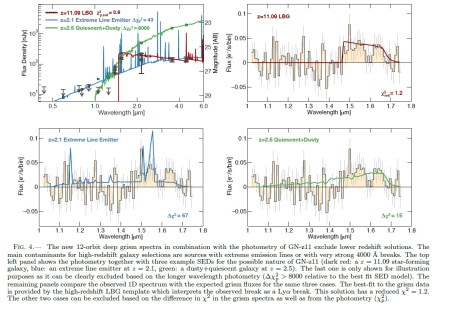
The claim is that the model spectrum on the top right is a much better fit to the data obtained using the Hubble Space Telescope Grism spectrograph than the two alternatives at much lower redshift. However, this depends a great deal on having a good model for the significant contamination from other sources. Moreover I’m sure the residuals are non-Gaussian and I’m not therefore convinced that a simple χ2 is the best way to assess the fit. Obviously I’d like to see a proper Bayesian model comparison!
So, as I have been on previous occasions (e.g. here), I remain not entirely convinced. But then I’m a theorist who is always excessively suspicious of data. Any experts out there want to tell me I’m wrong?
Follow @telescoper

 In the Dark