hunker down on their hands and knees
and sniff the problem
poke it with ungentle fingers
rub it raw with steel wool
wad it up in a ball and cackle
then pound it flat with little mallets
watch it rise like dough (uh oh)
resume its original shape
screech, swing at it with hatchets
spatter the walls with oozing fragments
stare horrified at the shattered bits
reassembling themselves, jump up
attack the problem with icepicks
gouge holes six inches deep
and seven inches across
(chew the mangled matter
spit it out and belch) kick the thing
into a corner, remove their belts
and beat it senseless, walk off
with the answer in their pockets.
Mathematicians at Work
Posted in Poetry with tags Judith Saunders, Mathematicians at Work, Poetry on January 29, 2016 by telescoperCritical Opalescence in Carbon Dioxide
Posted in The Universe and Stuff with tags critical opalescence on January 28, 2016 by telescoperFascinating demonstration of critical opalescence..

One feature of the teaching at Dalhousie University’s Physics Department is a laudable emphasis on demonstrations.
Visiting Professor Tom Duck there, I was delighted to be shown a demonstration I had heard of, but never seen: the phenomenon of critical opalescence in carbon dioxide.
I have written about critical opalescence previously on this blog (here) and with more pictures (here), so I won’t repeat most of that.
In my previous articles I described the phenomenon in two immiscible liquids which is an exact analogy for the physics of critical opalescence in a pure substance. But it’s not what physics students read about in text books.
Michael: What are you going on about?
The phenomenon occurs when one heats a liquid in a container with a small amount of free space.
- As the liquid heats up, it expands causing its density to fall.
- The liquid also evaporates causing the vapour (gas) pressure to…
View original post 338 more words
Hit and Run in Brighton
Posted in Brighton with tags Brighton, hit and run, Kemptown on January 27, 2016 by telescoperI was having a drink with friends on campus last night and the subject came up of a terrible hit-and-run incident in Kemptown on 14th July. I hadn’t heard about it until then. The location of this incident was Montague Place in Kemptown, which is due a couple of hundred yards from my flat . The police issued a video obtained from CCTV cameras and appealed for witnesses. Apparently this bore fruit and two people were arrested yesterday. Rumours are circulating that the car involved was stolen.
I’m including the horrific video here. The man who was hit suffered serious head injuries, but is apparently recovering well. He’s extremely lucky to have survived. If you watch the video I’m sure you will agree that he is very fortunate. Please be aware that this is extremely shocking to watch so don’t click it you’re squeamish. I’m showing it here because it’s a graphic illustration of what a speeding car can do to a human being. Cars frequently travel at ridiculous speeds around Kemptown. This is what can happen when people drive like maniacs.
If the persons arrested are guilty I hope they get very severe punishment.
Follow @telescoper
Stormy Weather (Billie Holiday)
Posted in Jazz with tags Billie Holiday, Stormy Weather on January 26, 2016 by telescoperDefining Sexual Harassment
Posted in Uncategorized with tags Sexual Harassment, University of Sussex on January 25, 2016 by telescoperSince I spent this morning at a training session about preventing bullying and harassment in the workplace, and after the latest high-profile sexual harassment case at Caltech I thought it might be useful to share my current employer’s definition of what may constitute sexual harassment in the workplace. In my earlier post on harassment I talked mainly about the processes that take place when it is alleged, but I didn’t include a clear statement of how sexual harassment is defined.
The following is taken from the University of Sussex’s Policy to Prevent Bullying and Harassment at Work (which is in the public domain):
Sexual harassment is a form of sex discrimination and involves unwanted and unwelcome attention of a sexual nature. This may be physical or verbal or involve the denigration of an individual on sexual grounds or by sexual means. Some examples of sexual harassment are:
- indecent assault
- deliberate physical contact to which the individual has not consented or had the opportunity to object to
- offensive or derogatory language alluding to a person’s private life or sexual behaviour or orientation by innuendo, jokes or remarks
- provocative suggestions
- pressing an individual to accept unwelcome invitations
- the display of suggestive or pornographic material
- unwelcome repeated telephone calls, letters or emails
These examples should not be seen as exhaustive: any unwelcome behaviour of a sexual nature which creates an intimidating, hostile or offensive environment for the recipient may be regarded as sexual harassment.
Morning over the Marina
Posted in Brighton on January 25, 2016 by telescoperHow clear, how lovely bright,
How beautiful to sight
Those beams of morning play;
How heaven laughs out with glee
Where, like a bird set free,
Up from the eastern sea
Soars the delightful day.

p.s. note the authentic “rosy fingers” to the left of the shot…
Follow @telescoperTannhäuser und der Sängerkrieg auf Wartburg
Posted in Opera with tags BBC Radio 3, Metropolitan Opera, Peter Mattei, Tannhauser on January 24, 2016 by telescoperAfter spending most of the day on campus for the first Applicant Visit Day of 2106 at the University of Sussex I went home feeling a bit exhausted, but my spirits were soon lifted when I switched on BBC Radio 3 to find a broadcast just startiong of Tannhäuser (or Tannhäuser und der Sängerkrieg auf Wartburg to give it it’s full title). It wasn’t quite the usual Saturday Night Live from the Met because the performance was actually recorded on October 31st 2015 at the Metropolitan Opera in New York, so I won’t quibble about that. Composed in 1845, Tannhäuser is a relatively early work by Richard Wagner which he called a “Romantic opera in three acts” indicating that it has the structure of a conventional opera; later on in his career he was to abandon that format in favour of the Music Drama (which is not built on a succession of arias and recitatives) as Tannhäuser is.
I won’t go into too much detail of the plot, but Tannhäuser is basically about typical Wagnerian themes: the conflict between spiritual and earthly love, between life and death, and the hope of redemption. The eponymous hero, a minstrel knight, takes a walk on the wild side in Act I by visiting Venusberg, in the course of which he is unfaithful to his beloved Elizabeth. He turns up in Act II at Wartburg where there i a sort of mediaeval Eurovision Song contest. First singer up is the naive but honorable Wolfram who sings a beautiful song about courtly love, but Tannhäuser finds it all a bit tame and sings a much raunchier number, which reveals that he’s been a naughty boy. There is uproar, swords are drawn and it all gets a bit fraught. Eventually Tannhäuser is persuaded to atone for his transgressions by undertaking a pilgrimage to Rome. Unfortunately for him the Pope isn’t in an absolving mood and tells him he’s going to suffer eternal damnation. In Act III, Tannhäuser, clearly unhinged, talks about returning to Venusberg – if he’s damned anyway he might as well go out with a bang – but then he discovers his beloved Elizabeth is dead and, overcome by grief and remorse, he dies too.
Regular readers of this blog will know that I have an ambivalent attitude to Wagner, but last night I was hooked from the moment I switched the radio on and listened right through to the end, which came four hours later. I have heard Tannhäuser before and knew the familiar show-stoppers (especially the famous Pilgrim’s Chorus, which is as uplifting a piece of music as you will hear anywhere). What was so very special last night, however, was the quality of the singing, which was truly wonderful all the way through the principals and chorus. The broadcast is available on iPlayer for the next month. If you have never had a taste of Wagner, give it a go. This opera is full of great tunes but they were sung better in this performance than in any other I have heard. As a little taster, here is Wolfram (sung by baritone Peter Mattei) from the same production we heard last night, singing his Act III aria O du mein holder Abendstern (O thou my fair evening star).
Follow @telescoper
Jazz, STEM and the Creative Process
Posted in Art, Jazz, The Universe and Stuff with tags Bill Evans, creativity, Jazz, Nigel Carrington, STEM, The Creative Process and Self-Teaching, theoretical physics on January 23, 2016 by telescoperThe Times Higher has given me yet another reason to be disgruntled this week, in the form of an article that talks about the possible effect of the proposed Teaching Excellence Framework (TEF) on “creative” subjects. What bothers me about this piece is not that it criticises the TEF – I think that’s an unworkable idea that will cause untold damage to the University system if, as seems likely, it is railroaded through for political reasons – but that the author (Nigel Carrington, Vice-Chancellor of the University of Arts London), like so many others, lazily implies that STEM disciplines are not creative. I think some of the most intensively creative people in the world are to be found in science and engineering and creativity is something we try very hard to nurture in students at Sussex University regardless of discipline.
Anyway, while feeling grumpy about this article, I remembered this video of an interview with the great jazz pianist, Bill Evans. Jazz is undoubtedly an intensely creative form, not only because it requires spontaneous real-time conversion of ideas into sounds. Evans talks with great passion and insight about creativity in music-making, but the striking thing about what he says at the very beginning about the need to analyse your subject at a very elementary level before proceeding in order to create something that’s “real” applies equally well to, e.g. theoretical physics as it does to jazz.
In the following section he reiterates this point, but also stresses the discipline imposed by a particular form and why this does not limit creativity but makes it stronger.
It’s better to do something simple that is real. It’s something you can build on. because you know what you’re doing. Whereas, if you try to approximate something very advanced and don’t know what you’re doing, you can’t build on it.
No matter how far I might diverge or find freedom in this format, it only is free insofar that it has reference to the strictness of the original form. That’s what gives it its strength.
In much the same way, theoretical physics is not made less creative because it has to obey the strict rules of mathematics but more so. This is true also in the fine arts: the more limited the canvas the more creative the artist must be, but it also applies to, e.g. engineering design. Self-teaching is important in STEM subjects too: the only really effective way of learning, e.g. physics, is by devoting time to working through ideas in your own mind, not by sitting passively in lectures.
All subjects require technical skill, but there is more to being a great jazz musician than mastery of the instrument just as there’s more to being a research scientist than doing textbook problems. So here’s to creativity wherever it is found, and let’s have a bit more appreciation for the creative aspects of science and engineering!
Follow @telescoper
Statement on the Litvinenko Case
Posted in Uncategorized with tags Alexander Litvinenko, ly, Norman Dombey on January 22, 2016 by telescoperYesterday while I was at the Winter Graduation ceremony, one of the esteemed Emeritus Professors in the Department of Physics of Astronomy, Norman Dombey, recorded two TV interviews about the Alexander Litvinenko case. Professor Dombey was an expert witness who contributed evidence to an inquiry that concluded that Mr Litvinenko was deliberately poisoned with radioactive Polonium, and that his murder was probably explicitly authorised by Vladimir Putin.
One of the interviews took place outside the Department:
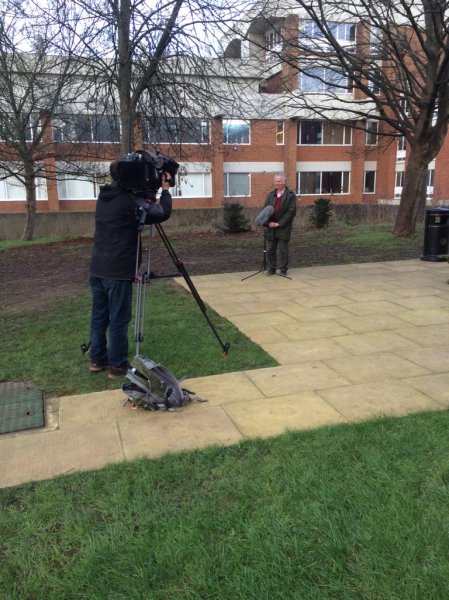
The other was filmed in my office while I was on graduation duty.
In case any KGB agents are in the habit of reading this blog, I wish to point out that the use of my office by Professor Dombey should not be taken as evidence that I endorse the conclusion that Vladimir Putin ordered the assassination of Mr Litvinenko. Even if that is probably the case.
Follow @telescoper
Winter Graduation
Posted in Uncategorized on January 21, 2016 by telescoper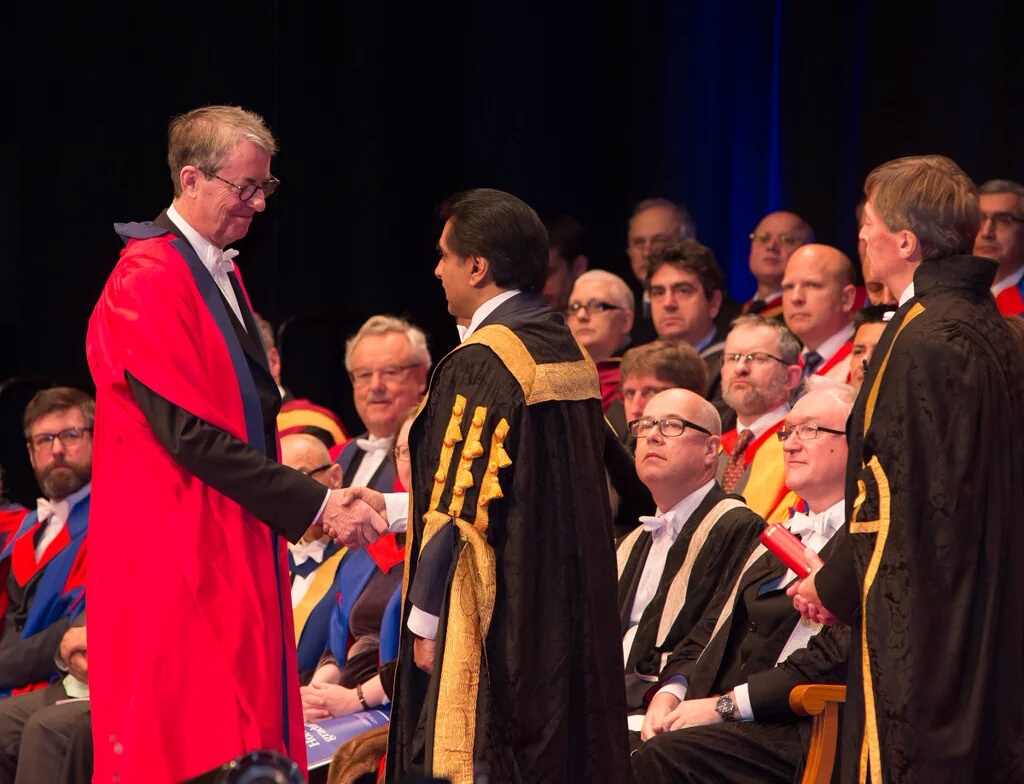
A very busy week found me on graduation duty today at the Brighton Dome for the Winter Graduation for the School of Mathematical and Physical Sciences at the University of Sussex. In fact students from all the Science schools at Sussex graduated this morning, so it was quite a long ceremony but it was, as usual, made very enjoyable by the presence of the Chancellor, Sanjeev Bhaskar, who was at one point lifted clean off his feet by a strapping graduand. I’ve seen hugs, handshakes and selfish galore on the stage at The Dome. but I don’t think Ive ever seen the Chancellor get picked up before!
In the photograph above Sanjeev is presenting an honorary degree to a distinguished expert in the field of art conservation, Dr David Bomford. You can just see me on the far left.
Many congratulations to all those who graduated today!
Follow @telescoper
 In the Dark