Winter: A Dirge

Posted in Poetry with tags on December 16, 2015 by telescoper

The wintry west extends his blast,
  And hail and rain does blaw;
Or the stormy north sends driving forth
  The blinding sleet and snaw:
While, tumbling brown, the burn comes down,
  And roars frae bank to brae;
And bird and beast in covert rest,
  And pass the heartless day.

“The sweeping blast, the sky o’ercast,”
  The joyless winter day
Let others fear, to me more dear
  Than all the pride of May:
The tempest’s howl, it soothes my soul,
  My griefs it seems to join;
The leafless trees my fancy please,
  Their fate resembles mine!

Thou Power Supreme, whose mighty scheme
  These woes of mine fulfil,
Here firm I rest; they must be best,
  Because they are Thy will!
Then all I want—O do Thou grant
  This one request of mine!—
Since to enjoy Thou dost deny,
  Assist me to resign.

by Robert Burns (1759-1796)

A Bump at the Large Hadron Collider

Posted in Bad Statistics, The Universe and Stuff with tags , , , on December 16, 2015 by telescoper

Very busy, so just a quickie today. Yesterday the good folk at the Large Hadron Collider announced their latest batch of results. You can find the complete set from the CMS experiment here and from ATLAS here.

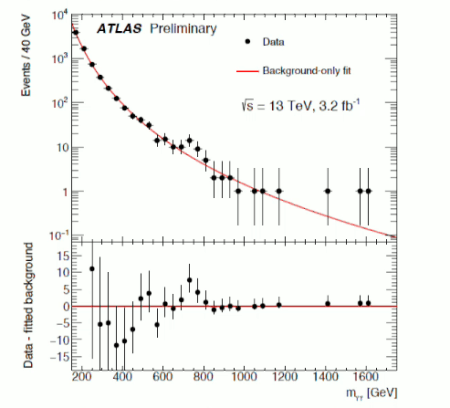
The result that everyone is talking about is shown in the following graph, which shows the number of diphoton events as a function of energy:

Atlas_Bump

Attention is focussing on the apparent “bump” at around 750 GeV; you can find an expert summary by a proper particle physicist here and another one here.

It is claimed that the “significance level” of this “detection” is 3.6σ. I won’t comment on that precise statement partly because it depends on the background signal being well understood but mainly because I don’t think this is the right language in which to express such a result in the first place. Experimental particle physicists do seem to be averse to doing proper Bayesian analyses of their data.

However if you take the claim in the way such things are usually presented it is roughly equivalent to a statement that the odds against this being a real detection are greater that 6000:1. If any particle physicists out there are willing to wager £6000 for £1 of mine that this result will be confirmed by future measurements then I’d happily take them up on that bet!

P.S. Entirely predictably there are 10 theory papers on today’s ArXiv offering explanations of the alleged bump, none of which says that it’s a noise feature..


Why Does Hot Water Freeze Faster Than Cold?

Posted in Biographical, Cute Problems, The Universe and Stuff with tags , , , on December 15, 2015 by telescoper

Many years ago I had to take a day off School to travel down to Cambridge in order to be interviewed for a place on the Natural Sciences Tripos at Magdalene College. One of the questions I was asked was the following:

If you put a bucket of hot water and a bucket of cold water outside on a freezing cold day, which would freeze first?

I think I gave the right answer, which is that it’s not obvious..

My main argument was that evaporation would increase the rate of cooling of the hot water and also mean that when it did get down to freezing point there would be less of it to freeze. I attempted to work something out based on the heat capacity of liquid water versus the latent heat of freezing, but didn’t get very far with that as I couldn’t remember any numbers. I do remember saying that this would also depend on the shape of the bucket, especially on the surface area exposed: water in a flat dish would experience more evaporation than a narrow cylinder.

I only realised later that it wasn’t really the purpose of such questions to arrive at a definite answer, more to give the interviewer an idea of whether the interviewee is capable of thinking on his/her feet. I guess I must have waffled enough to give the misleading impression that I could, and was offered a place.

The reason I am rambling on about this now is that I stumbled across a blog post yesterday about something called the Mpemba Effect from which I quote:

The Mpemba effect is the observation that warm water freezes more quickly than cold water. The effect has been measured on many occasions with many explanations put forward. One idea is that warm containers make better thermal contact with a refrigerator and so conduct heat more efficiently. Hence the faster freezing. Another is that warm water evaporates rapidly and since this is an endothermic process, it cools the water making it freeze more quickly.

None of these explanations are entirely convincing, which is why the true explanation is still up for grabs

It appears that, depending on the circumstances, hot water does indeed freeze faster than cold water but that the reason why is apparently still not obvious.

However, there is a (fairly) recent paper on the arXiv that claims to solve this problem. The abstract reads:

We demonstrate that the Mpemba paradox arises intrinsically from the release rate of energy initially stored in the covalent H-O part of the O:H-O bond in water albeit experimental conditions. Generally, heating raises the energy of a substance by lengthening and softening all bonds involved. However, the O:H nonbond in water follows actively the general rule of thermal expansion and drives the H-O covalent bond to relax oppositely in length and energy because of the inter-electron-electron pair coupling [J Phys Chem Lett 4, 2565 (2013); ibid 4, 3238 (2013)]. Heating stores energy into the H-O bond by shortening and stiffening it. Cooling the water as the source in a refrigerator as a drain, the H-O bond releases its energy at a rate that depends exponentially on the initially storage of energy, and therefore, Mpemba effect happens. This effect is formulated in terms of the relaxation time tau to represent all possible processes of energy loss. Consistency between predictions and measurements revealed that the tau drops exponentially intrinsically with the initial temperature of the water being cooled.

Although I did study chemistry as part of my Natural Sciences degree, I dropped it after the first year and have subsequently forgotten almost everything I learned. I’m therefore not really qualified to judge whether the explanation presented in this paper is reasonable. I would be convinced if the theory could predict other observable outcomes but at the moment it doesn’t seem to.

Any chemists care to comment?
17 Equations that Changed the World

Posted in History, The Universe and Stuff with tags , , on December 14, 2015 by telescoper

Yesterday I posted about a map that “changed the world”. Clearly the world changed a lot and for many different reasons because when I got home I noticed the following picture on Facebook, depicting 17 equations that also “changed the world”:


17 Equations

This is from a book by mathematician Ian Stewart.

Of course it’s actually 20 equations, because there are four Maxwell Equations. It is an interesting selection. Are there any surprising omissions?


William Smith and the First National Geological Map

Posted in History, The Universe and Stuff with tags , , , on December 13, 2015 by telescoper

Friday was the last day of teaching term here at the University of Sussex. Aided by the general winding down of things I managed the unusual feat of geting up to London in time to catch some of the monthly discussion meeting of the Royal Astronomical Society, which was on A Critical Assessment of Cluster Cosmology. Usually I only just manage to get there in time for some of the Ordinary Meeting which follows the specialist meetings at 4pm. And sometimes I only get there in time for the drinks reception at Burlington House followed by the RAS Club dinner at the Athenaeum!

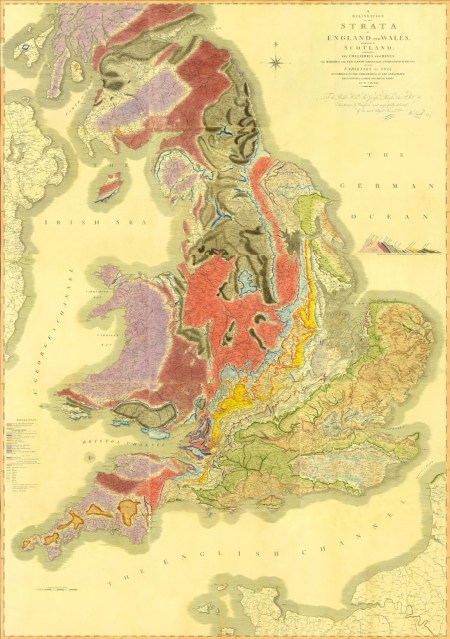
I may write something about Cluster Cosmology if I get time before Christmas, but I thought I’d post an item now inspired by one of the talks in the Ordinary Meeting by Tom Sharpe of Lyme Regis Museum and Cardiff University. This talk was timed to mark the 200th anniversary of the publication of the first ever geological map of England and Wales in 1815. To make it even more topical, the talk was given in the lecture theatre of the Geological Society of London where an original print of the Map is on permanent display:

William Smith Map

The person responsible for this map, which was the first to show nationwide geological strata, was a chap called William Smith who surveyed England and Wales on foot and on horseback, travelling over 10,000 miles to make it. It was a remarkable achievement which, among many other things, led the way to great changes in the understanding of geological time. Unfortunately his work didn’t have much impact when it was first published. Smith, who was evidently not a very astute businessman, eventually went bankrupt and spent some time in a debtor’s prison.

The map itself is extremely beautiful as well as very clever in the way it uses colours and shading to represent three-dimensional information on a two dimensional surface.

Anyway, there is a book  entitled  The Map that Changed the World  written by Simon Winchester which tells the story of William Smith and his map. I haven’t read it but I’m told it’s excellent. I’ll probably buy a copy with the book tokens I inevitably get for Christmas!


Forbrydelsen

Posted in Television with tags , , , , on December 12, 2015 by telescoper

Over the past week or so I’ve been watching the original TV series The Killing (in Danish with English subtitles). This was actually first broadcast in Denmark in 2007 but apparently achieved a bit of a cult following in the United Kingdom in 2011 when it was shown on BBC4. That was round about the time that I basically gave up watching television so I missed it then. However, I saw the DVD box set at a drastically reduced price a few weeks ago and decided to buy it. I’m very glad I did.

Forbrydelsen,_DVD

I’ve been to Copenhagen many times in my life but this is the first time I’ve seen some familiar locations on the small screen, which added a personal dimension for me, but my main reason for doing a blog about it is just to salute it for being exceptionally good.  The Killing (in Danish Forbrydelsen: “The Crime”) is often quoted as an example of Nordic or Scandinavian Noir but that term is generally reserved for crime fiction novels rather than movies or television programmes.  The Killing definitely retains some elements in common with classic  Film Noir – a strong central female character and low-key visual style to name but two – but I’m not sure I would categorize it as “noir“. On the other hand some classic examples of film noir don’t display many of the characteristics associated with the genre either. Categories don’t really matter that much anyway, even when they are easily defined which is not the case with Noir.

The plot of The Killing revolves around the police investigation into a terrible crime: the brutal rape and murder of a young woman, Nanna Birk Larsen, who disappears after a Halloween party. Each of the twenty 50-minute long episodes depicts one day; the series has to be that long to accommodate all the twists, red herrings and false dawns, but it never loses pace or tension. That everything happens in a Nordic November means short days of grey skies and long wintry nights, establishing an appropriatelt sombre visual mood.

The complexity of the plot and the Copenhagen setting are not the most compelling things about this as a piece of TV drama, however. What stood out for me was the excellence of the acting not only from Sofie Gråbøl as lead investigator Sarah Lund but from the entire cast. The effect on the Birk Larsen family of the loss of their daughter in such cruel circumstances is portrayed most movingly, especially by Bjarne Henriksen as the father, Theis Birk Larsen.

I am so late writing about this that I don’t suppose I would spoil it for too many people if I revealed who did it, but I’ll refrain from doing it. What I will say, however, is that I was pretty confident that I knew who the perpetrator was right from Episode 1 and I proved to be right. That doesn’t mean that I’d make a great detective, just that I’ve had enough experience of detective stories to know some of the tricks writers use to throw the reader (or viewer) off the scent.

If you haven’t seen The Killing, I thoroughly recommend it. I gather there’s a second series too. I must watch that sometime…


The student left’s broken moral compass

Posted in Politics on December 12, 2015 by telescoper

I’m taking the liberty of reblogging this post about the dire state of student politics – and of the far left generally. The problems described within the post are not confined to Goldsmiths College, nor indeed to Islamists, but I’d encourage you to watch the video here, which shows the disruption of the talk referred to in this post and which gives you an idea of the contempt some people have for the idea of free speech. Goldsmiths Student Union have asked for the video to be taken down. I hope it stays.

Sussex in Pseuds Corner

Posted in Uncategorized on December 11, 2015 by telescoper

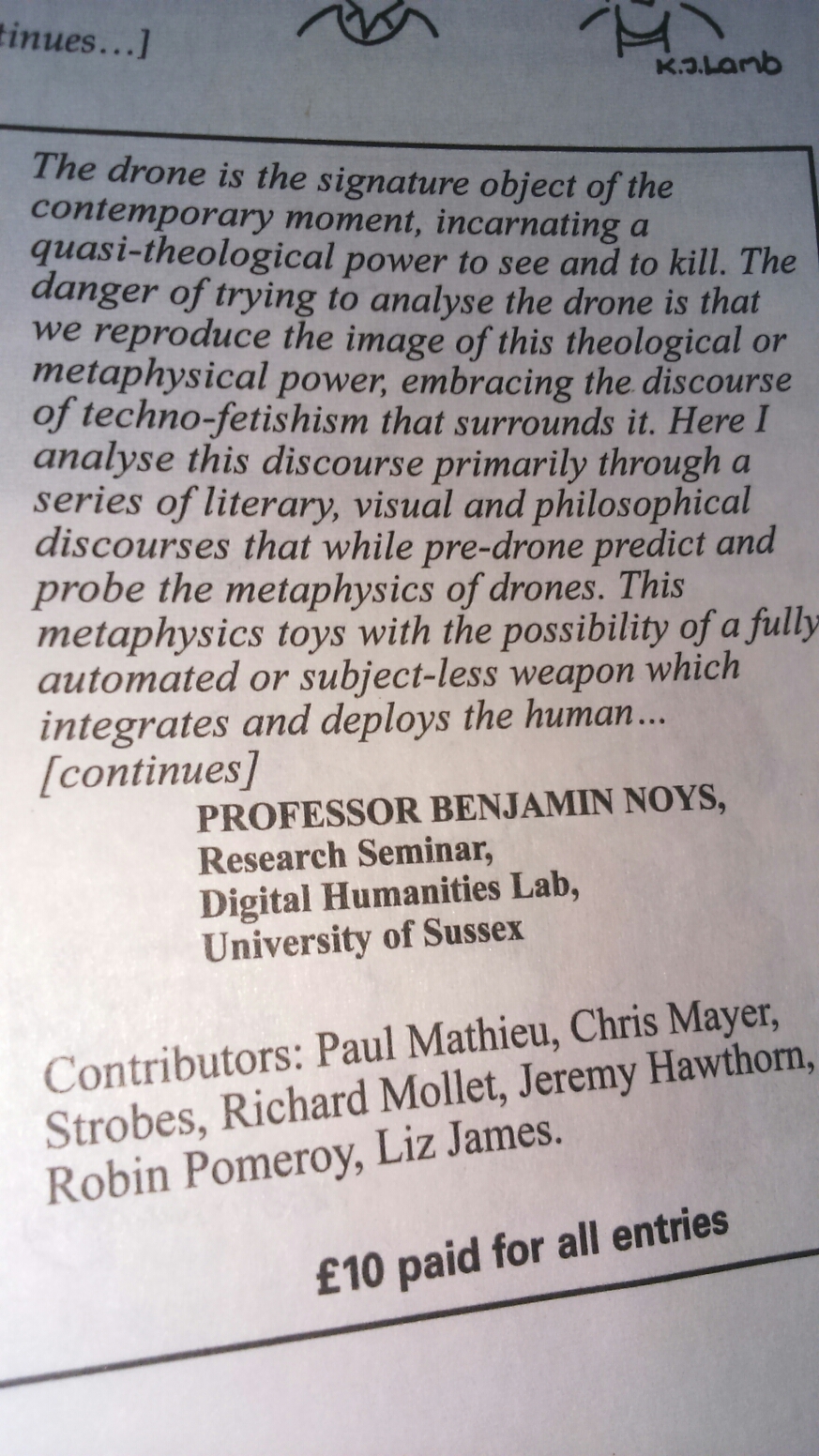
Travelling up to London for the last Royal Astronomical Society meeting and Club Dinner of the year, I noticed that the University of Sussex has rounded off a good year with a coveted place in Private Eye’s Pseuds Corner.

image

I am sure this achievement will be an inspiration to all my colleagues and spur us all on to even greater heights next year..

The Optic Glass

Posted in Cute Problems, The Universe and Stuff with tags , , on December 10, 2015 by telescoper

I thought you might be interested in this video demonstrating an interesting possible effect of refraction:

It’s not a trick, but it did take me quite a long time to reproduce the result. Can you figure out what’s going on?


Where Two Tribes Go To Roar…

Posted in Uncategorized on December 10, 2015 by telescoper

It seems that my former colleague from Nottingham days, Professor Philip Moriarty, has decided to leave Twitter.

I have to say my own experiences of Twitter haven’t been as bad as Philip’s. In fact I still find it rather fun,  but then I just tend to ignore or block people who irritate me rather than try to enter into pointless and frustrating dialogues…