Variations on the Theme of Northern Lights

Posted in Art, The Universe and Stuff with tags , , , , on December 9, 2015 by telescoper

This morning I woke up as usual to BBC Radio 3. Unusually however this morning’s breakfast programme was broadcast live from the picturesque town of Tromsø in Norway, which is well inside the Actic Circle so is dark all day at this time of year. The broadcast from Norway part of a three-week extravaganza called Northern Lights, which focusses on the music and culture North of 60° latitude.

Anyway, this prompted me to do a brief post about a couple of related matters connected by the theme of Northern Lights.

The first is to draw your attention to the fact that, to coincide with this Nobel Prize Week in Stockholm, the artist Olafur Eliasson has set up a temporary public artwork in Stockholm called Your Star, which involves putting an artificial star into the sky over Stockholm. I gather it has been quite difficult to get the star to behave in the windy conditions, but in any case you can use the website to view six short videos and even create your own star..

The second is this wonderful video of the  Aurora Borealis? If you haven’t seen this before then take a look. It’s not a fake. This is what it’s really like.

I stood under a show like this once, in Tromsø in fact, and I can tell you ever the word “awesome” applied to anything, this is it. The curious thing is that I had the definite feeling that there was a booming and whooshing sound to go with the light show. I wasn’t the only one there who thought they could hear it as well as see it. And I wasn’t drunk either. Well, not very.

I’m reliably informed however that there is no physical mechanism that could produce sound waves of sufficient power to reach ground level from the altitude at which the light is generated. It must have been psychological, as if the brain wants to add a backing track when it sees something as spectacular as this. Any views on this phenomenon would be welcome via the comments box..


UPDATE: here’s an interesting take on the Auroral Sounds issue.

In the Waitrose of My Mind

Posted in Biographical, Mental Health with tags , , on December 8, 2015 by telescoper

I’m not sure why, but the distressing events at Leytonstone at the weekend seem to have triggered a need to do one of those weird confessional posts that I seem to be prone to posting from time to time. So here goes.

A couple of weeks ago I visited Waitrose in Western Road, Hove. Nothing particularly unusual about that, you might think, although it isn’t actually a very convenient supermarket for me as I live on the other side of town. I’m not sure why I suddenly decided to go there, except that I had been avoiding it for such a long time. In fact I hadn’t set foot in that store for the best part of thirty years. The last time I went there was a few weeks after I had been beaten up on Brighton seafront. I had more-or-less recovered from the physical effects of that late-night encounter with four yobs, but I hadn’t quite got over the anxiety of going out, even in daylight. Little did I know that things were about to get a lot worse.

I only went in to buy a couple of things so it wasn’t long before I was waiting in the queue at the checkout. Suddenly I was gripped by  a deep feeling of apprehension or dread. I began to sweat and tremble, my heart was racing. I became aware of strange shapes moving unpredictably through the corner of my eye. Rapidly the shapes intensified and became threatening, monstrously distorted faces began to swirl around me uttering all kinds of threats and abuse. Terrible sounds reverberated in my ears. I couldn’t take it any more and ran from the store.

Unfortunately I was still carrying a pint of milk and some coffee so, not unreasonably, the security man jumped to the conclusion that I was  shoplifter. I made it as far as the street before he tackled me. By then I was completely incoherent, sobbing and struggling to escape, still beset by all kinds of scary visions. Someone must have called the Police, or maybe they were just passing, and I was soon bundled into a patrol car.

Thereafter it is all a bit of a blur. I was taken to a Police station and spent some time in a cell. I don’t remember how long. A person – presumably a psychiatrist – appeared and tried to talk to me but I don’t think I was making much sense. Pretty soon after that I was informed that I was being detained under then fairly new  Mental Health Act (1983). In other words I was sectioned. I think the idea that I was a shoplifter was abandoned at this point. I was taken to a psychiatric institution some way outside Brighton which looked like something out of a Gothic horror novel and was held there, for assessment.

Fortunately the worst effects of the panic attack I had experienced disappeared fairly quickly, and I was transferred to a (slightly) friendlier-looking hospital nearer home. After a couple of weeks I was discharged with a renewable prescription of heavy-duty antidepressants which seemed to work at preventing further episodes but at the cost of some quite unpleasant side-effects. I returned to work, making up a story to cover my absence. After six months I gave up taking the drugs.

Over the years since then I’ve experienced panic attacks of this type on an intermittent basis, usually much milder but sometimes not. I have been told that there isn’t really a treatment that will banish them for ever, so for the past few years  I have been controlling them using a different type of drug which seems to have fewer and less serious side-effects. I don’t like having to take medication every day, but have come to accept that’s just the way things are.

Anyway, you can now probably understand why I have avoided Waitrose in Western Road. It’s a place of painful memories for me. In a sense I went there a couple of weeks ago to attempt to exorcise a ghost.

When I walked into the shop, however, it was completely unrecognisable. The layout had changed. So had the colour scheme, the staff uniforms, the lighting, the lot.  Expecting to be overwhelmed by dread, I instead felt nothing. Relieved, I actually did some shopping. No ghosts. No swirling shapes. No terrifying noises. The only scary things there  were the prices…


The Top 10 Jazz Artists

Posted in Jazz with tags , , , , , on December 8, 2015 by telescoper

Back from a short break I thought I’d mention that BBC Radio 3 recently announced the results of a poll for the top Jazz artist of all time. The result was:

  1. Miles Davis
  2. Louis Armstrong
  3. Duke Ellington
  4. John Coltrane
  5. Ella Fitzgerald
  6. Charlie Parker
  7. Billie Holiday
  8. Thelonious Monk (8=)
  9. Bill Evans (8=)
  10. Oscar Peterson

Although my ordering would have been a little different, I was quite surprised that the top 10 corresponded so closely with my own selection. In fact 8 of the above list would have made it into mine: Miles Davis; Louis Armstrong; John Coltrane; Charlie Parker; Billie Holiday; Thelonious Monk; and Bill Evans.

The only differences were that (a) I couldn’t possibly have had Billie Holiday without having Lester Young and (b) I simply had to have Ornette Coleman in there. To accommodate Messrs Young and Coleman I would have displaced Ella Fitzgerald and Oscar Peterson. The latter are great artists, of course, but I wouldn’t say either influenced the development of Jazz as much as the others I mentioned, and that’s one of the criteria I applied.

miles-davis

No surprise that Miles Davis (above) came top. He changed musical direction so many times that he should actually count as four or five different musicians. It’s no coincidence that Miles Davis, John Coltrane and Bill Evans all appeared on Kind of Blue, which is arguably the greatest jazz record of all time. I don’t think any serious Jazz enthusiast could have left out Charlie Parker or Thelonious Monk either. And of course, Louis Armstrong just had to be there too. It’s hard to imagine what Jazz would have been without Satchmo. The same goes for the great Duke Ellington.

Anyway, it’s all a matter of personal choice. There are dozens of great jazz artists who didn’t make it into the top ten. Among my near misses were Coleman Hawkins, Sidney Bechet, Eric Dolphy and Dizzy Gillespie.

Who else would you have picked?


Bayes’ Theorem or Price’s Theorem?

Posted in History, The Universe and Stuff with tags , on December 4, 2015 by telescoper

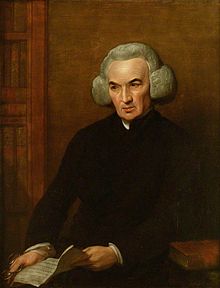
Richard_Price_West

I’m indebted to a fellow blogger for drawing my attention to the person shown in the above picture, Dr Richard Price who has been described as “the most original thinker ever born in Wales”, and who has a Society named after him.

Price was a moral philosopher, nonconformist preacher and also a mathematician of some note. Of particular interest to this blog is the role he played in the development of what is now known as Bayes’ Theorem, after the Reverend Thomas Bayes.

However, the paper in the Philosophical Transactions of the Royal Society that contains the first published form of this theorem was not published until 1763, over a year after Bayes’ death and, as you can see if you follow the link, is attributed jointly to “Mr Bayes and Mr Price”.  It appears that there was an original manuscript written by Bayes around about 1755  which was communicated to Price when Bayes died in 1761 and then presented for publication over a year later; Price had been asked to act as “literary executor” of Bayes’ estate.

Unfortunately the original manuscript has never been found and it is therefore impossible to say for sure how much Price contributed to the final version. However, a relatively recent and very interesting article  raises this question, and argues (reasonably convincingly to my mind) that Bayes’ part stops at page 14 of 32 pages. It is therefore quite possible that Price wrote over half the paper himself although most historical discussions of this matter simple state that Price “edited” Bayes’ work.

It has to be said that the paper is not exactly a model of clarity and pertains only to a particular case of the full theorem. The form in general use today was first published by Laplace in 1812, so it should really be called Laplace’s Theorem, but Laplace did give generous credit to the work of Bayes which is no doubt why the name stuck.

I don’t suppose we will know for sure exactly how much Price contributed to the development of Bayes’ theorem, but this may be yet another example of the law that any result in science or mathematics that has a person’s name attached to it has the wrong name attached to it!

Finally, I will mention that the Richard Price Society has started a petition to the Welsh government. I’m taking the liberty of copying the purpose of this petition here:

We call on the Welsh government to acknowledge the important contribution of Dr Richard Price not only to the eighteenth century Enlightenment, but also to the making of the modern world that we live in today, and develop his birthplace and childhood home into a visitor information centre where people of all nationalities and ages can discover how his significant contributions to theology, mathematics and philosophy have shaped the modern world.

Tynton Farm in Llangeinor, the birthplace and childhood home of Dr Richard Price is for sale. Once derelict, the farm has been sensitively restored and almost all of the original features have been preserved. The Richard Price Society is aware that the house attracts visitors from all corners of the globe and this is attested by the previous owner’s Visitors Book that was signed by visitors to the farm. The position of the farm and its provenance would make it an ideal learning centre where people can find out just what an important person he was and remains. This is an opportunity to buy the property at market value and help celebrate the achievements of Wales’ intellectual giant and apostle of liberty.


I have signed it, and hope you will consider doing likewise!


Pact, by R.S. Thomas

Posted in Poetry with tags , on December 3, 2015 by telescoper

This is my child;
that is yours. Let
peace be between them
when they grow up.

They are far off
now; let it not
be through war they are brought
near. Their languages

are different. Let them both
learn it is peace
in the hand is the translation
of peace in the mind.

by R.S. Thomas (1913-2000)

Lisa Pathfinder – better late than never!

Posted in Science Politics, The Universe and Stuff with tags , , , , , , , on December 3, 2015 by telescoper

Determined to post about something positive after yesterday’s act of collective idiocy by Parliament I find myself given a golden opportunity by today’s successful launch of the Lisa Pathfinder experiment by the European Space Agency.

As space missions go, LISA Pathfinder seems quite a modest one: it is basically a pair of identical 46 mm gold–platinum cubes separated by 38 cm. The idea is to put these test masses in free fall and measure their relative positions as accurately as possible.

After a false start yesterday, LISA Pathfinder was successfully launched in the early hours of this morning and is now en route to the First Lagrangian Point of the Earth-Sun system, about 1.5 million miles from Earth, at the location marked L1 in the diagram:

Lagrange_saddle

The contours show the “effective potential” of the Earth-Sun system, which takes into account the effect of rotation as well as gravity. The five Lagrangian points are the places at which tis effective potential is locally flat, i.e. where its spatial gradient vanishes. Any physics student will know that when the gradient of the potential is zero there is no force on a test particle. What this means is that an object placed exactly at any of the 5 Lagrangian points stays in the same position relative to the Earth and Sun as the system rotates. Put a spacecraft at one of these points, therefore, and it stays put when viewed in a frame rotating around the Sun  at the same speed as the Earth.

It’s not quite as simple as this because, as you will observe the Lagrangian points are not stable: L1, L2 and L3 are saddle-points; a  stable point would be a local minimum. However, around the first three there are stable orbits so in effect a test mass displaced from L1, say, oscillates around it without doing anything too drastic. L4 and L5 can be stable or unstable, in a general system but are stable for the case of the Solar System, hence the tendency of asteroids (the Trojans) to accumulate at these locations.

You may remember that WMAP, Planck and Herschel were all parked in orbits around L2. A spacecraft positioned exactly at L2 is permanently screened from the Sun by the Earth. That might be very useful if you want to do long-wavelength observations that require very cool detectors, but not if you want to use the Sun as a source of power. In any case, as I explained above, spacecraft are not generally located exactly at L2 but in orbit around it. Planck in fact had solar cells on the base of the satellite that provided power but also formed a shield as they always faced the Sun as the satellite rotated and moved in its orbit to map the sky. The choice of L1 for LISA Pathfinder was made on the basis of spacecraft design considerations as it will operate in a very different manner from Planck.

The reason for doing eLISA is to demonstrate the technological feasibility of a much more ambitious planned gravitational wave detector in space originally called LISA, but now called eLISA. The displacement of test masses caused by gravitational waves is tiny so in order for eLisa it is necessary (a) to screen out every effect other than gravity, e.g. electromagnetic interactions due to residual charges, to great precision and (b) to measure relative positions to great accuracy. That’s why it was decided to fly a cheaper technology demonstrator mission, to prove the idea is feasible.

LISA Pathfinder won’t make any science discoveries but hopefully it will pave the way towards eLISA.

It has to be said that LISA Pathfinder has had a fairly troubled history. I just had a quick look at some papers I have dating back to the time when I was Chair of PPARC Astronomy Advisory. Among them I found the categorical statement that

LISA Pathfinder will be launched in 2009.

Hmm. Not quite. It’s obviously running quite a long way behind schedule and no doubt considerably over its initial budget but it’s good to see it under way at last. There will be a lot of sighs of relief that LISA Pathfinder has finally made it into space! Now let’s see if it can do what it is supposed to do!


Wiston House, Wilton Park and Chatham House Rules

Posted in Biographical, Brighton with tags , , , on December 2, 2015 by telescoper

Back to work and a whole morning of meetings today I thought I’d pause briefly to say something about the venue for the recent awaydays…

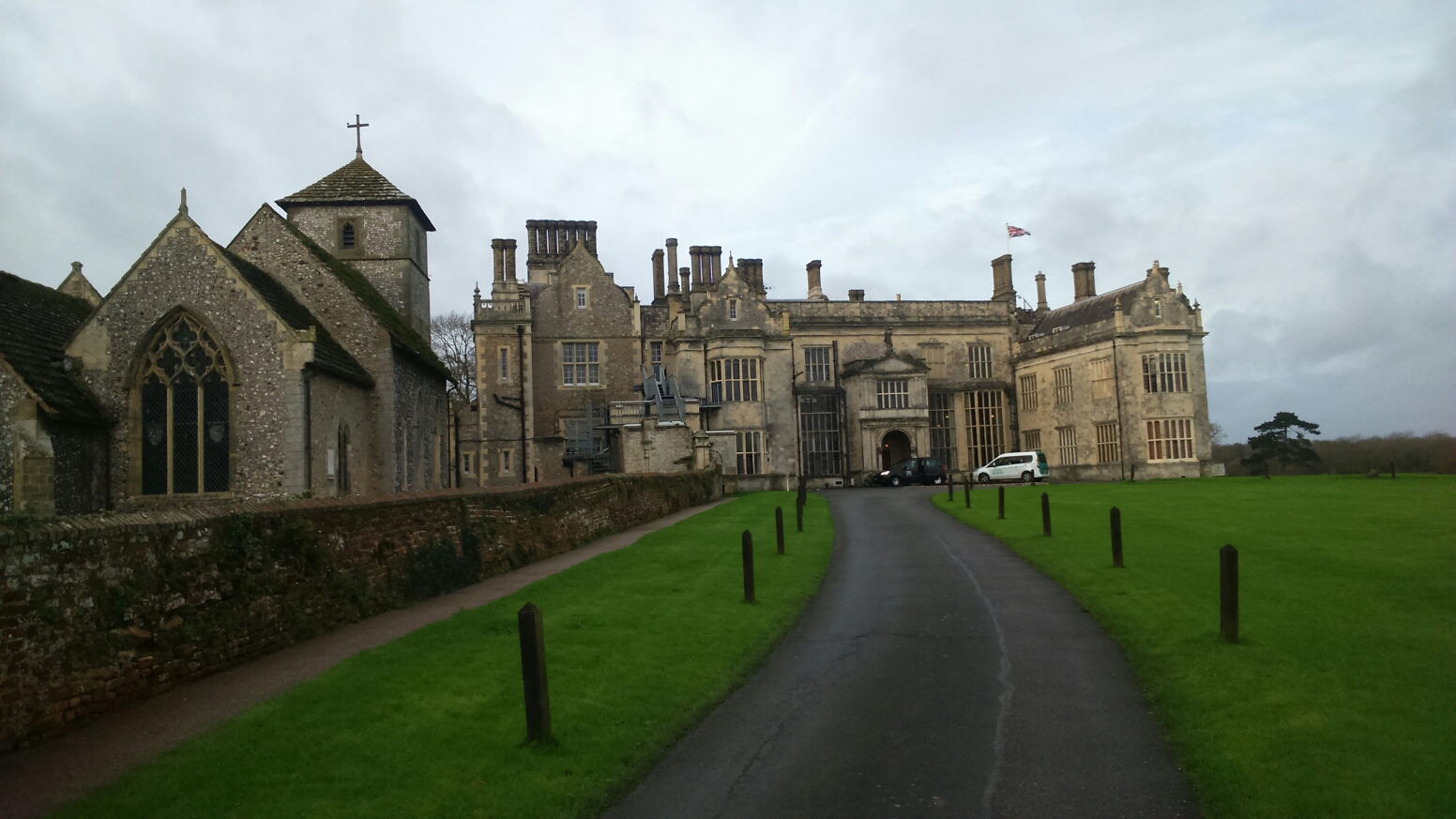
wp-1448904107687.jpeg

As Colin correctly spotted, the venue was Wiston House which is near Steyning, North of Shoreham, in West Sussex. The house was built in the late 16th Century but extensively modernised and refurbished over the years. It was built by a chap called Thomas Shirley, a politician who basically embezzled the funds needed to build it from the Treasury. Perhaps even worse than that he demolished an entire village to make way for what was essentially a private residence. When his fraud was uncovered he was imprisoned, his family declared bankrupt and the buildings seized by the Government. It wasn’t returned to the poor people thrown off their land to make way for it in the first place.

More recently, during World War 2, Wiston House (along with most large country houses near the South coast), was commandeered for military use; it became the Headquarters for the Canadian High Command and the surrounding parkland was used as a base for troops preparing for the Normandy landings, along with about 200 tanks and other vehicles. The troops stationed in the area formed part of the 3rd Canadian Division that led the the assault on Juno Beach in June 1944.

Since 1951, however, the House has been used by Wilton Park, an offshoot of the Foreign and Commonwealth Office. This organization is probably most famous as being responsible for mediating the talks that took place in 1946 about the future of post-war Germany but at that time it was based at a different location, Wilton Park in Buckinghamshire, which was the site of a camp for German Prisoners Of War. In 1951 it moved to Wiston House, but its name travelled with it so now, somewhat confusingly, Wilton Park is now based in Wiston House. It now hosts a very large number of events involved with global issues, including security, political strategy and conflict resolution as well as some more mundane things that can benefit from their expertise such as the Awaydays I attended on Monday and Tuesday. It’s not generally open to the public and security, though discreet, is quite extensive which is not surprising given the high profile nature of many of their guests, though not so much at the event I attended!

The staff at Wilton Park adopt strict protocols for how they facilitate its discussions, including Chatham House Rules, and bans on the use of social media during sessions. Hence my virtual twitter and blog silence over the past couple of days. Although we didn’t discuss anything that might threaten global security or engender any form of conflict, it would be inappropriate to break the rules for any reason so I won’t say anything about what was said or by whom…

Just for interesting, the small manor church to the left of the main building dates back almost 1000 years – it is mentioned in the Domesday Book – but the interior has been altered considerably and looks quite modern. I was not actually staying in the main house, but in one of the outbuildings, formerly stables but very comfortable and quite reminiscent of the arrangements at The Cosener’s House, a venue familiar to many physicists.

Away Days

Posted in Biographical, Brighton on November 30, 2015 by telescoper

No time to blog today as I am at yet another Awayday. In fact I will be Away for Two Days.

image

Can anyone name my location (in the photograph above)?

Einstein’s Legacy

Posted in The Universe and Stuff with tags , , , , , , , on November 29, 2015 by telescoper

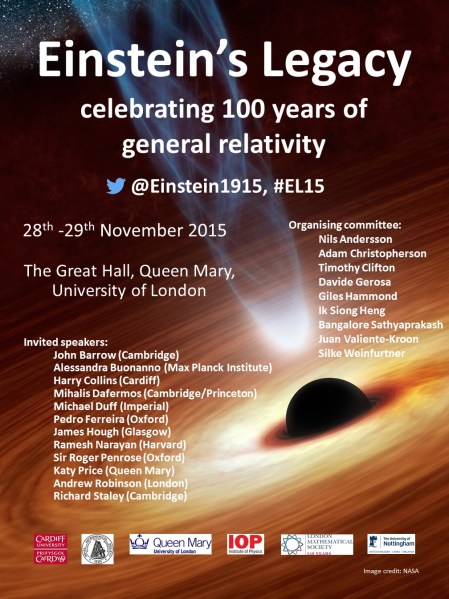
Yesterday I braved the inclement weather and the perils of weekend travel on Southern Trains to visit Queen Mary College, in the East End of London, for the following event:

GR100

I used to work at  Queen Mary, but haven’t been back for a while. The college and environs have been smartened up quite a lot since I used to be there, as seems to be the case for the East End generally. I doubt if I could afford to live there now!

Owing to a little local difficulty which I won’t go into, I was running a bit late so I missed the morning session. I did, however, arrive in time to see my former colleague Bangalore Sathyaprakash from Cardiff talking about gravitational waves, Jim Hough from Glasgow talking about experimental gravity – including gravitational waves but also talking about the puzzling state of affairs over “Big G” – and Pedro Ferreira from Oxford whose talk on “Cosmology for the 21st Century” gave an enjoyable historical perspective on recent developments.

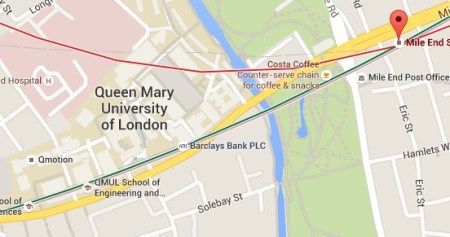
The talks were held in the Great Hall in the People’s Palace on Mile End Road, a large venue that was pretty full all afternoon. I’m not sure whether it was the District/Hammersmith & City Line or the Central Line (or both) that provided the atmospheric sound effects, especially when Jim Hough described the problems of dealing with seismic noise in gravitational experiments and a train rumbled underneath right on cue.

UPDATE: Thanks to Bryn’s comment (below) I looked at a map: the Central Line goes well to the North whereas the District and Hammersmith & City Line go directly under the main buildings adjacent to Mile End Road.

Under-QM

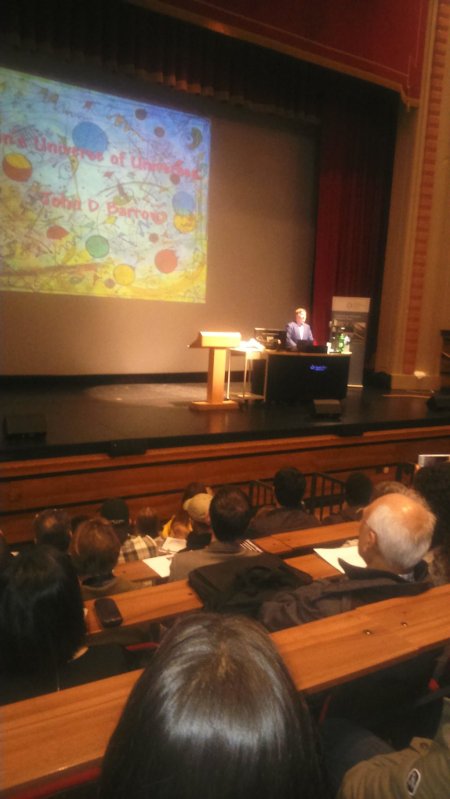
Anyway, the venue was even fuller for the evening session, kicked off by my former PhD supervisor, John Barrow:

Einstein's Legacy

This session was aimed at a more popular audience and was attended by more than a few A-level students. John’s talk was very nice, taking us through all the various cosmological models that have been developed based on Einstein’s theory of General Relativity.

Finally, topping the bill, was Sir Roger Penrose whose talk was engagingly lo-tech in terms of visual aids but aimed at quite a high level. His use of hand-drawn transparencies was very old-school, but a useful side-effect was that he conveyed very effectively how entropy always increases with time.

Penrose covered some really interesting material related to black holes and cosmology, especially to do with gravitational entropy, but my heart sank when he tried at the end to resurrect his discredited “Circles in the Sky” idea. I’m not sure how much the A-level students took from his talk, but I found it very entertaining.

The conference carries on today, but I couldn’t attend the Sunday session owing to pressure of work. Which I should be doing now!

P.S. I’ll say it before anyone else does: yes, all the speakers I heard were male, as indeed were the two I missed in the morning. I gather there was one cancellation  of a female speaker (Alessandra Buonanno), for whom Sathya stood in.  But still.


Browser Speeds

Posted in Uncategorized on November 27, 2015 by telescoper

image