Nurse Review Published

Posted in Science Politics with tags , , on November 19, 2015 by telescoper

I’ve been busy all day so unable to join in the deluge of comment and reaction to the Review of the Research Councils carried out by Sir Paul Nurse, President of the Royal Society, which was published today. I’ve only just had time to skim through it, so I won’t comment in detail, but it does seem to me that the main points are:

  1. The review does not call for a reduction in the current number of seven research councils (STFC, EPSRC, ESRC, AHRC, NERC, BBSRC and MRC); mergers were thought by many to be possible outcomes of this review.
  2. There is a proposal to set up an overarching structure, called Research UK (RUK), which is a beefed-up version of the current RCUK, one of the aims of which would be to provide better coordination between the Research Councils.
  3. It is proposed that RUK should liaise directly with a committee of government ministers who would have significant influence over the way funding was distributed to the Research Councils. It’s not clear to me how this squares with the Haldane Principle.
  4. It is also proposed that RUK might take over the distribution of QR funding (currently done by HEFCE), but that this should be done in such a way as to preserve the idea of “dual funding”.

There are other points of course, but these seemed to me to be the most significant. It remains to see how many of the proposals are implemented and how they will be made to fit into the framework of the Higher Education Green Paper published last week. Of more immediate concern to many researchers will be how much funding there will be to be distributed by any new organization if the Comprehensive Spending Review announced next week results in big cuts to the science budget, as many fear it will.

Comments are welcome through the box!

R.I.P. Jonah Lomu

Posted in Biographical, Rugby with tags , , , , , , , , on November 18, 2015 by telescoper

At the end of the 2015 Rugby World Cup, I wrote a post recalling the World Cup of 1995, which was held in South Africa while I was visiting there. I had the privilege of seeing the great Jonah Lomu demolishing the England defence that day. Today I learned with greant sadness that he has passed away, aged just 40. Since Jonah Lomu played such a central role in one of the most amazing sporting experiences of my life, which lives in my memory as if it happened yesterday, I wanted to take the opportunity to pay tribute to the awesome sportsman that he was by sharing that memory again.

In 1995 was visiting George Ellis at the University of Cape Town to work on a book, which was published in 1997. The book is now rather out of date, but I think it turned out rather well and it was certainly a lot of fun working on it. Of course it was a complete coincidence that I timed my trip to Cape Town exactly to cover the period of the Rugby Word Cup. Well, perhaps not a complete coincidence. In fact I was lucky enough to get a ticket for the semi-final of that tournament between England and New Zealand at Newlands, in Cape Town. I was in the stand at one end of the ground, and saw New Zealand – spearheaded by the incredible Jonah Lomu – score try after try in the distance at the far end during the first half. Here is the first, very soon after the kickoff when Andrew Mehrtens wrong-footed England by kicking to the other side of the field than where the forwards were lined up. The scrambling defence conceded a scrum which led to a ruck, from which this happened:

Jonah Lomu was unstoppable that day. One of the All Blacks later quipped that “Rugby is a team game. Fourteen players all know that their job is to give the ball to Jonah”.

It was one-way traffic in the first half but England played much better in the second, with the result that all the action was again at the far end of the pitch. However, right at the end of the match Jonah Lomu scored another try, this time at the end I was standing. I’ll never forget the sight of that enormous man sprinting towards me and am glad it wasn’t my job to try to stop him, especially have seen what happened to Underwood, Catt and Carling when they tried to bring him down. Lomu scored four tries in that game, in one of the most memorable performances by any sportsman in any sport. It’s so sad that he has gone. It’s especially hard to believe that such a phenomenal athlete could be taken at such a young age. My thoughts are with his family and friends.

Rest in Peace, Jonah Lomu (1975-2015)

Lucky Dictionaries

Posted in Crosswords with tags , , on November 17, 2015 by telescoper

Here’s a funny thing.

About two years ago I stopped buying the Observer on Sundays and switched to the Independent on Sunday. That decision was largely based on the cost of the paper rather than the quality of the crossword, but I ended up trading the Observer’s Azed and (easier) Everyman for the Sunday Independent’s Beelzebub and (easier) OUP Prize Cryptic. It’s paid off in terms of prizes – I’ve completely lost count of the number of dictionaries I’ve won from the Independent competitions.

However, two weeks ago I wasn’t feeling very well so I decided to stock up with diversions and for a change bought both the Independent on Sunday and the Observer. And so it came to pass that I did the Everyman crossword for the first time in more than two years. Today I received these:

Dictionaries

And a £15 book token to boot. All of which told me that I’d won the prize! Now what’s the probability of that? Maybe I’ll try again in a couple of years…

Inverted Cosmology

Posted in The Universe and Stuff on November 17, 2015 by telescoper

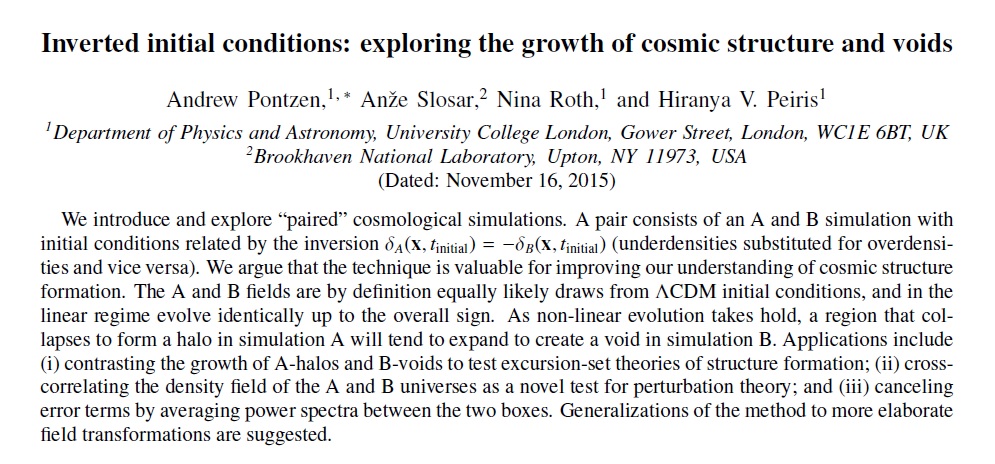
Just time for a quick post about a neat little paper by Pontzen et al. that has appeared on the arXiv. Here is the abstract:


inversionThe abstract is a model of clarity so there’s no need to add further explanation here. Having A and B simulations in which initial overdensities and underdensities are swapped but everything else is preserved allows a number of interesting things to be studied.

When I read the paper it struck me that it would be fun to use “paired” simulations like this to study statistical properties of the evolved density field that go beyond the usual power spectra discussed in the paper; you can find a nice review of power spectra and their uses here.

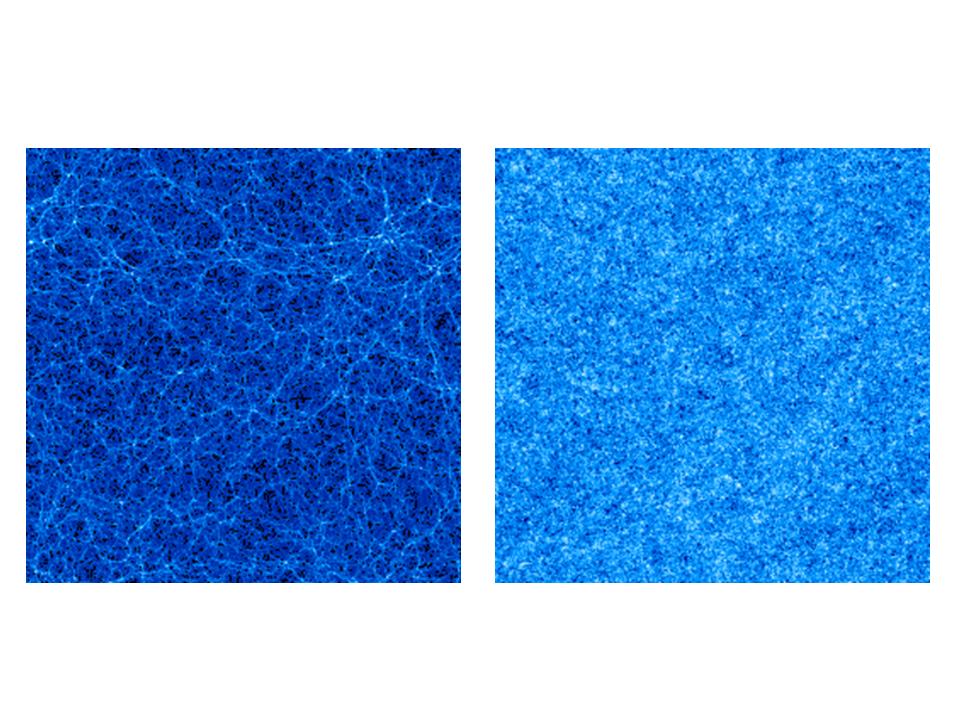
Here’s what I mean. Take a look at these two N-body computer simulations of large-scale structure:

The one on the left is a proper simulation of the “cosmic web” which is at least qualitatively realistic, in that in contains filaments, clusters and voids pretty much like what is observed in galaxy surveys.

To make the picture on the right I first took the Fourier transform of the original simulation shown on the left. This approach follows the best advice I ever got from my thesis supervisor: “if you can’t think of anything else to do, try Fourier-transforming everything”. Anyway, each Fourier mode is complex and can therefore be characterized by an amplitude and a phase (the modulus and argument of the complex quantity). What I did next was to randomly reshuffle all the phases while leaving the amplitudes alone. I then performed the inverse Fourier transform to construct the image shown on the right.

What this procedure does is to produce a new image which has exactly the same power spectrum as the first. You might be surprised by how little the pattern on the right resembles that on the left, given that they share this property; the distribution on the right is much fuzzier. In fact, the sharply delineated features are produced by mode-mode correlations and are therefore not well described by the power spectrum, which involves only the amplitude of each separate mode. These features are manifestations of non-linear dynamics and are not described by linear perturbation theory.

If you’re confused by this, consider the Fourier transforms of (a) white noise and (b) a Dirac delta-function. Both produce flat power-spectra, but they look very different in real space because in (b) all the Fourier modes are correlated in such away that they are in phase at the one location where the pattern is not zero; everywhere else they interfere destructively. In (a) the phases are distributed randomly.

The moral of this is that there is much more to the pattern of galaxy clustering than meets the power spectrum, i.e. all the information contained in the distribution of phases. However, studying the evolution of Fourier phases in the context of non-linear gravitational evolution is quite tricky for a number of technical reasons. Note that the “paired” simulations of Pontzen et al. are generated in such a way that the A and B simulations also have the same power spectrum, but unlike those shown above, have the same type of morphology, which might allow one to finesse some of these difficulties and separate out the effect of non-linear dynamics from the choice of initial power spectrum in a potentially interesting way.

Just a thought.

Home Thoughts of Paris

Posted in Biographical with tags , on November 16, 2015 by telescoper

Like many of you I’ve been following the events in Paris over the last few days with a mixture of shock and horror but I couldn’t think of anything useful or insightful to say on this blog. It’s truly terrible to see the levels of cruelty and inhumanity that people can descend to, enough to make one feel ashamed to be human, but the frenzied speculation on the net about the nationality of the assailants – based on very dubious documentary evidence – is’t helping anyone. Whoever they were or wherever they came from I doubt if we’ll ever really know what this murderous gang thought they were going to achieve when they set out on their killing spree on Friday evening. I’d be surprised if any of them could actually articulate their reasons for being involved, any more than a typical British soldier could explain, if asked, what he thought he was achieving by his presence in Iraq or Afghanistan.

It’s a matter of great shame that we have become relatively hardened to the news of deaths abroad. Practically every day we hear of killings of occupying troops, insurgents, or non-combatants in the Middle East or elsewhere but we Europeans seems to pay them little attention now. The sickening bombing of a funeral in Beirut killed 44 people on Thursday, but went largely unnoticed. The death toll in Paris is now at least 129, but this is just a tiny fraction of the number of lives lost to violence around the globe this year.

We live a relatively peaceful life in the West, with the result that it hits us rather hard when we can no longer keep such events at a safe distance in our minds, when they strike on familiar territory, such as was the case for the British in the London bombings of 2005. Only then do we see the horror close-up and personal. The people of Paris have to deal with that reality now, but we shouldn’t forget that in small towns we’ve never heard of all around the world many others are frightened and grieving too, and probably for just as little reason.

I don’t live in Paris, but I have been there many times and do have colleagues who live there, most of them in the suburb of Saclay. They’re all safe and unharmed. There will be many others who can’t say the same thing and my thoughts are with them at this terrible time. It must be very tough for Parisians as they try to restore normality to their lives, but that’s what they must do. The deadly attacks on Friday were not attacks on military targets. They were attacks on a sports stadium, a music venue and some bars and restaurants. The survivors owe it to the dead, the injured and the bereaved to carry on their lives regardless and to refuse to be intimidated by terror. I know that’s easy for me to say. I’m not there. But if London can do it in the wake of the atrocities of 2005, then so can Paris.

I find myself feeling much the same as I did in 2008 after a terrorist attack in Mumbai and in 2010 when the murderer Raoul Moat met a violent end in Rothbury. As I get older memories of places I’ve visited are increasingly precious and it’s deeply unsettling when those memories are corrupted by violence. But I am sure that Paris will survive not only as a place of happy memories for me, nor simply as a symbol of so many of the freedoms that others would destroy, but as a real place where real people continue live the way they want to live, in peace and liberty.

Liberté

Posted in Poetry with tags , , on November 15, 2015 by telescoper

Sur mes cahiers d’écolier
Sur mon pupitre et les arbres
Sur le sable sur la neige
J’écris ton nom

Sur toutes les pages lues
Sur toutes les pages blanches
Pierre sang papier ou cendre
J’écris ton nom

Sur les images dorées
Sur les armes des guerriers
Sur la couronne des rois
J’écris ton nom

Sur la jungle et le désert
Sur les nids sur les genêts
Sur l’écho de mon enfance
J’écris ton nom

Sur les merveilles des nuits
Sur le pain blanc des journées
Sur les saisons fiancées
J’écris ton nom

Sur tous mes chiffons d’azur
Sur l’étang soleil moisi
Sur le lac lune vivante
J’écris ton nom

Sur les champs sur l’horizon
Sur les ailes des oiseaux
Et sur le moulin des ombres
J’écris ton nom

Sur chaque bouffée d’aurore
Sur la mer sur les bateaux
Sur la montagne démente
J’écris ton nom

Sur la mousse des nuages
Sur les sueurs de l’orage
Sur la pluie épaisse et fade
J’écris ton nom

Sur les formes scintillantes
Sur les cloches des couleurs
Sur la vérité physique
J’écris ton nom

Sur les sentiers éveillés
Sur les routes déployées
Sur les places qui débordent
J’écris ton nom

Sur la lampe qui s’allume
Sur la lampe qui s’éteint
Sur mes maisons réunies
J’écris ton nom

Sur le fruit coupé en deux
Du miroir et de ma chambre
Sur mon lit coquille vide
J’écris ton nom

Sur mon chien gourmand et tendre
Sur ses oreilles dressées
Sur sa patte maladroite
J’écris ton nom

Sur le tremplin de ma porte
Sur les objets familiers
Sur le flot du feu béni
J’écris ton nom

Sur toute chair accordée
Sur le front de mes amis
Sur chaque main qui se tend
J’écris ton nom

Sur la vitre des surprises
Sur les lèvres attentives
Bien au-dessus du silence
J’écris ton nom

Sur mes refuges détruits
Sur mes phares écroulés
Sur les murs de mon ennui
J’écris ton nom

Sur l’absence sans désir
Sur la solitude nue
Sur les marches de la mort
J’écris ton nom

Sur la santé revenue
Sur le risque disparu
Sur l’espoir sans souvenir
J’écris ton nom

Et par le pouvoir d’un mot
Je recommence ma vie
Je suis né pour te connaître
Pour te nommer

Liberté.

by Paul Éluard (1895-1952)

Vive La France!

Posted in Uncategorized on November 14, 2015 by telescoper

image

To his love, by Ivor Gurney

Posted in Poetry with tags , , on November 11, 2015 by telescoper

He’s gone, and all our plans
Are useless indeed.
We’ll walk no more on Cotswolds
Where the sheep feed
Quietly and take no heed.

His body that was so quick
Is not as you
Knew it, on Severn River
Under the blue
Driving our small boat through.

You would not know him now…
But still he died
Nobly, so cover him over
With violets of pride
Purple from Severn side.

Cover him, cover him soon!
And with thick-set
Masses of memoried flowers-
Hide that red wet
Thing I must somehow forget.

by Ivor Gurney (1890-1937)

Ivor Gurney enlisted in the Gloucestershire Regiment of the British Army in 1915. He was seriously wounded in the shoulder in April 1917. He recovered and was soon sent back into battle. In September 1917, at Passchendaele, he was gassed and hospitalized again. He suffered a serious nervous breakdown in 1918 and spent much of the rest of his life in mental hospitals of various kinds. He died in 1937, of tuberculosis, in such an institution – the City of London Mental Hospital. He was a composer as well as a poet, and a short piece by him was played this morning on BBC Radio 3. I’m posting this poem today, Armistice Day, when we remember the fallen, as a reminder that the legacy of war can be brutal also for those that survive.

The bizarre naked man orchid

Posted in Uncategorized on November 10, 2015 by telescoper

Tired after a long afternoon on Senate, I lack the energy to do a proper blog post so I thought I’d just reblog this. I suppose it follows on from my Anthropic Principle item!

p.s. The word “Orchid” is derived from the Greek word for testicle. I just thought you would like to know that.

whyevolutionistrue's avatarWhy Evolution Is True

Let’s finish the week not with a cat, but a plant. This one, the “naked orchid” or “hanging naked man orchid,” is a real species, Orchis italica.

hanging-naked-man-orchid-1

There’s a reason they aren’t called the “naked hanging woman orchid”:

Orchis-italica-seeds-Pyramid-monkey-orchid-Italian-man-orchid-Home-Garden-Bonsai-Balcony-DIY-100-PCS

Don’t ask me the adaptive significance, if any, of this shape. Maybe there’s some insect that has a search image for men?

To see nine more bizarre flowers, many of them orchids, go here.

View original post

The Case for Science Spending

Posted in Politics, Science Politics with tags , , on November 9, 2015 by telescoper

Just a quick post with my Community Service hat on to draw your attention to the fact that the House of Commons Science and Technology Committee has issued a report “The Science Budget” (which is available to download as a PDF here). It makes a very strong case for increasing science spending to 3% of GDP, although suggests doing that gradually. I don’t agree with everything in it, actually, butit is good to see (in the 4th paragraph) an explicit acknowledgment of the absurdity of the current situation in which capital is given to build facilities but there is no resource available to run them (“Batteries Not Included”).

This document will hopefully help to persuade government that continued real-terms cuts in science spending make no sense whatsoever.

I’m taking the liberty of quoting the summary in full, but do read the full document. It’s very interesting.

–0–

The United Kingdom is a science superpower. In terms of both quality and productivity, our research base `punches above its weight’, setting a worldwide benchmark for excellence.

Government spending on the science base has been protected since 2010, with a flat-cash- ring-fenced budget for annual ‘resource’ spending distributed by the research councils, the Higher Education Funding Council and others. Annual ‘capital’ budgets have varied. The Government has already announced that capital spending within the science budget will be protected — in real terms — up to the end of 2021. The Government’s Spending Review on 25 November will determine the science — and innovation — budget allocations for the rest of this Parliament.

The UK has fallen behind its competitors in terms of total R&D investment and this will put UK competitiveness, productivity and high-value jobs at risk if it is not reversed. The Government should produce a long term ‘roadmap’ for increasing public and private sector science R&D investment in the UK to 3% of GDP — the EU target. This would send an important signal about the long term stability and sustainability of our science and innovation ecosystem, supercharging private sector R&D investment from industry, charities and overseas investors alike.

A more robust system is needed to integrate capital and resource funding allocations. The Government should urgently review existing capital allocations to ensure sufficient resource is in place to fully ‘sweat our assets’. Sufficient resource funding will only materialise, however, with an upward trajectory in the resource budget.

The Spending Review is being conducted under present accounting protocols, dealing with capital and resource budgets for science separately. ‘ESA-10’ accounting rules will in future count resource expenditure on R&D as capital, reflecting the fact that all expenditure on science research is an investment — an asset — in future economic capacity. The Government in the Spending Review should make it clear that this rules revision will not be used as a means to change the underlying funding settlement.

The ‘dual support’ system has produced a world class and highly efficient system for scientific research. Any significant changes to this system, including the balance of funding between research councils and university funding councils, would require a clear justification, which has yet to emerge. The Government should make clear its continued commitment to the dual support system, and the previous Government’s 2010 iteration of the Haldane Principle in the forthcoming Spending Review. A significant element of research funding should continue to be channelled though both the research councils and the higher education funding authorities. Clear justification will also be needed for any significant change in funding allocations between the research councils, and we caution against a radical reorganisation which could potentially harm the research programme.

Any expansion of the innovation catapult network should not come at the expense of other innovation priorities. The Government should focus on consolidating the existing catapults, to ensure that all will have the necessary operating resource and business strategies to operate at peak capacity. To show a clear commitment to innovation more generally, the Government should ring-fence Innovate UK’s budget.

The Government should also retain the current system of innovation grants — rather than loans — as a key policy tool, alongside R&D tax credits, for de-risking innovation investment.

The Spending Review will have a profound impact on our science base and our future prosperity. We have to get it right. We have a duty to take care that our spending and structural decisions in this area do more than merely maintain the status quo. If we get our spending priorities, our policies, regulatory frameworks or our immigration policy wrong, we will be on the wrong side of history. The Government must ensure that the UK remains a scientific superpower.