Planck Update

Posted in The Universe and Stuff with tags , , , , on February 5, 2015 by telescoper

Just time for a very quick post today to pass on thhe news that most of the 2015 crop of papers from the Planck mission have now been released and are available to download here. You can also find some related data products here.

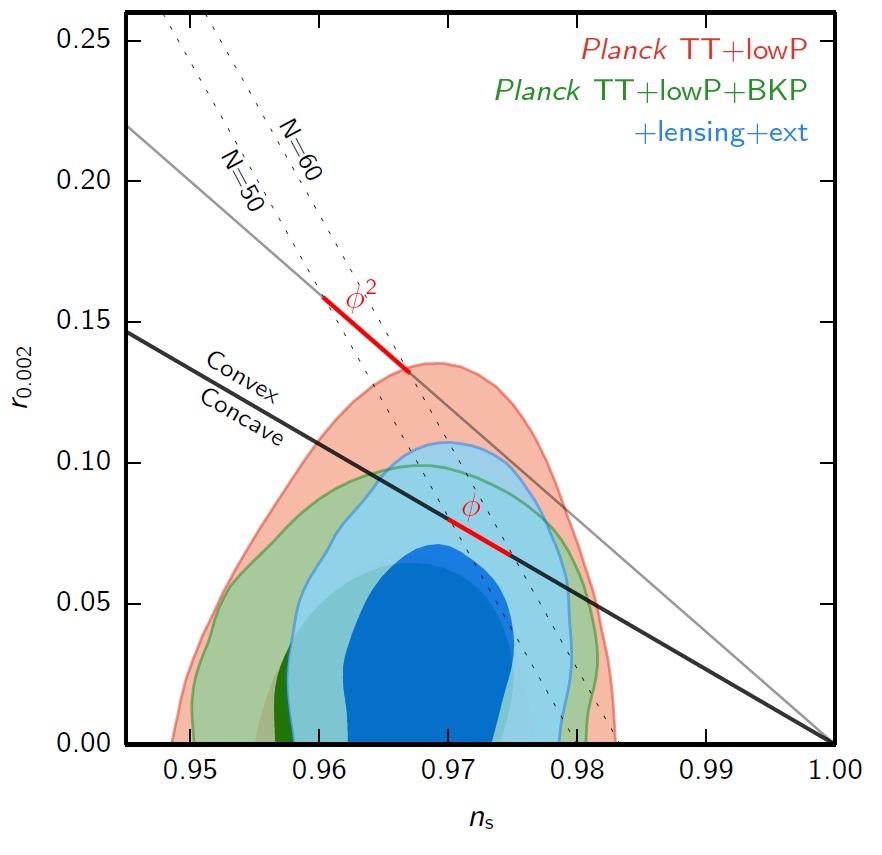
I haven’t had time to look at these in any detail myself, but my attention was drawn (in the light of the recently-released combined analysis of Planck and Bicpe2/Keck data) to the constraints on inflationary cosmological models shown in this figure:

inflation

It seems that the once-popular (because it is simple) m^2 \phi^2 model of inflation is excluded at greater than 99% confidence…

Feel free to add reactions to any of the papers in the new release via the comments box!

Helping Blind Physicists

Posted in Education with tags , , , , on February 4, 2015 by telescoper

The Department of Physics & Astronomy at the University of Sussex has been supporting some fantastic research into the accessibility of science education. Daniel Hajas, a blind second year physics undergraduate student has been working with Dr. Kathy Romer, Reader in Astrophysics, on a research project related to innovative assistive technology.

Daniel came up with the idea of an audio-tactile graphics display (TGD) that should allow representation of graphical information in audio and tactile modalities, mostly focusing on figures used in mathematical sciences such as graphs, geometric shapes etc. The TGD is a device  with approximate dimensions of a tablet that can sit on a table top and can be connected with a PC using either a wired or wireless solution.

During the summer of 2014, Daniel wrote a research proposal, attended an assistive technology oriented conference and since the beginning of this academic year has been searching for partners/funding. Daniel and Kathy recently submitted an application to the Inclusive Technology Price (ITP).

Since October they have made contact with IT and cognitive science experts from the Sussex IT department and are also in contact with an LHC Sound project (CERN) team member to assist with sonification. Daniel and Kathy plan to establish collaboration with experts from various fields, find research partners and funding. Such an interdisciplinary research requires collaboration of various Sussex Departments if not other Universities from across the UK.

Daniel's 3D Vector Board

Daniel’s 3D Vector Board

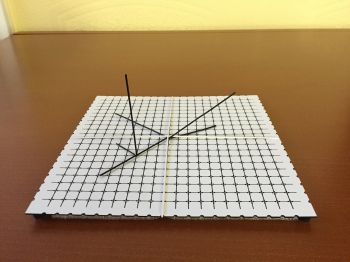
Daniel has also been busy inventing the ‘3D vector board’, a small plastic board with two flexible rubber stripes perpendicular to each other which can be can moved around such that they show the axes of a coordinate system. The board has a grid on it with 1×1 cm squares. At the junctions four little holes are drilled in the corner of the squares. This allows the vectors (metal sticks of different length) to be fixed on the board. Since there are horizontal, diagonal and vertical sticks i.e. the sticks are either in the plane, perpendicular to or in an angle respect to the plane of the board 3D vector scenarios can be modelled easily.

Although Daniel intended to use the board solely for his own purposes, feedback suggests this relatively simple tool could be used efficiently in education for demonstrational purposes. Both visually impaired and sighted students could benefit from it. Sketches on paper or black boards only allow 2D representations. The 3D vector board might also work well in illustrating aims of the TGD project. Although the main goal is to develop a very advanced high-tech assistive device over a period of years, Daniel and Kathy might also come up with a number of low-tech ideas to improve accessibility of mathematical sciences for visually impaired students.

See Daniel’s project website for further details about his research.

Scholarships for Masters in Physics, Astronomy and Quantum Technology at Sussex

Posted in Education with tags , , , , on February 3, 2015 by telescoper

Although I’m in the middle of a very busy day (with no time for a lunch break) I thought I’d take a few minutes to advertise a very special one-off opportunity. As many of you will be aware, the Chancellor of the Exchequer announced in the Autumn Statement last year that loans of up to £10,000 would be made available to students on postgraduate (Masters) courses from 2016/17 onwards.  Welcome though this scheme may be it does not apply to students wanting to start a Masters programme this September (i.e. for Academic Year 2015/16).

But fear not. The University of Sussex has come to the rescue! Last week the University unveiled a generous new funding scheme to bridge the gap. In particular, a huge  boost to the University’s flagship Chancellor’s Masters Scholarships means that 100 students graduating this summer with a first-class degree from any UK university will be eligible to receive a £10,000 package (non-repayable)  to study for a Masters degree at Sussex. There are also specific schemes to support students who are already at Sussex; see here.

I’m drawing this to the attention of readers of this blog primarily to point out that the Department of Physics & Astronomy at the University of Sussex is one of relatively few UK universities to have a significant and well-established programme of Masters (MSc) courses, including courses in Physics, Particle Physics, Cosmology, and Astronomy. In particular we are the only Department in the United Kingdom to have an MSc in Quantum Technology, an area which has just benefitted from a substantial cash investment from the UK government.

This is a huge opportunity for high-flying physics graduates to get a funded place on any of our MSc programmes to start later this year. Indeed, the deal that is being offered is so good that I would recommend students who are currently in the third year of 4-year MPhys or MSci integrated Masters programmes, perhaps at a dreary University in the Midlands, to consider switching to a BSc bailing out of your current course, and graduating in June in order to take up this opportunity. The last year of an integrated Masters consists of 120 credits of material for which you will have to be a further £9K of fees; a standalone Masters at Sussex would involve 180 credits and be essentially free if you get a scholarship.

Think about it, especially if you are interested in specializing in Quantum Technology. Sussex is the only university in the UK where you can take an MSc in this subject!

Note for Sussex students: if you’re on the 3rd year of an MPhys here at Sussex the situation is a bit more complicated and the incentive to move to MSc is much weaker because we have additional Scholarships to offset the £9K fee for the 4th year. Please feel free to discuss this with me if you want some more information.

Potato Head Blues

Posted in Biographical, Jazz with tags , , on February 2, 2015 by telescoper

Up very early this cold and frosty morning to get a train back from Cardiff to Brighton, I listened to this track on my iPod and no longer felt either tired or cold. I have posted this before, but that was six years ago, so I hope you won’t mind me posting it again too much.

At one point in the film Manhattan, the character played by Woody Allen makes a list of the things that make life worth living. This record is one of them. Potato Head Blues was recorded on May 10th 1927 in the Okeh Studios in Chicago by Louis Armstrong and the Hot Seven. It’s not actually a blues, but we won’t quibble about that because whatever it is not it is definitely a timeless Jazz masterpiece.

The other members of the band are Johnny Dodds (clarinet, heard to good effect in the solo before Louis Armstrong), Johnny’s brother Warren “Baby” Dodds (drums), Louis Armstrong’s first wife Lil Armstrong (née Hardin, piano), Johnny St Cyr (banjo), Pete Briggs (brass bass or tuba) and John Thomas on trombone. But the star of the performance is, of course, Satchmo himself, who was at the absolute peak of his powers when this record was made. If you have any doubts about what a musical genius he was, go straight to the point (at about 1:50) where he announces his intent with a characteristic three note BA-DA-DAA, a device he used very often to kick off a solo. In this case it provides an entry into his famous stop-time chorus which is just breathtaking in its power, inventiveness and sheer beauty. Built from a succession of dazzling impromptu phrases, it explodes into a joyous climax which is beautifully sustained into the final ensemble chorus that follows.  If I ever had to go on one of those radio programmes that involve people picking their favourite pieces of music, this would definitely be one of my selections.


Hirsute advised to take care of the beard in snowy weather

Posted in Beards on February 1, 2015 by telescoper

Important advice to the hirsute in inclement weather..

kmflett's avatarKmflett's Blog

Beard Liberation Front

PRESS RELEASE 30th January

Contact Keith Flett      07803 167266

HIRSUTE ADVISED TO TAKE CARE OF THE BEARD  IN SNOWY WEATHER

snow

The Beard Liberation Front, the informal network of beard wearers, has issued important advice for the hirsute in the light of snowfalls in some areas of the UK

The BLF says that it is essential to keep the beard protected from snow. The best way to do this is may be to remain indoors and away from possible contact with snow.

However if venturing out in the snow, the following guidelines should be followed:-

1] Protect the beard in its entirety with a scarf or roll neck jumper

2] Sweep any drifting snow from the beard on a regular basis. Do not allow snow to accumulate in the beard

3] If the beard becomes chilled or frozen due to icy weather it is essential to thaw it…

View original post 66 more words

January, 1795

Posted in Poetry with tags , , , on January 31, 2015 by telescoper

Pavement slipp’ry, people sneezing,
Lords in ermine, beggars freezing;
Titled gluttons dainties carving,
Genius in a garret starving.

Lofty mansions, warm and spacious;
Courtiers clinging and voracious;
Misers scarce the wretched heeding;
Gallant soldiers fighting, bleeding.

Wives who laugh at passive spouses;
Theatres, and meeting-houses;
Balls, where simp’ring misses languish;
Hospitals, and groans of anguish.

Arts and sciences bewailing;
Commerce drooping, credit failing;
Placemen mocking subjects loyal;
Separations, weddings royal.

Authors who can’t earn a dinner;
Many a subtle rogue a winner;
Fugitives for shelter seeking;
Misers hoarding, tradesmen breaking.

Taste and talents quite deserted;
All the laws of truth perverted;
Arrogance o’er merit soaring;
Merit silently deploring.

Ladies gambling night and morning;
Fools the works of genius scorning;
Ancient dames for girls mistaken,
Youthful damsels quite forsaken.

Some in luxury delighting;
More in talking than in fighting;
Lovers old, and beaux decrepid;
Lordlings empty and insipid.

Poets, painters, and musicians;
Lawyers, doctors, politicians:
Pamphlets, newspapers, and odes,
Seeking fame by diff’rent roads.

Gallant souls with empty purses;
Gen’rals only fit for nurses;
School-boys, smit with martial spirit,
Taking place of vet’ran merit.

Honest men who can’t get places,
Knaves who shew unblushing faces;
Ruin hasten’d, peace retarded;
Candour spurn’d, and art rewarded.

by Mary Robinson (1758-1800).
 

The BICEP2 Bubble Bursts…

Posted in The Universe and Stuff with tags , , , , on January 30, 2015 by telescoper

I think it’s time to break the worst-kept secret in cosmology, concerning the claimed detection of primordial gravitational waves by the BICEP2 collaboration that caused so much excitement last year; see this blog, passim. If you recall, the biggest uncertainty in this result derived from the fact that it was made at a single frequency, 150 GHz, so it was impossible to determine the spectrum of the signal. Since dust in our own galaxy emits polarized light in the far-infrared there was no direct evidence to refute the possibility that this is what BICEP2 had detected. The indirect arguments presented by the BICEP2 team (that there should be very little dust emission in the region of the sky they studied) were challenged, but the need for further measurements was clear.

Over the rest of last year, the BICEP2 team collaborated with the consortium working on the Planck satellite, which has measurements over the whole sky at a wide range of frequencies. Of particular relevance to the BICEP2 controversy are the Planck mesurements at such high frequency that they are known to be dominated by dust emission, specifically the 353 GHz channel. Cross-correlating these data with the BICEP2 measurements (and also data from the Keck Array which is run by the same team) should allow the identification of that part of the BICEP2 signal that is due to dust emission to be isolated and subtracted. What’s left would be the bit that’s interesting for cosmology. This is the work that has been going on, the results of which will officially hit the arXiv next week.

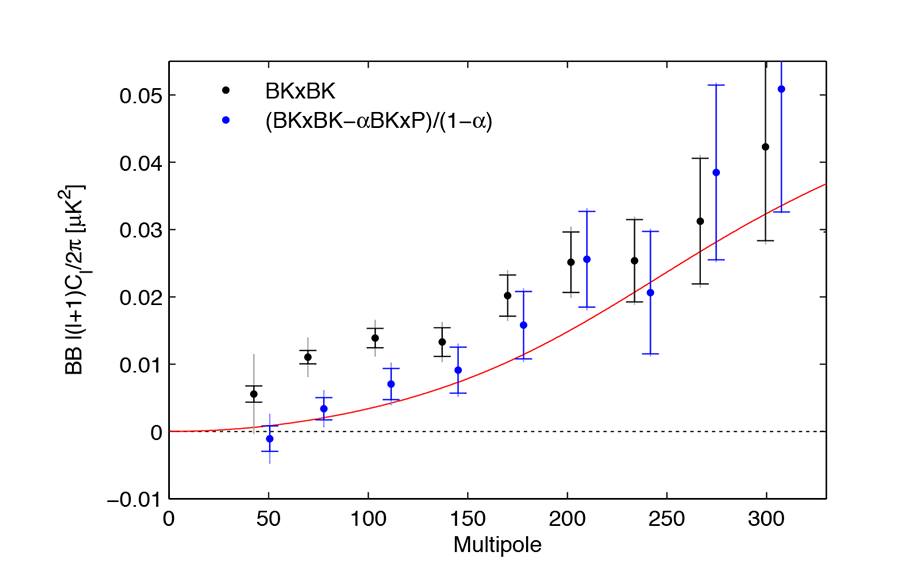
However, news has been leaking out over the last few weeks about what the paper will say. Being the soul of discretion I decided not to blog about these rumours. However, yesterday I saw the killer graph had been posted so I’ve decided to share it here:

cross-correlation

The black dots with error bars show the original BICEP/Keck “detection” of B-mode polarization which they assumed was due to primordial gravitational waves. The blue dots with error bars show the results after subtracting the correlated dust component. There is clearly a detection of B-mode polarization. However, the red curve shows the B-mode polarization that’s expected to be generated not by primordial gravitational waves but by gravitational lensing; this signal is already known. There’s a slight hint of an excess over the red curve at multipoles of order 200, but it is not statistically significant. Note that the error bars are larger when proper uncertainties are folded in.

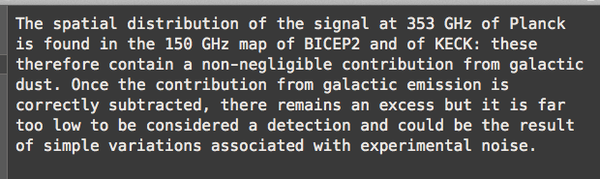
Here’s a quasi-official statement of the result (orginall issued in French) that has been floating around on Twitter:

BICEP_null

To be blunt, therefore, the BICEP2 measurement is a null result for primordial gravitational waves. It’s by no means a proof that there are no gravitational waves at all, but it isn’t a detection. In fact, for the experts, the upper limit on the tensor-to-scalar ratio  R from this analysis is R<0.13 at 95% confidences there’s actually till room for a sizeable contribution from gravitational waves, but we haven’t found it yet.

The search goes on…

UPDATE: As noted below in the comments, the actual paper has now been posted online here along with supplementary materials. I’m not surprised as the cat is already well and truly out of the bag, with considerable press interest, some of it driving traffic here!

UPDATE TO THE UPDATE: There’s a news item in Physics World and another in Nature News about this, both with comments from me and others.

Mistaken Identity

Posted in Uncategorized with tags , on January 29, 2015 by telescoper


wpid-wp-1422539203608.jpeg

R.I.P. Charles Townes, the physicist whose work touched all our lives

Posted in The Universe and Stuff with tags , , , , on January 28, 2015 by telescoper

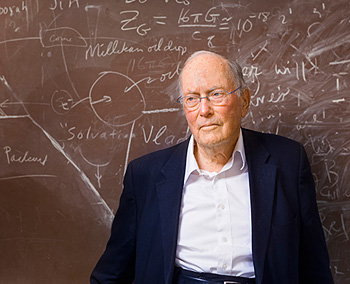
Just a short post to mark the passing of a truly great physicist, Charles H. Townes, who died yesterday at the age of 99.

Charles Townes, pictured in 2013

Charles Townes, pictured in 2013

Townes came to fame for his pioneering work on the theory and applications of the maser , which he then followed up by designing the first laser. Lasers are used in many common consumer devices such as optical disk drives, laser printers, barcode scanners and fibre-optic cables. They are also used in medicine for laser surgery and various skin treatments, and in industry for cutting and welding materials.

The work of Charles Townes in physics has thus had an enormous impact on everyday life; he was awarded the Nobel Prize for is his work on quantum electronics, especially lasers and masers.

It’s very sad that he didn’t quite make his century, especially because this year is the International Year of Light, which will involve many activities and celebrations relating to his work on lasers. Much of our experimental work in Physics here in the Department of Physics and Astronomy at the University of Sussex involves lasers in various ways, and we will find an appropriate occasion to celebrate the life and achievements of a truly great physicist. Until then let me just express my condolences to the friends, family and colleagues of Charles Townes on the loss not only of an eminent scientist but of an extremely nice man.

R.I.P. Charles Townes, physicist and gentleman (1915-2015).

A whole lotta cheatin’ going on? REF stats revisited

Posted in Education, Science Politics with tags , , , on January 28, 2015 by telescoper

Here’s a scathing analysis of Research Excellence Framework. I don’t agree with many of the points raised and will explain why in a subsequent post (if and when I get the time), but I reblogging it here in the hope that it will provoke some comments either here or on the original post (also a wordpress site).

dereksayer's avatarcoasts of bohemia


1.

The rankings produced by Times Higher Education and others on the basis of the UK’s Research Assessment Exercises (RAEs) have always been contentious, but accusations of universities’ gaming submissions and spinning results have been more widespread in REF2014 than any earlier RAE. Laurie Taylor’s jibe in The Poppletonian that “a grand total of 32 vice-chancellors have reportedly boasted in internal emails that their university has become a top 10 UK university based on the recent results of the REF”[1] rings true in a world in which Cardiff University can truthfully[2]claim that it “has leapt to 5th in the Research Excellence Framework (REF) based on the quality of our research, a meteoric rise” from 22nd in RAE2008. Cardiff ranks 5th among universities in the REF2014 “Table of Excellence,” which is based on the GPA of the scores assigned by the REF’s “expert panels” to the three…

View original post 2,992 more words