I think it frets the saints in heaven to see
How many desolate creatures of the earth
Have learnt the simple dues of fellowship
And social comfort, in a hospital.
Elizabeth Barrett Browning (1806-1861), from Aurora Leigh (Book 3).
The sonnet Ozymandias by Percy Bysshe Shelley is so famous that it really needs no introduction here. What you may not know, however, is that Shelley’s poem was one of a pair with the same title on the same theme and submitted to the literary magazine The Examiner. Shelley’s poem was published on January 11th 1818; the other Ozymandias, composed by Shelley’s friend Horace Smith, appeared about three weeks later on February 1st. I can see why Shelley’s is the more famous of the two!
In Egypt’s sandy silence, all alone,
Stands a gigantic Leg, which far off throws
The only shadow that the Desert knows.
“I am great Ozymandias,” saith the stone,
“The King of kings: this mighty city shows
The wonders of my hand.” The city’s gone!
Naught but the leg remaining to disclose
The sight of that forgotten Babylon.
We wonder, and some hunter may express
Wonder like ours, when through the wilderness
Where London stood, holding the wolf in chase,
He meets some fragment huge, and stops to guess
What wonderful, but unrecorded, race
Once dwelt in that annihilated place.
This lunchtime I put on a black tie and went to the funeral of Stuart Keir, who died suddenly a few weeks ago at the aged of 55. Stuart had only just retired, on grounds of ill health, having worked in IT services for over twenty years here at the University of Sussex. When I first started in 1985 the observational astronomers at Sussex were primarily based at the Royal Greenwich Observatory (RGO), which was at that time located in Herstmonceux and Stuart was one of the staff there supporting the computer systems. The RGO moved to Cambridge in 1990 (for reasons which still escape me) at which point some of the astronomers and support staff relocated permanently to the University of Sussex while others went to Cambridge; Stuart moved to Sussex when the Starlink node was consolidated here following the loss of the RGO.
Stuart Keir
I remember Stuart very well from my life here as a PhD student and then as a postdoc in the Astronomy Unit, both before and after he moved full-time to Falmer campus. He wasn’t always the easiest of characters to work with – he insisted on doing everything his own way, which sometimes conflicted with what the astronomers wanted – but it has to be said that he did usually know better than us about the important things. He also worked extremely hard at his job and was definitely a great help to me during my time at Sussex. I’m very sad that he didn’t have long to enjoy his well-earned retirement.
The news of Stuart’s death made me all nostalgic for my days as a PhD student, when life was definitely much simpler. It also made me look back affectionately at the Starlink system as it was in the 80s. I had been lucky enough to get a series of temporary jobs, between school and university and during summer vacations at university, that involved the use of VAX computers of exactly the same type as that used in Starlink so I was well prepared when I started my PhD. In fact, looking back, I still think the native Virtual Memory System (VMS) and Digital Command Language (DCL) were terrific to work with. Unfortunately it seems that DEC, the company that manufactured the VAX systems, made some unwise business decisions and they lost ground to SUN. During the 1990s there was a rapid phase transition within Starlink from VAX machines to a range of SUN workstations.
Much of the value of Starlink in the old days was the connectivity it provided in what was basically a pre-internet (enabled by DECNET) which allowed sharing of software across all UK astronomy groups. In this sense it was an important step towards Open Science. The growth of the internet however let to a reduced role for Starlink from the mid-1990s onwards. Stuart transferred from Starlink to general IT services at the University of Sussex when Starlink was winding down.
In its heyday, Starlink was a great resource that provided a superb environment for astronomical researchers. It would have been nothing, however, without the dedicated team of Starlink Managers like Stuart who managed the local nodes and worked so help the astronomers that worked there. Data-intensive subjects like astronomy depend as much now as they did then on the hard work of computer support staff, an effort that is in my view not given anything like sufficient recognition by universities and other research institutions.
Rest in Peace, Stuart Keir.
Follow @telescoperToo busy for a proper post today so here’s a bit of music. On Saturday I had the pleasure of listening on BBC Radio 3 to a live broadcast of the opera L’elisir d’amore from Covent Gardens, one of my all-time favourite works. I definitely have a thing for the kind of Italian Bel Canto exemplified by the work of Gaetano Donizetti and this is one of his greatest; certainly his most performed anyway. One the surface it’s a light romantic comedy with a very silly plot involving a quack doctor and a fake potion, but it’s beautifully characterized and has considerable dramatic depth and wonderful music. I don’t mind daft operas, as long as they’re sufficiently daft to be true to real life…
Anyway, listening on the radio made me realise how long it has been since I went to see an opera live. Looking at the Covent Garden website to see if there were any more performances due, I saw the prices of the remaining tickets, which brough tears to my eyes. All of which brings me to the highlight of L’elisir d’amore, the Act III aria Una Furtiva Lagrima, one of the most famous and beautiful tenor arias in the entire repertoire. Here it is, sung by the late great Pavarotti. Enjoy!
Oh, and while I am on the theme of opera I’ll just mention that Maria Callas was born on this day in 1923. Happy Birthday, La Divina!

A big conference started today in Ferrara, Italy, which my duties here at the University of Sussex unfortunately did not allow me to attend. The purpose of the meeting was to announce the latest science results and data products from the Planck mission. There was quite a lot of excitement in advance of today’s session as there was supposed to be a press conference at which some exciting results would be announced. Although I’m in Sussex rather than Italy, I have been doing my best to keep up with some of the goings-on via Twitter.
From what I have gathered, it has so far been a bit of an anti-climax. For a start, it was announced some time ago that the full data sets would not be released during this meeting after all, with the effect the conference would just give a preview of the final Planck results. Here’s an explanation from the Planck website:
– The data products and scientific results will be presented at a public conference in Ferrara.
– It is planned to release full mission data products and scientific papers to the public before the end of 2014. A few of the derived products will need a little more time to be readied for release, but will be made public within the month of January 2015.
So the results were to be “presented”, but not “released”. Hmm..
The press conference scheduled for this morning didn’t actually happen either, so we had to wait for the science sessions for juicy information. Not being there in person I had to pick up what I could from Twitter, which included only a few images with accompanying text (only in French).
Here, for example are the main power-spectra for temperature (TT), E-mode polarization (EE) and the cross-spectrum between the two (TE), together with a picture of the temperature pattern across the sky:

Lovely results of course – look how accurately the data fit the theoretical model curves – but notice that both the TE and EE spectra are cut off at low l. That’s because the polarization signal on large angular scales is so heavily affected by systematics that measurements for l<30 are unreliable. It’s not clear when, if ever, those systematic issues will be resolved. There’s no measurement of the primordial B-mode spectrum to compare with BICEP2, either, although there is a strong detection of a B-mode lensing signal obtained by cross-correlating Planck data with galaxy maps.
Still, that doesn’t mean that there is no polarization data at all. There is for example, this rather beautiful visualization of the polarized emission at 353 GHz, together with the Galactic magnetic field, shown over a thirty-degree square region of the sky:
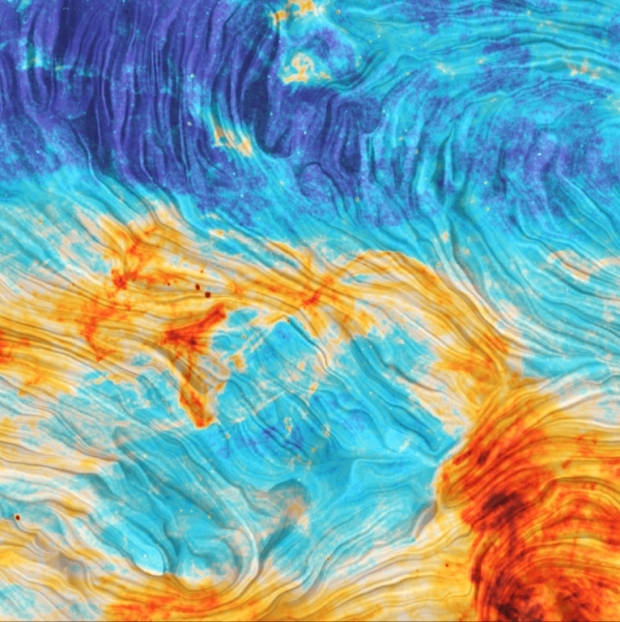
The science results that I’ve been able to glean from social media largely amount to minor corrections to last year’s results, with only small changes (less than ~1σ) to the cosmological parameters derived from them. Good science, of course, but nothing to get too worked up about. What with the “now you see it, now you don’t” press conference, the decision not to release the data, and the polarization data still being in a mess, I can’t help feeling distinctly underwhelmed by the whole thing. This might be a bit harsh, but I think it’s been a bit of a farce…
Still, at least I’m no longer sad I couldn’t make the conference!
Follow @telescoper
Here’s a fascinating physics video for your amusement and edification:
I think the video explains what is going on pretty well, but if you want more information (including some connections with other bits of physics) you can look at this paper (whence I’ve nicked the following pictures and description).
Basically what is happening is that the motion of the plate through the water in the pool creates a connected pair of Rankine Vortices, rotating in opposite directions. The kinetic energy and the angular momentum the vortices quickly decay so the structure turns into a pair of dimpled singular surfaces called Falaco Solitons. Although unstable, these structures can survive for several minutes if the water in the pool is otherwise still:

Severing the thin, string-like, structure that connects the two dimples will make them vanish extremely rapidly.
The spooky-looking black discs you can see apparently floating on the surface are actually an optical artefact, formed on the floor of the pool by Snell refraction through the rotationally-induced dimpled surface:

The physics is quite simple, really, but the result is fascinating to watch. If you agree, you’ll also be interested in this old post of mine about vortex rings.
Follow @telescoperLike any cricket fan I was horrified to hear last week of the death at the age of 25 of the Australian cricketer Phillip Hughes, three days after he received a head injury on the field of play during a Sheffield Shield match in Australia on Tuesday. Let me start by expressing my deepest condolences to his family and friends at what must be a terrible time for them. My thoughts also go to the bowler, Sean Abbott, whose delivery ended up causing the fatal injury. He should not be blamed and I’m sure he feels as bad as anyone about the incident.

What happened to Phillip Hughes is a reminder that cricket is a dangerous game. A cricket ball is hard – it is made of solid cork wrapped in leather – and can travel at speeds in excess of 90 mph when delivered by a fast bowler. When you get hit by one it really hurts. Thankfully serious injuries are relatively rare, but it nevertheless takes considerable physical and mental courage as well as great skill for a batsman to face up to fast bowling.
In this case it was Sean Abbott who bowled a short-pitched delivery (a “bouncer”) at Hughes. There’s nothing unusual about that – it’s a standard part of a fast bowler’s repertoire. Hughes saw it coming and got into position to play a hook shot, a cross-batted stroke played to a ball over waist height with the intent of sending it to the boundary. This is one of the most spectacular attacking shots in cricket but also one of the most dangerous. Often it involves playing the ball directly in front of the face, and if the batsman misses an injury is inevitable. On this occasion, Hughes seems to have misjudged the pace of the ball and went through with the shot too quickly. His upper body having swung around during the course of his attempted hook, when the ball missed the bat it thudded into the back of his head, underneath his protective helmet. The impact ruptured an artery and caused a massive flow of blood into his brain. He subsequently collapsed and was carried off the field, where he needed mouth-to-mouth resuscitation. He was taken to hospital, and a procedure carried out to reduce the pressure on his brain. Sadly he never recovered, and died three days later.
Of course the death of Phillip Hughes has led to a great deal of soul-searching in the cricket world. I think it’s quite right that a heart-breaking event like the death of a cricketer so make us redouble efforts to keep the game as safe as possible. I think that means looking very seriously at the design of the modern cricket helmet. Only this summer, England’s Stuart Broad was badly injured when he was hit by a ball that smashed through the faceguard on his helmet, which suggests to me that the design of the front of the standard helmet is faulty. The same type of helmet offers no protection to the lower part of the back of the skull, either. On the other hand, a helmet that was too bulky might restrict the movement of a batsman so much that it makes it more, not less, likely that they will get hit. One also has to try to maintain a reasonable perspective. The type of injury that killed Hughes – a vertebral artery dissection – is extremely rare, with only about 100 cases ever having been recorded at all, none which were on the cricket field. Not that long ago, nobody wore a helmet anyway; see below for an example.
Australians cricketers learn to play the game on pitches that are fast and hard, but generally of even bounce. That’s why the hook shoot is favoured more by Aussie batsman than by their English counterparts; pitches in England are generally slower and variable bounce is much more likely. Until relatively recently many English batsman didn’t play the hook shot at all, preferring instead to simply get out of the way of a bouncer than attempt to play it. After all, the ball isn’t going to hit the stumps if it’s bouncing around head height. Getting out of the way isn’t as easy as it sounds, however, because one’s instinctive reaction is either to try to protect your head with bat or gloves, to flinch away or try to duck. The proper technique, which requires practice to ingrain, is to keep your eye on the ball, drop the hands to keep the bat out of the way, and sway out of the path of the ball at the last minute. That may sound easy, but it certainly isn’t. I tried to do it in a school game years against a bowler a fraction of the pace of Sean Abbott, and ended up with the ball smacking me right on bridge of my nose. I had taken the “keep your eyes on the ball” advice a bit too literally…
Some have argued that bouncers should be banned. I think that would be a mistake. Part of the unique appeal of cricket is that the spectactors are aware not only of the skill of the players, but also their courage. A bouncer is a severe test of the mettle of a batsman, whether they choose to fight fire with fire by trying to hook, or simply standing firm and letting it go by. Some of the most enthralling passages of play I remember watching involved a demon fast bowler hurling down terrifying thunderbolts at batsman who could do little but get everything into line and try soak up whatever was thrown at him. Heroic defence is as much a part of the game as dashing strokeplay.
Take this example. Brian Close had been brought into open the England batting earlier in the 1976 series against the West Indies in an attempt to stiffen their resistance to the West Indian attack. He wasn’t the greatest player in the world nor the cricketing world’s most agreeable character, and as you can tell he wasn’t in the first flush of youth in 1976 either, but there is no denying his courage and determination. Here he is enduring a vicious battering at the hands of Michael Holding. One short-pitched delivery in this sequence came within a whisker of hitting him on the head; had it done so the consequences would have been horrendous as he was not wearing a helmet. As it was, he “only” had to take a succession of blows to his body. He scored 20 runs at Old Trafford, off 108 balls in 162 minutes, and was dropped for the next Test as was his opening partner John Edrich, although both had stood their ground and defended their wickets (and themselves) manfully.
Note that Michael Holding did get a warning here for excessive use of short-pitched deliveries, but the situation was very different from that faced by Phillip Hughes who was well set and trying to score runs rather than clinging on against a barrage aimed at his head and body.
The element of danger is not unique to the sport of cricket. Contact sports (e.g. rugby) also carry a risk of serious injury. Boxing is another, perhaps more extreme, example. Of course we should do everything we can to minimize the danger to the participants, but we can never remove the risk entirely. I’m not in favour of banning bouncers or boxing or other “dangerous sports”: as long as all concerned know the risks then they should be allowed to make the decision whether to expose themselves to those risks. In fact, everything we do in life carries an element of risk. If we’re not free to take chances, we’re not free to live at all.
R.I.P. Phillip Hughes (1988-2014).
POSTSCRIPT. In a touching gesture, the record of Phillip Hughes’s last innings has been changed to from “Retired Hurt 63” to “Not Out 63”.
Follow @telescoperTwo days ago, on Thursday, I had the pleasure of spending all day at an “Awayday” trying to work out how to implement the University of Sussex Strategic Plan, Making the Future. My main contribution was this beautifully clear diagram summarising a lengthy discussion on research strategy:
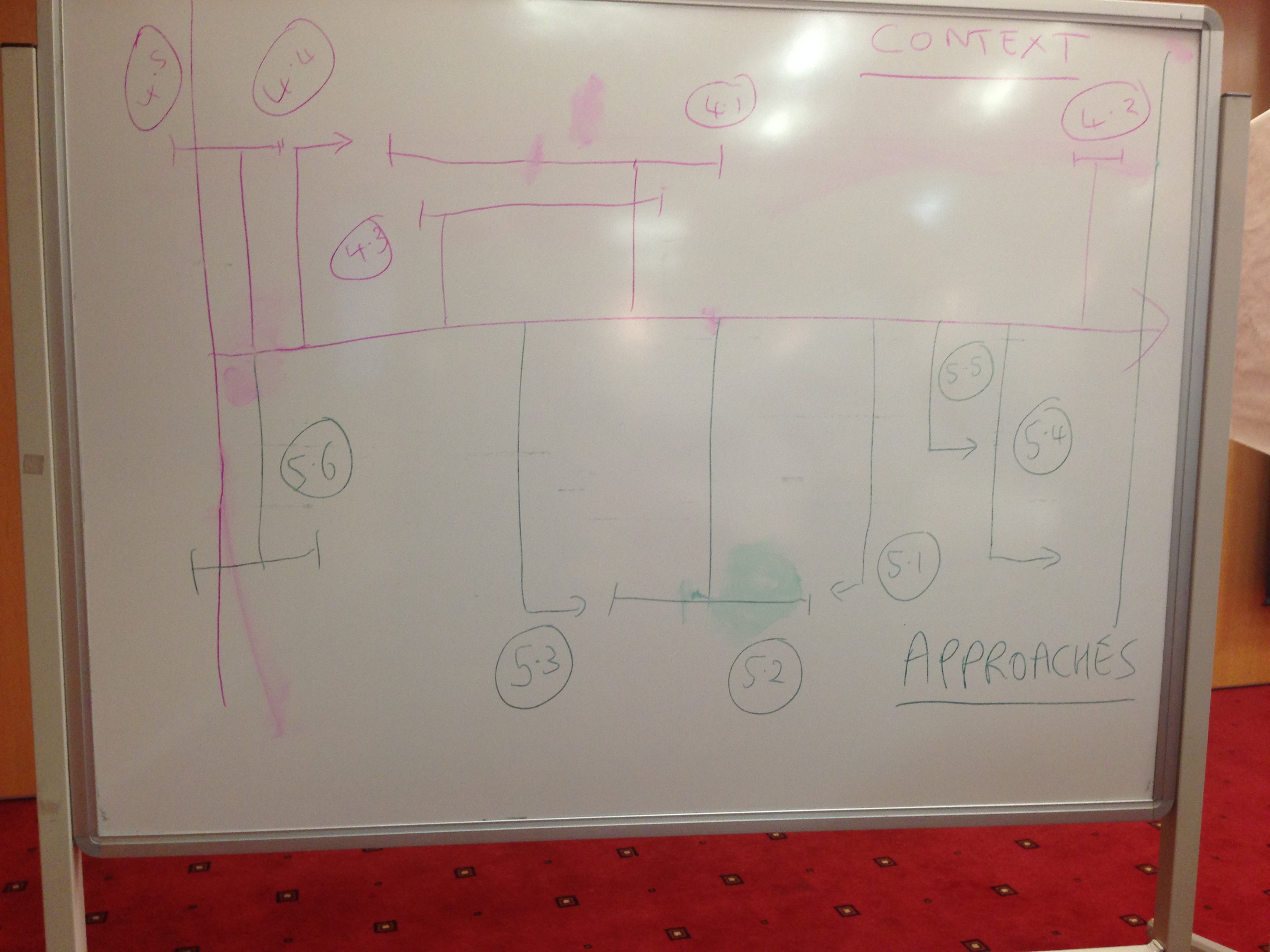
Obviously the diagram needs no further explanation, but members of the audience were so impressed with it as a piece of graphic art that the end of the day I was asked to sign it.
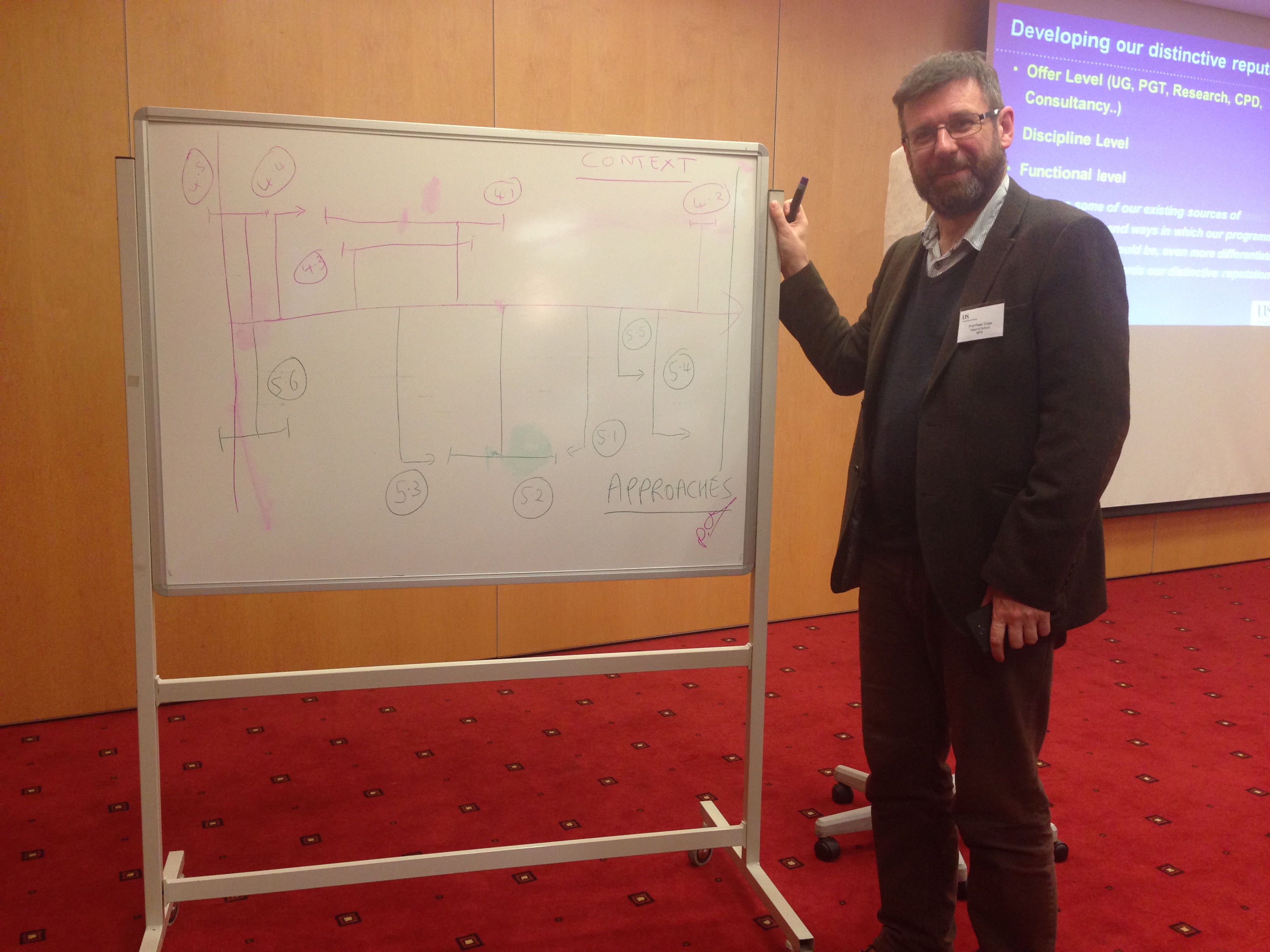
Now, who’s going to nominate me for the Turner Prize?
Follow @telescoperI was saddened yesterday to hear of the death, at the age of 94, of the great crime novelist P.D. James so decided to take a few minutes out of my lunch break to post this little tribute. I’ve long been a fan of detective fiction in general but there was something very special about the writing of P.D. James; the initials stand for Phyllis Dorothy, by the way. I think she was one of the few crime novelists who managed to transcend the whodunnit genre to produce work of authentic literary merit in its own right; Ruth Rendell is the only other that springs to mind among contemporary writers of detective fiction. Her style was as polished and the subject matter as meticulously researched was you would expect from a direct descendant of Dorothy L. Sayers, one of the leading exponents of the “Golden Age” of detective fiction.
P.D. James is most famous for her series of fourteen books featuring the poetry-loving detective Adam Dalgleish, the first of which, Cover Her Face, was published in 1962. That series contained many superb stories, such as Shroud for a Nightingale, Devices and Desires, and Death of an Expert Witness. She also wrote two novels about the female private detective Cordelia Gray, including An Unsuitable Job for a Woman. More recently she wrote a murder mystery sequel to Jane Austen’s Pride and Prejudice called Death Comes to Pemberley. I bought this last year, but somehow never got around to reading it but will definitely do so now, as I now know it her last; I have read all her other books.
As well as numerous awards for her writing, P.D. James was honoured by the Establishment with an OBE in 1983 and a Life Peerage in 1999. It’s says most however that so many other authors, even those whose style is markedly different have offered heartfelt tributes to her (including these in the Guardian). The main reason why she was held in such high regard by fellow authors was simply that she was bloody good at being a writer; she cared about her craft and was proud of what she did.
There’s something distinctively English about the detective novels of P.D. James, although that something is a something that clearly tends to polarize people. Some find her approach a bit too detached and genteel, some find it, “cosy”, snobbish and class-ridden, and some think that she was just an anachronism, harking back too much to the era of Agatha Christie and Dorothy L. Sayers. Yet others can’t understand the attraction of the genre at all. People are welcome to their opinions of course, but I think that the best detective fiction is not just about setting a puzzle for the reader to solve, but also posing questions about the nature of a society in which such crimes can happen. Far from being “cosy”, great crime writing actually unsettles bourgeois attitudes. The solution of the mystery may offer us a form of comfort, but the questions exposed by the investigation do not go away. As Val McDermid
wrote in the Guardian, “People who know no better sometimes describe her work as cosy. If a scalpel is cosy, then so was Phyllis”.
Rest in Peace, P.D. James (1920-2014).
Follow @telescoperSo it seems that I’ve made the shortlist for Beard of the Year 2014. No doubt many would consider it to be unseemly for me to tout for votes on this blog. All I can say to such people is VOTE FOR ME!
Beard Liberation Front
Press release 27th November
Contact keith Flett 07803 167266
Cricketer Moeen Ali & author Philip Ardagh on Beard of Year shortlist as Russell Brand doesn’t make cut
The Beard Liberation Front, the informal network of beard wearers, has revealed the 10 names that will go forward to a poll for the Beard of the Year after a public vote eliminated such well known beard wearers as Russell Brand and Pink Floyd’s Dave Gilmour.
England cricketer Moeen Ali who has just scored the third fastest England ODI century and author Philip Ardagh are among the favourites to win the coveted Award, along with surprise contender the Bishop of Brentwood.
After an on-line vote which opens on 28th November the winners of Beard of the Year will be revealed on December 28th.
BLF Organiser Keith Flett said, it’s fair to say that competition for the Beard of the…
View original post 114 more words


 In the Dark