BICEP2 Redux: How the Sausage is Made

Posted in The Universe and Stuff with tags , , , on July 6, 2014 by telescoper

I came across this (rather lengthy, but very good) discussion of the BICEP2 story so far so thought I would share it here. There’s a particularly useful collection of articles at the end for those who would like to read more.

I’ll also take this opportunity to refer you to a recent BBC News story which states that the BICEP2 and Planck teams are now in discussions about sharing data. About time, if you ask me. Still, it will take a considerable time to work out the ordering of the authors if they ever do write a paper!

Glen Mark Martin's avatarWhiskey...Tango...Foxtrot?

An ongoing problem with communicating science to the general public is the existence of widely-held misconceptions among the public regarding how science actually works. A case in point is the March 17 announcement by the BICEP2 Collaboration regarding the detection of B-Mode polarization in the Cosmic Microwave Background and the events which have unfolded since then.

All too often, news stories and blog posts will trumpet some announcement with sensational headlines like “Scientists Say Cheap, Efficient Solar Cells Just Around the Corner”, or “Scientists Close in on Cure for Cancer.” Many people take such announcements at face value and consider the case closed. The work has been done.  The reality of the situation, however, is that the initial announcement of a discovery or breakthrough is just the beginning of the hard work, breathlessly hyped headlines notwithstanding.

How Science Actually Works (or at least how it is supposed to work)

Once…

View original post 2,843 more words

One July Summer

Posted in Poetry with tags , , on July 5, 2014 by telescoper

What has happened to summer,
That’s what I want to know.
Is she on a vacation –
Who knows where did she go?
Tell, what was she wearing;
A zephyr breeze and rosebud
Or grass and wild berry?
Could she be honeymooning
With spring or early fall
Or has she gone so far away
She’ll not return at all?

by Dorothy Ardelle Merriam.

Does anyone know anything about this poet? I can’t find anything at all about her on the internet!

When David heard that Absalom was slain…

Posted in Music with tags , , , on July 4, 2014 by telescoper

I heard this beautiful music on Radio 3 this morning. It stopped me in my tracks and couldn’t do anything until it was finished. It’s by someone who’s quite new to me called Thomas Tomkins, a Welsh composer who lived from 1572 to 1656. This piece is setting of a biblical text from the 2nd Book of Samuel (Chapter 18 Verse 13) when David learns of the death of his son Absalom. In the King James version this reads

And the king was much moved, and went up to the chamber over the gate, and wept: and as he went, thus he said, O my son Absalom, my son, my son Absalom! would God I had died for thee, O Absalom, my son, my son!

Astronomy Look-alikes, No. 93

Posted in Astronomy Lookalikes with tags , on July 3, 2014 by telescoper

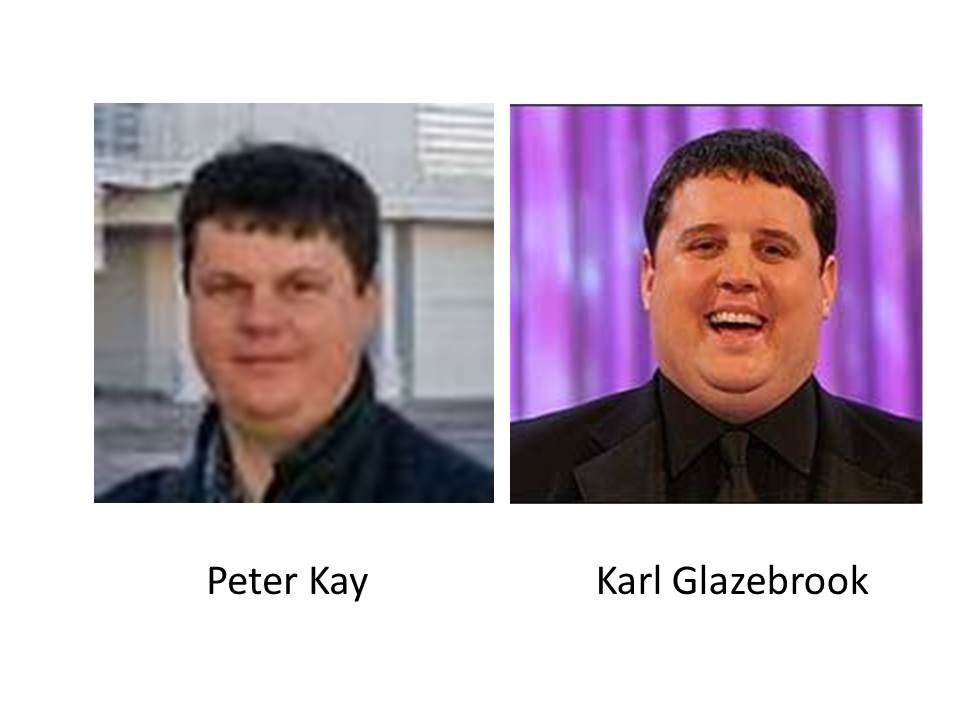
I’m struck by the similarity between astronomer Karl Glazebrook of Swinburne University, Melbourne (in Australia) and comedian Peter Kay from Lancashire (in the Midlands). I wonder if by any chance they might be related?

Lookalkie

Warm Weather advice on Beards, Shorts & Sandals issued

Posted in Beards with tags , , on July 3, 2014 by telescoper

Important seasonal advice from the BLF…

kmflett's avatarKmflett's Blog

Beard Liberation Front
PRESS RELEASE 3rd July
Contact Keith Flett 07803 167266

WARM WEATHER ADVICE ON BEARDS, SHORTS & SANDALS ISSUED

The Beard Liberation Front, the informal network of beard wearers, has issued updated advice on the wearing of Beards, Shorts and Sandals with warm weather in some areas of the UK forecast for the next few days

Guidelines
1] Shorts and sandals may be worn after 9am until 8pm at the discretion of the wearer.
2] Where sandals are worn the wearing of socks is discouraged but not forbidden
3] If socks are not worn toenails must be neat, trimmed, clean and fungus free
4] Shorts should ideally be around knee length to provide a balanced image with the beard
5] Shorts should be of conservative design and colour. Wearing of bright red, yellow or floral patterned shorts is forbidden and shorts should generally come below the knee
6]…

View original post 147 more words

Talking About Undergraduate Physics Research…

Posted in Education, The Universe and Stuff with tags , , , , , , , on July 2, 2014 by telescoper

One of the courses we offer in the School of Physics & Astronomy here at the University of Sussex is the integrated Masters in Physics with a Research Placement. Aimed at high-flying students with ambitions to become research physicists, this programme includes a paid research placement as a Junior Research Associate each summer vacation for the duration of the course; that means between Years 1 & 2, Years 2 & 3 and Years 3 & 4 . This course has proved extremely attractive to a large number of very talented students and it exemplifies the way the Department of Physics & Astronomy integrates world-class research with its teaching in a uniquely successful and imaginative way.

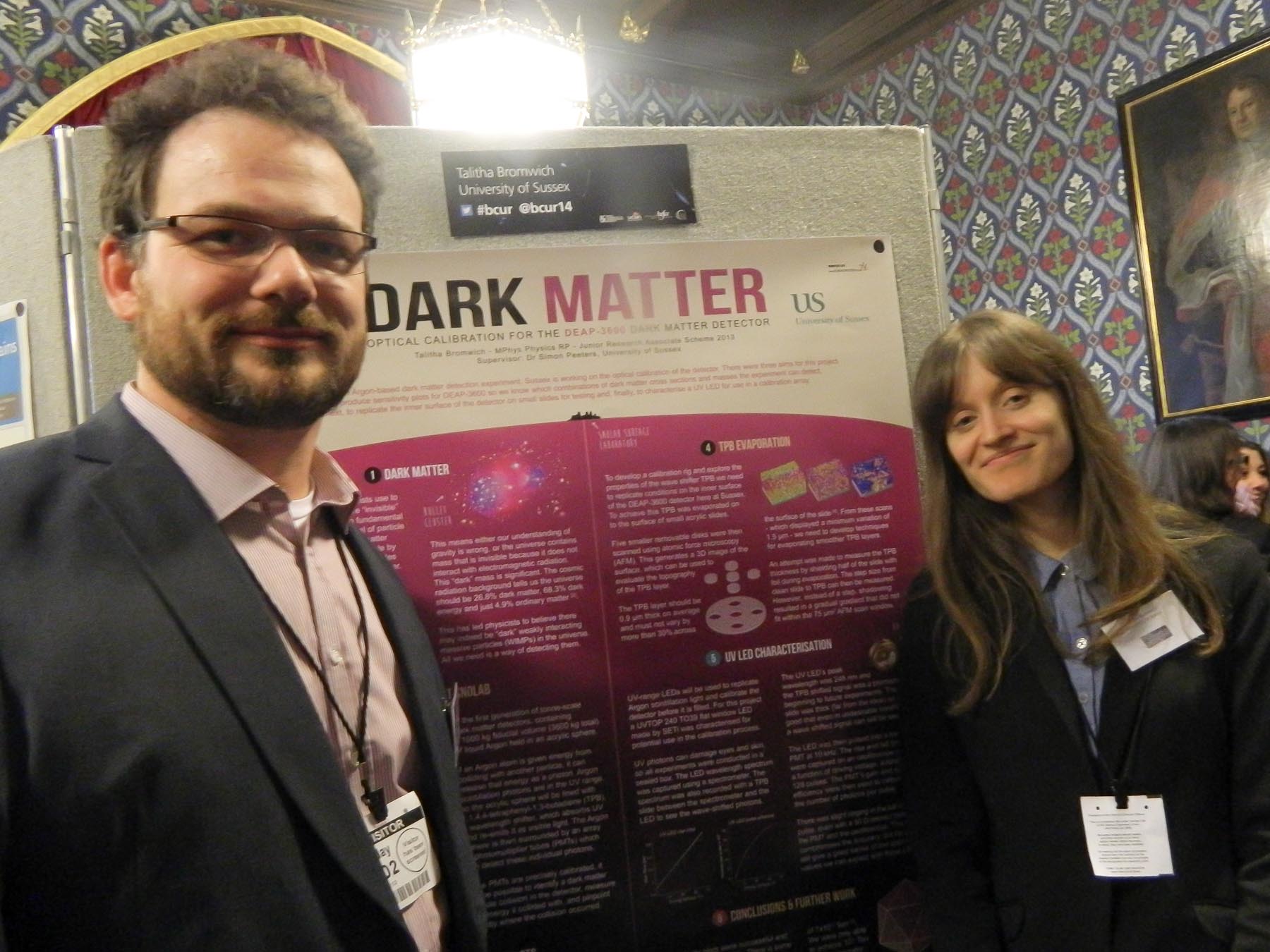
Some time ago I blogged about  some very good news about one of our undergraduate researchers, Talitha Bromwich, who is about to graduate from her MPhys degree, after which she will be heading to Oxford to start her PhD DPhil; she is pictured below with her supervisor Dr Simon Peeters:

Talitha Bromwich with her JRA supervisor Dr Simon Peeters at 'Posters in Parliament' event 25 Feb 14

Talitha spent last summer working on the DEAP3600 dark-matter detector after being selected for the University’s Junior Research Associate scheme. Her project won first prize at the University’s JRA poster exhibition last October, and she was then chosen to present her findings – alongside undergraduate researchers from 22 other universities – in Westminster yesterday as part of the annual Posters in Parliament exhibition, organized under the auspices of the British Conference of Undergraduate Research (BCUR).

A judging panel – consisting of Ben Wallace MP, Conservative MP for Wyre and Preston North; Sean Coughlan, Education Correspondent for the BBC; and Professor Julio Rivera, President of the US Council of Undergraduate Research; and Katherine Harrington of the Higher Education Academy – decided to award Talitha’s project First Prize in this extremely prestigious competition.

We held a small drinks party in the School of Mathematical and Physical Sciences to congratulate Talitha on her success. Here are a couple of pictures of that occasion:

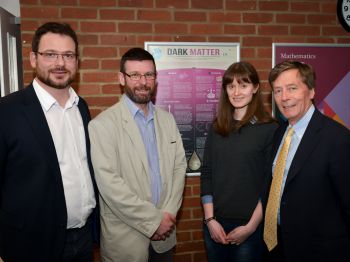
3479.item

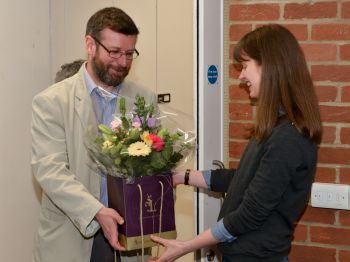
From left to right you see Simon Peeters, myself, Talitha and Prof. Michael Farthing (the Vice Chancellor of the University of Sussex); the winning poster is in the background. Here’s me presenting a little gift:

3478.item

More recently still, the MPS Elves have made a little video featuring Talitha talking about her research placement:

We take undergraduate research very seriously here at the University of Sussex, and are now extending the Research Placement scheme to Mathematics. Many Departments talk about how important it is that their teaching is based on state-of-the-art research, but here at Sussex we don’t just talk about research to undergraduates – we let them do it!


When you and I were young, Maggie

Posted in Jazz with tags , on July 1, 2014 by telescoper

Very busy day today so just time for a quick post of a piece of music. No political interpretation is to be put on this choice; Maggie Thatcher and I were never young at the same time. I’m just proving that football isn’t the only field to have produced a famous John Barnes:


The Zel’dovich Lens

Posted in The Universe and Stuff with tags , , , , on June 30, 2014 by telescoper

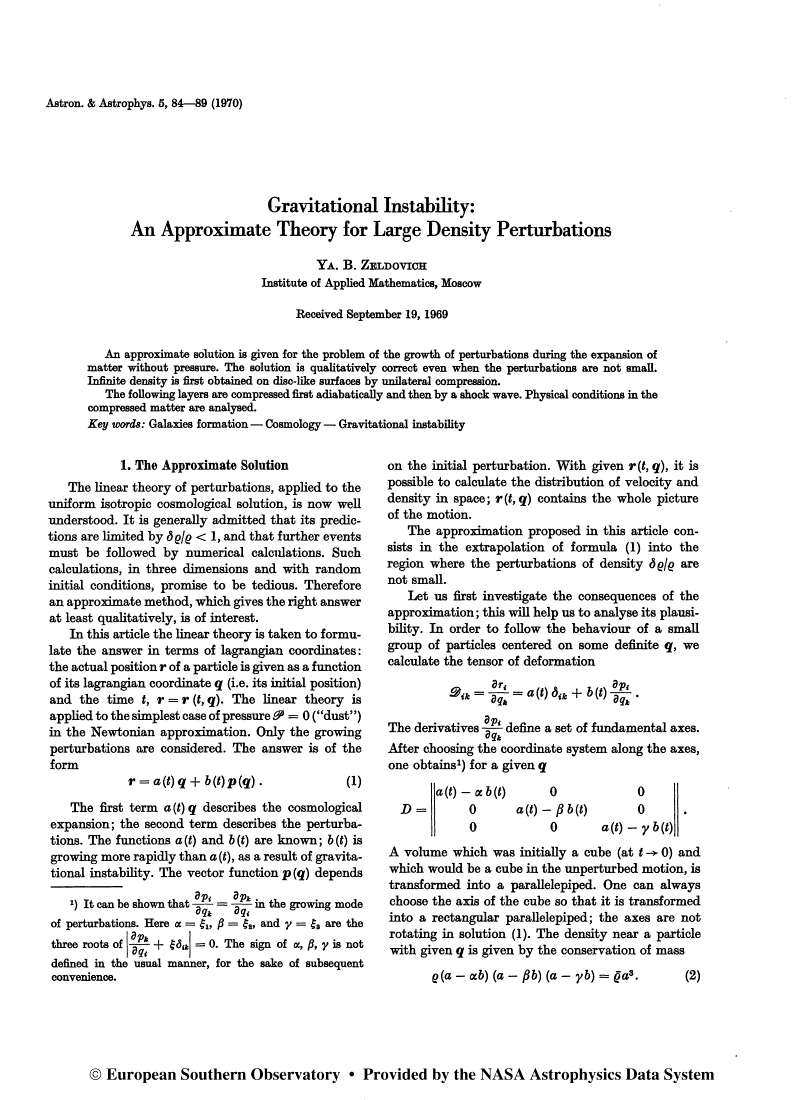
Back to the grind after an enjoyable week in Estonia I find myself with little time to blog, so here’s a cute graphic by way of  a postscript to the IAU Symposium on The Zel’dovich Universe. I’ve heard many times about this way of visualizing the Zel’dovich Approximation (published in Zeldovich, Ya.B. 1970, A&A, 5, 84) but this is by far the best graphical realization I have seen. Here’s the first page of the original paper:

zeld

In a nutshell, this daringly simple approximation considers the evolution of particles in an expanding Universe from an early near-uniform state into the non-linear regime as a sort of ballistic, or kinematic, process. Imagine the matter particles are initial placed on a uniform grid, where they are labelled by Lagrangian coordinates \vec{q}. Their (Eulerian) positions at some later time t are taken to be

\vec{r}(\vec(q),t) = a(t) \vec{x}(\vec{q},t) = a(t) \left[ \vec{q} + b(t) \vec{s}(\vec{q},t) \right].

Here the \vec{x} coordinates are comoving, i.e. scaled with the expansion of the Universe using the scale factor a(t). The displacement \vec{s}(\vec{q},t) between initial and final positions in comoving coordinates is taken to have the form

\vec{s}(\vec{q},t)= \vec{\nabla} \Phi_0 (\vec{q})

where \Phi_0 is a kind of velocity potential (which is also in linear Newtonian theory proportional to the gravitational potential).If we’ve got the theory right then the gravitational potential field defined over the initial positions is a Gaussian random field. The function b(t) is the growing mode of density perturbations in the linear theory of gravitational instability.

This all means that the particles just get a small initial kick from the uniform Lagrangian grid and their subsequent motion carries on in the same direction. The approximation predicts the formation of caustics  in the final density field when particles from two or more different initial locations arrive at the same final location, a condition known as shell-crossing. The caustics are identified with the walls and filaments we find in large-scale structure.

Despite its simplicity this approximation is known to perform extremely well at reproducing the morphology of the cosmic web, although it breaks down after shell-crossing has occurred. In reality, bound structures are formed whereas the Zel’dovich approximation simply predicts that particles sail straight through the caustic which consequently evaporates.

Anyway the mapping described above can also be given an interpretation in terms of optics. Imagine a uniform illumination field (the initial particle distribution) incident upon a non-uniform surface (e.g. the surface of the water in a swimming pool). Time evolution is represented by greater depths within the pool.  The light pattern observed on the bottom of the pool (the final distribution) displays caustics with a very similar morphology to the Cosmic Web, except in two dimensions, obviously.

Here is a very short  but very nice video by Johan Hidding showing how this works:

In this context, the Zel’dovich approximation corresponds to the limit of geometrical optics. More accurate approximations can presumably be developed using analogies with physical optics, but this programme has only just begun.

The Zel’dovich Universe – Days 5 & 6 Summary

Posted in History, The Universe and Stuff with tags , , , , , on June 29, 2014 by telescoper

Well, it’s Sunday morning and it’s raining in Tallinn. I’ve got a few hours to kill but fortunately don’t have to check out of the hotel until noon so I thought I’d briefly summarize Days Five and Six of IAU Symposium No. 308, The Zel’dovich Universe just to complete the story.

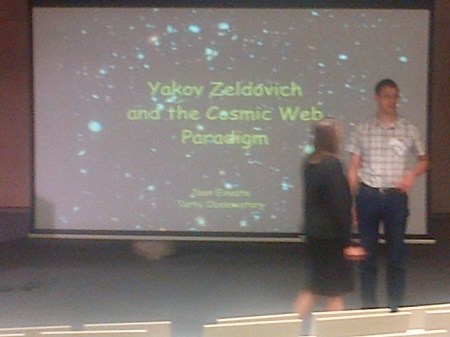
Day Five (Friday) began with a talk by Jaan Einasto, recent winner of the Gruber Prize for Cosmology. As you can see from this picture I took before his talk commenced,  the topic was Yakov Zel’dovich and the Comic Sans Cosmic Web Paradigm:
IMG-20140627-00354

The following talk was by the ebullient Rashid Sunyaev, whose name is associated with Zel’dovich in so many contexts, including the Sunyaev-Zeld’ovich effect. Sunyaev is such a big personality that he is unconstrained by the banal notions of time, and his talk set the schedule back for the rest of the morning. Among the things I remember from his contribution was a discussion of the Berkeley-Nagoya distortion. This was a hot topic during the time I was a graduate student, as it was a measurement that suggested the spectrum of the cosmic microwave background departed significantly from a black-body (Planck) curve in the Wien part of the spectrum; this is now usually known as a y-distortion. Anyway, lots of theorists wrote papers explaining the measured excess in terms of this that and the other and then it was shown to be an error; the excess emission came not from the Big Bang but from the exhaust of the rocket carrying the measurement. The thing I remember most strongly about this was that as soon as the error was identified it ceased to be the Berkeley-Nagoya distortion and became instead the Nagoya-Berkeley distortion…

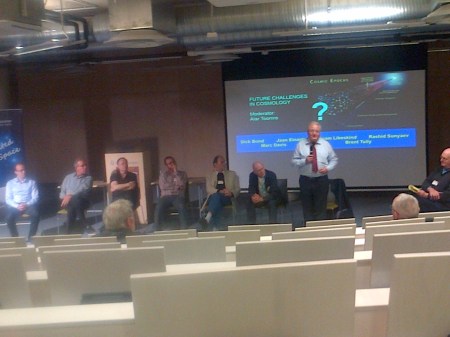
Rashid Sunyaev was himself a winner of the Gruber prize some years ago, as indeed were Dick Bond and Brent Tully who spoke erlier in the conference, so the organizers decided to form a Gruber-panel to discuss various topics suggested by the audience. Here is Sunyaev, hogging the microphone:
IMG-20140627-00355

Carlos Frenk is also a Gruber prize winner, but he only arrived after lunch so wasn’t part of this discussion. The afternoon was all about cosmological simulations of various aspects of the Cosmic Web. This gives me an opportunity to repeat how the Oxford English Dictionary defines “simulation”:

1. a. The action or practice of simulating, with intent to deceive; false pretence, deceitful profession.

b. Tendency to assume a form resembling that of something else; unconscious imitation.

In the World Cup players can even get sent off for simulation, although regrettably they seldom are.

Anyway, Friday evening found us at the famous House of Blackheads (aptly on Pikk Street) for an evening of very long speeches punctuated by small amounts of food and wine (and of course some very lovely music as I described yesterday). When the party was over a group of us adjourned to a local bar, from which I returned to my hotel at about 2am.

Day Six was a half-day, with some very interesting talks about gravitational len-sing in the first session and “superstructures” in the cosmic web. Then we were into the final furlong as it were. Nick Kaiser was put in Session (No. 21) all of his own. As usual, given how annoyingly brilliant he is, Nick gave  fabulously interesting talk full of insights and ideas. The organizers had definitely saved the best for second-to-last.

Then, after five-and-a-half days and almost 100 talks, it was down to me to give the conference summary. Obviously I couldn’t really summarize all that such I just picked up a few things that occurred to me during the course of the conference (some of which I’ve written about over the last week or so on this blog) and made a few jokes, primarily at the expense of Carlos Frenk. I was interested to see that signs like this had been put up around Tallinn advertising my talk:

IMG-20140628-00356

The OMG and WOW are self-explanatory, but I was a bit confused about the SAH so I googled it and found that it means the Society of Architectural Historians. I’ve never heard it put quite like that before, but I guess that’s what we cosmologists are: trying to understanding the origins and time evolution of the architecture of the Universe.

A number of speakers at this conference referred to a conference in Hungary in 1987 at which they had met Zel’dovich (who died later that year). I was a graduate student (at Sussex) at that time and owing the shortage of travel funds I wasn’t able to go; I went to a meeting in Cambridge called The Post-Recombination Universe instead. If memory serves that’s when I gave my first conference talk. Anyway, Carlos Frenk gave a talk at that meeting in Hungary which he decribed in his talk at this conference on Friday afternoon. Somebody back in 1987 had written a series of limericks to describe that meeting, so I was challenged to come up with one to conclude this one. Here’s my effort, which is admittedly pretty feeble, but at least the sentiments behind it are genuine..

In Tallinn (IAU 308)
The sessions invariably ran late
But despite being tired
We still much inspired
By Yakov Zel’dovich (the Great).

Mu süda, ärka üles

Posted in History, Music with tags , , , on June 28, 2014 by telescoper

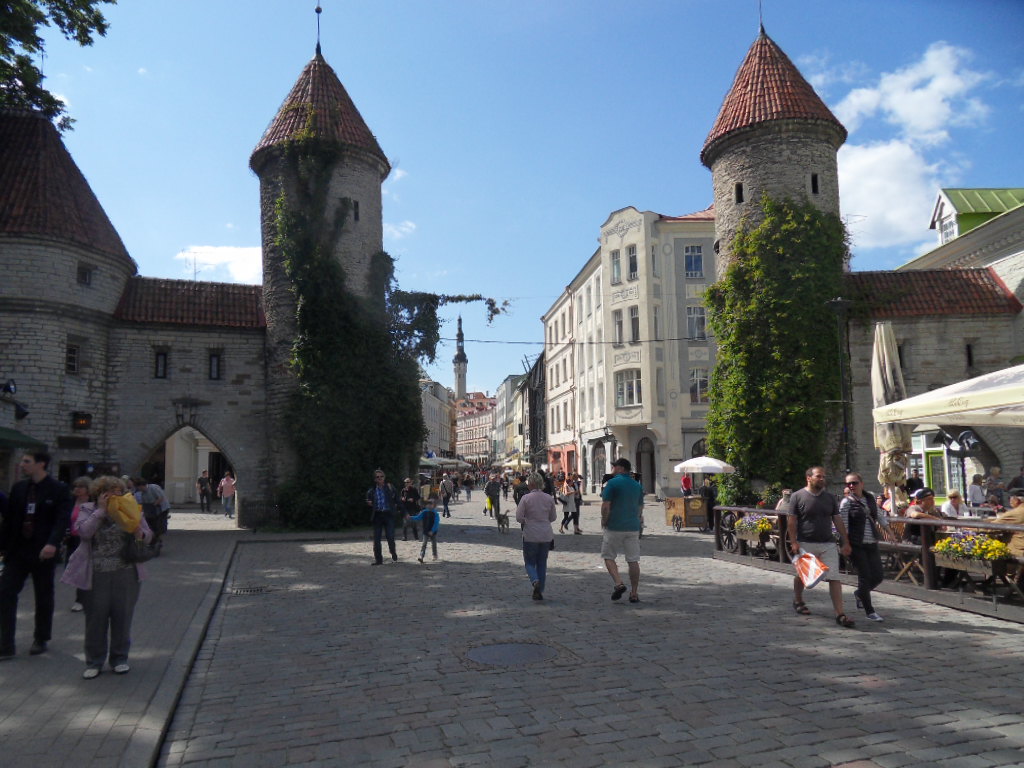
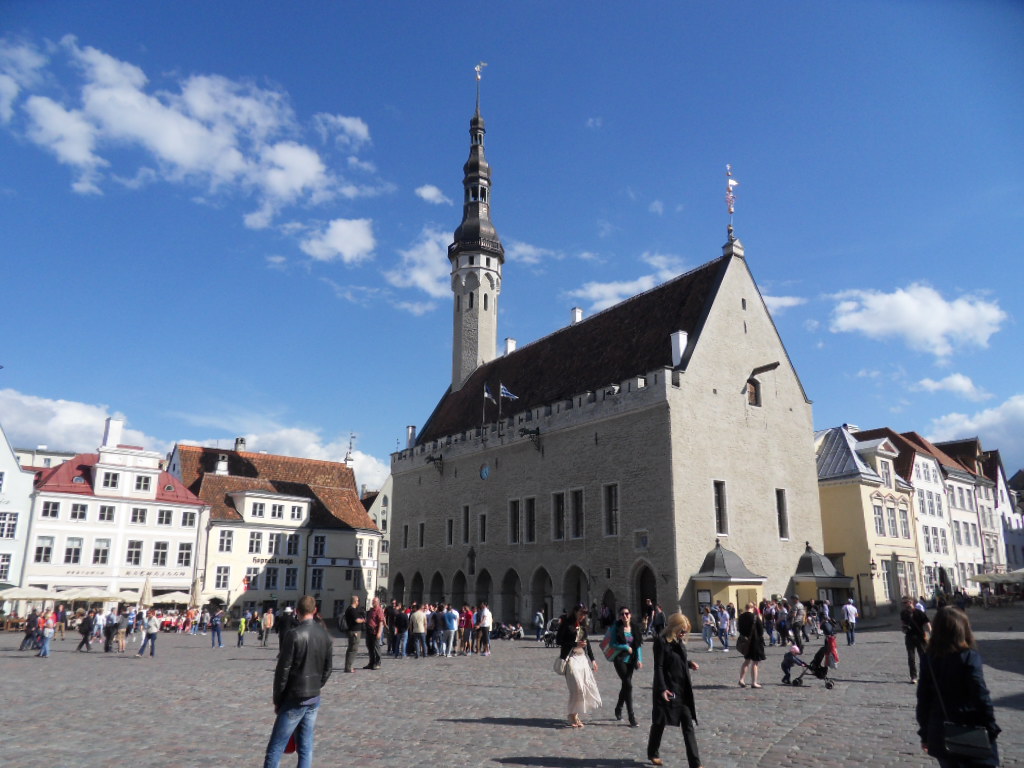
Well, the conference is over. I did my summary talk this afternoon and most of the conference attendees have already begun their journey home. I’m coming back to England tomorrow so I spent the early evening doing a bit of exploration. The conference schedule has been so packed that this is the first time I’ve been able to act like a tourist. I have to say the old town of Tallinn really is exceptionally beautiful, especially in the bright summer sunshine. Here’s a couple of pictures I took on my stroll.

SAMSUNG DIGITAL CAMERASAMSUNG DIGITAL CAMERASAMSUNG DIGITAL CAMERA

On Friday we had the conference dinner at the House of the Blackheads, which doesn’t sound so promising in English but is in fact a spending old building in the centre of Tallinn. To my delight we were serenaded by a choir (The Estonian Girls’ TV Choir). Estonia is a small country, with a population of only 1.3 Million, but it has an exceptionally strong musical tradition especially in choral music. Estonia has more choirs per unit population than any other country in the world, or so I’m told. Even more than Wales!

Anyway, this is the folk hymn they started with last night; the lights were dimmed in the ancient hall and the girls stood around the dining hall holding candles as they sang. The effect was stunning. Mu süda, ärka üles which means Awake, my heart is a traditional song, but the wonderful arrangement is by a composer who is quite new to me, Cyrillus Kreek.

I’ll complete my series of summaries of the conference tomorrow morning.