When I’m struggling to find time to do a proper blog post I’m always grateful that I work in cosmology because nearly every day there’s something interest to post. I’m indebted to Andy Lawrence for bring the following wonderful video to my attention. It comes from the Galaxy And Mass Assembly Survey (or GAMA Survey for short), a spectroscopic survey of around 300,000 galaxies in a region of the sky comprising about 300 square degrees; the measured redshifts of the galaxies enable their three-dimensional positions to be plotted. The video shows the shape of the survey volume before showing what the distribution of galaxies in space looks like as you fly through. Note that the galaxy distances are to scale, but the image of each galaxy is magnified to make it easier to see; the real Universe is quite a lot emptier than this in that the separation between galaxies is larger relative to their size.
Follow @telescoperFly through of the GAMA Galaxy Catalogue
Posted in The Universe and Stuff with tags Astrophysics, Cosmology, Galaxy and Mass Assembly Survey, GAMA, GAMA Survey, Large-scale Structure, large-scale structure of the Universe, redshift survey, video on March 13, 2014 by telescoperOne Hundred Years of Zel’dovich
Posted in The Universe and Stuff with tags Cosmic Web., Large-scale Structure, Sergei Shandarin, Yakov Borisovich Zel'dovich, Zel'dovich Approximation on March 12, 2014 by telescoperLovely weather today, but it’s also been an extremely busy day with meetings and teachings. I did realize yesterday however that I had forgotten to mark a very important centenary at the weekend. If I hadn’t been such a slacker that I took last Saturday off work I would probably have been reminded…
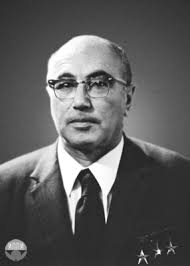 The great Russian physicist Yakov Borisovich Zel’dovich (left) was born on March 8th 1914, so had he lived he would have been 100 years old last Saturday. To us cosmologists Zel’dovich is best known for his work on the large-scale structure of the Universe, but he only started to work on that subject relatively late in his career during the 1960s. He in fact began his life in research as a physical chemist and arguably his greatest contribution to science was that he developed the first completely physically based theory of flame propagation (together with Frank-Kamenetskii). No doubt he also used insights gained from this work, together with his studies of detonation and shock waves, in the Soviet nuclear bomb programme in which he was a central figure, and which no doubt led to the chestful of medals he’s wearing in the photograph.
My own connection with Zel’dovich is primarily through his scientific descendants, principally his former student Sergei Shandarin, who has a faculty position at the University of Kansas. For example, I visited Kansas back in 1992 and worked on a project with Sergei and Adrian Melott which led to a paper published in 1993, the abstract of which makes it clear the debt it owed to the work of Ze’dovich.
The accuracy of various analytic approximations for following the evolution of cosmological density fluctuations into the nonlinear regime is investigated. The Zel’dovich approximation is found to be consistently the best approximation scheme. It is extremely accurate for power spectra characterized by n = -1 or less; when the approximation is ‘enhanced’ by truncating highly nonlinear Fourier modes the approximation is excellent even for n = +1. The performance of linear theory is less spectrum-dependent, but this approximation is less accurate than the Zel’dovich one for all cases because of the failure to treat dynamics. The lognormal approximation generally provides a very poor fit to the spatial pattern.
The Zel’dovich Approximation referred to in this abstract is based on an extremely simple idea but which, as we showed in the above paper, turns out to be extremely accurate at reproducing the morphology of the “cosmic web” of large-scale structure.
Zel’dovich passed away in 1987. I was a graduate student at that time and had never had the opportunity to meet him. If I had done so I’m sure I would have found him fascinating and intimidating in equal measure, as I admired his work enormously as did everyone I knew in the field of cosmology. Anyway, a couple of years after his death a review paper written by himself and Sergei Shandarin was published, along with the note:
The Russian version of this review was finished in the summer of 1987. By the tragic death of Ya. B.Zeldovich on December 2, 1987, about four-fifths of the paper had been translated into English. Professor Zeldovich would have been 75 years old on March 8, 1989 and was vivid and creative until his last day. The theory of the structure of the universe was one of his favorite subjects, to which he made many note-worthy contributions over the last 20 years.
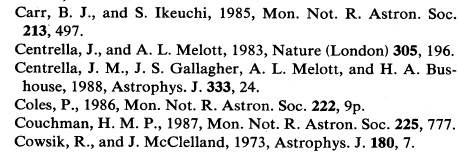
As one does if one is vain I looked down the reference list to see if any of my papers were cited. I’d only published one paper before Zel’dovich died so my hopes weren’t high. As it happens, though, my very first paper (Coles 1986) was there in the list. That’s still the proudest moment of my life!
Anyway, this post gives me the opportunity to advertise that there is a special meeting called The Zel’dovich Universe coming up this summer in Tallinn, Estonia. It looks a really interesting conference and I really hope I can find the time to fit it into my schedule. I’ve never been to Estonia…
Follow @telescoperNOvA and Neutrinos
Posted in The Universe and Stuff with tags Fermilab, neutrinos, Nova, Particle Physics, University of Sussex on March 11, 2014 by telescoperYesterday’s Grauniad blog post by Jon Butterworth about neutrino physics reminded me that I forgot to post about an important milestone in the development of the NOvA Experiment which involves several members of the Department of Physics and Astronomy in the School of Mathematical and Physical Sciences here at the University of Sussex. Here’s the University of Sussex’s press release on the subject, which came out a couple of weeks ago.
The NOvA experiment consists of two enormous particle detectors, one at the Fermi National Accelerator Laboratory “Fermilab” near Chicago and the other in Minnesota. The neutrinos are actually generated at Fermilab; the particle beam is then aimed at the detectors the, one near the source at Fermilab, and the other in Ash River, Minnesota, near the Canadian border. The particles, sent in their billions every couple of seconds, complete the 500-mile trip in less than three milliseconds.
The point is that the experiment has managed for the first time to actually detect neutrinos through the 500 miles of rock separating the two ends of the experiment. This is obviously just a first step, but it’s equally obviously a crucial one.
Colleagues from Sussex University are strongly involved in calibrating and fine-tuning the detector, which produces light when particles pass through it. Dr Abbey Waldron and PhD student Luke Vinton have developed a calibration procedure that uses known properties of muons to calibrate precise measurements of the neutrinos, which are less well understood. The detector sees 200,000 particle interactions a second, produced by cosmic rays bombarding the atmosphere, and scientists can’t record every single one. Sussex’s Dr Matthew Tamsett has developed a trigger algorithm that searches for events that look like neutrinos among the billions of other particle interactions.
Neutrino physics is an interesting subject to someone like me, who isn’t really a particle physicist. My impression of the field is that was fairly moribund until 1998 when the first measurement of atmospheric neutrino oscillations was announced. All of a sudden there was evidence that neutrinos can’t all be massless (as many of us had long assumed, at least as far as lecturing was concerned). Now the humble neutrino is the subject of intense experimental activity, not only in the USA and UK but all around the world in a way that would have been difficult to predict twenty years ago.
But then, as the physicist Niels Bohr famously observed, “Prediction is very difficult. Especially about the future.”
Follow @telescoperFrühling
Posted in Music with tags Four Last Songs, Gundula Janowitz, Richard Strauss on March 11, 2014 by telescoperI thought I’d post this recording of Frühling (“Spring”) which I heard on the radio at the weekend; it seems appropriate enough for the season and for the lovely weather we’re currently enjoying. It features the gorgeous voice of Gundula Janowitz, wonderfully bright and clear like finest crystal. I have so far posted two of the Four Last Songs by Richard Strauss; this makes it three.
Follow @telescoperThat Fishy Saying of Einstein…
Posted in The Universe and Stuff with tags Albert Einstein, Fish, Mangrove Rivulus, Trees on March 10, 2014 by telescoper
There are two interesting things about the above Einstein meme that has been doing the rounds. The first is that there’s absolutely no evidence that I can find that Albert Einstein ever said the words attributed to him; that’s also true for the vast majority of Einstein quotes, in fact.
The other interesting thing (and I risk being labelled a pedant here) is that there are species of fish, such as the Mangrove Rivulus, that really are able to climb trees…
Follow @telescoperA Spring Physics Problem
Posted in Cute Problems with tags fleas, hairs, Physics, spring on March 9, 2014 by telescoperIt’s been a while since I posted anything in the Cute Problems category, so since Spring is in the air I thought I’d post a physics problem which involves springing into the air…
Two identical fleas, each of which has mass m, sit at opposite ends of a straight uniform rigid hair of mass M, which is lying flat and at rest on a smooth frictionless table. If the two fleas make simultaneous jumps with the same speed and angle of take-off relative to the hair as they view it, under what circumstances can they change ends in one jump without colliding in mid air?
UPDATE Monday 10th March: No complete answers yet, so let’s try this slightly easier version:
Two identical fleas, each of which has mass m, sit at opposite ends of a straight uniform rigid hair of mass M, which is lying flat and at rest on a smooth frictionless table. Show that, by making simultaneous jumps with the same speed and angle of take-off relative to the hair as they view it, the two fleas can change ends without colliding in mid-air as long as 6m>M.
Answers via the comments box please..
Follow @telescoperSpring Song, Meirionydd
Posted in Poetry with tags John Dressel, Spring Song on March 9, 2014 by telescoper Spring Song, Meirionydd
A white combustion rules these fields,
and testifies to men, and rams;
the mind of winter thaws, and yields–
Great God, the world is drunk with lambs.
The high grey stone is clean of snows,
the streams come tumbling, far from dams;
the wind is green, the day’s eye grows–
Great God, the world is drunk with lambs.
The heart, gone light as all the ewes,
redounds with milk, and epigrams
that make no sense; except their news–
Great God, the world is drunk with lambs.
In gold October, grown to size,
they’ll know the hook, and hang with hams,
but March is all their enterprise–
Great God, the world is drunk with lambs.
by John Dressel.
Follow @telescoperA Bit of Green Trivia..
Posted in Film, History, The Universe and Stuff, Uncategorized with tags Edward Bromhead, George Green, Michael Caine, Physics on March 8, 2014 by telescoperFollowing on from yesterday’s post about George Green, I thought I’d add this little bit of Green trivia.
 George Green’s sponsor and patron was the mathematician Edward Bromhead, a Baronet and member of the landed gentry of the county of Lincolnshire. Two generations later in the Bromhead family you will find a certain Gonville Bromhead (presumably named after Gonville & Caius College, the Cambridge college that both Edward Bromhead and George Green attended). As a young man, in January 1879, Lt. Gonville Bromhead fought in the Battle of Rorke’s Drift. Almost a century later he was played by Michael Caine in the film Zulu.
Not a lot of people know that.
Follow @telescoperFrom Darkness to Green
Posted in History, The Universe and Stuff with tags Alan Heavens, black hole, black holes, Electromagnetism, fluxions, George Green, Imperial College, Isaac Newton, John Michell, Malcolm Longair, Method of Fluxions on March 7, 2014 by telescoperOn Wednesday this week I spent a very enjoyable few hours in London attending the Inaugural Lecture of Professor Alan Heavens at South Kensington Technical College Imperial College, London. It was a very good lecture indeed, not only for its scientific content but also for the plentiful touches of droll humour in which Alan specialises. It was also followed by a nice drinks reception and buffet. The talk was entitled Cosmology in the Dark, so naturally I had to mention it on this blog!
At the end of the lecture, the vote of thanks was delivered in typically effervescent style by the ebullient Prof. Malcolm Longair who actually supervised Alan’s undergraduate project at the Cavendish laboratory way back in 1980, if I recall the date correctly. In his speech, Malcolm referred to the following quote from History of the Theories of the Aether and Electricity (Whittaker, 1951) which he was kind enough to send me when I asked by email:
The century which elapsed between the death of Newton and the scientific activity of Green was the darkest in the history of (Cambridge) University. It is true that (Henry) Cavendish and (Thomas) Young were educated at Cambridge; but they, after taking their undergraduate courses, removed to London. In the entire period the only natural philosopher of distinction was (John) Michell; and for some reason which at this distance of time it is difficult to understand fully, Michell’s researches seem to have attracted little or no attention among his collegiate contemporaries and successors, who silently acquiesced when his discoveries were attributed to others, and allowed his name to perish entirely from the Cambridge tradition.
I wasn’t aware of this analysis previously, but it re-iterates something I have posted about before. It stresses the enormous historical importance of British mathematician and physicist George Green, who lived from 1793 until 1841, and who left a substantial legacy for modern theoretical physicists, in Green’s theorems and Green’s functions; he is also credited as being the first person to use the word “potential” in electrostatics.
Green was the son of a Nottingham miller who, amazingly, taught himself mathematics and did most of his best work, especially his remarkable Essay on the Application of mathematical Analysis to the theories of Electricity and Magnetism (1828) before starting his studies as an undergraduate at the University of Cambridge which he did at the age of 30. Lacking independent finance, Green could not go to University until his father died, whereupon he leased out the mill he inherited to pay for his studies.
Extremely unusually for English mathematicians of his time, Green taught himself from books that were published in France. This gave him a huge advantage over his national contemporaries in that he learned the form of differential calculus that originated with Leibniz, which was far more elegant than that devised by Isaac Newton (which was called the method of fluxions). Whittaker remarks upon this:
Green undoubtedly received his own early inspiration from . . . (the great French analysts), chiefly from Poisson; but in clearness of physical insight and conciseness of exposition he far excelled his masters; and the slight volume of his collected papers has to this day a charm which is wanting in their voluminous writings.
Great scientist though he was, Newton’s influence on the development of physics in Britain was not entirely positive, as the above quote makes clear. Newton was held in such awe, especially in Cambridge, that his inferior mathematical approach was deemed to be the “right” way to do calculus and generations of scholars were forced to use it. This held back British science until the use of fluxions was phased out. Green himself was forced to learn fluxions when he went as an undergraduate to Cambridge despite having already learned the better method.
Unfortunately, Green’s great pre-Cambridge work on mathematical physics didn’t reach wide circulation in the United Kingdom until after his death. William Thomson, later Lord Kelvin, found a copy of Green’s Essay in 1845 and promoted it widely as a work of fundamental importance. This contributed to the eventual emergence of British theoretical physics from the shadow cast by Isaac Newton which reached one of its heights just a few years later with the publication a fully unified theory of electricity and magnetism by James Clerk Maxwell.
But as to the possible reason for the lack of recognition for John Michell who was clearly an important figure in his own right (he was the person who first developed the concept of a black hole, for example) you’ll have to read Malcolm Longair’s forthcoming book on the History of the Cavendish Laboratory!
Follow @telescoperAstronomy Look-alikes, No. 91
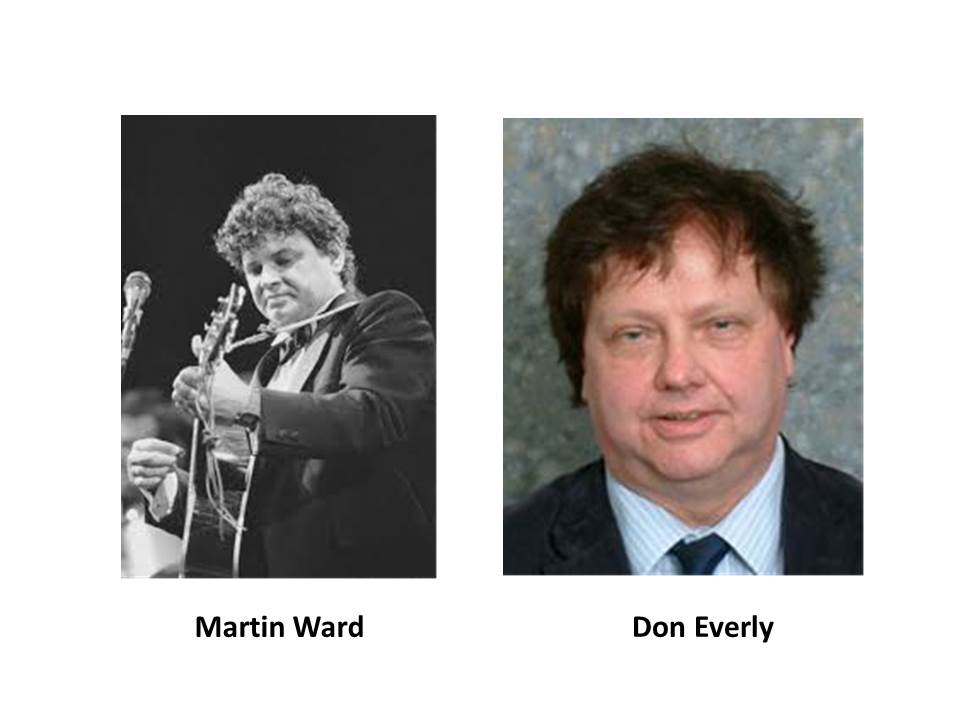
Posted in Astronomy Lookalikes with tags Don Everly, Martin Ward on March 6, 2014 by telescoperI wonder if anyone else has noticed the remarkable similarity between Martin Ward, surviving member of vocal duet The Ward Brothers, and distinguished astronomer Don Everly? I’m told the resemblance even extends to the wearing of cowboy boots. I wonder if, by any chance, they might be related?

 In the Dark