The Queen’s Agent

Posted in History, Literature with tags , , , , , on February 9, 2014 by telescoper

francis-walsinghamI’ve just finished reading The Queen’s Agent: Francis Walsingham at the Court of Elizabeth I by John Cooper and thought I’d post a quick review before settling down to an afternoon of work in the office. Sir Francis Walsingham (left) has acquired an almost mythical status as chief “spymaster” for the Crown during a time when Queen Elizabeth I was beset on all sides by plots and intrigues; The Queen’s Agent tries to find the man behind the legend. Not surprisingly, as Walsingham was as secretive as his trade might suggest, it doesn’t always succeed, but it does at least explode a few myths and give some insights into the character of a very complex man who was capable of great compassion as well as terrible ruthlessness.

Apart from anything else this book allowed me to indulge a longstanding interest in codes and ciphers; specifically, there are many interesting parallels between the story of the Spanish Armada and the breaking of the Enigma code at Bletchley Park during World War II, of which more shortly.

My first encounter with Sir Francis Walsingham came during history lessons at School, especially concerning his role in the infamous Babington Plot of 1586, which resulted in the execution for treason of Mary Stuart (Mary Queen of Scots). Mary had been officially under arrest for 18 years, and had been moved around the country for much of that time with her retinue lest she become a focus for a Catholic plot to put her on the throne of England. In fact for much of her time in captivity, Mary had been communicating in secret with various individuals for precisely that purpose but, unknown to her, most of her letters were being read by Walsingham and his expert team of code-breakers, including  Thomas Phelippes. By 1586 Walsingham already had more than enough evidence to have Mary Stuart tried for treason, but he hit on a plan that if it worked would lead to the entrapment of a large number of her supporters as well as ensuring that he knew the full extent of the conspiracy surrounding Mary Stuart. And so the Babington plot was hatched.

In late 1585, Mary Stuart was moved to Chartley Hall in Staffordshire. A young man called Gilbert Gifford with impeccable Catholic credentials, and apparently sympathetic to the Stuart cause, starting working for the household.  Gifford was in fact a double agent, placed there by Walsingham. Mary was shown a new way to communicate with the outside world, by concealing letters in the beer barrels that were brought regularly in and out of the Hall. She was eventually persuaded to try this channel, but was reluctant to take too many risks; her caution led her to commit a terrible error.

The encryption system used by Mary Stuart was widespread in Europe at that time. It was a form of substitution cipher known as a nomenclator. This consisted of a large alphabet with symbols (some made up, some from other languages) standing sometimes for individual letters, and sometimes for the names of individuals or places. Interesting devices were also deployed to try to confound the frequency analysis that was already being used in code-breaking at this time: symbols were included in the alphabet to instruct the recipient to “repeat the next letter”, for example.

In fact the Babington cipher (or at least a copy of it) still exists:

443px-Mary-cipher-code

Incidentally, in the nomenclators in use by Spain during the time of the Spanish Armada the symbol for Sir Francis Drake was “22”. I’m tempted to suggest that this is the origin of the Bingo call “two little ducks, quack quack”!

As is the case with most ciphers of this type, both sender and receiver would have to have a copy of the agreed alphabet and it is in the possibility of intercepting the key that such methods are most vulnerable . Nomenclators are not impossible to break without the key but not easy either; some 16th century codes of this type remain unbroken to this day. Mary did not know that the communication channel that had opened up was compromised at the very outset, so it probably seemed a sensible move for her to use it first to send a new cipher alphabet to Babington. Of course that decision was an enormous stroke of luck for Elizabeth’s agents because it meant that Phelippes and Walsingham could immediately read every single word of her subsequent messages all of which were intercepted and transcribed, before being replaced in the beer barrels and delivered to their recipient. Her fate, and that of a dozen or so co-conspirators, was quickly sealed. A transcript of the crucial item of correspondence, in which Mary discussed openly the strategy for the planned coup, was forwarded to Walsingham after decryption with a macabre addition: a picture of a gallows drawn in Phelippes’ own hand.

Another dimension that emerges from this story relates to just how difficult it must have been to know who was really on what side. Double agents abounded, and Walsingham must have known that some of his own men were actually working for the enemy at least some of the time; he apparently kept them going despite knowing that they had been turned in order to feed them with false information for the purposes of deception. That’s a very dangerous game to play, but they were dangerous times.

A couple of years after the Babington Plot came the Spanish Armada. The English army was so tiny in comparison with the huge force that planned to invade in 1588 that there was no way it could defend the entire coastline of England. Walsingham relied on intelligence in order to come to the conclusion that the invasion (if it came) would be in Essex. The Spanish would have wanted to get to London as quickly as possible, so this was far more likely to be the landing place than Sussex or the Isle of Wight, both of which were touted as possibilities. An English army of 16,500 was therefore assembled at Tilbury. It’s by no means clear how they would have fared against the Spanish, who outnumbered them by more than two-to-one and who were vastly more experienced and better equipped, but at least they would have had a chance. Walsingham must have been vastly relieved when he received news that the Armada had passed Portsmouth without attempting a landing, because had they done so they would not have met with any meaningful opposition.

Of course we all know what actually happened: harried but not seriously disrupted by a much smaller English naval force, the Armada proceeded up the English channel to Gravelines where it was planned to link up with Spanish ground forces encamped in the Netherlands. There they were attacked by Drake’s Fire Ships and fled into the North Sea in panic. The bulk of the Armada foundered on the coasts of Scotland and Ireland trying to find its way back to Spain in terrible weather.

We’re all taught at school that this was a defining period in English history, when our island nation was saved from Spanish tyranny and emerged into an age of unparalleled peace and prosperity. That’s the narrative we like to hear over and over again, perhaps because it provides us with a sense of moral certainty. A truer picture perhaps emerges when you look at it through the eyes of a man like Walsingham. This is history in all its cloak-and-dagger brutality, fascinating but at the same time profoundly unsettling because it reveals that all that ever really happens is that one side is slightly cleverer and more ruthless than the other.

So what was Walsingham really like as  a man? Obviously we’ll never know. But I’m glad I’ll never have him as an enemy…

The Shape of Jazz to Come

Posted in Jazz with tags , , , on February 8, 2014 by telescoper

The other night I was listening to the Ornette Coleman album The Shape of Jazz to Come and decided that I really should write something about it on here. Released in 1959, this was Ornette Coleman’s third album but it was the first to issue a fully coherent statement of his musical intentions and it was from this work that his influence began to spread. The prophetic title proved to be extremely accurate; what remains astonishing is that such a radical album was recorded as long ago as 1959, in what I consider to be a Golden Age of musical innovation.

What Coleman did in this album was truly revolutionary. The fundamental change involved was a complete rejection of conventional harmonic progression, i.e. the sequences of chords which underpinned and connected earlier jazz improvisations with a repeating cycle that imposed not only its own order but also its own formal restrictions. By rejecting these, Coleman gave his music complete freedom of melodic movement. His intentions are signalled even by the choice of band members. Consisting Coleman on alto saxophone, Don Cherry on trumpet, Charlie Haden on bass and Billy Higgins on drums, the quartet did not involve any chord-playing instruments at all. With the wider latitude allowed by this approach the melodic patterns are bolder and less predictable than in earlier forms of Jazz. The thematic phrases do not conform to the traditional 4 or 8-bar norms involved in traditional tunes. Freed of the necessity of catching up the next chord as it comes up in the accompaniment, improvisation can range further, crossing bar-lines at will. The resulting music was considered almost shocking in 1959, but although unconventional by the standards of the time, it can be heard to carry its own force and logic, respecting the fundamental laws of jazz improvisation while at the same time calling into question many of the assumptions on which these laws had been thought to rest.The rejection of harmonic dominance also altered other aspects of the music. Coleman’s melodic inventiveness was even enhanced by a (partial) rejection of equal-temperament tuning.

None of these changes was made just for the sake of it, and in many fundamental respects the music isn’t radical at all. The horns open and close each performance in fairly conventional style and they play clearly delineated solos. Billy Higgins keeps a steady beat going throughout, and Haden plays in between that beat and the trumpet and saxophone.  But that disguises some important differences in responsibility, especially for the bass player, Charlie Haden. Instead of following a chord sequence and knowing roughly what his line would be throughout the piece, he has to listen to the soloist and improvise a line to fit.  As always, increased freedom brings increased responsibility.

All four men are generous with their talents on this album, which is a feast of beauty and originality as well as skill and daring. It would be wrong to single out any particular track, which is why I’ve linked to the whole album, but I’d have to mention Peace, which is a lovely performance emerging from a statement of mood rather than a chord sequence; Don Cherry’s trumpet solo on that track is really remarkable. In an entirely different vein there’s Congeniality, which was the first in a long line of superbly swinging up-tempo numbers hitting a groove that Coleman was to make his own in subsequent years. There’s also Lonely Woman, which is the one tune on this album that became  a Jazz standard.

An album of extraordinary genius that was (and probably still is) way ahead of its time, The Shape of Jazz to Come is a must-have album for any serious Jazz enthusiast.

Happy Birthday, Harry Nyquist!

Posted in History, The Universe and Stuff with tags , on February 7, 2014 by telescoper

Harry_NyquistThis morning I learned via Twitter that today is the 125th anniversary of the birth of Harry Nyquist, a physicist and electrical engineer, who was a prolific inventor who made fundamental theoretical and practical contributions to the field of telecommunications. He also gave his name to the Nyquist frequency and the Nyquist sampling theorem, now usually known as the Nyquist-Shannon sampling theorem.

Harry Nyquist (left) was born on February  7, 1889, in Nilsby, Sweden but moved to the United States in 1907. In 1917, after earning a Ph.D. in physics from Yale University, he joined the American Telephone and Telegraph Company (AT&T). There he remained until his retirement in 1954, working in the research department and then (from 1934) at Bell Laboratories.  Apparently he didn’t have a beard, but he seems to have overcome this obstacle and had an illustrious career in research.

In my opinion, Harry Nyquist’s achievements are not sufficiently appreciated either by physicists or by the wider world, so here’s a quick summary of some of his greatest hits:

Some of Nyquist’s best-known work was done in the 1920s and was inspired by telegraph communication problems of the time. Because of the elegance and generality of his writings, much of it continues to be cited and used. For example, his 1928 paper Certain Topics in Telegraph Transmission Theory refined his earlier results and established the principles of sampling continuous signals to convert them to digital signals. The Nyquist sampling theorem showed that the sampling rate must be at least twice the highest frequency present in the sample in order to reconstruct the original signal. These two papers by Nyquist, along with one by R.V.L. Hartley, are cited in the first paragraph of Claude Shannon’s classic essay The Mathematical Theory of Communication (1948), where their seminal role in the development of information theory is acknowledged.

In 1927 Nyquist provided a mathematical explanation of the unexpectedly strong thermal noise studied by J.B. Johnson. The understanding of noise is of critical importance for communications systems. Thermal noise is sometimes called Johnson noise or Nyquist noise because of their pioneering work in this field.

In 1932 Nyquist discovered how to determine when negative feedback amplifiers are stable. His criterion, generally called the Nyquist stability theorem, is of great practical importance. During World War II it helped control artillery employing electromechanical feedback systems.

I think that demonstrates the tremendous debt the modern world of telecommunications owes to Harry Nyquist, and why we should remember him on his 125th birthday..

Mad about the Boy

Posted in LGBTQ+, Music with tags , , on February 6, 2014 by telescoper

I came across this a while ago and thought I’d save it for a rainy day. Today is very rainy indeed so here it is. Mad about the Boy was written by Noel Coward and published in 1932. It’s a song about an infatuation with a movie star  and has generally been performed by female singers, although it was apparently inspired by Coward’s own crush on Douglas Fairbanks Jnr (which wasn’t reciprocated). The song became popular again in 1992 when a version recorded by Dinah Washington was used in a famous Levi commercial, but I love this wonderfully world-weary performance by Greta Keller.


Was it right to drop Pietersen?

Posted in Cricket with tags , , on February 5, 2014 by telescoper

Big sporting news this morning was the decision by a panel representing the  England and Wales Cricket Board to part company with Kevin Pietersen.   In his Test career Pietersen has scored 8,181 runs at an average of 47 in 104 Tests, which is pretty outstanding – certainly compared with other current England batsmen. And at 33 he’s probably still got a few years of international cricket in him. Can England really afford to cast him aside just because some of his team-mates find him a bit difficult?

I’m perfectly well aware that Pietersen is not the kind of player who always puts the team first, and being such a maverick he must be a very frustrating player to captain, but he is clearly also a prodigiously talented batsmen. It’s true that he didn’t play well in Australia, but then who did (other than Ben Stokes)? In fact Pietersen averaged better with the bat than his Captain, so you could argue that it’s Alastair Cook who should be dropped if the problem is between the two of them (as some have suggested).

And then there’s the fact that – love them or hate them – it’s players like KP who are the crowd-pullers. It’s never just been about the ability to play the game. People like to see larger-than-life characters in sport.

Anyway, I know that opinions differ  on this issue so I thought I’d try a quite poll:

Did Hawking Say “There Are No Black Holes”?

Posted in Astrohype, The Universe and Stuff with tags , , , on February 5, 2014 by telescoper

Last week there was a rather tedious flurry of media activity about Stephen Hawking’s alleged claim that there are no black holes after all. Here’s a nice blog post explaining what Hawking actually said. Also, check out the link at the start of this article to a very nice layperson’s guide to the Black Hole Information Paradox.

Matt Strassler's avatarOf Particular Significance

Media absurdity has reached new levels of darkness with the announcement that Stephen Hawking has a new theory in which black holes do not exist after all.

No, he doesn’t.

[Note added: click here for my new introduction to the black hole information paradox.]

First, Hawking does not have a new theory… at least not one he’s presented. You can look at his paper here — two pages (pdf), a short commentary that he gave to experts in August 2013 and wrote up as a little document — and you can see it has no equations at all. That means it doesn’t qualify as a theory. “Theory”, in physics, means: a set of equations that can be used to make predictions for physical processes in a real or imaginary world. When we talk about Einstein’s theory of relativity, we’re talking about equations. Compare just the look and…

View original post 979 more words

A Matter of Life and Death

Posted in Film, Poetry with tags , , , , on February 4, 2014 by telescoper

One for the file marked “they don’t make films like this any more”. Here is a clip from very near the beginning of the extraordinarily imaginative romantic fantasy A Matter of Life and Death. It’s not quite the opening sequence as titled, though: there’s an astronomically themed preamble before the sequence shown in the clip.

Directed by Michael Powell and Emeric Pressberger and released in 1946, A Matter of Life and Death has remained in most film critics’ lists of top British movies for almost seventy years. If you really want to know why then you’ll have to watch the whole film, but this is a memorable opening to a film if ever there was one.

Incidentally, the splendid poem by Sir Walter Raleigh from which Peter Carter character (played by David Niven) quotes is called The Passionate Man’s Pilgrimage. Here it is in full:


GIVE me my scallop-shell of quiet,

My staff of faith to walk upon,
My scrip of joy, immortal diet,
My bottle of salvation,
My gown of glory, hope’s true gage;
And thus I’ll take my pilgrimage.

Blood must be my body’s balmer,
No other balm will there be given;
Whilst my soul, like a quiet palmer,
Travelleth towards the land of heaven;
Over the silver mountains,
Where spring the nectar fountains:
There will I kiss
The bowl of bliss;
And drink mine everlasting fill
Upon every milken hill:
My soul will be a-dry before;
But after, it will thirst no more.
Then by that happy blestful day,
More peaceful pilgrims I shall see,
That have cast off their rags of clay,
And walk apparelled fresh like me.
I’ll take them first
To quench their thirst,
And taste of nectar suckets,
At those clear wells
Where sweetness dwells
Drawn up by saints in crystal buckets.

And when our bottles and all we
Are filled with immortality,
Then the blessed paths we’ll travel,
Strowed with rubies thick as gravel;
Ceilings of diamonds, sapphire floors,
High walls of coral, and pearly bowers.
From thence to heavens’s bribeless hall,
Where no corrupted voices brawl;
No conscience molten into gold,
No forged accuser bought or sold,
No cause deferred, nor vain-spent journey ;
For there Christ is the King’s Attorney,
Who pleads for all without degrees,
And he hath angels, but no fees.
And when the grand twelve-million jury
Of our sins, with direful fury,
‘Gainst our souls black verdicts give,
Christ pleads his death, and then we live.

Be thou my speaker, taintless pleader,
Unblotted lawyer, true proceeder!
Thou giv’st salvation even for alms ;
Not with a bribèd lawyer’s palms.
And this is my eternal plea
To him that made heaven, earth, and sea,
That, since my flesh must die so soon,
And want a head to dine next noon,
Just at the stroke, when my veins start and spread,
Set on my soul an everlasting head.
Then am I ready, like a palmer fit;
To tread those blest paths which before I writ.

Big Trouble with Big G

Posted in The Universe and Stuff with tags , , on February 4, 2014 by telescoper

An Antonymous email correspondent this morning drew my attention to an interesting article in the latest Physics World about the trials and tribulations of groups of physicists trying to measure Newton’s Gravitational Constant,  G. This is probably the first physical constant that most of us encounter when we’re learning the subject so it might seem strange that it’s the one which is known to the lowest accuracy. That’s not for want of trying to make the measurements more precise, just that gravity is such a very weak force that it’s very difficult to eliminate systematic effects down to the necessary level.

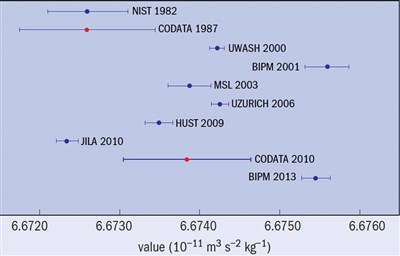
Just how difficult it is to measure Big G is demonstrated by the following graphic which shows the latest measurements:

Big_G

Here’s the caption, so you can identify the various groups responsible for the various measurements:

Disagreeing over “big G” This chart shows wildly differing values of the gravitational constant, G, as measured by various high-profile research groups (blue). The values do not agree even within their error bars. Also shown are two values of G adopted by the Committee on Data for Science and Technology (CODATA) as international standards (red). The groups are based at the National Institute of Standards and Technology (NIST), the University of Washington (UWASH), the International Bureau of Weights and Measures (BIPM), the Measurement Standards Laboratory of New Zealand (MSL), the University of Zurich (UZURICH), the Huazhong University of Science and Technology (HUST) and the Joint Institute for Astrophysics (JILA).

Clearly there’s quite a lot of disagreement between recent results, with some a long way outside each other’s error bars. They can’t all be right, but who’s most likely to be wrong? Answers on a postcard.

I’m by no means an expert on experimental gravity so I won’t attempt to suggest who is right and who is wrong. What I will say is that although this kind of research is clearly extremely important it is clearly also fiendishly difficult. I’m not really surprised that the pieces of the puzzle haven’t fallen into place yet. The dedicated teams who have been tackling this problem for many decades deserve the deep admiration as well as the continued support of the physics community. Theoretical physics is generally perceived to be more glamorous and exciting than its experimental counterpart, but the subject as a whole is nothing without its empirical foundations. That said, I’m glad it’s not my job to measure Big G. I have neither the practical skill nor the patience to cope with so many frustrations!

The super-compressible Cosmic Microwave Background

Posted in The Universe and Stuff with tags , , on February 3, 2014 by telescoper

I just came across this blog post, one of a series on cosmology from the African Institute for Mathematical Sciences, which is in Muizenberg near Cape Town, South Africa. I thought I’d reblog it, partly because it’s on a topic I often discuss in talks and partly because I wanted to draw your attention the site and the other interesting posts on it.

In this article Bruce Bassett explains just how much of the information we get from measurements of the Cosmic Microwave Background can be squeezed into precise estimates of just a few parameters. The only point I would add is that this does assume at the outset that all relevant information is contained within the angular power spectrum; that’s not necessarily the case, but we don’t have any compelling evidence that it’s a wrong assumption for the CMB; see here for a previous discussion of this.

Bruce Bassett's avatarCosmology at AIMS

One of the most striking features about the Cosmic Microwave Background (CMB) is that it is incredibly compressible from an information content point of view. The Planck satellite produced maps with of order a billion pixels whose information could be compressed almost perfectly into a power spectrum of order one thousand real numbers.

This already is a massive compression. But in addition, most of this information can be compressed further into just six of the parameters of the standard model, yielding a total compression of about one billion to one. This is both remarkable and annoying because we want to be surprised and find things that we can’t explain. And if there are things we can’t explain we want to have clear signals data about them, not just vague hints of their existence.

Anyway, to illustrate just how efficient the compression is, I took the binned WMAP 9 TT power spectrum…

View original post 520 more words

Irony 101

Posted in Uncategorized with tags , on February 3, 2014 by telescoper

birmingham_image