You may decide for yourself who this is aimed at!

Well, it’s the First of February which means it’s a year to the day since I started my current job as Head of the School of Mathematical Sciences at the University of Sussex, or MPS for short.
It’s been an eventful year, and not really like I expected. What I mean is that I knew it would be hard work, but the hardest bits were not the things I’d imagined. The first half of the year was primarily involved with appointing new staff to the School. All the interviews and other activities associated with that took up a huge amount of time but I think it all went well in the end. The number of full-time staff in MPS has increased by more than 50% over this time; from 15 to 23 in Mathematics (including 3 new Professors) and from 23 to 38 in Physics & Astronomy. The primary motivation for this is growth in student numbers: the number of undergraduates in Physics & Astronomy has doubled in the last three years or so, and this year we had our biggest ever intake of over 140 students.
All that wasn’t my doing, of course. The expansion of staff numbers was planned before I arrived, and the increase in student numbers is down to hard work by the admissions team.
I spent the latter part of last year involved with planning further expansion of our research activity as the contribution of MPS to the University’s Strategic Plan and am looking forward to turning that into reality over the next year or so.
I’ve tried to ensure that MPS is a friendly and open place for all staff and students, where everyone has a say and everyone feels valued. It’s not for me to say how well I’ve succeeded in that, but I’ll carry on trying.
I should mention some of the frustrations. One is that I became an academic in the first place because I enjoy both teaching and research. When I became Head of School here I found I had so many administrative duties that I had very little time for either of those activities. I got especially depressed about not being involved in teaching because I didn’t see how I could properly understand how things work in MPS without working at the coalface.
Against the advice of several colleagues I decided to teach a full module this year on Theoretical Physics to a class of about 50 students. It’s been a struggle to find the time to prepare everything, as I’m doing this for the first time, but I’ll persevere. Hopefully the students will bear with me while I get my act together. I’m very impressed with their engagement with the material so far, but then they have chosen the Theoretical Physics option so are obviously the intellectual elite of MPS; obviously, that’s my theorist’s bias speaking!
Oh, and in my spare time I grew a beard:

I suppose that will have to do. I’ll be heading up to campus shortly to spend Saturday afternoon in the office. A Head of School’s work is never done..
Follow @telescoperA very touching blog post from a Sussex student who graduated In Absentia this week…
29 January 2014
The stage is set, the lights are on…the Brighton dome is electric with energy and booming with excitement. Miles away, I am sitting across the computer with sparkling eyes and a beating heart. Awaiting the live streaming to begin…awaiting my graduation ceremony to commence.
Today, 2 months into the professional world, I turn around for a peek into the student life once again. As my classmates walk across the stage, I share in their happiness, I share in their smiles and just a tiny shiver of disappointment travels through me. I envision them laughing their hearts out, breathing a sigh of relief for finally and officially crossing the bridge from being graduands to becoming graduates. ‘In absentia’ the University confers the degree upon me as well, and an audible sigh of relief escapes my lips. “Yes, I have done it!”
From being a Sussex post-graduate student, I…
View original post 216 more words
Another very busy day means I’ve almost reached the end of a very busy week. I spent this morning in a meeting with colleagues from the University of Sussex and representatives of the Brighton Institute for Modern Music (also known as BIMM), which focusses on courses intended to prepare students to work in some aspect of the popular music industry, including performing and songwriting as well as, e.g., management.
It’s one of the odd things about being a Head of School that you get invited to do strange things every now and again and this was one such occasion. The University of Sussex validates degree programmes for a number of education institutions, BIMM being one of them and it was my job to Chair a session this morning (at a location in central Brighton) that formed part of the validation process. We had some nice pastries for breakfast too.
Regular readers of this blog (both of them) will know that I’m not really up to date on popular beat combos so I wasn’t picked for this task for any music expertise; the idea was rather that being a complete ignoramus I could be an impartial Chair…
It was great to talk to have the chance to talk to some of the current BIMM students as well as the staff and one of the things that struck me was that although I work in a very different discipline, many of the educational challenges faced by the School of Mathematical and Physical Sciences and BIMM are very similar. I can’t talk about the details we discussed, but it was a very friendly meeting and there was lots of constructive discussion.
That business concluded it was back up to Falmer for a quick lunch and a meeting about undergraduate admissions. And finally, because it’s the last Friday of the month it was time this afternoon for our monthly MPS cake event. This month’s cake had a vaguely mathematical theme and also raised the issue of the correct plural of the word conundrum:
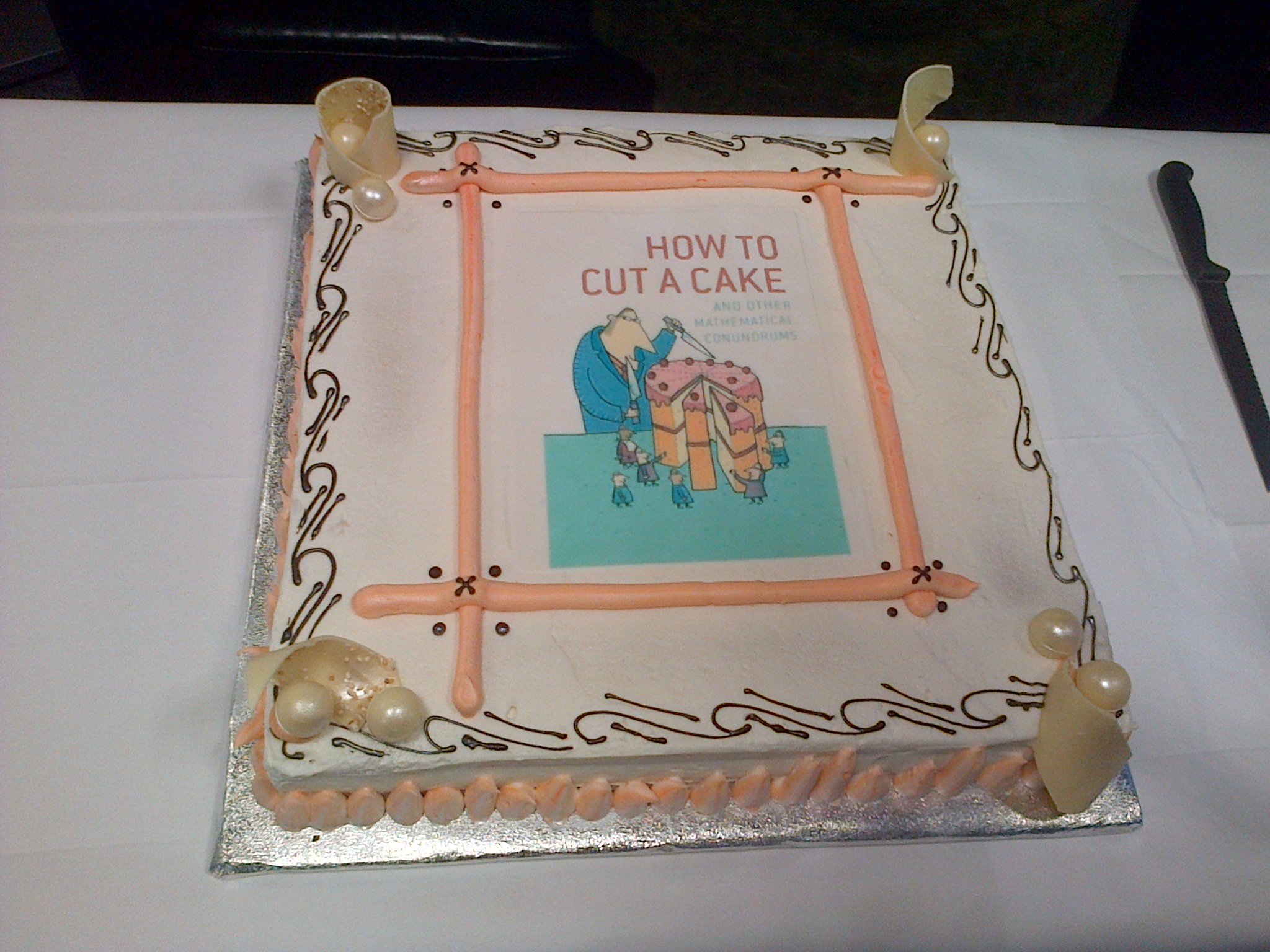
I thought it was appropriate to invite the Head of the Department of Mathematics, Miro Chlebik, to solve this particular conundrum by cutting the cake:
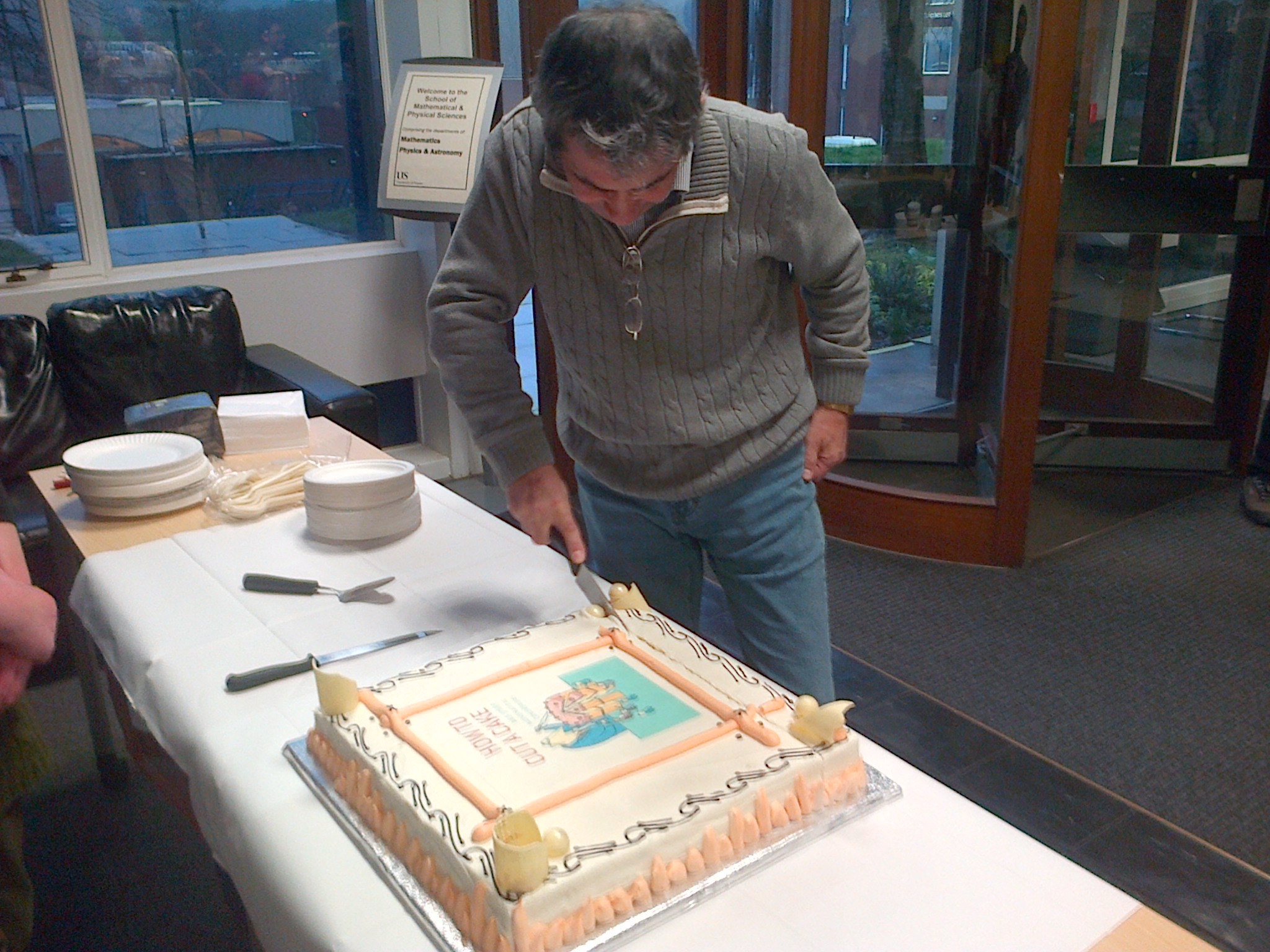
The cake vanished pretty quickly thereafter.
Follow @telescoperI had an interesting exchange via Twitter the other day after listening to “CD Review” on BBC Radio 3. The programme included a few examples of Opera singers trying – and, in my opinion, failing – to sing like Jazz singers.
I was reminded of this discussion last night when I got home to find a lovely Clarinet sonata by Poulenc being played. It turns out that this piece was commissioned by none other than the “King of Swing”, clarinetist Benny Goodman.
I love both Jazz and Opera, but attempts to mix the two very different genres are not often successful. Jazz and Classical music are rather like different languages and musicians are rather like poets: fully bilingual exponents who can perform their art in more than one tongue are few and far between. There are, however, notable exceptions to this rule if not among singers but among instrumentalists. I think this is largely because so many Jazz musicians are so unbelievably virtuosic on their instruments that they can play more-or-less anything they put their mind to.
Anyway, I thought I’d post a few examples of famous Jazz musicians who have proved that they can play Classical music well. Here’s the man Benny Goodman playing the Mozart Clarinet Quintet K. 581:
Wynton Marsalis playing a Haydn Trumpet Concerto:
Keith Jarrett playing the first movement of the Italian Concerto by J.S. Bach BWV971. I would have included his version of the Goldberg Variations, but it’s on harpsichord and therefore not allowed…
I’d like to hear any further suggestions of excellent performances of Classical repertoire by Jazz musicians, so feel free to comment through the box.
Follow @telescoperI’ve had a very busy day today including giving a lecture on Electrostatics and the Method of Images and, in an unrelated lunch-hour activity, filing my tax return (and paying the requisite bill). The latter was the most emotionally draining.
With no time for a proper post, I thought I’d give some examples of the images produced by yesterday’s graduands, including some who used a particular approach called the Method of Selfies. Unfortunately some of these are spoiled by having a strange bearded person in the background.
But first you might like to try the following example using the actual Method of Images:
Given two parallel, grounded, infinite conducting planes a distance a apart, we place a charge +q between the plates, a distance x from one of them. What is the force on the charge?
This is, in fact, from Griffiths, David J. (2007) Introduction to Electrodynamics, 3rd Edition; Prentice Hall – Problem 3.35.
Solutions via the comments box as usual, please.
And now here are some of the official pictures from yesterday
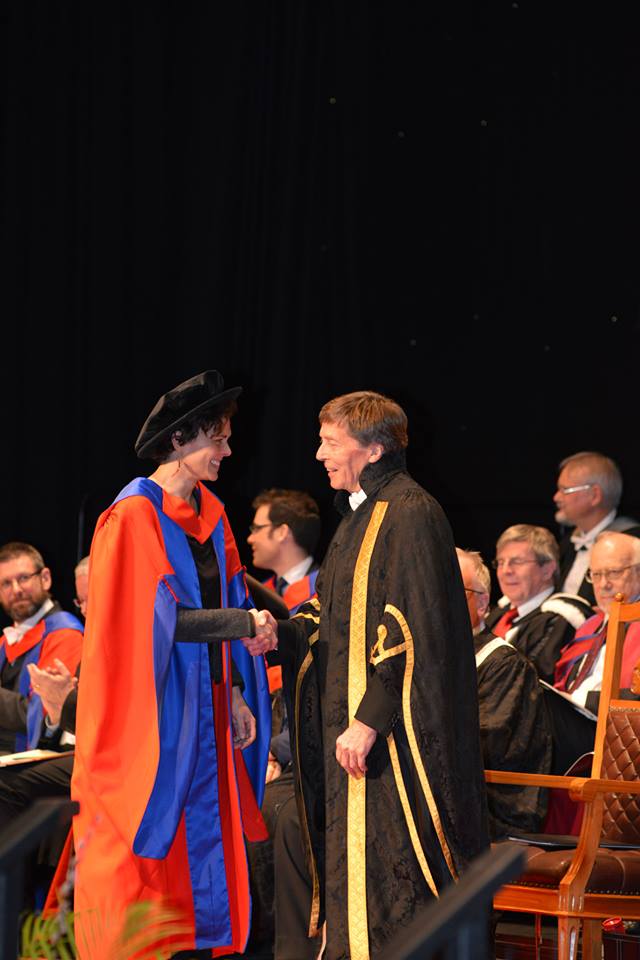
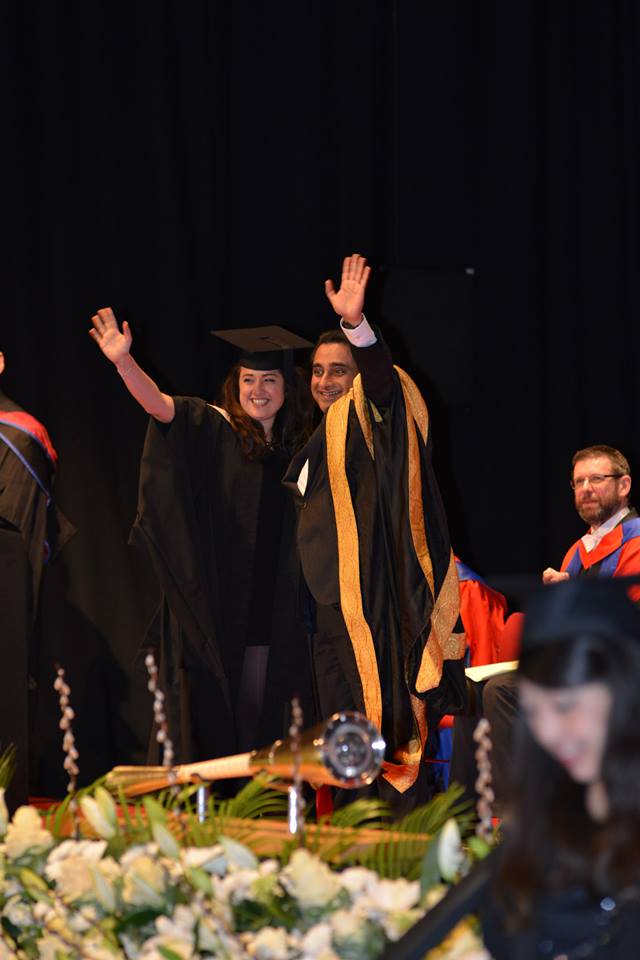
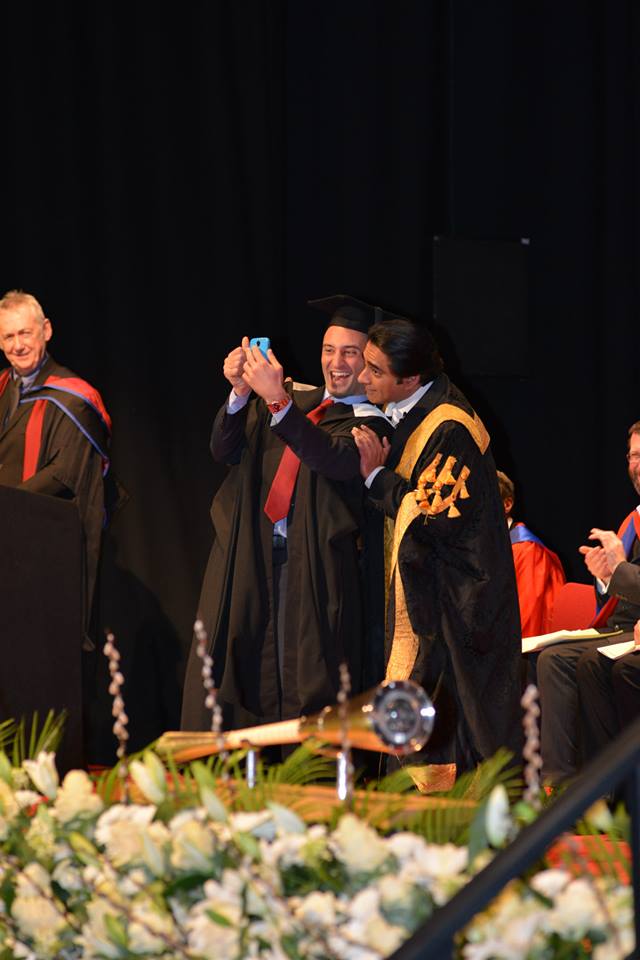
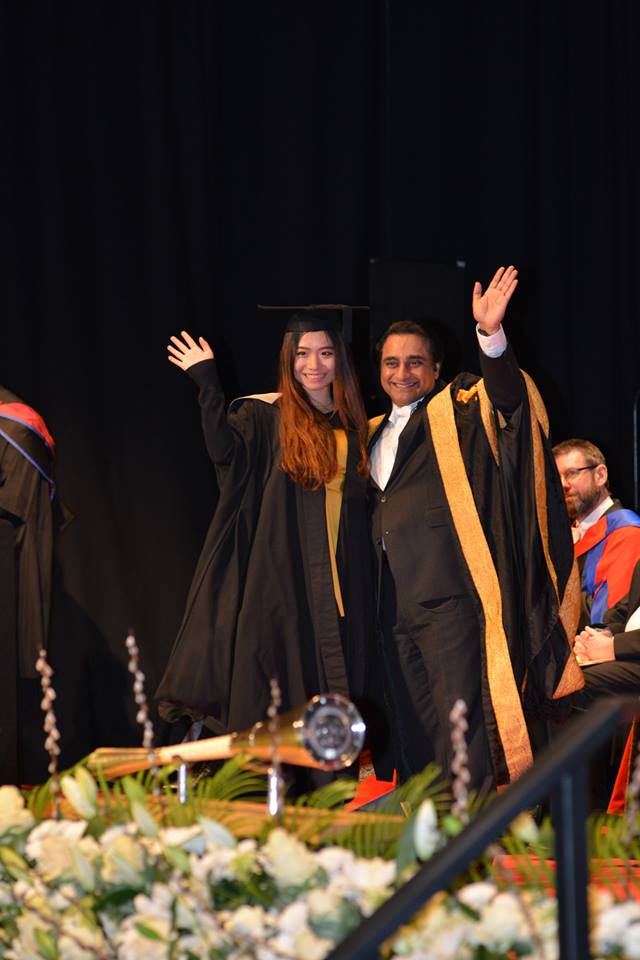
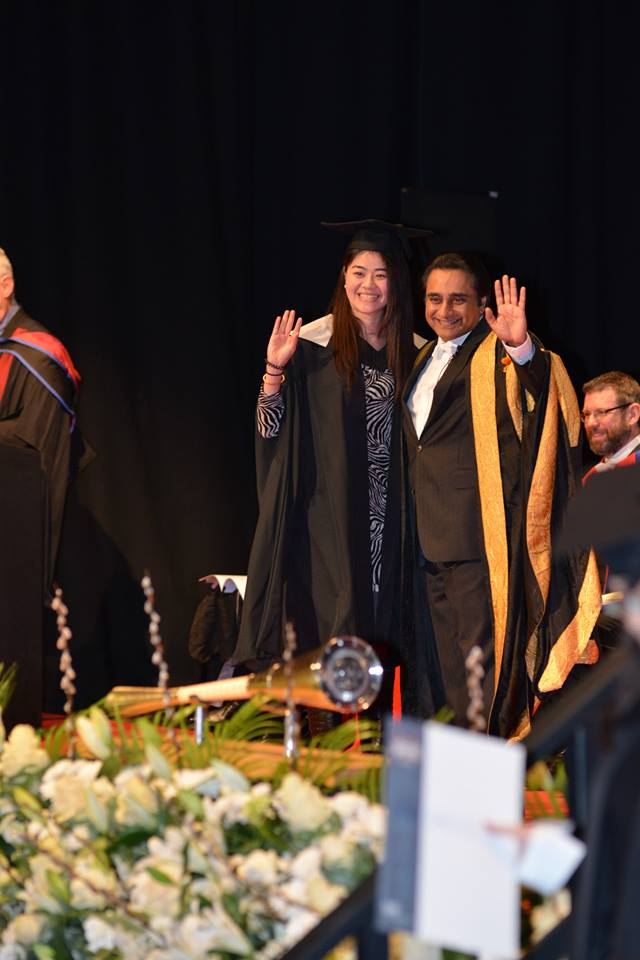
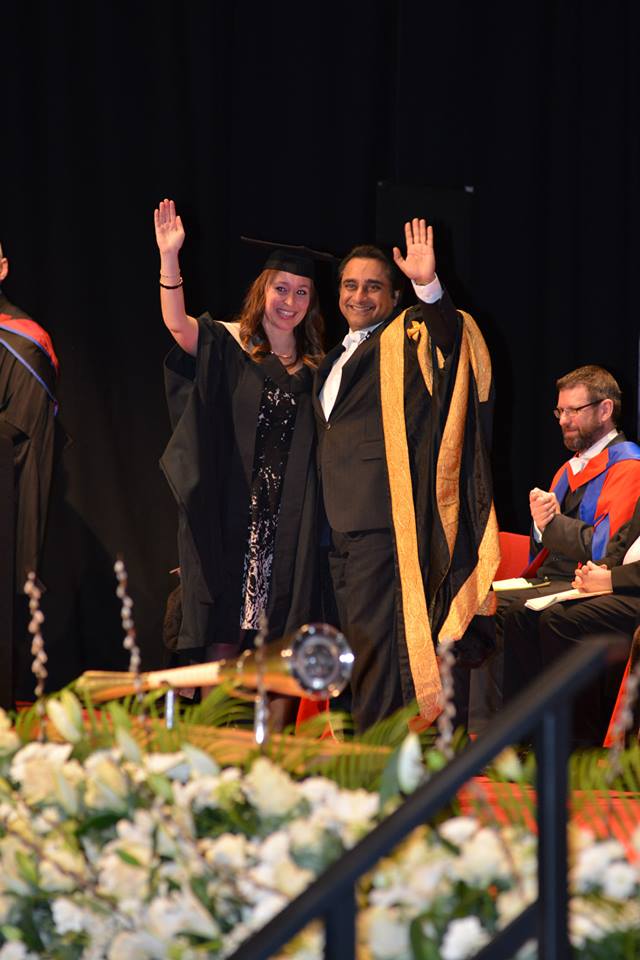
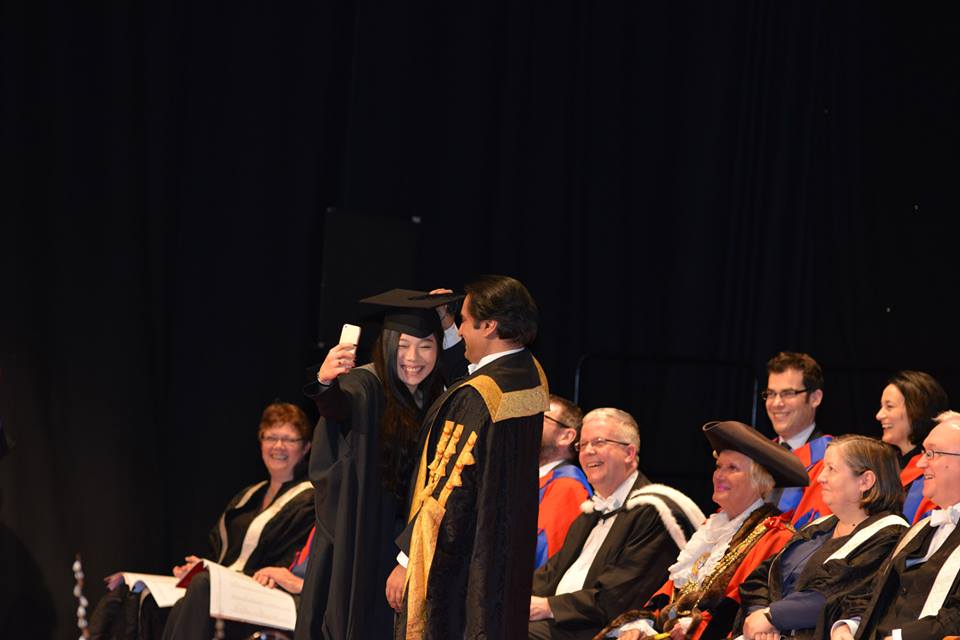
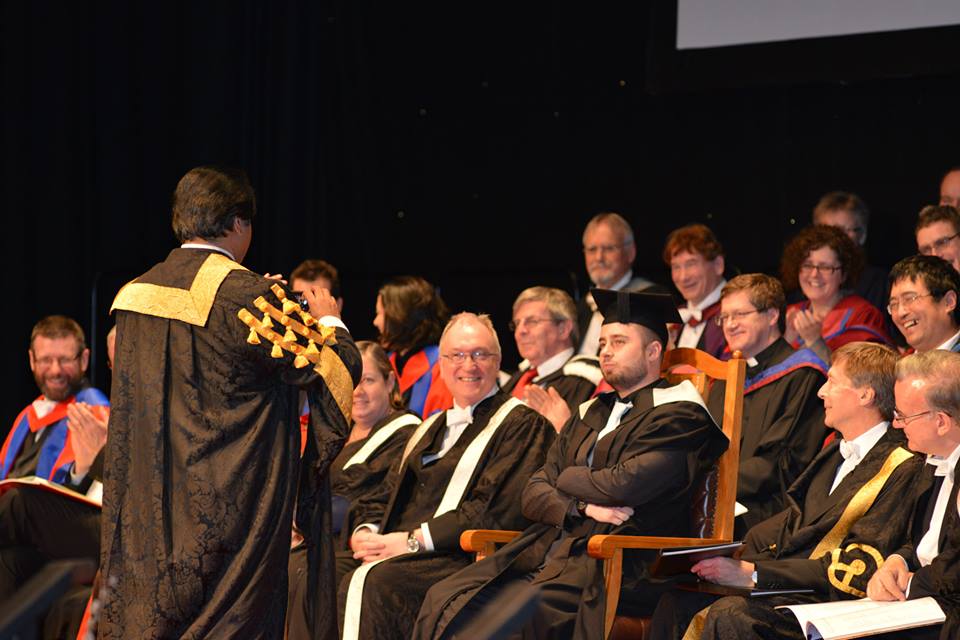
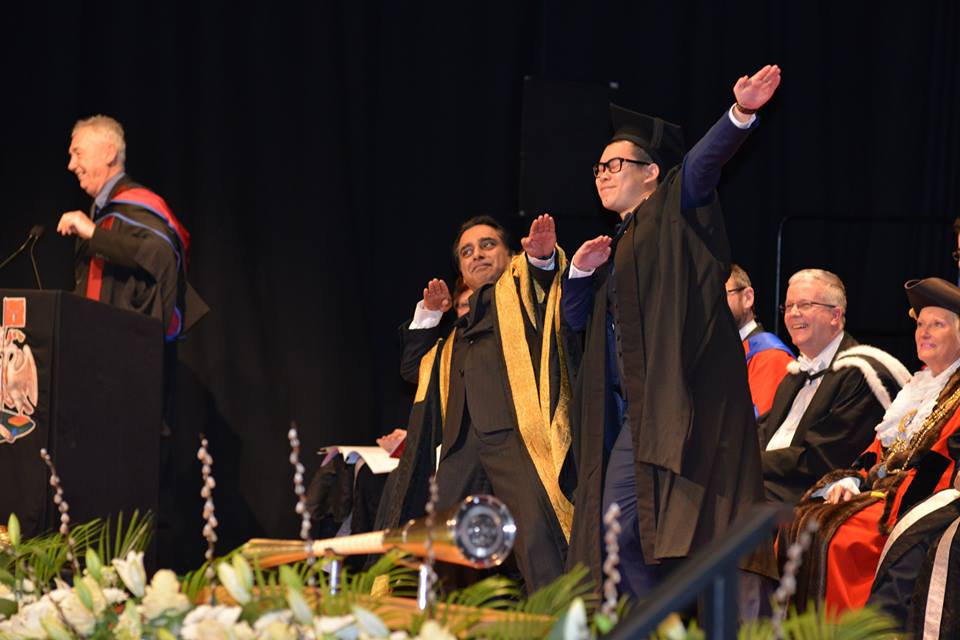
Just back home from the drinks reception that followed today’s Winter Graduation Ceremony at the University of Sussex at the Dome, in Brighton. And a very nice event it was too!
The Winter Graduation ceremony is primarily taken up with postgraduate degrees, and within School of Mathematical and Physical Sciences the largest proportion of those are in Mathematics, especially in the MSc courses in Financial Mathematics and Corporate and Financial Risk Management on which we have a large number of overseas students, e.g. From China. My first graduation ceremony as Head of School therefore presented me with some pronunciation challenges as I read out the names of the graduands. I was a bit nervous beforehand, not because I’m afraid of making a fool of myself but because these days everything is captured on video for posterity and I didn’t want to ruin anyone’s record of their Big Day. I practised quite a lot actually, and think it was OK.
I am always impressed at students who have the courage to travel halfway around the world to study in a foreign land. Graduation is a rite of passage for all students, but it must be of even greater significance for students from abroad.
I’ve attended graduation ceremonies at a number of other universities, and the big difference with Sussex is how much less formal it is. A great deal of credit for that must go to the Chancellor, the brilliantly funny and approachable Sanjeev Bhaskar, who ran the show in inimitable style. He also has a lovely head of hair.
Sanjeev always had a word with the graduands as they crossed the stage, often a hug, and very allowed them to take a selfie, once sitting in the Chancellor’s chair! I found it all very amusing, which helped me relax before my turn at the podium with the list of names. I’ve sat through a large number of dull and stuffy graduation ceremonies in my time, and much prefer the Sussex style!
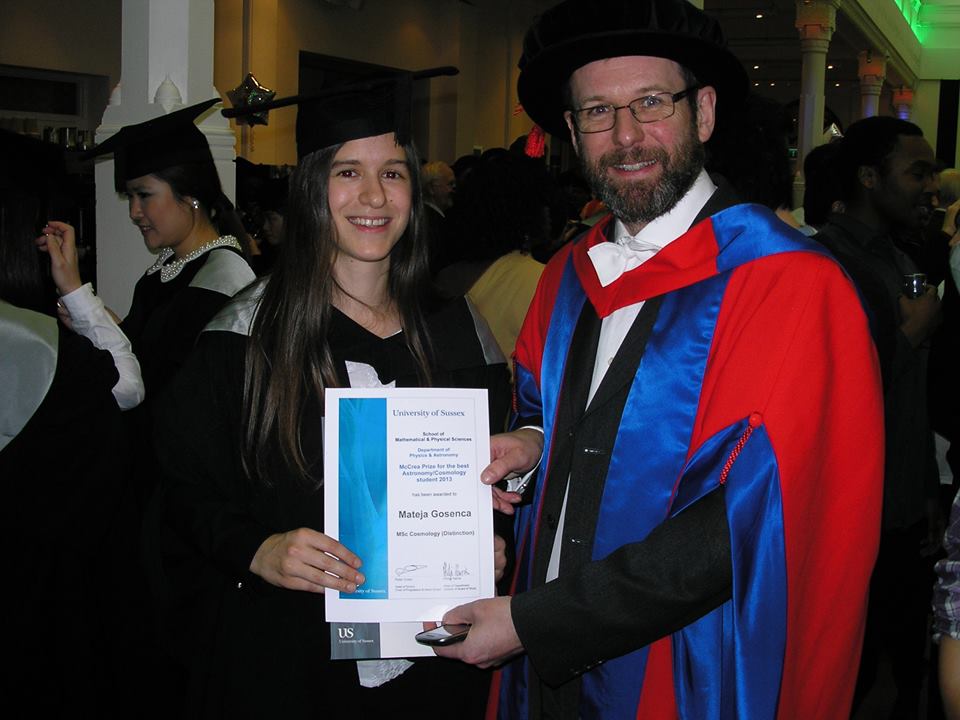
Also graduating with top marks in our MSc in Cosmology was Mateja Gosenca, who is now my PhD student. Here we are at the drinks party after the graduation ceremony; Mateja is looking very happy holding her certificate as winner of the Sir William McCrea Prize for the best student on the MSc programme!

That one was taken with my Blackberry; here’s a much nicer version taken with a proper camera:
Well, it’s been a very long day. I got up at 5am so I could try a travel experiment. Given my dislike for Victoria station I decided to take the scenic route to and from Cardiff for the weekend. That involves going from Brighton to Portsmouth (or Fratton to be precise), and then taking a train from there via Salisbury and Bath Spa. It takes about an hour longer than going via London, but I found it far less stressful. It’s also significantly cheaper, even for peak-time travel. And so it came to pass that I caught the 6.28 from Cardiff Central, and got to Falmer before lunch. Quite a pleasant journey, actually, although there were clear signs of recent flooding close to the track.
I have a lecture from 5pm until 6pm on Mondays this term, so Mondays are going to be long days whether or not I travel, especially because I’m teaching a new course and am only just keeping up with writing the lectures given all the other things I have to do as Head of School. Here’s a picture I took just before the lecture, the sun going down across wintry Falmer.
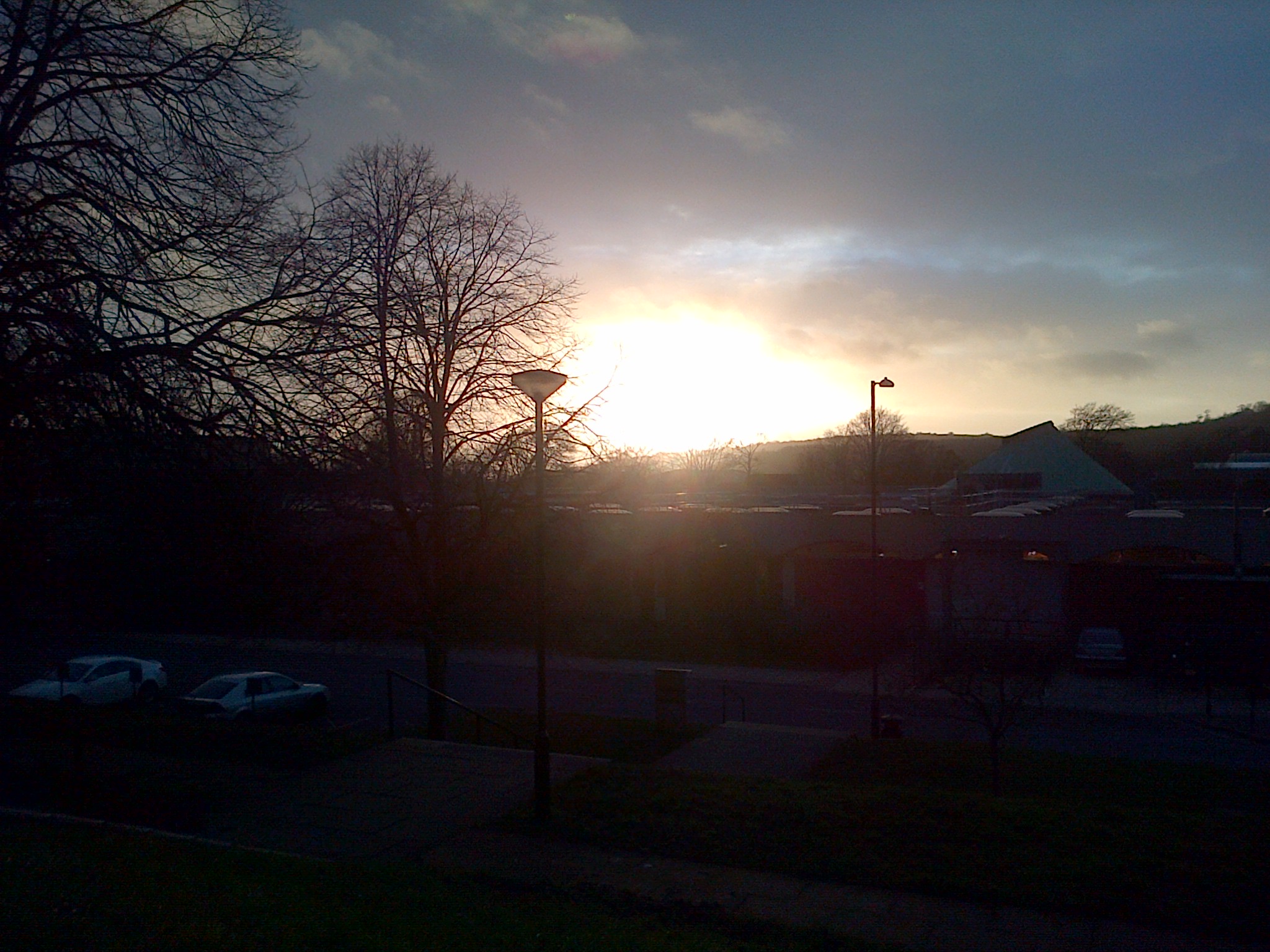
Talking of which, tomorrow is the University of Sussex Winter Graduation Ceremony and I have to present the graduands from the School of Mathematical and Physical Sciences. That means I’m going to have to spend the evening practicing some unfamiliar names, getting my posh clothes in order and (hopefully at some point) sleeping.
Follow @telescoperLast night I was drinking a glass or several of wine while listening to the radio and thinking about a brainwave I’d had on Friday. Naturally I decided to wait until I reconsidered it in the cold light and sobriety of day before posting it, which I have now done, so here it is.
The idea that came to me simply joins two threads of discussion that have appeared on this blog before. The first is that, despite strenuous efforts by many parties, the fraction of female students taking A-level Physics has flat-lined at 20% for over a decade. This is the reason why the proportion of female physics students at university is the same, i.e. 20%. In short, the problem lies within our school system.
The second line of argument is that A-level Physics is not a useful preparation for a Physics degree because it does not develop the sort of problem-solving skills or the ability to express physical concepts in mathematical language on which university physics depends. Most physics admissions tutors that I know care much more about the performance of students at A-level Mathematics than Physics.
Hitherto, most of the effort that has been expended on the first problem has been directed at persuading more girls to do Physics A-level. Since all universities require a Physics A-level for entry into a degree programme, this makes sense but it has not been successful.
I now believe that the only practical way to improve the gender balance on university physics course is to drop the requirement that applicants have A-level Physics entirely and only insist on Mathematics (which has a much more even gender mix). I do not believe that this would require many changes to course content but I do believe it would circumvent the barriers that our current school system places in the way of aspiring female physicists.
Not all UK universities seem very interested in widening participation, but those that are should seriously consider this approach.
Follow @telescoperHere’s one of an occasional series of cute problems, which I offer as a challenge for whiling away a wild and rainy Saturday afternoon..
You enter a competition which consists of a never-ending series of contests. The probability that you win any single contest is p, and the outcomes of the contests are independent of one another.
Let X be the probability that you ever take the lead in the competition. What is X in terms of p, for any value of p?
Solutions through the comments box please!
UPDATE: Since a correct answer has now been posted, here is my solution:
Consider the first contest: the probability that you win it is p and if you do you take the lead straight off.
If you lose the first one, with probability (1-p), you are down by 1. Now you must (a) make up the deficit and (b) go on to take the lead. Clearly the probability of (a) is just X (the same as getting ahead from a level start). The probability of (b) is also X.
Hence X=p+(1-p)X^2.
There are two solutions of this quadratic equation: X=1 and X=p/(1-p). But the answer must be a probability so cannot exceed unity. Hence if p>1/2 then X=1, in accord with intuition: in the long run you’d expect to lead sometime if p>1/2. If p<1/2 then the other solution is correct. The two solutions match at p=1/2.
Simples.
Follow @039telescoper039

 In the Dark