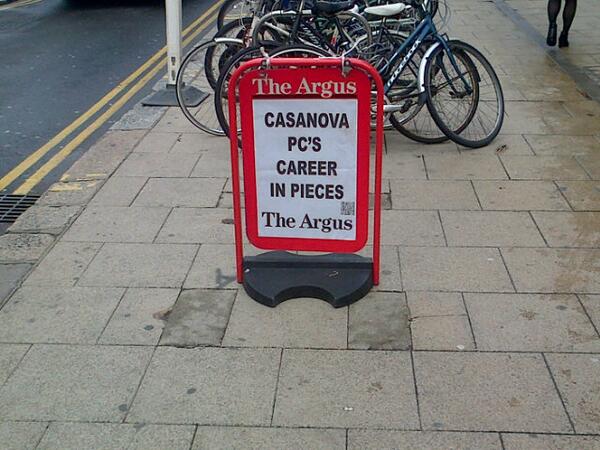
Open Access Repositories should be based on Subject, not Institution

Posted in Open Access with tags , , , , on September 18, 2013 by telescoper

Just when we thought that the powers that be might be starting to see the light on Open Access, round comes another circular from the Higher Education Funding Council for England (HEFCE) that shows that policymakers have an unlimited ability to get things wrong at the most basic level.

The document concerned opens a “Consultation on open access in the post-2014 Research Excellence Framework” by putting forward a number of proposals.

Now it’s depressing enough that the entire document is predicated on the assumption that there will be another Research Excellence Framework, perhaps in 2020. The current REF is such a disaster that one might have hoped somebody up there would have decided that enough is enough. But then we thought that about Research Assessment Exercise in 2008. Even the most pessimistic of us hope that the REF would have a “lighter touch” than the RAE, but as it has turned out it’s many times worse both in the time it has taken to prepare submissions and the ridiculous game-playing and dodgy employment practices that it has encouraged among participation institutions.

I hope there’s still time to drive a stake through the heart of the runaway bureaucracy that keeps imposing this idiocies on us. After all, a new Chief Executive about to take over at HEFCE. Perhaps a new broom will be wielded? I hope against hope.

However, setting all that to one side, I had a look at the proposals for Open Access after 2014 contained in the document. Here is the summary of the proposals:

HEFCE

Aarrgh!

Why on Earth should the proposals favour national institutional repositories over international subject-based ones? A shining example of the latter is the arXiv which has, for Physics and Astronomy, become the basic resource for researchers around the world; it’s a one-stop shop at which one can access research from all around the world. By contrast, having work in the same field stored over a plethora of institutional repositories will serve no useful purpose at all, because UK research will not  treated in the same way as work from other countries and in any case individual repositoes will lead to an absurd level of duplication of infrastructure and other resources. This requirement is particularly indefensible in Physics and Astronomy, as it would require us to duplicate in (probably inferior) institutional repositories what we already do with the arXiv.

The UK Funding Councils need realize that the solution to many of the challenges of Open Access has already been found. In fact, the European Research Council seems to have acknowledged this and is now directly funding the arXiv. The UK Research Councils should be required to construct similar archives for their disciplines. That shouldn’t be difficult, because all the hard work has already been done. There is a working model.

I’ll be responding to the consultation document in no uncertain terms. The Royal Astronomical Society is also collating responses for a collective submission. We have to resist these, and other proposals such as another REF, which are being foisted on us by people who have no idea what they’re doing and no idea what damage they’re causing.

Any resemblance is purely coincidental..

Posted in Brighton with tags on September 18, 2013 by telescoper

They are my initials, but…

BUbgpziCYAAjD72

Coronal Rain

Posted in The Universe and Stuff with tags , , , on September 17, 2013 by telescoper

Well it’s dark and gloomy and pouring with rain on the day on which I’m required to do the most running about on campus. I think we could all do with another look at the Sun – which might otherwise fade into a distant memory. This is no ordinary look at the Sun, though, it’s a spectacular video taken by NASA’s Solar Dynamics Observatory. According to the description on Youtube,

Eruptive events on the Sun can be wildly different. Some come just with a solar flare, some with an additional ejection of solar material called a coronal mass ejection (CME), and some with complex moving structures in association with changes in magnetic field lines that loop up into the Sun’s atmosphere, the corona.

On July 19, 2012, an eruption occurred on the sun that produced all three. A moderately powerful solar flare exploded on the Sun’s lower right hand limb, sending out light and radiation. Next came a CME, which shot off to the right out into space. And then, the Sun treated viewers to one of its dazzling magnetic displays — a phenomenon known as coronal rain.

Over the course of the next day, hot plasma in the corona cooled and condensed along strong magnetic fields in the region. Magnetic fields, themselves, are invisible, but the charged plasma is forced to move along the lines, showing up brightly in the extreme ultraviolet wavelength of 304 Angstroms, which highlights material at a temperature of about 50,000 Kelvin. This plasma acts as a tracer, helping scientists watch the dance of magnetic fields on the Sun, outlining the fields as it slowly falls back to the solar surface.

The footage in this video was collected by the Solar Dynamics Observatory’s AIA instrument. SDO collected one frame every 12 seconds, and the movie plays at 30 frames per second, so each second in this video corresponds to 6 minutes of real time. The video covers 12:30 a.m. EDT to 10:00 p.m. EDT on July 19, 2012.

Those are the facts, and here is the video, which is simply stunning:

Five Years in the Dark

Posted in Biographical on September 16, 2013 by telescoper

I came in this morning to find a little message from WordPress pointing out that it’s five years ago today that I first registered on their website and started this blog. They even gave me a logo with a laurel. At least I think that’s what it is.

My first post on September 16th 2008 actually came out second because, with characteristic incompetence, I forgot to press the “publish” button on it before writing another one later the same day. D’Oh!

birthday-five

I’d like to take this opportunity to send my best wishes to everyone, and to thank everyone, who reads this blog, however occasionally. According to the WordPress stats, I’ve got readers from all round the world, including one in the Vatican! If you’re interested in statistics then, as of 9.15 this morning, I have published 2107 blog posts in all, and have received 1,592,554 hits altogether (I get about 1300 per day, but this varies very erratically). There have been 17,650 comments published on here and 356,694 rejected as spam or abuse; a lot goes on behind the scenes that you don’t want to know about!

Anyway, the numbers don’t really matter but it does mean a lot to know that there are people who find my ramblings interesting enough to look at, and sometimes even to come back for more! I’m read by a number of powerful and influential people too, and John Womersley….

Do keep the comments coming. I don’t always have time to respond when a thread gets busy, but I do find it fascinating how the discussion tends to go off in random directions.

It’s the start of Fresher’s Week here at Sussex University, so I’m going to be quite busy today, but I may just have a quiet drink this evening to celebrate!

Toodle-pip!

The Little Red Book Revisited

Posted in Biographical, Poetry with tags , , , , on September 15, 2013 by telescoper

I can hardly believe it, but tomorrow this blog will be five years old; my first ever post was on September 16th 2008. I’ve decided to use this occasion as an excuse to wallow in self-indulgence by reposting some vintage items, with appropriate updates. This one was originally posted on 27th September 2008, but I’ve updated it with a picture of the eponymous little red book and a scan from one of its pages.

–0–


It’s now late September and there’s no sign that the Indian summer we’ve been having is going to fade. Once again, I’m sitting outside in the sunshine while Columbo daydreams. In the newspapers there’s yet more panic about the global financial crisis and the US Government’s attempts to persuade Congress to bail out the profligate bankers. The Republicans don’t want to play along, apparently because they don’t like the idea of government getting involved in the markets. I’m opposed to it for the opposite reason, which is I think those who have caused the problem should be the ones that pay for it. If the UK government decides to bail out any banks, I hope it will be at the price of public representation on their boards or even nationalisation.

Not long ago there was talk about energy companies having a windfall tax levied upon them owing to the sudden leap in their profits arising from high oil and gas prices. This seemed like a good idea to me. A retrospective windfall tax on city bonuses to pay for any packages cobbled together to pay the financial sector’s debts appears at least as justifiable as that proposed for the energy sector.

It’s now about a year since my father died. He hadn’t left a will so I had to travel to Weymouth to tidy up his things and organise a funeral. I hadn’t seen him much in recent years and was never particularly close, since my parents split up when I was about 12 and I went to live with my mother when that happened.

My dad never really came to terms with life after the break up of the family. His business eventually went down the tubes and he left Newcastle to live in Weymouth near his sister, my Auntie Ann, who had lived there for quite a while. He had a history of heart problems so his death wasn’t really a shock, but it did bring feelings of guilt to me, for not having kept in touch very well, as well sudden and unpredictable pangs of nostalgia which I’m still a bit prone to.

Among the memories that popped uncontrollably into my mind last year was a visit we made as a family to the house of my late Auntie Vi, who I don’t think I ever met. I don’t remember when this was but it was just after she died, when I guess I was probably about seven or eight which would make it around 1970 or so. My dad was among those invited to the house to help clear it by taking away anything they wanted.

I don’t remember the house very well except that it was rather dark, decorated with Victorian designs, and cluttered with heavy old-fashioned furniture. I imagined Auntie Vi (or “Violetta”, which was her real name) to be quite scary, perhaps like a governess in some gothic novel. I don’t know much about her except that she wasn’t well liked by the rest of the family. There was talk of some scandal, but I never found out what it was. I was just intrigued how she got the name Violetta. Perhaps her parents liked opera.
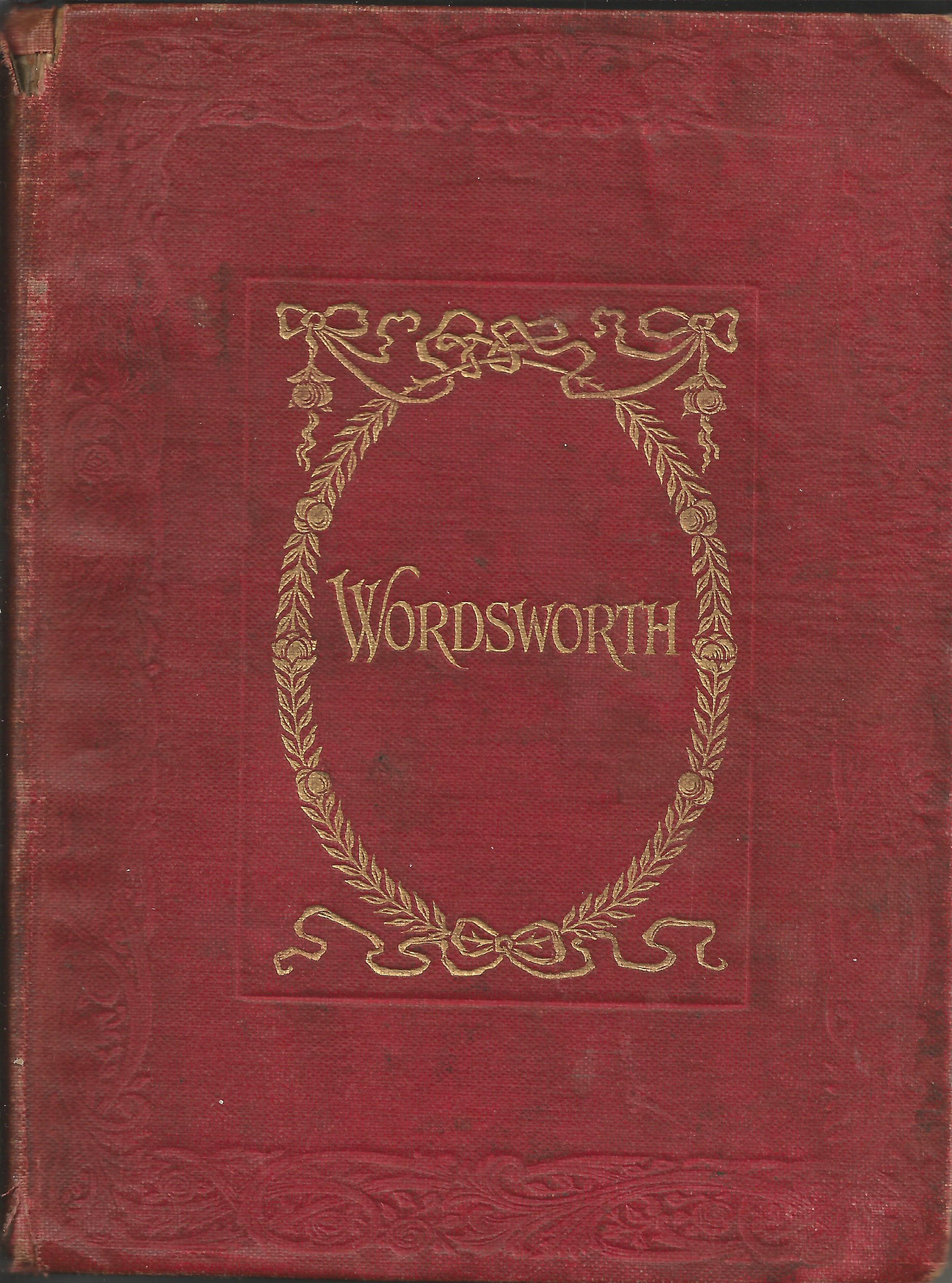
Wordsworth

The only relic from that visit that I still know about was a little red book that we took home with us. It was a book of Poems by Wordsworth which my mum kept when she split up with my dad and moved out. I asked her about it last year, after my dad’s funeral, and was quite surprised to find she still had it. She gave it to me to keep, and it is on the table beside me now as I write this.

Out of curiosity last year I looked for the date the little book was published, but couldn’t find one anywhere inside. I don’t know why, but the lack of that little bit of information bothered me. I looked on the web to see if there was information about this or similar books was to be found. No luck.

I turned instead to the task of finding out whatever I could about the publisher. The book is in a series called “Canterbury Poets” which was published by the Walter Scott Publishing company (London, New York and Felling). That made be laugh. As if anyone could ever have imagined Felling to be on a par with New York or London!

I had assumed that Sir Walter Scott was the famous novelist of Ivanhoe and the Waverley novels, but digging about a little I found out that it was named for someone else entirely. This particular Sir Walter Scott was born in 1826. He had very little formal education, but became a highly successful businessman. By the 1880s he owned a large network of business interests in the North East, primarily involving engineering and construction companies. In 1882 Scott expanded his empire by buying a publishing company “The Tyne Publishing Company”, which had just gone bust. Scott built a new factory (at Felling) and established a new office in London for his new publishing house, and the Walter Scott Publishing Company was born.

I think Scott must have been a very shrewd entrepreneur because the printing business grew rapidly, primarily through its list of editions of classic works of literature that were out of copyright. The Canterbury Poets series was first published in 1884, which is also the date of their first edition of the Wordsworth. These books were extremely well made, with hard covers, fine quality paper and good stitching . They sold for a shilling, which is an astonishingly low price for books of this quality. I can’t be sure, but have a feeling that a lot of them were given as “rewards” , for good behaviour at sunday schools and the like. That market accounted for a lot of the book trade in those days.Sir Walter Scott died in 1910 and the company ceased trading in 1931. At its peak it did indeed have offices in New York, and also sold large quantities of books in Australia.

I found this all out quite easily, because the Walter Scott Company turned out to be quite famous for the role it played in the story of working class literacy, but it didn’t tell me about the specific edition I had. However, I did discover that a scholarly work had been published in 1997 that contained a complete biliography of all the works it published until the company finally went down the tubes. Quite apart from the connection with my peculiar Aunt, I found the whole story quite fascinating. I sent off for the bibliography, which is basically a kind of catalogue that painstakingly records the size, typeface, cover design, and printers colophons for all known editions. (It’s quite boring to read, as you can imagine). I searched through it to find references to William Wordsworth. Number 99c is the entry for the “Poems” of William Wordsworth.

With a bit of work I established that the specific edition I have was first published in 1892 but reprinted many times after that. Details of the book, however, indicate that my version was actually printed in 1902. Among the clues is the fact that the colophon states “The Walter Scott Publishing Co, Ltd.” and it didn’t become a limited company until 1902. The company also moved its London and New York offices a couple of times which helps pin down the date, as these changes are noted on the imprint.

So there you have it. The little red book was printed in Felling in 1902, which happens to be the same year that my little house in Pontcanna was built, just after the death of Queen Victoria. I don’t know how old Auntie Vi was when she died, but she must have been a young girl when she got it and had obviously kept it all the rest of her life. That fits with the way her name is written in pencil, in what looks like a child’s hand, inside the front cover.

The book isn’t particularly valuable. A lot were printed and it’s not particularly rare. I’m not sure Wordsworth is very collectible nowadays either. I am still amazed, though, how well it had withstood the passage of time. Today’s books are cheaply bound and printed on chatty paper. Most modern paperbacks are in bad condition only a few years after you buy them. They made things to last in those days.

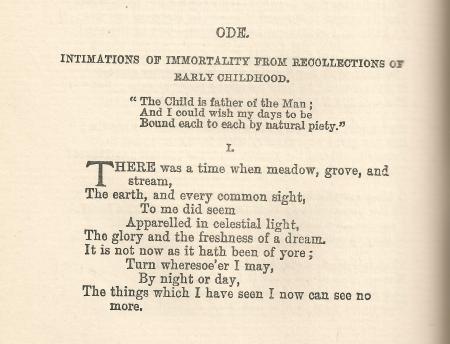
It seems appropriate to end with one of Wordsworth’s poems, of which (I forgot to mention) I’m very fond indeed. I’ve picked the start of the Ode “Intimations of Immortality from Recollections of Early Childhood”, partly because there’s a wonderful setting of this work to music by Gerald Finzi which was performed at this years Proms.

I think it’s apt enough. Here is the first verse as it appears in the Little Red Book:
wordsworth_intiminations


Welcome to Astronomy (unless you’re female)

Posted in Biographical, Education with tags , , , , , on September 14, 2013 by telescoper

I’m here on campus preparing to attend a series of receptions at the start of Freshers’ Week to welcome new students to the University of Sussex. Over the next few days I’m going to be involved in a lot of events aimed at helping all our new undergraduate students settle in, before teaching starts properly. There’ll also be events for our new postgraduates, at both Masters and Doctoral levels.

Every year the Science and Technology Facilities Council (STFC) funds an Introductory Summer School for new postgraduate research students in Astronomy. It’s held at a different university each year and is a long-running tradition. I attended such a School at Durham University way back in 1985, long before STFC was invented! We organized and ran one at Nottingham while I was there and last year the corresponding fixture was held at Sussex University, though that was before my time here and I wasn’t involved in it at all. This year, the Introductory Summer School was held at Queen Mary, University of London (often abbreviated to QMUL).

I spent eight happy years at Queen Mary (from 1990-98) so it pains me to have to criticize my friends and former colleagues there, but I really feel that I have to. Look at the programme for the Summer School. You will see that 18 (eighteen) lecturers were involved, covering virtually all areas of current research interest in the field. There is not a single female lecturer among them.

Yesterday I blogged about the invisibility of LGBT astrophysicists, but this is a glaring example of the problems facing female scientists embarking on a career in the same discipline. What message does a male-only programme send to aspiring female astronomers and astrophysicists? The lack of female speakers probably wasn’t deliberate, but was clearly thoughtless. Discrimination by omission is real and damaging. I mean no disrespect at all to the lecturers chosen, but looking through the topics covered I could easily have picked a female alternative who would have done just as good a job, if not better.

I think this is a scandal. I’ll be writing a letter of complaint to STFC myself, and I encourage you to do likewise if you agree. It’s too late to do anything about this year’s School, of course, but STFC must make sure that nothing like this happens again.

Where are all the LGBT astrophysicists?

Posted in Biographical, LGBTQ+, Science Politics with tags , , , , , on September 13, 2013 by telescoper

Having scoffed my lunchtime pasty in record time today, I seem to have a few spare minutes to spend writing a brief blog post on a question which popped into my mind when I accidentally discovered that somebody had recently written a blog post (about Einstein’s Blackboard) which mentions me. I used to look after this famous relic when I was in Nottingham many years ago, you see.

There’s a sentence in the post that says

Professor Coles is one of the few out gay astrophysicists in the UK.

Well, it all depends by what you mean by “few” but I think there are more gay (or lesbian or bisexual or transgendered) astrophysicists out there than most people probably think. I know quite a large number personally, dozens in fact, most of whom are “out”. It’s a safe bet that there are many more who aren’t open about their sexuality too. However, it is probably the case that LGBT scientists are much less visible as such through their work than colleagues in the arts or humanities. Read two research papers, one written by a straight astrophysicist and one by an LGBT astrophysicist, and I very much doubt you could tell which is which. Read two pieces of literary criticism, however, and it’s much more likely you could determine the sexual orientation of the writer.

There have been attempts to raise the profile of, e.g., LGBT astronomers through such initiatives as The Outlist, but only a very small fraction of the LGBT astronomers I know have their names on it. I’m not on it myself, although I used to be. It seems I’ve been struck off.

You might ask why it matters if an astrophysicist is straight or gay? Surely what is important is whether they are good at their job? I agree with that, actually. When it comes to career development, sexual orientation should be as irrelevant as race or gender. The problem is that the lack of visibility of LGBT scientists – and this doesn’t just apply to astrophysics, but across all science disciplines – could deter young people from choosing science as a career in the first place.

It has always annoyed me that the Independent newspaper’s annual “Pink List” of the UK’s most influential LGBT people never – and I mean never – has a single LGBT scientist on it, despite the immense amount they do not only in research, but also in teaching and outreach. It’s very sad that this work is largely unacknowledged and even sadder that a great many potential role models are hidden.

The effect of this invisibility is to reinforce the perception that science just isn’t something that LGBT people do. I have known gay students in physics or astrophysics who were on the verge of quitting because of this. I think it’s important for established scientists to be as open as possible about their sexual orientation to counter this. I really don’t think the consequences of coming out are as frightening as people think. This is not to say that homophobia doesn’t exist, but that straight colleagues are much more likely to be supportive than not and (with a few exceptions) most workplaces nowadays won’t tolerate discrimination or bullying based on sexual orientation.

But that brings us to the question of why we should care about whether LGBT students might be deterred from becoming scientists. This is much the same issue as to why we should worry that there are so few female physics students. The obvious answer is based on notions of fairness: we should do everything we can to ensure that people have equal opportunity to advance their career in whatever direction appeals to them. But I’m painfully aware that there are some people for whom arguments based on fairness simply don’t wash. For them there’s another argument that may work better. As scientists whose goal is – or should be – the advancement of knowledge, the message is that we should strive as hard as possible to recruit the brightest and most creative brains into our subject. That means ensuring that the pool from which we recruit is as large and as diverse as possible. The best student drawn from such a pool is likely to be better than the best student from a smaller and more restricted one.

Big companies haven’t become gay-friendly employers in recent years out of a sudden urge for altruism. They’ve done it because they know that they’d be discouraging many excellent employees from joining them. It’s exactly the same way for research.

At Sussex University we will soon be welcoming well over a hundred new students about to start their degree programmes in the Department of Physics & Astronomy. It’s a reasonable estimate than one in ten of these will be an LGBT student. The same will be true for many other departments around the country. So, regardless of your own orientation, if you’re reading this and you’re involved in teaching science just try not to assume, just because you’re talking to a science student, that you must be talking to a straight student. That shouldn’t be be too hard, should it?

(Guest Post) De Profundis

Posted in Music with tags , , , , on September 12, 2013 by telescoper

Time for a guest post, methinks. Here is a review of a recent concert by the one and only Leonard Cohen. I wasn’t lucky enough to be there myself, but the pseudonymous Miss Lemon certainly was, and here are her reflections on the performance.

–0–

Merveilleux, superbe, meraviglioso, di sogno – I have run out of English superlatives to even try to begin to describe the masterclass that was Leonard Cohen’s Old Ideas concert (NG Arena 8 September 2013). It’s not often that you can put the words magical and Birmingham in the same sentence (spoken as a Brummie) but this was one such occasion.

My initial introduction to the venerable man was as a teenager in the mid-70s. Whilst my parents and I sat downstairs probably watching something like Family at War, upstairs my slightly older, and much more in touch with her poetic side, teenage sister would allow the, as I/we heard it then, drones of Leonard Cohen to seep through the ceiling, much to the familial annoyance below. However, sometime later intrigued as to quite what this dirge-like music was, whilst Sis was back at school (I was fortunate to have longer school holidays), I listened to the Songs of Leonard Cohen and was bewitched by the, as I now realise, legend that is Leonard.

I first saw Mr Cohen back in the early ‘80s – a memorable and unexpectedly good-humoured concert – but nothing could have prepared me for Sunday’s dreamlike experience. His voice even more distinctive than I remember it and now ‘aged into a worn leather bass’. An audience whose ages ranged from early 20s to late 70s filled the cavernous halls of the NG Arena in Birmingham.  A large number of men of a certain age, not all with balding pates and ponytails, were adorned with Cohen fedoras and the first vision on the stage was that of all of the band wearing fedoras so that immediate identification of the great man himself was made a little difficult, which brought a wry smile to the assembled throng in the forum.

His nine-piece band, among them a glorious violin virtuoso, proved more than suitable playmates. An appealing alchemy of Leonard at his self-deprecating best enchanting us with songs old and new, the beautiful and haunting version of Alexandra Leaving sung by Sharon Robinson – even after three hours, like a bird on the wire, hey why not ask for more?

The esteemed Mr Cohen – modest and most generous of spirit – age has not diminished his ability to pen glorious words and sublime songs and to send 10,000 people home with a smile which would last even longer than his concert, nor has it dimmed the twinkle in his eye. He was indeed ‘born with the gift of a golden voice’.

Sincerely

Miss Lemon

A Late Flash from the Argus

Posted in Brighton with tags , on September 11, 2013 by telescoper

IMG-20130910-00167

On the Interpretation of Dreams

Posted in Biographical with tags , , , , on September 11, 2013 by telescoper

Last night I had a peculiar dream in which, for reasons obscure, I hijacked one of the dishes of the Ryle Telescope at the Mullard Radio Astronomy Observatory in Cambridge and drove it at high speed along a railway line all the way to Oxford (pursued by an ice cream van). To non-astronomers this probably sounds completely barking, but I should point out that the Mullard Radio Astronomy Observatory is located at the site of Lord’s Bridge, a former railway station on the (now defunct) line between Cambridge and Oxford and some of the telescope dishes move along sections of the old track. Of course the track no longer extends all the way to Oxford, and in any case there would be bridges under which one of the 13-metre antennae of the Ryle Telescope could not possibly pass. Such mundane considerations don’t matter in the world of dreams, however, and the whole escapade was like a madcap chase scene from a daft movie. I woke up chuckling.

I’m by no means an expert in the interpretation of dreams but on the occasions when I can remember what I’ve dreamt about it always seems to be a weird juxtaposition of things I’ve experienced in the recent past. In this particular case I recall reading an article about the possibility (now, I believe, shelved) that the Oxford-Cambridge railway might be reinstated. I’ve also been reading tweets and facebook messages from people currently at a radio-astronomy workshop in the Netherlands.

My interpretation of this sort of thing is that during a dream the sleeping brain is sifting through recent experiences and relating them to others, including recent events and things lodged in long-term memory. If I’m right, then this kind of dream is basically a by-product of the workings of a sort of subconscious filing system. Not sure how the ice cream van fits into this scheme though.

There are other kinds of dream, of course, and they don’t always fit into this pattern. In my experience the majority don’t make any sense at all, so I won’t say any more about that class. I don’t know how many people have regular recurrent dreams, but I do; these are of two types. The first is a standard “anxiety” dream. I could be sitting in an orchestra on the stage of a concert hall, or some similar situation. I have a musical instrument in my hands and am dressed for the part, like all the other musicians. It is shortly before the performance is due to start. The problem is that I don’t actually know how to play the instrument. Time is ticking away and I’m soon to be found out. How do I escape? I think it’s obvious that this dream is closely related to impostor syndrome.

The second type of recurrent dream is harder to fathom. I’ve moved around quite a lot during my career: starting in Sussex, then in London, Nottingham, Cardiff and then back to Sussex. In this kind of dream I’m supposed to be back in one of the places I used to live, but it’s curiously different from what it was like in reality. One example involved me being back in my old flat in Bethnal Green. Exploring the place I took a nice walk through the French windows and into the garden. Trouble is, the flat didn’t actually have French windows or a garden. How could it? It wasn’t even on the ground floor…

That kind of dream is quite disconcerting, especially since it’s recurrent. But I can give an example that’s even weirder. As regular readers of this blog – both of them – will know, I was unwell for a period last summer. During the worst of this episode I was confined for a while in a psychiatric clinic. I wasn’t there for very long (perhaps 3-4 days) but I didn’t really keep track of time very well and in retrospect it seems I was there much longer than that. I was also heavily sedated for a lot of the time I was there. The effect of this was to blur the distinction between sleeping and waking almost completely so I literally didn’t know whether I was conscious or unconscious.

Now I know for a fact that I didn’t have any visitors when I was in that place. However, I have perfect recollection of a time when a young man (a former student of mine of Cardiff University) came into my room, sat down beside my bed and opened a discussion about physics, his plans for doing a PhD in Early Universe Cosmology, and various other topics to do with books and films. Looking back on this I realize that the conversation I’d imagined was actually a kind of synthesis of bits of other conversations I’d previously had with the same person in a different environment (i.e. my old office in Cardiff University). The peculiarity is that I now remember that imagined pastiche of a conversation as if it were actually real, and it has always been difficult for me to convince myself that it didn’t happen. It’s almost as if the filing system had gone into reverse, pulling old memories out of their drawers and sticking them back in my consciousness.

Related to this (possibly) are various memories I have of very early childhood. These are often very vivid, but in many cases completely at odds with facts that I’ve subsequently established. I think what has happened in such examples is that I haven’t actually remembered the event in question, but have been told things about it so frequently that a memory has somehow been constructed to accommodate the narrative.

Over a year on I still find the clinic episode quite scary to think about. I think that’s mostly because it’s an extreme example of how one’s perception of what is real and remembered versus what is imaginary and dreamt can get confused. Am I really writing this? Or am I dreaming? Are you really reading it? Are you dreaming? Wake-up!