Some Day My Prince Will Come..

Posted in Jazz with tags , , on July 3, 2013 by telescoper

I’m currently sitting in my office eating a sandwich and girding my loins for three hours of appraisal training this afternoon. Just time, therefore, to post this musical gem I recently discovered on Youtube. It’s Bill Evans recorded in 1965

Miles Davis said of Bill Evans “He plays the piano the way it should be played”. I’m not going to disagree with that, because I think Bill Evans was wonderful, but keep an ear out for Chuck Israels fantastic work on bass too!

Physics Proverbs

Posted in The Universe and Stuff with tags , on July 2, 2013 by telescoper

I was a bit bored on the bus this morning, as it got stuck in a traffic jam, so decided to amuse myself (and probably nobody else) by thinking up physics-related versions of traditional proverbs and tweeting them (hashtag #physicsproverbs). I thought it might be fun to use them to indulge in a bit of audience participation, by asking the blogosphere to contribute their own through  the comments box below.

Here are some of my offerings:

  • Never mind the Q-factor, feel the FWHM
  • Don’t throw stones if there are periodic boundary conditions
  • A stitch in time may violate causality
  • A thing of beauty is now generally known as a bottom
  • No amplifier, no gain
  • Nothing is certain, except death and deterministic processes
  • Blood is thicker than dark matter
  • May the Devil take the Hindmarsh
  • Don’t change potentials in mid streamline
  • Angular momentum makes the world go round
  • Many a micro makes a mega
  • When the cat’s away the mice will annoy Dr Schrödinger
  • Ask a silly question, and you might well get a research grant
  • Discreteness is the greater part of granularity
  • There’s no time like t=0
  • The course of a random walk never did run smooth
  • Many hadrons make very few Higgs Bosons at CERN
  • Actions speak louder than differential equations
  • Radiation pressure makes light work
  • Don’t cast your PRLs before swine
  • Nature abhors most of the papers submitted there
  • Photons should be seen and not heard. As opposed to phonons.
  • Power corrupts. Absolute power has exactly the same effect because power is always positive.

You can see all the tweets resulting from the Twitter version of this game here.

The Local Universe

Posted in The Universe and Stuff with tags , , , , on July 2, 2013 by telescoper

I just stumbled across this on Amanda Bauer’s blog  and thought I’d post it here because it’s so nice. The film is by Hélène Courtois, Daniel Pomarède, R. Brent Tully, Yehuda Hoffman, and Denis Courtois and it describes the Cosmography – like geography, only more cosmic – of the Local Universe. I’m not sure there’s a consensus among cosmologists about what exactly “local” means, but I’d say it probably means out to a few hundred Megaparsecs from the observer (say up to about a billion light years) or, alternatively, with redshifts much less than unity.  That may not sound very nearby at all, but even on such scales the look-back time is sufficiently short that the effect of cosmic evolution and/or the expansion of the Universe is negligible, so when we look at objects at such distances we’re seeing them as they are “now” rather than as they were in the past, which is the case when we study extremely distant objects.

Slow Progress for Female Physics Professors

Posted in Biographical, The Universe and Stuff with tags , , , , on July 1, 2013 by telescoper

One of the more pleasant jobs I have to do these days is to congratulate staff in the School of Mathematical and Physical Sciences at the University of Sussex when they get promoted, whether it be to Senior Lecturer, Reader or Professor. There has been quite a crop of promotions at all levels in the School recently, owing to the excellent contributions made by so many people to teaching, research and other aspects of the work we do.

One of the successful promotion candidates in the latest round was the Head of our Experimental Particle Physics group, Antonella de Santo, whose promotion to Professor of Physics makes her the first ever female Professor of Physics at the University of Sussex. I’m rather embarrassed to admit that, actually, as the University has existed for 51 years, but at least I can say better late then never!

Anyway, Antonella’s well-deserved success prompted me to look into the statistics of female physics & astronomy professors. I’ve already posted about how the proportion of female undergraduates studying physics as been stuck at around the 20% mark for a decade despite strenuous efforts to widen participation. A recent (2012) study by the Institute of Physics contains a wealth of statistical information about staff in Physics departments, which I encourage people to read if they’re interested in the overall issue with equality and diversity in physics. Here I’ll just pull out the figure (based on a 2010 survey) that out of a total of 650 Professors of Physics (and/or Astronomy) in the UK, just 5.5% were female. At that date about 20 physics departments had no female professors at all; that would have included Sussex, of course.

Another University, Liverpool, also recently appointed its first female Professor of Physics in the person of Tara Shears, another particle physicist. The current  Head of the  Department of Physics at Imperial Collge is Joanna Haigh, (who I thought was the first to occupy such a position until corrected by the comment below) so there are signs that career prospects are improving for female physicists, but progress is painfully slow. The first ever female Professor of Physics in the United Kingdom was Daphne Jackson, a nuclear physicist, who took up her Chair at the University of Surrey way back in 1971. It’s interesting to note that when Daphne Jackson studied physics as an undergraduate at Imperial College she was one of only two women among the 88 undergraduates in her year.

I don’t personally think that there’s a significant gender bias when it comes to the consideration of promotion cases at the University of Sussex (or at any other institution I’ve worked at), but there’s plenty of anecdotal evidence that women are much more reluctant than men to put themselves forward for consideration at any level. I hope that recent successes in MPS, such as Antonella’s Professorship and Readerships for astronomer Kathy Romer and mathematician Vanessa Styles, will provide the necessary encouragement.

A Bit of Simon Fanshawe

Posted in Biographical, Brighton, Politics with tags , , , , on June 30, 2013 by telescoper

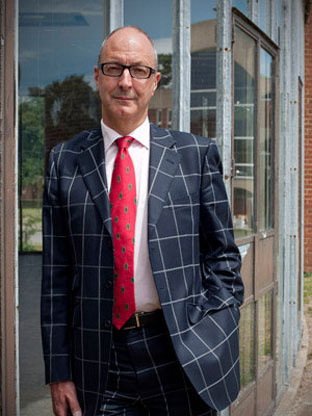
27On Friday I attended a very interesting event on the University of Sussex campus. This was arranged to mark the forthcoming end of the term of office of the current Chair of Council of the University of Sussex, Simon Fanshawe (left). Simon Fanshawe OBE is, of course,  a well-known radio and TV broadcaster, award-winning comedian and co-founder of the campaigning organization Stonewall. He also has an interesting taste in suits, and provided evidence of that in his outfit on Friday. But enough of matters sartorial. Simon has been Chair of Council for six years, and served as a member of Council for as many years before that, so really has contributed a huge amount to the University over that period. I think it’s safe to say that he has had a much higher profile in his role as Chair than most of his counterparts in other UK universities, so the idea of having a special event in his honour was thoroughly well justified.

First we had a series of three short lectures by Sussex on various issues relating to equality and diversity and how their relate to power and governance. More specifically these were talks about female islamic religious leaders, the nature of political corruption and attitudes to it in different countries, and a particularly fascinating talk by Robert Livingston that touched on many things, including how facial features seem to correlate with success in leadership positions.

After that there was a wine reception and a nice dinner with lots of stimulating conversation. For some reason a major topic on my table was bell-ringing, and why English church bells sound so different from those in continental Europe. I wrote some stuff about that years ago, while I was teaching probability, and may blog about it in future. Everyone else seemed to head home via taxi after dinner, but I wobbled off to the bus stop and got the trusty No. 23 back to Kemptown.

Anyway, I may post later on about some things that popped into my mind as a result of the talks and the subsequent discussion and conversation but for the time being I’ll just mention a very tenuous link with Simon Fanshawe that involves taking a little trip down memory lane. The picture below was taken in either 1988 or 1989 (I’m not very good at dates). It shows me and my partner at the time, Roger, preparing to act as volunteer waiters at a fund-raising dinner (somewhere in Lewes if I remember correctly) organized by the Communist Party of Great Britain:

Marxism_today

I wasn’t involved very much in campus politics when I was a graduate student at Sussex (from 1985 to 1988) or a postdoctoral researcher (1988-90) because I found most of it depressingly puerile and short-sighted, that being especially true of the sizable lunatic fringe which also had a disagreeable taste for mindless vandalism. Sadly, times haven’t changed in that respect. I did, however, during that time become an avid reader of magazine called Marxism Today which I thought contained the most incisive political writing of the time and which therefore prompted me to join the CPGB, and eventually became Branch Secretary until I left for London in 1990. Incidentally the Cee-Pee-Gee-Bee decided to dissolve itself as a political party in 1991 and became a sort of leftist think-tank called Democratic Left.

Anyway, the point about that photograph is that the after-dinner speaker on that occasion was none other than Simon Fanshawe, although I doubt if he remembers!

I see the boys of summer

Posted in Poetry with tags , , on June 29, 2013 by telescoper

I

I see the boys of summer in their ruin
Lay the gold tithings barren,
Setting no store by harvest, freeze the soils;
There in their heat the winter floods
Of frozen loves they fetch their girls,
And drown the cargoed apples in their tides.

These boys of light are curdlers in their folly,
Sour the boiling honey;
The jacks of frost they finger in the hives;
There in the sun the frigid threads
Of doubt and dark they feed their nerves;
The signal moon is zero in their voids.

I see the summer children in their mothers
Split up the brawned womb’s weathers,
Divide the night and day with fairy thumbs;
There in the deep with quartered shades
Of sun and moon they paint their dams
As sunlight paints the shelling of their heads.

I see that from these boys shall men of nothing
Stature by seedy shifting,
Or lame the air with leaping from its heats;
There from their hearts the dogdayed pulse
Of love and light bursts in their throats.
O see the pulse of summer in the ice.

II

But seasons must be challenged or they totter
Into a chiming quarter
Where, punctual as death, we ring the stars;
There, in his night, the black-tongued bells
The sleepy man of winter pulls,
Nor blows back moon-and-midnight as she blows.

We are the dark deniers let us summon
Death from a summer woman,
A muscling life from lovers in their cramp
From the fair dead who flush the sea
The bright-eyed worm on Davy’s lamp
And from the planted womb the man of straw.

We summer boys in this four-winded spinning,
Green of the seaweeds’ iron,
Hold up the noisy sea and drop her birds,
Pick the world’s ball of wave and froth
To choke the deserts with her tides,
And comb the county gardens for a wreath.

In spring we cross our foreheads with the holly,
Heigh ho the blood and berry,
And nail the merry squires to the trees;
Here love’s damp muscle dries and dies
Here break a kiss in no love’s quarry,
O see the poles of promise in the boys.

III

I see you boys of summer in your ruin.
Man in his maggot’s barren.
And boys are full and foreign to the pouch.
I am the man your father was.
We are the sons of flint and pitch.
O see the poles are kissing as they cross.

by Dylan Thomas (1914-1953)
Punch and Judy meet Quantum Technology

Posted in The Universe and Stuff with tags , , , , , , on June 28, 2013 by telescoper

It’s an Open Day here on campus, and there’s quite a crowd of potential students and parents gathering in the School of Mathematical and Physical Sciences here at the University of Sussex to find out a bit more about the School in advance of making decisions about where to apply next year.

I noticed the other day that quite a few of these have appeared on campus over the last few days:

IMG-20130627-00139

Apparently they’re information points manned by various helpers to help visitors find their way around the place. When I first saw this one, I thought it was a Punch and Judy box, so assumed that there was some sort of conference of Punch and Judy performers going on. That wouldn’t be inappropriate for a University campus, actually, because the traditional name for a Punch & Judy puppeteer is a “Professor”. Not a lot of people know that.

Anyway, none of that is really relevant to what I wanted to post today. I stumbled across this video featuring Winfried Hensinger (one of my colleagues from the Department of Physics & Astronomy within the School of Mathematical and Physical Sciences). I thought it would be fun to share it here, just to give an idea of some of the work that’s going on here outside my own speciality of astrophysics. I hope this will complement the real open day with a mini virtual open day on the blog.

Winfried is Reader in Quantum, Atomic and Optical Physics at the University of Sussex and he works in the group we generally call “AMO” (Atomic, Molecular and Optical). In this TEDX lecture he talks about the future of quantum computers and the role the team he is part of, at Sussex University, plays as they develop large scale quantum computers using ions cooled to extremely low temperatures using lasers. Enjoy!

Farewell, then, Leighton Andrews…

Posted in Education, Finance, Politics with tags , , , , , , , on June 27, 2013 by telescoper

Although I no longer live in Wales I couldn’t resist commenting on the resignation, announced on Tuesday, of the Welsh Education Minister, Leighton Andrews. It seems that Mr Andrews was spotted holding a placard protesting against the planned closure of a school, a closure that results from his own policies. Personally, I think that it’s quite an imaginative move for a Minister to campaign against his own policies. It shows an open-mindedness absent in most politicians.

Leighton Andrews will probably be best remembered as the architect of the policy that students domiciled in Wales would be protected from having to pay large tuition fee rise by a system of grants, meaning that the Welsh Assembly will pick up the tab for Welsh students. They will still have to pay the “old”  fee level of £3290 per annum, but the WAG will pay the extra approx £6K charged by most Universities since the fee cap was raised. This is good news for the students of course, but the grants will be available to Welsh students not just for study in Welsh universities but wherever they choose to go. Since about 16,000 Welsh students are currently at university in England, this means that the WAG is handing over a great big chunk (up to 16,000 × £6000 = £96 million) of its hard-earned budget straight back to England. This has always seemed to me a very strange thing to do when the Welsh Government is constantly complaining that the Barnett formula doesn’t give them enough money in the first place.

What’s more, the Welsh Assembly grants for Welsh students are paid for by top-slicing the grants that HECFW makes to Welsh universities. So funding cuts for universities in Wales have been  imposed in order to subsidize English universities. This is hardly in the spirit of devolution either!

English students wanting to study in Wales will have to pay full whack, but will be paying to attend universities whose overall level of state funding is even lower than in England (at least for STEM subjects whose subsidy is protected in England). Currently about 25,000 English students study in Wales, compared with the 16,000 Welsh students who study in England, but I wonder how many of them realize that if they study England their £9K fee attracts an additional investment of £1.5K from HEFCE whereas there is no equivalent central resource supplied by HEFCW if they study in Wales? To put it another way, each £1 of tuition fee paid by a STEM student is worth £1.16 in England, but just £1 in Wales.

The other drastic implication of this policy is that HEFCW will have no money left to fund research via the QR mechanism that pertains in England (at least for the time being). I blogged about this a couple of days ago so won’t say any more today.

I don’t think any of my former colleagues in Cardiff are terribly upset to see Leighton Andrews go, but there is some nervousness about whether the replacement might be even worse. The new Education Minister is Huw Lewis. I wish him well in his new post, and hope he has the courage to question some of the decisions made by his predecessor that have had such a negative effect on education in Wales.

Anyway, in bidding farewell to Leighton Andrews I thought I’d show him all due respect, and do him the honour of presenting a look-alike. All reference to Muppets purely coincidental…

Slide1

Can We Actually Even Tell if Humans Are Affecting the Climate? What if we did nothing at all?

Posted in Bad Statistics with tags , , on June 26, 2013 by telescoper

Reblog of a post about the doctrine of falsifiablity and its relevance to Climate Change….following on from Monday’s post.

University Research Funding: Will the Axe Fall on QR?

Posted in Finance, Politics, Science Politics with tags , , , on June 25, 2013 by telescoper

As we tremble in anticipation of this week’s Spending Review, which will determine the budgets for Science and Higher Education in 2015/16, there’s fairly strong evidence that Chancellor of the Exchequer George Osborne is looking to save about £11.5 billion of public spending. Given that funding for some Whitehall departments is ring-fenced there is considerable speculation that the axe will fall heavily on the Department for Business, Innovation and Skills (BIS), which seems likely to have to make over £1 billion of savings.

But where will these savings in the BIS budget be made? The government has made noises that it will protect science funding (at least in cash terms) so big cuts in the larger research council budgets appear unlikely. However, Treasury officials have been rumoured as thinking that the Universities are now “awash with money” and should therefore be cut. On the other hand, incoming for University teaching now largely comes from fees so there’s very little of the HEFCE teaching budget to cut further.

Now here’s the rub. The part of HEFCE’s budget that deals with research amounts to about £1.6 billion per year. This, the so-called `QR’ funding, is currently being distributed to Higher Education Institutions according to the outcome of the 2008 Research Assessment Exercise (RAE). This year we
are preparing submissions to a new system called the Research Excellence Framework (REF), which was always intended to be used to distribute QR funding from 2015/16 onwards. But what if the government decides that the only way to balance the books is to remove the QR funding stream entirely?

The 2012 funding letter from HEFCE states explains that it is distributing

£1,558 million for research. The ring-fenced settlement for science and research means that we will be able to maintain overall funding, in cash terms, until 2014-15.

But this does not include the period covered by the spending review, so it’s perfectly possible that the “ring fence” could be removed, or at least re-interpreted as a result of this spending review.

The government could argue that QR and Research Council grant income correlate so well that there’s no need to continue with the current dual funding system, by which the Research Councils provide grants for specific projects and programmes and the higher education funding bodies provide block grant funding to universities via the QR line. It could also argue that the high fees being charged mean that Universities will be able to cope with these cuts without undue hardship. There is a precedent in Wales, where HEFCW will not be awarding any QR funding after the 2013 REF, so why shouldn’t England do the same? They could also get away with the argument that this money isn’t part of the ring fence mentioned above.

The only problem is that so many institutions have spent so much time on preparations for the REF that cancelling the funding associated with it will mean all that effort is wasted. Indeed, the only remaining justification (if it can be called that) for Universities participating in the REF is for position in various league tables, which is rather a lot of expense for something of extremely debatable value.

Anyway, if I were a gambling man (which I am, actually) I don’t think I’d be betting against this outcome. Predictions are very difficult, especially about the future, but this one is mine. And I hope it’s proved wrong…