Switching Allegiances

Posted in Biographical, Education, Football, Rugby with tags , , , , , on February 3, 2013 by telescoper

So here I am, then, in the office on a Sunday afternoon,which I suspect is going to be a pretty regular occurrence for the foreseeable future. I mainly came in to sort out papers for tomorrow’s Senior Management Group meeting, which will be the first such meeting I’ll be attending in my new capacity. I have managed to prepare for it in fine style by losing my diary, which isn’t a very good start to my career as any kind of manager.

Yesterday was taken up with flat-hunting which, if all turns out well this time, was successful. I also had time to watch a bit of the opening match of the Six Nations Rugby between Wales and Ireland. For the last five years or so I’ve always been in Cardiff for Wales’ first home game of the competition, although I’ve never actually managed to get a ticket for the match. It felt a bit strange not being there anyway. It has to be said that Wales were pretty chronic in the first half, going into the break at 30-3 down, but they recovered in the second half and it was quite an absorbing match all considered. Ireland’s excellent defence held off a spirited Welsh comeback and Ireland won 30-22.

Although I’ve lived in Wales for a while, and have enjoyed the match-day atmosphere in Cardiff, I’ve never switched allegiance from England as far as rugby is concerned. Later on yesterday England beat Scotland in their opening match of the Six Nations, showing quite a bit of flair in doing so but also making quite a lot of mistakes. The 38-18 scoreline flattered England, I felt, and they’ll have to up their game a lot if they’re going to match Wales’ Grand Slam last season.

Football is another matter in which allegiances are difficult to change. Many’s the time I’ve thought of giving up being a Newcastle United supporter but I’ve never managed it. I disapprove of people who think they have an option concerning which team to support, actually. I was born in Newcastle therefore I support Newcastle United. That’s the end of it. We all have our cross to bear. Anyway, yesterday brought an unexpected ray of sunshine into a gloomy season for the Toon with a 3-2 victory over Chelsea. Following a first away win of the season against Aston Villa last week it may even be possible that they’ll avoid relegation. Perhaps.

Switching allegiances between universities is almost as difficult. In today’s academic world we’re supposed to think of higher education as a marketplace in which different institutions compete for funding for both teaching and research. I’ve never felt comfortable with the idea that opening up higher education to “market forces” is in anyone’s interests. Certainly on the research side, there are so many collaborations between groups in different universities that cooperation is more the rule than competition although, as with any rule, there are exceptions. Friendly rivalry is as good a thing in higher education as it is in football, but anything more serious than that can only be justified in the case of Sunderland.

The Rolling English Road

Posted in Poetry with tags , , on February 2, 2013 by telescoper

Before the Roman came to Rye or out to Severn strode,
The rolling English drunkard made the rolling English road.
A reeling road, a rolling road, that rambles round the shire,
And after him the parson ran, the sexton and the squire;
A merry road, a mazy road, and such as we did tread
The night we went to Birmingham by way of Beachy Head.

I knew no harm of Bonaparte and plenty of the Squire,
And for to fight the Frenchman I did not much desire;
But I did bash their baggonets because they came arrayed
To straighten out the crooked road an English drunkard made,
Where you and I went down the lane with ale-mugs in our hands,
The night we went to Glastonbury by way of Goodwin Sands.

His sins they were forgiven him; or why do flowers run
Behind him; and the hedges all strengthening in the sun?
The wild thing went from left to right and knew not which was which,
But the wild rose was above him when they found him in the ditch.
God pardon us, nor harden us; we did not see so clear
The night we went to Bannockburn by way of Brighton Pier.

My friends, we will not go again or ape an ancient rage,
Or stretch the folly of our youth to be the shame of age,
But walk with clearer eyes and ears this path that wandereth,
And see undrugged in evening light the decent inn of death;
For there is good news yet to hear and fine things to be seen,
Before we go to Paradise by way of Kensal Green.

by G.K. Chesterton (1874-1936).

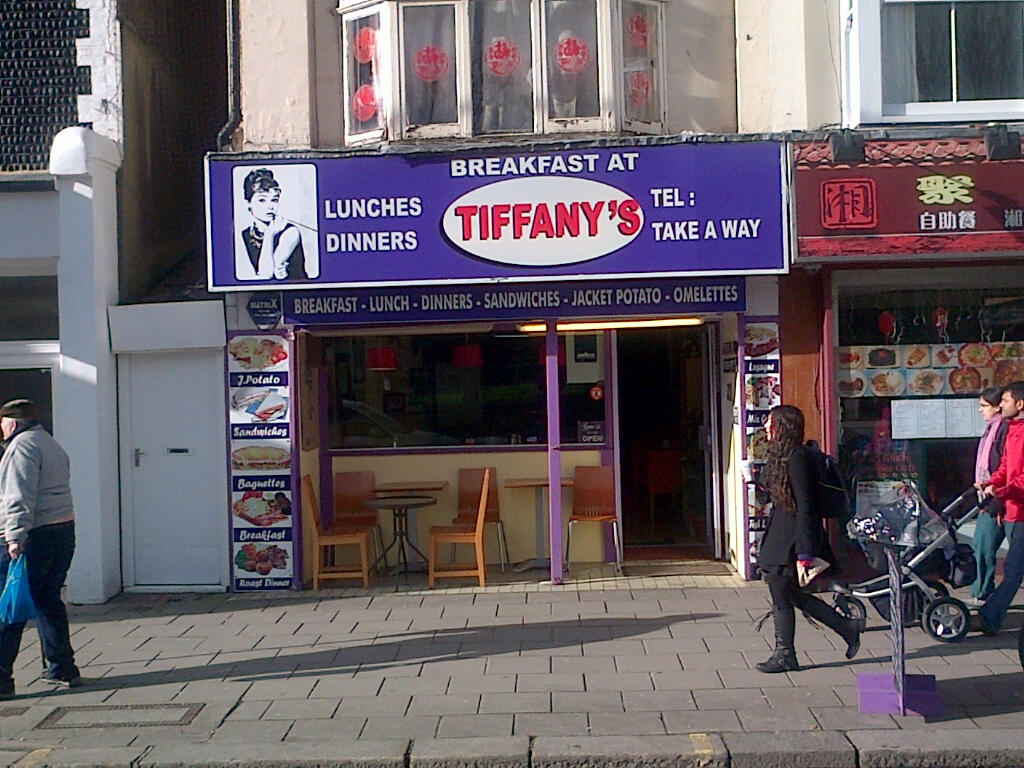
If Audrey Hepburn were alive today..

Posted in Uncategorized on February 2, 2013 by telescoper

…she’d be turning in her grave!

..and hello from Sussex!

Posted in Biographical with tags on February 1, 2013 by telescoper

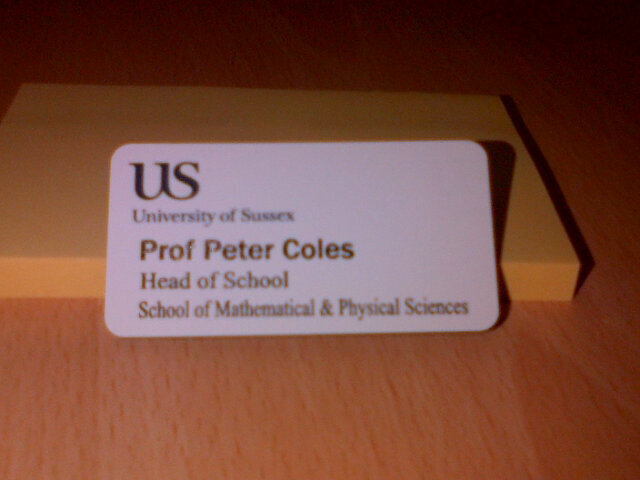
Well, nearing the end of my first day in my new job at the University of Sussex, I can safely say that I’m more than a bit knackered. I’ve had a day filled with meetings as well as devoid of lunch. On the other hand I did manage to get the keys to my new office and, after some fiddling about, am now connected to the interwebs. They’ve even given me a nice new badge in case I forget who I am.

pic0

I didn’t get to leave Cardiff yesterday until later than I’d imagined I would and then managed to miss the train and had to wait an hour in Cardiff station. In the end I didn’t make it to my temporary lodgings until well after 11. I crashed out and slept like a log, and only just managed to drag myself out of bed to get to the campus in time for the first meeting.

My new office is very nice, although it looks a bit empty at the moment because all my boxes are still in Cardiff awaiting the attentions of hunky removal men. Here’s a picture taken yesterday by Dan Read in my old office…

Pic_2

..having finished packing I was about to add the final touch and clean my whiteboard, but I was persuaded that it’s such a work of art that, far from cleaning it off, I should actually sign it. So I did. No doubt it will be cleaned off soon, if it hasn’t been already.

Anyway, a weekend in Brighton now beckons which I’m going to start by doing down the pub for a pint, which may be the first of many…

Farewell to Cardiff…

Posted in Biographical on January 31, 2013 by telescoper

Well, it’s my last day of official employment at Cardiff University and I’ve just finished my last big job, checking and collating the marks for the module I taught last semester. That done, I thought I’d have a quick sandwich before packing up a few final bits and pieces, vacating the old office, and handing in my keys.

There was a gathering in the department yesterday afternoon to celebrate my departure, followed by drinks and a nice dinner (at the splendid Purple Poppadom, although the Poppadoms weren’t actually Purple).

The Head of the School of Physics and Astronomy at Cardiff University, Prof. Walter Gear, made a little speech at my departmental send-off before handing me a nice card as well as a gift voucher for the Royal Opera House at Covent Garden. I’m a bit overwhelmed by the generosity shown by the good folks of PHYSX – the gift voucher will mean I can afford a few trips from Brighton to the Opera in London, even at Covent Garden’s outrageous prices.

I’ll miss the department here, especially the people that work and/or study here who have put up with me for the past five and a half years or so. Other things I’ll miss about Cardiff include Welsh National Opera, of course, for its excellence and (relative inexpensiveness).

But I’m not going completely just yet. I still have two PhD students and three 4th year project students to look after, so I’ll be coming back from time to time to meet with them. I’ll also be keeping the house in Pontcanna until the summer, so I’ll have a pied-a-terre here when I come back, either for work or for the Opera.

Anyway, I just wanted to say a public “thank you” to Walter for his kind words yesterday, for the support he has given me over the years, and especially last summer, and the generosity he showed in agreeing so quickly to transfer my STFC grant to Sussex. Would that everyone I’ve worked with had acted so unselfishly…

Now, to finish packing….

Cardiff Bridge in the Dark

Posted in Uncategorized with tags , , on January 31, 2013 by telescoper

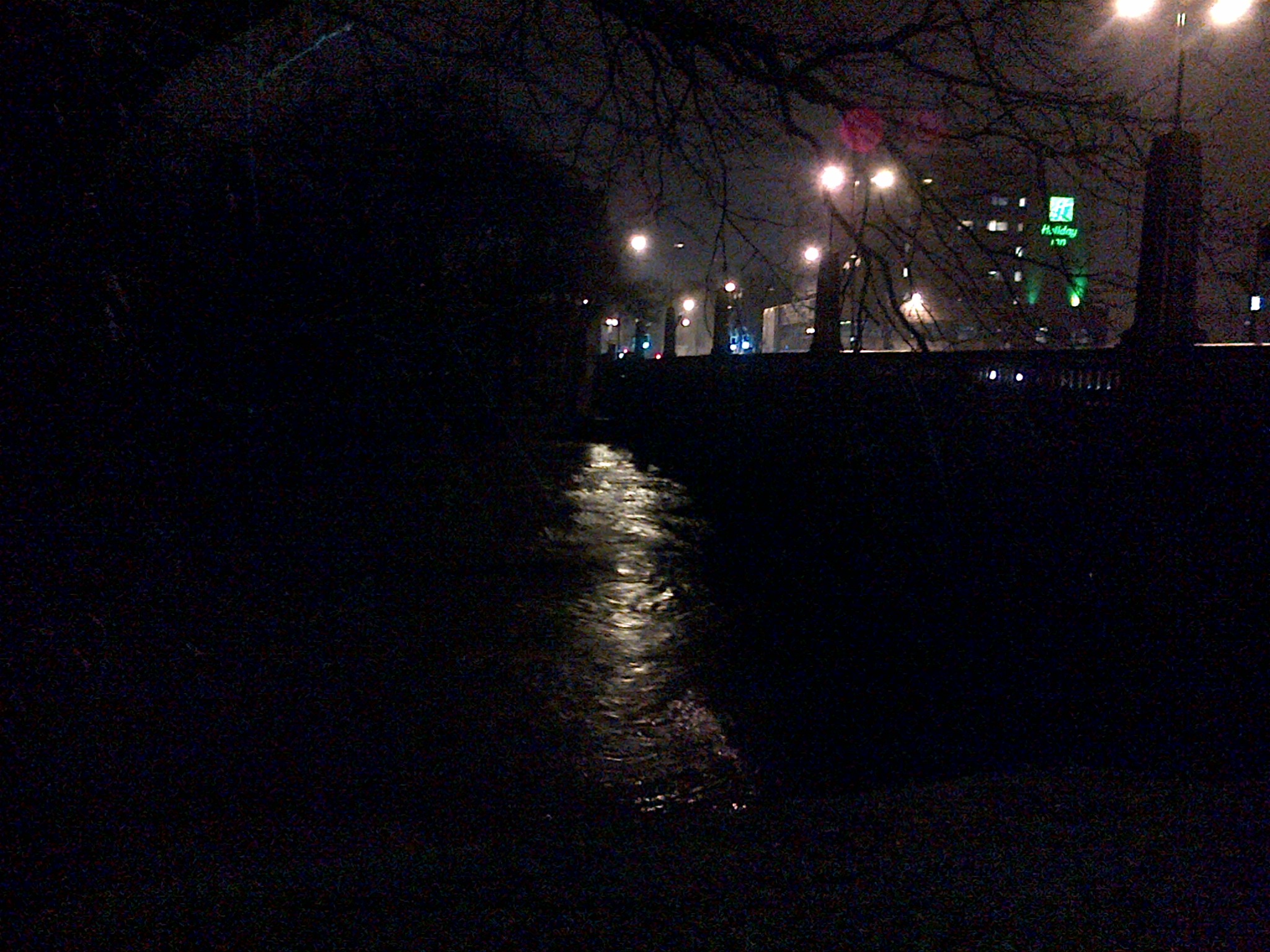
I took this with my Blackberry walking home on Monday night along the Taff embankment in the torrential rain; it was taken just by Cardiff Bridge where the Taff flows under Castle Street/Cowbridge Road. As you can see, the river was pretty swollen as the result of recent heavy downpours. Yet another flood alert was issued yesterday afternoon, but I have seen the Taff higher than this. It’s still an impressive beast when it’s got its dander up, growling along as it speeds down towards Cardiff Bay.

IMG-20130129-00048

Goodbye-ee!

Posted in Biographical, Music, Television with tags , , on January 30, 2013 by telescoper

The Old Familiar Faces

Posted in Poetry with tags , , on January 29, 2013 by telescoper

I have had playmates, I have had companions,
In my days of childhood, in my joyful school-days,
All, all are gone, the old familiar faces.

I have been laughing, I have been carousing,
Drinking late, sitting late, with my bosom cronies,
All, all are gone, the old familiar faces.

I loved a love once, fairest among women;
Closed are her doors on me, I must not see her —
All, all are gone, the old familiar faces.

I have a friend, a kinder friend has no man;
Like an ingrate, I left my friend abruptly;
Left him, to muse on the old familiar faces.

Ghost-like, I paced round the haunts of my childhood.
Earth seemed a desart I was bound to traverse,
Seeking to find the old familiar faces.

Friend of my bosom, thou more than a brother,
Why wert not thou born in my father’s dwelling?
So might we talk of the old familiar faces —

How some they have died, and some they have left me,
And some are taken from me; all are departed;
All, all are gone, the old familiar faces.

by Charles Lamb (1775-1834).


Missing the Point on Open Access

Posted in Open Access with tags , , , , , , on January 28, 2013 by telescoper

Blogging this week will be a bit patchy as I try to finish off a few Cardiff jobs before the big move to Sussex at the end of the week. However, I have got time today for a quick comment on an article I saw in yesterday’s Observer.

The piece tries argue  that the government’s plans for Open Access, stemming from the Finch Report, amount to an “attack on academic freedoms”, a stance apparently held by a number of eminent historians (and others). The argument is that the Gold Open Access model preferred by RCUK will require the payment of Article Processing Charges (APCs) which could in some cases amount to thousands of pounds per article. Departmental budget holders (possibly administrators rather than academics) will then have to be involved in decisions about which papers can be funded and which can’t. This, it is argued, will mean that researchers will have much less freedom to publish when, where and what they like – the people holding the purse strings will have the final say.

A similar point was made by Mike Cruise in a strange article that appeared in the latest Astronomy and Geophysics (house organ of the Royal Astronomical Society):

Even in the UK it is not clear how the flow of funding for APCs will work. Will universities limit an academic’s publication rate or where he or she can publish? How and by whom will this funding be controlled? Academic freedom may, perversely, be curtailed as a result of open access.

So does Open Access pose a real threat to academic freedom? The answer is “yes”, but only if the Research Councils persist in forcing academics to pay the extortionate APCs demanded by academic publishers, out of all proportion to the real cost of publishing a paper on the internet, which is (at the very most) a few tens of pounds per article. Publishers want a much higher fee than this because they want to maintain their eye-watering profit margins, despite the fact that the “service” they provide has been rendered entirely obsolete by digital technologies. Any protests against open access should be directed to the real enemy, i.e. the profiteers.

The Finch Report was hi-jacked by the publishing lobby, with the result that RCUK has been persuaded to pour  millions of pounds of taxpayers’ money down a gold-plated drain. The model it recommends is absurd and clearly unsustainable. Low-cost repositories and community-based refereeing can deliver Green Open Access at a tiny fraction of the cost of the Gold Option, by cutting out the middle men.

All that’s needed to defend academic freedoms  is to set up on-line subject-based repositories in much the same way as physicists and astronomers have set up the arXiv. In other words, the historians just need an archive.  They should be comfortable with that idea. And as for refereeing, they can do that the way it will shortly be done in astronomy…

P.S.  Astronomy & Geophysics have invited me to write a response to Mike Cruise’s article; my piece should appear in the April 2013 issue. Hopefully it won’t be behind a paywall.

The Strangest Man

Posted in Literature, The Universe and Stuff with tags , , , , , on January 27, 2013 by telescoper

Since getting rid of my telly a few weeks ago I’ve reverted to a previous incarnation as a bookworm, and have been tackling the backlog of unread volumes sitting on my coffee table at home. Over the last couple of days I’ve spent the evenings reading The Strangest Man by Graham Farmelo, a biography of the great theoretical physicist Paul Dirac.

I’m actually quite ashamed that it has taken me so long to get around to reading this. I’ve had it for two years or more and really should have found time to do it before now. Dirac has long been one of my intellectual heroes, for his unique combination of imagination and mathematical rigour; the Dirac equation is one of the topics I most enjoy lecturing about to physics students. I am also immensely flattered to be one of his academic descendants: Paul Dirac was the PhD supervisor of Dennis Sciama, who supervised my supervisor John Barrow, making me (in a sense) his great-grandson. Not that I’ll ever achieve anything of the magnitude he did.

The book is pretty long, and I suppose one of the factors putting me off reading it was that I thought it might be heavy going. That turned out to be far from the case. It’s wonderfully well written, never getting bogged down in details, and cleverly interweaving Dirac’s life and scientific career together against a vivid historical backdrop dominated by the rise of Nazism in Germany and the tragedy of World War 2. It also beautifully conveys the breathless sense of excitement as the new theory of quantum mechanics gradually fell into place. Altogether it’s a gripping story that had me hooked from the start, and I devoured the 400+ pages in just a couple of evenings (which is quick by my standards). I’ve never read a scientific biography so pacey and engaging before, so it’s definitely hats off to Graham Farmelo!

Among the book’s highlights for me were the little thumbnail sketches of famous physicists I knew beforehand mostly only as names. Niels Bohr comes across as a splendidly warm and avuncular fellow, Werner Heisenberg as a very slippery customer of questionable political allegiance (likewise Erwin Schrödinger), Ernest Rutherford as blunt and irascible. I was already aware of the reputation of Wolfgang Pauli had for being an absolute git; this book does nothing to dispel that opinion. We tend to forget that the names we came to know through their association with physics also belonged to real people, with all that entails.

I was also interested to learn that Dirac and his wife Manci spent their honeymoon in 1937, as the clouds of war gathered on the horizon, in Brighton, which Farmelo describes as

..a peculiarly raffish town., famous for its two Victorian piers jutting imperiously out to sea, for the pale green domes of its faux-oriential pavilions, its future-robot and a host of other tacky attractions.

So in most respects it hasn’t changed much, although one of the two piers  has since gone for a Burton.

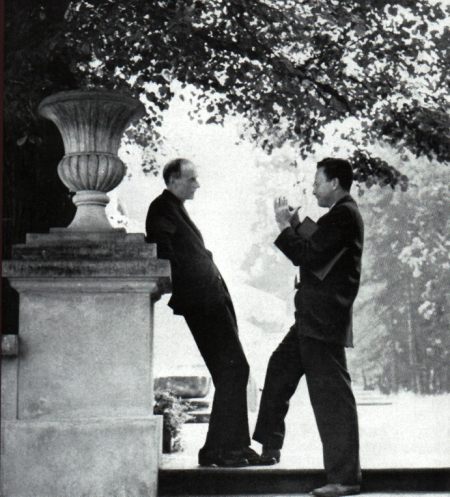
So what of Dirac himself? Most of what you’re likely to hear about him concerns his apparently cold and notoriously uncommunicative nature. I never met Dirac. He died in 1984. I was an undergraduate at Cambridge at the time, but he had moved to Florida many years before that. I have, however, over the years had occasion to talk to quite a few people who knew Dirac personally, including Dennis Sciama. All of them told me that he wasn’t really anything like the caricature that is usually drawn of him. While it’s true that he had no time for small talk and was deeply uncomfortable in many social settings, especially formal college occasions and the like, he very much enjoyed the company of people more extrovert than himself and was more than willing to talk if he felt he had anything to contribute. He got on rather well with Richard Feynman, for example, although they couldn’t have had more different personalities. This gives me the excuse to include this wonderful picture of Dirac and Feynman together, taken in 1962 – the body language tells you everything there is to know about these two remarkable characters:
feyndir2

Feynman is also an intellectual hero of mine, because he was outrageously gifted not only at doing science but also at communicating it. On the other hand, I suspect (although I’ll obviously never know) that I might not have liked him very much at a personal level. He strikes me as the sort of chap who’s a lot of fun in small doses, but by all accounts he could be prickly and wearingly egotistical.

On the other hand, the more I read The Strangest Man the more I came to think that I would have liked Dirac. He may have been taciturn, but at least that meant he was free from guile and artifice. It’s not true that he lacked empathy for other people, either. Perhaps he didn’t show it outwardly very much, but he held a great many people in very deep affection. It’s also clear from the quotations peppered throughout the book that people who worked closely with him didn’t just admire him for his scientific work; they also loved him as a person. A strange person, perhaps, but also a rather wonderful one.

In the last Chapter, Farmelo touches on the question of whether Dirac may have displayed the symptoms of autism. I don’t know enough about autism to comment usefully on this possibility. I don’t even know whether the term autistic is defined with sufficient precision to be useful. There is such a wide and multidimensional spectrum of human personality that it’s inevitable that there will be some individuals who appear to be extreme in some aspect or other. Must everyone who is a bit different from the norm be labelled as having some form of disorder?

The book opens with the following quote from John Stuart Mill’s On Liberty, which says it all.

Eccentricity has always abounded when and where strength of character has abounded; and the amount of eccentricity in a society has generally been proportional to the amount of genius, mental vigor, and courage which it contained. That so few now dare to be eccentric, marks the chief danger of the time.

Another thought occurred to me after I’d finished reading the book. Dirac’s heyday as a theoretical physicist was the period 1928-1932 or thereabouts. Comparatively speaking, his productivity declined significantly in later years; he produced fewer original results and became increasingly isolated from the mainstream. Eddington’s career followed a similar pattern: he did brilliant work when young, but subsequently retreated into the cul-de-sac of his Fundamental Theory. Fred Hoyle is another example – touched by greatness early in his career, but cantankerous and blinded by his own dogma later on. Even Albert Einstein, genius-of-geniuses, spent his later scientific life chasing shadows.

I think there’s a tragic inevitability about the mid-life decline of these geniuses of theoretical physics, because the very same determination and intellectual courage that allowed them to break new ground also rendered them unwilling to be deflected by subsequent innovations elsewhere. And break new ground Dirac certainly did. The word genius is perhaps over-used, but it certainly applies to Paul Dirac. We need more like him.