I couldn’t resist a quick comment about the news that today the House of Commons began a debate on the second reading of the Marriage (Same Sex Couples) Bill. The timing of this when I’ve just moved back to Brighton after an absence of 23 years or so made me think back to what things were like when I was previously here as a DPhil student.
In those days the dominant concern facing LBGT staff and students was the notorious Section 28, part of the Local Government Act of 1988, which, among other things, attacked promotion of “the acceptability of homosexuality as a pretended family relationship”. I remember very well the numerous demonstrations and other protests I went on as part of the campaign against that repugnant and obviously discriminatory piece of legislation, but it passed into law anyway. I know 25 years is a long time, 1988 was before today’s generation of undergraduates was even born, but it’s still amazing to me that attitudes have changed so much that there’s even a remote possibility that same sex marriage might be legalized. And from what I hear, the possibility isn’t remote at all…
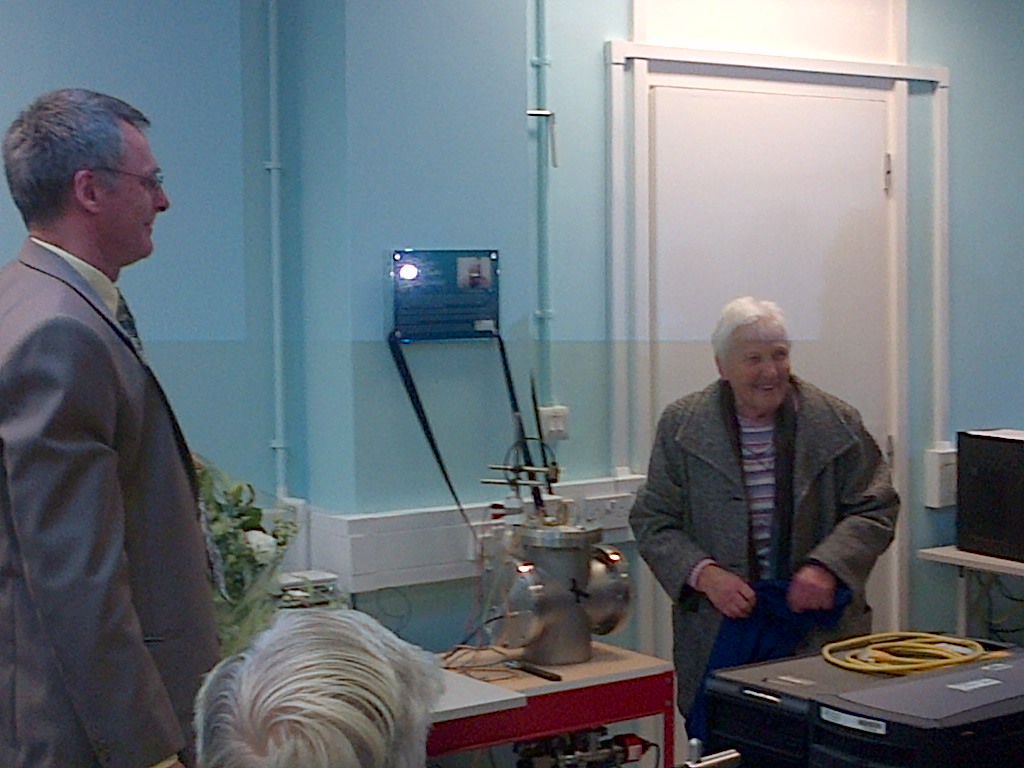
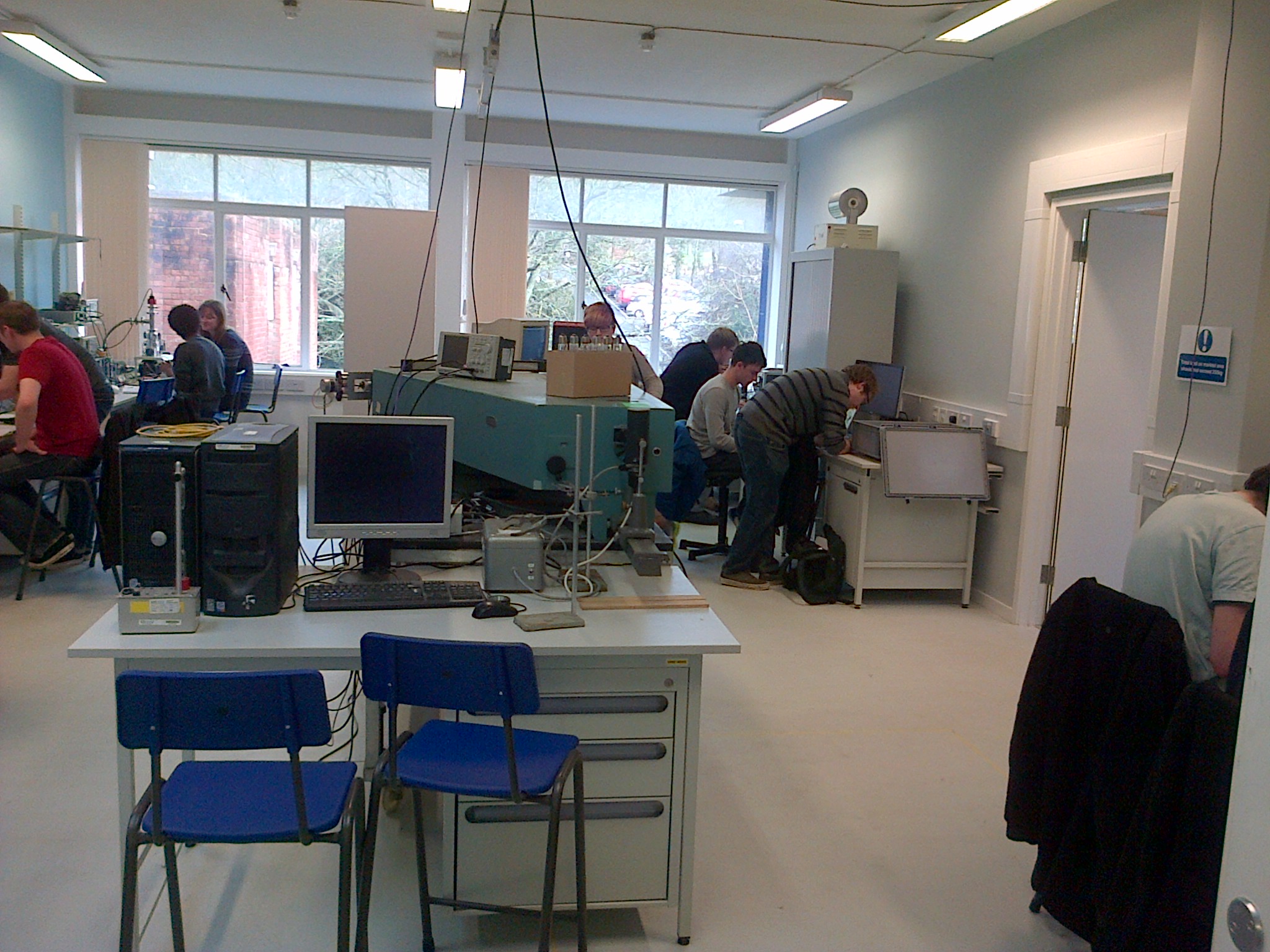
Last Friday, my first day in post here at the University of Sussex, there was a small ceremony to mark the formal opening of a new undergraduate teaching laboratory. Appropriately, it was named after Professor Ken Smith who died last year. Professor Smith was an outstanding experimental physicist who joined the University of Sussex way back in 1960 before the campus had even been built. Over the next three decades, as well as developing a new research activity in which the Department is now world-leading, he made substantial contributions to laboratory teaching in particular. He also played his part in the administration of the Department, serving as the first Chairman of Physics, and then as Dean of the School of Mathematical and Physics Sciences (MAPS) and later as Laboratory Director. Prof. Smith retired in 1988, which was the year I finished my DPhil from the (then) School of Mathematics and Physical Sciences.
Anyway, it was a pleasant occasion at which Prof. Philip Harris (to the left of the picture), Head of the Department of Physics & Astronomy, spoke of Professor Ken Smith’s many achievements, Ken’s widow Verena unveiled the commemorative plaque, and we all gathered for tea and cakes in the foyer so as not to disturb further the students still hard at work at their experiments…
Very busy today, so just time for a quick post (and associated poll) about Open Science.
As you all know I’ve been using this blog for a while to bang on about Open Access to scientific publications. I’m not going to repeat my position in detail here except to say that I’m in favour of Open Access but not at the immense cost envisaged by the Finch Report.
I thought however that it might be useful to float some opinions about wider issues related to open science. In particular, the question that often troubles me is that is open access to scientific results actually enough, or do we have to go a lot further?
I think an important aspect of the way science works is that when a given individual or group publishes a result, it should be possible for others to reproduce it (or not as the case may be). Traditional journal publications don’t always allow this. In my own field of astrophysics/cosmology, for example, results in scientific papers are often based on very complicated analyses of large data sets. This is increasingly the case in other fields too. A basic problem obviously arises when data are not made public. Fortunately in astrophysics these days researchers are pretty good at sharing their data, although this hasn’t always been the case.
However, even allowing open access to data doesn’t always solve the reproducibility problem. Often extensive numerical codes are needed to process the measurements and extract meaningful output. Without access to these pipeline codes it is impossible for a third party to check the path from input to output without writing their own version assuming that there is sufficient information to do that in the first place. That researchers should publish their software as well as their results is quite a controversial suggestion, but I think it’s the best practice for science. There isn’t a uniform policy in astrophysics and cosmology, but I sense that quite a few people out there agree with me. Cosmological numerical simulations, for example, can be performed by anyone with a sufficiently big computer using GADGET the source codes of which are freely available. Likewise, for CMB analysis, there is the excellent CAMB code, which can be downloaded at will; this is in a long tradition of openly available numerical codes, including CMBFAST and HealPix.
I suspect some researchers might be reluctant to share the codes they have written because they feel they won’t get sufficient credit for work done using them. I don’t think this is true, as researchers are generally very appreciative of such openness and publications describing the corresponding codes are generously cited. In any case I don’t think it’s appropriate to withhold such programs from the wider community, which prevents them being either scrutinized or extended as well as being used to further scientific research. In other words excessively proprietorial attitudes to data analysis software are detrimental to the spirit of open science.
Anyway, my views aren’t guaranteed to be representative of the community, so I’d like to ask for a quick show of hands via a poll…
…and you are of course welcome to comment via the usual box.
So here I am, then, in the office on a Sunday afternoon,which I suspect is going to be a pretty regular occurrence for the foreseeable future. I mainly came in to sort out papers for tomorrow’s Senior Management Group meeting, which will be the first such meeting I’ll be attending in my new capacity. I have managed to prepare for it in fine style by losing my diary, which isn’t a very good start to my career as any kind of manager.
Yesterday was taken up with flat-hunting which, if all turns out well this time, was successful. I also had time to watch a bit of the opening match of the Six Nations Rugby between Wales and Ireland. For the last five years or so I’ve always been in Cardiff for Wales’ first home game of the competition, although I’ve never actually managed to get a ticket for the match. It felt a bit strange not being there anyway. It has to be said that Wales were pretty chronic in the first half, going into the break at 30-3 down, but they recovered in the second half and it was quite an absorbing match all considered. Ireland’s excellent defence held off a spirited Welsh comeback and Ireland won 30-22.
Although I’ve lived in Wales for a while, and have enjoyed the match-day atmosphere in Cardiff, I’ve never switched allegiance from England as far as rugby is concerned. Later on yesterday England beat Scotland in their opening match of the Six Nations, showing quite a bit of flair in doing so but also making quite a lot of mistakes. The 38-18 scoreline flattered England, I felt, and they’ll have to up their game a lot if they’re going to match Wales’ Grand Slam last season.
Football is another matter in which allegiances are difficult to change. Many’s the time I’ve thought of giving up being a Newcastle United supporter but I’ve never managed it. I disapprove of people who think they have an option concerning which team to support, actually. I was born in Newcastle therefore I support Newcastle United. That’s the end of it. We all have our cross to bear. Anyway, yesterday brought an unexpected ray of sunshine into a gloomy season for the Toon with a 3-2 victory over Chelsea. Following a first away win of the season against Aston Villa last week it may even be possible that they’ll avoid relegation. Perhaps.
Switching allegiances between universities is almost as difficult. In today’s academic world we’re supposed to think of higher education as a marketplace in which different institutions compete for funding for both teaching and research. I’ve never felt comfortable with the idea that opening up higher education to “market forces” is in anyone’s interests. Certainly on the research side, there are so many collaborations between groups in different universities that cooperation is more the rule than competition although, as with any rule, there are exceptions. Friendly rivalry is as good a thing in higher education as it is in football, but anything more serious than that can only be justified in the case of Sunderland.
Before the Roman came to Rye or out to Severn strode, The rolling English drunkard made the rolling English road. A reeling road, a rolling road, that rambles round the shire, And after him the parson ran, the sexton and the squire; A merry road, a mazy road, and such as we did tread The night we went to Birmingham by way of Beachy Head.
I knew no harm of Bonaparte and plenty of the Squire, And for to fight the Frenchman I did not much desire; But I did bash their baggonets because they came arrayed To straighten out the crooked road an English drunkard made, Where you and I went down the lane with ale-mugs in our hands, The night we went to Glastonbury by way of Goodwin Sands.
His sins they were forgiven him; or why do flowers run Behind him; and the hedges all strengthening in the sun? The wild thing went from left to right and knew not which was which, But the wild rose was above him when they found him in the ditch. God pardon us, nor harden us; we did not see so clear The night we went to Bannockburn by way of Brighton Pier.
My friends, we will not go again or ape an ancient rage, Or stretch the folly of our youth to be the shame of age, But walk with clearer eyes and ears this path that wandereth, And see undrugged in evening light the decent inn of death; For there is good news yet to hear and fine things to be seen, Before we go to Paradise by way of Kensal Green.
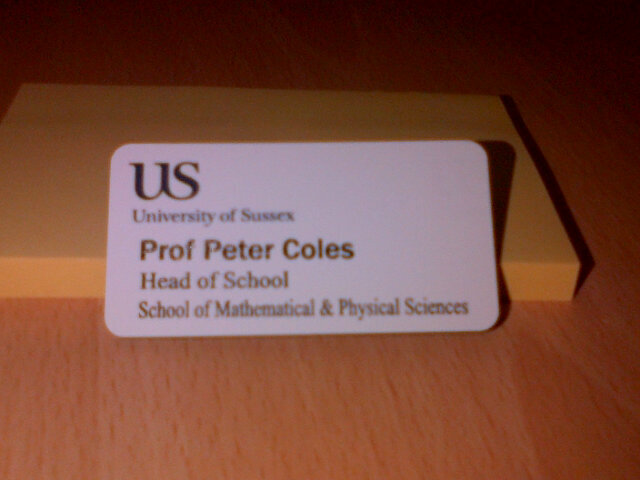
Well, nearing the end of my first day in my new job at the University of Sussex, I can safely say that I’m more than a bit knackered. I’ve had a day filled with meetings as well as devoid of lunch. On the other hand I did manage to get the keys to my new office and, after some fiddling about, am now connected to the interwebs. They’ve even given me a nice new badge in case I forget who I am.
I didn’t get to leave Cardiff yesterday until later than I’d imagined I would and then managed to miss the train and had to wait an hour in Cardiff station. In the end I didn’t make it to my temporary lodgings until well after 11. I crashed out and slept like a log, and only just managed to drag myself out of bed to get to the campus in time for the first meeting.
My new office is very nice, although it looks a bit empty at the moment because all my boxes are still in Cardiff awaiting the attentions of hunky removal men. Here’s a picture taken yesterday by Dan Read in my old office…
..having finished packing I was about to add the final touch and clean my whiteboard, but I was persuaded that it’s such a work of art that, far from cleaning it off, I should actually sign it. So I did. No doubt it will be cleaned off soon, if it hasn’t been already.
Anyway, a weekend in Brighton now beckons which I’m going to start by doing down the pub for a pint, which may be the first of many…
Posted in Biographical on January 31, 2013 by telescoper
Well, it’s my last day of official employment at Cardiff University and I’ve just finished my last big job, checking and collating the marks for the module I taught last semester. That done, I thought I’d have a quick sandwich before packing up a few final bits and pieces, vacating the old office, and handing in my keys.
There was a gathering in the department yesterday afternoon to celebrate my departure, followed by drinks and a nice dinner (at the splendid Purple Poppadom, although the Poppadoms weren’t actually Purple).
The Head of the School of Physics and Astronomy at Cardiff University, Prof. Walter Gear, made a little speech at my departmental send-off before handing me a nice card as well as a gift voucher for the Royal Opera House at Covent Garden. I’m a bit overwhelmed by the generosity shown by the good folks of PHYSX – the gift voucher will mean I can afford a few trips from Brighton to the Opera in London, even at Covent Garden’s outrageous prices.
I’ll miss the department here, especially the people that work and/or study here who have put up with me for the past five and a half years or so. Other things I’ll miss about Cardiff include Welsh National Opera, of course, for its excellence and (relative inexpensiveness).
But I’m not going completely just yet. I still have two PhD students and three 4th year project students to look after, so I’ll be coming back from time to time to meet with them. I’ll also be keeping the house in Pontcanna until the summer, so I’ll have a pied-a-terre here when I come back, either for work or for the Opera.
Anyway, I just wanted to say a public “thank you” to Walter for his kind words yesterday, for the support he has given me over the years, and especially last summer, and the generosity he showed in agreeing so quickly to transfer my STFC grant to Sussex. Would that everyone I’ve worked with had acted so unselfishly…
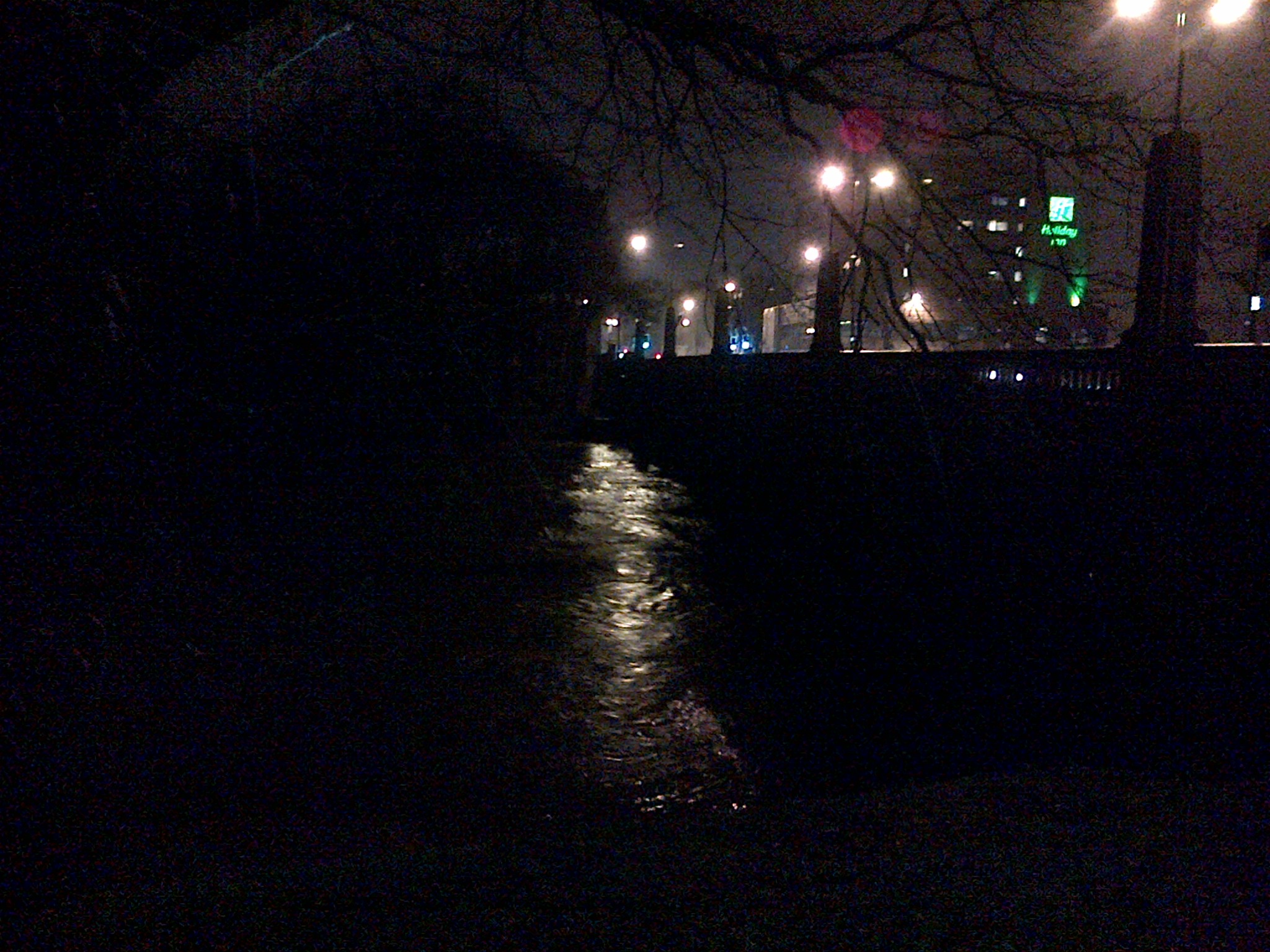
I took this with my Blackberry walking home on Monday night along the Taff embankment in the torrential rain; it was taken just by Cardiff Bridge where the Taff flows under Castle Street/Cowbridge Road. As you can see, the river was pretty swollen as the result of recent heavy downpours. Yet another flood alert was issued yesterday afternoon, but I have seen the Taff higher than this. It’s still an impressive beast when it’s got its dander up, growling along as it speeds down towards Cardiff Bay.
The views presented here are personal and not necessarily those of my employer (or anyone else for that matter).
Feel free to comment on any of the posts on this blog but comments may be moderated; anonymous comments and any considered by me to be vexatious and/or abusive and/or defamatory will not be accepted. I do not necessarily endorse, support, sanction, encourage, verify or agree with the opinions or statements of any information or other content in the comments on this site and do not in any way guarantee their accuracy or reliability.