Taking a post-prandial perambulation around Pontcanna Fields this afternoon, in a mixture of sunshine and fog. Here’s a view of one of the playing fields being prepared for a game of football. You can see the SWALEC Stadium in the background, with the Millennium Stadium just visible in the mist beyond. Today Cardiff City are playing Bristol City, and I could here the chanting from Ninian Park (a mile or so away) carried on the cold breeze as I took the picture.
Follow @telescoperA little piece about Little Sun..
Posted in Uncategorized with tags Little Sun on February 15, 2013 by telescoperJust time for a nano post today to alert you to the fact that my little contribution to the Charter of Light and Energy has now been published online at:
http://littlesun.com/index.php?sec=charter&p=Peter%20Coles
Please have a look, and why not read the other pieces while you’re there?
Follow @telescoperTwo cultures, or none?
Posted in Art, Biographical, Education with tags C.P. Snow, Two Cultures, Universities on February 14, 2013 by telescoperJust a quick rehash of an old post by way of a follow-up to Sunday’s blog about Emotion and Creativity which touched on the negative stereotypes sometimes used to characterize scientists.
Anti-science attitudes are far from unusual among the Arts & Humanities fraternity, even in the supposedly enlightened environment of a University, which I think is a real shame. After all, you’ll have to work very hard to find a scientist who would be prepared to stand up in front of audience and proudly announce “I hate art”. Many of my scientific colleagues have deep passions for the performing arts (especially music and drama) as well as being very well read across a wide range of subjects. Many also hold strong (and often idiosyncratic) political opinions and are involved in a huge range of activities outside science.
In short, scientists don’t just sit in their labs and offices making dangerous chemicals or torturing small animals. We live in the real world and have as much contact with wider society as anyone else. Imagination, creativity and free thinking can be found in scientists, just as they can in the arts. Scientists both contribute to and participate in our society’s cultural heritage. Scientists are human beings. Culture belongs to us too.
Some time ago there was an article in the Times Higher with the title “Life depends on science but the arts make it worth living“. I agree with a lot of what is written in the piece, in fact, although it does seem also to contain numerous examples of non sequitur and I think it’s both poorly argued and highly exaggerated. The arts are undoubtedly among the things that make life worth living, but there are others, such as “ordinary” human relationships and the “simple” enjoyment of the natural world, which academics of all persuasions all too frequently neglect.
One of the most prominent examples of non sequitur in the Times Higher article is that we have music, literature, poetry and the rest but how much of this is actually done in universities? The article compares Einstein with Beethoven. Albert went to University in Zurich. Beethoven didn’t go to a university. There’s a big difference between making art and writing about it. One of the big cultural differences between art and science is that we don’t have science critics, although we do have people who popularize it and also people who try to explain it to the general public. Much of the impenetrable cultural analysis that emerges from academia concerning the arts seems to have the opposite aim. Does any university have a Professor of the Public Understanding of Art?
You probably think I’m going to go off on a rant about the famous Two Cultures thesis advanced by C.P. Snow, but I’m not. I think Snow’s analysis is only marginally relevant. I do think that there are “two cultures”, but these are not “science” and “the arts”. One is a creative, thinking culture that encompasses arts, the humanities and science. The other is its antithesis, a “culture” that sees the sole function of education as being to train people to take their place on the never-ending treadmill of production and consumption.
The way we are heading, it’s not “two cultures” that we should be worried about. It’s no culture at all.
Follow @telescoperMy Funny (and very sad) Valentine
Posted in Jazz with tags Chet Baker, My Funny Valentine, St Valentine's Day on February 14, 2013 by telescoperI suppose I should make some concession to Valentine’s Day, so here’s the classic 1954 Chet Baker version of the Rodgers & Hart tune My Funny Valentine. This was a big hit during the period when jazz switched from the frenetic pace and jagged angularity of bebop to the smooth cocktail bar sounds of the Cool School; its popularity owed as much to Baker’s youthful good looks and attractive singing voice as to the trumpet solo on this recording.
But that was 1954. A lifelong addiction to heroin exacted a terrible toll on Chet Baker. Here’s a harrowing and heart-rending reprise of My Funny Valentine recorded, just a year before his death, at a concert in Tokyo in 1987.
Sic transit gloria mundi.
Presentation by the CEO of STFC at the IOP
Posted in Science Politics with tags Comprehensive Spending Review, John Womersley, Research Councils, STFC on February 13, 2013 by telescoperYesterday the Supreme Leader Chief Executive of the Science and Technology Facilities Council (STFC), Professor John Womersley, gave a presentation to the assembled masses of the Institute of Physics in London, followed by a discussion at the RAS Astronomy Forum. Topics he covered, including the Triennial Review of the Research Councils, which is seeking evidence via an open consultation exercise. Contributions are invited by the end of February.
I was planning to attend both sessions, but had pressing matters to attend to here in Sussex so wasn’t able to make it in the end. However, owing to a miracle of technology I’ve been furnished with the slides used in the presentation and, with his permission, am sharing them here as a service to the community because,as you will see, there is a lot at stake for all of us…
Mardi Gras Special Menu
Posted in Uncategorized on February 12, 2013 by telescoperSince folk around the world are celebrating Mardi Gras (“Fat Tuesday”) today, I thought I’d pass on the following topically inspired menu:
Mardi Gras Special
—•—
Starters
—•—
Mixed Horse D’Oeuvres
Colt Consommé
Boiled Trotter
—•—
Main Courses
—•—
Roast Beef with Mustang
Pot au Foal
Filly Mignon
Frutti di Mare
Mules Marinière
—•—
Desserts
—•—
Strawberries with Mascarpony
Red Rum Baba (no added Shergar)
Roast Chestnuts
—•—
Extras
—•—
Thorough Bread
—•—
I hope the above menu proves satisfactory but if not please send your suggestions for additions through the comments box…
Fifty Years On
Posted in Poetry with tags Poetry, Sylvia Plath, Years on February 12, 2013 by telescoperI missed a sad anniversary yesterday. Fifty years ago, on 11th February 1963, the poet Sylvia Plath took her own life by putting her head in a gas oven. I’ve posted this poem before, but make no apology for posting it again as an act of remembrance..
They enter as animals from the outer
Space of holly where spikes
Are not thoughts I turn on, like a Yogi,
But greenness, darkness so pure
They freeze and are.
O God, I am not like you
In your vacuous black,
Stars stuck all over, bright stupid confetti.
Eternity bores me,
I never wanted it.
What I love is
The piston in motion —-
My soul dies before it.
And the hooves of the horses,
Their merciless churn.
And you, great Stasis —-
What is so great in that!
Is it a tiger this year, this roar at the door?
It is a Christus,
The awful
God-bit in him
Dying to fly and be done with it?
The blood berries are themselves, they are very still.
The hooves will not have it,
In blue distance the pistons hiss.
by Sylvia Plath (1932-63). Rest in peace.
Spiegel im Spiegel
Posted in Biographical, Music with tags Arvo Pärt, Piano, Spiegel im Spiegel, Violin on February 11, 2013 by telescoperI’ve been so busy this last week that I really needed to unwind a bit on Sunday morning, for which purpose I picked this beautifully spare and sublimely contemplative piece by the great Estonian composer Arvo Pärt. This music always makes me think of the first line of the Desiderata…
Go placidly amidst the noise and haste, and remember what peace there may be in silence
..except of course that it’s not silent.
Emotion and the Scientific Method
Posted in Biographical, Music, The Universe and Stuff with tags Emotions, Observer, research, Science, scientific method on February 10, 2013 by telescoperThere was an article in today’s Observer in which four scientists from different disciplines talk about how in various ways they all get a bit emotional about their science. The aim appears to correct “the mistaken view that scientists are unemotional people”. It’s quite an interesting piece to read, but I do think the “mistaken view” is very much a straw man. I think most people realize that scientists are humans rather than Vulcans and that as such they have just as many and as complex emotions as other people do. In fact it seems to me that the “mistaken view” may only be as prevalent as it is because so many people keep trying to refute it.
I think anyone who has worked in scientific research will recognize elements of the stories discussed in the Observer piece. On the positive side, cracking a challenging research problem can lead to a wonderful sense of euphoria. Even much smaller technical successes lead to a kind of inner contentment which is most agreeable. On the other hand, failure can lead to frustration and even anger. I’ve certainly shouted in rage at inanimate objects, but have never actually put my first through a monitor but I’ve been close to it when my code wouldn’t do what it’s supposed to. There are times in that sort of state when working relationships get a bit strained too. I don’t think I’ve ever really exploded in front of a close collaborator of mine, but have to admit that one one memorable occasion I completely lost it during a seminar….
So, yes. Scientists are people. They can be emotional. I’ve even known some who are quite frequently also tired. But there’s nothing wrong with that not only in private life but also in their work. In fact, I think it’s vital.
It seems to me that the most important element of scientific research is the part that we understand worst, namely the imaginative part. This encompasses all sorts of amazing things, from the creation of entirely new theories, to the clever design of an experiment, to some neat way of dealing with an unforeseen systematic error. Instances of pure creativity like this are essential to scientific progress, but we understand very little about how the human brain accomplishes them. Accordingly we also find it very difficult to teach creativity to science students.
Most science education focuses on the other, complementary, aspect of research, which is the purely rational part: working out the detailed ramifications of given theoretical ideas, performing measurements, testing and refining the theories, and so on. We call this “scientific method” (although that phrase is open to many interpretations). We concentrate on that aspect because we at have some sort of conception at least of what the scientific method is and how it works in practice. It involves the brain’s rational functions, and promotes the view of a scientist as intellectually detached, analytic, and (perhaps) emotionally cold.
But what we usually call the scientific method would be useless without the creative part. I’m by no means an expert on cognitive science, but I’d be willing to bet that there’s a strong connection between the “emotional” part of the brain’s activities and the existence of this creative spark. We’re used to that idea in the context of art, and I’m sure it’s also there in science.
That brings me to something else I’ve pondered over for a while. Regular readers of this blog will know that I post about music from time to time. I know my musical tastes aren’t everyone’s cup of tea, but bear with me for a moment. Some of the music (e.g. modern Jazz) I like isn’t exactly easy listening – its technical complexity places a considerable burden on the listener to, well, listen. I’ve had comments on my musical offerings to the effect that it’s music of the head rather than of the heart. Well, I think music isn’t an either/or in this respect. I think the best music offers both intellectual and emotional experiences. Not always in equal degree, of course, but the head and the heart aren’t mutually exclusive. If we didn’t have both we’d have neither art nor science.
In fact we wouldn’t be human.
Brighton at home, and at home in Brighton
Posted in Biographical, Education, Football with tags Brighton and Hove Albion, School of Mathematical and Physical Science, UCAS, University of Sussex on February 9, 2013 by telescoperSo here I am again, in the office on a Saturday. This morning was the first UCAS Admissions Days during my tenure as Head of School so I came up to campus in order to make a short speech to welcome the prospective students and their parents to the University. Although I’ve only been in post for a week and hadn’t had time to prepare a proper presentation I think it went reasonably well. It’s bound to sound like a cliché when someone like me stands up and says it’s a very exciting time to be coming to the University of Sussex, but it just happens to be true in this case. We’re currently in the middle of quite a large expansion in the faculty across the School of Mathematical and Physical Sciences, or MPS for short, which means that there’s a lot of new blood coming with lots of new ideas in both teaching and research. The buzz around the place is unmistakable.
As far as MPS is concerned, today’s event was exclusively for students applying to do Mathematics so I had to pretend to know about draw on my past experience of working in a Mathematics department in speaking to students and their parents. Of course the various activities inside the School were more detailed, so I tagged along a bit in order to find out what goes on in such events. Among the things that have changed since I was a postgraduate student here 25 years ago, is that there’s a thing called the Creativity Zone, which is a flexible interactive working space for the students to use in a variety of ways. I’m not saying we didn’t have any creativity when I was a student but teaching was rather one-dimensional in those days. I think the wider the range of teaching methods we can deploy the better, because different students respond differently to any given style; what’s best for one may not be best for everyone.
Anyway, in case anyone is interested I managed to find myself a flat in Brighton and took possession of the keys on Thursday morning. I then had to dash around buying bits and bob – bedlinen etc – before coming into work for some meetings in the afternoon. OnThursday evening I made a quick trip back to the old homestead in Cardiff to check everything was OK and pick up some stuff for the flat (and my P45 which hadn’t arrived by the time I left last week). Passing through London on the way to Brighton last night I managed to make it to the Athenaeum for dinner with the RAS Club before returning late and very tired to my new Brighton residence.
If I hadn’t had to do the honours on campus this morning I would happily have slept until noon. It’s been such a busy week, that I’m definitely a bit knackered. But then I knew it was going to be hectic and it’s all gone fairly well so far really. Now I’m going to head back home, put my feet up and do today’s crosswords.
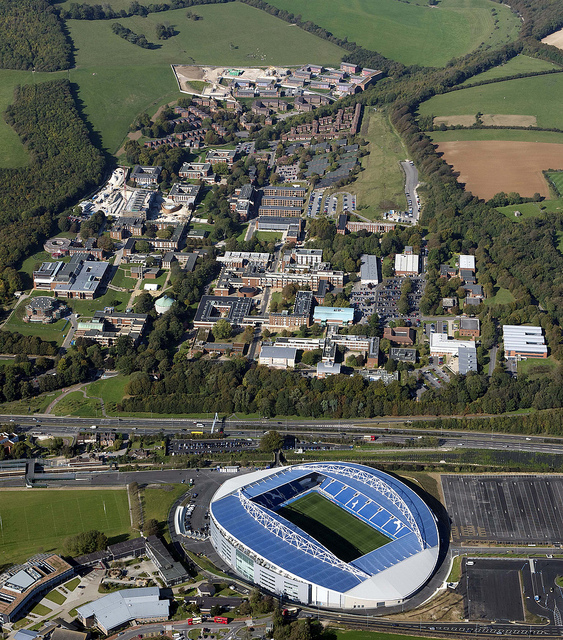
The one complication is that Brighton and Hove Albion are playing at home today (against Hull) and their stadium,as you can see from the map, is right next to the campus, just on the other side of the A27…
However, the match is not until this evening (17.20) so I should be able to get home without too many problems.