Dr Dee

Posted in History, Music, Opera, The Universe and Stuff with tags , , , , , on July 10, 2012 by telescoper

Last Friday evening, after my afternoon shift at the Royal Society Summer Exhibition, I took the chance to go and see something a bit different, in the shape of English National Opera’s production of  Dr Dee at the Coliseum. I hadn’t really known what to expect of this beforehand, actually, but needed to find a bit of distraction in London and was fortunately able to persuade my lovely friends Joao and Kim to come with me to try it out.

Dr Dee is based on the life of John Dee, the famous Elizabethan mathematician, astrologer, courtier, and spymaster. Written by Mr Damon Albarn, former lead singer of the popular beat combo Blur, it’s not exactly an opera but more of a renaissance-style pageant depicting the life of this mysterious character in a series of dramatic tableaux. Not being at all naturalistic in style it would have been quite difficult to follow what was going on without the programme notes, but each episode was brilliantly realised with dramatic staging, dancing and stunning visual effects. Rufus Norris was responsible for the overall direction of the piece. Hat’s off to him. I wasn’t really expecting the music to be so interesting, either; mixing pop vocals with orchestral music from the period could have been awful, but actually I warmed to it very quickly.

An influential polymath, Dee was, for a time, a trusted confidante of Elizabeth I and he was recruited by Sir Francis Walsingham to set up a network of informants and decipher Catholic codes in the build-up to the attempted invasion of England by the Spanish Armada. Dee is also purported to be the inspiration behind Prospero in Shakespeare’s The Tempest. What’s particularly interesting about him from an historical perspective is that lies at the crossroads between magic and science. A gifted mathematician, Dee developed an obsession for the occult after meeting a very dodgy character called Edward Kelly, who persuaded Dee that he could talk to angels in their own language with the help of a crystal ball, a technique known as scrying. Dee eventually went mad and was alienated not only from Elizabethan society but also from his own family. Had he lived at a slightly different time, he could well have ended up burned as a heretic. His story reminds us that the distinction between rationality and irrationality has not always been so clear. Alchemy and the occult could co-exist in many great minds alongside mathematics and empirical study so it should not surprise us that science and pseudoscience both seem able to thrive in modern culture.

The run of Dr Dee at ENO has now ended, but I’m definitely glad I plucked up the courage to go and see it. It’s a truly imaginative work and produced a memorable theatrical experience.

Trouble in Mind

Posted in Jazz with tags , on July 10, 2012 by telescoper

Science 2.0 and all that

Posted in Open Access, Science Politics with tags , , , on July 9, 2012 by telescoper

I cam across this on Twitter today and thought I’d share it. Although I have written at various times about open access and the virtues of sharing scientific data, I hadn’t realised that such things came under the umbrella of “Science 2.0“, a term which is quite new to me. This post contains some very interesting ideas and information on the subject.

katarzynasz's avatarScience 2.0 study

We’re approaching the final stage of our study. So far, we have  opened up our bibliography on our Mendeley group here; our notes through this very blog; our model for open science; and our draft policy recommendations for EU. And we’ve benefited from your comments and insight.

Now, we need your help to improve the evidence about the importance of Science 2.0, if we want policy-makers to take it seriously.

Therefore, we share the final presentation that we have presented to the European Commission, DG RTD here.

Help us improving it, by gathering more data and evidence, showing that Science 2.0 is important and disruptive, and that it’s happening already. In particular, we ask to share evidence and data on the take-up of Science 2.0: how many scientist are adopting it? With what benefits?

We ask all people interested in Science 2.0 to share the evidence at hand, by adding

View original post 15 more words

Munch at Tate Modern

Posted in Art, Biographical with tags , , , , , on July 8, 2012 by telescoper

On Friday I had the morning off from my stint at the Royal Society Summer Exhibition I mentioned a few days ago, so I took the short walk from my hotel to Tate Modern to see an exhibition of art by Edvard Munch called Edvard Munch: The Modern Eye.  Before seeing the collection, which is housed on the second floor of Tate Modern, I took a picture of the view from the balcony looking across the Thames from Bankside towards St Paul’s.

Not inappropriate weather for this exhibition!

Everyone knows Munch by his famous work The Screamwhich isn’t part of this exhibition. I don’t regret this omission it allows the visitor to focus on his lesser-known works, some of which I think are even more powerful than The Scream which, incidentally, I have seen when it was part of an exhibition of Munch’s work in Berlin in 1995. In fact I bought a poster of that exhibition, the design of which includes a copy of The Scream; it is hanging in my study as I write this.

The gallery’s booklet describes Munch’s paintings as

..profoundly introspective, unflinchingly depicting his experience of ageing, emotional turmoil, sickness and bodily decay.

Indeed. Some of the works are so powerful as to be almost unbearable to look at. I’ll just mention a few that struck me in particular.

One room is filled with a number of almost identical paintings entitled Weeping Woman, in which a naked female figure stands bowed and sobbing within a dreary claustrophobic room. The repetition of this theme across many canvases seems almost compulsive, and they’re painted with crude almost frantic strokes.

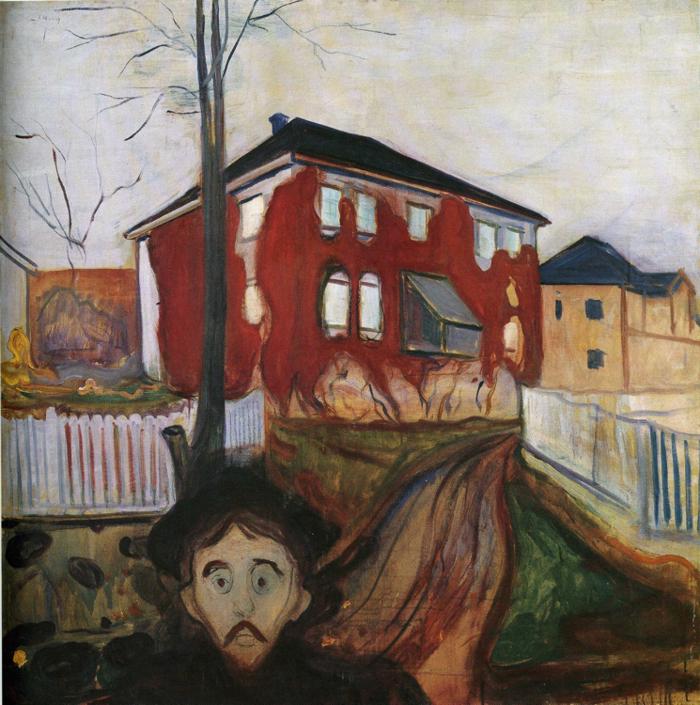
This is a painting called Red Virginia Creeper, a plant that grows on my house in fact, but which in this case has transformed into a dripping bloodstain behind the crudely drawn but obviously bewildered figure in the foreground.

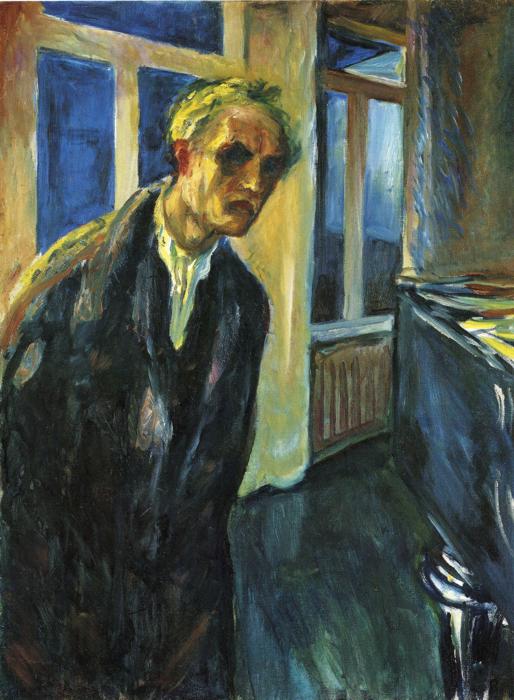
But the most powerful works by Munch were made later in his life. He was born in 1863 (100 years before me) and suffered a complete nervous breakdown in 1908. Here is a self-portrait called The Night Wanderer, showing himself as a gaunt insomniac figure wandering around a darkened house:

Then, right at the end of the exhibition, is his most moving work of all. Self Portrait between Clock and Bed, painted near the end of his life – he died in 1944 – shows a lonely old man standing between the clock, symbolising the remorseless passage of time, and the bed in which he no doubt expected to die.

This exhibition is not exactly a comfortable experience, filled as it is with images of alienation, despair and inner torment, but it was a “must-see” for me as Munch is such an important artist. Groups of schoolchildren were being led around the exhibition while I was there. Most of them giggled. I wonder how long it will be before they understand that the world really can be exactly as Munch painted it?

Anyway, I headed back across the river to the Royal Society to do the afternoon shift at the Herschel Telescope stand, which included playing with an infra-red camera to show the visitors young and old how it detects body heat, and taking pictures of them in the near infra-red as souvenirs. To show that the Munch collection hadn’t affected me too much, I took one of myself.

Intermission

Posted in Uncategorized on July 5, 2012 by telescoper

Owing to a combination of circumstances, I’ve decided to take a break from blogging for a while. Normal services will be resumed as soon as possible but, for the time being, there will now follow a short intermission.

The Higgs? A Definite Maybe..

Posted in The Universe and Stuff with tags , , , , , , on July 4, 2012 by telescoper

This is really something for expert particle physicists to blog about, but I couldn’t resist saying something about this morning’s dramatic physics news.

Well, after yesterday’s preview here is the actual press release from CERN:

Geneva, 4 July 2012. At a seminar held at CERN1 today as a curtain raiser to the year’s major particle physics conference, ICHEP2012 in Melbourne, the ATLAS and CMS experiments presented their latest preliminary results in the search for the long sought Higgs particle. Both experiments observe a new particle in the mass region around 125-126 GeV.

“We observe in our data clear signs of a new particle, at the level of 5 sigma, in the mass region around 126 GeV. The outstanding performance of the LHC and ATLAS and the huge efforts of many people have brought us to this exciting stage,” said ATLAS experiment spokesperson Fabiola Gianotti, “but a little more time is needed to prepare these results for publication.”

“The results are preliminary but the 5 sigma signal at around 125 GeV we’re seeing is dramatic. This is indeed a new particle. We know it must be a boson and it’s the heaviest boson ever found,” said CMS experiment spokesperson Joe Incandela. “The implications are very significant and it is precisely for this reason that we must be extremely diligent in all of our studies and cross-checks.”

“It’s hard not to get excited by these results,” said CERN Research Director Sergio Bertolucci. “ We stated last year that in 2012 we would either find a new Higgs-like particle or exclude the existence of the Standard Model Higgs. With all the necessary caution, it looks to me that we are at a branching point: the observation of this new particle indicates the path for the future towards a more detailed understanding of what we’re seeing in the data.”

The results presented today are labelled preliminary. They are based on data collected in 2011 and 2012, with the 2012 data still under analysis.  Publication of the analyses shown today is expected around the end of July. A more complete picture of today’s observations will emerge later this year after the LHC provides the experiments with more data.

The next step will be to determine the precise nature of the particle and its significance for our understanding of the universe. Are its properties as expected for the long-sought Higgs boson, the final missing ingredient in the Standard Model of particle physics? Or is it something more exotic? The Standard Model describes the fundamental particles from which we, and every visible thing in the universe, are made, and the forces acting between them. All the matter that we can see, however, appears to be no more than about 4% of the total. A more exotic version of the Higgs particle could be a bridge to understanding the 96% of the universe that remains obscure.

“We have reached a milestone in our understanding of nature,” said CERN Director General Rolf Heuer. “The discovery of a particle consistent with the Higgs boson opens the way to more detailed studies, requiring larger statistics, which will pin down the new particle’s properties, and is likely to shed light on other mysteries of our universe.”

Positive identification of the new particle’s characteristics will take considerable time and data. But whatever form the Higgs particle takes, our knowledge of the fundamental structure of matter is about to take a major step forward.

There’s a hive of internet activity related to this announcement, and I can’t possibly link to all the excellent expert commentary going on, but for details you can do no better that Sean Carroll’s live blog from Geneva or the Guardian’s live blog.

In a nutshell, there’s definitely something in both CMS and Atlas data which, if it really is a new particle,  is definitely a boson and which weighs in around 125 GeV. The two-photon decays are consistent with what a standard model Higgs boson would be expected to produce, for example. The consistency between the two experiments is very compelling.

The overall level of significance is around 5σ. I’ll refrain from making churlish comments about the frequentist language and just say that the LHC certainly seems to have detected something that could definitely be the Higgs. This is genuinely exciting because it has come more quickly than most people expected. That’s a tribute to the LHC teams, I’d say.

However, it isn’t yet proven that the Higgs what this particle is. If it’s a new particle that’s not the Higgs that could be even more interesting. To establish the identity of the particle that has been discovered will require a lot more work,  looking at much more detailed aspects of its behaviour as revealed by collision data. But it’s certainly possible that it is the Higgs, and I venture to suggest that’s what most particle physicists think it is.

So a discovery. A palpable discovery. Now comes the exploration…

Higgs Preview

Posted in Science Politics, The Universe and Stuff with tags , , , , , , on July 3, 2012 by telescoper

I’m a bit slow to post anything about the ongoing bout of Higgs-steria that’s been engulfing the interwebs in recent days. Even Andy Lawrence got there ahead of me.  What’s caused all the commotion is an announcement about an announcement from CERN at a special seminar tomorrow (Wednesday 4th July) at 9am CEST, which is 8am British “Summer” Time.  Here’s a bit of the press release:

CERN will hold a scientific seminar at 9:00 CEST on 4 July to deliver the latest update in the search for the Higgs boson. At this seminar, coming on the eve of this year’s major particle physics conference, ICHEP, in Melbourne, the ATLAS and CMS experiments will deliver the preliminary results of their 2012 data analysis.

“Data taking for ICHEP concluded on Monday 18 June after a very successful first period of LHC running in 2012,” said CERN’s Director for Accelerators and Technology, Steve Myers. “I’m very much looking forward to seeing what the data reveals.”

The 2012 LHC run schedule was designed to deliver the maximum possible quantity of data to the experiments before the ICHEP conference, and with more data delivered between April and June 2012 than in the whole 2011 run, the strategy has been a success. Furthermore, the experiments have been refining their analysis techniques to improve their efficiency in picking out Higgs-like events from the millions of collisions occurring every second. This means that their sensitivity to new phenomena has significantly increased for both years’ data sets.  The crunching of all this data has been done by the Worldwide LHC Computing Grid, which has exceeded its design specifications to handle the unprecedented volume of data and computing.

“We now have more than double the data we had last year,” said CERN Director for Research and Computing, Sergio Bertolucci, “that should be enough to see whether the trends we were seeing in the 2011 data are still there, or whether they’ve gone away. It’s a very exciting time.”

I won’t try to repeat what’s been said better and more authoritatively elsewhere; a nice collection of video material at the STFC website and a piece by Sean Carroll (also here) are worth mentioning if you’re not up on why the Higgs Boson is so important.

I wrote  a rather facetious post about the last episode of Higgs-mania way back in December because I found the actual announcement to be a bit of a damp squib and the associated hype rather irritating. This time there are even more rumours flying around – not to everyone’s approval – but it’s obviously best to wait and see what is actually announced rather than comment on them.

The main question in my mind is whether it’s sufficiently interesting to get up in time to watch the seminar 8am tomorrow morning…

Brian Cox is 44.

Herschel at the Royal Society

Posted in The Universe and Stuff with tags , , , on July 2, 2012 by telescoper

I found this nice little video about the forthcoming Royal Society Summer Science Exhibition which opens tomorrow at the Royal Society’s premises in Carlton House Terrace in London.

Astronomers from Cardiff University are heavily involved in one of the exhibits related to the Herschel Telescope – To infrared and beyondI’m actually doing a couple of shifts on the Herschel stand myself, on  Thursday and Friday afternoons, as well as during a posh black tie  “soirée” on Thursday evening. Last time I attended such an event (in 2009) was during a heat wave, which made the soirée an uncomfortably sticky experience, but the forecast suggests the weather might be a bit different this time round…

The Rain

Posted in Poetry with tags , , on July 2, 2012 by telescoper

All night the sound had
come back again,
and again falls
this quiet, persistent rain.

What am I to myself
that must be remembered,
insisted upon
so often? Is it

that never the ease,
even the hardness,
of rain falling
will have for me

something other than this,
something not so insistent—
am I to be locked in this
final uneasiness.

Love, if you love me,
lie next to me.
Be for me, like rain,
the getting out

of the tiredness, the fatuousness, the semi-
lust of intentional indifference.
Be wet
with a decent happiness.

by Robert Creeley (1926-2005).


Five Years On

Posted in Biographical with tags , , , , on July 1, 2012 by telescoper

So here we are then. July 1st 2012. Five years to the day since I started my job here in the School of Physics and Astronomy at Cardiff University. Cardiff students reading this will probably be surprised that I haven’t been here for longer than that, because it no doubt seems to younger folks that the staff must have been here since the Boer War. In fact, though, I’ve only been here long enough to see one generation of MPhys students through from induction to graduation; the second such group will graduate in a couple of weeks.

There’s a wikipedia page listing all the important events of July 1st 2007 but owing to some form of administrative error my move to Cardiff isn’t listed there. I notice that July 1st 2007 was also a Sunday, incidentally.

Thinking back to 2007 all I can remember was that my departure from Nottingham appeared to precipitate a collapse in the world’s financial system, ushering in the Credit Crunch just when I put my house in Beeston on the market, with the result that it took me the best part of a year to sell it and buy one here in lovely Pontcanna. In the meantime I had to rent a flat in Cardiff in which I lived during the week and travel back and forth to and from Nottingham at weekends. Actually, the weather in the summer of 2007 wasn’t too different from that of 2012; heavy rain in June and July that year led to the Severn flooding, causing considerable problems for my weekly commute.

Coincident with being the fifth anniversary of my arrival here from Nottingham, today is also the day that I’m officially promoted to Deputy Head of School and Director of Learning and Teaching. Or is it Director of Teaching and Learning? Anyway, five years isn’t exactly a meteoric rise through the ranks but I’m still shocked to have been placed in a position of such responsibility. I fear that the Peter Principle may be doubly appropriate.

The reason I got landed in it was given this opportunity for career progression was the departure of Derek Ward-Thompson to a position of Director of the Jeremiah Horrocks Institute at the University of Central Lancashire (in the Midlands); there was a farewell party for Derek at the Poet’s Corner on Friday which I attended briefly before heading off to the concert I wrote about yesterday. After fourteen years in Cardiff, Derek will be missed around here and I wish him well in his new job.

Meanwhile, life goes on. The last five years have certainly had their ups and downs, both personal and professional, but I’ve definitely got no regrets about moving here. I wouldn’t have predicted in 2007 that I’d be able to gather such a wonderful group of PhD students (Jo, Geraint and Ian), for example, nor that I’d find Cardiff undergraduates such fun to teach, especially as project students.

Here’s to the next five years!

PS. I am tempted to joke that Derek’s move from Cardiff to UCLAN improves the quality of astronomical research at both institutions. But of course I wouldn’t dream of saying anything like that…

:)