Fun with Vortex Rings

Posted in Education, The Universe and Stuff with tags , , on November 5, 2012 by telescoper

I decided to squeeze in a little bit about vortex rings into this morning’s lecture, partly because they illustrate the connections between fluid vorticity and magnetism, and partly because they’re fun…

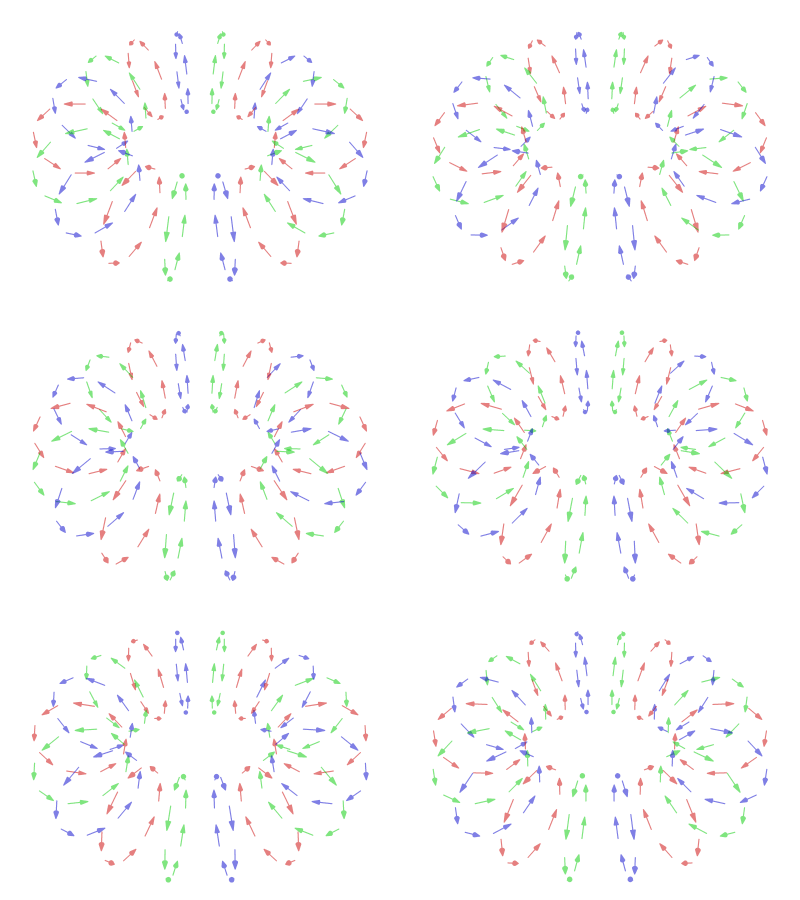
Here’s an animation of a vortex ring showing how the fluid elements move around it (you might need to click on it to make it animate):

It’s quite easy to generate vortex rings in everyday situations, the simplest way being when a mass of fluid is impulsively pushed from an enclosed space through a narrow opening. In this case the poloidal flow is set in motion, at least in part, by interaction between the outer parts of the fluid mass and the edges of the opening. This results in fluid elements travelling in little circles, like those above, around a “core”; the direction of the vorticity is at right angles to these circles, i.e. in the toroidal direction. A vortex line can be formed from by joining together the vorticity vectors from each little circle to form a circle defining the core of the vortex ring. The behaviour of vortex lines in flows like this is entirely analogous to that of magnetic field lines. In this case, the vortex line follows the motion of the fluid, which is at right angles to it, so it propagates more-or-less without disruption. This is how most vortex ring toys work, such as shown in the two examples here; the second is far more dramatic!

The last video features some naturally-occurring vortex rings (as well as some  distinctly man-made examples). What I didn’t realise until I found this video last night is that whales and dolphins know how to make vortex rings too, only underwater. Why do they do this? Is there an evolutionary explanation? I doubt it! I think they’re just having fun.

A Name for Open Astrophysics?

Posted in Open Access with tags , , , , , on November 4, 2012 by telescoper

Regular readers of this blog may recall that  while ago  I posted an item in which I suggested setting up The Open Journal of Astrophysics. The motivation behind this was to demonstrate that it is possible to run an academic journal which is freely available to anyone who wants to read it, as well as at minimal cost to authors. Basically, I want to show that it is possible to “cut out the middle man” in the process of publishing scientific research and that by doing it ourselves we can actually do it better.

I was unwell for much of the summer, and more recently have had lots to do in connection with my forthcoming move to Sussex, so things have moved more slowly than I’d hoped but I just wanted to take this opportunity to give my assurance that this project is definitely going ahead. We have a (good) website design with ample space and other resources to run it, and a sufficient number of persons of suitable eminence have agreed to serve on the Editorial Board. It will basically be a front-end for the Arxiv, but will have a number of interesting additional features which make it a lot  more than that.  I’d prefer to save further details to the official launch, which is now planned to take place in January (as it would probably get buried in the pre-Xmas rush if we tried to launch before then). I can also confirm that the service we will provide will be free at the start, although if the volume of submissions grows we may have to charge a small fee for refereeing. And when I say “small” I mean small, not the hundreds or thousands of pounds charged by the rip-off merchants.

One thing I would like some ideas about, however, is the name. My working title for this project is The Open Journal of Astrophysics, which I think is OK but what I’d really like to do is break away from the old language of academic publishing as much as possible. I did think of the People’s Revolutionary Journal of Astrophysics, but feared that it might then split into Trotskyite and Marxist-Leninist factions. In any case the very name “journal” suggests something published periodically, whereas my idea is to have something that is updated continuously whenever papers are accepted. I’m therefore having second thoughts about having the word “Journal” in the title at all. Open Astrophysics might suffice, but I’m sure someone out there can come up with a better name. I know that Shakespeare said that a rose by any other name would smell as sweet, but I think a good title might make the difference between success and failure for this initiative…

That gives me the idea of enlisting the help of the denizens of the internet for some help in coming up with a better title; given the nature of the project, this seems an entirely appropriate way of proceeding. So please engage in collective or individual brainstorming sessions and let me have your suggestions through the comments box!

Se pieta di me non senti

Posted in Opera with tags , , , , on November 3, 2012 by telescoper

I heard this piece of music on Radio 3 earlier today and it completely blew me away.  I must get the DVD of the 2011 performance of Handel’s  Giulio Cesare from which it was taken, but in the meantime here’s a clip from Youtube to give you an idea. This is the marvellous Natalie Dessay as Cleopatra singing the da capo aria Se pieta di me non senti. It’s a truly sublime and moving performance from a singer at the very peak of her prowess. Brava!

Three Tips for Solving Physics Problems

Posted in Cute Problems, Education with tags , , , , , on November 2, 2012 by telescoper

I spent quite some time this morning going over some coursework problems with my second-year Physics class. It’s quite a big course – about 100 students take it – but I mark all the coursework myself so as to get a picture of what  the students are finding easy and what difficult. After returning the marked scripts I then go through general matters arising with them, as well as making the solutions available on our on-line system called Learning Central.

Anyway, this morning I decided to devote quite a bit of time to some tips about how to tackle physics problems, not only in terms of how to solve them but also how to present the answer in an appropriate way.

I began with the Feynman algorithm for solving physics problems:

  1. Write down the problem.
  2. Think very hard.
  3. Write down the answer.

That may seem either arrogant or facetious, or just a bit of a joke, but that’s really just the middle bit. Feynman’s advice on points 1 and 3 is absolutely spot on and worth repeating many times to an audience of physics students.

I’m a throwback to an older style of school education when the approach to solving unseen mathematical or scientific problems was emphasized much more than it is now. Nowadays much more detailed instructions are given in School examinations than in my day, often to the extent that students  are only required to fill in blanks in a solution that has already been mapped out.

I find that many, particularly first-year, students struggle when confronted with a problem with nothing but a blank sheet of paper to write the solution on. The biggest problem we face in physics education, in my view, is not the lack of mathematical skill or background scientific knowledge needed to perform calculations, but a lack of experience of how to set the problem up in the first place and a consequent uncertainty about, or even fear of, how to start. I call this “blank paper syndrome”.

In this context, Feynman’s advice is the key to the first step of solving a problem. When I give tips to students I usually make the first step a bit more general, however. It’s important to read the question too.

The middle step is more difficult and often relies on flair or the ability to engage in lateral thinking, which some people do more easily than others, but that does not mean it can’t be nurtured.  The key part is to look at what you wrote down in the first step, and then apply your little grey cells to teasing out – with the aid of your physics knowledge – things that can lead you to the answer, perhaps via some intermediate quantities not given directly in the question. This is the part where some students get stuck and what one often finds is an impenetrable jumble of mathematical symbols  swirling around randomly on the page.

Everyone gets stuck sometimes, but you can do yourself a big favour by at least putting some words in amongst the algebra to explain what it is you were attempting to do. That way, even if you get it wrong, you can be given some credit for having an idea of what direction you were thinking of travelling.

The last of Feynman’s steps  is also important. I lost count of the coursework attempts I marked this week in which the student got almost to the end, but didn’t finish with a clear statement of the answer to the question posed and just left a formula dangling.  Perhaps it’s because the students might have forgotten what they started out trying to do, but it seems very curious to me to get so far into a solution without making absolutely sure you score the points.  IHaving done all the hard work, you should learn to savour the finale in which you write “Therefore the answer is…” or “This proves the required result”. Scripts that don’t do this are like detective stories missing the last few pages in which the name of the murderer is finally revealed.

So, putting all these together, here are the three tips I gave to my undergraduate students this morning.

  1. Read the question! Some solutions were to problems other than that which was posed. Make sure you read the question carefully. A good habit to get into is first to translate everything given in the question into mathematical form and define any variables you need right at the outset. Also drawing a diagram helps a lot in visualizing the situation, especially helping to elucidate any relevant symmetries.
  2. Remember to explain your reasoning when doing a mathematical solution. Sometimes it is very difficult to understand what you’re trying to do from the maths alone, which makes it difficult to give partial credit if you are trying to the right thing but just make, e.g., a sign error.
  3.  Finish your solution appropriately by stating the answer clearly (and, where relevant, in correct units). Do not let your solution fizzle out – make sure the marker knows you have reached the end and that you have done what was requested.

There are other tips I might add – such as checking answers by doing the numerical parts at least twice on your calculator and thinking about whether the order-of-magnitude of the answer is physically reasonable – but these are minor compared to the overall strategy.

And another thing is not to be discouraged if you find physics problems difficult. Never give up without a fight. It’s only by trying difficult things that you can improve your ability by learning from your mistakes. It’s not the job of a physics lecturer to make physics seem easy but to encourage you to believe that you can do things that are difficult.

So anyway that’s my bit of “reflective practice” for the day. I’m sure there’ll be other folk reading this who have other tips for solving mathematical and scientific problems, in which case feel free to add them through the comments box.
At the Mountains of Madness

Posted in Literature, The Universe and Stuff with tags , , , , on November 1, 2012 by telescoper

Well, I don’t know whether it is some sort of Hallowe’en skit or what, but the estimable arXiv has certainly served up something unusual today, in the form of a paper by one Benjamin K. Tippett with the intriguing title Possible Bubbles of Spacetime Curvature in the South Pacific. Here is the abstract:

In 1928, the late Francis Wayland Thurston published a scandalous manuscript in purport of warning the world of a global conspiracy of occultists. Among the documents he gathered to support his thesis was the personal account of a sailor by the name of Gustaf Johansen, describing an encounter with an extraordinary island. Johansen`s descriptions of his adventures upon the island are fantastic, and are often considered the most enigmatic (and therefore the highlight) of Thurston`s collection of documents.

We contend that all of the credible phenomena which Johansen described may be explained as being the observable consequences of a localized bubble of spacetime curvature. Many of his most incomprehensible statements (involving the geometry of the architecture, and variability of the location of the horizon) can therefore be said to have a unified underlying cause.

We propose a simplified example of such a geometry, and show using numerical computation that Johansen`s descriptions were, for the most part, not simply the ravings of a lunatic. Rather, they are the nontechnical observations of an intelligent man who did not understand how to describe what he was seeing. Conversely, it seems to us improbable that Johansen should have unwittingly given such a precise description of the consequences of spacetime curvature, if the details of this story were merely the dregs of some half remembered fever dream.

We calculate the type of matter which would be required to generate such exotic spacetime curvature. Unfortunately, we determine that the required matter is quite unphysical, and possess a nature which is entirely alien to all of the experiences of human science. Indeed, any civilization with mastery over such matter would be able to construct warp drives, cloaking devices, and other exotic geometries required to conveniently travel through the cosmos.

Despite the unusual subject matter, it certainly doesn’t read like a skit, which means that if that’s what it is then it’s a very good one. Alternatively, it could just be that Dr Tippett might be taking it all a bit too literally. However, the paper is full of names that will ring a bell to anyone familiar with the works of H.P. Lovecraft, especially those relating to Cthulhu. Anyway, sounds like an ideal topic for further investigation. Time to put my grant-writing hat on!

P.S. The title of this post is taken from ref. [2] in the aforementioned arXiv paper.

Monster Mash-up

Posted in Biographical, Music with tags , , , on October 31, 2012 by telescoper

It’s Hallowe’en again, and although I feel I should concoct something appropriate, I really don’t have time. I’ve decided therefore to recycle a couple of items I’ve previously posted on this lamentable occasion.

We never had Halloween when I was a kid. I mean it existed. People mentioned it. There were programmes on the telly. But we never celebrated it. At least not in my house, when I was a kid. It just wasn’t thought of as a big occasion. Or, worse, it was “American” (meaning that it was tacky, synthetic and commercialised).  Cue this seasonable clip from Fry & Laurie

So there were no Halloween parties, no costumes, no horror masks, no pumpkins and definitely no trick-or-treat when I was a lad.

Having never done trick-or-treat myself as a child, I never really had any clue what it was about until relatively recently. I’d always assumed “Trick or Treat?” was a rhetorical question or merely a greeting like “How do you do?”.

In fact my first direct experience of this perculiar custom  didn’t happen until I was in my mid-thirties and had moved to a suburban house in Beeston, just outside Nottingham. I was sitting at home one October 31st, watching the TV and – probably, though I can’t remember for sure – drinking a glass of wine, when the front door bell rang. I didn’t really want to, but I got up and answered it.

When I opened the door, I saw in front of me two small girls in witches’ costumes. Behind them, near my front gate, was an adult guardian, presumably a parent, keeping a watchful eye on them.

“Trick or Treat?” the two girls shouted. Trying my best to get into the spirit but not knowing what I was actually supposed to do, I answered “Great! I’d like a treat please”.

They stared at me as if I was mad, turned round and retreated towards their minder who was clearly making a mental note to avoid this house in future. Off they went and I, embarrassed at being exposed as a social inadequate, retired to my house in shame.

Ever since then I’ve tried to ensure that I never again have to endure such Halloween horrors. Every October 31st, when nightfall comes, I switch off the TV, radio and lights and sit soundlessly in the dark so the trick-or-treaters think there’s nobody home.

That way I can be sure I won’t be made to feel uncomfortable.

Anyway, despite my own  reservations about Hallowe’en, I’ve decided to resurrect the following little video which seems to be appropriate for the occasion. It’s made of bits of old horror B-movies but the music – by Bobby “Boris” Pickett and the Crypt-kickers is actually the second single I ever bought, way back in 1973. I wonder if you can guess what the first one was?

A Sense of Proportion – Postscript

Posted in The Universe and Stuff with tags , , on October 30, 2012 by telescoper

It took all day to do so, evidently because I’m old and slow, but this morning’s post eventually got round to reminding me of this cartoon, the context of which is described here. Was that really in 1992? That was twenty years ago!

The Total Perspective Vortex

Posted in The Universe and Stuff with tags , , on October 30, 2012 by telescoper

Vortices are swirling around in my mind these days. Not only because of Hurricane Sandy, but also because I’ve got to prepare a couple of lectures about vorticity in fluid mechanics to give next week. Anyway, all that reminded me of this classic sequence from the original radio series The Hitchhiker’s Guide to the Galaxy, by the late great Douglas Adams. I particularly agree with the conclusion “that if life is going to exist in a Universe of this size, then the one thing it cannot afford to have is a sense of proportion”.

Gravity Waves Detected!

Posted in The Universe and Stuff with tags , , on October 29, 2012 by telescoper

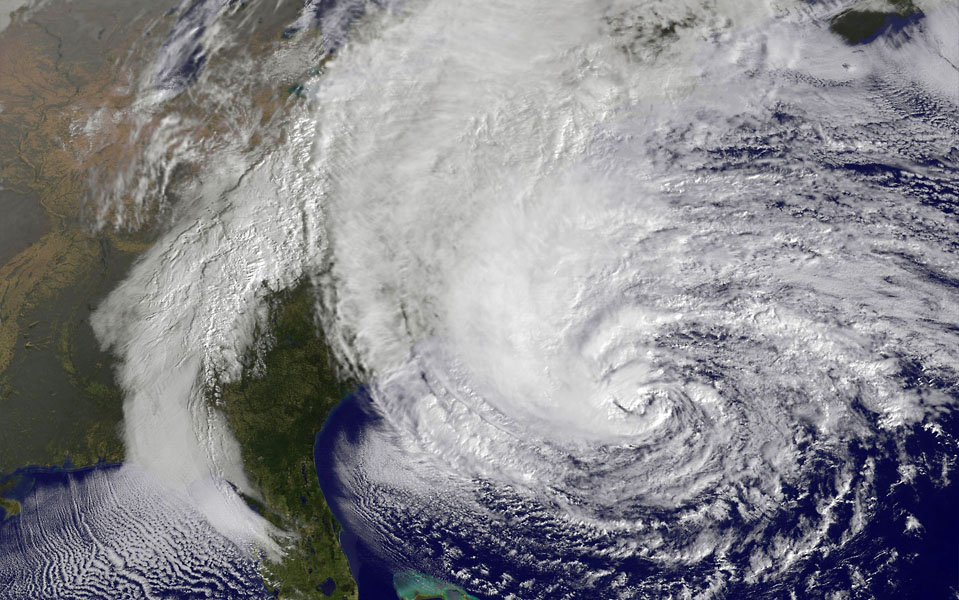
At last, for all you sceptics out there, Hurricane Sandy has finally provided definitive proof of the existence of gravity waves, clearly visible to the South West of the storm…

Apologies if you thought I meant gravitational waves. The confusion was entirely intentional.

Out of the Cool

Posted in Jazz with tags , , , on October 28, 2012 by telescoper

I’ve been taking it easy today, attempting to recover from a bout of sickness by loafing about and listening to old records. I don’t know why I haven’t listened to Out of the Cool by the Gil Evans Orchestra for a while, but at least that meant I came back to it relatively fresh.

Gil Evans was one of the few composer/arrangers in Jazz to have successfully blended his own orchestral textures with solo improvisations in such a way that both complement each other; the scored passages he devised are complex and beautiful, but never so rigid that they inhibit the soloist’s imagination. He directed a number of albums that incorporated Jazz solos in classically-inspired orchestral settings, including Sketches of Spain and Porgy and Bess (with Miles Davis). This one is less famous than those, but in my opinion at least as good.

Trumpeter Johnny Coles (no relation) is particularly inspired by the imaginative surroundings constructed by Gil Evans on this album, and he responds by inventing beautiful solo lines on several tracks on this album. But the tonal spectrum he encompasses, his use of dynamics, and his distinctive play with inflection are best illustrated by his feature piece, Sunken Treasure, a mysterious, almost evanescent creation which he fashions out of Evans’ floating harmonies. I think this is the best track off a great album.