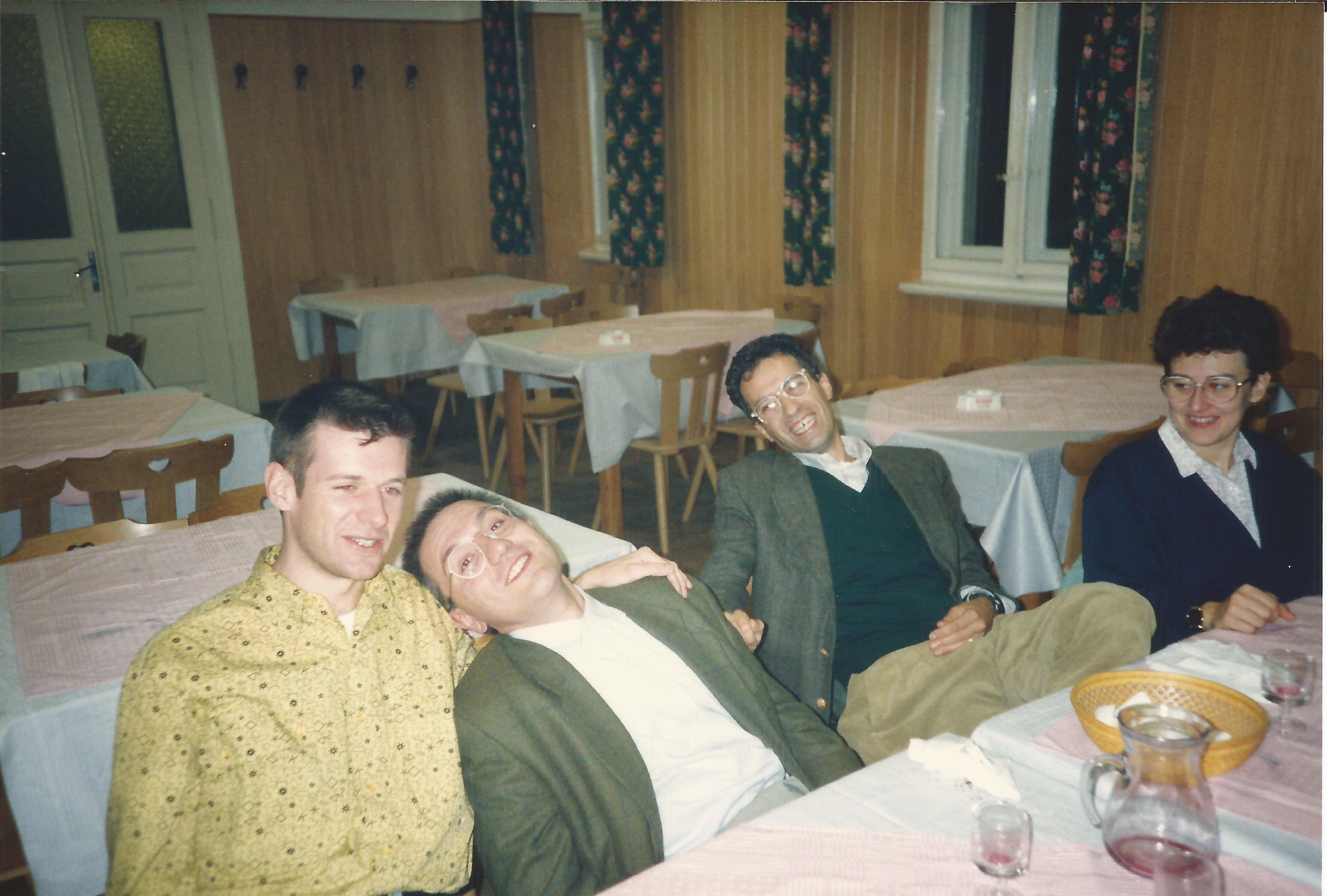
I think Cambridge astrophysicist Mike Hobson bears more than a passing resemblance to Norwich City Coventry City Newcastle United Blackburn Rovers Liverpool West Ham United Manchester City Cardiff City Liverpool striker Craig Bellamy. I wonder if, by any chance, they might be related?
Astronomy Look-alikes, No. 73
Posted in Astronomy Lookalikes with tags Astronomy Look-alikes, Craig Bellamy, Mike Hobson on February 6, 2012 by telescoperLeave the kids alone!
Posted in Education, Literature with tags Charles Dickens, Claire Tomalin, education, literature, University on February 6, 2012 by telescoperI’ve been annoyed ever since I woke up this morning because there was an item on the 7am news that irked me. A person called Claire Tomalin was quoted as saying, among other things, that
Children are not being educated to have prolonged attention spans and you have to be prepared to read steadily for a Dickens novel and I think that’s a pity.
She goes on to lay most of the blame for this shortcoming on television, as such people tend to do.
It’s a facile argument. For one thing most of Dickens’ novels were originally published in short installments, so reading them that way seems quite a sensible approach to me, and one that should probably be encouraged not criticized. There’s no getting away either from the fact that some of Dickens’ output is very heavy going indeed. Dare I say that not all Dickens is particularly good? Not liking Dickens is a matter of taste, not a mental defect caused by watching Big Brother.
And another thing: what fraction of children in Dickens’ time could read at all? Much lower than today, I suspect.
Claire Tomalin’s comment is not just a lazy generalization, it’s also yet another easy shot at the younger generations who have to put up with this sort of gibe from middle-aged grouches over and over again.
Examination results usually provoke similar outbursts, related to “dumbing down”. I actually do think that, at least in some subjects, examinations are much easier than they were “in my day”, but I don’t think that’s a reason to criticize the examinees. It’s more a fault with the examiners, who have decided that the young can’t cope with difficult challenges. That’s an insult in its own right. I maintain my view that education, especially higher education, is not about making things easy. It’s about showing students that they can do things that are hard. Most importantly, though, dumbing down examinations is not the same as dumbing down people.
It’s not just young schoolkids that attract such ill-informed invective. I come across it quite regularly with respect to the (alleged) lack of skills possessed by the young adults (usually 18-22) we teach as undergraduates, some of it even from colleagues.
I was thinking the other day what a boon it is for a middle-aged fogey – and obvious potential grouch – like myself to have the pleasure of actually talking to so many younger people at work, and listening to what they have to say. That way I’ve come to my own conclusions about what they’re really like. You know, like you do with people. Most folk of my age don’t have jobs that bring them into contact with younger folk, so they have to rely on articles in the Daily Telegraph to tell them what to think. That, sadly, even goes for those lecturers who have fixed ideas about the inferiority of “students nowadays”.
I think I’ve been very lucky, especially over the last few years, to have had the opportunity to work with a wide range of students as, e.g., project supervisor or tutor. Interactions like this provide a constant reminder not to generalize about the generations. There is of course a range of ability and commitment, but there was in my day too. The majority still work hard, learn quickly, and are friendly and courteous. There’s also no doubt in my mind that the best students nowadays are as good as they have ever been, if not better.
It’s the oldies who are the problem.
Follow @telescoperA Shared Disservice
Posted in Biographical, Science Politics with tags BIS, P60, RCUK, Shared Sevices Centre, SSC, tax on February 5, 2012 by telescoperIf you’ve never heard of the Shared Services Centre then you’re a very lucky person. If you have heard of it, and especially if you’ve had any dealings with it, then the following excerpt from the SSC website description of itself will make you either laugh or cry:
The UK’s seven Research Councils, working together as Research Councils UK (RCUK), set up a shared services centre to reduce spend on administration. Sharing and standardising processes simply frees more funds for keeping the UK at the forefront of research and innovation.
Each year the Research Councils invest around £2.8 billion in research into understanding and improving the world around us. They’re involved in everything from tackling superbugs or studying social trends to analysing the geo-climate of the Antarctic. So, operating efficiently benefits our whole society.
What is more, sharing services does not mean compromising quality. The RCUK Shared Services Centre Ltd (SSC) is dedicated to providing exceptional standards of service in Human Resources, Finance, Procurement, IT IS and Grants administration. Our people achieve this by sharing their skills, knowledge and our vision:
‘Professional people working together, delivering quality services for the benefit of the research community’
The italics are mine. I added them to sections that made me laugh out loud. In fact almost all the above description of the SSC is complete tripe. The organization is a fiasco. It has cost more than twice its original budget to implement and since its inception the quality of research administration has deteriorated beyond all recognition. The only thing I’ll say about the statement quoted above is that George Orwell would have been very proud.
This has serious consequences for those dependent for funding on the Research Councils, including the Science and Technology Facilities Council (STFC), which has been forced to use the Shockingly Shambolic Catastrophe to administer the grants it issues. The time taken to process and issue grants is now far longer than it was previously, when such tasks were done by people who actually knew (and cared about) what they were doing.
I’m told by reliable sources that the whole SSC debacle is such an embarrassment that staff employed by the Research Councils have been forbidden to say negative things about it and have instead to pretend everything is just hunky-dory lest the mess damages the reputations of their political masters in BIS. The result of this strategy is that BIS now think the SSC is doing a fabulous job and are going to expand its activities across other departments. If nobody blows the whistle on it, the SSC behemoth will gradually take over the entire government and turn everything into crap. Or perhaps that has already happened?
Anyway, I’m far too old to play David versus Goliath in this particular battle. I’ll leave that to the continuing efforts of, e.g., Private Eye. But I will give you a tiny – and not particular important – illustration of how useless the SSC really is. I’m one of those people who has to fill in a self-assessment tax return every year. It’s not too difficult to do because I retain a chap to organize my accounts and in any case income I receive on top of my main salary is usually documented in the various P60s I get at the end of each tax year. Except this year I didn’t get a P60 for the work I did for STFC on the Astronomy Grants Panel. Such payments are also administered by SSC, and it is their statutory responsibility to provide a P60, but despite repeated attempts to extract one, I didn’t get it in time for the January 31st deadline. I therefore filed my return with estimated figures and an explanatory note.
Finally SSC replied. It seems they had decided to send my P60 to my old address in Nottingham, along with a number of other items of correspondence. Why they did so I have no idea, as I moved from there in 2008. I told STFC my new address at that time, and have been receiving various bits and bobs from them at my correct address since then. Moreover, SSC have been sending items here too, so they do have the right details. Only it seems I’ve been getting letters from Finance, whereas the tax stuff is dealt with by the dreaded Human Resources. As seems inevitable with large bureaucracies, the different parts clearly do not communicate with each other.
Anyway, to cut a very long story very short, after I filed my tax return I finally received an email from SSC explaining what had happened. It also said that it was not possible to issue a duplicate P60, but they were attaching a statement of earnings and tax paid. Only there was no attachment. I emailed back to ask what had happened to the attachment. Three days later I got a reply with the attachment. The email began “Dear Professor Collins…”.
Curiously the attachment – when it finally was sent – arrived in encrypted form “for security”. A bit of a waste of time, methinks, when they’ve been posting confidential documents to the wrong address for more than three years!
I’ve corrected my tax return in the light of the new information they sent, but I may still be liable for some sort of surcharge. It’s clearly the fault of the SSC, but there’s no symmetry in tax affairs. If Joe Bloggs is late or makes an error, he gets stamped on by the Inland Revenue. If a government agency messes up it probably gets away scot free.
This is all small potatoes of course, but the dire state of their record-keeping in a trivial case like mine makes me worry about what might be going wrong with more serious things…
I have the feeling that there might be one or two people out there with SSC stories of their own. Do feel free to share them via the comments box.
Follow @telescoperSpellbound
Posted in Poetry with tags Emily Bronte, Poem, Spellbound on February 4, 2012 by telescoperThe night is darkening round me,
The wild winds coldly blow;
But a tyrant spell has bound me
And I cannot, cannot go.
The giant trees are bending
Their bare boughs weighed with snow.
And the storm is fast descending,
And yet I cannot go.
Clouds beyond clouds above me,
Wastes beyond wastes below;
But nothing dear can move me;
I will not, cannot go.
by Emily Brontë (1818-1848)
Follow @telescoperWinterreise – Das Wirtshaus
Posted in Art, Music with tags Benjamin Britten, Peter Pears, Schubert, Winterreise on February 4, 2012 by telescoperIt’s cold again, and it’s just started snowing, so here’s some wintry music. I know that the recording of Winterreise by Benjamin Britten and Peter Pears is by no means everyone’s favourite version, but I like it a lot. There’s the added bonus in this video of a glimpse of the art of Caspar David Friedrich.
P.S. Das Wirtshaus means “The Inn”, but in the poem by Müller that forms the lyric for this song, the inn is actually a graveyard…
Follow @telescoperTerra Nova
Posted in Art, History, The Universe and Stuff with tags Antarctica, astronomy, BLAST, BOOMERANG, Captain Scott, quad, Robert Falcon Scott, South Pole on February 3, 2012 by telescoperWe’re currently enduring a spell of cold weather here in Cardiff, although I think it might be rather milder here then elsewhere in the UK. My garden thermometer showed a mere -5 C when I looked at it at 7.15 this morning. The other day we had a meeting of half-a-dozen people in one of our large teaching rooms and it was absolutely freezing. I don’t know what was wrong with the heating. Yesterday I actually did a lecture in the same room, but with 80-odd “warm bodies” (or “students” as they are sometimes known) in there, it was bearable.
The cold here of course is nothing compared with that endured by Captain Scott‘s ill-fated expedition to the South Pole, but I mention it here for a number of reasons. First, the centenary of the death of Scott and his companions is coming up next month; the tragedy unfolded in March 1912. There’s actually a very special concert coming up next week, featuring Vaughan Williams’ wonderful music written for the classic film Scott of the Antarctic (which, incidentally, you can actually watch in full on Youtube). I’m definitely going along, and will probably review the performance next week, but quite a number of my colleagues are also going, for reasons which will become obvious..
The concert is special because of the very strong connections between the Scott Expedition and the City of Cardiff. Much of the financial support needed to fund the trek to the South Pole was raised from Cardiff businessmen and Scott’s ship, the Terra Nova, actually set sail from Cardiff (in June 1910) on its journey, first to New Zealand and thence to Antarctica.
Incidentally, an article in this morning’s Western Mail relates to a historic painting of the departure of the Terra Nova which is about to be auctioned:

Cardiff Bay has certainly changed a great deal since 1910, but quite a lot is recognizable, especially the Pierhead Building, which can be seen to the right. The actual docks, the locations of which are revealed by the lines of masts of tall ships, are now mainly filled in. But there is at least one other reminder of this occasion to be found at Cardiff Bay, a large waterfront bar itself called Terra Nova…
There’s also a deep connection with the South Pole, and the Antarctic generally, for many members of the Astronomy Instrumentation Group here in the School of Physics & Astronomy at Cardiff University, quite a few of whom have actually been to the South Pole in connection with various experiments, including Quad, Boomerang and BLAST, because of the unique observing conditions there.
Follow @telescoperThe Snow Man
Posted in Poetry with tags Poetry, The Snow Man, Wallace Stevens on February 2, 2012 by telescoperOne must have a mind of winter
To regard the frost and the boughs
Of the pine-trees crusted with snow;
And have been cold a long time
To behold the junipers shagged with ice,
The spruces rough in the distant glitter
Of the January sun; and not to think
Of any misery in the sound of the wind,
In the sound of a few leaves,
Which is the sound of the land
Full of the same wind
That is blowing in the same bare place
For the listener, who listens in the snow,
And, nothing himself, beholds
Nothing that is not there and the nothing that is.
by Wallace Stevens (1879-1955).
Follow @telescoperIs there only one electron in the Universe?
Posted in The Universe and Stuff with tags Antimatter, Dirac Sea, electrons, John Archibald Wheeler, Particle Physics, Paul Dirac, positrons, Richard Feynman, time travel on February 1, 2012 by telescoperI started teaching Nuclear and Particle Physics to the 3rd year Physics students today. I decided to warm up with a few basics about elementary particles and their properties – all pretty standard stuff and no hairy mathematics. Cue pretty picture:
This doesn’t show the whole picture, of course, because for every particle there is an antiparticle, so there are antiquarks and antileptons. The existence of these was first suggested by Paul Dirac in 1928 based on his investigations into relativistic quantum theory, basically because invariance of special relativity is compatible with the existence of both positive and negative energy states, i.e.
has two sets of solutions, one with and the other with
. Instead of simply assuming the latter set were physically unrealistic, Dirac postulated that they might be real, but completely filled in “empty” space; these filled negative-energy states are usually called the “Dirac Sea”. Injection of an appropriate amount of energy can promote something from a negative state into a positive one, leaving behind a kind of hole (very similar to what happens in the case of semiconductor). This process creates a pair consisting of a (positive energy) particle and a (negative energy) antiparticle (i.e. a hole in the Dirac Sea). In the case of electrons, the hole is called a positron.
The alternative, and even wackier, explanation of antimatter I usually mention in these lectures derives, I think, from Feynam who noted that in quantum (wave) mechanics the time evolution of particles involves things like
which have the property that changing into
has the same effect as changing
into
. This is, in essence, the reason why, in Feynman diagrams, antiparticles are usually represented as particles travelling backwards in time…
This is a useful convention from the point-of-view of using such diagrams in calculations, but it allows one also to raise the wacky bar to a higher level still, to a suggestion that, coincidentally, was doing the rounds very recently – namely whether it is possible that there may really be only one electron in the entire Universe:
….I received a telephone call one day at the graduate college at Princeton from Professor Wheeler, in which he said, “Feynman, I know why all electrons have the same charge and the same mass” “Why?” “Because, they are all the same electron!” And, then he explained on the telephone, “suppose that the world lines which we were ordinarily considering before in time and space—instead of only going up in time were a tremendous knot, and then, when we cut through the knot, by the plane corresponding to a fixed time, we would see many, many world lines and that would represent many electrons, except for one thing. If in one section this is an ordinary electron world line, in the section in which it reversed itself and is coming back from the future we have the wrong sign to the proper time—to the proper four velocities—and that’s equivalent to changing the sign of the charge, and, therefore, that part of a path would act like a positron.”—Feynman, Richard, Nobel Lecture December 11, 1965
In other words, a single electron can appear in many different places simultaneously if it is allowed to travel backwards and forwards in time…
I think this is a brilliant idea, especially if you like science fiction stories, but there’s a tiny problem with it in terms of science fact. In order for it to work there should be as many positrons in the Universe as there are electrons. Where are they?
Di Provenza
Posted in Opera with tags Giuseppe Verdi, La Traviata, Titta Ruffo on February 1, 2012 by telescoperIt’s a cold and gloomy morning as befitting the first of February, so I thought you might appreciate a touch of the warmth of the South of France. This is Germont’s Aria Di Provenza il mar, il suol from La Traviata by Giuseppi Verdi. The recording – made, incredibly, in 1907 – provides a rare chance to hear the magnificent baritone of the legendary Titta Ruffo whose nickname, appropriately enough, was Voce del Lione “Voice of the Lion”. Despite the limitations of the recording, which required the aria to be cut down to fit within 3 minutes, this is still a stunning performance which makes most modern-day baritones sound like a wet weekend. If you listen carefully right at the end you’ll hear someone say “bravo”…
Follow @telescoperAcademic Interactions
Posted in The Universe and Stuff with tags Feynman Diagrams, PhD Comics on January 31, 2012 by telescoperI’ve spent nearly all day getting my notes ready to start teaching Accidental Raunchy Slippers Nuclear and Particle Physics tomorrow to the massed ranks of Third-Year Physics students here in the School of Physics & Astronomy at Cardiff University. I’ve drawn so many Feynman diagrams in the last couple of days that I’ve started to see them everywhere I look, even in entirely unexpected contexts, as in this example from the excellent PHD Comics…