Planck Time

Posted in The Universe and Stuff with tags , , , , , , on February 13, 2012 by telescoper

Only time for a quickie today, as I have a busy afternoon in store at a meeting in the Graduate College (zzz…). Today there has been a press conference in Bologna about latest results from the ESA experiment, Planck. Here’s a picture taken at the press conference by roving reporter astrophysicist Mike Peel.

I gave a talk in that room once, actually, although there weren’t any press people there on that occasion.

Although it will be some time still before the full cosmological results from Planck are released to the public (and researchers outside the Planck Consortium), the press conference covered a number of new and interesting discoveries, particularly about our own Galaxy. You can read about them at the  ESA Planck website here and on the UK Planck site (hosted at Cardiff University) here.

Among the results are beautiful maps of microwave emission from cold molecular gas (e.g.  carbon monoxide) from sources inside the Milky Way:

Planck wasn’t specifically designed to detect CO emission, but it’s part of the “foreground” radiation that must be understood and modelled on the way to extracting cosmological information from the results.

Another exciting item is the Galactic Haze that emanates from the central regions of the Milky Way, which you can see in this picture poking out from behind the “mask” that is used to blank out emission from the Galactic Plane (i.e. the disk of our Galaxy).

The origin of this haze, which appears to be consistent with synchrotron radiation but with quite a hard spectrum, is not known and is the topic of much discussion in the astrophysics community.

For more information, see the main Planck site or, with more technical details, here.

It’s that time again…

Posted in Music, Rugby with tags , , on February 12, 2012 by telescoper

Today was the day for the first home game of the RBS Six Nations for Wales, so Cardiff was absolutely buzzing with that special atmosphere that only rugby and an influx of 80,000 people into a city with a population of 325,00 can bring. I was out and about earlier on but had to watch the game on TV as I lack the wherewithal to get tickets for occasions of such immensity. Wales were red-hot favourites for this game, and won comfortably enough in the end against Scotland although the game was closer than the 27-13 scoreline might suggest; Scotland had a try incorrectly disallowed, which might have made all the difference. The Scots fans also played their part, some of them camping out in the park near my house in the freezing cold for two nights before today’s game, and offered a fine rendition of Flower of Scotland before the kick-off. But there’s something special about the Welsh National Anthem on days like this. I’m glad they’ve dispensed with the professional pop singers that they’ve sometimes used to lead the singing. Wales is a nation that doesn’t need to pay people  to sing for it…

Energy Inversion

Posted in Uncategorized with tags , , , , , on February 12, 2012 by telescoper

Like many people I’ve just received my gas and electricity bills. Unlike many, I can actually afford to pay them. My little terraced house is actually pretty easy to keep warm, even in the very cold weather we’ve had recently. I’m helped in that by the next door neighbours, who seem to have their heating on all the time thus warming one side of the house for me. I do occasionally put a few logs in the fireplace and treat myself to the comfort of the resulting blaze, but that’s not really necessary to keep warm, just me being a bit  bourgeois.

Coincidentally, the Independent recently ran an interesting article about fuel poverty and the inflated profits being made by the energy utilities in the United Kingdom.  The two are obviously connected, and it seems quite clear to me that the primary mechanism by which the public are being exploited is through the infamous ratchet. When wholesale fuel prices go up the regulator Ofgen allows the utilities to increase their retail energy prices accordingly. When the wholesale price comes down again, the retail price remains high and Ofgen does nothing. Next time wholesale prices rise, retail prices go up again, and so on. Prices to customers increase monotonically, with the inevitable result that the poor get squeezed and the companies’ profit spiral upwards.

There’s talk of the regulator getting tougher with the bastards companies concerned, but there’s been talk of that for ages. Nothing of any consequence ever happens. Meanwhile, vulnerable people, especially the elderly poor, die in the cold. It’s yet another sickening example of  the grossly distorted priorities of the world we live in.

I don’t claim to have an answer to all forms of capitalist exploitation, but reading my gas bill did give me an idea to help with this particular one. In common with many customers, my gas bill (from SWALEC in my case) is constructed in two parts: “standard energy” (which is quite expensive) and “discounted energy” (which is much cheaper, little over half the cost per kiloWatt-hour of the standard tariff). The way this works is the first 1000 kWh or so one uses are charged at the standard rate, then the additional energy consumption is charged at the discount rate.

This pricing system seems pretty normal, but it suddenly struck me when I got my bill as being completely the wrong way around. If one instead were charged the discounted rate initially and the higher rate for the excess, that would (a) benefit the poor, who presumably live in smaller houses than the rich and therefore use less energy to heat them, and (b) discourage profligate energy use beyond the switch-over point. Such a pricing system would give each user an “allowance” of cheaper energy, but charge them at a higher rate if they exceed it.

Inverting the tariff system in this way would  both help the most vulnerable and provide a real incentive for heavy users of energy to increase their efficiency. No point, though, in expecting the cartel of privatised energy suppliers to do something like that off their own bat. They’re doing very nicely out of the status quo and have no reason to change it. Dead pensioners don’t have much effect on their profits.

P.S. It also occurs to me that the £200 winter fuel payment currently paid by the government would be more efficiently targetted if it were passed on directly by energy utilities in the form of free energy to its elderly customers. I’d even make the case that they should pay it out of their own profits…

Antarctica

Posted in Literature with tags , , , on February 11, 2012 by telescoper

‘I am just going outside and may be some time.’
The others nod, pretending not to know.
At the heart of the ridiculous, the sublime.
He leaves them reading and begins to climb,
Goading his ghost into the howling snow;
He is just going outside and may be some time.
The tent recedes beneath its crust of rime
And frostbite is replaced by vertigo:
At the heart of the ridiculous, the sublime.
Need we consider it some sort of crime,
This numb self-sacrifice of the weakest? No,
He is just going outside and may be some time
In fact, for ever. Solitary enzyme,
Though the night yield no glimmer there will glow,
At the heart of the ridiculous, the sublime.

by Derek Mahon (b. 1941).

Update on the Elsevier Affair…

Posted in Science Politics with tags , on February 11, 2012 by telescoper

No time for a post of my own this morning, as I’m off to the department to help with a UCAS admissions visit day. I’ll take the opportunity, therefore, to point you towards mathematician Tim Gowers’ excellent blog for an update on the Elsevier boycott (and related issues) that I posted about a while ago.

P.S. At times like this I’m so grateful WordPress brought the “reblog” option back, although I’m not sure I like the new format…

gowers's avatarGowers's Weblog

A group of mathematicians have been putting together a statement that explains some of the background to, and reasons for, the Elsevier boycott. This statement, which has been signed by 34 mathematicians (we are confident that many more would be happy to endorse it, but we had to stop somewhere), is now ready for release. If you are interested in reading it, then click here.

View original post 440 more words

Astronomy Look-alikes, No. 74

Posted in Astronomy Lookalikes with tags , , on February 10, 2012 by telescoper

Last night I was watching a motion picture entitled The Exorcist III, with the alarming result that I now suspect that distinguished astronomer and occasional commenter on this blog, Prof.  Robert Kirshner,  may in fact be a supernatural serial killer from beyond the grave. No wonder he’s so interested in the dark side of the Universe…

Flyin’ High

Posted in Jazz with tags , , on February 10, 2012 by telescoper

I’m in need of a bit of a pick-me-up today, because it’s wet and gloomy outside and we’re all busy making the final push to get our STFC consolidated grant application together. I found this on Youtube the other day and it definitely does the trick for me. It’s by the marvellous Jazz clarinettist Edmond Hall. I always thought he was very underrated, but judging by the superbly detailed wikipedia page devoted to him, someone out there rates him very highly indeed! Ed Hall’s clarinet style is immediately recognizable for the incisiveness of his tone, which made him one of the “hottest” jazz clarinet players of all time. He’s also pretty much unique because he stuck with the old Albert System (aka “Simple System”) clarinet; the vast majority of practitioners prefer the Boehm System. In fact I don’t even know if it’s possible to buy an Albert System clarinet these days.

Anyway, whatever clarinet he played, he played it beautifully. I love the way he keeps changing gear throughout this performance, especially around 2.42 when he pulls out all the stops and shifts into the higher register for a sizzling last set of choruses. Wonderful.

Why not pardon Turing?

Posted in History, Politics with tags , , , , on February 9, 2012 by telescoper

I couldn’t resist a quick comment or two on the government’s decision not to issue a posthumous pardon to Alan Turing, in the matter of his his criminal conviction for homosexuality, recently announced by Lord McNally. This is Lord McNally’s reply to a question asked by Lord Sharkey:

The question of granting a posthumous pardon to Mr Turing was considered by the previous Government in 2009.

As a result of the previous campaign, the then Prime Minister Gordon Brown issued an unequivocal posthumous apology to Mr Turing on behalf of the Government, describing his treatment as “horrifying” and “utterly unfair”. Mr Brown said the country owed him a huge debt. This apology was also shown at the end of the Channel 4 documentary celebrating Mr Turing’s life and achievements which was broadcast on 21 November 2011.

A posthumous pardon was not considered appropriate as Alan Turing was properly convicted of what at the time was a criminal offence. He would have known that his offence was against the law and that he would be prosecuted. It is tragic that Alan Turing was convicted of an offence which now seems both cruel and absurd-particularly poignant given his outstanding contribution to the war effort. However, the law at the time required a prosecution and, as such, long-standing policy has been to accept that such convictions took place and, rather than trying to alter the historical context and to put right what cannot be put right, ensure instead that we never again return to those times.

In other words he is using the argument that Turing was properly convicted of behaviour that was considered an offence at the time so that conviction should not be negated.

This argument is entirely specious. A pardon is an act of clemency or forgiveness, exercised under the royal prerogative whenever advised by the government. It is not the mechanism for overturning wrongful convictions, so the observation that this conviction was lawful at the time is a red herring. Moreover, in what I consider to be an entirely analogous situation, all soldiers convicted and executed for cowardice in World War I actually received pardons in 2006. Their actions were also considered punishable at the time. This sets a clear precedent. Why is the Turing case logically different?

The answer to that is that if Turing were to receive a pardon, why should all the other gay people convicted of the criminal offence of being homosexual not also receive pardons? Why does it matter logically in this case that Turing was a brilliant mathematician who made immense contributions to the Allied effort during World War II? What about those gay men who were prevented from joining the services because of their sexuality? Why should one’s brilliance or eminence in a given field lead one to be treated differently under the law? Wouldn’t that just be saying “yes, he was gay, which is a problem, but we’ll forgive him because he made up for it in other ways”?

I think the government’s primary motivation for denying a pardon in this case is in fact the argument I just gave: that they should then have to pardon everyone convicted of homosexuality…

Of course you might ask in that case why it is that people are campaigning for a pardon for Turing in particular? Why not campaign for a universal pardon? I admit that it’s slightly illogical to do so, but it’s a question of pragmatism. Arguing the case for Turing in particular provides a focus which hopefully will lead to a wider resolution of the issue.

Asking for a posthumous pardon isn’t asking for very much, but I suspect the government is more worried about those people still alive who were convicted of homosexuality before 1967, which is when such acts were decriminalized. The case for denying pardons in this situation, when pardons were granted in the case of the executed WWI troops, therefore rests entirely on the possibility that there may be some pesky people who were convicted of homosexuality in the past but who unfortunately, unlike Turing, are not yet dead.

That’s the message this decision sends from the government to gay people.

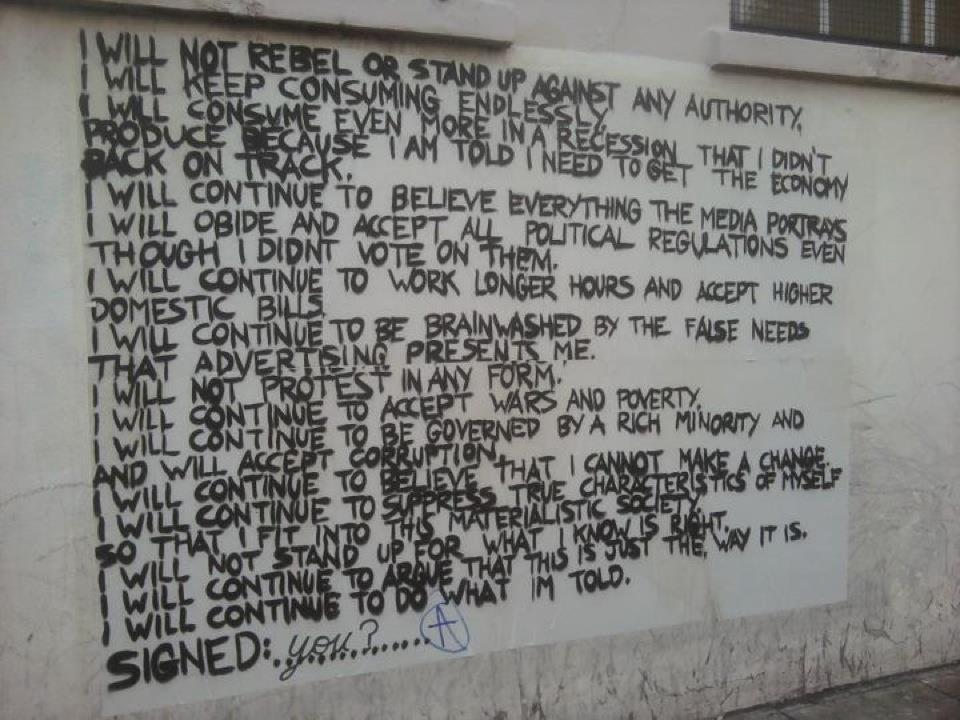
Graffiti Politti

Posted in Art, Politics with tags , , , on February 9, 2012 by telescoper

Sonnet No. 29

Posted in Poetry with tags , on February 8, 2012 by telescoper

When, in disgrace with fortune and men’s eyes,
I all alone beweep my outcast state
And trouble deaf heaven with my bootless cries
And look upon myself and curse my fate,
Wishing me like to one more rich in hope,
Featured like him, like him with friends possess’d,
Desiring this man’s art and that man’s scope,
With what I most enjoy contented least;
Yet in these thoughts myself almost despising,
Haply I think on thee, and then my state,
Like to the lark at break of day arising
From sullen earth, sings hymns at heaven’s gate;
For thy sweet love remember’d such wealth brings
That then I scorn to change my state with kings.

Sonnet No. 29, by William Shakespeare (1564-1616)