I wonder if anyone else has noticed the remarkable similarity between this clue, by Paul, in yesterdays Guardian Prize Crossword (No. 25634)
Foolishly cash lost in ’em? (4,8)
and this one in Everyman No. 3423 which appeared in today’s Observer:
One-armed bandits – lost cash in ’em, stupidly (4,8)
I wonder if, by any chance, they might be related?
More interestingly, the clue by Paul is a nice example of an “&lit” clue whereas the Everyman one has the traditional definition + cryptic parts. In an &lit clue two different readings of the clue give the definition and cryptic allusion. In this one the word “foolishly” is an anagram indicator (acting on the subsequent letters); the surface reading (“literally what it says”) defines something you might lose money in foolishly. This kind of clue often ends with a “?” or even a “!” to suggest something a bit sneaky is going on so a bit more lateral thinking than usual may be required. The second clue has the same anagram (indicated by “stupidly”) but this is preceded by a straightforward definition of the answer so has no “?” at the end.
I’m not going to give the answer, but it’s quite an easy one so I assume the penny has dropped.
Well, here I am back in Cardiff after my little trip to Merseyside. The weather behaved itself and so did the trains in both directions, so it was quite a pleasant travelling experience. In fact, going there yesterday I managed to make a technically impossible connection at Crewe, owing to the train from Cardiff being a minute or two early and the train to Liverpool being a minute late.
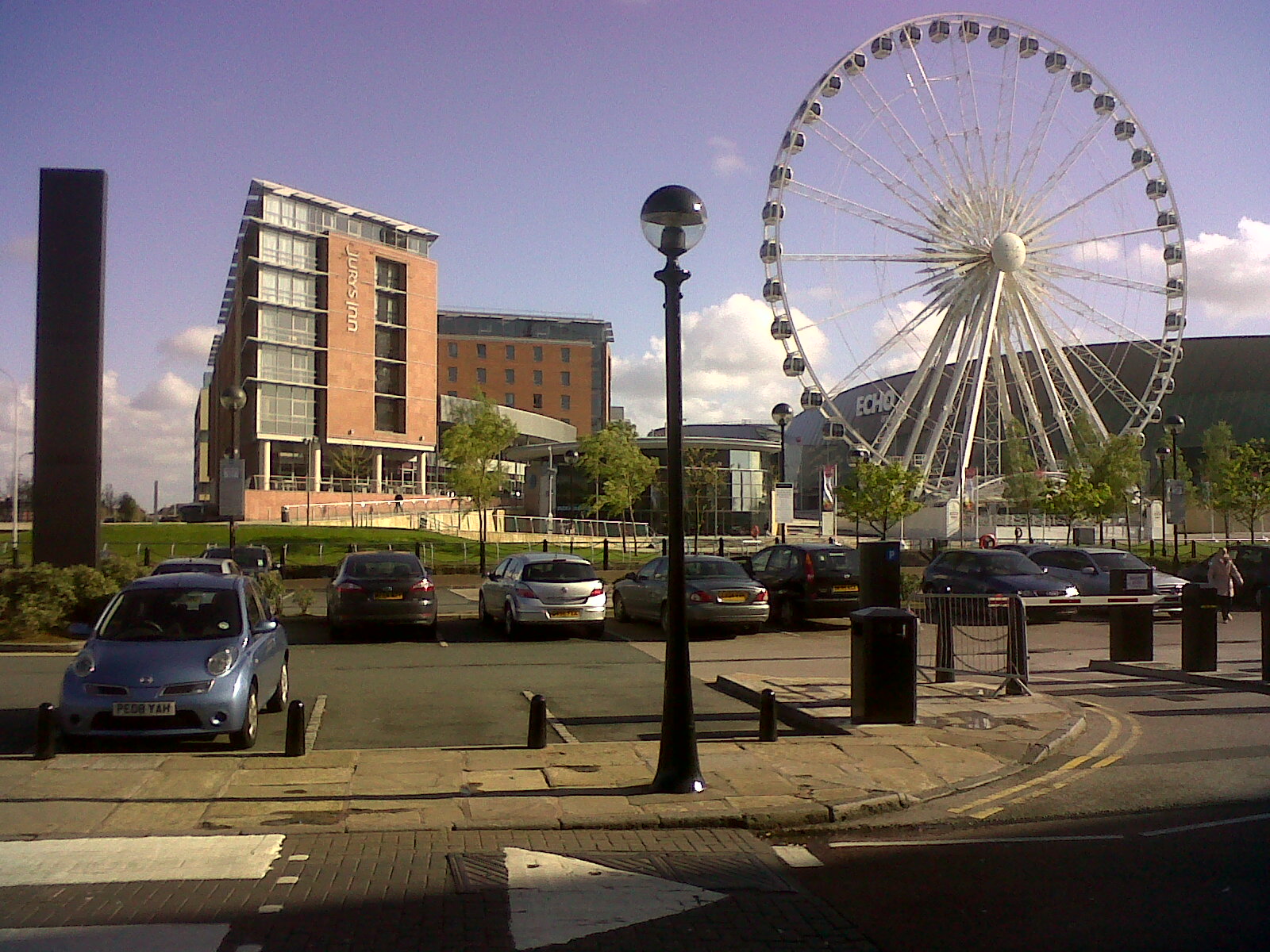
I stayed last night at the Jury’s Inn at Albert Dock, shown on the left here. There’s a sort of Ferris Wheel thing next to it. These contraptions seem to be popping up all over the place. Next thing you know there’ll be one in London! The hotel was of its type, generic but reasonably comfortable. Brings back memories of STFC panel meeting; the Jury’s Inn there is a standard place to stay in Swindon when sentenced to hard labour. Unfortunately the one I stayed in was booked up by multiple stag and hen parties and was ridiculously noisy all night. I didn’t really get any sleep until well after 4am. Grump.
Anyway, last night we had a very nice dinner at the Clove Hitch restaurant/bistro (which I definitely recommend) preceded by a pint at the famous Philharmonic Pub. Thanks to Phil and Sue for looking after us so nicely.
My talk opened the proceedings at the Merseyside Astronomy Day, which was held at Spaceport on the Birkenhead side of the Mersey. Here’s a view of Liverpool’s impressive skyline taken from there, with a nice sailing barge on the Mersey.
The small auditorium – usually used for Planetarium shows – was pretty full and I think my talk went quite well, although it’s not really for me to say. They did actually record everything so if I can get hold of a copy I might post it. Anyway, after my turn there was a fascinating lecture by Prof. Peter Read of Oxford University about the atmospheres of Jupiter and Saturn.
After a quick lunch we used Liverpool’s excellent public transport to zip back to Liverpool Lime Street and I had a relaxing and punctual journey back to Cardiff, albeit with no miracle change at Crewe this time. Dozing on the train I quite startled to wake up near Shrewsbury to find a vintage steam locomotive in sight:
No doubt there’ll be someone out there in internetshire who will tell me all about this train through the comments box but for now I’m going to make some dinner and take it easy as I’m rather knackered.
I’m just about to head by train off up to Merseyside (which, for those of you unfamiliar with the facts of British geography, is in the Midlands). The reason for this trip is that I’m due to give a talk tomorrow morning (Saturday 12th May) at Merseyside Astronomy Day, the 7th such event. It promises to be a MAD occasion.
My lecture, entitled The Cosmic Web, is an updated version of a talk I’ve given a number of times now; it will focus on the large scale structure of the Universe and the ideas that physicists are weaving together to explain how it came to be the way it is. Over the last few decades astronomers have revealed that our cosmos is not only vast in scale – at least 14 billion light years in radius – but also exceedingly complex, with galaxies and clusters of galaxies linked together in immense chains and sheets, surrounding giant voids of empty space. Cosmologists have developed theoretical explanations for its origin that involve such exotic concepts as ‘dark matter’ and ‘cosmic inflation’, producing a cosmic web of ideas that is in some ways as rich and fascinating as the Universe itself.
Anyway, I’m travelling to Liverpool this afternoon so I can meet the organizers for dinner this evening and stay overnight because there won’t be time to get there by train from Cardiff tomorrow morning. It’s not all that far from Cardiff to Liverpool as the crow flies, but unfortunately I’m not going by crow by train. I am nevertheless looking forward to seeing the venue, Spaceport, which I’ve never seen before.
If perchance any readers of this blog are planning to attend MAD VII please feel free to say hello. No doubt you will also tell me off for referring to Liverpool as the Midlands…
Yesterday being the day of my last revision lecture I decided to mark the end of the teaching year last night by going to a concert which was part of a series belonging to the 2012 Vale of Glamorgan Music Festival and was held in All Saints’ Church, Penarth. I would like to have been to more of these performances, but unfortunately it’s the busiest period of the academic year and I just couldn’t spare the time.
I made a special effort to make sure I could get to last night’s concert by the choir Ars Nova Copenhagen partly because of their illustrious reputation as choral singers but also because the programme featured music by Danish composer Per Nørgård, whose music I have only just discovered. Ars Nova Copenhagen consists of twelve singers of extraordinary individual ability and wonderful collective cohesion under the direction of Søren Kinch Hansen. Last night’s performance was truly marvellous.
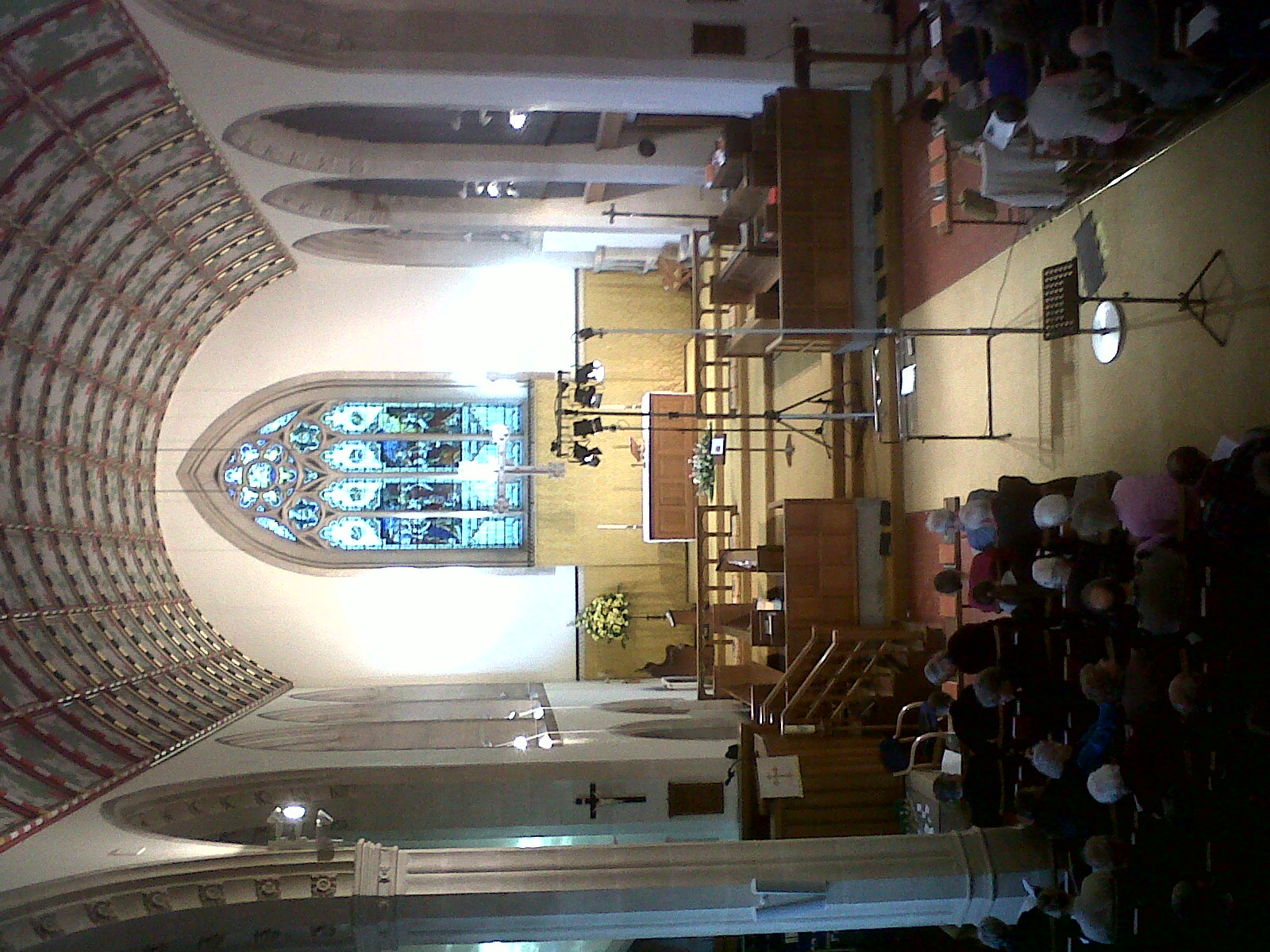
To the left you can see a picture of the venue, just before the concert started; we had seats in the gallery giving an excellent view of the whole performance. The choir made full use of this space, sometimes dividing into groups and standing in different parts of the church. I’m not all that familiar with the terminology of church architecture, but that includes just in front of the sanctuary (where the altar is), in the choir, and in the aisles either side of the central one. Incidentally, I have been told on more than one occasion that the central passageway through the nave is not, as is often stated, the aisle; the aisles are the smaller parallel passageways to either of the nave. I’m sure someone will correct me if I’m wrong!
Anyway, the programme consisted of a mixture of sacred and secular music (some of the latter actually rather profane), starting with a longish piece by Pelle Gudmundsen-Holmgreen which had the choir not only singing but also tweeting like birds and doing animal impressions. I was initially unsettled by this, but pretty soon decided that I liked it.
There then followed three pieces by the great Estonian composer Arvo Pärt – all of which were lovely, but I particularly enjoyed the piece called Morning Star – and then three beautiful pieces by Per Nørgård bringing the first half of the concert to a close.
Somewhat surprisingly for a concert in a church, there followed an interval at which we had a glass of wine. Then there was a second half which had a rather different, rather eclectic flavour. It started with two new works commissioned especially for this Festival, by Peter Bannister and Gavin Bryars, the latter being a moving setting of Psalm 141. A subset of the male voices of the choir then performed a piece by minimalist composer Steve Reich. Finally we heard a fascinating work by Anne Boyd called As I crossed the bridge of dreams which was bore the hallmarks of an oriental influence.
All in all, it was a fascinating and adventurous evening of music, by a wonderful and versatile group of vocal artists, helped by the intimate yet rich acoustic of All Saints’ Church.
You can’t beat live music. What with the various concert venues and the Opera here in Cardiff there are so many opportunities to hear the real thing that my CD collection is steadily gathering dust.
A bit fed up today, and too tired to post anything substantive, so I thought I’d cheer myself up this lunchtime the old-fashioned way with a bit of Louis Armstrong. This was recorded in 1928 by Satchmo with the later incarnation of the Hot Five, which naturally numbered six people in total. The title, Muggles, has nothing to with Harry Potter but is a slang word popular in 1920s Chicago that refers to a certain smoking material of an illicit nature, to which Mr Armstrong was rather partial all his life and which no doubt contributed to the relaxed atmosphere pervading this recording session..
This is the season when our second-year students are picking the projects they want to do in their third year, as are those third-year students intending to carry on for Year 4 of the MPhys programme. I’ve been chatting to quite a few students about this particular project so thought I’d do a quick post here.
One of the third-year projects I’ve got in the current catalogue for next year concerns a computer model of dielectric breakdown based on the idea of diffusion-limited aggregation. This is a neat model that allows the students to simulate pretty patterns like the one shown on the left.
The mathematics of it was first presented in Niemeyer, L., Pietronero, L., Wiesmann, H., “Fractal dimension of dielectric breakdown,” Physical Review Letters52 (1984), 1033-1036.
Dielectric breakdown happens when a sufficiently large voltage is applied across a material that doesn’t normally conduct electricity, the classic example being a lightning strike. Here’s another example, which I find particularly electrifying…
Now the bright morning-star, Day’s harbinger,
Comes dancing from the East, and leads with her
The flowery May, who from her green lap throws
The yellow cowslip and the pale primrose.
Hail, bounteous May, that dost inspire
Mirth, and youth, and warm desire!
Woods and groves are of thy dressing;
Hill and dale doth boast thy blessing.
Thus we salute thee with our early song,
And welcome thee, and wish thee long.
Here’s a nice blog peace giving the case for JUICE (The Jupiter Icy Moon Explorer recently selected by the European Space Agency for its next L-class mission).
There’s been a lot of chatter in astronomy circles about the negative consequences of ESA’s latest L-class (i.e. large) space mission selection. JUICE (The JUpiter Icy moon Explorer) was selected over two rival missions – the New Gravitational wave Observatory (NGO), and the Advanced Telescope for High ENergy Astrophysics (ATHENA). In the current age of global austerity, one group’s win is several groups’ losses, and understandably the X-Ray and gravitational wave communities are upset at the choice. Indeed, reading the comments section on astro blogs might make planetary scientists go a little pale. Not least the fact that ATHENA supporters have already delivered a 1450 signature petition demanding a rethink. The fact that the decision making process has been somewhat cloudy doesn’t help matters.
It does indeed suck that this is a zero-sum game (in fact, probably…
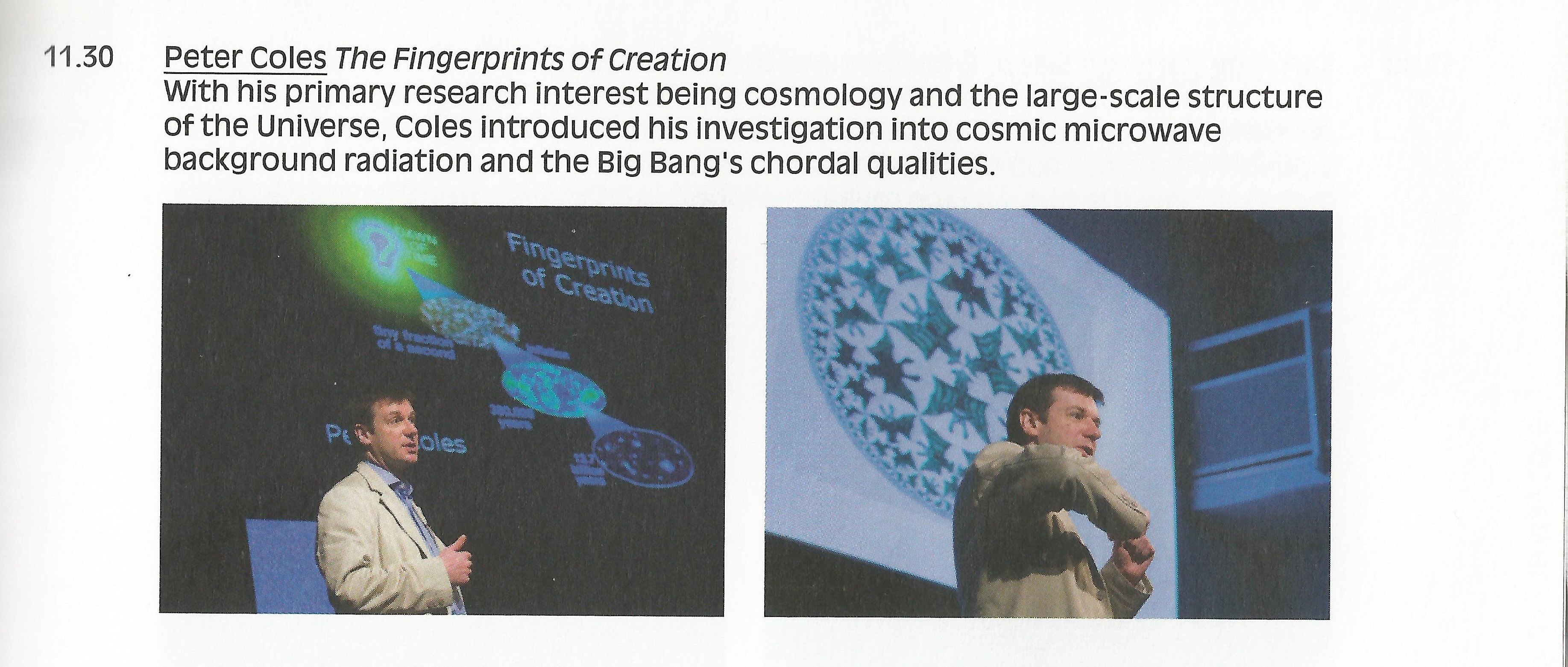
A while ago I blogged about an event I attended, called Experimental Marathon, which was held in Reykjavik Art Museum in May 2008. I was reminded about this for various reasons recently and managed to dig up a couple of pictures of my presentation, which appeared in the glossy book of the event that was produced later on.
As you can probably infer, I gave a talk which was basically about the cosmic microwave background. My “experiment” was a television set that wasn’t tuned properly producing a screenful of static. I pointed out that some (actually not that much) of the buzz was coming from the beginning of the universe. Pretty unoriginal and gimmicky, I know, but it seemed to go down quite well with the audience and I had some nice questions and comments at the end of my 20 minutes.
During the three days of the event I also got to meet quite a few artists, scientists and other luminaries whose names are on the list here.:
You can find one of the numerous reviews of this event here, which also includes quite a few pictures of various experiments including one that some might consider to be NSFW …
Well it’s a Bank Holiday (hooray!) so naturally it’s raining (boo!). Nice to have a lie-in on a Monday morning for a change, but will probably spend the afternoon working anyway. We’ve just finished formal teaching term, and now we have a “Guided Study Week” of revision lectures etc before examinations start next week.
By way of a diversion I thought I’d mention that on my recent trip to South Africa I got a chance the see the film version of John le Carré’s superb novel Tinker, Tailor Soldier, Spy. It was much as I’d expected, actually. Well acted and directed in itself, but rather difficult to enjoy if you’ve either read the book or seen the seven-part 1979 BBC TV dramatisation which, centred around a flawlessly understated performance by Alec Guinness as George Smiley, is surely one of the finest TV drama series ever made, although the sequel Smiley’s People is perhaps even better.
The point is that the original plot by John le Carré is just too complicated to fit in the usual duration of a feature film, so if one knows the full story one can’t fail but be conscious of the alterations and huge chunks completely missing from the movie. Nevertheless, given the constraints, it’s a good film in its own right. I’m glad I watched it, though that was mainly because it reminded me how good the TV version was.
Incidentally, parts of the film were apparently shot at Imperial College. I didn’t actually spot this when watching it, but was told about it afterwards.
Anyway I found this clip on Youtube of the very start of the TV series Tinker, Tailor, Soldier, Spy , a sceneplacedbefore the opening titles rolled. Although it doesn’t correspond to anything in the book, I think it epitomizes what was so good about the television version. It features the four characters who belong to the Witchraft “Magic Circle” responsible for running Source Merlin, a Soviet agent who is supposed to be working as double-agent for British Intelligence (called “The Circus” because of its headquarters in Cambridge Circus). Of course it turns out everything is actually the other way round, and Source Merlin is Moscow Centre’s contact with a mole inside the Circus (codename “Gerald”) who is handing over British secrets. Gerald must be one of the four who have regular contact with Source Merlin, but which one?
I think this scene is brilliant because nobody says a word for most of it, but it immediately establishes the different characters of the respective protagonists. The pompous and punctilious pipe-smoking Percy Alleline (“Tinker”) brings a huge dossier of papers to the meeting, evidently enjoying his role as Head Boy. Flamboyant Bill Haydon (“Tailor”) displays his studied eccentricity by bringing only a cup of tea, with the saucer on top, and a biscuit. Haydon’s expression as Percy starts the meeting is priceless. Dishevelled chain-smoking Roy Bland (“Soldier”) seems entirely preoccupied with other things. Snappily dressed Toby Esterhase (“Poor Man”) betrays his status as a junior member of the club by arriving early – no doubt to impress – and closing the door that Haydon carelessly left open.
The views presented here are personal and not necessarily those of my employer (or anyone else for that matter).
Feel free to comment on any of the posts on this blog but comments may be moderated; anonymous comments and any considered by me to be vexatious and/or abusive and/or defamatory will not be accepted. I do not necessarily endorse, support, sanction, encourage, verify or agree with the opinions or statements of any information or other content in the comments on this site and do not in any way guarantee their accuracy or reliability.