While at Edinburgh this week I was struck by the similarity between theoretical and computational astrophysicist Dr Ken Rice and cosmologist Sean M. Carroll. I wonder if by any chance they might be related?

Sean Carroll

Ken Rice
While at Edinburgh this week I was struck by the similarity between theoretical and computational astrophysicist Dr Ken Rice and cosmologist Sean M. Carroll. I wonder if by any chance they might be related?
Sean Carroll
Ken Rice
I’m back home now after a trip to and from the fine city of Edinburgh which, in case you weren’t aware, is known to the locals as Auld Reekie. I wonder if there’s a local internet guide called Reekipedia?
The excuse for this trip was an invitation to take part in an exercise called a Teaching Programme Review in the School of Physics & Astronomy at the University of Edinburgh. The TPR is an exercise that looks at the courses on offer in the department, how they are taught, as well as the technical and administrative arrangements to back it all up. The Panel involved people from other departments inside the University and a couple of external advisers (both physicists), of which I was one. The Panel will be writing a detailed report on our findings which I hope will turn out to be useful, but it definitely wouldn’t be appropriate to comment on the details here.
What I will say here is that, although it was a very intense and busy few days, including face-to-face meetings with all kinds of academic and support staff, as well as current students, it was extremely interesting. As well as hopefully providing some input and suggestions to the TPR, it was also a chance for me to see the inner workings of another department and pick up a few ideas for the way we teach Physics courses in Cardiff.
One of the striking things about this visit was how similar are many of the problems facing Edinburgh to those we encounter in Cardiff. Another is how easy it is to recognize kindred spirits. It may not always be obvious to the students, but physicists are passionate about their subject, not only in terms of their research but also in terms of nurturing the talents of the students in their care. In the Brave New World of Higher Education we’re all supposed to see universities as businesses, competing ruthlessly in an unforgiving marketplace. In fact, most of us at the real business end of the university system (i.e. teaching and research as opposed to PR and marketing) see our competitors more as colleagues than as rivals. Long may that continue, in my opinion.
During the visit I was taken on a tour of the excellent facilities available at Edinburgh, including some really snazzy and impressive “teaching studios” the like of which I’d never seen before. I’d really love to have a go at teaching in one of those some day, as they offer a different style of education which I’m sure complements the more traditional lecture format. The students seem to like them a lot, which is the most important thing.
However, I have to say that the thing that I was most jealous about was the fact that most of their teaching rooms still have blackboards. Ours have all been replaced with horrible whiteboards that require expensive markers and are far less visible to a big audience. “Chalk and talk” is a tried and tested method and when it’s done well I still think it’s a very effective one. I’m all for innovation in teaching, but some traditional methods are actually pretty good!
Anyway, I’d like to thank everyone from Auld Reekie University for hosting this visit. It was hard work, but thoroughly enjoyable. If anyone from Edinburgh reads this I hope they will pass on my thanks to all the staff and students there for making it such a rewarding occasion! I’m just sorry I didn’t have the chance to see a bit more of the city, but the schedule was just too hectic.
What I did enjoy was staying in a nice hotel for 3 days that offered a truly splendid cooked breakfast in the mornings. I hadn’t started the day with kippers for a very long time! Might need to go on a diet for a few days though….
Follow @telescoperOwing to a combination of circumstances, I’ve decided to take a break from blogging for a few days. Normal services will be resumed as soon as possible but, for the time being, there will now follow a short intermission.
Follow @telescoperI feel like posting a bit of classic blues today, so here’s the inimitable Gertrude “Ma” Rainey way back in 1928. Ma Rainey was one of the very first professional blues singers. She started performing as a teenager around the turn of the last century, so by the time she started making records in the 1920s she had already developed a mature style. Owing to the limitations of recording technology the lyrics of much of her large repertoire are virtually inaudible on disc, but here’s a superb example of her style. She may have been no oil painting, but boy could she sing the blues…
Follow @telescoperI worked all the way through my lunch break getting stuff ready for a short tripette that I have to make next week. My regular post-prandial blogpost is consequently a bit later than usual, and also a bit shorter.
Anyway, the little orbital dynamics question I posted a couple of days ago, which seems to have attracted quite a number of responses, also reminded me of something that happened about 12 years ago, just after I had moved to Nottingham to take up the position of Professor of Astrophysics at the University of Nottingham. I was sitting in my office, working – blogs hadn’t been invented then – when the phone rang and the voice at the other end said May I speak to Professor Coles please? When I replied that I was he, the caller went on to explain that he was a surgeon who worked at Queen’s Medical Centre, a hospital located right next to the University of Nottingham, with teaching staff working for the University.
It turned out that news of the setting up of the new Astronomy group there had made it into the University newsletter which my caller had seen. He asked if I had a few moments to answer a question about astrophysics which had been bothering him for some time and which he had just been discussing with some of his colleagues. I said yes, and he asked: Does the Moon rotate?
I paused a bit, thinking how best to explain, and he went on to clarify his point, which was that if the Moon always has the same face towards the Earth does that mean it’s not rotating.
Understanding his question, I went on to explain that, yes, the Moon does rotate and that the reason it always shows the same face to the Earth (more-or-less, ignoring libration) is that the period of its rotation is the same as the Moon’s orbital period around the Earth. I also explained how to demonstrate this with two coffee mugs, moving one in a circle around the other and rotating the outer one so as to keep the handle pointing towards the central mug. Moreover, I explained the physics of this phenomenon, which is called tidal locking, and pointed out other examples in astrophysics.
After this spiel the caller said that was all very interesting but he had to go now. Assuming I had bored him, as I fear I tend to do rather a lot, I apologized for going on about it for too long. He said no he wasn’t at all bored by the detail I had put in, he found it all absolutely fascinating. The reason for him needing to go was that he had to go back to tell the answer to the colleagues he had been discussing it with just before phoning me. They were all in the operating theatre, standing around a patient lying on the operating table, waiting for him to return and complete the operation he had left in order to make the call…
Follow @telescoperFrom time to time I like to post nice physics problems on here. Here is a quickie that I used to use in my first-year Astrophysical Concepts course which has now been discontinued, so I don’t need to keep it to myself it any longer.
A simple way to travel from one planet in the solar system to another is to inject a spacecraft into an elliptical transfer orbit, like the one shown by the dashed curve, which is described by Kepler’s Laws in the same way that the planetary orbits (solid curves) are.

Kepler’s Third Law states that the period of an elliptical orbit is given by 

All of a sudden it’s November and the arrival of the new month has found me in the mood for a bit of Sylvia Plath. This is November Graveyard, read by the poet herself in that uniquely unsettling voice of hers. Sylvia Plath was born in America but eventually moved to England after she married the poet Ted Hughes. Her accent sounds to me neither American nor British. Her diction, as polished as cut glass but also as brittle, is that of a person striving to re-invent herself. And failing. Her voice sounds to me redolent with alienation, and its coldness gives this reading of this bleak poem an even harder edge than the text alone. Plath took her own life in 1963 and was subsequently buried in the same graveyard referred to in the poem, in Heptonstall, Yorkshire.
The text, as read, differs from some published versions:
The scene stands stubborn: skinflint trees
Hoard last leaves, won’t mourn, wear sackcloth, or turn
To elegiac dryads, and dour grass
Guards the hard-hearted emerald of its grassiness
However the grandiloquent mind may scorn
Such poverty. So no dead men’s cries
Flower forget-me-nots between the stone
Paving this grave ground. Here’s honest rot
To unpick the elaborate heart, pare bone
Free of the fictive vein. When one stark skeleton
Bulks real, all saints’ tongues fall quiet:
Flies watch no resurrections in the sun.
At the essential landscape stare, stare
Till your eyes foist a vision dazzling on the wind:
Whatever lost ghosts flare,
Damned, howling in their shrouds across the moor
Rave on the leash of the starving mind
Which peoples the bare room, the blank, untenanted air.
I’m struck by the resemblance between purveyor of popular comic verse Pam Ayres and Oxford astrophysicist Dr Dimitra Rigopoulou. I wonder if by any chance they might be related?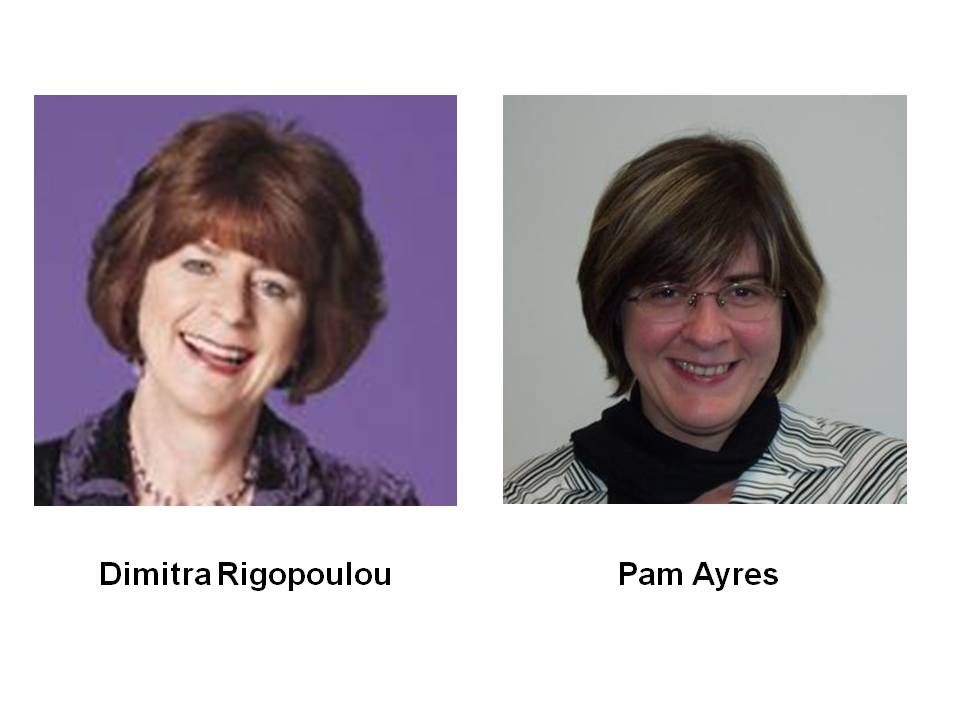
Regular readers of this blog (both of them) will know that a few months ago I tried my hand at stand-up comedy at the Second Bright Club Wales (see posts here and here). Last night I went along to the latest Bright Club show, number 4 of what I hope will be a long-running series. This time it was much more relaxing for me, as I didn’t have to “perform” and was therefore not only spared the nervous tension but also offered the potential of a bit of schadenfreude. Whether it was Hallowe’en horror or stage fright that caused the impromptu renaming of last night’s extravaganza “Fright Club”. As it turned out, all the acts were very good and the audience very friendly, so despite a few nerves nobody actually died…
I know one particular contributor, our own Ed Gomez (who also blogs), was a bit apprehensive before the show, because he told me as much. But he needn’t have worried, as his set turned out to be as hilarious as I thought it would. My only criticism is that I was a bit disappointed with his use of foul language. There just wasn’t enough of it. Anyhow, Ed had the prescience to record his set so here it is in all its glory….
Kudos to all the contributors last night, and to the inestimable MC Dean Burnett for directing the traffic with such aplomb. It was great fun, and as a bonus it gave me an excuse to be out of the house when the trick-or-treaters came round!
Follow @telescoper
 In the Dark