Not Waving but Drowning

Posted in Poetry with tags , on November 19, 2011 by telescoper

Nobody heard him, the dead man,
But still he lay moaning:
I was much further out than you thought
And not waving but drowning.

Poor chap, he always loved larking
And now he’s dead
It must have been too cold for him his heart gave way,
They said.

Oh, no no no, it was too cold always
(Still the dead one lay moaning)
I was much too far out all my life
And not waving but drowning.

by Stevie Smith (1902-1971)

P.S. This is by far the most famous poem by Stevie Smith; it even has its own wikipedia page.


Google Citations

Posted in Uncategorized with tags , , on November 18, 2011 by telescoper

Just time for a quick post this morning to pass on the news that Google Citations is now openly available. I just had a quick look at my own bibliometric data and, as far as I can tell, it’s pretty accurate. As well as total citations, Google Scholar also produces an h-index and something called the i10-index (which is just the number of papers with more than 10 citations). It also gives the corresponding figures for the past 5 years as well as for the entire career of a given researcher.

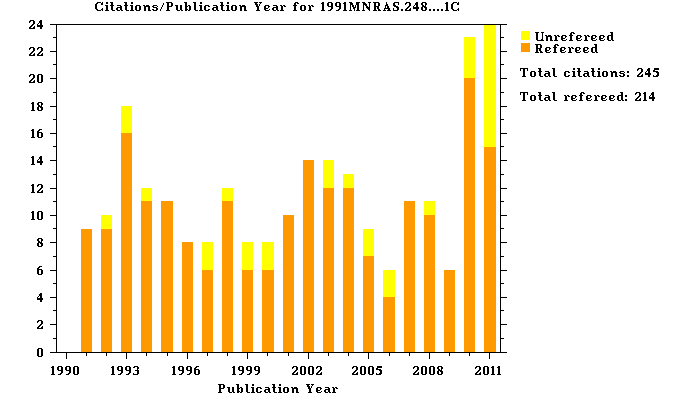
I’ve bragged blogged already about my most popular paper citation-wise, which has 287 citations on Google Scholar, which doesn’t exactly make it a world-beater but I’m still quite please with its impact. What I find particularly interesting about that paper is its longevity. This paper was published in 1991, i.e. 20 years ago, but I  recently looked on the ADS system at its citation history and found the following:

Curiously, it’s getting more citations now than it did when it was first published. I’ve got quite a few “slow burners” like this, in fact, and many of the citations listed for me in the last 5 years actually stem from papers written much earlier. Unfortunately, although I think this steady rate of citation is some sort of indicator of something or other, this is exactly the wrong sort of paper for the Research Excellence Framework, as it is only papers that are published within the roughly 5-year REF window that are taken into account. It would be more useful for the REF panels if the “5-year” window listed citations only to those papers actually published within the last five years. I wonder how the panel will try to use this limited information in assessing the true quality of  a paper?

I should also say that although this paper is, by a large margin, the nearest I’ve got to the citation hit parade, I don’t think it’s by any means the best paper I’ve ever written.

Another weakness is that Google Scholar doesn’t give a normalized h-index (i.e. one based on citations shared out amongst the authors of multi-author papers).

Still, you can’t have everything. Now that this extremely useful tool is available (for free) to all scientists and other denizens of the interwebs, I re-iterate my point that the panels involved in the assessing research for the Research Excellence Framework should use it rather than the inferior commercial versions, which are much less accurate.


Polished Cox

Posted in Uncategorized with tags , on November 17, 2011 by telescoper

It looks like impressionist Jon Culshaw has been working hard on Cox in his spare time judging by the following, rather polished, article recently unveiled on TV:


Kennst du das Land

Posted in Music, Poetry with tags , , on November 16, 2011 by telescoper

I listened to this recording on CD last night and couldn’t resist sharing it on here because it’s so lovely. It’s Hugo Wolf‘s  setting of a poem by Goethe,  called Mignon’s Song, which is actually a reminiscence about Italy (hence the distinctly Italianate flavour of the images in the video).  I’ve actually posted the verse before;  I learned it at school, where I studied German for one year before giving it up to concentrate on science subjects.

I had a rather eccentric teacher who thought the best way to learn a language was to read poetry rather than learning how to say banal things like “Please can you direct me to the railway station?”. It wasn’t a very good idea from an educational point of view, but at least it left me with bits of German poetry still in my head over 30 years later. I can still remember every word of this wonderful poem…

Kennst du das Land wo die Zitronen Blühn,
Im dunklen Laub die Gold-Orangen glühn,
Ein sanfter Wind vom blauen Himmel weht,
Die Myrte still und hoch der Lorbeer steht,
Kennst du es wohl?
Dahin! Dahin,
Möcht ich mit dir, o mein Geliebter, ziehn.

Kennst du das Haus? Auf Säulen ruht sein Dach,
Es glänzt der Saal, es schimmert das Gemach,
Und Marmorbilder stehn und sehn mich an:
Was hat man dir, du armes Kind getan?
Kennst du es wohl?
Dahin! Dahin
Möcht ich mit dir, o mein Beschützer, ziehn!

Kennst du den Berg und seinen Wolkensteg?
Das Maultier sucht im Nebel seinen weg:
In Höhlen wohnt der Drachen alte Brut;
Es stürzt der Fels und über ihn die Flut,
Kennst du ihn wohl?
Dahin! Dahin
Geht unser weg! o Vater, laß uns ziehn!

For an English translation you can look here. But  here it is in its beautiful musical setting by Hugo Wolf,  as performed by the inimitable Elisabeth Schwarzkopf. Gorgeous.


Depressed Superman

Posted in Art with tags , on November 15, 2011 by telescoper

It’s been a while since I posted anything in the box marked “Art”, but I’m inspired to do so now by a short piece in Sunday’s Observer about an artist who is quite new to me called Lora Zombie. It also kind of fits with a theme established by a recent post. The Observer piece about her series of Depressed Superheroes was in the print edition, but doesn’t seem to be available on the website – or if it is I couldn’t find it – but I found another blog article about it here. The pieces are made using acrylics on paper and there are four altogether. I think they’re really excellent. I particularly liked the rather effete and slightly Byronesque Depressed Superman:

You can order a limited edition print of this work here.

Order-of-magnitude Physics

Posted in Cute Problems, Education with tags , , , on November 14, 2011 by telescoper

A very busy day today so I thought I’d wind down by giving you a chance to test your brains with some order-of-magnitude physics problems. I like using these in classes because they get people thinking about the physics behind problems without getting too bogged down in or turned off by complicated mathematics. I’ve also kept some of these in archaic units just to annoy people who can only do things in the SI system. I think it’s good to practice swapping between systems, especially for us astro-types who use all kinds of bizarre units, so if you don’t know the units, look them up! And if there’s any information missing that you need to solve the problem, make an order-of-magnitude estimate!

Give  order of magnitude answers to the following questions:

  1. What is the mass of a body whose weight is equivalent to the total force exerted by a 40 mph gale on the side of a house 40 ft long and 20 ft high? Express your answer in tons.
  2. What is the power required to keep in the air a helicopter of mass 500 kg whose blades are 3m long? Express your answer in kilowatts.
  3. The base of the Great Pyramid  is 750 ft square and its  height is 500ft. How much work was done building it?  Express your answer in Joules.
  4. How high would the jet of a fountain reach if it were aimed vertically up and supplied by a water main in which the pressure is 3 atmospheres? Express your answer in feet.

There’s no prize involved, but feel free to post answers through the comments box. It would be helpful if you explained a  bit about how you arrived at your answer!


Remembered Heroes

Posted in Books, Talks and Reviews, Cricket, History with tags , on November 13, 2011 by telescoper

Two things have come up recently that I’d like to mention here. They’re both, in their different ways, about heroes, but the remembrance that’s called for is different to that normally observed on this day.

First, I couldn’t resist passing on a link to a short but intensely moving piece by Alan Garner in yesterday’s Guardian about Alan Turing, in the My Hero series.

I suppose most readers of this blog will know of Turing’s pioneering work on computer science and his crucial contribution to the war effort in cracking the German Enigma codes. I also suppose most know about the circumstances of his death; he took is own life in 1954 after being forced to endure a form of chemical castration after being found guilty of homosexuality, in case you didn’t already know. Many of you will also have read some (or in my case many) of the various books about his life and work. (If not I recommend Andrew Hodges’ excellent The Enigma of Intelligence, which I read when I was an undergraduate, over 25 years ago.)

But what those of us who never met Alan Turing will never know is what he was really like as a man, and that is why pieces like the one by Alan Garner are so moving. Turing comes across as eccentric (I think we all know what was the case), but also as a very amusing character who was excellent company and a bit of a chatterbox, despite suffering from a stammer. The circumstances of his arrest and subsequent conviction for the “crime” of being gay also confirm the impression that he had an almost childlike innocence about the world outside academe. In other words, he was a very easy target. We like to think we live in more enlightened times nowadays – and I suppose in many ways we do – but I think Alan Turing would be as much, or even more of, a misfit in today’s world than he was in the 1950s. Although he was undoubtedly a genius, he rarely bothered to publish academic papers so I dread to think how he would fare in the present university system!

Anyway, I’d just like to say thank you to Alan Garner (who knew Turing well as a friend) for sharing his thoughts and experiences. I may have never met Alan Turing, but he’s my hero too…

And that brings me to another sad story. I only learned this morning that former cricketer Peter Roebuck died yesterday, at the age of 55, having taken his own life in a hotel room in Cape Town. Peter Roebuck always seemed to me an unlikely figure for a sportsman, with his spectacles, cerebral air, and rather stooped gait he looked more like an academic than an athlete, but he was a fine cricketer. I remember him very well from the time I was a schoolboy mad keen about cricket, and I liked him particularly because he wasn’t – or didn’t seem to be – someone blessed with prodigious natural skill. He made it in the professional game because he worked hard. People like that are always heroes to those, like me, who love sport but don’t have any innate talent for it.

After retiring from cricket Roebuck went to live in Australia and took up a career as writer and commentator on the sport, a role at which he excelled, as much for his lucid prose as for his deep technical knowledge. Although he mainly covered Australian cricket, I often read his articles and admired his writing enormously. I have no idea what caused him to commit suicide, and I wouldn’t wish to speculate about that, let alone presume to judge. All I can say is that it’s the saddest thing when someone takes their own life, whatever the circumstances.

UPDTATE: 14/11/2011 There’s a lot of traffic coming to this post via Google searches of “Was Peter Roebuck gay” or suchlike. I have no idea whether he was or wasn’t and I’m not going to indulge in gossip, so I’m afraid that if that’s the reason you’re here you’re going to be disappointed.

Rest in peace, Peter Roebuck.
 

The Biggest Things in the Universe

Posted in The Universe and Stuff with tags , , , , on November 12, 2011 by telescoper

I’ve never really thought of this blog as a vehicle for promoting my own research in cosmology, but it’s been a while since I posted anything very scientific so I thought I’d put up a brief advertisement for a paper that appeared on the arXiv this week by myself and Ian Harrison (who is a PhD student of mine). Here is the abstract, which I think is pretty informative about the contents of the paper; would that were always the case!

Motivated by recent suggestions that a number of observed galaxy clusters have masses which are too high for their given redshift to occur naturally in a standard model cosmology, we use Extreme Value Statistics to construct confidence regions in the mass-redshift plane for the most extreme objects expected in the universe. We show how such a diagram not only provides a way of potentially ruling out the concordance cosmology, but also allows us to differentiate between alternative models of enhanced structure formation. We compare our theoretical prediction with observations, placing currently observed high and low redshift clusters on a mass-redshift diagram and find – provided we consider the full sky to avoid a posteriori selection effects – that none are in significant tension with concordance cosmology.

The background to this paper is that,  according to standard cosmological theory, galaxies and other large-scale structures such as galaxy clusters form hierarchically. That is to say that they are built from the bottom-up from a population of smaller objects that progressively merge  into larger and larger structures as the Universe evolves. At any given time there is a broad distribution of masses, but the average mass increases as time goes on. Looking out into the distant Universe we should therefore see fewer high-mass objects at high redshift than at low redshift.

Recent observations – I refer you to our paper for references – have revealed evidence for the existence of some very massive galaxy clusters at redshifts around unity or larger, which corresponds to a look-back time of greater than 7 Gyr. Actually these are not at high redshift compared to galaxies, which have bee found at redshifts around 10, where the lookback time is more like 12 Gyr, but these are at least a thousand times less massive than large clusters so their existence in the early Universe is not surprising in the framework of the standard cosmological model. On the other hand, clusters of the masses we’re talking about – about 1,000,000,000,000,000 times the mass of the Sun – should form pretty late in cosmic history so have the potential to challenge the standard theory.
In the paper we approach the issue in a different manner to other analyses and apply Extreme Value Statistics to ask how massive we would expect the largest cluster in the observable universe should be as a function of redshift. If we see one larger than the limits imposed by this calculation then we really need to consider modifying the standard theory. This way of tackling the problem attempts to finesse a  number of biases  in the usual approach, which is to attempt to estimate the number-density n(M) of clusters as a function of mass M, because it does not require a correction for a posteori  selection effects; it is not obvious, for example, prevcisely what volume is being probed by the surveys yielding these cluster candidates.

Anyway, the results are summarised in our Figure 1, which shows some estimated cluster masses, together with their uncertainties, superimposed on the theoretical distribution of the mass of the most massive cluster at that redshift:

If you’re wondering why the curves turn down at very low redshift, it’s just because the volume available to be observed at low redshift is small: although objects are generally more massive at low redshift, the chance of getting a really big one is reduced by the fact that one is observing a much smaller part of space-time.

The results show:  (a) that, contrary to some claims, the current observations are actually entirely consistent with the standard concordance model; but also  (b)  that the existence of clusters at redshifts around 1.5 with masses much bigger than 10^{15} M_{\odot} would require the tabling of an amendment to the standard theory.

Of course this is is a very conservative approach and it yields what is essentially a null result, but I take the view that while theorists should be prepared to consider radical new theoretical ideas, we should also be conservative when it comes to the interpretation of data.


The Connoisseuse of Slugs

Posted in Poetry on November 12, 2011 by telescoper

I couldn’t resist posting this, one of the strangest yet most beautiful love poems I’ve ever read,  by the American poet Sharon Olds. The damp climate of Cardiff makes it something of a paradise for slugs and they’re such a nuisance in my garden that I never dreamt anyone would write devotional verse about them. Anyway, I love it and I hope you enjoy it too.

When I was a connoisseuse of slugs
I would part the ivy leaves, and look for the
naked jelly of those gold bodies,
translucent strangers glistening along the
stones, slowly, their gelatinous bodies
at my mercy. Made mostly of water, they would shrivel
to nothing if they were sprinkled with salt,
but I was not interested in that. What I liked
was to draw aside the ivy, breathe the
odor of the wall, and stand there in silence
until the slug forgot I was there
and sent its antennae up out of its
head, the glimmering umber horns
rising like telescopes, until finally the
sensitive knobs would pop out the
ends, delicate and intimate. Years later,
when I first saw a naked man,
I gasped with pleasure to see that quiet
mystery reenacted, the slow
elegant being coming out of hiding and
gleaming in the dark air, eager and so
trusting you could weep.

Insensibility

Posted in Poetry with tags , , , on November 11, 2011 by telescoper

It’s the Eleventh Day of the Eleventh Month which means it’s Remembrance Day. I’ve posted about my thoughts about this time of year before (see, for example, here and here). Rather than say it all again, therefore, I decided to post a poem by the greatest poet of the First World War, Wilfred Owen. I might even go as far as to say that this is Wilfred Owen’s greatest poem. It’s certainly one of his most complex and ambivalent works, as it juxtaposes the necessary insensitivity of men who have to survive in conditions so appalling
that they might otherwise go mad, with the unawakened or even wilful insensibility of people who have never been confronted with the horror of what war is really like. Lest we forget.

I

Happy are men who yet before they are killed
Can let their veins run cold.
Whom no compassion fleers
Or makes their feet
Sore on the alleys cobbled with their brothers.
The front line withers,
But they are troops who fade, not flowers
For poets’ tearful fooling:
Men, gaps for filling
Losses who might have fought
Longer; but no one bothers.

II

And some cease feeling
Even themselves or for themselves.
Dullness best solves
The tease and doubt of shelling,
And Chance’s strange arithmetic
Comes simpler than the reckoning of their shilling.
They keep no check on Armies’ decimation.

III

Happy are these who lose imagination:
They have enough to carry with ammunition.
Their spirit drags no pack.
Their old wounds save with cold can not more ache.
Having seen all things red,
Their eyes are rid
Of the hurt of the colour of blood for ever.
And terror’s first constriction over,
Their hearts remain small drawn.
Their senses in some scorching cautery of battle
Now long since ironed,
Can laugh among the dying, unconcerned.

IV

Happy the soldier home, with not a notion
How somewhere, every dawn, some men attack,
And many sighs are drained.
Happy the lad whose mind was never trained:
His days are worth forgetting more than not.
He sings along the march
Which we march taciturn, because of dusk,
The long, forlorn, relentless trend
From larger day to huger night.

V

We wise, who with a thought besmirch
Blood over all our soul,
How should we see our task
But through his blunt and lashless eyes?
Alive, he is not vital overmuch;
Dying, not mortal overmuch;
Nor sad, nor proud,
Nor curious at all.
He cannot tell
Old men’s placidity from his.

VI

But cursed are dullards whom no cannon stuns,
That they should be as stones.
Wretched are they, and mean
With paucity that never was simplicity.
By choice they made themselves immune
To pity and whatever mourns in man
Before the last sea and the hapless stars;
Whatever mourns when many leave these shores;
Whatever shares
The eternal reciprocity of tears.