The PostDoc Apocalypse: How it begins (via The Upturned Microscope)

Posted in Uncategorized with tags , , , , , on June 16, 2011 by telescoper

I think this might strike a chord with some of my readers, but any implication that postdocs are equivalent to zombies is completely uninentional.

The PostDoc Apocalypse: How it begins From the people who brought you The PostDoc Trailer! … Read More

via The Upturned Microscope

Cat Call

Posted in Columbo with tags , , , on June 16, 2011 by telescoper

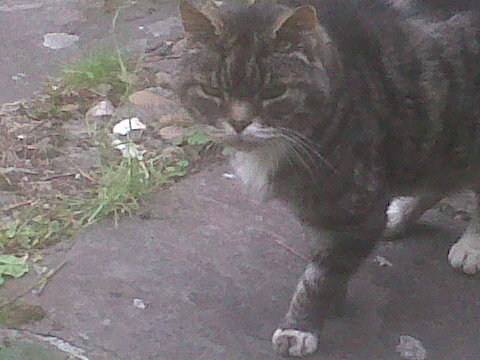
Just time for a quick post today, as I’m off to the airport this afternoon for a short trip (which I’ll no doubt blog about at the weekend when I get back). I’m also late into the office because I had to take my cat Columbo to the vet for his six-monthly check-up.

Columbo is now 17 years old (and a few months) and has been diabetic for the last six or seven of those. He needs to have a check-up every 6 months primarily to monitor whether his insulin dose (which is administered twice a day) is adequate to control his blood sugar level. The vet also gives him a general medical, and weighs him, during these visits.

This morning Columbo was even more reluctant than usual to get into his box for the trip to the vets. Eventually I got him in, but was apprehensive. Usually when he’s in that sort of mood he retaliates by befouling the box. This time, however, he settled down quite quickly and there were no toiletary disasters en route. The vet’s waiting room was empty when we arrived at 9am so we got seen straight away.

The vet was impressed by his age, especially when she saw how long he has been diabetic. Even without this condition 16 is a pretty good age for a tom cat. Columbo has been through a number of serious medical episodes, at least a couple of which took him near death, but he has always managed to bounce back. He may be an old boy now, but he gets 10/10 for resilience. Looking back over his (substantial) medical history, the vet seems to be amazed by his powers of recovery although history is now definitely taking its toll and he’s looking a bit frail nowadays.

The vet noted the effects of the advancing years. His eyesight has clearly dimmed. He’s never been very good at catching birds and mice, but I think he struggles even to see them nowadays. Despite the glucosamine treatment he has been having, his arthritis has also deteriorated. The stiffness in his joints makes it difficult for him to groom himself, so his coat isn’t in great condition even though I brush him regularly. He’s also lost a bit of weight since the last visit; not enough to be life-threatening, but significant nevertheless.

On the other hand, his heartbeat and other vital signs seem to be in order, and he purred contentedly on the table during the examination. The vet was a little concerned about his weight loss, but said he clearly wasn’t in any discomfort and trying to prod and probe, take blood samples and whatever to find out the reason was just going to cause him distress. And even if they could fix it, he was still going to be a very old cat if and when he recovered and there’s no cure for old age.

During these visits the vet usually takes a blood sample in order to check glucose and fructosamine levels for diagnostic purposes. This time, however, she suggested that it was probably best to skip it. The business of drawing a vial of blood from a cat’s neck is unpleasant and extremely distressing for the animal. Given that his bodily signs were OK, there seemed little point in subjecting him to this. Instead she suggested we just maintain the current insulin level unless and until something appears to go wrong. I agreed.

Not doing the blood tests saved me a bit of money, but that’s not the point at all. I know the old boy is much nearer the end of his life than the beginning. I just want his last days to be as comfortable and happy as possible. I don’t see the point of making him uncomfortable to satisfy veterinary curiosity or to prolong his life by a few months. When the time comes, I’d rather he went peacefully.

The one thing I did agree on was to try some anti-inflammatory treatment for his arthritis, stuff you squirt on food. If that works it might make it easier for him to get around, and also groom himself. It does have a side-effect with some cats, making them nauseous, so I have to build it up slowly and keep an eye on him in case he gets sick.

Anyway, when it was time to go he climbed willingly into his box – the cat-box process is a very different business at the vet compared to what it’s like at home. When we got home he bundled out at high speed and headed straight for his food dish. He still has a healthy appetite, that’s for sure.

Here’s a quick picture for his fans, taken just before he went in his basket for a nap.

Welsh fee plans up in the air…

Posted in Education, Politics with tags , , , , , , , , on June 15, 2011 by telescoper

I had just finished the exciting job of marking my examinations and collating all the results with coursework when I noticed a rumour circulating on twitter about the Higher Education Funding Council for Wales (HEFCW) having rejected plans by all Welsh universities to charge higher fees than the basic £4K laid down by the Welsh Assembly Government. The rumour later developed into a story on the NUS website and then on the local BBC News, Wales Online and the Times Higher.

In case you’re not up with the intricacies of Welsh Higher Education policy, universities here in the Principality will, from 2012, be allowed to charge fees of up to £9K per annum (as in England) if and only if they have approval from HEFCW for plans relating “to widening access and to improving the student experience.” Note there’s apparently no requirement of providing a better education in that. As a mere university teacher I have no idea at all what has gone into Cardiff University’s plan nor do I know why it is deemed satisfactory. Such things are done by our lords and masters in the University administration.

It does seem strange, though, that the process works this way, i.e. that HEIs have to produce plans that they hope will be accepted by HEFCW. Why doesn’t HEFCW simply tell the HEIs what they have to do to be able to charge the fees? I wonder how the clear the guidance from HEFCW was. It might be a case of “Read my mind to see what I want, and if you don’t give it to me I’ll shoot you”.

Universities wishing to charge £9K (which is, predictably, nearly all of them) had to submit their plans to HEFCW by the end of May. Several universities did so, including Cardiff, Aberystwyth, Bangor, and even Glamorgan, who all want to charge the maximum £9K. HEFCW has now announced that none of them meet the standard needed to charge more than £4k. There’s still quite a bit of time for universities to amend their plans before the deadline of 11th July, so this is by no means the end of the story, but it has certainly set alarm bells ringing where I work!

The point is that the Welsh Assembly Government is heavily cutting the funds it allocates to Welsh Universities from 2012, so if institutions are not allowed to charge sufficiently high fees to recoup that loss then many departments are going to be in really big trouble, especially those teaching expensive subjects.

Education Minister Leighton Andrews is quoted as saying

I asked for Hefcw to be thorough and robust when scrutinising the fee plans submitted by our higher education and further education institutions. It is clear that they have been and I heartily endorse this.

There are a number of ways of reading the lie of the land here. One is that it’s actually a sensible process of consultation between individual institutions and HEFCW. Since this is uncharted territory for both there may well be things that need to be clarified on both sides, and HEFCW may therefore be engaging in a sensible process of consultation and iteration in order to help institutions produce acceptable plans. It could also represent an element brinkmanship, so the Minister and HEFCW can be seen to be flexing a bit of muscle, in contrast to the situation in England, where it appears the government has no power to prevent institutions charging higher fees. I always felt it was inevitable that Cardiff, as a Russell Group University, would want to charge £9K, but I can imagine Leighton Andrews being irritated by places like Glamorgan wanting to charge the same.

Whatever game is being played, it’s a very dangerous one and the stakes are very high. The Welsh Assembly Government has already indicated it will pay the fees of any Welsh domiciled students wherever they study in the UK. For the most part that will mean £9K per student per year for Welsh students wanting to study in England. If Welsh universities can only charge £4K per year for students coming from England to Wales then there will be a huge imbalance in funds flowing in and out of the higher education sector. In effect, the Welsh Assembly Government will be subsidising English universities at the expense of Welsh ones.

Currently the number of English students coming to Wales exceeds the number of Welsh students studying in England. The WAG’s plan relies on a net influx of funds to offset the cuts in central funding needed to pay student bursaries. However, English students do not come in equal numbers to all Welsh institutions. More come to Cardiff University than, say, Bangor. So how will this extra income from England benefit the Welsh HE sector generally? Is the proposal to cut HEFCW funds to Universities who succeed in attracting English cash cows students and redistribute the dosh among those institutions that don’t? That hardly seems equitable to me.

I’m certainly not in a panic about this news, although I may be on July 11th when we find out the final outcome. In the meantime, as a humble academic at the bottom of the ladder when it comes to such matters, I’ll get on with my teaching and research and pray that those in charge actually know what they’re doing…

Astronomy Look-alikes, No. 57

Posted in Astronomy Lookalikes with tags , , on June 15, 2011 by telescoper

I wonder if anyone else has noticed the remarkable similarity both in character and appearance between Cardiff’s own Professor Derek Ward-Thompson and Thumper, the obdurate quarry vehicle from Thomas the Tank Engine? Is this why the 200 micron photometer on which Derek was the Principal Investigator was also called THUMPER?

Derek

Thumper

The Final Analysis

Posted in Education with tags , , , , on June 14, 2011 by telescoper

It’s that time of year again. The annual meeting of the Board of Examiners of the School of Physics & Astronomy at Cardiff University met this afternoon to consider the marks for students due to graduate this year and to draw up recommendations for the final degree classifications.

This year’s meeting was actually quite interesting and, at just over two hours, somewhat shorter than some we’ve had in previous years.  A group of students has already gathered in the foyer waiting for the dreaded list to be posted, and many will no doubt be celebrating or drowning their sorrows in local hostelries shortly after their fate is revealed.

Cardiff is a little old-fashioned in the way the final examiners’ meetings are conducted. For a start we still have a system of viva voce examinations for borderline candidates; they happened yesterday, in fact. Many universities have dispensed with this aspect of the process, but I still think they’re worthwhile. The Board of Examiners, including the two External Examiners,  also still has some discretion in how it arrives at the degree boundaries (which are nominally at 70% for a first, 60% for a 2.1, 50% for a 2.2, and 40% for a 3rd).

The tide is turning against this very traditional approach, however, and there are moves here to dispense with the viva examinations and with academic discretion. I’m not sure when this will happen, but it’s likely to be sooner rather than later. I think the main reason for this is to make the system more automatic so there’s less chance of legal challenge. In any case there doesn’t seem to me that there can be any educational reason for it.

The one thing that strikes me about the system we have is that it’s the whole business of classifying degrees into broad categories which is where the problem lies.  It was suggested some time ago that we should dispense with, e.g., the “Desmond” (2.2) and the “Thora Hird” (3rd) and instead simply give each student a transcript containing details of the entire spectrum of their academic performance. It’s been suggested again just recently too. That would seem to me to make much more sense than the current system of classifying degrees which involves (a) trying to condense a huge amout of information – examination marks, coursework, project assignments and the like – into a single number and then (b) drawing boundaries based on this number precisely where the distribution is most densely peaked. However, years have passed and nothing concrete has happened. The academic world is good at inertia.

Anyway, this isn’t the time or the place for a lengthy diatribe about the ins-and-outs of degree classifications. I’ve got to go back to marking my 1st year examination papers shortly in fact; these are considered by a separate meeting of the Board of Examiners.

It is time, however, for me to congratulate all our graduating students on their success. It’s the first group of Cardiff MPhys students that I’ve seen all the way through from entry  to graduation. I’ll be sad to see them go, but wish them all the best as they venture forth into the real world. At least I hope to see them back next month for graduation.  Until then, however, all I’ll  say is

Congratulations!

Topological Escapology

Posted in Education, The Universe and Stuff with tags , on June 13, 2011 by telescoper

The occasional  teasers I post on here seem to go down quite well so I thought I’d try this one on you.  I recently found it in an old book on the topic of  topology, a fascinating field that finds many applications in physics, including several in my own field of  cosmology.

It’s probably best not to ask why, but the two gentlemen in the picture, A and B, are tied together in the following way. One end of a piece of rope is tied about A’s right wrist, the other about his left wrist. A second rope is passed around the first and its ends are tied to B’s wrists.

Can A and B free each other without cutting either rope, performing amputations,  or untying the knots at either person’s wrists?

If so, how?

Louco

Posted in Biographical, Music with tags , on June 12, 2011 by telescoper

I’ve been saving this remarkable old record for a rainy day, and since it’s been tipping down all morning I think it’s time to share it.

Just a few months after I moved to my house in bit of Cardiff called Pontcanna I went with a friend to a little Portuguese restaurant just around the corner. The food was pretty cheap, fairly simple, but very tasty. The staff were friendly but extremely disorganized, taking ages to produce the food even though the place wasn’t at all busy. They also had some Portuguese fado music playing while we waited. I normally don’t like music in restaurants because even if the music’s worth listening to – which it usually isn’t – you can’t hear it properly anyway over the chatter and sound of knives on plates. In this case, however, towards the end of the meal,  I heard, for the very first time, a record featuring an agonized voice – as much haunted as haunting – which immediately sent cold shivers down my spine. I asked the waitress who was singing on the record we were listening to, and she told me it was the great Alfredo Marceneiro.

I’m not going to pretend to be any kind of an expert on fado, although I have at least heard of Amália Rodrigues (the greatest female fado performer of the classic era), and am a big fan of her wonderful modern counterpart Mariza. I hadn’t known until that night in the restaurant that there were any male fado singers at all. However, Alfredo Marceneiro’s career spanned a half a century, from the mid 1920s, and he has been an immense influence on younger generations of musicians since then. His compositions have also become part of the standard  repertoire. I suppose you could say that Alfredo Marceneiro is to fado what Robert Johnson is to the blues.

Fado is very much a Portuguese genre and I suppose it’s difficult to “get” if you’re not brought up with the tradition or even the language. I barely know a word of Portuguese myself, and have no idea what the words of the following song actually mean. I think it’s a testament to the power of the music that the actual words don’t seem to matter all that much when you can sing out of your very soul like this man could.

I’m afraid the Youtube version of this track is a bit truncated, but I’m putting it up anyway because it’s exactly the recording I heard that night three years ago. I think it’s a riveting performance, by an extraordinary artist who is celebrated in his own country, but who in my opinion deserves much wider recognition.

P.S. I know that the title “Louco” means “Crazy” in Portuguese, but   I’d be very grateful if someone could supply a translation of the rest of the song…..

P.P.S. I went back to the restaurant about six months after the time I mention in the post, but it had changed name and ownership. It’s now cleaner, but has much less character and no music. I haven’t returned.

Astronomy Look-alikes, No. 56

Posted in Astronomy Lookalikes with tags , on June 12, 2011 by telescoper

I wonder if anyone else has noticed the remarkable resemblance between Dr Anthony Challinor and Ludwig Wittgenstein? I wonder if perhaps they might be related? After all, a picture is a fact…

Anthony Challinor

Ludwig Wittgenstein

A Bridge Too Far

Posted in Education with tags , , , on June 11, 2011 by telescoper

My commitment to the education of the great unwashed knows no bounds. Tonight’s subjects are architecture and geography.

Not a lot of people know that the relatively unknown Sydney Harbour Bridge is in fact a cheap replica of a much more famous structure in a much more interesting location:

Sydney Harbour Bridge

Tyne Bridge

The Value of Honour

Posted in Politics with tags , , , on June 11, 2011 by telescoper

Big news this morning was the release of the Queen’s Birthday Honours List for 2011 which, if you’re interested, you can download in full here. The awards that made the headlines were a knighthood for Bruce Forsyth and gongs for England cricket stars  Andrew Strauss and Alastair Cook. A smattering of academics (including an astrophysicist and a particle physicist) were also among those to get invitations to  Buckingham Palace in order to receive honours of various sorts from Her Majesty.

The honours system must appear extremely curious to people from outside the United Kingdom. It certainly seems so to me. On the one hand, I am glad that the government has a mechanism for recognising the exceptional contributions made to society by certain individuals. Musicians, writers, sportsmen, entertainers and the like generally receive handsome financial rewards, of course, but that’s no reason to begrudge a medal or two in recognition of the special place they occupy in our cultural life.  It’s  good to see scientists recognized too, although they tend not to get noticed so much by the press.

On the other hand, there are several things about the system that make me extremely uncomfortable. One is that the list of recipients  of certain categories of award is overwhelmingly dominated by career civil servants, for whom an “honour”  goes automatically with a given rank. If an honour is considered an entitlement in this way then it is no honour at all, and in fact devalues those awards that are  given on merit to people outside the Civil Service. Civil servants get paid for doing their job, so they should have no more expectation of an additional reward than anyone else.

Honours have relatively little monetary value on their own, of course so this is not question of financial corruption. An honour does, however, confer status and prestige on the recipient so what we have is a much more subtle form of perversion.

Worse still is the dishing out of gongs to political cronies, washed-up ministers, and various sorts of government hangers-on. An example of the latter is the knighthood awarded to Steve Smith, Chair of Universities UK, who stated, apparently without humorous intent,

Normally the UUK president gets a knighthood in the summer after they finish, so I was expecting it – in the sense that you ever expect these things – in July next year.

I read this as meaning

Usually the UUK president is rewarded for being a spineless government lackey after they’ve finished, but I’ve been such a brilliant spineless government lackey I’m getting my reward early.

Although the honours system has opened up a little bit over the last decade or so, to me it remains a sinister institution that attempts to legitimise the self-serving nature of its patronage by throwing the odd bone to individuals outside the establishment. I don’t intend any disrespect to the individuals who have earned their knighthoods, MBEs, OBEs, CBEs or whatnot. I just think they’re being rewarded with tainted currency.

And that’s even before you take into account the award of a knighthood to the loathsome homophobic spiv Brian Souter. Well, I mean. Does anyone really think it’s an honour to be in the same club as him? I find it deeply offensive that he could  have been considered an appropriate person to be on the list. If you feel the way I do, please sign the petition here.

There. I’ve said it. Bang goes my knighthood.