NAM 2011

Posted in The Universe and Stuff with tags , , , , on January 20, 2011 by telescoper

Just a quick post to plug this year’s forthcoming Royal Astronomical Society National Astronomy Meeting, incorporating the MIST and UKSP meetings, which will be taking place at the splendid Venue Cymru conference centre, Llandudno, North Wales, from Sunday 17 April to Thursday 21 April.

Registration is now open, and you can now also submit abstracts of either oral or poster presentations to be considered for inclusion in the various sessions described in the science programme.

I’ve been asked to organise a small part of this meeting, namely a session on Recent Developments in Astro-statistics, so if you’d like to give a talk in that session please register and upload an abstract to the website. You can’t do the latter until you have done the former. Astro-statistics will be interpreted widely, so I hope to have a varied programme including as many applications of statistics to astronomy and astrophysics as I can get!

NAM is a particularly good opportunity for younger researchers – PhD students and postdocs – to present their work to a big audience so I particularly encourage such persons to submit abstracts. Would more senior readers please pass this message on to anyone they think might want to give a talk?

If you have any questions please feel free to use the comments box (or contact me privately).


Share/Bookmark

What is a Galaxy?

Posted in The Universe and Stuff with tags , , , , , , on January 19, 2011 by telescoper

An interesting little paper by Duncan Forbes and  Pavel Kroupa appeared today on the arXiv today. It asks what you would have thought was the rather basic question “What is a Galaxy?”. Like many basic questions, however, it turns out to be much  more complicated than you imagined.

Ask most people what they think a galaxy is and they’ll think of something like Andromeda (or M31), shown on the left, with its lovely spiral arms. But galaxies exist in many different types, which have quite different morphologies, dynamical properties and stellar populations.

The paper by Forbes and Kroupa lists examples of definitions from technical articles and elsewhere. The Oxford English Dictionary, for instance, gives

Any of the numerous large groups of stars and other
matter that exist in space as independent systems.

I suppose that is OK, but isn’t very  precise. How do you define “independent”, for example? Two galaxies orbiting in a binary system aren’t independent, but you would still want to count them as two galaxies rather than one. A group or cluster of galaxies is likewise not a single large galaxy, at least not by any useful definition. At the other extreme, what about a cluster of stars or even a binary star system? Why aren’t they regarded as gaaxies too? They are (or can be) gravitationally bound..

Clearly we have a particular size in mind, but even if we restrict ourselves to “galaxy-sized” objects we still have problems. Why is a globular cluster not a small galaxy while a dwarf galaxy is?

To be perfectly honest, I don’t really care very much about nomenclature. A rose by any other name would smell as sweet, and a galaxy by any other name would be just as luminous. What really counts are the physical properties of the various astronomical systems we find because these are what have to be explained by astrophysicists.

Perhaps it would be better to adopt Judge Potter Stewart‘s approach. Asked to rule on an obscenity case, he wrote that hard-core pornography was difficult to define, but ” I know it when I see it”….

As a cosmologist I tend to think that there’s only one system that really counts – the Universe, and galaxies are just bits of the Universe where stars seemed to have formed and organised themselves into interesting shapes. Galaxies may be photogenic, nice showy things for impressing people, but they aren’t really in themselves all that important in the cosmic scheme of things. They’re just the Big Bang’s bits of bling.

I’m not saying that galaxies aren’t extremely useful for telling us about the Universe; they clearly are. They shed light (literally) on a great many things that we wouldn’t otherwise have any clue about. Without them we couldn’t even have begun to do cosmology, and they still provide some of the most important evidence in the ongoing investigation of the the nature of the Universe. However, I think what goes on in between the shiny bits is actually much more interesting from the point of view of fundamental physics than the shiny things themselves.

Anyway, I’m rambling again and I can hear the observational astronomers swearing at me through their screens, so let me move on to the fun bit of the paper I was discussing, which is that the authors list a number of possible definitions of a galaxy and invite readers to vote.

For your information, the options (discussed in more detail in the paper) for the minimum criteria to define a galaxy are:

  • The relaxation time is greater than the age of the Universe
  • The half-light radius is greater than 10 parsecs
  • The presence of complex stellar systems
  • The presence of dark matter
  • Hosts a satellite stellar system

I won’t comment on the grammatical inconsistency of these statements. Or perhaps I just did. I’m not sure these would have been my choices either, but there you are. There’s an option to add your own criteria anyway.

The poll can be found here.

Get voting!

UPDATE: In view of the reaction some of my comments have generated from galactic astronomers I’ve decided to add a poll of my own, so that readers of this blog can express their opinions in a completely fair and unbiased way:


Share/Bookmark

Disturbing Admissions

Posted in Education, Politics with tags , , , on January 18, 2011 by telescoper

In a rare moment of wakefulness during yesterday’s Board of Studies, I listened to a report from our departmental admissions tutor about the state of play with applications for entry onto our physics courses next year. It was good news – applications are up more than 50% on last year – but this was tempered by the fact that our quota has gone down slightly, owing to the presence of a cap on student numbers. I’m not sure whether the increase, perhaps caused by students trying to get into university before the fee  goes up to £9K, is echoed around the country, but it seems likely that competition for places will be intense this year, with the almost certain result that many students  will be disappointed at being unable to get into their first choice university.

Coincidentally, I noticed a story on the BBC at the weekend suggesting that the whole timetable of university admissions might change. What the government is planning remains to be seen, but there’s no doubting the system is far from perfect and if we had the opportunity to design a process for university admissions from scratch, there is no way on Earth we would end up with a system like the current one.

As things stand, students apply for university places through UCAS before they have their final A-level results (which don’t come out until July). Most applications are in by January of the year of intended admission, in fact. The business of selecting candidates and making offers therefore makes use of “predicted grades” as supplied by teachers of the applicant.

According to the BBC news

..under the current system those from poorer backgrounds typically have their grades under-predicted.

I simply don’t know whether there is any information to back this up – in my (limited) experience most teachers systematically overestimate the grades of their pupils – but if it is the case then it would be a good reason for changing the timetable so that potential students could apply once they have their results in the bag. They can do that now, of course, but only if they take a gap-year, applying for admission the year after they have their A-levels.

But the inaccuracy of predicted A-level grades is not the only absurdity in the current system. Universities such as Cardiff, where I work, have to engage in enormous amounts of guesswork during the admissions process. Suppose a department has a quota of 100, defining the target number students to take in. They might reasonably get a minimum of 500 applications for these 100 places, depending on the popularity of university and course.

Each student is allowed to apply to 5 different institutions. If a decision is made to make an offer of a place, it would normally be conditional on particular A-level grades (e.g. AAB). At the end of the process the student is expected to pick a first choice (CF) and an insurance choice (CI) out of the offers they receive. They will be expected to go to their first choice if they get the required grades, to the insurance choice if they don’t make it into the first choice but get grades sufficient for the reserve. If they don’t make either grade they have to go into the clearing system and take pot luck among those universities that have places free after all the CFs and CIs have been settled.

Each university department has to decide how many offers to make. This will always be larger than the number of places, because not all applicants will make an offer their CF. We have to honour all offers made, but there are severe penalties if we under or over recruit. How many offers to make then? What fraction of students with an offer will put us first? What fraction of them will actually get the required grade?

The answers to these questions are not at all obvious, so the whole system runs on huge levels of uncertainty. I’m amazed that each year we manage to get anywhere close to the correct number, and we usually get very close indeed by the end.

It’s a very skilled job, being an admissions tutor, but there’s no question it would all be fairer on both applicants and departments to remove most of the guesswork.

But there is the rub. There are only two ways I can see of changing the timetable to allow what the government seems to want to do:

  1. Have the final A-level examinations earlier
  2. Start the university academic year later

The unavoidable consequence of the first option would be the removal of large quantities of material from the A-level syllabus so the exams could be held several months earlier, which would be a disaster in terms of preparing students for university.

The second option would mean starting the academic year in, say, January instead of October. This would in my opinion be preferable to 1, but would still be difficult because it would interfere with all the other things a university does as well as teaching, especially research.  The summer recess (July-September), wherein  much research is currently done, could be changed to an autumn one (October-December) but there would be a great deal of resistance, especially from the older establishments; I can’t see Oxbridge being willing to abandon its definitions of teaching term! And what would the students do between July and January?

The apply-after-A-level idea has been floated before, about a decade ago, but it sank without trace. I wonder if it will do any better this time around?


Share/Bookmark

Bristol and Back

Posted in Biographical, The Universe and Stuff with tags , , on January 17, 2011 by telescoper

I almost did the unthinkable today by not posting anything on my blog. It’s been such a busy day that I wasn’t able to post at lunchtime, chiefly because I didn’t have a lunch break.  I don’t want to let the side down, so I decided to put something up, but the following “quick” post will have to do for today.

After an interminable meeting (zzzz...) of the Board of Studies this morning in the School of Physics & Astronomy at Cardiff, where I work, I had to rush back to the office, grab my things and dash off to the station to catch a train to the fine city of Bristol, where I was giving a colloquium in the School of Physics at the University of Bristol. I got there just in time for a quick slurp of tea before heading off to do my bit. I hope the talk was OK, but that’s not really for me to judge.

After the colloquium I got the chance to relax over a pint of beer, chat to staff and students and was then whisked off for a splendid curry. One of the folks that looked after me was Professor Mark Birkinshaw, who taught a course I took when I was an undergraduate at Cambridge; he seemed quite chuffed when I told him I still had the notes! And if Anton is reading this, he asked me to pass on his good wishes to you too! Thence it was back by train in the rain to Cardiff.

I think that’s all I have the energy to write. In fact, this is the first time ever I’ve used the “Quick Post” feature on WordPress, a streamlined interface limited to shorter items without graphics and other complicated extras which I don’t usually use because my typical posts don’t count as “quick” on account of the fact that I usually keep on writing long after I’ve made the points I was going to make and have run out of useful things to say, the excessive verbosity of the resulting articles giving me a bad name in the blogosphere, which, notwithstanding its more problematic aspects, does seem to me at least to have the virtue of encouraging a more concise form of communication than is to be found in other contexts while at the same time … [continued, page 94]


Share/Bookmark

Dress Rehearsal Rag

Posted in Music with tags , on January 16, 2011 by telescoper

It’s been a while since I posted anything by Leonard Cohen, so how about this live performance of his own cheerful little ditty Dress Rehearsal Rag? The Maestro himself delivers a health warning at the start of the recording, so please don’t listen to this if you’re of a depressive disposition…

Here are the lyrics

Four o’clock in the afternoon
and I didn’t feel like very much.
I said to myself, “Where are you golden boy,
where is your famous golden touch?”
I thought you knew where
all of the elephants lie down,
I thought you were the crown prince
of all the wheels in Ivory Town.
Just take a look at your body now,
there’s nothing much to save
and a bitter voice in the mirror cries,
“Hey, Prince, you need a shave.”
Now if you can manage to get
your trembling fingers to behave,
why don’t you try unwrapping
a stainless steel razor blade?
That’s right, it’s come to this,
yes it’s come to this,
and wasn’t it a long way down,
wasn’t it a strange way down?

There’s no hot water
and the cold is running thin.
Well, what do you expect from
the kind of places you’ve been living in?
Don’t drink from that cup,
it’s all caked and cracked along the rim.
That’s not the electric light, my friend,
that is your vision growing dim.
Cover up your face with soap, there,
now you’re Santa Claus.
And you’ve got a gift for anyone
who will give you his applause.
I thought you were a racing man,
ah, but you couldn’t take the pace.
That’s a funeral in the mirror
and it’s stopping at your face.
That’s right, it’s come to this,
yes it’s come to this,
and wasn’t it a long way down,
ah wasn’t it a strange way down?

Once there was a path
and a girl with chestnut hair,
and you passed the summers
picking all of the berries that grew there;
there were times she was a woman,
oh, there were times she was just a child,
and you held her in the shadows
where the raspberries grow wild.
And you climbed the twilight mountains
and you sang about the view,
and everywhere that you wandered
love seemed to go along with you.
That’s a hard one to remember,
yes it makes you clench your fist.
And then the veins stand out like highways,
all along your wrist.
And yes it’s come to this,
it’s come to this,
and wasn’t it a long way down,
wasn’t it a strange way down?

You can still find a job,
go out and talk to a friend.
On the back of every magazine
there are those coupons you can send.
Why don’t you join the Rosicrucians,
they can give you back your hope,
you can find your love with diagrams
on a plain brown envelope.
But you’ve used up all your coupons
except the one that seems
to be written on your wrist
along with several thousand dreams.
Now Santa Claus comes forward,
that’s a razor in his mit;
and he puts on his dark glasses
and he shows you where to hit;
and then the cameras pan,
the stand in stunt man,
dress rehearsal rag,
it’s just the dress rehearsal rag,
you know this dress rehearsal rag,
it’s just a dress rehearsal rag.

Incidentally, the song he refers to in the preamble,  Gloomy Sunday, in fact originated in Hungary, not Czechoslovakia; check out the classic version by Billie Holliday, but only if you’re feeling brave…


Share/Bookmark

Blow, Blow Thou Winter Wind

Posted in Literature, Poetry with tags , on January 16, 2011 by telescoper

Blow, blow, thou winter wind.
Thou art not so unkind
As man’s ingratitude;
Thy tooth is not so keen,
Because thou art not seen,
Although thy breath be rude.

Heigh-ho! sing, heigh-ho! unto the green holly:
Most friendship is feigning, most loving mere folly:
Then, heigh-ho, the holly!
This life is most jolly.

Freeze, freeze, thou bitter sky,
That dost not bite so nigh
As benefits forgot:
Though thou the waters warp,
Thy sting is not so sharp
As friend remember’d not.

Heigh-ho! sing, etc.

From Act II, Scene 7, As You Like It by William Shakespeare.


Share/Bookmark

Take the A Train

Posted in Jazz with tags , on January 15, 2011 by telescoper

No particular reason for posting this unusual trio version of the Duke Ellington standard Take the A Train, except that I think it’s wonderful to see the great man playing the kind of extended solo that his big band rarely allowed him space to do.


Share/Bookmark

The Travellers and the Rest

Posted in Biographical with tags , , , , , , , , , , on January 15, 2011 by telescoper

Yesterday’s journey to the Big Smoke wasn’t as bad as it might have been, although it was a bit frustrating at times. The train was diverted through Bath to avoid flooding near Bristol, which added about 20 minutes to the journey time. That was expected, so didn’t cause any major anxiety. After the rather scenic detour we found ourselves back in familiar territory on the Cardiff-London line, Swindon. I never thought I’d see the day when I was pleased to arrive at Swindon! However, my pleasure soon evaporated when we sat on the platform at Swindon without moving, and with no announcements or information or explanation, for another 15 minutes. Obviously 25 minutes late just wasn’t late enough for First Great Western, so they had to hold the train to enhance further their record of unpunctuality. In the end we arrived at Paddington 40 minutes late. Not good.

I still got to the meeting in time for a quick cup of tea before the afternoon’s proceedings. Straight away there was some great news. The President of the RAS, Prof. Roger Davies, announced the recipients of this year’s medals and awards and among them was Cardiff’s own Matt Griffin, who receives the Jackson-Gwilt Medal.  According to the RAS website

The Jackson-Gwilt Medal is available for award annually for the invention, improvement or development of astronomical instrumentation or techniques; for achievement in observational astronomy; or for achievement in research in the history of astronomy.

Matt Griffin’s citation reads as follows:

This year’s winner is Professor Matt Griffin of the University of Cardiff, for his work on instrumentation for astronomy in the submillimetre waveband, the region of the electromagnetic spectrum between the far-infrared and microwave wavebands.

Matt Griffin is one of a select group of scientists that helped establish a UK lead in the technical development of instrumentation for submillimetre astronomy. He has been involved in most submillimetre instrument projects over the last three decades, including the Spectral and Photometric Imaging Receiver (SPIRE) camera on Herschel. Matt led a diverse international team to bring this project to fruition, encompassing 18 institutions on three different continents.

SPIRE represents a step change in capability. With the ground-based SCUBA camera, 20 nights of observing led to the detection of 5 galaxies at submillimetre wavelengths. With SPIRE, 6000 galaxies can be detected in 8 hours.

Matt Griffin thus receives the Jackson-Gwilt Medal for in particular his outstandingly successful work on SPIRE, an instrument that is transforming submillimetre astronomy.

Heartiest congratulations to Matt and, of course, to the rest of this year’s awardees!

After the RAS meeting it was time for dinner. Owing to a muddle with bookings The Athenaeum wasn’t available for this month’s RAS Club dinner so we dined instead in the unfamiliar surroundings of The Travellers Club, which is actually next door at 106 Pall Mall.Given the trials and tribulations of travelling with First Great Western, perhaps I should apply for honorary membership?

The room we had was smaller than usual, but cosy, and the staff were very friendly. The dinner wasn’t marvellous but as always there was no shortage of interesting conversation, some of it even relating to astronomy! I got grilled by a few people about what’s going on with STFC new consolidated grants system. I told everyone who asked everything I know about it, which didn’t break any confidentiality because I don’t know anything at all.

The table service was a bit slower than at the Athenaeum so it was quite late by the time we got onto the club business. The January dinner is the “Parish” dinner at which new members and, if necessary, new officers are elected by an amusingly arcane process. A few members had to leave  to catch trains before the business was completed but I stayed to the end at about 10.00pm,  placing (perhaps unjustified) confidence in  the 10.45 train from Paddington actually existing and getting there in time to get it.

I did get to Paddington in good time, and the train hadn’t been cancelled, but it was a bit late leaving.  It then apparently developed an unspecified “mechanical fault” which made for slow running. I got into Cardiff about 25 minutes late. No diversions on the way back – presumably the floods had subsided. Perhaps there’s an excuse for the chaos ensuing from the floods, but poor maintenance is surely entirely the fault of the train company.  Not a good day for First Great Western, especially when they’ve raised their already exorbitant fares for the new year..

Oh, and one other thing that’s not at all connected with anything else. As I walked back through Sophia Gardens from the station to my house in Pontcanna about quarter to two in the morning, I saw a fox hurtling across the path in front of me then vanishing into the trees. When I lived in Beeston (a suburb of Nottingham) I saw foxes very regularly, often in my own garden. Likewise even when I lived in Bethnal Green, in the East End of London. I was  quite surprised when I moved to my house in Cardiff, right next to Pontcanna Fields and Bute Park, that no foxes were to be seen despite the apparently more promising surroundings. I’ve now lived here for two and a half years and this is the first one I’ve ever spotted. I wonder why there are so few foxes in this area?


Share/Bookmark

Flooding into London

Posted in Biographical with tags , , , , , , on January 14, 2011 by telescoper

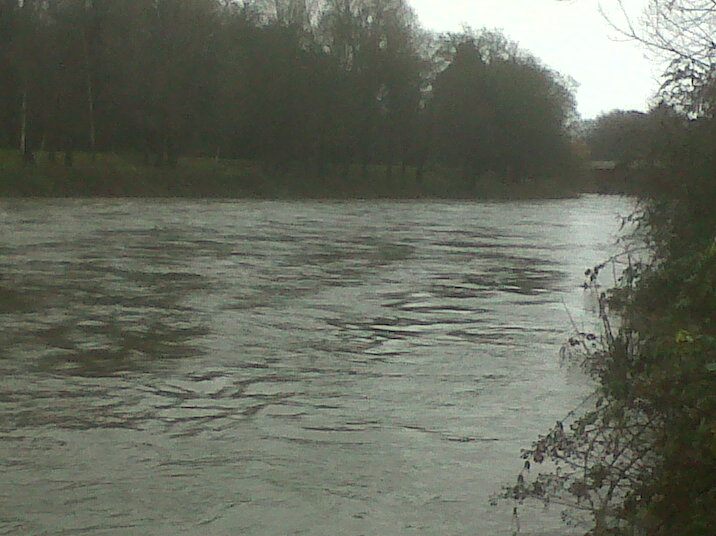
A brave bunch of hardy Cardiff  University astronomers are heading into London today for a meeting of the Royal Astronimical Society in London which celebrates the first year of science from the Herschel Space Observatory. This wouldn’t normally constitute too arduous a trip, but it turns out after the last couple of days torrential rain in Wales and the South-West of England, there is flooding on the line at Sodding Chipbury Chipping Sodbury which has sent the railway network into one of its regular episodes of chaos. Half the trains from Cardiff to London are cancelled, and the other half diverted all round the houses so they will take at least an extra half-hour to reach their destination at Paddington.

There isn’t any flooding actually in Cardiff, but the River Taff, which hibernated peacefully through the recent snowy period, has now sprung back into life and seems to be in an angry mood. I took these snaps yesterday as I walked into work, so you can see the water level is high enough to submerge some of the riverside shrubs and trees, but not high enough (yet) to threaten the embankments.

At times like this the Taff is more than a little scary, not so much because of the way it looks but because of the sound of it growling along down to Cardiff Bay, carrying the occasional car tyre and traffic cone with it.

I suppose this is small potatoes compared to the terrible floods in Australia, Brazil and elsewhere in the world, but it is quite exasperating, especially since it happens so regularly yet still catches the train companies completely unawares.

Anyway, I don’t know if the first wave of Cardiff folk managed to get to London in time for the start of the meeting. I had a couple of things to do this morning so decided to go later, even though that meant missing some of the talks that are closer to my own interests. I did think about cancelling my trip entirely, but decided in the end to give it a go. I hope I make it there at least in time for dinner at the RAS Club.

But then there’s the question of what time I’ll get  home tonight…


Share/Bookmark

Mud Wrestling and Microwaves

Posted in The Universe and Stuff with tags , , , on January 13, 2011 by telescoper

Reading through an interesting blog post about the new results from Planck by the ever-reliable Jonathan Amos (the BBC’s very own “spaceman”), I was reminded of a comment I heard made by Martin Rees (now Lord Rees) many years ago.

The remark concerned the difference between cosmology and astrophysics. Cosmology, said Lord Rees, especially the part of it that concerns the very early Universe, involves abstract mathematical concepts, difficult yet logical reasoning and the ability to see deep things in complicated spatial patterns. In that respect it’s rather like chess. Astrophysics, on the other hand, which is not at all elegant and has so many messy complications that it is sometimes difficult even to work out what is going on or what the rules are, is more like mud wrestling.

The following image, which I borrowed from Jonathan Amos’ piece, explains why I was reminded of this and why some cosmologists are having to abandon chess for mud wrestling, at least for the time being. The picture shows the nine individual frequency maps (spanning the range from 30 GHz to 857 GHz) obtained by Planck.

What we cosmologists really want to see is a pristine map of the cosmic microwave background, the black-body radiation that pervades the entire Universe. It’s black body form means that it would have the same brightness temperature across all frequencies, and would also be statistically homogeneous (i.e. looking roughly the same all across the sky).

What you actually see is a mess. There are strong contributions from the disk of our own Galaxy, some of it extending quite a way above and below the plane of the Milky Way. You can also see complicated residuals produced by the way Planck scans the sky. On top of that there is radiation from individual sources within our Galaxy, other Galaxies and even clusters of Galaxies (which I mentioned a couple of days ago). These “contaminants” constitute valuable raw material for astronomers of various sorts, but for cosmologists they are an unwanted nuisance. Unfortunately, there is no other way to reach the jewels of the CMB than by hacking through this daunting jungle of foregrounds and instrumental artefacts.

Looking at the picture might induce one of two reactions. One would be to assume that there’s no way that all the crud can be removed with sufficient accuracy and precision to do cosmology with what’s left. Another is  to appreciate how well cosmologists have done with previous datasets, especially WMAP, have confidence that they’ll solve the numerous problems associated with the Planck data, but understand why  will take another two years of high-powered data analysis by a very large number of very bright people to extract cosmological results from Planck.

There might be gold at the end of the pipeline, but until then it’s going to be mud, glorious mud…


Share/Bookmark