I came across this on Youtube a while ago, but I’ve been saving it up because I thought it might make a nice St Valentine’s Day gift for all lovers of astronomy (and/or someone special). Enjoy!

I came across this on Youtube a while ago, but I’ve been saving it up because I thought it might make a nice St Valentine’s Day gift for all lovers of astronomy (and/or someone special). Enjoy!
Last week I received an email from BBC Wales asking me to get in touch with one of their reporters. It turned out to be about a blog post I wrote some time ago concerning the recent decision by the Welsh Assembly Goverment to pay the fees of Welsh domiciled students wherever they go to study within the UK. The reporter had read my post and wanted to “pick my brains” for a story she was working on. I didn’t have time last week as I was too busy, but I found out yesterday that the BBC had indeed run a story.
According to the BBC version, the policy of paying for Welsh students to go to English universities will cost the Welsh Assembly Government £51.7 million in 2015-6 although, according to their projections, this will be more than offset by an expected £83.5 million coming from English students electing to study in Wales (who will have to pay their own fees).
The net cost of this policy will be about £97.6 million in the same year, allowing for the assumed net profit from English students, which will be met by cutting the core teaching grants to Welsh universities by about 35% – this is less than the cuts in England, but big cut nevertheless.
But these calculations depend on several assumptions. One is what level of fees are charged. If all English universities charge £9K (which is possible) then the outflow of cash related to Welsh students going to England increases. If Welsh university fees are capped at £6K (which also seems likely) then the cash inflow decreases. In fact, in this scenario the differential between money in and money out completely disappears.
Moreover there is the question of how many students move in each direction. It’s possible that in the Age of Austerity more students will be forced to study near their family homes, which will also alter the balance. In addition, student places are being cut in Wales while there is a possibility that the cap on numbers in English universities will soon be lifted. This raises the possibility that Welsh students may be forced to study in England anyway, as they might not be able find a place in Wales. We’re certainly not going to benefit much in the School of Physics & Astronomy at Cardiff University from the current boom in applications, as our numbers have been cut since last year despite applications going up by 50%…
On the other hand – and I’ve anecdotal evidence for this from talking to parents at UCAS admissions days – there seems also to be a feeling that the WAG’s commitment to students is serving to convince a number of English residents that the Welsh universities are in safer hands than those in England.
So, although I strongly support the WAG’s reasons for wanting to help Welsh students as much as possible there remains considerable uncertainty about how things will pan out over the next few years. It could get very grim if reality departs significantly from the projections.
One of the arguments put forward by Leighton Andrews (the Welsh Assembly Minister responsible for Universities in Wales) is that the policy of paying for Welsh students to go to England was in fact a commitment made the Labour-Plaid Cymru coalition that controls the Welsh Assembly. That’s fair enough, but of course it makes one wonder what will happen if the balance changes with the Welsh Assembly Elections due in May 2011.
Only when we know the complexion of the new WAG will we learn whether it might revisit the policy. I’ve heard many arguments for and against, but it still strikes me as very strange to see the devolved administration spending so much of its hard-earned budget in England. That £50.7 million would go a long way if it were kept in Wales.
All things considered, however, despite all the difficulties I think the situation is much more positive for universities in Wales than in England.
Incidentally, another sensible idea being discussed by Leighton Andrews is that Welsh schools might be forced to ditch “soft” A-level subjects, such as (inevitably) Media Studies, in favour of “quality” ones (presumably including mathematics and physics). Perhaps he should do the same for Mickey Mouse degrees in Welsh universities too?
At the Royal Astronomical Society on Friday, Prof. Mark Birkinshaw gave a talk about the life of Johannes Hevelius the 400th anniversary of whose birth lies this year. Anyway, he (Mark Birkinshaw, that is, not Johannes Hevelius) reminds me a bit of Graeme Garden of the Goodies, although I’m Sorry I Haven’t a Clue if anyone agrees with me.

Mark Birkinshaw

Graeme Garden
I came back late last night from an interesting Open Meeting at the Royal Astronomical Society, followed by another exceedingly pleasant Club Dinner at the Travellers’ in Pall Mall; next time we’ll be back at The Athenaeum.
I didn’t get home until 1.30am, and went straight to bed. I woke early to news of momentous events. The discredited authoritarian leader of an exausted regime who had presided over financial collapse and who had been clinging tenaciously to the offices of power, attempting to stave off the widespread clamour for his resignation with the promise of a new administration in several months’ time, had finally resigned. The news filled me with jubilation and a sense of optimism for the future.
I went back to sleep, waking again a couple of hours later with the sad realisation that it had all been a dream.
Keith Mason is still in charge of STFC.
Busy day today, necessitating an early start and a packed morning followed by a trip to the Big Smoke later on.
I thought I’d use my daily post to try a little experiment.
Yesterday I mentioned that applications to do Physics courses in the School of Physics & Astronomy at Cardiff University had increased enormously since last year. That prompted a couple of people to contact me, via email and Twitter, to admit that the same thing is happening at their institutions. With UCAS reporting that applications nationwide are up by only about 4%, I’m a bit confused as to what is going on.
I don’t know how many of my (1000+) daily readers work in UK universities, let alone which ones or whether they’re in a position to know what undergraduate applications are doing, but I would be very interested to hear whether this pattern is being repeated and whether it’s just physics that’s booming.
So, in lieu of a proper blog post for today, let me invite you to take part in a straw poll through the comments box. Where are you? What’s your subject? Are your applications up?
Do tell.
What a day.
For a start we had another manic UCAS admissions event. Applications to study physics here have rocketed, by more than 50% compared to last year, so it’s all hands on deck on days like this. Next weekend we have our first Saturday event of the year, and that promises to be even more popular. Still, it’s good to be busy. Without the students, we’d all be on Her Majesty’s Dole. At least some of our advertising is hitting the target.
After that it was back to the business of handing out 1st Semester examination results to my tutees – the Exam Board met yesterday but I skived off because I wasn’t involved in any exams last semester. Then a couple of undergraduate project meetings and a few matters related to postgraduate admissions that needed sorting out.
Finally, being a member of our esteemed Course Committee, I spent a little bit of time trying to assemble some new syllabuses. All our Physics (and Astrophysics) courses are changing next year, so this is a good chance to update the content and generally freshen up some of the material we teach.
In the course of thinking about this, I dug about among some of my old course notes from here there and everywhere, some of which I’ve kept on an old laptop. I chanced upon this cute little graphic, which I don’t think I’ve ever used in a lecture, but I thought I’d put it up here because it’s pretty. Sort of.
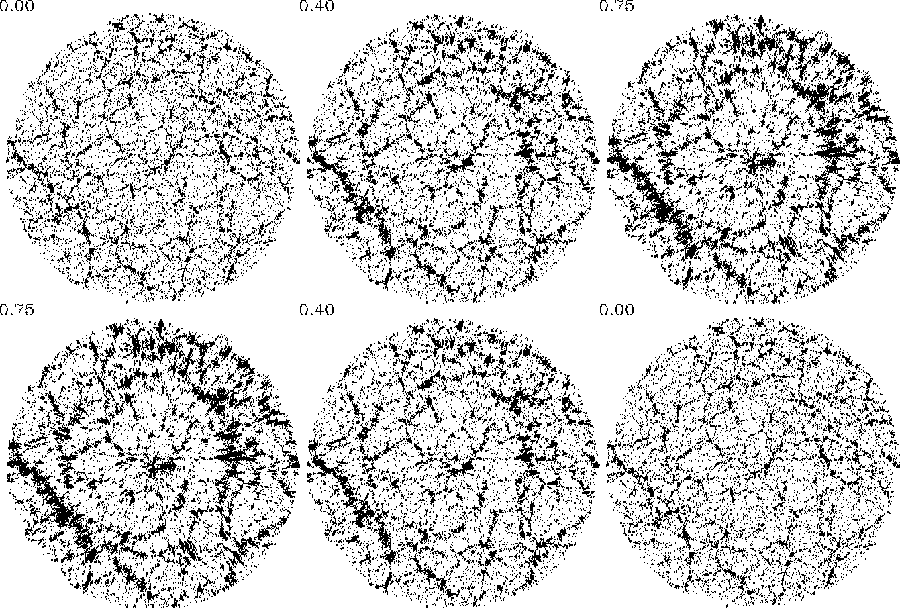
What it shows is a simulation of the large-scale structure of the Universe as might be mapped out using a galaxy redshift survey. The observer is in the centre of the picture (which a two-dimensional section through the Universe); the position of each galaxy is plotted by assuming that the apparent recession velocity (which is what a redshift survey measures) is related to the distance from the observer by Hubble’s Law:
where 


These distort the pattern seen in redshift space compared to real space. In real space the pattern is statistically isotropic, but in redshift space things look different along the line of sight from the observer compared to the directions at right angles as described quite nicely by this slide from a nice web page on redshift-space distortions.

There are two effects. One is that galaxies in tightly bound clusters have high-speed disordered motions. This means that each cluster is smeared out along the line of sight in redshift space, producing artefacts sometimes called “Fingers of God” – elongated structures that always point ominously at the observer. The other effect caused by large-scale coherent motions as matter flows into structures that are just forming, which squashes large-scale features in the redshift direction more-or-less opposite to the first.
These distortions don’t simply screw up our attempts to map the Universe. In fact they help us figure out how much matter might pulling the galaxies about. The number in the upper left of the first (animated) figure is the density parameter, 
Notice that in the high-density universe the wall-like structures look thicker (owing to the large peculiar velocities within them) but that they are also larger than in the low-density universe. In a paper a while ago, together with Adrian Melott and others, we investigated the dynamical origin of this phenomenon, which we called the Bull’s-Eye Effect because it forms prominent rings around the central point. It turns out to be Quite Interesting, because the merging of structures in redshift-space to create larger ones is entirely analogous the growth of structure by hierarchical merging in real space, and can be described by the same techniques. In effect, looking in redshift space gives you a sneak preview of how the stucture will subsequently evolve in real space…
I suspect I’m not the only person working in astronomy who found inspiration in Carl Sagan‘s epic TV series Cosmos, which was broadcast on British television when I was at Secondary School. Although the graphics are a bit dated now, and the language perhaps a bit florid for modern tastes, it has lost nothing of its splendour or profundity which is largely due to the charisma (and beautiful writing) of the presenter. It’s also in stark contrast to the simple-minded stuff served up by modern so-called science programmes. Here’s a little taster, which brought back happy memories to me, and I hope will do the same for fellow astronomers-of-a-certain-age.
We live on an insignificant planet of a humdrum star lost in a galaxy tucked away in some forgotten corner of a Universe in which there are far more galaxies than people. We make our World significant by the courage of our questions, and by the depth of our answers.
We live in our own world,
A world that is too small
For you to stoop and enter
Even on hands and knees,
The adult subterfuge.
And though you probe and pry
With analytic eye,
And eavesdrop all our talk
With an amused look,
You cannot find the centre
Where we dance, where we play,
Where life is still asleep
Under the closed flower,
Under the smooth shell
Of eggs in the cupped nest
That mock the faded blue
Of your remoter heaven.
by R.S. Thomas (1913-2000)
…like a little old lady with a handbag.
According to the BBC, one of the potential robbers was detained at the scene by members of the public and another three arrested by the Police shortly afterwards.
There are many things about this country that are in decline, but I firmly believe that our Little Old Ladies are the finest in the world.
There’s an interesting discussion going on over at the e-Astronomer Andy Lawrence’s blog about truth, lies and astronomy grant funding.
The centrepiece of Andy’s post is the following graph, which is based on the most accurate available figures, showing how the number of postdoctoral research associate (postdoc) positions funded (first by SERC, then by PPARC, and then by STFC) in Astronomy has evolved over the last couple of decades, along with the number of permanent academic staff employed in UK universities.

To be precise it shows the number of new postdoc posts funded each year; since a postdoc position typically lasts 3 years, the total number of postdocs at ay time is roughly 3 times the number shown.
A few things are immediately clear. One is that both the number of academics and the number of postdocs grew steadily over the period covered by the graph, until 2006 after which there was a steep decline in the number of postdocs to a level substantially lower than the number funded in 2000. It’s not a coincidence that STFC was created in 2007.
The numerical growth of the UK astronomical community coincided with a general expansion of the number of academics in the University resulting from the growth of funded student numbers, but it also was also accompanied by improved access to large facilities. It also happened to be a time of high achievement by British astronomers, who played major roles in large projects that uncovered many deep secrets of the Universe, such as the existence of cosmological dark matter and dark energy.
Further details of the achievements of UK Astronomy over the last decade are given by our own Bill Frindall, Paul Crowther (see his page for references):
Astrophysics: UK space science (astrophysics) is ranked 2nd in citations (1999-2009), while UK physics ranks 5th internationally (1997-2007). According to Section 3 of the RCUK Review of Physics, combining these two categories places the UK 2nd to the USA overall – see bibliometric analysis. According to the IoP Survey of Academic Appointments in Physics, the UK astronomy academic community grew by 14 per cent in the 5 years leading up to 2008, compared with 12% for physics overall. From 2003/04 to 2007/08 physics departments expanded by 14%, equal to the wider UK average for all disciplines (see Sustainability of the UK research workforce report from RCUK. Undergraduate applications (admissions) to physics grew by 19% (11%) between 2002-2007 according to the DIUS Research Report 08-21. Astrophysics formed one of the case studies for a CSHE (UC Berkeley) science communication report from Jan 2010.
All this expansion didn’t come cheap, of course, but in my view it was entirely justified on the grounds of scientific excellence. That used to count for something among the science policy makers, but those times seem to have gone. Not that the collateral benefits were negligible, as you can see from the above.
I’ll grant that it is not easy to establish what fraction of STFC’s budget should be spent on its “core” science and how much on managing facilities, but I think the balance has obviously gone way too far in one direction. I’m not the only one to think so. The probably deliberate decision to clobber astronomy grants flies in the face of the Institute of Physics Review of International Perceptions of UK Physics, carried out in 2005, which says
In summary, the state of astrophysics and solar system physics is relatively healthy at this time. Morale is good in the research community, particularly among the young, and wise investments seem to have been made since the 2000 review. Attention will need to be paid over the next five years to foster the astronomical observing community so as to recoup the investment in large telescope access.
STFC has done many things since its creation in 2007, but fostering the astronomical observing community is definitely not amongst them. Instead it has slashed the postdocs needed to collect, reduce and analyse the data coming from the facilities we paid so much to access.
I still don’t know what UK astronomy did to deserve the kick in the teeth it received in 2006 which precipitated the steep decline shown in the graph. Remember that this was before the credit crunch, which really took hold in 2008, so the cuts imposed STFC were clearly not in response to that. The message consistently being put out by the STFC Executive at the time was that it was spending “too much on science exploitation”, i.e. on doing science, and that a larger slice of the cake needed to be devoted to facilities and operations.
I suspect that the backlash against astronomy was led by senior figures in the Treasury who did not, still do not, and probably never will, see science as worth doing for its own sake rather than as a way of subsidising industry. I suspect also some senior figures in UK Physics were not sorry to see the astronomical arrivistes get their comeuppance. I have encountered a number of distinguished physicists – usually of the condensed matter persuasion – who clearly resented the new wave of astronomers arriving in their departments. As long as they bring in more students, take on heavy teaching loads and don’t ask for expensive equipment then astronomers are fine, but what they do isn’t really proper physics is it?
But precisely who it was that was behind the strange demise of British astronomy is now not the main issue. The real question is what can be done about it starting from where we are now.
As things stand under the current STFC leadership, the grant line will stay roughly level in cash terms for the next three years. Adding in the effect of inflation that means the number of postdoc grants will slowly dwindle. Better than the last few years, but hardly grounds for celebration. The steady attrition of grant funding will eventually push many excellent university research groups over the edge and prematurely terminate many promising scientific careers.
STFC will be looking for a new Chief Executive very soon, and that raises at the admittedly faint hope that some things might change for the better. What we need is a someone who is prepared to champion fundamental research because he or she actually believes in it; the bedgrudging attempts of the current Chief Executive simply don’t convince in this regard.
Whether we get someone who fits the bill remains to be seen. If we don’t the future for UK astronomy looks very bleak.


