The Browne Stuff

Posted in Education, Finance, Politics with tags , , on October 13, 2010 by telescoper

I’m basically in purdah this week, shuttling to and fro between Cardiff and Swindon on the business of the STFC Astronomy Grants Panel. However, I couldn’t resist a brief early morning post about yesterday’s news about the report on higher education funding by Lord Browne. I haven’t had time to read the report in full, so won’t comment in detail on it, but a few things did strike me from what I’ve picked up from the media. Perhaps others will add their views through the comments box.

  • For a start it’s quite amusing how far wide of the mark most of the rumour-mongering about the report’s recommendations has been. In fact the proposals are far more radical than had been touted.
  • The suggestion of lifting the cap on fees entirely, and allowing universities to decide how much to charge for tuition, will delight the so-called “elite” universities, but will alarm those (like me) who worry about the impact on students from poorer backgrounds. Most difficult, however, as far as I’m concerned will be the impact on middle-grade universities who won’t know where to pitch themselves in the free market that such a move would create. We know that Oxbridge will be able to get away with charging pretty much whatever they like, and many of the former polytechnics will clearly go for the budget end of the market, but in between there will be tricky decisions to make.
  • The increased fee is to be offset by a cut of a whopping 80% (from £3.5bn to £0.8bn) in the teaching grant to English universities. A cut of this scale may well mean that some courses do not receive any direct contribution from the taxpayer at all (the so-called “unit of resouce”). If this goes ahead it will undoubtedly lead to course closures across the country. Although I would oppose a blanket cut of this scale, I’m not against the idea of withdrawing support from Mickey Mouse courses and concentrating it on important subjects.
  • It seems likely, and indeed there are already signs, that full implementation of the Browne proposals will be politically difficult for the ConDem coalition.  In fact, unless some of the recommendations are diluted, this may well lead to a full-scale revolt. We’ll have to wait and see.
  • Vince Cable has endorsed the report, despite his own party’s previous opposition to raising tuition fees. Any resisual respect I had for him is going down the plughole very rapidly indeed.
  • Finally, I’ll just point out that, even if they are fully implemented, the draconian cuts to English higher education funding are not necessarily going to be replicated here in Wales (or in Scotland or Northern Ireland). The Welsh Assembly has issued a statement on the Browne report, but clearly doesn’t know what to do about it. If they make good decisions now, Welsh universities could prosper by bucking the English trend, but if they get it wrong….

Anyway, that’s all for this am. Got a train to catch!


Share/Bookmark

O World of Many Worlds

Posted in Poetry, The Universe and Stuff with tags , , on October 12, 2010 by telescoper

You probably don’t associate the poet Wilfred Owen (1893-1918) with cosmology or astrophysics, as his poems were almost exclusively about the horror of war. This one, however,  which was begun in 1913, before the First World War broke out – Owen himself enlisted in 1915 –  will surely strike several chords with those interested in the use of the phrase Many Worlds in other contexts, and it also contains a number of astronomical references.

O World of many worlds, O life of lives,
What centre hast thou? Where am I?
O whither is it thy fierce onrush drives?
Fight I, or drift; or stand; or fly?

The loud machinery spins, points work in touch;
Wheels whirl in systems, zone in zone.
Myself having sometime moved with such,
Would strike a centre of mine own.

Lend hand, O Fate, for I am down, am lost!
Fainting by violence of the Dance…
Ah thanks, I stand – the floor is crossed,
And I am where but few advance.

I see men far below me where they swarm…
(Haply above me – be it so!
Does space to compass-points conform,
And can we say a star stands high or low?)

Not more complex the millions of the stars
Than are the hearts of mortal brothers;
As far remote as Neptune from small Mars
Is one man’s nature from another’s.

But all hold course unalterably fixed;
They follow destinies foreplanned:
I envy not these lives in their faith unmixed,
I would not step with such a band.

To be a meteor, fast, eccentric, lone,
Lawless; in passage through all spheres,
Warning the earth of wider ways unknown
And rousing men with heavenly fears…

This is the track reserved for my endeavour;
Spanless the erring way I wend.
Blackness of darkness is my meed for ever?
And barren plunging without end?

O glorious fear! Those other wandering souls
High burning through that outer bourne
Are lights unto themselves. Fair aureoles
Self-radiated these are worn.

And when in after times those stars return
And strike once more earth’s horizon,
They gather many satellites astern,
For they are greater than this system’s Sun.


Share/Bookmark

Astronomy Look-alikes, No. 41

Posted in Astronomy Lookalikes with tags , , , on October 11, 2010 by telescoper

Not a lot of people know that the late great British astrophysicist Sir Fred Hoyle was in fact born in Royston Vasey and has many famous relatives from the same place.

Edward Tattsyrup

Sir Fred Hoyle

A Brush with Columbo

Posted in Columbo with tags , on October 10, 2010 by telescoper

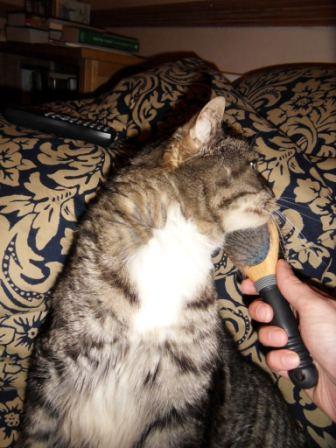
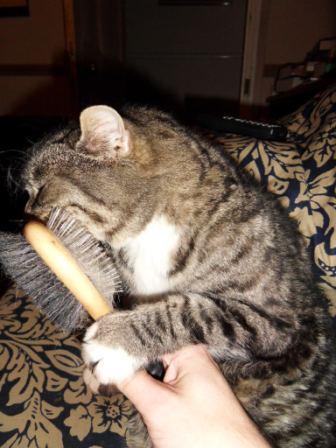
I bumped into a few people I haven’t seen for a while at the rally yesterday, and quite a number of them told me off for not posting more updates about my old moggy, Columbo. Suitably chastened, I decided to put up a couple of snaps today. I was actually away Friday night and most of Saturday so had had to arrange for Columbo to be looked after by a professional catsitter so he could get his insulin jabs on Friday night and Saturday morning. Although the catsitter I use is very reliable, I always worry a little bit when I’m not there as I think he gets a little bit lonely.

As a treat for him, I stopped in a shop and bought him a bit of fish before I got on the train in Paddington. It was very cheap because they were about to close but I’m sure Columbo didn’t know that. Two and a half hours later when I got home it had certainly started to pong a bit, but that merely served to drive Columbo wild with anticipation.

I gave him his insulin as he scoffed the fish, sounding more like a pig than a cat – the combination of eating and purring noises is not all that pleasant. After he was done and had established that there really wasn’t any more, he joined me on the sofa for his favourite after-dinner pastime: getting brushed. He loves getting the metal brush over his head and face and often grabs the thing himself just to do it that little bit better.

After a good going over he looked quite a lot smarter and adjourned to the floor for a sleep. I think he’d forgiven me for leaving him alone for so long because, unusually, he didn’t try to eat the newspaper as I did the Guardian crossword.

Science (still) is Vital

Posted in Politics, Science Politics with tags , , on October 9, 2010 by telescoper

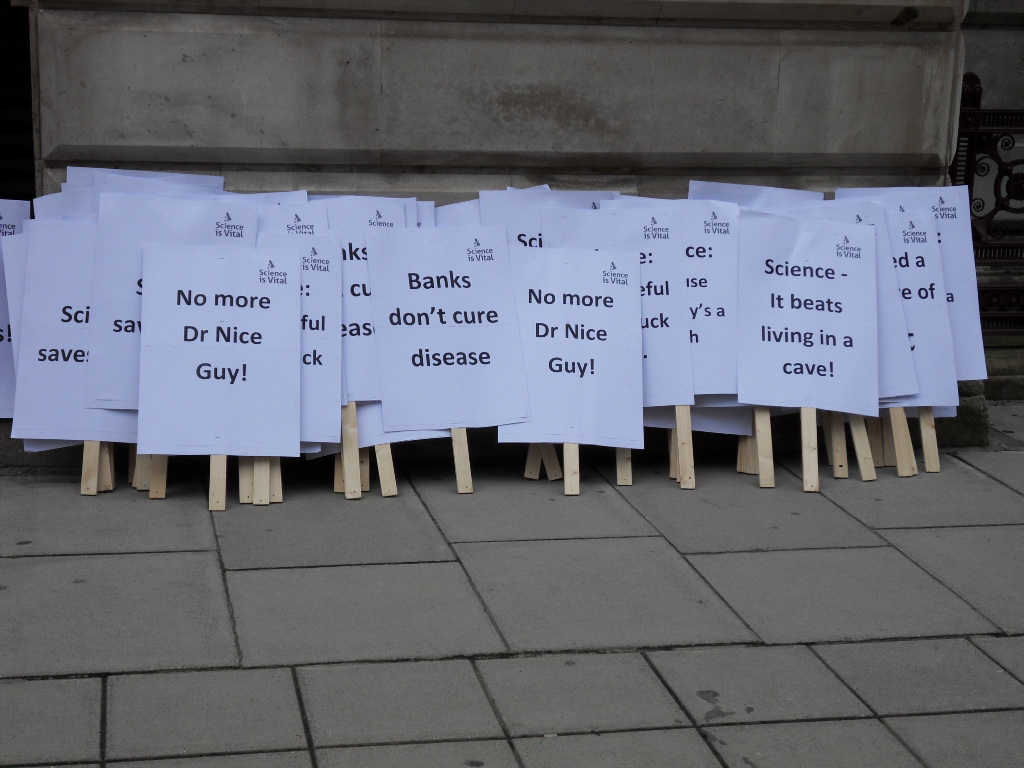
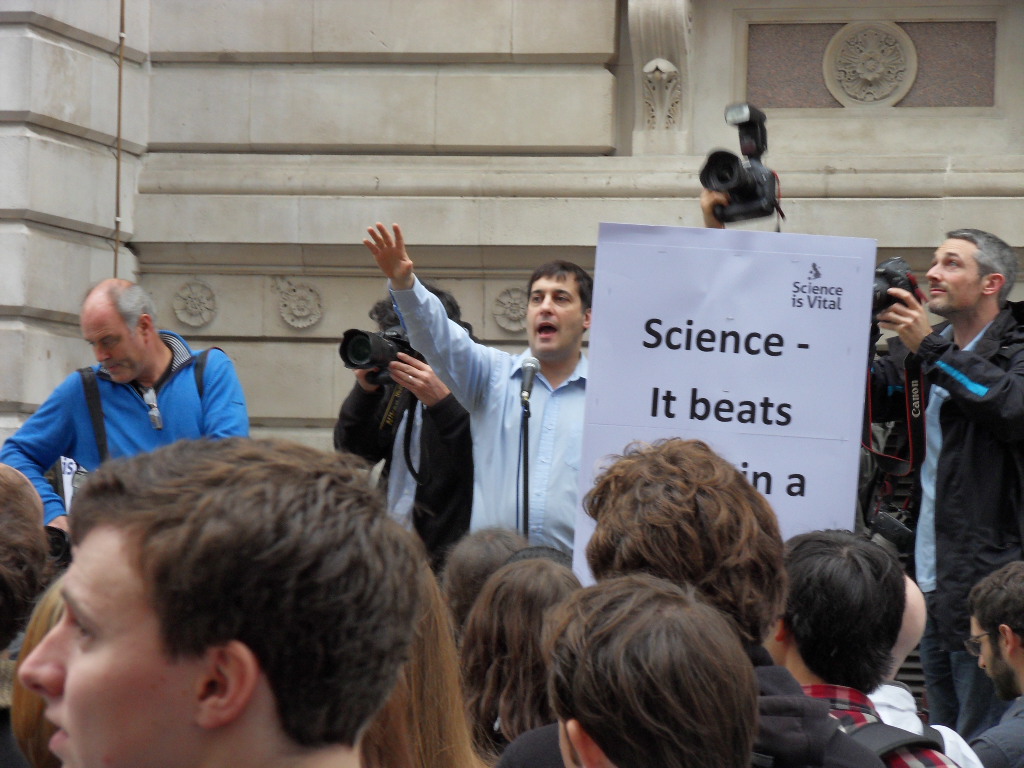
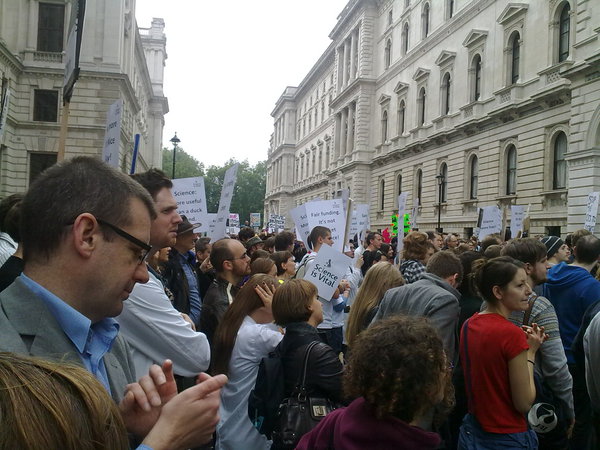
Just back from the Science is Vital rally in Whitehall, which was attended by an estimated 2000 people. I’m actually pretty tired after a late night in town following yesterday’s Royal Astronomical Society meeting and dinner at the Athenaeum after that, not to mention later events…

Anyway, I’m going to catch up with some quality Columbo time so I’ll just post a few snaps to prove I was there!

Just before the rally

A fellow astronomer, whose name I didn’t catch!

Rather unfortunate pose by Dr Evan Harris; he’s not a Nazi, honest!

Ben Goldacre, complete with anorak…

And here’s me in mid-tweet on the left of the picture, in front of the Treasury building and facing the Foreign & Commonwealth Office (to the right).

Picture taken by Paul Crowther


Many congratulations to those who organized the rally at such short notice, especially Jenny Rohn. The only thing I’d say here is that, although this was a truly inspiring and enjoyable occasion, if the campaign is going to make any lasting difference this must be the start not the finish…


Share/Bookmark

Ariadne auf Naxos

Posted in Opera with tags , , , , on October 8, 2010 by telescoper

There are three operas in the current season from Welsh National Opera, and last night I went to see the final one of the set,   a revival of their 2004 production of Ariadne auf Naxos by Richard Strauss. It seems I saved the best until last! It was a wonderful evening, beautifully sung and imaginatively staged.

It’s a strange opera, consisting of two acts. The first is a prologue, set backstage during the preparations for  a musical performance commissioned by the “wealthiest man in Vienna”, a character who never actually makes an appearance but who communicates with the others through his Major-Domo (a speaking role, played by Eric Roberts).  The centrepiece of the performance is to be a new opera, the tragedy of Ariadne on the Island of Naxos, written by a gifted young composer (played in male drag by the lovely Sarah Connolly). Afraid that the opera might bore his guests, the patron decides to liven up the performance by adding a musical comedy act, in the style of the Commedia dell’Arte, and a firework display. While the opera singers argue with assorted clowns and grotesques of the rival Harlequinade about who should perform first, news comes down from on high that in order that the fireworks are not delayed, instead of performing one after the other, the two performances will be merged. The upshot of this is that instead of being marooned on a desert island with only three nymphs for company, the lovelorn Ariadne has to put up with the presence of the entire cast of a comic burlesque.

In case you hadn’t figured it out, this is a comedy. It’s very German, of course, in the sense that it’s not all that funny really, but the set up does pay off in the second act, wherein the comedy and tragedy (or, more precisely, an Opera Buffa and an Opera Seria) are played together. It’s a bit like the “play-within-a-play” in Shakespeare’s Midsummer Night’s Dream.

First Ariadne (played by Orla Boylan) appears on her island, singing of her desire for death after the loss of her beloved Theseus. Then the clowns interrupt the performance and try to cheer her up, by suggesting she finds another man. Then the comics take over the show entirely, at least for a while. Finally Ariadne reappears and is met by Bacchus, the god of wine, who brings much-needed consolation. The two sing a rapturous duet and eventually ascend to heaven, in a style reminiscent of Close Encounters, while the clowns look on from the wings.

It’s all a bit daft, of course, but the juxtaposition of comedy and tragedy is unexpectedly moving. It works largely because of the sheer beauty of Strauss’ music, especially in the second act. People who don’t like opera probably don’t understand how it’s possibly to fall into such a stylised form of drama in which people sing to each other rather than speak, but somehow – at least for me – that’s what happens. Something draws you into the drama and you forget the artificiality of the performance. That it works in this opera is especially surprising because it’s  a second-order opera; the audience knows it’s an opera, but within the opera there’s another opera. Nevertheless, the sensuously romantic score still pulls you in, especially in the scenes with Ariadne. Strauss was always a superb writer for the female voice, and this opera is no exception.

Last night’s performance was lovely, with Sarah Connolly and   Orla Boylan both oustanding. Boyland in particular was simply superb, a true dramatic soprano with a voice of great lyrical beauty as well as  thrilling power when needed. I was expecting Sarah Connolly to be great, and she didn’t disappoint at all, but Orla Boylan was even better. 10/10.

The only part I didn’t like was the Wig-Maker, a crude gay stereotype mincing ostentatiously around the stage during the Prologue. Very naff.

Oh, and Eric Roberts as the Major-Domo seemed to get a bit confused in a couple of places and repeated his lines, sending the surtitle machine into chaos for a bit. Even though the performance was in German I didn’t really look at the surtitles. When you wear varifocals it’s quite difficult to read them without missing out on what’s happening on stage.

These were only minor blemishes, however, and overall it was a wonderful evening. I’ll add a word for the orchestra too, which played beautifully under the baton of Lothar Koenigs.

There’s only one other performance of this in Cardiff, tomorrow night (Saturday 9th October). Do go and see it if you can!


Share/Bookmark

National Poetry Day

Posted in Poetry with tags , , on October 7, 2010 by telescoper

In case you hadn’t realised, today is National Poetry Day. I sometimes post poems on here whenever I have the urge – either because they’re favourites of mine or because they seem topical. For a change, and to celebrate the special nature of today, I thought I’d try to solicit some from my friends and colleagues via Facebook or Twitter.

This, Welsh Landscape by R.S. Thomas, was suggested by Rhodri Evans.

To live in Wales is to be conscious
At dusk of the spilled blood
That went into the making of the wild sky,
Dyeing the immaculate rivers
In all their courses.
It is to be aware,
Above the noisy tractor
And hum of the machine
Of strife in the strung woods,
Vibrant with sped arrows.
You cannot live in the present,
At least not in Wales.
There is the language for instance,
The soft consonants
Strange to the ear.
There are cries in the dark at night
As owls answer the moon,
And thick ambush of shadows,
Hushed at the fields’ corners.
There is no present in Wales,
And no future;
There is only the past,
Brittle with relics,
Wind-bitten towers and castles
With sham ghosts;
Mouldering quarries and mines;
And an impotent people,
Sick with inbreeding,
Worrying the carcase of an old song.


This one, Beauty, by Edward Thomas was suggested by Steve Eales.

WHAT does it mean? Tired, angry, and ill at ease,
No man, woman, or child alive could please
Me now. And yet I almost dare to laugh
Because I sit and frame an epitaph–
“Here lies all that no one loved of him
And that loved no one.” Then in a trice that whim
Has wearied. But, though I am like a river
At fall of evening when it seems that never
Has the sun lighted it or warmed it, while
Cross breezes cut the surface to a file,
This heart, some fraction of me, hapily
Floats through a window even now to a tree
Down in the misting, dim-lit, quiet vale;
Not like a pewit that returns to wail
For something it has lost, but like a dove
That slants unanswering to its home and love.
There I find my rest, and through the dusk air
Flies what yet lives in me. Beauty is there


Here’s one from me. I learnt it at school where I studied German for one year before giving it up. I had a rather eccentric teacher who thought the best way to learn a language was to read poetry rather than learning how to say banal things like “Please can you direct me to the railway station?”. It wasn’t a very good idea, but at least it left me with bits of German poetry still in my head over 30 years later. I can still remember every word of this wonderful poem by Goethe …

Kennst du das Land wo die Zitronen Blühn,
Im dunklen Laub die Gold-Orangen glühn,
Ein sanfter Wind vom blauen Himmel weht,
Die Myrte still und hoch der Lorbeer steht,
Kennst du es wohl?
Dahin! Dahin,
Möcht ich mit dir, o mein Geliebter, ziehn.

Kennst du das Haus? Auf Säulen ruht sein Dach,
Es glänzt der Saal, es schimmert das Gemach,
Und Marmorbilder stehn und sehn mich an:
Was hat man dir, du armes Kind getan?
Kennst du es wohl?
Dahin! Dahin
Möcht ich mit dir, o mein Beschützer, ziehn!

Kennst du den Berg und seinen Wolkensteg?
Das Maultier sucht im Nebel seinen weg:
In Höhlen wohnt der Drachen alte Brut;
Es stürzt der Fels und über ihn die Flut,
Kennst du ihn wohl?
Dahin! Dahin
Geht unser weg! o Vater, laß uns ziehn!

If you have a favourite of your own you’d like to suggest, please let me know through the suggestions box…

Number Crunching

Posted in Finance, Politics, Science Politics with tags , , on October 6, 2010 by telescoper

Only time for a (very) brief post this evening, as I’ve been in London all day and got back much later than expected.

In this morning’s Guardian there was a story about how the UK’s banks intend to pay out a whopping £7bn in bonuses this year. Banks. Remember them? They’re the organisations whose behaviour almost brought this country’s economy to its knees a few years ago and needed to be baled out by the taxpayer, at enormous cost to the public purse.

Meanwhile, the Science is Vital campaign is gearing up for Saturday’s rally. An article over on cosmic variance has raised the profile of this increasingly vocal campaign to stave off cuts which threaten to destroy Britain’s position as a leading scientific nation. The petition has now been signed by over 17,000 people (including the winners of this year’s Nobel Prize for Physics, announced yesterday).

It’s worth emphasizing the numbers behind this story too.  The annual UK science budget, before the next round of cuts, stands at £3.2billion. That’s everything – particle physics, astronomy, chemistry, biosciences, and countless other things.

I need hardly point out the irony. The amount we’re waging an increasingly desperate fight to protect is less than half the amount to be spent on yachts and fancy cars by the people who got us into this mess in the first place. Some of us hoped the financial sector would show some contrition after the disaster of 2007. Fat chance!  Their rescue by the taxpayer has probably just convinced them that however they behave they can always rely on Joe Public to get them out of trouble. It seems they’ve reverted to type.

So let’s have no more of the specious arguments about having to cut science in order to avoid having to cut, say, the National Health Service. Science isn’t as expensive as some people would have us believe, and it’s not a luxury either. It’s vital to our economic and cultural well-being. Each pound spend on science is worth a lot more to this country than  two disappearing into a banker’s offshore tax haven.

In any case the government should just tax the greedy bankers’ bonus payments and use the money to increase the science budget. Better still, put pressure on the banks to themselves invest in science, alongside other areas of innovation, which we know will generate healthy profits for those brave enough to take a calculated risk, rather than going back to the old game of playing around with dodgy property-based financial speculations, which have a good chance of taking us down the plughole for good.

Physics Nobel Prize 2010

Posted in The Universe and Stuff with tags , , , , on October 5, 2010 by telescoper

Just a quick newsflash: the 2010 Nobel Prize for Physics has gone to Andre Geim and Konstantin Novoselov (both of the University of Manchester)  “for groundbreaking experiments regarding the two-dimensional material graphene“.

For more details see the official announcement.

Heartiest congratulations to them both! Thoroughly well deserved.

ps. They were predicted to win two years ago by Thomson Reuters.

pps. It’s a clean sweep for UK-based scientists, so far. I wonder if the government is listening?

(Guest Post) STFC – It isn’t just about money

Posted in Science Politics with tags , , , , , , on October 4, 2010 by telescoper

The following piece was written by Professor George Efstathiou, FRS, who is Professor of Astrophysics at the University of Cambridge and Director of the Kavli Institute for Cosmology. The views expressed therein are George’s own, but I’m not saying that out of a desire to distance myself from his opinions. As a matter of fact, I was one of the people who signed the petition he describes in the article…

–o–

As Peter has reported on this site, physicists around the country are anxiously awaiting the results of the forthcoming Comprehensive Spending Review. Scientists whose research is supported by the Science and Technology Facilities Council (STFC)  are particularly anxious.  Since its creation, STFC has gone through two difficult scientific prioritisation exercises. Many excellent projects have been cancelled and grants supporting University groups have been cut savagely, by about 35%. STFC science has already descended into the Royal Society’s ‘game over‘ scenario. All of this has happened before the consequences of the economic crisis have hit the science budget. STFC has left itself uniquely poorly placed amongst the Research Councils to absorb further reductions following the CSR.

It is for this reason, that I and a few others organised a petition expressing a loss of confidence in the Chief Executive of STFC. The petition was signed by 916 researchers, including 162 Professors and 18 Fellows of the Royal Society. It was formally submitted to the STFC Chair (Michael Sterling) on 1st July together with an explicit request that STFC Council should review its role in this loss of confidence.

People will have had many different reasons for signing the petition. I made my views public well in advance (see my Letter to Lord Drayson). In all of my letters to ministers and others concerning the STFC ‘crisis’, I have never asked for more money. More money would help, of course, but this is utterly unrealistic in the current economic circumstances. No, over the last three years I have been lobbying for good governance. The strutural difficulties with STFC were easy to identify and I believe that with good governance the STFC programme could have been managed without such a catastrophic loss of science. Over three years, STFC have failed to establish a compelling narrative, strategy and constructive engagement with its science community. When one bears in mind that about 40 % of Physics staff work in areas for which STFC is the primary funding source, the consequences of the STFC crisis for University Departments, and the rest of the science base, are indeed serious.

So, whatever the outcome of the CSR, there are governance issues that we should be concerned about. There are three that I would like to raise here:

1. Fellowships and grants. Senior scientists from outside the UK point to the Fellowships and Rolling Grants as two of the most effective features of the UK funding system. Both are now under threat. I was responsible for making the case for the current 5 year system to PPARC Council. In addition to the evident benefits of continuity and reduction in peer review, Council need to understand that recruitment for postdocs involves a substantial lead time. If we are to compete for the best postdocs around the world (and not lose our best post docs), grant funds must be committed four years in advance. The 5 year rolling grant system, even with tapers, allows groups to advertise posts on an international timetable and to vire funds to maximise science output. Any move to responsive mode 3 year grants is guaranteed to deliver less science for a fixed amount of money. I would vigorously defend the Fellowships. Fellowships encourage scientific independence and provide a valuable “bottom-up” correction to the increasingly narrow “top-driven” science programme of STFC. Attacks on Fellowships and Rolling Grants will inevitably lead to a more introspective and less internationally competitive science programme.

2. The Composition of STFC Council. STFC Council, with a minority of leading research scientists, differs from other Research Councils. I have had several vigorous discussions with Michael Sterling concerning this issue and, in particular, the recent decision by BIS to appoint three new non-academic members to STFC. This led me to write a long letter to Adrian Smith (Director General of the Research Councils) reproduced here. Professor Smith replied that he approved of the present balance of Council and thought that it was compatible with the recommendations of previous reviews. I will leave readers to decide whether they agree. This is not a minor point. My experience on PPARC Council was that `lay members’ can often provide interesting perspectives on problems, but if they lack understanding of the science (sometimes alarmingly so) they will tend to accept the recommendations of the Executive. STFC needs a scientifically strong Council. Competent management is not enough. It is easy to keep within budget – you can be tough about cutting things. It is much harder to maximise the amount of science that you can do on a fixed budget. For that you need a scientific strategy and scientific judgement.

3. The New CEO. The search has begun for a new Chief Executive. There is one school of thought that a suitable candidate may be found from the corporate sector. Someone who may not understand the science, but would be a capable manager and communicator. I think that this would be a disaster. In my view, it is essential that a new CEO have an understanding of the science programme at STFC and should be prepared to act as an enthusiastic advocate for STFC science. We need a CEO who can engage constructively with the academic community and, when times are tough, articulate a strategy to limit the loss of science rather than gloat at our misfortune.

It would be great to have more money for STFC science. But money isn’t everything – we need to pay attention to governance issues as well. If we had been braver back in 2008 and openly challenged the Executive, we might not be in such a weak position now. We should not be so reticent in the future.


Share/Bookmark