Killing Vectors

Posted in The Universe and Stuff with tags , , , on February 16, 2010 by telescoper

I’ve been feeling a rant coming for some time now. Since I started teaching again three weeks ago, actually. The target of my vitriol this time is the teaching of Euclidean vectors. Not vectors themselves, of course. I like vectors. They’re great. The trouble is the way we’re forced to write them these days when we use them in introductory level physics classes.

You see, when I was a lad, I was taught to write a geometric vector in the folowing fashion:

\underline{r} =\left(\begin{array}{c} x \\ y \\ z \end{array} \right).

This is a simple column vector, where x,y,z are the components in a three-dimensional cartesian coordinate system. Other kinds of vector, such as those representing states in quantum mechanics, or anywhere else where linear algebra is used, can easily be represented in a similar fashion.

This notation is great because it’s very easy to calculate the scalar (dot) and vector (cross) products of two such objects by writing them in column form next to each other and performing a simple bit of manipulation. For example, the scalar product of the two vectors

\underline{u}=\left(\begin{array}{c} 1 \\ 1 \\ 1 \end{array} \right) and \underline{v}=\left(\begin{array}{c} 1\\ 1 \\ -2 \end{array} \right)

can easily be found by multiplying the corresponding elements of each together and totting them up:

\underline{u}\cdot \underline{v} = (1 \times 1) + (1\times 1) + (1\times -2) =0,

showing immediately that these two vectors are orthogonal. In normalised form, these two particular vectors  appear in other contexts in physics, where they have a more abstract interpretation than simple geometry, such as in the representation of the gluon in particle physics.

Moreover, writing vectors like this makes it a lot easier to transform them via the action of a matrix, by multipying rows in the usual fashion, e.g.

\left(\begin{array}{ccc} \cos \theta & \sin\theta & 0 \\ -\sin\theta & \cos \theta & 0 \\ 0 & 0 & 1\end{array} \right) \left(\begin{array}{c} x \\ y \\ z \end{array} \right) = \left(\begin{array}{c} x\cos \theta + y\sin\theta \\ -x \sin \theta + y\cos \theta \\ z \end{array} \right)

which corresponds to a rotation of the vector in the x-y plane. Transposing a column vector into a row vector is easy too.

Well, that’s how I was taught to do it.

However, somebody, sometime, decided that, in Britain at least, this concise and computationally helpful notation had to be jettisoned and students instead must be forced to write

\underline{r} = x \underline{\hat{i}} + y \underline{\hat{j}} + z \underline{\hat{k}}

Some of you may even be used to doing it that way yourself. Why is this awful? For a start, it’s incredibly clumsy. It is less intuitive, doesn’t lend itself to easy operations on the vectors like I described above, doesn’t translate easily into the more general case of a matrix, and is generally just …well… awful.

Worse still, for the purpose of teaching inexperienced students physics, it offers the possibility of horrible notational confusion. In particular, the unit vector \underline{\hat{i}} is too easily confused with i, the square root of minus one. Introduce a plane wave with a wavevector \underline{k} and it gets even worse, especially when you want to write \exp(i\underline{k}\cdot\underline{x})!

No, give me the row and column notation any day.

I would really like to know is who decided that our schools had to teach the horrible notation, rather than the nice one, and why? I think everyone who teaches physics knows that a clear and user-friendly notation is an enormous help and a bad one is an enormous hindrance.  It doesn’t surprise me that some student struggle with even simple mathematics when its presented in such a silly way. On those grounds, I refuse to play ball, and always use the better notation.

Call me old-fashioned.

Astronomy Look-alikes, No. 16

Posted in Astronomy Lookalikes with tags , on February 15, 2010 by telescoper

I read with great interest a recent story that Geoff Hoon MP is planning to stand down at the next election. No doubt he took this decision in order to avoid the embarassment of losing his seat by popular vote. Perhaps he took his lead from his double, astronomer Richard Ellis, who also recently jumped ship from his Chair at Oxford in order to return to Caltech?

Richard Ellis

Geoff Hoon

The Abduction from the Seraglio

Posted in Opera with tags , , , on February 14, 2010 by telescoper

It’s been an unusually long time since I last went to the Opera, but now the spring season of Welsh National Opera has finally arrived I couldn’t resist the chance last night to see their brand new and wonderfully entertaining production of The Abduction from the Seraglio by Mozart. It was also nice to be accompanied on this occasion by fellow astrologists Ed and Haley, who I hope enjoyed the show as much as I did.

I was particularly glad to see this on the schedule for this season because it’s an Opera I haven’t seen staged before and didn’t know very much about. Mozart composed the music for  it in 1781, when he was at the ripe old age of 25 , to a libretto in German and with the title Die Entführung aus dem Serail. The WNO production is sung in the original language, which is the way I like it.

Like  The Magic Flute, which Mozart wrote about a decade later, The Abduction is a singspiel rather than an opera, in that the recitative is spoken rather than sung. The music is not through-composed as you find in a true opera, but a series of set-piece arias, duets, trios and quartets. Still, Mozart was pretty good at those. It’s also, in case you hadn’t realised, like the Magic Flute, a comedy which Mozart was also pretty good at!

The plot, such as it is, concerns the hero Belmonte’s search for his beloved Konstanze, her servant Blonde and his own servant Pedrillo, who have been captured by the Turk Pasha Selim who hopes to persuade Konstanze to join the harem inside his Seraglio. The Pasha’s heavy, Osmin, acts as bouncer, keeping Belmonte from getting into the place and releasing the captives but eventually, Pedrillo tricks Osmin into drinking some drugged wine; while he’s asleep the lovers are re-united. However, the attempt by Belmonte and Pedrillo to help  Konstanze and Blonde escape is botched and they are captured by Pasha Selim and his guards. Contrary to all expectations, however, the Pasha doesn’t take his revenge, but allows them to leave. Osmin flies into a rage and suffers some sort of splenetic seizure. The Opera ends with the others celebrating their freedom, while Pasha Selim consoles himself with his other wives and a hookah.

It’s admittedly a bit thin, even by the standards of comic opera but, right from the fabulous overture, the music is lovely and there’s a great deal of good-humoured fun, especially during the Pasha’s attempt to shower Konstanze with gifts of jewelry, frocks and shoes, in Act 2, and the abduction itself, in Act 3, which is bungled in appropriately hilarious fashion.

Belmonte was played by Robin Tritschler, who has a tenor voice of exceptional clarity and beauty and who invested his role with an engaging wide-eyed innocence. Petros Magoulas played the psychopathic Osmin for laughs and provided the performance with some of its funniest moments. Pedrillo was played by local boy Wynne Evans and Blonde was Claire Ormshaw; both were excellent, musically and comedically. Pasha Selim was also very well played by Simon Thorpe. The Pasha has to appear a bit frightening early on, so that his later magnanimity comes as a surprise; this he did very well. The only weak point I felt was Lisette Oropesa as the heroine Konstanze. She didn’t sing at all well in Act I, perhaps owing to first-night nerves,  but seemed to settle down by Act 2 where she coped with the coloratura a lot better. Her acting, however, was extremely disappointing and, at times, downright embarassing. It wasn’t enough to spoil the production – at least not for me – but it was a shame, as a really good night could have been a truly superb one.

Finally I should mention that all the action is set on the Orient Express, circa 1920, with costumes and props of that period too. The scenery is cleverly designed so that it can be slid to and fro along the stage to reveal cabins either side of the main saloon at its centre. The whole thing looks wonderful and the mobile set also provided comic moments of its own, especially during the abduction scene when Pedrillo is accidentally left clinging to the outside of the train.

I was left wondering to some extent why this Opera isn’t better known. It’s probably because it  doesn’t have the subtlety of the famous da Ponte comedies, but the music is gorgeous especially in the passages for multiple voices, such as the quartet in Act II. In other passages the music  sounds a bit like a parts of the Magic Flute. In many ways I think you can see this piece as Mozart on his way to perfecting the style he would achieve in these works. It’s pretty good, but perhaps doomed to lie in the shadow of his later masterpieces.

All in all, a great night out. There’s only one other performance of The Abduction from the Seraglio in Cardiff (next Saturday, 20th February) and then it goes on the road. I’m not sure there are any tickets remaining for next week:  if there are, it’s well worth seeing but if not then all is not lost – it’s likely this will be in the WNO repertoire for some time to come.

Match Day

Posted in Biographical, Sport with tags , , , , , , , , on February 13, 2010 by telescoper

Unusually for a saturday, I’ve been a bit busy today and I’m also going out later, so I’ll refrain from one of my discursive weekend posts and keep it brief (but not necessarily to any particular point).

Today, of course, is the date of Wales’ first home match in this year’s RBS Six Nations Rugby competition. They lost to England 30-17 last week (at Twickenham) largely because of a bit of indiscipline by Alan Wyn Jones who got himself sent off the field for ten minutes after tripping an England player. England forged ahead during the time Wales were down to 14 men and although Wales fought back later on I thought England deserved to win. It wasn’t, however, a very good game to watch.

The scene was thus set for a home game for Wales in Cardiff  today against Scotland (who lost at home to France last week). It’s really impossible to describe how special it is to be in this city when Wales are playing rugby. The Millennium Stadium can hold about 75,000 which is large compared to Cardiff’s population of around 330,000. The Scottish fans, easily identified by the kilts and the smell of alcohol, were out on the townin large numbers last night. No doubt many of them woke with substantial hangovers this morning, but it has been a beautiful sunny day and the sight of the Scots – blue and tartan – mixing with the Welsh – red and green with a liberal sprinkling of dragons- was marvellous to see as I walked around this morning running a few errands.

The atmosphere in town was just sensational, unique to Cardiff, and enough to make you just want to walk around and soak it up. Actually, enough to make you wish you had a ticket for the match too, which unfortunately I didn’t. Still, it was live on TV.

When I got home the crowds were already walking down past my house towards the stadium, which is only a mile or so away,  for the 2pm kickoff. Among them was the sizeable frame of legendary Welsh rugby hero JPR Williams. He’s quite  old now – a quick look on wikipedia reveals that he was born in 1949 – but he hasn’t changed much at all since his heyday in the 1970s.  Taller than I had imagined.

Anyway, I did a little gardening in the sunshine just before the match started and, standing outside, I could hear the sound of Land of my Fathers being sung before the kickoff all the way from the Stadium. It made the hairs stand up on the back of my neck. Tremendous.

The match itself was strangely disjointed to begin with but ended in extremely exciting fashion. Wales playing surprisingly poorly in the first half and Scotland surprisingly well. Wales appeared nervous and a bit disorganised and the two Scottish tries both involved defensive errors by the Welsh. The half-time score of  Wales 9 Scotland 18 was not what I would have expected before the start of the game, but was a fair reflection of the balance of play at that point.

The second half initially followed a similar pattern, Scotland edging 21-9 ahead at one point,  but Wales gradually crept back into it. However, it was a yellow card for a Scottish infringement that led to Wales gaining enough momentum to claw their way back to 21-24 with a try created by Shane Willians and scored by Leigh Halfpenny. Then, with less than a minute to play,  Scotland lost another player for a cynical piece of foul play that prevented another Welsh try. Wales decided to take the penalty kick to tie the game at 24-24 with just 40 seconds left. The Scots restarted with only 13 men on the field and only seconds left to play, hoping to run down the clock and finish with a draw. However the Welsh were scenting an unlikely victory and the Scots were very tired. The Welsh managed to keep the ball alive – the next dead ball would have been the end of the game – and, unbelievably, Shane Williams popped in to score a try. The match ended Wales 31 Scotland 24.

It wasn’t the best rugby I’ve ever seen in terms of quality, but it’s definitely the most dramatic final ten minutes! I’m not sure the referee was right to allow the restart after the kick to level it at 24-24 as it seemed to me the time was up then. I’m sure the rugby fans in Cardiff  tonight won’t be quibbling, though. The city will be buzzing tonight!

Today was also the day for two important footall matches. In the FA Cup, Cardiff City travelled to Premiership leaders Chelsea and, predictably, got thrashed 4-1. The other match that interested me was Swansea City versus Newcastle United in the Championship. That finished 1-1, a result I was happy with since Swansea are playing well and Newcastle had lost in feeble fashion 3-0 away at Derby County earlier in the week. They go back top, if only by one point.

All in all, a most satisfactory day, and it’s not over yet. Tonight I’m off to the Opera (for the first time in what seems like ages). So guess what tomorrow’s post will be about….

Playfair

Posted in Crosswords with tags , , , , on February 12, 2010 by telescoper

It’s been a while since I’ve blogged about my passion for crosswords, but this Sunday’s Azed puzzle in the Observer was one of my favourite kind so I thought I’d mention it briefly here.

Azed is the pseudonym used by Jonathan Crowther who has been setting the Observer crossword since 1972; this week’s was number 1967. His  puzzles are usually standard cryptic crosswords which, though quite difficult as such things go, are nevertheless set in a fairly straightforward style. Every now and again, however,  he puts together a different type of puzzle that makes a different set of demands on the solver.  To be honest, I don’t always like these “funny” ones as they sometimes seem to me to be contrived and inelegant, but this last one was a type I really like as it combines the normal cryptic crossword style with another interest of mine, which is  codes and codebreaking.

The interesting aspect of this particular puzzle, which is laid out on a normal crossword grid, is that it involves a type of code called a Playfair cipher. In fact, this particular scheme was invented by the scientist Charles Wheatstone whom most physicists will have heard of through “Wheatstone Bridge“. It was, however, subsequently popularized by Lord Playfair, whose name stuck rather than its inventor’s.

The Playfair scheme is built around the choice of a code word, which must have the special property that no letter occurs twice within it.  Other than that, and the fact that the more letters in the codeword the better the code, there aren’t any real constraints on the choice. The particular example used by Azed to illustrate how it works is ORANGESTICK.

The codeword is used to construct a Playfair square which is a 5×5 arrangement of letters involving the codeword first and then afterwards the rest of the alphabet not used in the codeword,  in alphabetical order. Obviously, there are 26 letters altogether and the square only holds 25 characters,  so we need to ditch one: the usual choice is to make I stand for both I and J, doing double duty, which rarely causes ambiguity in the deciphering process. The Playfair square formed from ORANGESTICK is thus

This square is then used as the basis of a literal digraph substitution cipher, as follows. To encode a word it must first be split into pairs of letters e.g. CR IT IC AL. Each pair is then seen as forming the diagonally opposite corners of a rectangle within the word square, the other two corner letters being the encoded form. Thus, in the example shown, CR gives SG (not GS, which RC would give).

Where a pair of letters appears in the same row or column in the word square, its encoded form is produced from the letters immediately to the right of or below each respectively. For the last letters in a row or column the first letters in the same row or column become the encoded forms. Thus IC is encoded as CE. When all the pairs are encoded, the word is joined up again, thus CRITICAL is encoded as SGCICEOP.

The advantage of this over simpler methods of encipherment is that a given letter in the plain text is not always rendered as the same letter in the encrypted form: that depends on what other letter is next to it in the digraph.

Obviously, to decipher encrypted text into plain one simply inverts the process.

Now, what does this have to do with a crossword? Well, in a Playfair puzzle like the one I’m talking about a certain number of answers – in this case four – have to be encrypted before they will fit in the diagram. These “special” clues, however, are to the unencrypted form of the answer words. The codeword is not given, but must be deduced. We are, however, told that the answers to these special clues and the codeword are “semantically linked”.

What one has to do, therefore, is to solve the clues for the unencrypted words, then solve all the other clues that intersect with them on the grid. Given a sufficient number of digraphs in both plain text and encrypted form one can infer the codeword and hence encrypt the remaining (unchecked) letters for the special answers.

It probably sounds very convoluted, but in this puzzle it isn’t so bad because the four special clues weren’t so difficult. These are the following “across” clues:

1.  Footman having to plough yard (6)

which gives “FLUNKY” – “plough” in university slang, meaning “fail” or “flunk” + y (standard abbreviation for yard).

18. Wallaby No. 2 in penalty infringement, right? (8)

has to be “OFFSIDER”, Australian slang for a deputy and hence Wallaby No. 2,  with the cryptic allusion “OFFSIDE” for “penalty infringement” and R for “right”.

19. Staff inadequately blunder – many will conceal this (8)

this is the easiest – straightforward hidden word “UNDERMAN”, meaning “staff inadequately”.

32. Younger mussels one goes for in jar (6)

I think this is the best of this quartet of clues. The answer is “JUNIOR”, with “UNIO” (the genus of mussels) replacing the “a” (i.e. one) in JAR.

This set of answers clearly suggests the common theme that links them to the codeword. Moreover, the geometry of the grid along with the answers to the rest of the clues gives us ten digraphs in plain and encrypted form.

What has to be done then is to try to work out the Playfair square from the letter pairs, work out the codeword and then complete the unchecked letters in the specials in their encrypted form. It isn’t actually all that difficult to find the codeword in this example, by a mixture of induction and deduction. It turns out to be “SUBORDINATELY”, a fine candidate for a Playfair codeword as it is thirteen letters long and doesn’t feature any letter twice.

To enter the monthly Azed competition, however, one generally has to supply a clue as well as solving the puzzle. I’m really not very good at this aspect of crosswords- I much prefer solving the puzzles to setting ones of my own – which is why I’m quite a long way down the annual Azed Honours Table, in 29th place as of this month.

In the “Plain” competition puzzles, one has to supply a clue to replace one which is given as a straight definition.  In this case a clue was requested to the codeword, but I think  I’ll keep my attempt at  “SUBORDINATELY” to myself unless and until I win at least an honourable mention!


Astronomy Look-alikes, No. 15

Posted in Astronomy Lookalikes with tags , , on February 11, 2010 by telescoper

Since it is rumoured that the BBC  has decided to axe Top Gear, it’s fortunate that James May has an alternative career as Chief Executive of the Science and Technology Facilities Council. Still, all that experience of things crashing and burning  seems to have stood him in good stead..

Professor Keith Mason

James May

Astronomy Look-alikes, No. 14

Posted in Astronomy Lookalikes with tags , on February 10, 2010 by telescoper

Looking at my copy of this month’s Gramophone magazine reminded me that this year, 2010, sees the 150th anniversary of the birth of composer Gustav Mahler (born 7th July 1860). However, the front cover of the special celebratory issue of the esteemed organ that this event inspired features a photograph that reveals something of a  likeness to Professor Ian Smail, another noted individual (geddit?) … though, perhaps, one not always known for his harmoniousness.

Gustav Mahler

Professor Ian Smail

Colour in Fourier Space

Posted in The Universe and Stuff with tags , , , , , on February 9, 2010 by telescoper

As I threatened promised after Anton’s interesting essay on the perception of colour, a couple of days ago, I thought I’d write a quick item about something vaguely relevant that relates to some of my own research. In fact, this ended up as a little paper in Nature written by myself and Lung-Yih Chiang, a former student of mine who’s now based in his homeland of Taiwan.

This is going to be a bit more technical than my usual stuff, but it also relates to a post I did some time ago concerning the cosmic microwave background and to the general idea of the cosmic web, which has also featured in a previous item. You may find it useful to read these contributions first if you’re not au fait with cosmological jargon.

Or you may want to ignore it altogether and come back when I’ve found another look-alike

The large-scale structure of the Universe – the vast chains of galaxies that spread out over hundreds of millions of light-years and interconnect in a complex network (called the cosmic web) – is thought to have its origin in small fluctuations generated in the early universe by quantum mechnical effects during a bout of cosmic inflation.

These fluctuations in the density of an otherwise homogeneous universe are usually expressed in dimensionless form via the density contrast, defined as\delta({\bf x})=(\rho({\bf x})-\bar{\rho})/\bar{\rho}, where \bar{\rho} is the mean density. Because it’s what physicists always do when they can’t think of anything better, we take the Fourier transform of this and write it as \tilde{\delta}, which is a complex function of the wavevector {\bf k}, and can therefore be written

\tilde{\delta}({\bf k})=A({\bf k}) \exp [i\Phi({\bf k})],

where A is the amplitude and \Phi is the phase belonging to the wavevector {\bf k}; the phase is an angle between zero and 2\pi radians.

This is a particularly useful thing to do because the simplest versions of inflation predict that the phases of each of the Fourier modes should be randomly distributed. Each is independent of the others and is essentially a random angle designating any point on the unit circle. What this really means is that there is no information content in their distribution, so that the harmonic components are in a state of maximum statistical disorder or entropy. This property also guarantees that fluctuations from place to place have a Gaussian distribution, because the density contrast at any point is formed from a superposition of a large number of independent plane-wave modes  to which the central limit theorem applies.

However, this just describes the initial configuration of the density contrast as laid down very early in the Big Bang. As the Universe expands, gravity acts on these fluctuations and alters their properties. Regions with above-average initial density (\delta >0) attract material from their surroundings and get denser still. They then attract more material, and get denser. This is an unstable process that eventually ends up producing enormous concentrations of matter (\delta>>1) in some locations and huge empty voids everywhere else.

This process of gravitational instability has been studied extensively in a variety of astrophysical settings. There are basically two regimes: the linear regime covering the early stages when \delta << 1 and the non-linear regime when large contrasts begin to form. The early stage is pretty well understood; the latter isn’t. Although many approximate analytical methods have been invented which capture certain aspects of the non-linear behaviour, general speaking we have to  run N-body simulations that calculate everything numerically by brute force to get anywhere.

The difference between linear and non-linear regimes is directly reflected in the Fourier-space behaviour. In the linear regime, each Fourier mode evolves independently of the others so the initial statistical form is preserved. In the non-linear regime, however, modes couple together and the initial Gaussian distribution begins to distort.

About a decade ago, Lung-Yih and I started to think about whether one might start to understand the non-linear regime a bit better by looking at the phases of the Fourier modes, an aspect of the behaviour that had been largely neglected until then. Our point was that mode-coupling effects must surely generate phase correlations that were absent in the initial random-phase configuration.

In order to explore the phase distribution we hit upon the idea of representing the phase of each Fourier mode using a  colour model. Anton’s essay discussed the  RGB (red-green-blue) parametrization of colour is used on computer screens as well as the CMY (Cyan-Magenta-Yellow) system preferred for high-quality printing.

However, there are other systems that use parameters different to those representing basic tones in these schemes. In particular, there are colour models that involve a parameter called the hue, which represents the position of a particular colour on the colour wheel shown left. In terms of the usual RGB framework you can see that red has a hue of zero, green is 120 degrees, and blue is 240. The complementary colours cyan, magenta and yellow lie 180 degrees opposite their RGB counterparts.

This representation is handy because it can be employed in a scheme that uses colour to represent Fourier phase information. Our idea was simple. The phases of the initial conditions should be random, so in this representation the Fourier transform should just look like a random jumble of colours with equal amounts of, say, red green and blue. As non-linear mode coupling takes hold of the distribution, however, a pattern should emerge in the phases in a manner which is characteristic of gravitational instability.

I won’t go too much further into the details here, but I will show a picture that proves that it works!
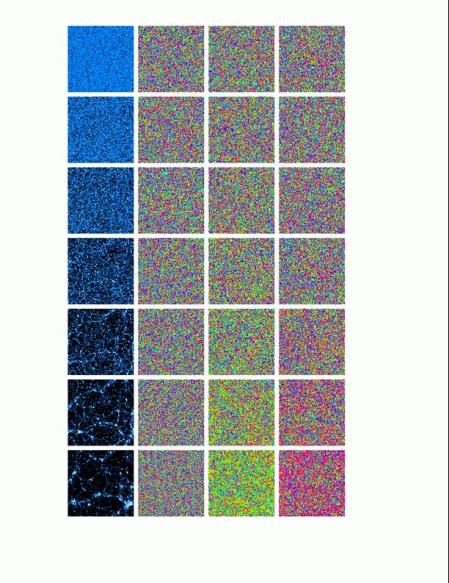
What you see here are four columns. The leftmost shows (from top to bottom) the evolution of a two-dimensional simulation of gravitational clustering. You can see the structure develops hierarchically, with an increasing characteristic scale of structure as time goes on.

The second column shows a time sequence of (part of) the Fourier transform of the distribution seen in the first; for the aficianados I should say that this is only one quadrant of the transform and that the rest is omitted for reasons of symmetry. Amplitude information is omitted here and the phase at each position is represented by an appropriate hue. To represent on this screen, however, we had to convert back to the RGB system.

The pattern is hard to see on this low resolution plot but two facts are noticeable. One is that a definite texture emerges, a bit like Harris Tweed, which gets stronger as the clustering develops. The other is that the relative amount of red green and blue does not change down the column.

The reason for the second property is that although clustering develops and the distribution of density fluctuations becomes non-Gaussian, the distribution of phases remains uniform in the sense that binning the phases of the entire Fourier transform would give a flat histogram. This is a consequence of the fact that the statistical properties of the fluctuations remain invariant under spatial translations even when they are non-linear.

Although the one-point distribuition of phases stays uniform even into the strongly non-linear regime, they phases do start to learn about each other, i.e. phase correlations emerge. Columns 3 and 4 illustrate this in the simplest possible way; instead of plotting the phases of each wavemode we plot the differences between the phases of neighbouring modes in the x  and y directions respectively.

If the phases are random then the phase differences are also random. In the initial state, therefore, columns 3 and 4 look just like column 2. However, as time goes on you should be able to see the emergence of a preferred colour in both columns, showing that the distribution of phase differences is no longer random.

The hard work is to describe what’s going on mathematically. I’ll spare you the details of that! But I hope I’ve at least made the point that this is a useful way of demonstrating that phase correlations exist and of visualizing some of their properties.

It’s also – I think – quite a lot of fun!

P.S. If you’re interested in the original paper, you will find it in Nature, Vol. 406 (27 July 2000), pp. 376-8.

Astronomy Look-alikes, No. 13

Posted in Astronomy Lookalikes with tags , on February 8, 2010 by telescoper

Some of you may previously have been unaware that Professor Ian Roxburgh of Queen Mary, University of London had an extremely successful career playing Compo in the longrunning television series Last of the Summer Wine. Sadly, I’ve been unable to find a look-alike for Nora Batty.

Compo

Ian Roxburgh

RIP Sir John Dankworth

Posted in Jazz with tags , on February 7, 2010 by telescoper

I awoke this morning to news of the death of Sir John Dankworth (on Saturday 6th February) at the age of 82. I won’t write a long post about him today as the newspapers and television have been filled with glowing detailed tributes that do greater justice to his many achievements than I could possibly do. However, there is a special place in my heart for Jazz musicians, do I couldn’t let this sad event pass without paying a small tribute here.

John Dankworth was born in 1927 and started playing Jazz clarinet as a teenager in the 1940s, largely inspired by Benny Goodman. However, he soon came under the spell of Charlie Parker who was leading the way towards a new, “modern” kind of Jazz called bebop. In the early 1950s, the British jazz scene was split in two hostile camps, the traditionalists (exemplified at that time by Humphrey Lyttelton‘s band) and the modernists (exemplified by the lovely band that John Dankworth put together in 1952). The mutual loathing of the fans of these two kinds of music often erupted in the form of pitched battles which prefigured the fights between “mods” and “rockers” in the 1960s.  You can find a fine example of John Dankworth with his  7-piece band (vintage 1950) here, playing a Charlie Parker tune called Marmaduke and showing the Parker influence clearly during his alto sax solo.

As I’ve often mentioned on this blog, my Dad played the drums with various jazz bands over the years but was firmly rooted in the traditionalist camp. I remember him telling me how furious he and his friends were when Humphrey Lyttelton’s marvellous trombonist Keith Christie defected to John Dankworth’s band in the 50s. It was like a Newcastle player signing for Sunderland. However, despite this treason, even diehard traddies like my Dad never had personal animosity towards John Dankworth, who was universally admired for his technical playing ability, encyclopedic knowledge of music and, above all, kindly and warm personality. But then musicians rarely think the same way that their fans do. Humph was a great admirer of John Dankworth’s music as, incidentally, was Benny Goodman of Charlie Parker’s…

Everyone who got to meet John Dankworth – which I did only once, and only very briefly – immediately came to the conclusion that he was a class act. A few days ago I quipped about how few remaining National Treasures we have in Britain. How could I have forgotten John Dankworth? Now he’s gone too.

He broke up his small group around 1952 or so to concentrate on running a big band, which gave him the opportunity to develop his talents as an arranger. During the 60s and 70s he became a prolific writer of TV and film music, including the original theme tune  for Tomorrow’s World. However, it’s his partnership with Cleo Laine that I guess people will remember best. He hired her as a singer for his small band in 1951. . They married in 1958 and remained together for over 50 years, until separated by John’s death. She was (and is) a feisty lady, but you could tell whenever you saw them together at any time that John loved her very much.

Anyway, let’s go out on a high note with this lovely version of George Gershwin’s great tune Lady be Good. John Dankworth takes a back seat – as he often did when Cleo was singing – but the band is in great form. And if you didn’t realise what a terrific vocalist Cleo Laine was, then pin back your lugholes around 2 minutes in where she demonstrates a range and level of control that would put many opera singers to shame.