Archive for academic publishing

Why traditional scientific journals are redundant

Posted in Open Access, The Universe and Stuff with tags , , , , on August 20, 2015 by telescoper

Was it really six years ago that I first blogged about the Academic Journal Racket which siphons off millions from hard-pressed research budgets into the coffers of profiteering publishing houses?

Change is coming much more slowly over the last few years than I had anticipated when I wrote that piece, but at least there are signs that other disciplines are finally cottoning on to the fact that the old-style model of learned journals is way past its sell-by date. This has been common knowledge in Physics and Astronomy for some time, as I’ve explained many times on this blog. But, although most wouldn’t like to admit it, academics are really a very conservative bunch.

Question: How many academics does it take to change a lightbulb?

Answer: Change!!???

Today I came across a link to a paper on the arXiv which I should have known about before; it’s as old as my first post on this subject. It’s called Citing and Reading Behaviours in High-Energy Physics. How a Community Stopped Worrying about Journals and Learned to Love Repositories, and it basically demonstrates that in High-Energy Physics there is a massive advantage in publishing papers in open repositories, specifically the arXiv.Here is the killer plot:

citations_arXivThis contains fairly old data (up to 2009) but I strongly suspect the effect is even more marked than it was six years ago.

I’d take the argument further, in fact. I’d say that journals are completely unnecessary. I find all my research papers on the arXiv and most of my colleagues do the same. We don’t need journals yet we keep paying for them. The only thing that journals provide is peer review, but that is done free of charge by academics anyway. The profits of their labour go entirely to the publishers.

Fortunately, things will start to change in my own field of astrophysics – for which the picture is very similar to high-energy physics. All we need to do is to is dispense with the old model of a journal and replace it with a reliable and efficient reviewing system that interfaces with the arXiv. Then we’d have a genuinely useful thing. And it’s not as far off as you might think.

Watch this space.

A scientific paper with 5000 authors is absurd, but does science need “papers” at all?

Posted in History, Open Access, Science Politics, The Universe and Stuff with tags , , , , , , , , , on May 17, 2015 by telescoper

Nature News has reported on what appears to be the paper with the longest author list on record. This article has so many authors – 5,154 altogether – that 24 pages (out of a total of 33 in the paper) are devoted just to listing them, and only 9 to the actual science. Not, surprisingly the field concerned is experimental particle physics and the paper emanates from the Large Hadron Collider; it involves combining data from the CMS and ATLAS detectors to estimate the mass of the Higgs Boson. In my own fields of astronomy and cosmology, large consortia such as the Planck collaboration are becoming the rule rather than exception for observational work. Large ollaborations  have achieved great things not only in physics and astronomy but also in other fields. A for  paper in genomics with over a thousand authors has recently been published and the trend for ever-increasing size of collaboration seems set to continue.

I’ve got nothing at all against large collaborative projects. Quite the opposite, in fact. They’re enormously valuable not only because frontier research can often only be done that way, but also because of the wider message they send out about the benefits of international cooperation.

Having said that, one thing these large collaborations do is expose the absurdity of the current system of scientific publishing. The existence of a paper with 5000 authors is a reductio ad absurdum proof  that the system is broken. Papers simply do not have 5000  “authors”. In fact, I would bet that no more than a handful of the “authors” listed on the record-breaking paper have even read the article, never mind written any of it. Despite this, scientists continue insisting that constributions to scientific research can only be measured by co-authorship of  a paper. The LHC collaboration that kicked off this piece includes all kinds of scientists: technicians, engineers, physicists, programmers at all kinds of levels, from PhD students to full Professors. Why should we insist that the huge range of contributions can only be recognized by shoe-horning the individuals concerned into the author list? The idea of a 100-author paper is palpably absurd, never mind one with fifty times that number.

So how can we assign credit to individuals who belong to large teams of researchers working in collaboration?

For the time being let us assume that we are stuck with authorship as the means of indicating a contribution to the project. Significant issues then arise about how to apportion credit in bibliometric analyses, e.g. through citations. Here is an example of one of the difficulties: (i) if paper A is cited 100 times and has 100 authors should each author get the same credit? and (ii) if paper B is also cited 100 times but only has one author, should this author get the same credit as each of the authors of paper A?

An interesting suggestion over on the e-astronomer a while ago addressed the first question by suggesting that authors be assigned weights depending on their position in the author list. If there are N authors the lead author gets weight N, the next N-1, and so on to the last author who gets a weight 1. If there are 4 authors, the lead gets 4 times as much weight as the last one.

This proposal has some merit but it does not take account of the possibility that the author list is merely alphabetical which actually was the case in all the Planck publications, for example. Still, it’s less draconian than another suggestion I have heard which is that the first author gets all the credit and the rest get nothing. At the other extreme there’s the suggestion of using normalized citations, i.e. just dividing the citations equally among the authors and giving them a fraction 1/N each. I think I prefer this last one, in fact, as it seems more democratic and also more rational. I don’t have many publications with large numbers of authors so it doesn’t make that much difference to me which you measure happen to pick. I come out as mediocre on all of them.

No suggestion is ever going to be perfect, however, because the attempt to compress all information about the different contributions and roles within a large collaboration into a single number, which clearly can’t be done algorithmically. For example, the way things work in astronomy is that instrument builders – essential to all observational work and all work based on analysing observations – usually get appended onto the author lists even if they play no role in analysing the final data. This is one of the reasons the resulting papers have such long author lists and why the bibliometric issues are so complex in the first place.

Having thousands of authors who didn’t write a single word of the paper seems absurd, but it’s the only way our current system can acknowledge the contributions made by instrumentalists, technical assistants and all the rest. Without doing this, what can such people have on their CV that shows the value of the work they have done?

What is really needed is a system of credits more like that used in the television or film. Writer credits are assigned quite separately from those given to the “director” (of the project, who may or may not have written the final papers), as are those to the people who got the funding together and helped with the logistics (production credits). Sundry smaller but still vital technical roles could also be credited, such as special effects (i.e. simulations) or lighting (photometic calibration). There might even be a best boy. Many theoretical papers would be classified as “shorts” so they would often be written and directed by one person and with no technical credits.

The point I’m trying to make is that we seem to want to use citations to measure everything all at once but often we want different things. If you want to use citations to judge the suitability of an applicant for a position as a research leader you want someone with lots of directorial credits. If you want a good postdoc you want someone with a proven track-record of technical credits. But I don’t think it makes sense to appoint a research leader on the grounds that they reduced the data for umpteen large surveys. Imagine what would happen if you made someone director of a Hollywood blockbuster on the grounds that they had made the crew’s tea for over a hundred other films.

Another question I’d like to raise is one that has been bothering me for some time. When did it happen that everyone participating in an observational programme expected to be an author of a paper? It certainly hasn’t always been like that.

For example, go back about 90 years to one of the most famous astronomical studies of all time, Eddington‘s measurement of the bending of light by the gravitational field of the Sun. The paper that came out from this was this one

A Determination of the Deflection of Light by the Sun’s Gravitational Field, from Observations made at the Total Eclipse of May 29, 1919.

Sir F.W. Dyson, F.R.S, Astronomer Royal, Prof. A.S. Eddington, F.R.S., and Mr C. Davidson.

Philosophical Transactions of the Royal Society of London, Series A., Volume 220, pp. 291-333, 1920.

This particular result didn’t involve a collaboration on the same scale as many of today’s but it did entail two expeditions (one to Sobral, in Brazil, and another to the Island of Principe, off the West African coast). Over a dozen people took part in the planning,  in the preparation of of calibration plates, taking the eclipse measurements themselves, and so on.  And that’s not counting all the people who helped locally in Sobral and Principe.

But notice that the final paper – one of the most important scientific papers of all time – has only 3 authors: Dyson did a great deal of background work getting the funds and organizing the show, but didn’t go on either expedition; Eddington led the Principe expedition and was central to much of the analysis;  Davidson was one of the observers at Sobral. Andrew Crommelin, something of an eclipse expert who played a big part in the Sobral measurements received no credit and neither did Eddington’s main assistant at Principe.

I don’t know if there was a lot of conflict behind the scenes at arriving at this authorship policy but, as far as I know, it was normal policy at the time to do things this way. It’s an interesting socio-historical question why and when it changed.

I’ve rambled off a bit so I’ll return to the point that I was trying to get to, which is that in my view the real problem is not so much the question of authorship but the idea of the paper itself. It seems quite clear to me that the academic journal is an anachronism. Digital technology enables us to communicate ideas far more rapidly than in the past and allows much greater levels of interaction between researchers. I agree with Daniel Shanahan that the future for many fields will be defined not in terms of “papers” which purport to represent “final” research outcomes, but by living documents continuously updated in response to open scrutiny by the community of researchers. I’ve long argued that the modern academic publishing industry is not facilitating but hindering the communication of research. The arXiv has already made academic journals virtually redundant in many of branches of  physics and astronomy; other disciplines will inevitably follow. The age of the academic journal is drawing to a close. Now to rethink the concept of “the paper”…

A Happy Hubble Coincidence

Posted in Biographical, Books, The Universe and Stuff with tags , , , on April 25, 2015 by telescoper

image

Preoccupied with getting ready for my talk in Bath  I forgot t post an item pointing out that yesterday was the 25th anniversary of the launch of the Hubble Space Telescope. Can it really be so long?

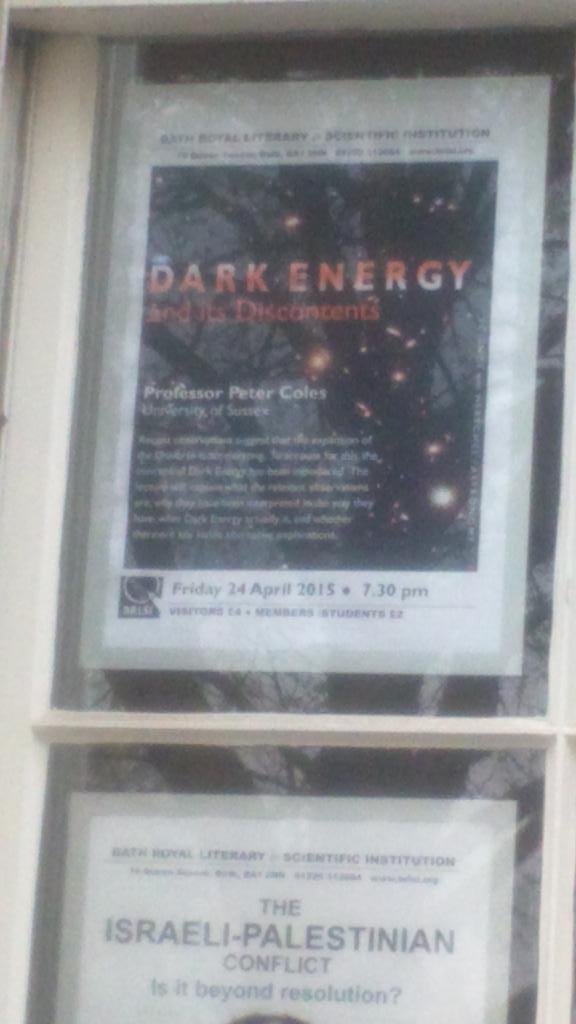
Anyway, many happy returns to Hubble. I did manage to preempt the celebrations however by choosing the above picture of the Hubble Ultra Deep Field as the background fo the poster advertising the talk.

Anyway it went reasonably well. There was a full house and questions went on quite a while. Thanks to Bath Royal Literary and Scientific Institution for the invitation!

Elsevier journals — some facts

Posted in Open Access with tags , , on April 24, 2014 by telescoper

Read this, and weep as you learn that Elsevier’s ruthless profiteering continues unabated…

gowers's avatarGowers's Weblog

A little over two years ago, the Cost of Knowledge boycott of Elsevier journals began. Initially, it seemed to be highly successful, with the number of signatories rapidly reaching 10,000 and including some very high-profile researchers, and Elsevier making a number of concessions, such as dropping support for the Research Works Act and making papers over four years old from several mathematics journals freely available online. It has also contributed to an increased awareness of the issues related to high journal prices and the locking up of articles behind paywalls.

However, it is possible to take a more pessimistic view. There were rumblings from the editorial boards of some Elsevier journals, but in the end, while a few individual members of those boards resigned, no board took the more radical step of resigning en masse and setting up with a different publisher under a new name (as some journals have…

View original post 10,674 more words

Open Journal of Astrophysics Revived

Posted in Open Access with tags , , , , , on July 8, 2013 by telescoper

Regular readers of this blog (Sid and Doris Bonkers) may recall that  while ago  I posted an item in which I suggested setting up The Open Journal of Astrophysics. The motivation behind this was to demonstrate that it is possible to run an academic journal which is freely available to anyone who wants to read it, as well as at minimal cost to authors. Basically, I want to show that it is possible to “cut out the middle man” in the process of publishing scientific research and that by doing it ourselves we can actually do it better. As people interested in this project will be aware, progress on this has been slower than I’d anticipated, largely because I changed job recently and have had so many administrative responsibilities that I haven’t had time to get too involved with it. The other folk who offered help have also been similarly preoccupied and some technical issues remain to be solved. However, the project has not been abandoned. Far from it. In fact, I’ve just received an update that strongly suggests we can get this idea off the ground over the course of the summer, so that it is in place in time for the new academic year.

We have a (good) website design with ample space and other resources to run it, and a significant number of persons of suitable eminence have agreed to serve on the Editorial Board. It will basically be a front-end for the Arxiv, but will have a number of interesting additional features which make it a lot  more than that.  I’d prefer to save further details to the official launch, which is now planned to take place in January (as it would probably get buried in the pre-Xmas rush if we tried to launch before then). I can also confirm that the service we will provide will be free at the start, although if the volume of submissions grows we may have to charge a small fee for refereeing. And when I say “small” I mean small, not the hundreds or thousands of pounds charged by the rip-off merchants.

There are, however, a couple of things I’d like to ask of my readers.

The first concerns the Editorial Board. I plan to contact those who offered help with this, but I’m still open to more volunteers. So, would anyone interested in getting involved – or at least thinking about getting involved please contact me via email. Also if you previously agreed please feel free to email to confirm your continued interest or, if you’ve changed your mind please let me know too.

The other thing  I would still like some ideas about is the name. I have asked about this before, but still haven’t settled on a compelling selection so I’m repeating the request here.

My working title for this project is The Open Journal of Astrophysics, which I think is OK but what I’d really like to do is break away from the old language of academic publishing as much as possible. I did think of the People’s Revolutionary Journal of Astrophysics, but feared that it might then split into Trotskyite and Marxist-Leninist factions. In any case the very name “journal” suggests something published periodically, whereas my idea is to have something that is updated continuously whenever papers are accepted. I’m therefore having second thoughts about having the word “Journal” in the title at all. Open Astrophysics might suffice, but I’m sure someone out there can come up with a better name. I know that Shakespeare said that a rose by any other name would smell as sweet, but I think a good title might make the difference between success and failure for this initiative…

That gives me the idea of enlisting the help of the denizens of the internet for some help in coming up with a better title; given the nature of the project, this seems an entirely appropriate way of proceeding. So please engage in collective or individual brainstorming sessions and let me have your suggestions through the comments box!

Desperate Publishers

Posted in Open Access with tags , , , , on April 28, 2013 by telescoper

I’m on campus to get some work done but before that I thought I do a quick postette as I eat my lunch. A good topic for a short contribution is a story I heard last week from one of my colleagues in the Department of Physics & Astronomy here at the University of Sussex. It seems he gave a talk at a conference a while ago.  As is far from unusual in such circumstances he was asked to write up his contribution for a special edition of a journal.

Before I go on I’ll just digress a bit to mention a less well-known aspect of the Academic Publishing Racket, the Conference Proceedings Volume. For a long time you couldn’t attend a conference in astrophysics without having to contribute an article to one of these books. Although usually produced on the cheap, using camera-ready copy, and with minimal editorial oversight, these were sold to participants and (more lucratively) to university libraries at enormously inflated prices, often over £100 a go. It wasn’t unusual for funding agencies to insist that a conference talk be followed up with a publication, so this racket flourished for a while. I’ve actually got a shelf full of such volumes accumulated over the years, although I don’t really know why I kept them as it is in their nature that they date very quickly.

Anyway, as time passed, and the internet expanded and improved, most conference organizers began to realize that it was much better just to keep their own record of the conference: putting summaries, and even full presentations, on the web for interested persons to download gratis. No doubt it is still de rigueur in some subjects to produce books of this type, but  most in astrophysics don’t bother any more.  Quite rightly, in my opinion. I think they’re a waste of time, money and shelf space.

The original thread of this post, however, isn’t about standalone books of conference proceedings but special editions of a regular academic journal; for an example of one such see here. Note the unsubtle and entirely gratuitous  link to one of my own papers! I’ve always thought this format was just as bad as putting them in a book, with the additional disadvantage that people might misinterpret the journal reference as meaning that the paper had been refereed. The paper I linked to above was not refereed, for instance. In any case they’re a bit of a chore to write, and are just as likely to be of ephemeral interest, but if one is invited to give a talk one generally feels obliged to play ball and deliver the article requested.

Which all brings me back to my colleague here at Sussex. He did his talk and wrote up the obligatory article for the special journal edition of the conference proceedings. But times have changed. When he tried to submit his article via the web upload facility he was directed to a screen asking whether his work was funded by the Science and Technology Facilities Council. When he answered “yes” he was told he was obliged to pay $3000 for the privilege of publishing his paper in Gold Open Access mode….

When he asked me if the School of Mathematical and Physical Sciences would pay the $3000 I nearly had a seizure. It’s bad enough getting landed with a hefty bill for writing an article as a favour to the conference organizers, but it’s even worse than that. The publisher was deliberately and disgracefully misleading the author about the RCUK policy on open access in order to take money from them. There is no requirement for researchers to pay for Gold OA in such a case. Sharp practice is too polite a phrase to describe the actions of this publisher. And of course nobody mentioned the $3000 fee when he signed up to give a talk at the conference.

Unfortunately, I think this sort of questionable business practice is bound to proliferate as publishers seek to maximize their revenue from Gold Open Access before the academic community rumbles the scam and cuts them out all together. So let this post be a warning. Do not trust academic publishers who try to charge you up front. Check the rules very carefully before committing yourself or, preferably, declining to publish with them. There are sharks out there and they’re after your funding.

Oh, and the name of the publisher involved in the scam I just described? I’m sure you can guess it before clicking this link to check.

A Name for Open Astrophysics?

Posted in Open Access with tags , , , , , on November 4, 2012 by telescoper

Regular readers of this blog may recall that  while ago  I posted an item in which I suggested setting up The Open Journal of Astrophysics. The motivation behind this was to demonstrate that it is possible to run an academic journal which is freely available to anyone who wants to read it, as well as at minimal cost to authors. Basically, I want to show that it is possible to “cut out the middle man” in the process of publishing scientific research and that by doing it ourselves we can actually do it better.

I was unwell for much of the summer, and more recently have had lots to do in connection with my forthcoming move to Sussex, so things have moved more slowly than I’d hoped but I just wanted to take this opportunity to give my assurance that this project is definitely going ahead. We have a (good) website design with ample space and other resources to run it, and a sufficient number of persons of suitable eminence have agreed to serve on the Editorial Board. It will basically be a front-end for the Arxiv, but will have a number of interesting additional features which make it a lot  more than that.  I’d prefer to save further details to the official launch, which is now planned to take place in January (as it would probably get buried in the pre-Xmas rush if we tried to launch before then). I can also confirm that the service we will provide will be free at the start, although if the volume of submissions grows we may have to charge a small fee for refereeing. And when I say “small” I mean small, not the hundreds or thousands of pounds charged by the rip-off merchants.

One thing I would like some ideas about, however, is the name. My working title for this project is The Open Journal of Astrophysics, which I think is OK but what I’d really like to do is break away from the old language of academic publishing as much as possible. I did think of the People’s Revolutionary Journal of Astrophysics, but feared that it might then split into Trotskyite and Marxist-Leninist factions. In any case the very name “journal” suggests something published periodically, whereas my idea is to have something that is updated continuously whenever papers are accepted. I’m therefore having second thoughts about having the word “Journal” in the title at all. Open Astrophysics might suffice, but I’m sure someone out there can come up with a better name. I know that Shakespeare said that a rose by any other name would smell as sweet, but I think a good title might make the difference between success and failure for this initiative…

That gives me the idea of enlisting the help of the denizens of the internet for some help in coming up with a better title; given the nature of the project, this seems an entirely appropriate way of proceeding. So please engage in collective or individual brainstorming sessions and let me have your suggestions through the comments box!

Open Journal of Astrophysics: Update

Posted in Open Access with tags , , , , , on August 27, 2012 by telescoper

Regular readers of this blog (Sid and Doris Bonkers) may recall that a few weeks ago I posted an item in which I suggested setting up The Open Journal of Astrophysics. The motivation behind this was to demonstrate that it is possible to run an academic journal which is freely available to anyone who wants to read it, as well as at minimal cost to authors. Basically, I want to show that it is possible to “cut out the middle man” in the process of publishing scientific research and that by doing it ourselves we can actually do it better.

I have been unwell for much of the summer, so haven’t been able to carry this project on as much as I would have liked, and  I also received many messages offering help and advice that I have been unable to reply to individually. But I can assure you that I haven’t forgotten about the idea, nor have I quietly withdrawn the financial backing I suggested in my earlier post. Indeed, my interest in, and excitement, about this project has grown significantly over the summer as new possibilities have been suggested and my resentment about how the academic publishing industry hijacked the Finch Report has deepened.

In fact, quite a lot of effort has already been put in by people elsewhere thinking about how to set this journal up in the best way to make maximal use of digital technology to produce something radically different from the stale formats offered by existing journals.  I hope to be able to report back soon with more details of how it will work, when we propose to launch the site, and even what its name will be, Open Journal of Astrophysics being just a working title. I think it’s far better to wait until we have a full prototype going before going further.

In the meantime, however, I have a request to make. The Open Journal of Astrophysics will need an Editorial Board with expertise across all astrophysics, so they can select referees and deal with the associated correspondence.  The success of this venture will largely depend on establishing trust with the research community and one way of doing that will be by having eminent individuals on the Editorial Board. I will be contacting privately various scientists who have already offered their assistance in this, but if any senior astronomers and/or astrophysicists out there are interested in playing a part please contact me. I can’t offer much in the way of remuneration, but I think this is an opportunity to get involved in a venture that in the long run will benefit the astronomical community immensely.

Oh, and please feel free pass this on to folks you think might be interested even if you yourself are not!

Opening Access – The Finch Report

Posted in Open Access with tags , , , on June 19, 2012 by telescoper

Just a quickie this morning for those of you who have been following the debate about Open Access to academic research. Yesterday saw the publication of the Finch Report which was commissioned by David Willetts at the end of 2011. Here’s part of the opening paragraph of the announcement:

The report of the Working Group chaired by Dame Janet Finch published on 18 June recommends a programme of action to enable more people to read and use the publications arising from research. Better, faster communication of research results will bring benefits for public services and for economic growth. It will also bring improved efficiency for researchers, and opportunities for more public engagement with research.

Sounds promising. Even more promising is the following statement you can find in the summary:

The principle that the results of research that has been publicly funded should be freely accessible in the public domain is a compelling one, and fundamentally unanswerable

However, it is a long report that also raises many difficulties, some real but many (in my opinion) imaginary. It will take a while to digest it and judge whether the momentum that seems to have been generated towards open access dissipates under pressure from the academic publishing industry, which has been lobbying vigorously in recent months. At first reading, however, I’m bound to say that it looks like a sell-out.

A particular worry is that the report favours the so-called “Gold” open access model in which authors pay up front to make their articles publicly available, rather than publishing them in journals to which access is restricted to subscribers. There’s a danger that this will simply provide the publishers with another way of profiteering and won’t save any money at all. In fact, as the Finch report says, phasing in such a system alongside the old one would cost an additional $50 million per year.

My favoured solution is to dispense with the academic journal racket altogether, and for researchers just to put their results on publicly accessible repositories, like the arXiv. Disciplines such as Physics and Astronomy could stop using journals immediately at no additional cost whatsoever, and with an enormous saving in library subscriptions. This option – the so-called “Green” Open Access – is favoured by most researchers but obviously not the academic publishing lobby. Of course this report could turn out to be an irrelevance, if UK researchers have the courage to go Green unilaterally.

I don’t really have time to do a full job on the Finch Report now, but fortunately you can find a number of commentaries already, including a blog piece by Stephen Curry, a piece by Alok Jha in the Grauniad, an item in the Times Higher, and an article on the BBC Website.

I feel I should also draw your attention to a related piece in the Daily Mail which, in a manner that’s typical for said organ, gets hold of the wrong end of the stick and proceeds to beat about the bush with it. At least it doesn’t claim that Open Access will have a devastating effect on house prices.

Anyway, I’m sure to return to this when I’ve had time to read the report thoroughly, but in the meantime please feel free to comment through the usual channel…

P.S. Let me also plug my recent piece on open access in the Guardian

The Academic Publishing Empire Strikes Back

Posted in Open Access with tags , , , , on May 25, 2012 by telescoper

There’s an article in this morning’s Grauniad in which a representative of the academic publishing industry, by the name of Graham Taylor,  tries to counter the vociferous criticism that has been aimed at this sector in recent months. Mr Taylor is right when he comments that most of the furore relates to the issue of Open Access, i.e. the fact that academic  articles are often hidden behind paywalls when published, even when the research on which they are based is funded by the taxpayer.

Mr Taylor actually claims that the publishing industry is all for open access. Perhaps this is true, but if that’s the case it’s because they’ve been forced to that point by pressure from external agencies.  The latest sign of this pressure is a petition in the US to force taxpayer-funded research out into the open. I’m sure academic publishers are smart enough to read the writing on the wall, so it has now become politic for them to pretend that the proposals for open access were what they wanted all along.

However, the main thrust of Mr Taylor’s argument is that we must ensure that any new model of academic publishing is “sustainable”. What he means by that is that he wants academic publishers to be able to sustain their healthy profit margins at the expense of the taxpayer.  I disagree with his arguments in almost every respect, so much so that it actually made me rather angry to read the piece.

Here’s an example

The publishing process involves: soliciting and managing submissions; managing peer review; editing and preparing scripts; producing the articles; publishing and disseminating journals; and of course archiving.

This description bears very little relation to what happens in my field. Journals do not “solicit” manuscripts – they just wait for submissions to arrive. “Managing peer review” merely involves farming the job out to unpaid external referees. “Editing and preparing scripts”? All journals I deal with require authors to typeset and copy-edit their own papers. “Producing the articles” is done by the authors! Moreover, everyone in my field also publishes their work for free on the arXiv. Articles can be disseminated over the internet at negligible cost via a number of routes as well as the arXiv.

No, Mr Taylor, the process of academic publishing you describe in your article went out the window years ago. Now virtually everything is done by academics apart from the bit at which the academic publishers really excel – the imposition of extortionate costs to maintain your profits. The fact is that the academic publishing industry is not only redundant but also parasitic. The only viable solution is to bypass it altogether.

Another particularly specious bit of argument is the following:

Scholarly publishers support 10,000 jobs in the UK and we are significant net revenue earners for the UK. The members of the Publishers Association pay more in taxes to the UK exchequer than all UK universities collectively pay to all publishers globally for access to their journals.

This may be the case, but the problem is that the money that underwrites this thriving export industry is taken from a budget that was intended to be spent on research. As the science budget dwindles – yes, it is dwindling – an ever-increasing proportion is being devoted to supporting these racketeers. Can you imagine the outcry if taxpayer’s money were used to support other private publishing interests, perhaps even the porn industry?

And consider this:

However, in 2010 – the last year for which Society of College, National and University Libraries data are available – UK universities had access to 2.42m journal subscriptions, an increase of 93% over 2006. The price paid for these subscriptions, £134m, increased by only 31% over the same period, so the price paid per journal accessed actually fell by 32%.

The real scandal is that the cost of journal subscriptions has gone up at all when the real cost of digital publishing has plummeted over the same period. All the price increase has done is line the pockets of folk who seem to think they have a God-given right to sponge off the public purse. And so what if they have created a plethora of extra journals? That’s just to acquire more raw material to mark up and sell on to the gullible consumer.

Returning to the subject of Open Access, Mr Taylor argues for a model in which scholarly publishers can continue to fleece the research sector but in a way that’s different from their current racket. They want authors to pay a huge fee up-front (a “paper management fee” perhaps £2000) to have their paper published. Such a system would have the merit of making research available free of charge to anyone who is interested in it, but in terms of its function as a scam it is just as ludicrous as the current racket. Since authors do all the work anyway, there’s no reason to charge an amount anything like this. It simply does not cost  £2000 to publish papers on the internet!  Any fee of this magnitude would just be fed to the parasites.

The activities of academic publishing industry are no longer relevant when it comes to dissemination of research results; academics can do that for ourselves. You have done very well for yourselves at our expense, but you’ve been rumbled. Time to face the music.