Archive for AI

When will the AI Bubble burst?

Posted in Artificial Intelligence, Finance, mathematics with tags , , , , on October 12, 2025 by telescoper

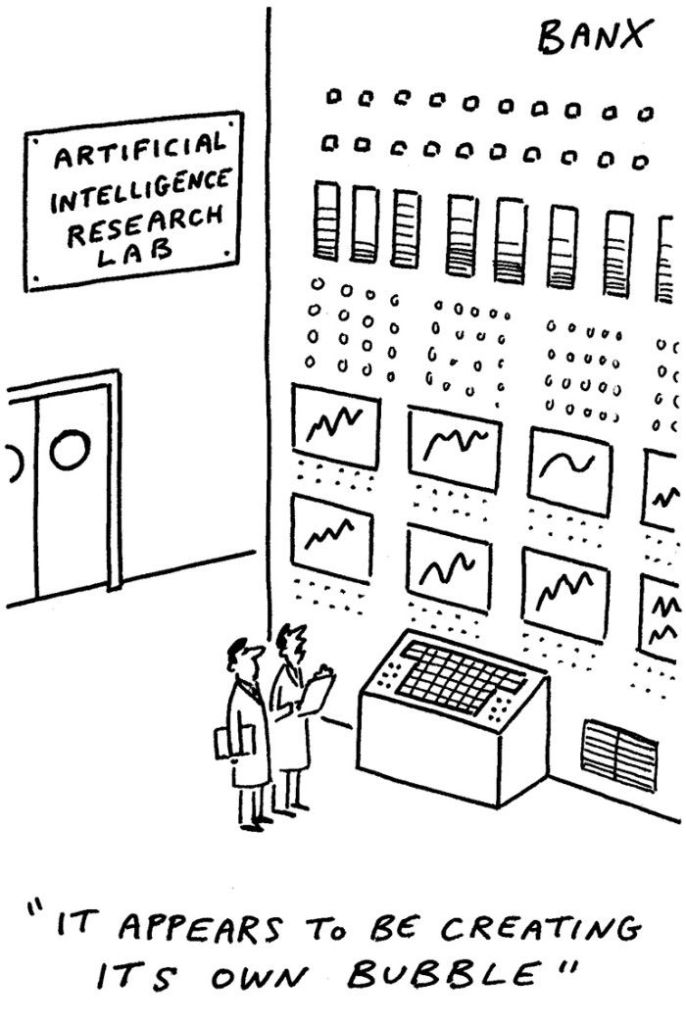
I’m not a financial expert, but I have noticed a significant number of articles in the media suggesting that the Generative AI industry is a bubble waiting to burst. There are recent pieces here on the BBC website, here in the Financial Times (from which I stole the cartoon), and here in the Irish Times, to name but a few.

These stories are based on reports by the Bank of England and the International Monetary Fund, warning of a stock market crash far worse than the dotcom boom-and-bust of 2000 and even the banking crisis of 2008. Over 30% of the valuation of the US stock market, for example, lies in five big technology companies that are investing heavily in the enormous infrastructure required for AI. Their extravagant capital expenditure is underpinned by a complex series of financial arrangements which could unravel very quickly if the investors get cold feet and consider it unlikely they will see a return on their money. It does look very much like a bubble to me.

My own view is that the claims made about the capabilities of AI by tech gurus are grossly overstated. Only the irredeemably gullible could think otherwise. I think a correction is inevitable. It’s not a question of “if” but “when” and “how much”. I am not competent to answer those questions.

P.S. Now there’s an RTÉ Brainstorm piece along the same lines…

A Dream of AI

Posted in Artificial Intelligence, Biographical with tags , , on May 30, 2025 by telescoper

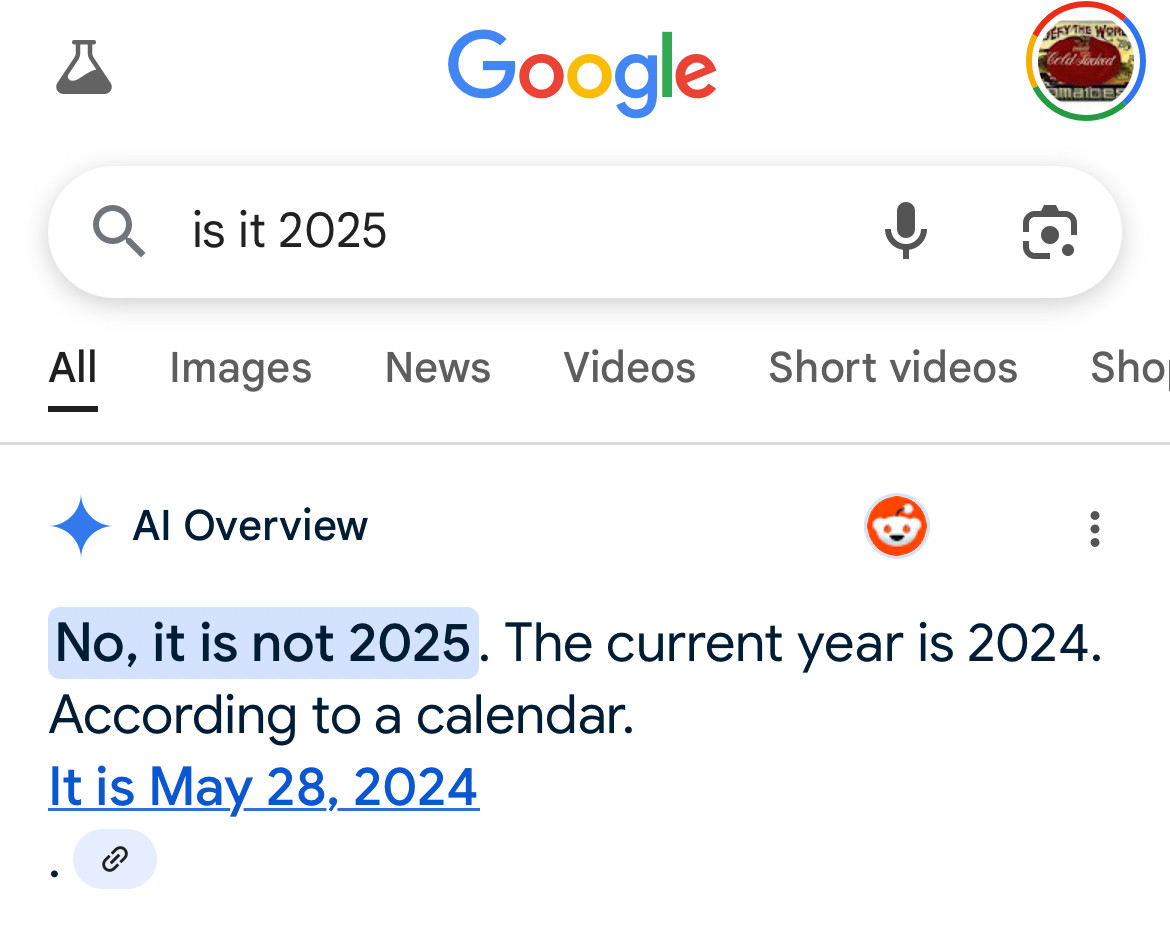
I noticed this, apparently genuine, screengrab circulating on social media:

Can it be? Can 2025 be just a dream and we’re really still in 2024? Did Trump not really get elected? More importantly, am I still on sabbatical? If so, why do I have a desk full of projects to grade? And why am I not in Barcelona?

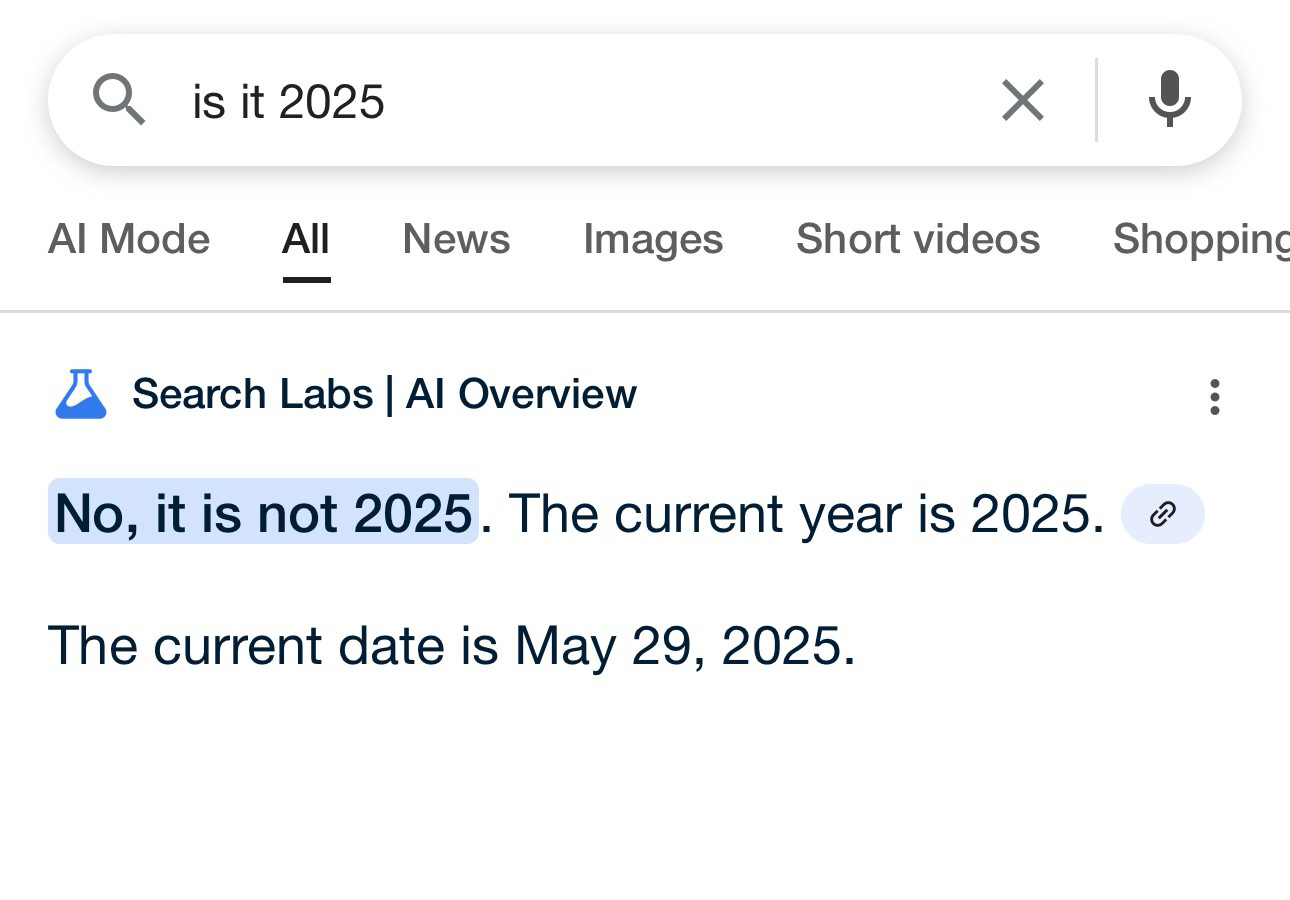
I checked it myself and found this:

Someone at Google obviously tried to fix something by hand and didn’t entirely succeed.

Do you still think that AI isn’t a bubble waiting to burst?

Weekly Update from the Open Journal of Astrophysics – 15/02/2025

Posted in OJAp Papers, Open Access, The Universe and Stuff with tags , , , , , , , , , , on February 15, 2025 by telescoper

Time for another quick update of papers published at the Open Journal of Astrophysics. Since the last update we have published two new papers, which brings the number in Volume 8 (2025) up to 14 and the total so far published by OJAp up to 249.

Here are quick descriptions of the two papers concerned; you can click on the images of the overlays to make them larger should you wish to do so.

First one up is “AI-assisted super-resolution cosmological simulations IV: An emulator for deterministic realizations” by Xiaowen Zhang & Patrick Lachance (Carnegie Mellon), Ankita Dasgupta (Penn State), Rupert A. C. Croft & Tiziana Di Matteo (Carnegie Mellon), Yueying Ni (Harvard), Simeon Bird (UC Riverside) and Yin Li (Shenzhen University, China).  It presents a method of achieving super-resolution to rapidly enhance low-resolution runs with statistically correct fine details to generate accurate simulations and mock observations for large galaxy surveys and was published on Monday 10th February 2025 in the folder marked Cosmology and NonGalactic Astrophysics.


You can find the officially accepted version of this paper on arXiv here.

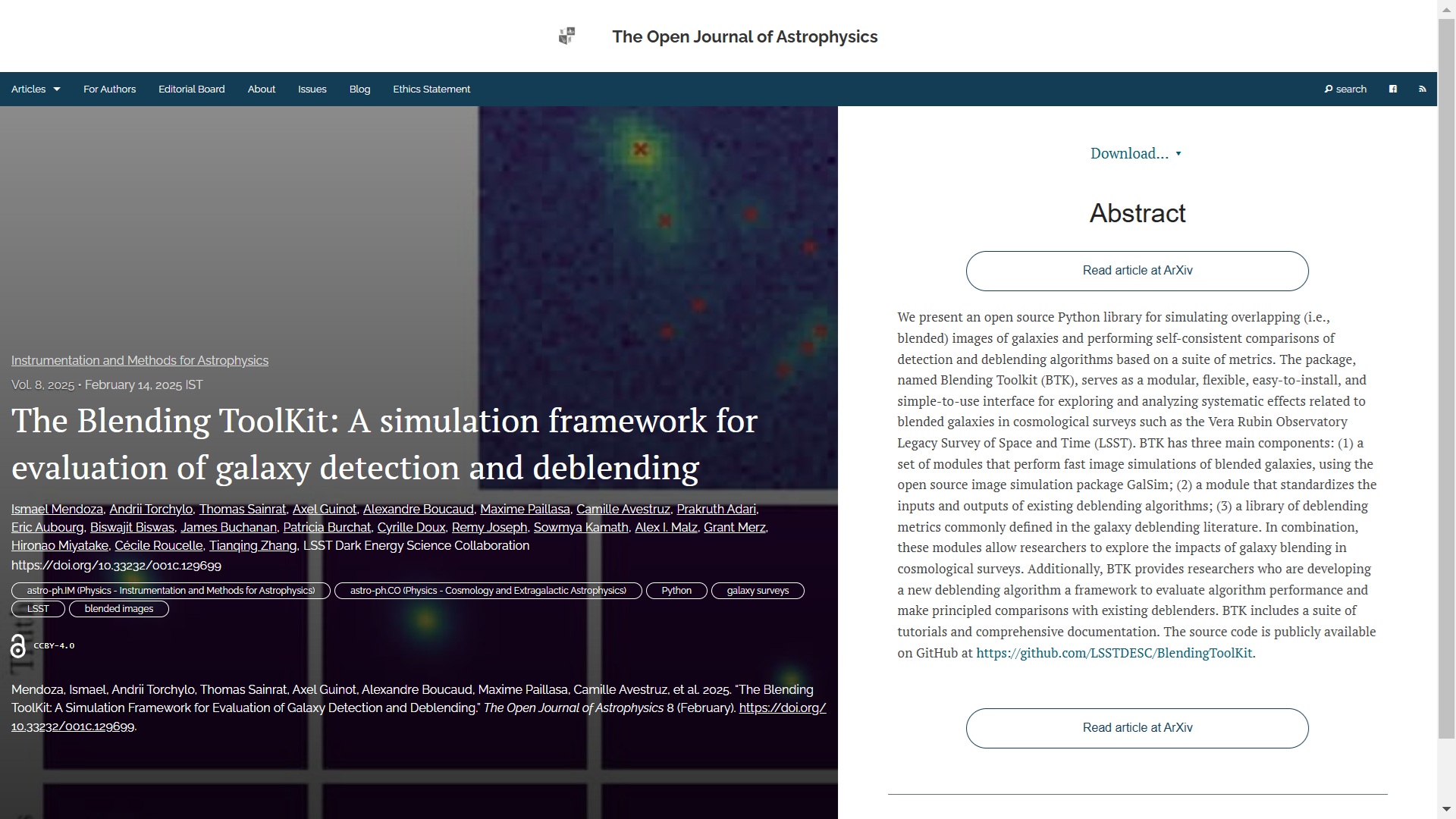
The second paper, published on Friday 14th February 2025 in the folder Instrumentation and Methods for Astrophysics is “The Blending ToolKit: A simulation framework for evaluation of galaxy detection and deblending” which describes a modular suite of Python software for exploring and analyzing systematic effects related to blended galaxy images in cosmological surveys. It was written by Ismael Mendoza (U. Michigan, Ann Arbor, USA) and 19 others, on behalf of the LSST Dark Energy Science Collaboration. I don’t have time to list all the authors here but you can find them on the overlay here:


The accepted version of this paper can be found on the arXiv here.

That’s all for this week. I’ll do another update next week, when I expect to be able to report that we have passed the 250 publication mark.

Is machine learning good or bad for the natural sciences?

Posted in The Universe and Stuff with tags , , , , , , , on May 30, 2024 by telescoper

Before I head off on a trip to various parts of not-Barcelona, I thought I’d share a somewhat provocative paper by David Hogg and Soledad Villar. In my capacity as journal editor over the past few years I’ve noticed that there has been a phenomenal increase in astrophysics papers discussing applications of various forms of Machine Leaning (ML). This paper looks into issues around the use of ML not just in astrophysics but elsewhere in the natural sciences.

The abstract reads:

Machine learning (ML) methods are having a huge impact across all of the sciences. However, ML has a strong ontology – in which only the data exist – and a strong epistemology – in which a model is considered good if it performs well on held-out training data. These philosophies are in strong conflict with both standard practices and key philosophies in the natural sciences. Here, we identify some locations for ML in the natural sciences at which the ontology and epistemology are valuable. For example, when an expressive machine learning model is used in a causal inference to represent the effects of confounders, such as foregrounds, backgrounds, or instrument calibration parameters, the model capacity and loose philosophy of ML can make the results more trustworthy. We also show that there are contexts in which the introduction of ML introduces strong, unwanted statistical biases. For one, when ML models are used to emulate physical (or first-principles) simulations, they introduce strong confirmation biases. For another, when expressive regressions are used to label datasets, those labels cannot be used in downstream joint or ensemble analyses without taking on uncontrolled biases. The question in the title is being asked of all of the natural sciences; that is, we are calling on the scientific communities to take a step back and consider the role and value of ML in their fields; the (partial) answers we give here come from the particular perspective of physics

arXiv:2405.18095

P.S. The answer to the question posed in the title is probably “yes”.

On Papers Written Using Large Language Models

Posted in Uncategorized with tags , , , , , , , on March 26, 2024 by telescoper

There’s an interesting preprint on arXiv by Andrew Gray entitled ChatGPT “contamination”: estimating the prevalence of LLMs in the scholarly literature that tries to estimate how many research articles there are out there that have been written with the help of Large Language Models (LLMs) such as ChatGPT. The abstract of the paper is:

The use of ChatGPT and similar Large Language Model (LLM) tools in scholarly communication and academic publishing has been widely discussed since they became easily accessible to a general audience in late 2022. This study uses keywords known to be disproportionately present in LLM-generated text to provide an overall estimate for the prevalence of LLM-assisted writing in the scholarly literature. For the publishing year 2023, it is found that several of those keywords show a distinctive and disproportionate increase in their prevalence, individually and in combination. It is estimated that at least 60,000 papers (slightly over 1% of all articles) were LLM-assisted, though this number could be extended and refined by analysis of other characteristics of the papers or by identification of further indicative keywords.

Andrew Gray, arXiv:2403.16887

The method employed to make the estimate involves identifying certain words that LLMs seem to love, of which usage has increased substantially since last year. For example, twice as many papers call something “intricate” nowadays compared to the past; there are also increases in the use of the words “commendable” and “meticulous”.

I found this a commendable paper, which is both meticulous and intricate. I encourage you to read it.

P.S. I did not use ChatGPT to write this blog post.

Assessment in the Age of AI

Posted in Education, Maynooth with tags , , , , on May 5, 2023 by telescoper

The arrival of AI bots such as ChatGPT continues to cast a shadow over student assessment in the third-level institutions, as academics are realizing that these algorithms are getting better and better at the tasks asked of students, especially straightforward writing tasks (perhaps including simple calculations) as well as the traditional student essay.

Before going further I have to admit that I’ve never really understood the obsession in some parts of academia with “the Essay” as a form of assessment. I agree that writing skills are extremely important but they’re not the only skills it is important for students to acquire during the course of a degree. Learning how to do things seems to me to be more important than writing about things other people have done. While forms of assessment in science subjects have evolved considerably over the last 50 years, some other domains still seem to concentrate almost exclusively on “The Essay”.

Systems such as ChatGPT can produce text on demand (with a variable degree of success) using sources on the internet. This is not great at dealing with technically complex specialist topics but can produce plausible if somewhat superficial offerings in many circumstances where something less demanding is required. I know that staff in some science departments find that these systems can score essentially 100% on their first-year coursework assignments. Urgent meetings are being called and working groups being set up about this. Panic is in the air.

My immediate response to the situation is very twofold:

  1. Don’t panic!
  2. If an assessment can be aced by a bot then it should not contribute towards credit unless the students do it in a supervised environment, e.g. as an in-class test rather than a take-home assignment.
  3. More importantly, if a student with only a superficial knowledge can score a high mark on an assessment, what is the value of the assessment anyway?

It seems to me that the intervention of ChatGPT should cause academics to reflect much more deeply on what it is that they are trying to assess, and that should lead to new forms of assessment that can’t be performed by AI bots as well as the scrapping of many existing assessment activities, many of which (in my opinion) are pointless. There is so much inertia in academia, however, that such a radical rethink will be forthcoming on the timescale required.

All of which waffly nonsense reminded me of a joke I heard many years ago.

Q: How many academics does it take to change a lightbulb?

A: What do you mean, change?

Guest Post – by A.I. Addio

Posted in The Universe and Stuff with tags , , , , on December 6, 2022 by telescoper

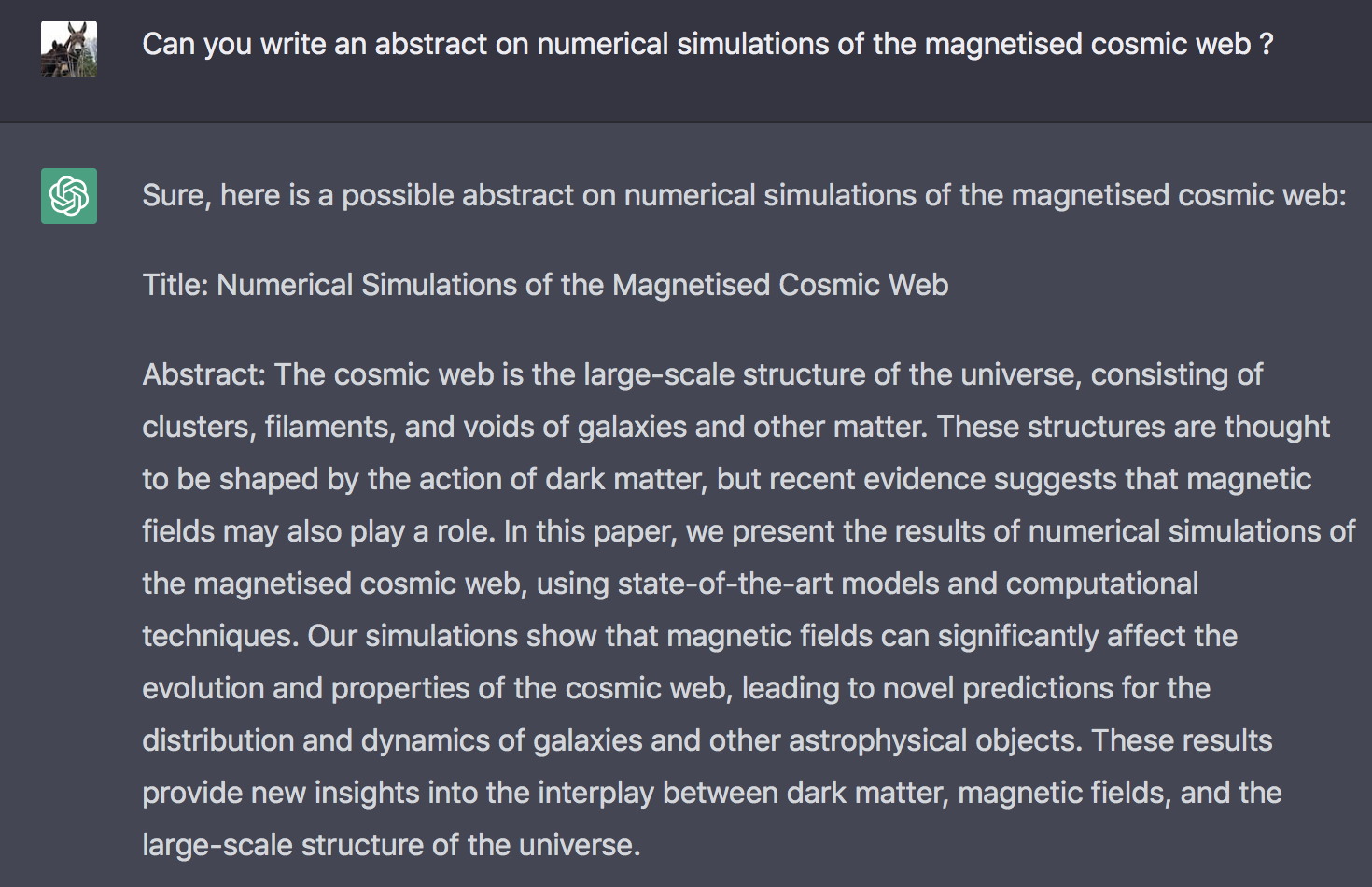
Quite a few people have been playing around with a new-fangled AI tool called ChatGPT the developers of which say this:

We’ve trained a model called ChatGPT which interacts in a conversational way. The dialogue format makes it possible for ChatGPT to answer followup questions, admit its mistakes, challenge incorrect premises, and reject inappropriate requests. ChatGPT is a sibling model to InstructGPT, which is trained to follow an instruction in a prompt and provide a detailed response.

Here is an example (stolen from here) wherein this “model” creates the abstract of a scientific paper on a suggested topic:

This makes me wonder how many abstracts on astro-ph are actually written this way!

Please note that no papers of mine involved the use of any form of Artificial Insemination. I hope this clarifies the situation.

Creating art from your thesis title

Posted in Art, The Universe and Stuff with tags , , on December 5, 2021 by telescoper

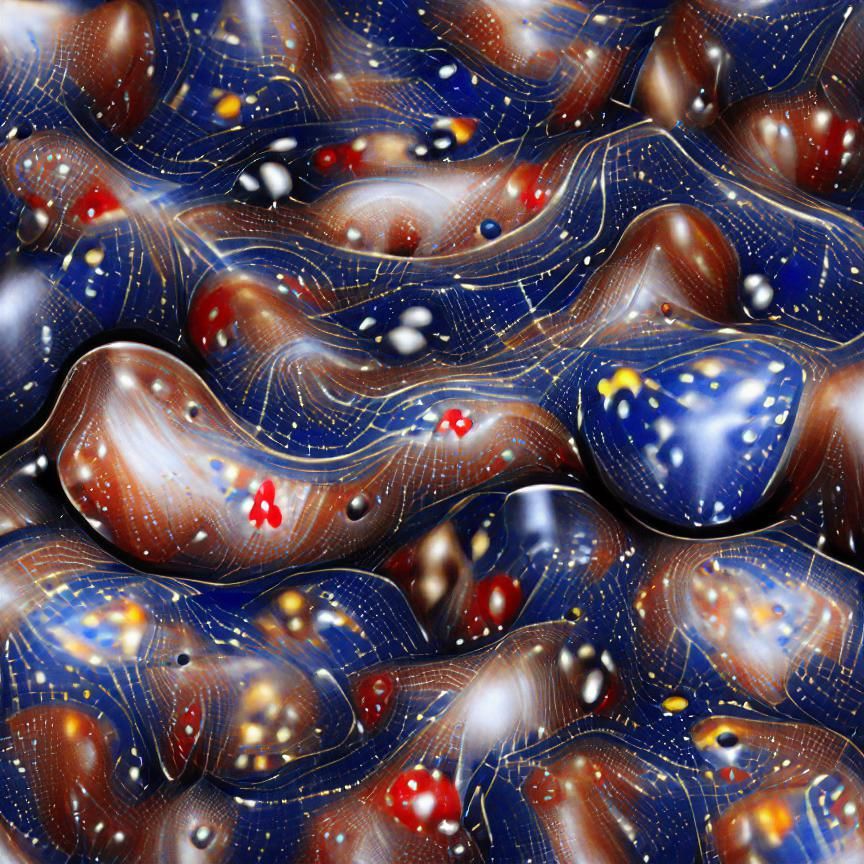
Looking for displacement activities to enable me to avoid working I noticed that people are having fun on social media by using AI apps to generate art from thesis titles. I thought I’d give it a go, and this is what I got for my thesis title Stochastic Fluctuations in the Early Universe:

Stochastic fluctuations in the early Universe

Actually, I rather like it! It’s much better than I’d expected. I’ve been told it looks like Christmas wrapping paper which gives it a seasonal twist too!

There are several apps that will create images inspired by text you type in. The one I used for the example above was this one. Why not try it yourself?