With thoughts turning to the new academic year I noticed an Open Letter to Universities in the Netherlands, which I have signed. You can read the letter yourself but here is a summary of the main calls to action:
• Resist the introduction of AI in our own software systems, from Microsoft to OpenAI to Apple. It is not in our interests to let our processes be corrupted and give away our data to be used to train models that are not only useless to us, but also harmful.
• Ban AI use in the classroom for student assignments, in the same way we ban essay mills and other forms of plagiarism. Students must be protected from de-skilling and allowed space and time to perform their assignments themselves.
• Cease normalising the AI hype and the lies which are prevalent in the technology industry’s framing of these technologies. The technologies do not have the advertised capacities and their adoption puts students and academics at risk of violating ethical, legal, scholarly, and scientific standards of reliability, sustainability, and safety.
• Fortify our academic freedom as university staff to enforce these principles and standards in our classrooms and our research as well as on the computer systems we are obliged to use as part of our work. We as academics have the right to our own spaces.
• Sustain critical thinking on AI and promote critical engagement with technology on a firm academic footing. Scholarly discussion must be free from the conflicts of interest caused by industry funding, and reasoned resistance must always be an option.
I agree with all of these. I don’t think The Management does though.
In Maynooth University there has been a total absence of leadership from the Management about the academic threats posed by the uncritical adoption of “AI” . I’ve put “AI” in quotes because most of what is being described as AI nowadays (e.g. LLMs) is not is in no way Artifical Intelligence. There is a place for such things as Machine Learning. Indeed, much of the data-driven research in my own field of cosmology would be impossible without them. The key, however, is not whether you insist on calling it AI or not, but the word uncritical. Much of what I have heard from our “Leadership” is simple-minded boosterism. And yes, that word is in quotes for the same reason as “AI”.
In planning my teaching for next term, which starts in two weeks, I have taken a hard line on assignments. I allow no assignment to contribute to a module grade unless it is supervised in such a way as to prevent “AI” being used. Both modules I will be teaching next semester are mathematical in nature, and the summative assessments will consist of four (unseen) in-class tests and a written exam. Phones, laptops and tablets are banned from all these.
I believe that this is the only way to maintain the integrity of these assessments and that to do anything else will result in a lowering of academic standards. I believe this is the case across a great many disciplines, so there should be university-wide regulations to manage it. I find the absence of any “Leadership” on this scandalous (but I’m afraid not surprising).
This is not to say that I will band the use of LLMs etc entirely. Students will be free to use ChatGPT or CoPilot or whatever to check their answers to the formative assessments I hand out, if they think that will help, but these will not contribute to their module mark.
It’s Saturday again so it’s time for another update of activity at the Open Journal of Astrophysics. Since the last update we have published a further three papers, bringing the number in Volume 9 (2026) to 129 and the total so far published by OJAp up to 577.
I will continue to include the posts made on our Mastodon account (on Fediscience); these announcements also show the DOI for each paper.
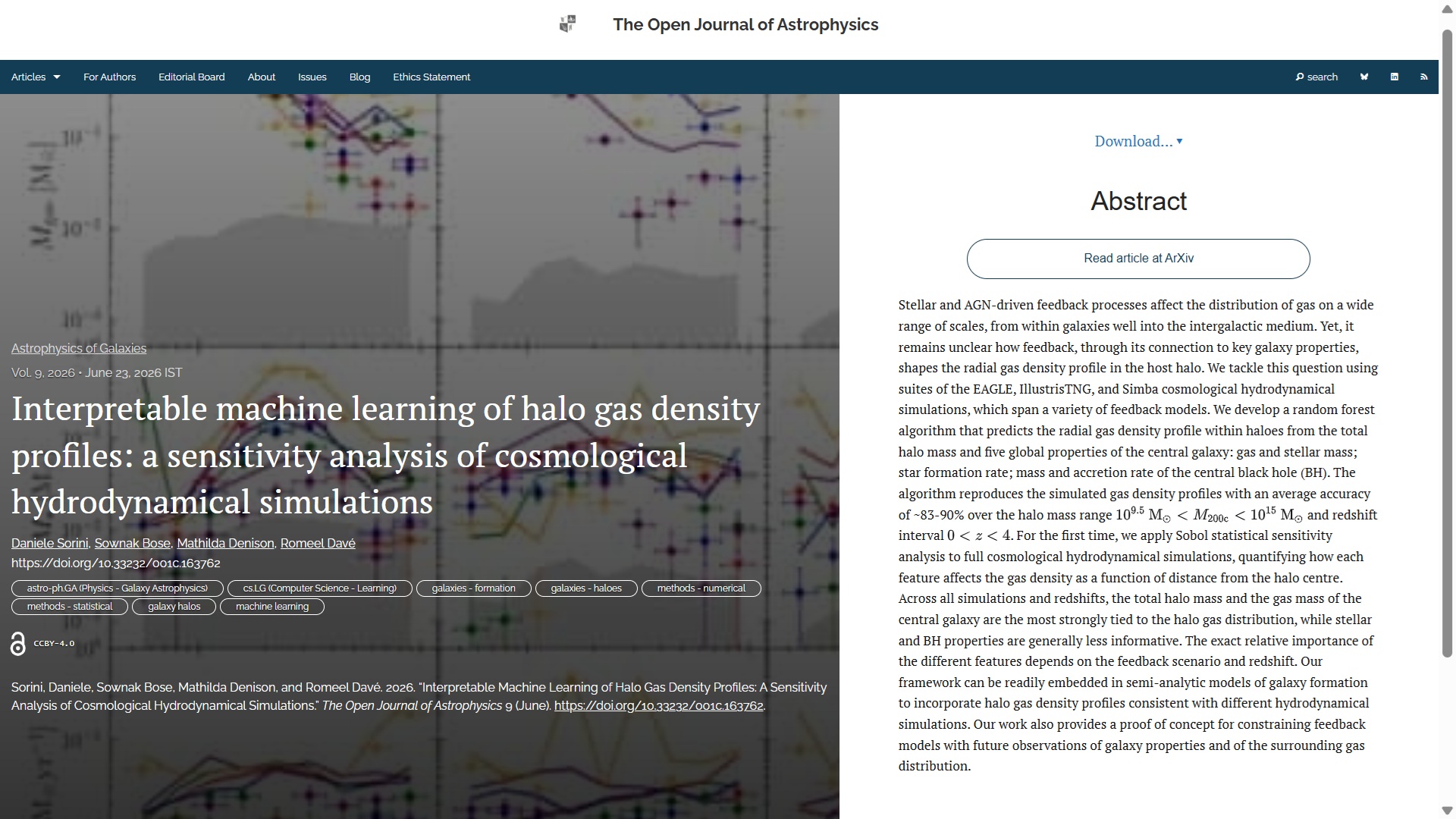
The first paper to report this week, published on Tuesday 23rd June, is “Interpretable machine learning of halo gas density profiles: a sensitivity analysis of cosmological hydrodynamical simulations” by Daniele Sorini & Sownak Bose (Durham University, UK), Mathilda Denison (U. Penn., USA) and Romeel Davé (University of Edinburgh, UK). This study uses cosmological hydrodynamical simulations and a random forest algorithm to understand how feedback processes affect the gas distribution in galaxies by predicting gas density profiles in various models. It is published in the folder Astrophysics of Galaxies.
The overlay for this paper is here
You can find the officially accepted version on arXiv here and the announcement on Fediverse here:
New Publication atthe Open Journal of Astrophysics: "Interpretable machine learning of halo gas density profiles: a sensitivity analysis of cosmological hydrodynamical simulations" by Daniele Sorini & Sownak Bose (Durham U., UK), Mathilda Denison (U. Penn., USA) and Romeel Davé (U. Edinburgh, UK)
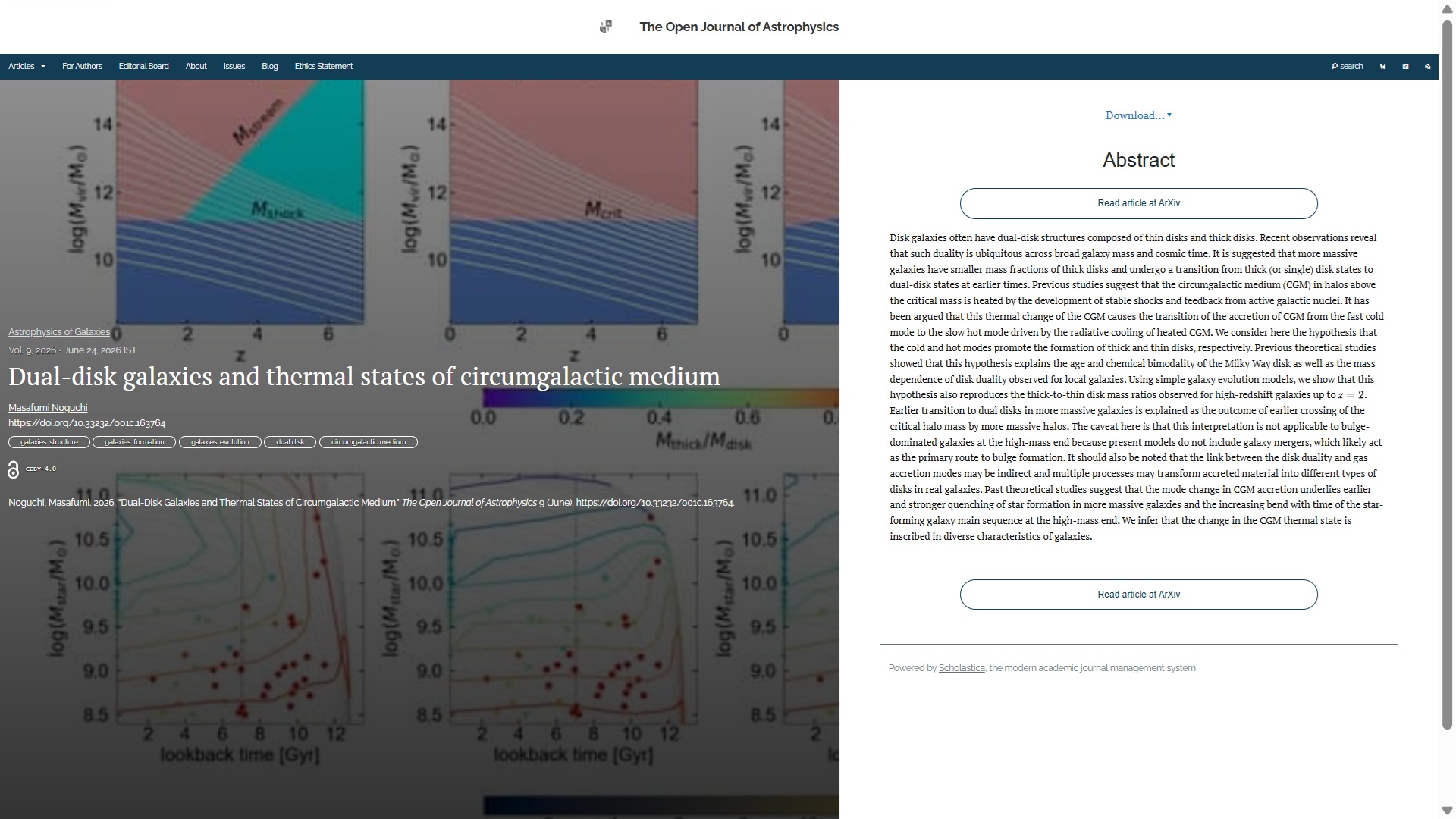
The second paper for this week, published on Wednesday June 24th in the folder Astrophysics of Galaxies is “Dual-disk galaxies and thermal states of circumgalactic medium” by Masafumi Noguchi (Tohoku University, Japan). This paper explores the suggestion that the transition from thick to dual-disk galaxies is influenced by thermal changes in the circumgalactic medium (CGM), which also affects star formation.
The overlay looks like this:
The official version of the paper can be found on arXiv here and the Fediverse announcement here:
New Publication at the Open Journal of Astrophysics: "Dual-disk galaxies and thermal states of circumgalactic medium" by Masafumi Noguchi (Tohoku University, Japan).
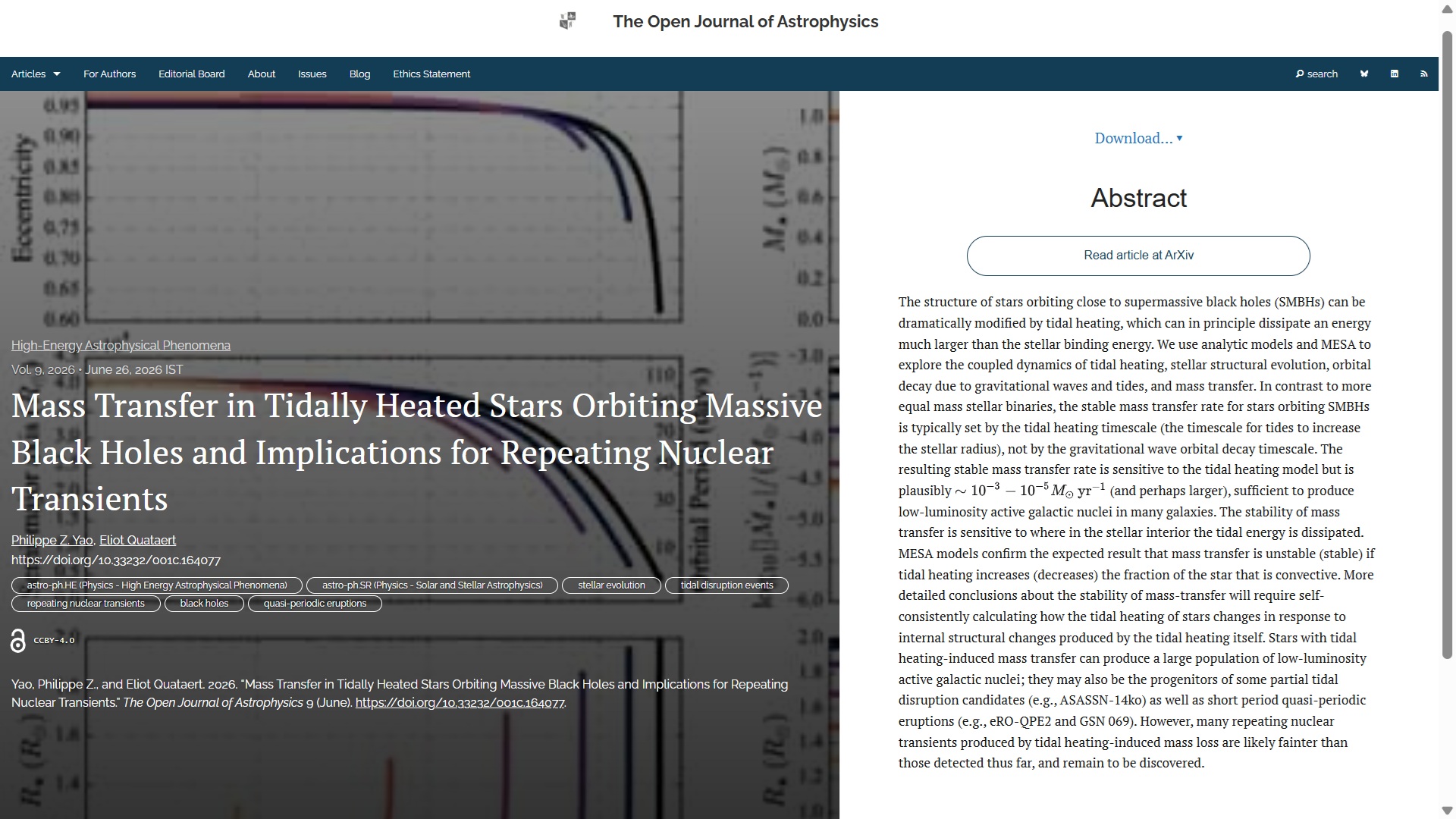
New Publication at the Open Journal of Astrophysics: "Mass Transfer in Tidally Heated Stars Orbiting Massive Black Holes and Implications for Repeating Nuclear Transients" by Philippe Z. Yao and Eliot Quataert (Princeton University, USA)
And that concludes this week’s update. It has been another slow week on the publishing front. We have a steadily growing backlog of papers accepted for publication but with final versions yet to appear on arXiv. I suppose it’s the holidays…
P.S. The other day I checked the stats for the Open Journal of Astrophysics and saw that we’ve passed 8,000 citations. The average number of citations per paper is 14.0, which is not bad when you consider that over half the papers were published under a year ago…
It’s Saturday once more, so it’s time for another update of activity at the Open Journal of Astrophysics. Since the last update we have published a further eight papers, bringing the number in Volume 9 (2026) to 59 and the total so far published by OJAp up to 507. We passed the 500 mark on Monday, and the week was also notable because we once again published at least one paper each working day.
I will continue to include the posts made on our Mastodon account (on Fediscience) to encourage you to visit it. Mastodon is a really excellent service, and a more than adequate replacement for X/Twitter (which nobody should be using); these announcements also show the DOI for each paper.
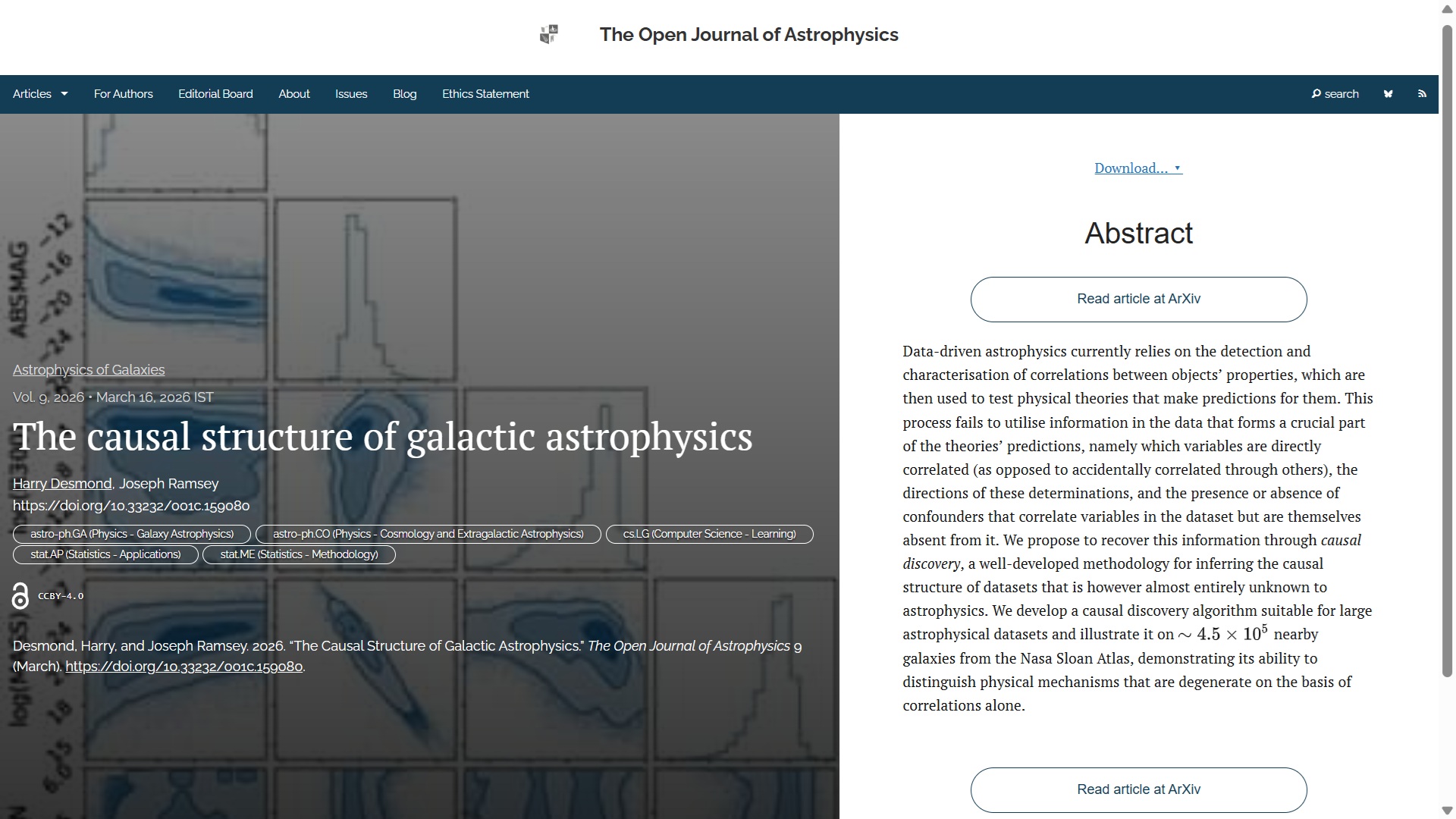
The first paper to report this week is our 500th publication. The title is “The causal structure of galactic astrophysics” and the authors are Harry Desmond (U. Portsmouth, UK) and Joseph Ramsey (Carnegie Mellon U., USA). This paper was published on Monday March 16th 2026 in the folder Astrophysics of Galaxies. It proposes using causal discovery, a method for inferring data structure, to better utilize information in astrophysical data, demonstrated through an algorithm applied to a large galaxy dataset.
The overlay is here:
You can find the officially accepted version on arXiv here and the announcement on Fediverse here:
New Publication at the Open Journal of Astrophysics: "The causal structure of galactic astrophysics" by Harry Desmond (U. Portsmouth, UK) and Joseph Ramsey (Carnegie Mellon U., USA)
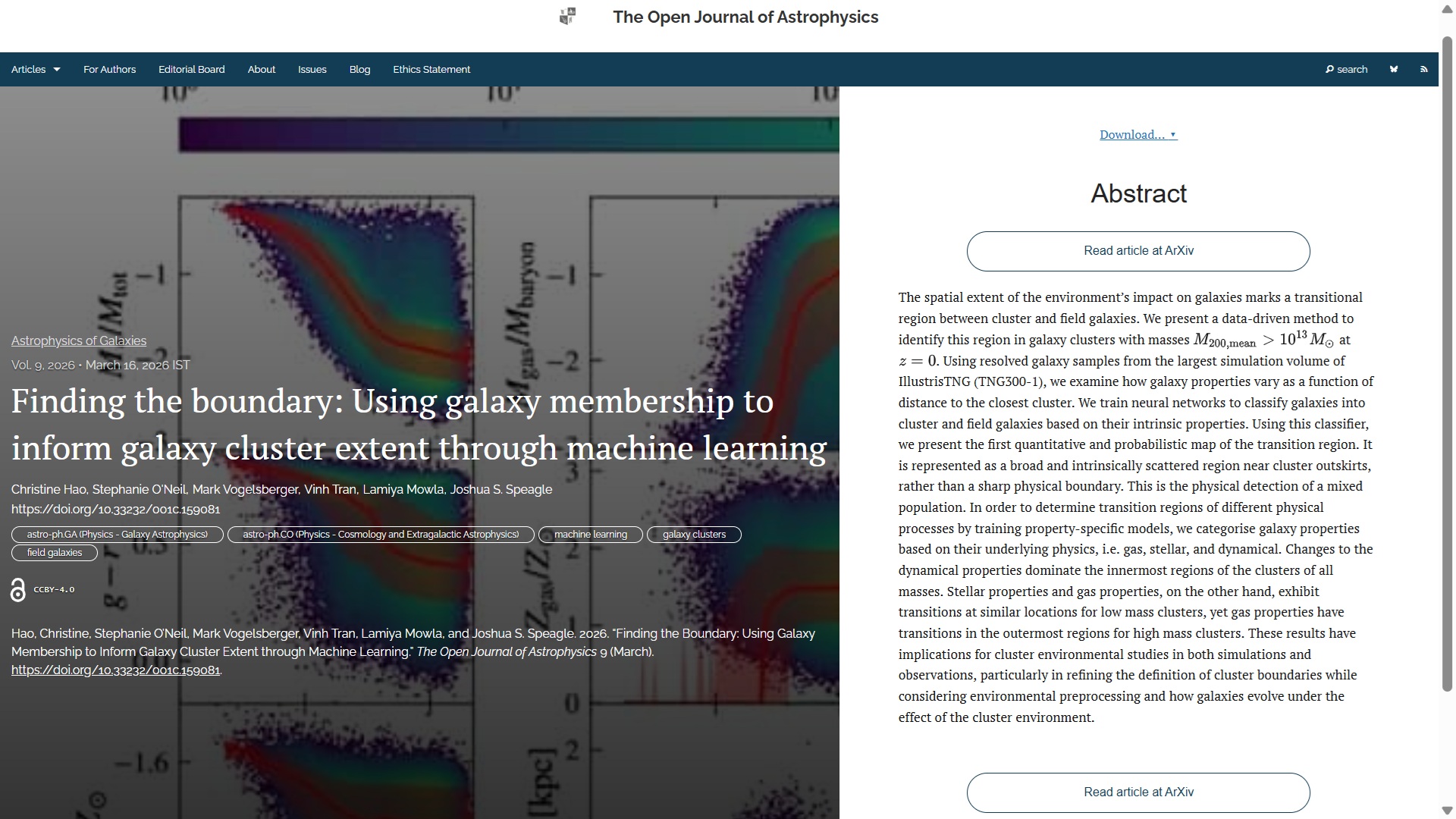
The second paper for this week, also published on March 16th in the folder Astrophysics of Galaxies, is “Finding the boundary: Using galaxy membership to inform galaxy cluster extent through machine learning” by Christine Hao, Stephanie O’Neil, Mark Vogelsberger, & Vinh Tran (MIT, USA), Lamiya Mowla (Wellesley College, USA) and Joshua S. Speagle (U. Toronto, Canada). This study uses neural networks and simulations to identify and map the transitional region between cluster and field galaxies, revealing it as a scattered area rather than a sharp boundary.
The overlay for this one is here:
The official version of the paper can be found on arXiv here and the Fediverse announcement here:
New Publication at the Open Journal of Astrophysics: "Finding the boundary: Using galaxy membership to inform galaxy cluster extent through machine learning" by Christine Hao, Stephanie O'Neil, Mark Vogelsberger, & Vinh Tran (MIT, USA), Lamiya Mowla (Wellesley College, USA) and Joshua S. Speagle (U. Toronto, Canada)
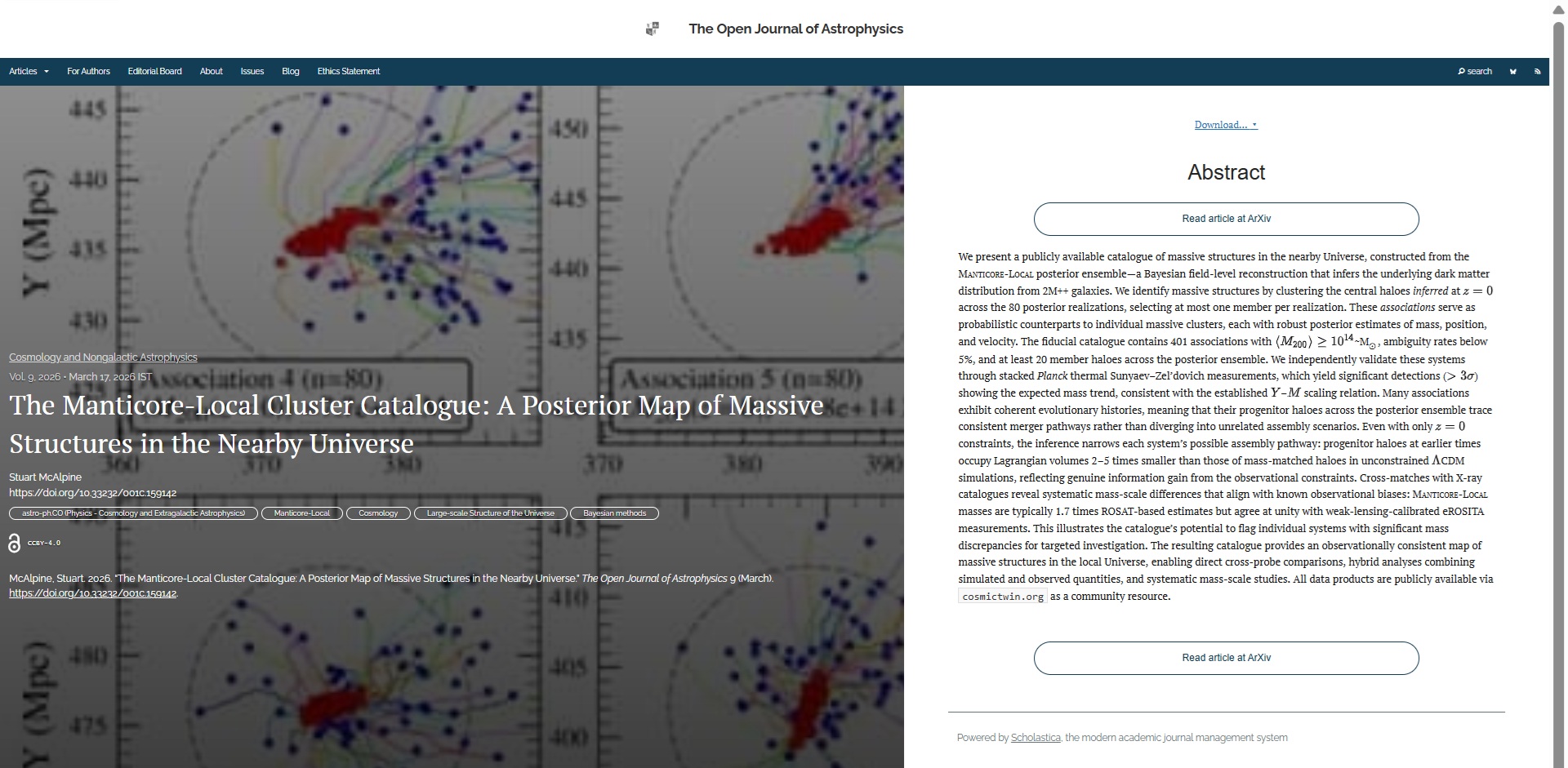
New Publication at the Open Journal of Astrophysics: "The Manticore-Local Cluster Catalogue: A Posterior Map of Massive Structures in the Nearby Universe" by Stuart McAlpine (Oskar Klein Centre, Stockholm U., Sweden)
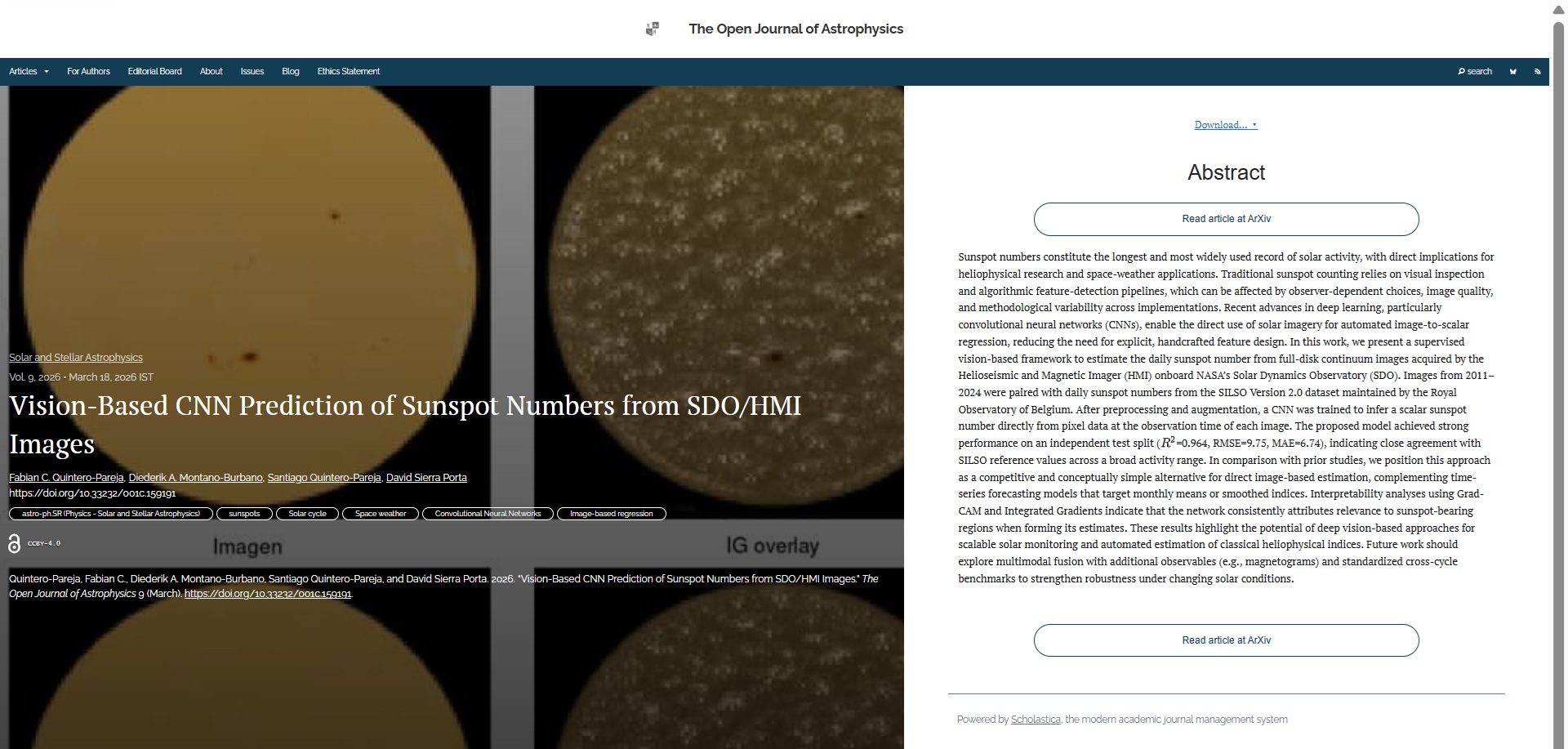
The fourth paper this week, published on 18th March 2026 in the folder Solar and Stellar Astrophysics is “Vision-Based CNN Prediction of Sunspot Numbers from SDO/HMI Images” by Fabian C. Quintero-Pareja, Diederik A. Montano-Burbano, Santiago Quintero-Pareja & David Sierra Porta (Universidad Tecnológica de Bolívar, Colombia). This article describes a deep learning framework that uses convolutional neural networks to estimate daily sunspot numbers from solar images, offering a scalable and accurate method for solar monitoring.
The overlay is here:
The finally accepted version of this paper can be found here and the Mastodon announcement is here:
New Publication at the Open Journal of Astrophysics: "Vision-Based CNN Prediction of Sunspot Numbers from SDO/HMI Images" by Fabian C. Quintero-Pareja, Diederik A. Montano-Burbano, Santiago Quintero-Pareja & David Sierra Porta (Universidad Tecnológica de Bolívar, Colombia)
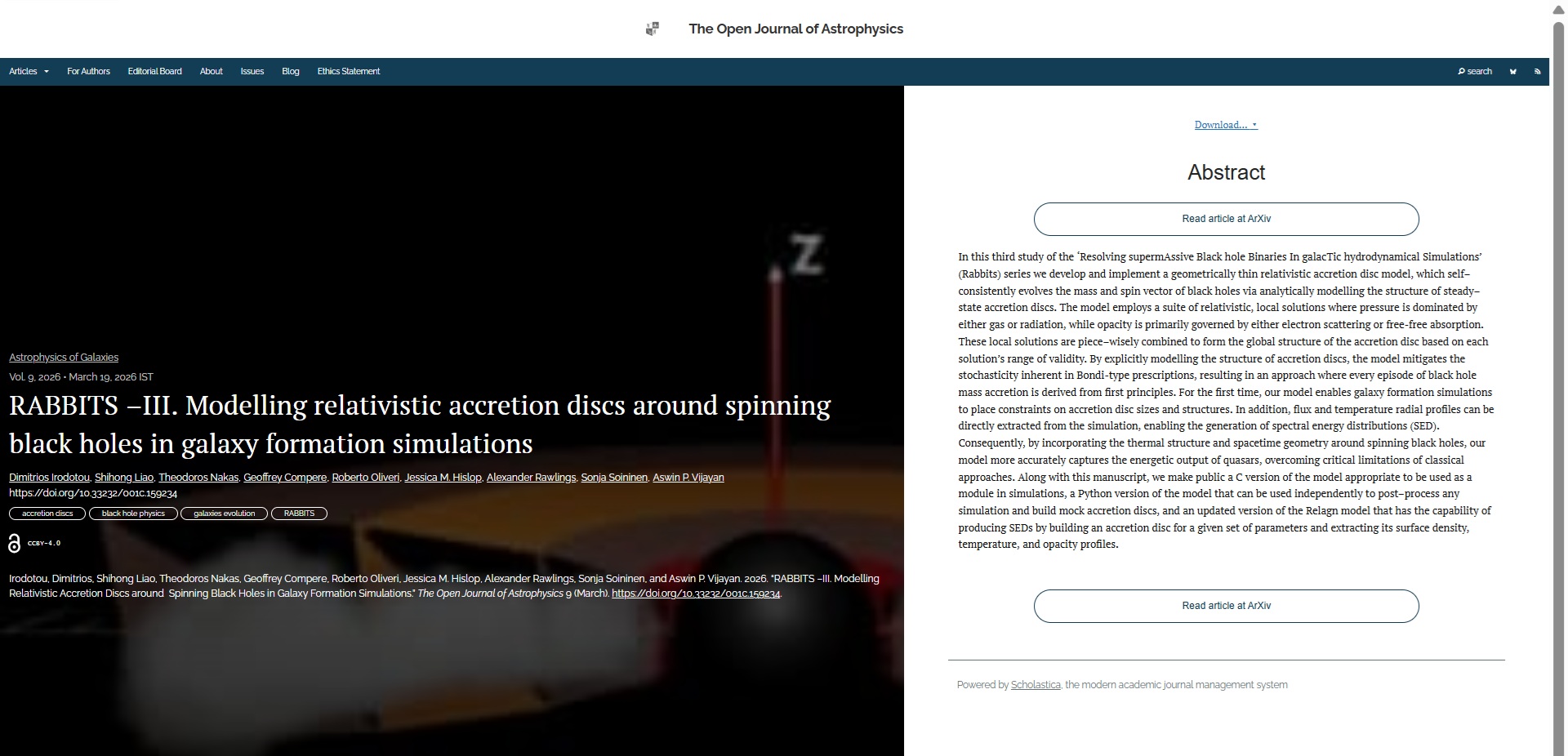
New Publication at the Open Journal of Astrophysics: "RABBITS –III. Modelling relativistic accretion discs around spinning black holes in galaxy formation simulations" by Dimitrios Irodotou (ICR, London) and 8 others based in China, Korea, Belgium, France, Finland and the UK.
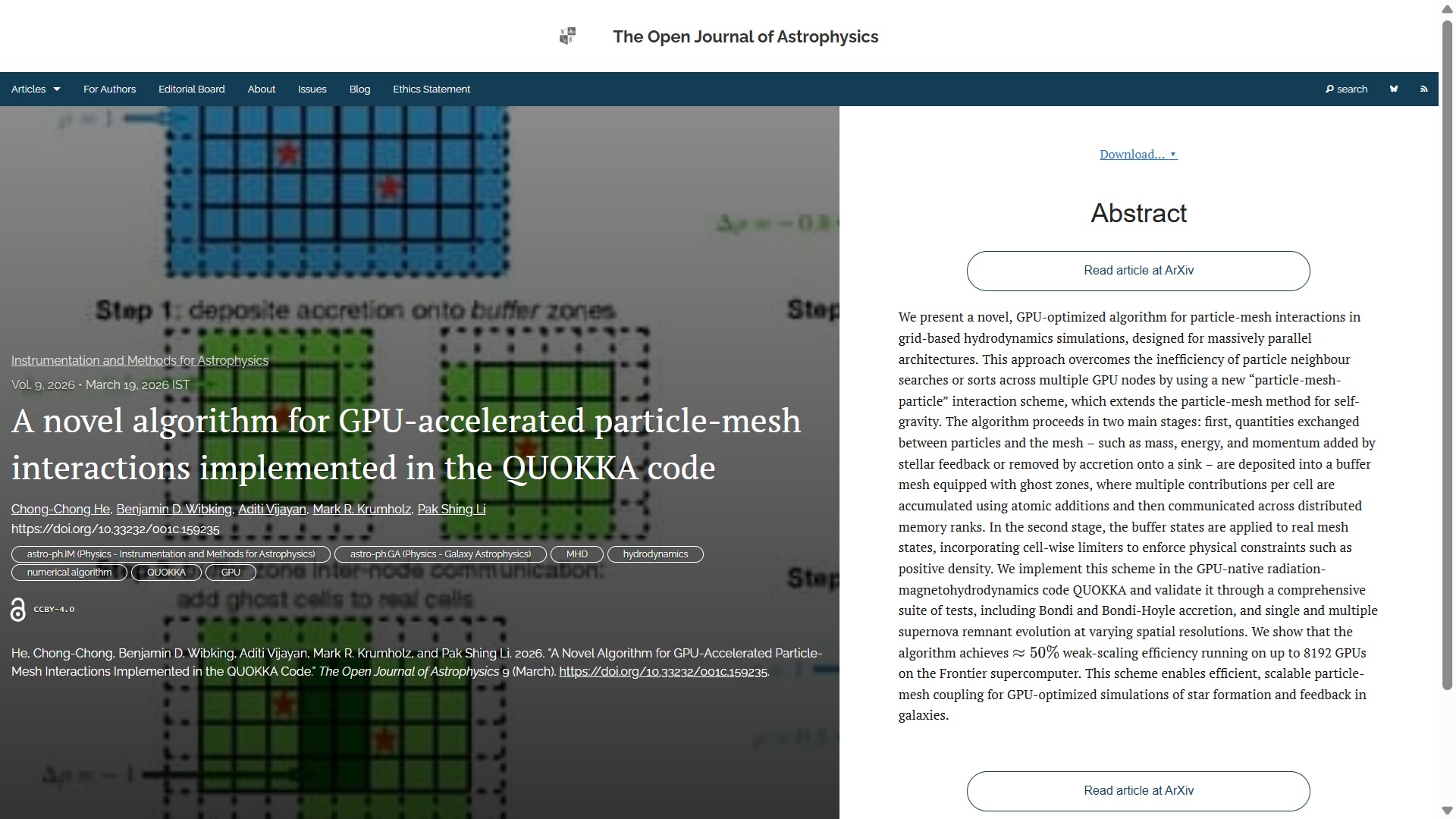
The sixth paper this week is “A novel algorithm for GPU-accelerated particle-mesh interactions implemented in the QUOKKA code” by Chong-Chong He (Australia National University), Benjamin D. Wibking (Michigan State U., USA), Aditi Vijayan (ANU), Mark R. Krumholz (ANU) and Pak Shing Li (Shanghai Astronomical Observatory, China). This was published on Thursday 19th March in the folder Instrumentation and Methods for Astrophysics. The article introduces a GPU-optimized algorithm for particle-mesh interactions in hydrodynamics simulations, improving efficiency and scalability in simulations of star formation and feedback in galaxies.
The overlay is here:
The officially accepted version of this paper can be found on arXiv here, and the Mastodon announcement is here:
New Publication at the Open Journal of Astrophysics: "A novel algorithm for GPU-accelerated particle-mesh interactions implemented in the QUOKKA code" by Chong-Chong He (Australia National University), Benjamin D. Wibking Michigan State U., USA), Aditi Vijayan (ANU), Mark R. Krumholz (ANU) and Pak Shing Li (Shanghai Astronomical Observatory, China)
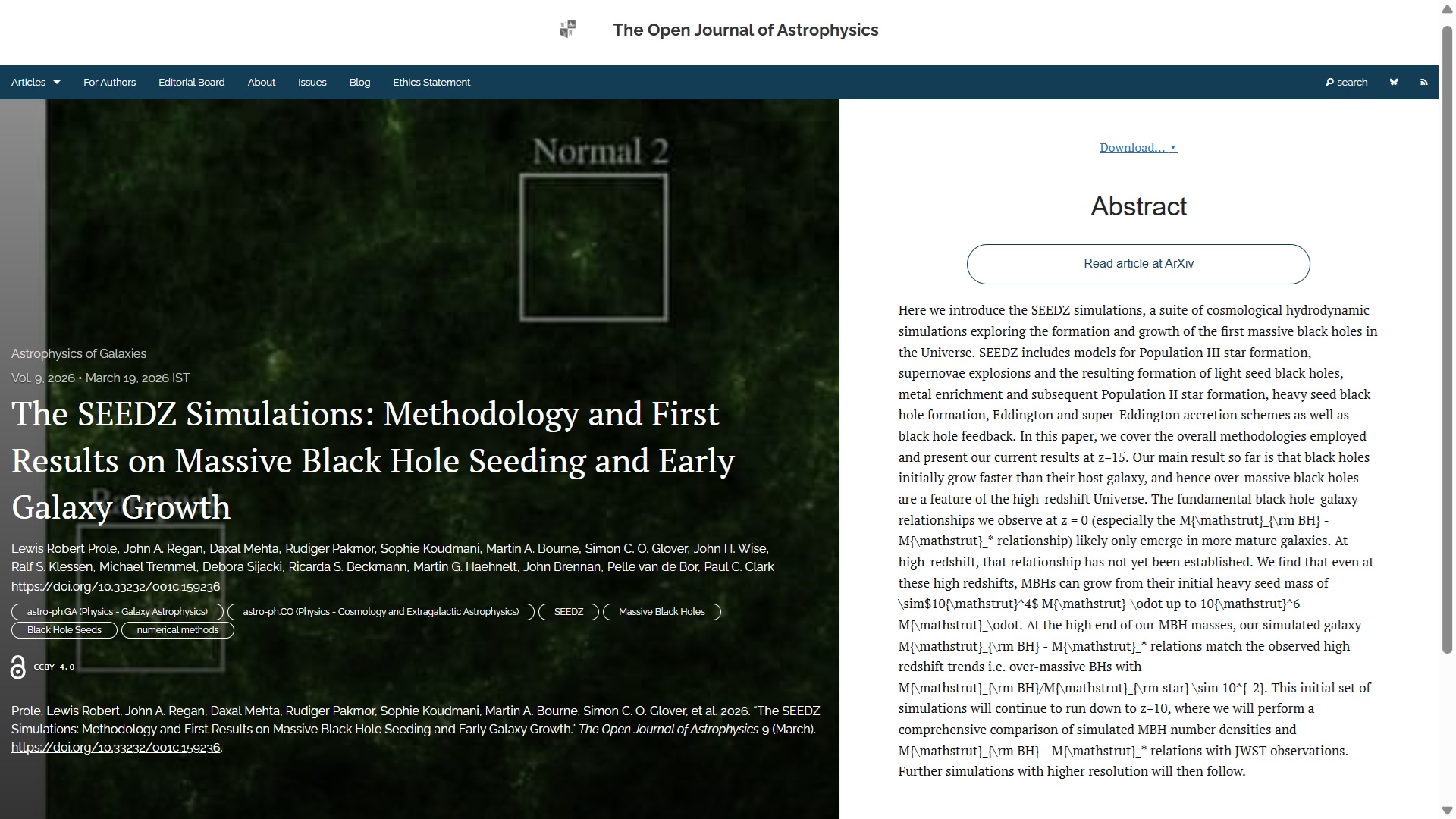
The penultimate, seventh, paper for this week is “The SEEDZ Simulations: Methodology and First Results on Massive Black Hole Seeding and Early Galaxy Growth” by Lewis Prole (NUI Maynooth, Ireland) and 15 others based in Ireland, Germany and the UK. This paper was also published on Thursday March 19th 2026 in the folder Astrophysics of Galaxies. Ir presents the SEEDZ simulations, studying the formation and growth of the universe’s first massive black holes, finding that these black holes initially grow faster than their host galaxies.
The overlay for this one is here:
The official version of this paper can be found here. This is the Mastodon announcement:
New Publication at the Open Journal of Astrophysics: "The SEEDZ Simulations: Methodology and First Results on Massive Black Hole Seeding and Early Galaxy Growth" by Lewis Prole (NUI Maynooth, Ireland) and 15 others based in Ireland, Germany and the UK.
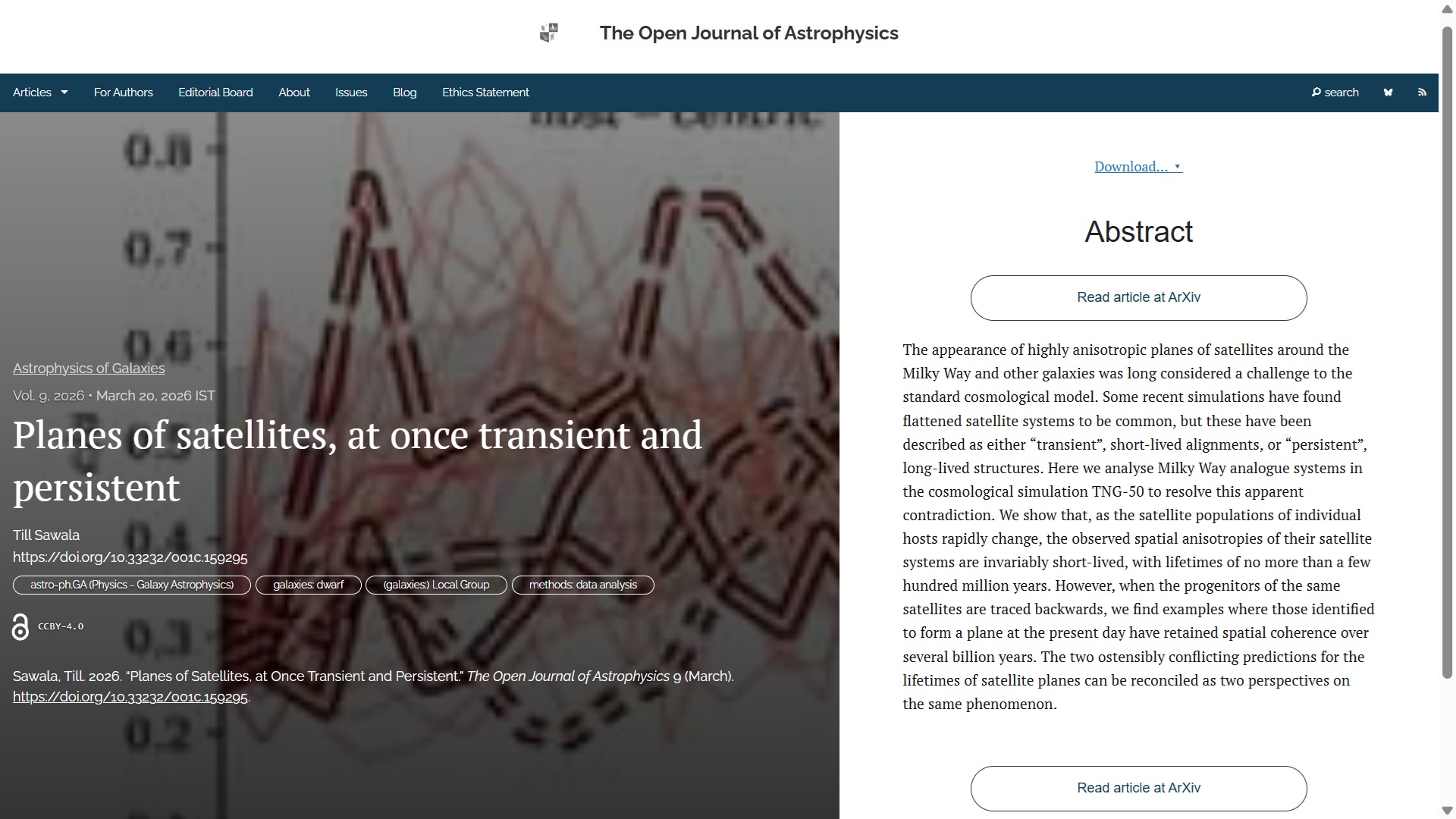
And finally for this week, published yesterday (Friday 20th March 2026) in the folder Astrophysics of Galaxies, we have “Planes of satellites, at once transient and persistent” by Till Sawala (University of Helsinki, Finland). This study resolves the contradiction in the lifespan of satellite systems around galaxies, showing they are short-lived but maintain spatial coherence over billions of years.
Here is the overlay for this one:
The officially accepted version can be found on arXiv here and the Mastodon announcement is here:
New Publication at the Open Journal of Astrophysics: "Planes of satellites, at once transient and persistent" by Till Sawala (University of Helsinki, Finland)
And that concludes the update for this week. Will we keep the rate up next week? Tune in next Saturday to find out!
P.S. Thank you once again to the many people who have responded to the latest call for editors. The Editorial Board has grown substantially over the last few weeks – an up-to-date version can be found here – and there are still some people waiting to get onboard, so please bear with me!
It’s Saturday once more, so it’s time for another update of activity at the Open Journal of Astrophysics. It has been a busy week. Since the last update we have published a further nine papers, bringing the number in Volume 9 (2026) to 45 and the total so far published by OJAp up to 493.
I will continue to include the posts made on our Mastodon account (on Fediscience) to encourage you to visit it. Mastodon is a really excellent service, and a more than adequate replacement for X/Twitter (which nobody should be using); these announcements also show the DOI for each paper.
The first four papers this week were all published on Monday 23rd February.
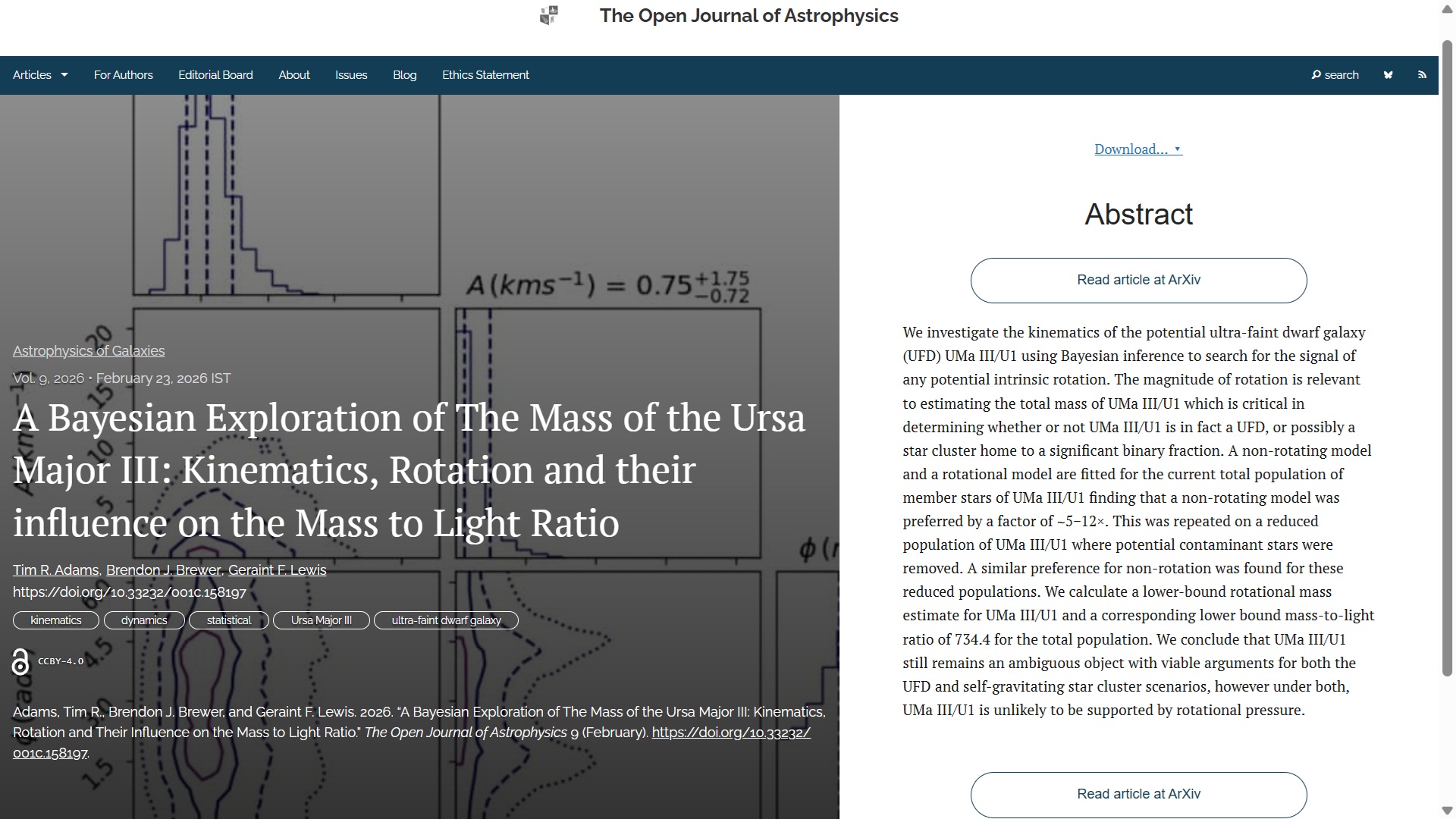
New Publication at the Open Journal of Astrophysics: "A Bayesian Exploration of The Mass of the Ursa Major III: Kinematics, Rotation and their influence on the Mass to Light Ratio" by Tim R. Adams (U. Sydney, Australia), Brendon J. Brewer (U. Auckland, New Zealand) and Geraint F. Lewis (Sydney)
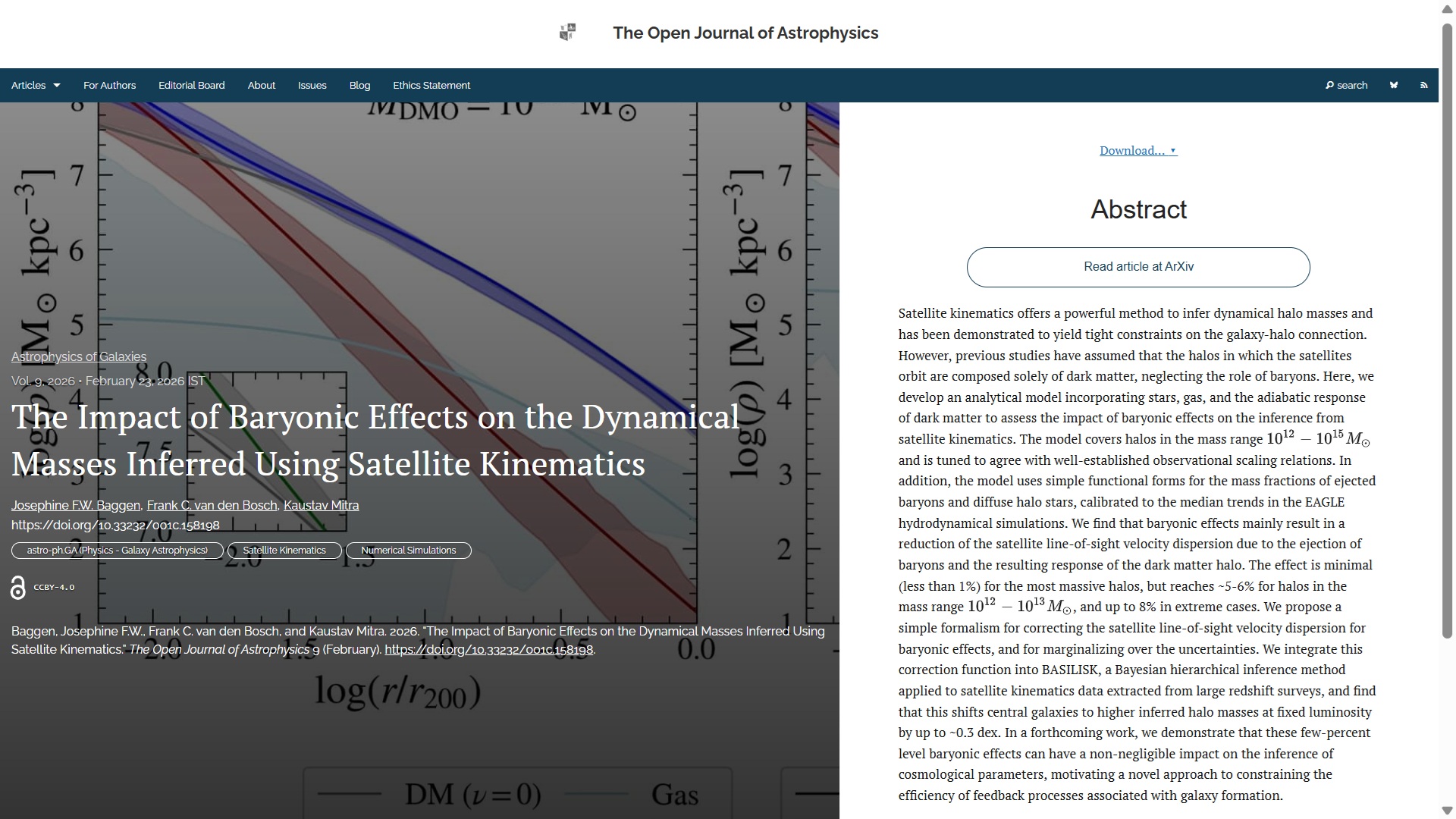
The second paper is “The Impact of Baryonic Effects on the Dynamical Masses Inferred Using Satellite Kinematics” by Josephine F.W. Baggen, Frank C. van den Bosch, and Kaustav Mitra (Yale U., USA). This paper, also in the folder Astrophysics of Galaxies, presents a model to assess the impact of stars and gas on satellite kinematics, showing that these baryonic effects can reduce the satellite velocity dispersion and increase inferred central galaxy masses.
The overlay for this one is here:
The official version of the paper can be found on arXiv here and the Fediverse announcement here:
New Publication at the Open Journal of Astrophysics: "The Impact of Baryonic Effects on the Dynamical Masses Inferred Using Satellite Kinematics" by Josephine F.W. Baggen, Frank C. van den Bosch, and Kaustav Mitra (Yale U., USA)
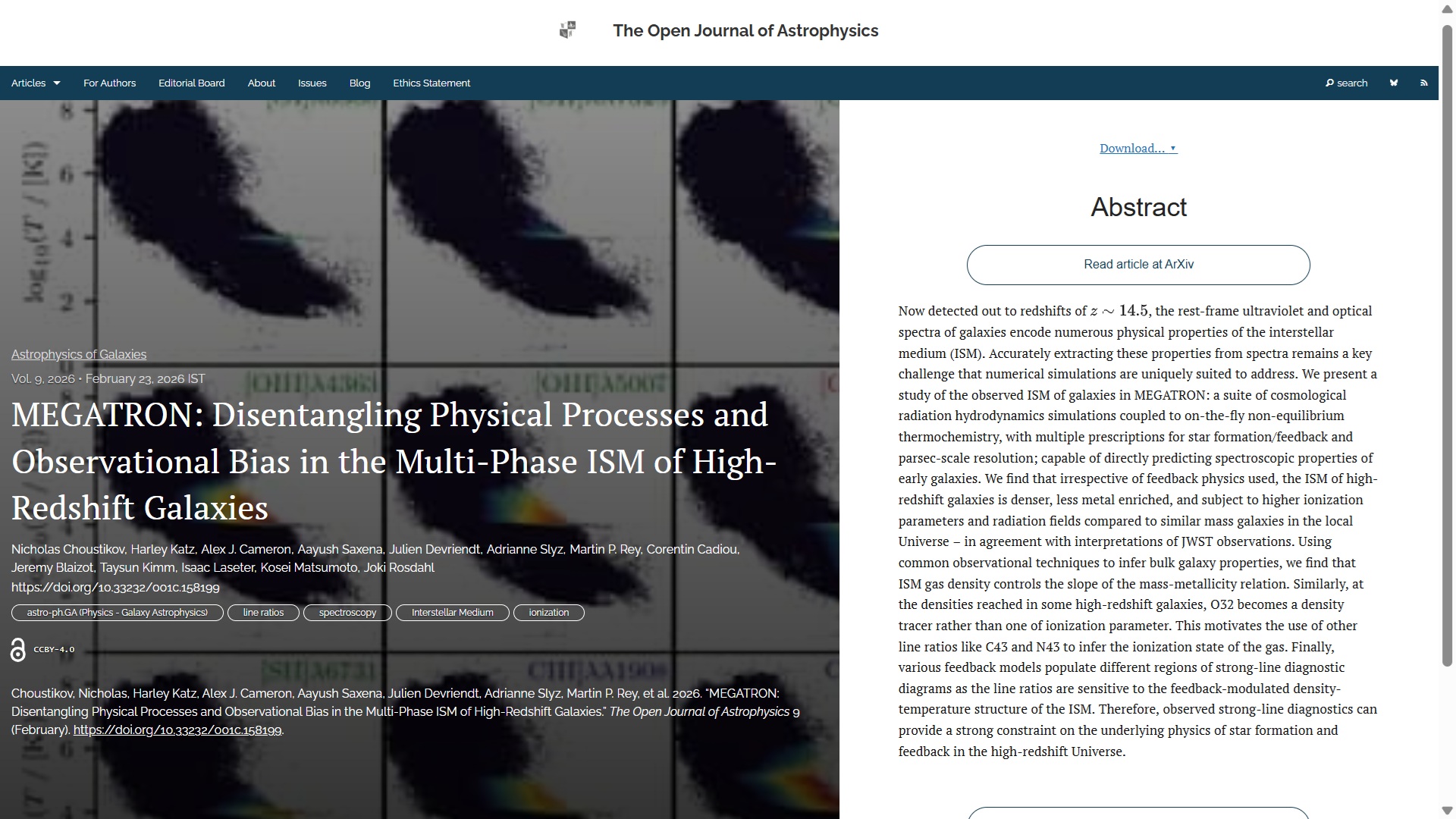
The third paper this week, and the third published on Monday 23rd February, and the third in the folder Astrophysics of Galaxies, is “MEGATRON: Disentangling Physical Processes and Observational Bias in the Multi-Phase ISM of High-Redshift Galaxies” by Nicholas Choustikov (U. Oxford, UK) and 12 others based in UK, USA, France, Korea and Belgium. The study uses MEGATRON simulations to analyze the interstellar medium (ISM) of high-redshift galaxies, finding it denser and less metal-enriched than local galaxies with implications for line ratios as diagnostics
The overlay is here:
The official version can be found on arXiv here and the Fediverse announcement is here:
New Publication at the Open Journal of Astrophysics: "MEGATRON: Disentangling Physical Processes and Observational Bias in the Multi-Phase ISM of High-Redshift Galaxies" by Nicholas Choustikov (U. Oxford, UK) and 12 others based in UK, USA, France, Korea and Belgium
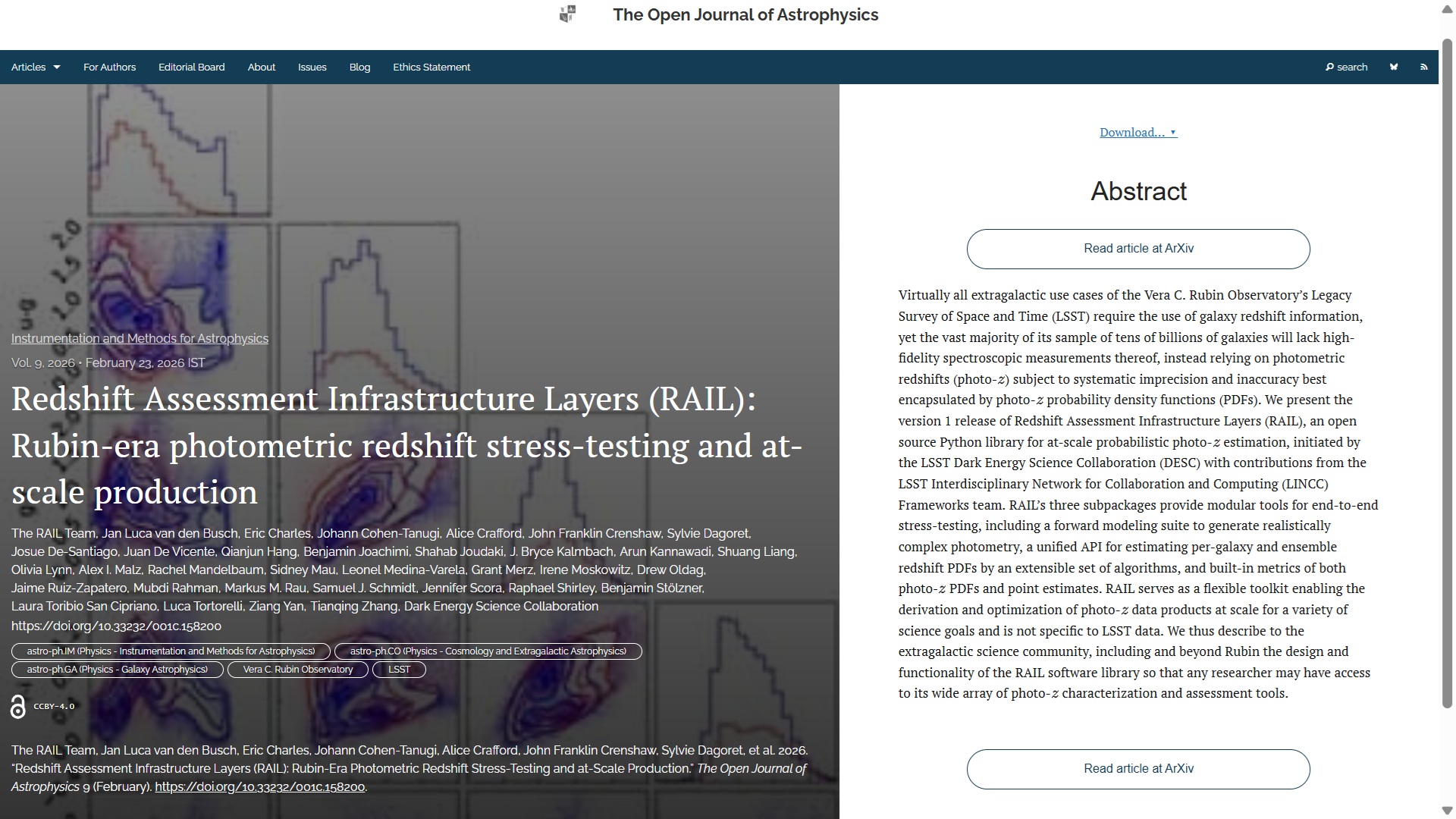
New Publication at the Open Journal of Astrophysics: "Redshift Assessment Infrastructure Layers (RAIL): Rubin-era photometric redshift stress-testing and at-scale production" by the RAIL Team (31 authors) and the Dark Energy Science Collaboration
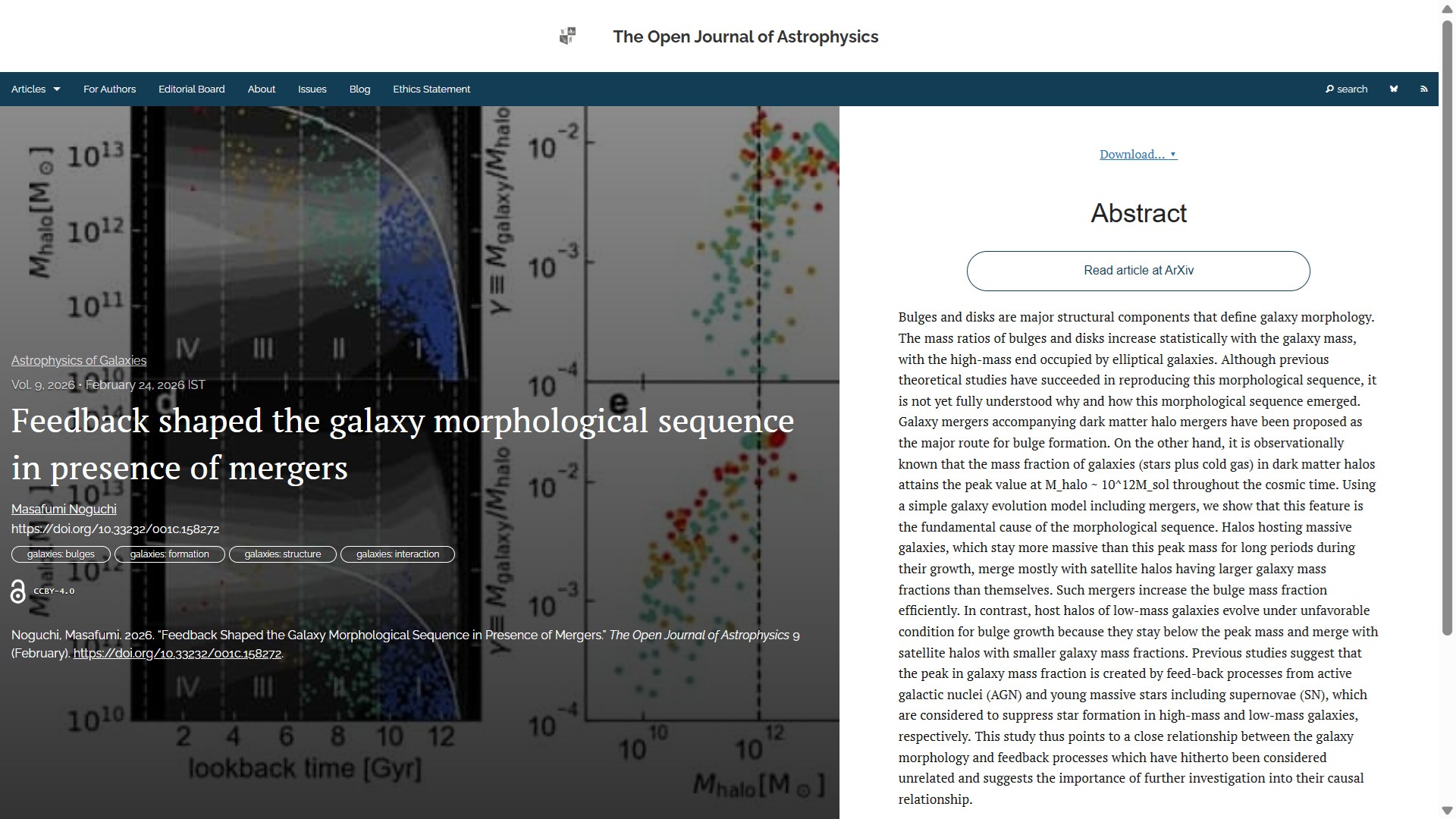
Moving on to Tuesday 24th February, the fifth paper this week, is “Feedback shaped the galaxy morphological sequence in presence of mergers” by Masafumi Noguchi (Tohoku University, Japan). This article was published in the folder Astrophysics of Galaxies. This study suggests that galaxy morphology, specifically the mass ratios of bulges and disks, is influenced by galaxy mergers and feedback processes from active galactic nuclei and supernovae.
The overlay is here:
The accepted version can be found on arXiv here, and the fediverse announcement is here:
New Publication at the Open Journal of Astrophysics: "Feedback shaped the galaxy morphological sequence in presence of mergers" by Masafumi Noguchi (Tohoku University, Japan)
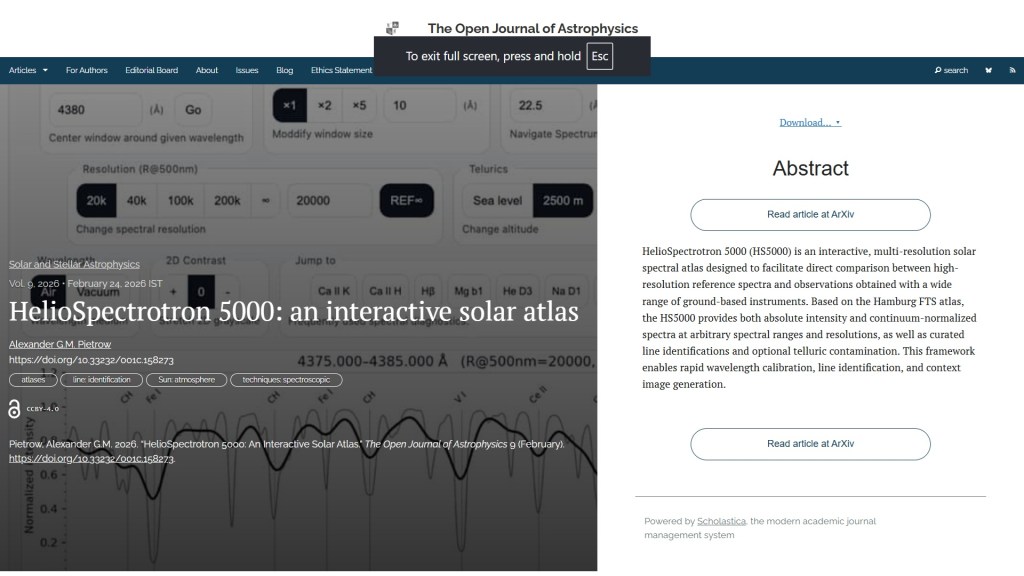
The sixth paper this week is “HelioSpectrotron 5000: an interactive solar atlas” by Alexander G.M. Pietrow (AIP Potsdam, Germany). This was published on Tuesday 24th February in the folder Solar and Stellar Astrophysics. This describes HelioSpectrotron~5000 (HS5000), which is an interactive solar spectral atlas that allows comparison between high-resolution spectra and ground-based instrument observations, aiding in wavelength calibration and line identification. The software can be found here; I had a play with it yesterday and it’s very easy to use!
The overlay is here:
You can find the officially accepted version on arXiv here and the Mastodon announcement is here:
New Publication at the Open Journal of Astrophysics: "HelioSpectrotron 5000: an interactive solar atlas" by Alexander G.M. Pietrow (AIP Potsdam, Germany)
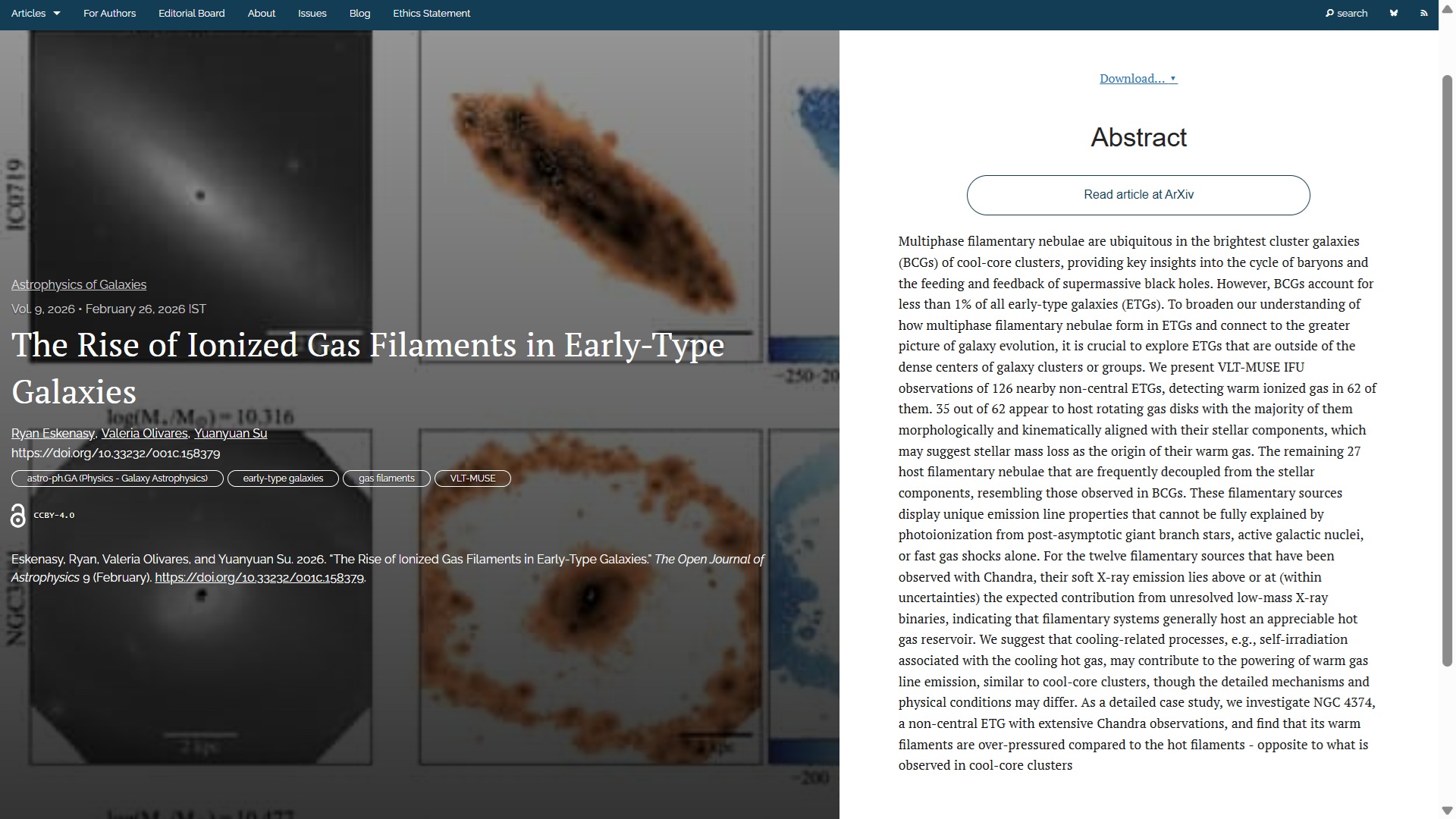
The seventh paper of this week was published on Thursday 26th February is “The Rise of Ionized Gas Filaments in Early-Type Galaxies” by Ryan Eskenasy (U. Kentucky, USA), Valeria Olivares (Universidad de Santiago de Chile) and Yuanyuan Su (U. Kentucky, USA). This article, in the folder Astrophysics of Galaxies, is an exploration of the formation of multiphase filamentary nebulae in early-type galaxies (ETGs), using VLT-MUSE IFU observations of 126 non-central ETGs, focussing on the hot gas components thereof.
The overlay is here:
The officially accepted version of this paper can be found on the arXiv here and the Mastodon announcement is here:
New Publication at the Open Journal of Astrophysics: "The Rise of Ionized Gas Filaments in Early-Type Galaxies" by Ryan Eskenasy (U. Kentucky, USA), Valeria Olivares (Universidad de Santiago de Chile) and Yuanyuan Su (U. Kentucky, USA)
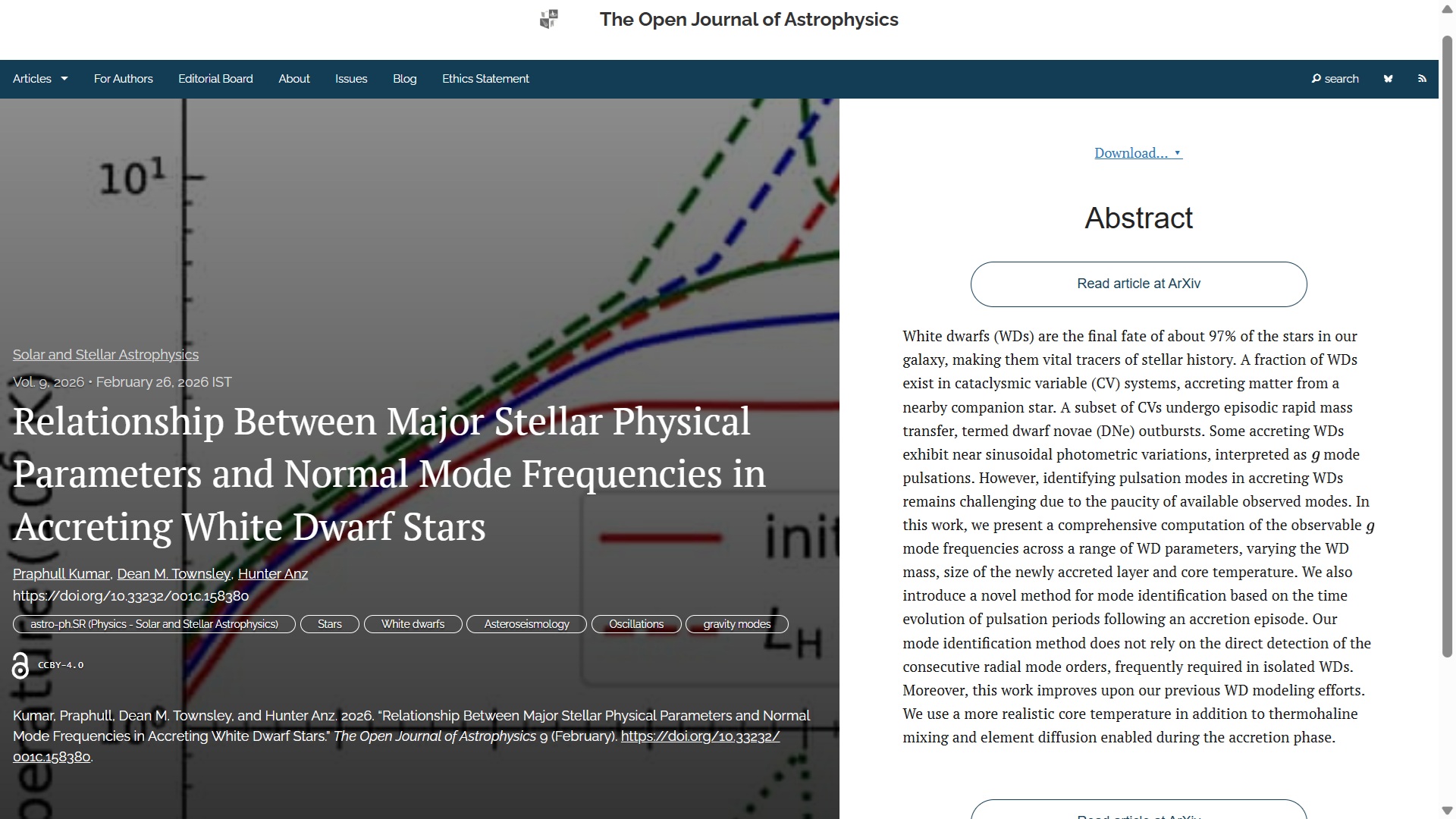
New Publication at the Open Journal of Astrophysics: "Relationship Between Major Stellar Physical Parameters and Normal Mode Frequencies in Accreting White Dwarf Stars" by Praphull Kumar, Dean M. Townsley and Hunter Anz (U. Alabama, USA)
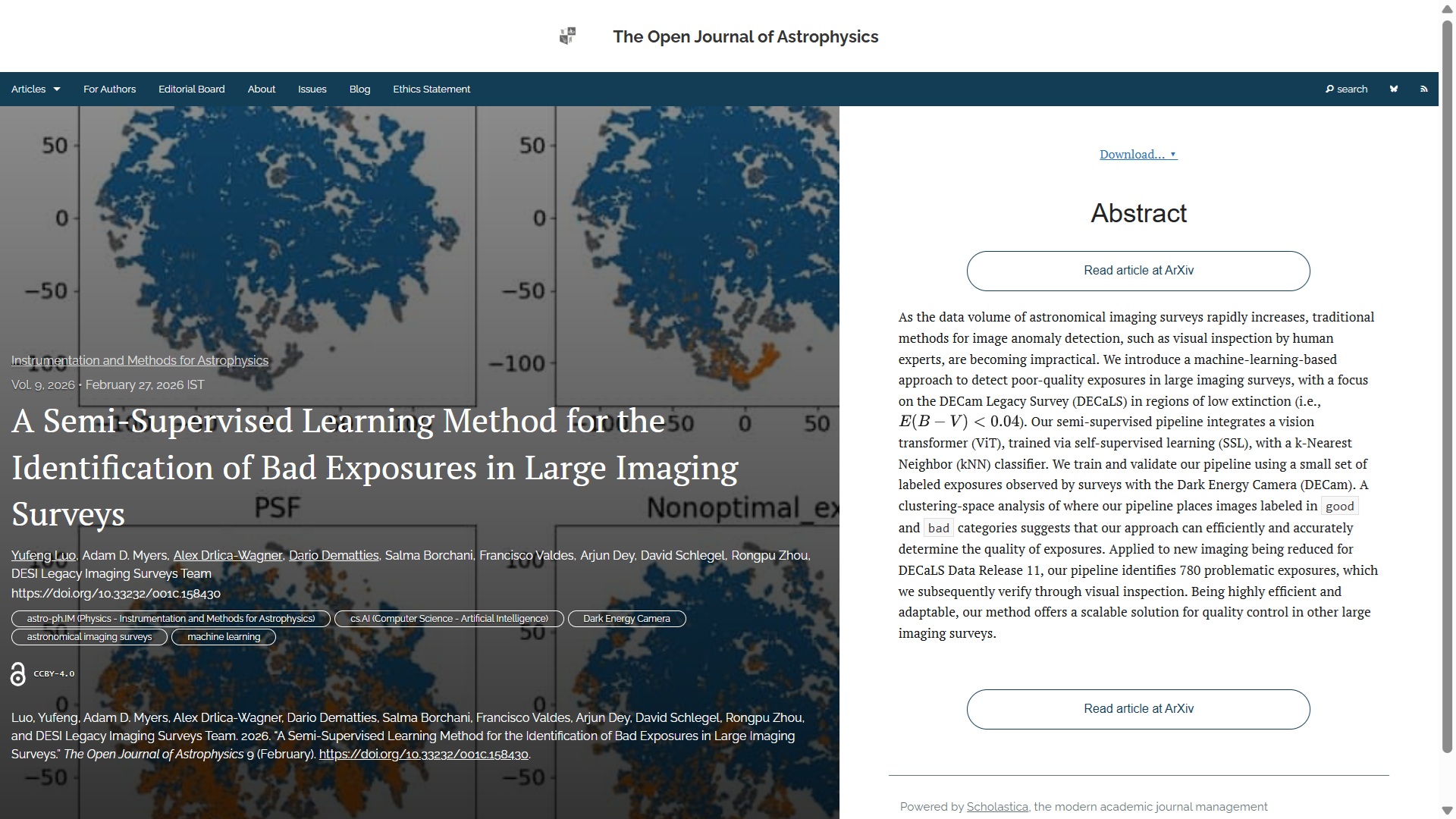
The ninth, and final, paper for this week is “A Semi-Supervised Learning Method for the Identification of Bad Exposures in Large Imaging Surveys” by Yufeng Luo (U. Wyoming, USA) and 8 others from the DESI Legacy Imaging Surveys Team. This was published on Friday 27th February, i.e yesterday, in the folder Instrumentation and Methods for Astrophysics. The paper describes a machine-learning approach for detecting poor-quality exposures in large astronomical imaging surveys, proving efficient and accurate in identifying problematic exposures.
The overlay is here:
The official version on arXiv can be found here and the Mastodon announcement follows:
New Publication at the Open Journal of Astrophysics: "A Semi-Supervised Learning Method for the Identification of Bad Exposures in Large Imaging Surveys" by Yufeng Luo (U. Wyoming, USA) and 8 others from the DESI Legacy Imaging Surveys Team
And that concludes this week’s update. We have now published 45 papers in two complete months of 2026, on which basis we can estimate about 270 papers in the year. For the record, in the first two months of 2025 we published 21 papers.
P.S. Thank you to the many people who responded to the latest call for editors. I’ve been sending out invitations and getting people onboard as quickly as I can, but I still have a number to get to so please bear with me!
It’s Saturday once more so time for another update of activity at the Open Journal of Astrophysics. Since the last update we have published a further six papers, bringing the number in Volume 9 (2026) to 24 and the total so far published by OJAp up to 472.
I will continue to include the posts made on our Mastodon account (on Fediscience) to encourage you to visit it. Mastodon is a really excellent service, and a more than adequate replacement for X/Twitter which nobody should be using; these announcement also show the DOI for each paper.
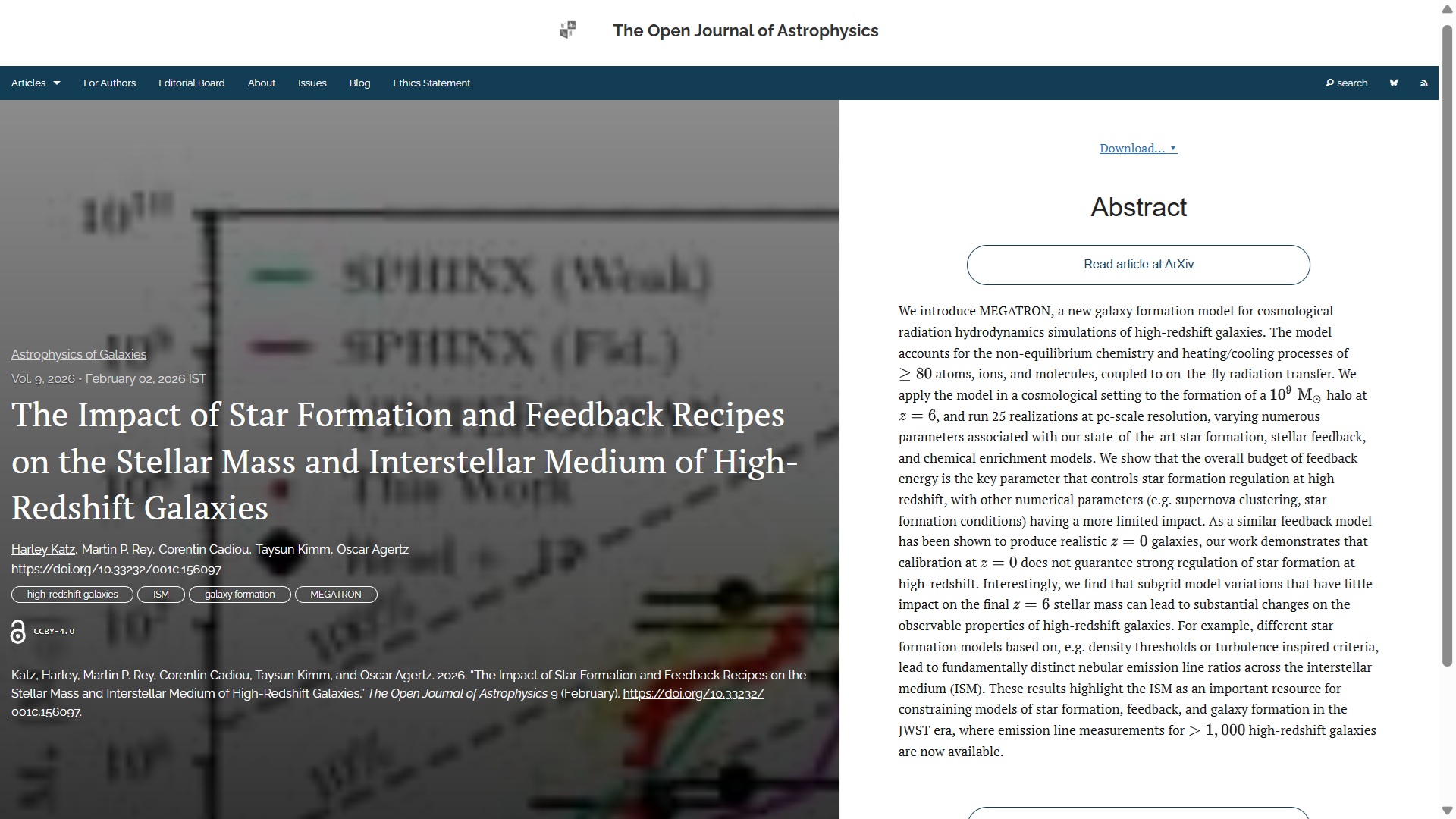
The first paper to report this week is “The Impact of Star Formation and Feedback Recipes on the Stellar Mass and Interstellar Medium of High-Redshift Galaxies” by Harley Katz (U. Chicago, USA), Martin P. Rey (U. Oxford, UK), Corentin Cadiou (Lund U., Sweden) Taysun Kimm (Yonsei U., Korea) and Oscar Agertz (Lund). This paper was published on Monday 2nd February 2026 in the folder Astrophysics of Galaxies. It introduces MEGATRON, a new model for galaxy formation simulations, highlighting that feedback energy controls star formation at high redshift and highlighting the importance of the interstellar medium.
The overlay is here:
You can find the officially accepted version on arXiv here and the announcement on Fediverse here:
New Publication at the Open Journal of Astrophysics: "The Impact of Star Formation and Feedback Recipes on the Stellar Mass and Interstellar Medium of High-Redshift Galaxies" by Harley Katz (U. Chicago, USA), Martin P. Rey (U. Oxford, UK), Corentin Cadiou (Lund U., Sweden) Taysun Kimm (Yonsei U., Korea) and Oscar Agertz (Lund)
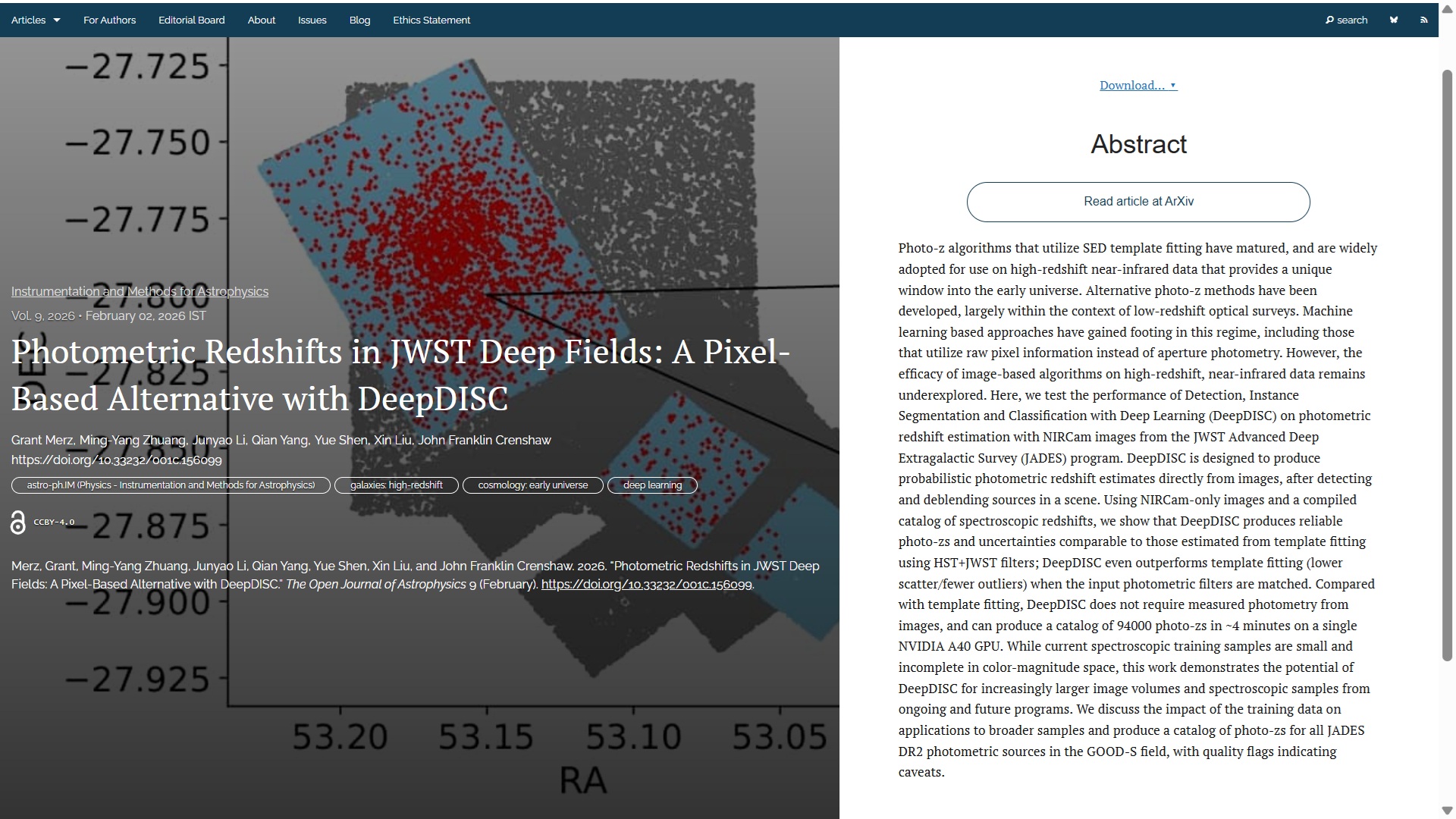
The second paper is “Photometric Redshifts in JWST Deep Fields: A Pixel-Based Alternative with DeepDISC” by Grant Merz (U. Illinois at Urbana-Champaign) and 6 others, all based in the USA. This paper was published on Monday February 2nd 2026 in the folder Instrumentation and Methods for Astrophysics. This paper explores the effectiveness of the DeepDISC machine learning algorithm in estimating photometric redshifts from near-infrared data, demonstrating its potential for larger image volumes and spectroscopic samples
The overlay for this one is here:
The official version of the paper can be found on arXiv here and the Fediverse announcement here:
New Publication at the Open Journal of Astrophysics: "Photometric Redshifts in JWST Deep Fields: A Pixel-Based Alternative with DeepDISC" by Grant Merz (U. Illinois at Urbana-Champaign) and 6 others, all based in the USA
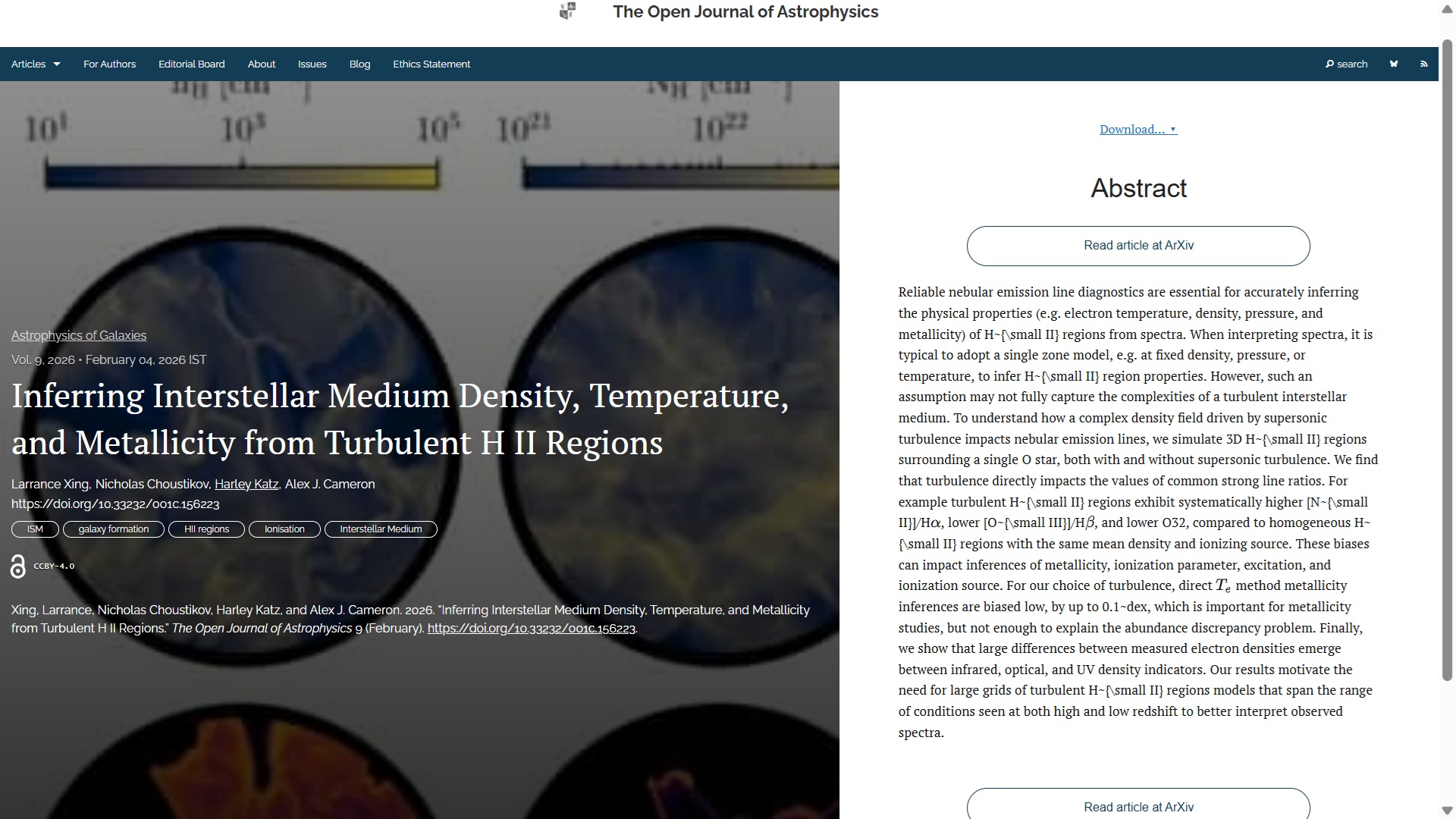
Next, published on Wednesday 4th February in the folder Astrophysics of Galaxies, is “Inferring Interstellar Medium Density, Temperature, and Metallicity from Turbulent H II Regions” by Larrance Xing (U. Chicago, USA), Nicholas Choustikov (U. Oxford, UK), Harley Katz (U. Chicago) and Alex J. Cameron (DAWN, Denmark). This paper argues that supersonic turbulenc affects the interpretation of H II region properties, potentially impacting inferred metallicity, ionization, and excitation from in nebular emission lines, motivating more extensive modelling.
The overlay is here:
The official version can be found on arXiv here and the Fediverse announcement is here:
New Publication at the Open Journal of Astrophysics: "Inferring Interstellar Medium Density, Temperature, and Metallicity from Turbulent H II Regions" by Larrance Xing (U. Chicago, USA), Nicholas Choustikov (U. Oxford, UK), Harley Katz (U. Chicago) and Alex J. Cameron (DAWN, Denmark)
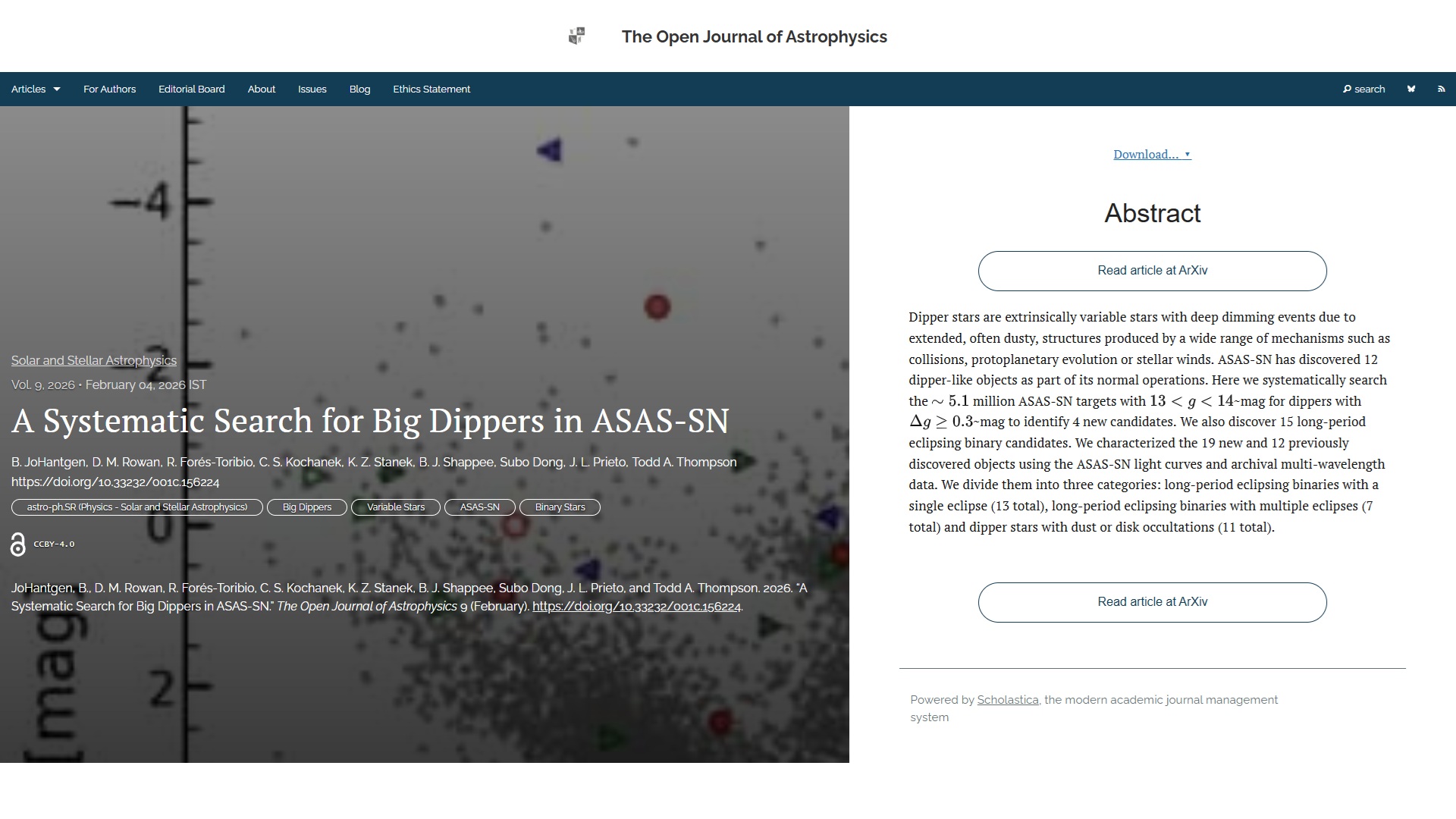
The fourth paper this week, also published on Wednesday 4th February, but in the folder Solar and Stellar Astrophysics, is “A Systematic Search for Big Dippers in ASAS-SN” by B. JoHantgen, D. M. Rowan, R. Forés-Toribio, C. S. Kochanek, & K. Z. Stanek (Ohio State University, USA), B. J. Shappee (U. Hawaii, USA), Subo Dong (Peking University), J. L. Prieto Universidad Diego Portales, Chile) and Todd A. Thompson (Ohio State). This study identifies 4 new dipper stars and 15 long-period eclipsing binary candidates using ASAS-SN light curves and multi-wavelength data, categorizing them based on their characteristics.
Here is the overlay:
The official version can be found on arXiv here and the Fediverse announcement is here:
New Publication at the Open Journal of Astrophysics: "A Systematic Search for Big Dippers in ASAS-SN" by B. JoHantgen , D. M. Rowan, R. Forés-Toribio, C. S. Kochanek, & K. Z. Stanek (Ohio State University, USA), B. J. Shappee (U. Hawaii, USA), Subo Dong (Peking University), J. L. Prieto Universidad Diego Portales, Chile) and Todd A. Thompson (Ohio State)
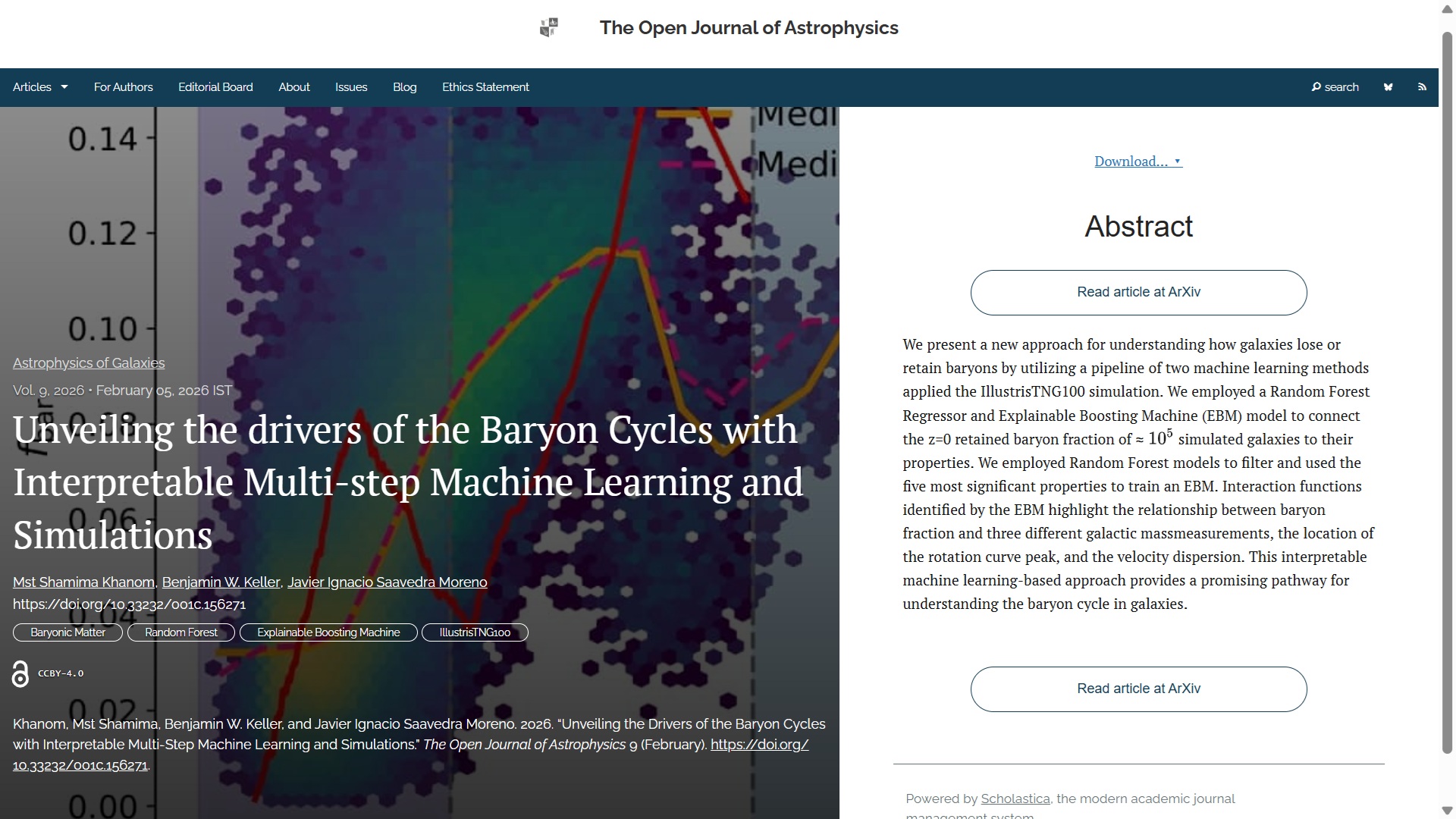
Fifth, and next to last this week we have “Unveiling the drivers of the Baryon Cycles with Interpretable Multi-step Machine Learning and Simulations” by Mst Shamima Khanom, Benjamin W. Keller and Javier Ignacio Saavedra Moreno (U. Memphis, USA). This paper was published on Thursday 5th February 2026 in the folder Astrophysics of Galaxies. This study uses machine learning methods to understand how galaxies lose or retain baryons, highlighting the relationship between baryon fraction and various galactic measurements.
The overlay is here:
The accepted version can be found on arXiv here, and the fediverse announcement is here:
New Publication at the Open Journal of Astrophysics: "Unveiling the drivers of the Baryon Cycles with Interpretable Multi-step Machine Learning and Simulations" by Mst Shamima Khanom, Benjamin W. Keller and Javier Ignacio Saavedra Moreno (U. Memphis, USA)
Finally for this week we have “The Bispectrum of Intrinsic Alignments: II. Precision Comparison Against Dark Matter Simulations” by Thomas Bakx (Utrecht U., Netherlands), Toshiki Kurita (MPA Garching, Germany), Alexander Eggemeier (U. Bonn, Germany), Nora Elisa Chisari (Utrecht) and Zvonimir Vlah (Ruđer Bošković Institute, Croatia). This paper was accepted in December, but publication got delayed by the Christmas effect so was published on February 6th 2026, in the folder Cosmology and Nongalactic Astrophysics. This study uses N-body simulations to accurately measure three-dimensional bispectra of halo intrinsic alignments and dark matter overdensities, providing a method to determine higher order shape bias parameters.
The overlay is here:
You can find the published version of the article here, and the Mastodon announcement is here:
New Publication at the Open Journal of Astrophysics: "The Bispectrum of Intrinsic Alignments: II. Precision Comparison Against Dark Matter Simulations" by Thomas Bakx (Utrecht U., Netherlands), Toshiki Kurita (MPA Garching, Germany), Alexander Eggemeier (U. Bonn, Germany), Nora Elisa Chisari (Utrecht) and Zvonimir Vlah (Ruđer Bošković Institute, Croatia)
It’s time once again for the usual Saturday morning update of the week’s new papers at the Open Journal of Astrophysics. Since the last update we have published a further five papers, which brings the number in Volume 8 (2025) up to 195, and the total so far published by OJAp up to 430.
The first paper this week is “Cosmic Rays Masquerading as Cool Cores: An Inverse-Compton Origin for Cool Core Cluster Emission” by Philip F. Hopkins (Caltech), Eliot Quataert (Princeton), Emily M. Silich, Jack Sayers, Sam B. Ponnada and Isabel S. Sands (Caltech). This was published on Tuesday 9th December 2025 in the folder marked High-Energy Astrophysical Phenomena. It presents an argument that cosmic-ray inverse-compton emission could contribute significantly to the X-ray surface brightness (SB) in cool-corre clusters, implying that gas densities may have been overestimated therein.
The overlay is here:
You can find the officially accepted version on arXiv here and the Fediverse announcement is here:
New Publication at the Open Journal of Astrophysics: "Cosmic Rays Masquerading as Cool Cores: An Inverse-Compton Origin for Cool Core Cluster Emission" by
Philip F. Hopkins (Caltech), Eliot Quataert (Princeton), Emily M. Silich, Jack Sayers, Sam B. Ponnada and Isabel S. Sands (Caltech)
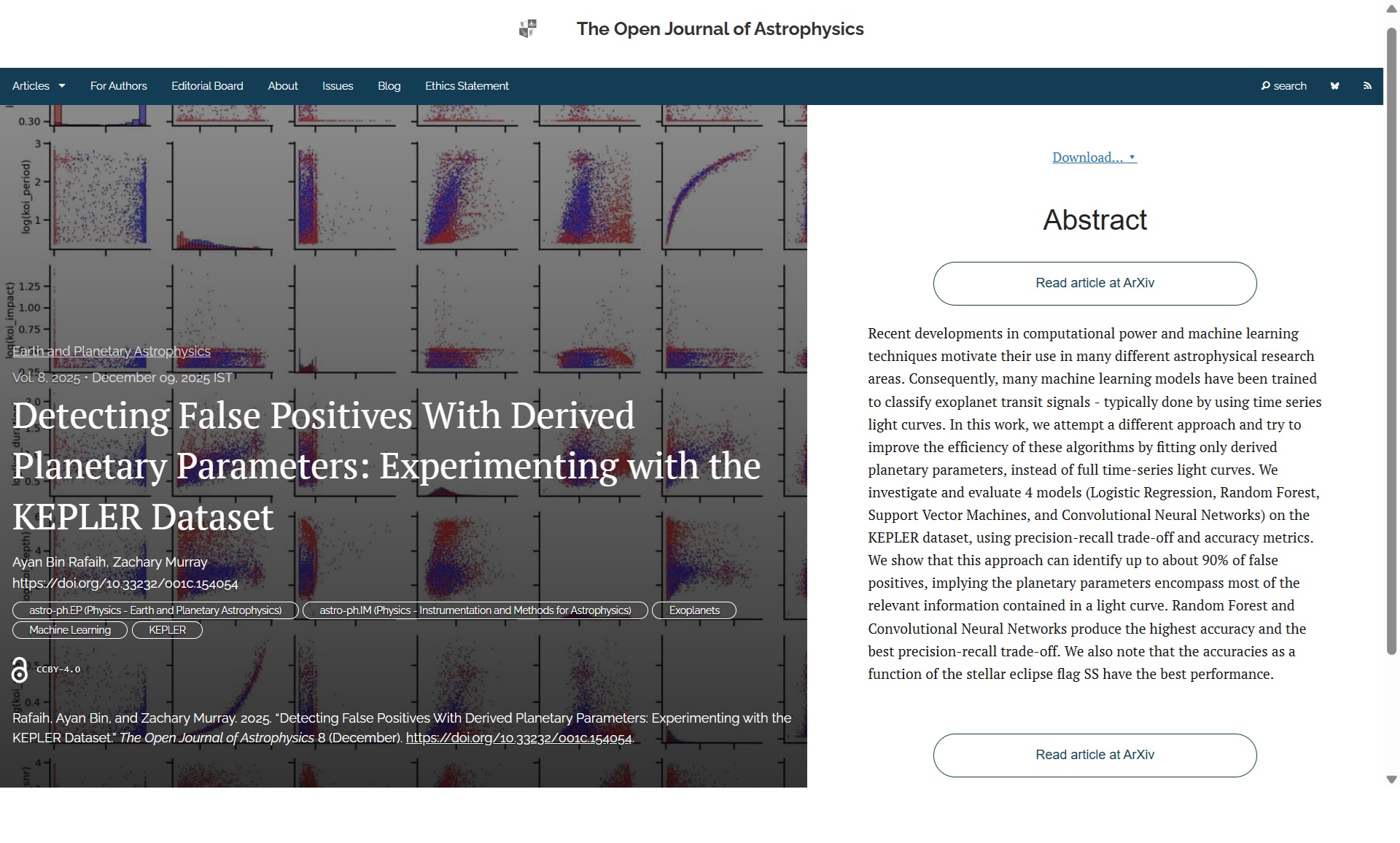
New Publication at the Open Journal of Astrophysics: "Detecting False Positives With Derived Planetary Parameters: Experimenting with the KEPLER Dataset" by Ayan Bin Rafaih (Aitchison College, Lahore, Pakistan) and Zachary Murray (Université Côte d’Azur, France)
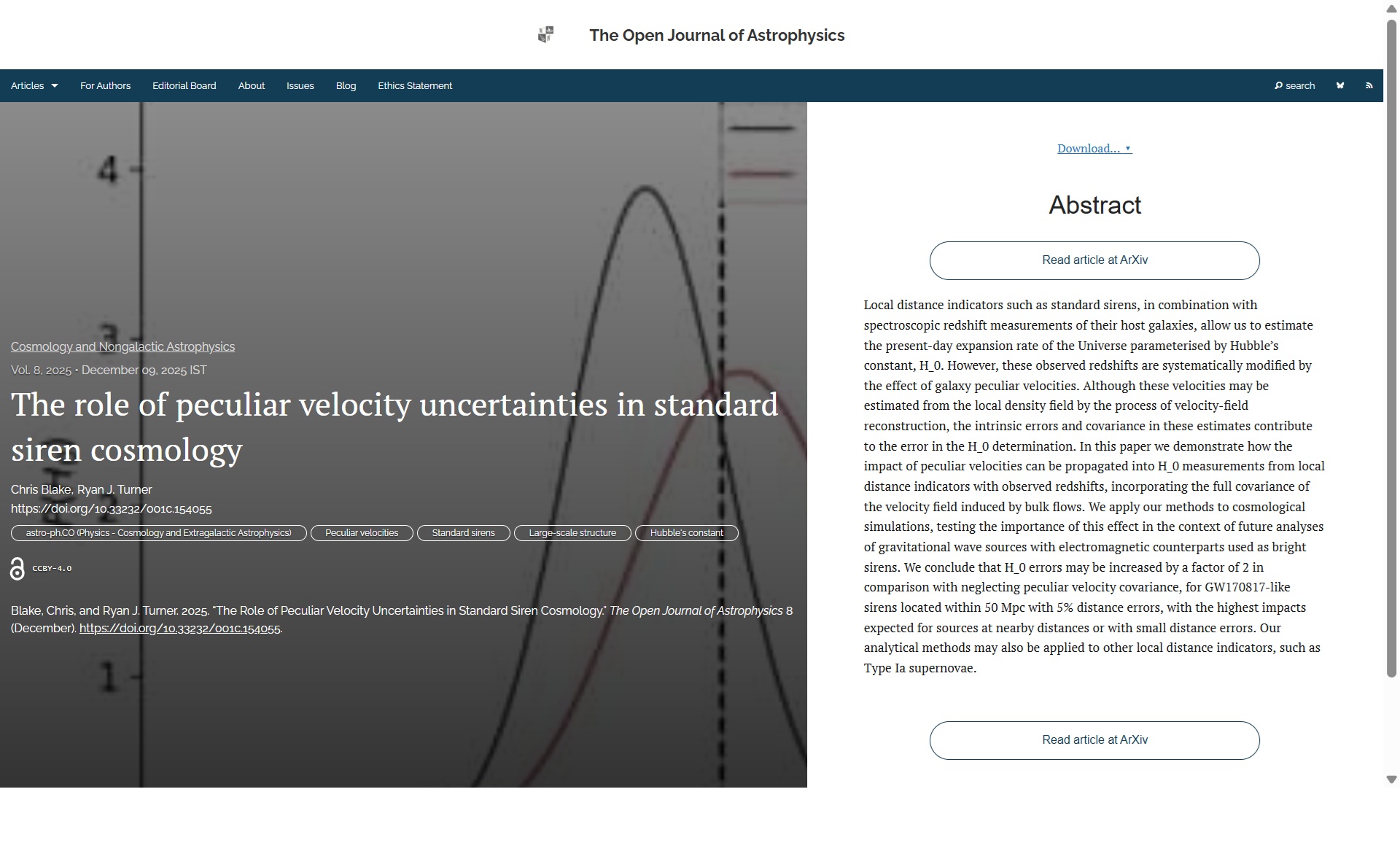
New Publication at the Open Journal of Astrophysics: "The role of peculiar velocity uncertainties in standard siren cosmology" by Chris Blake and Ryan J. Turner (Swinburne, Australia)
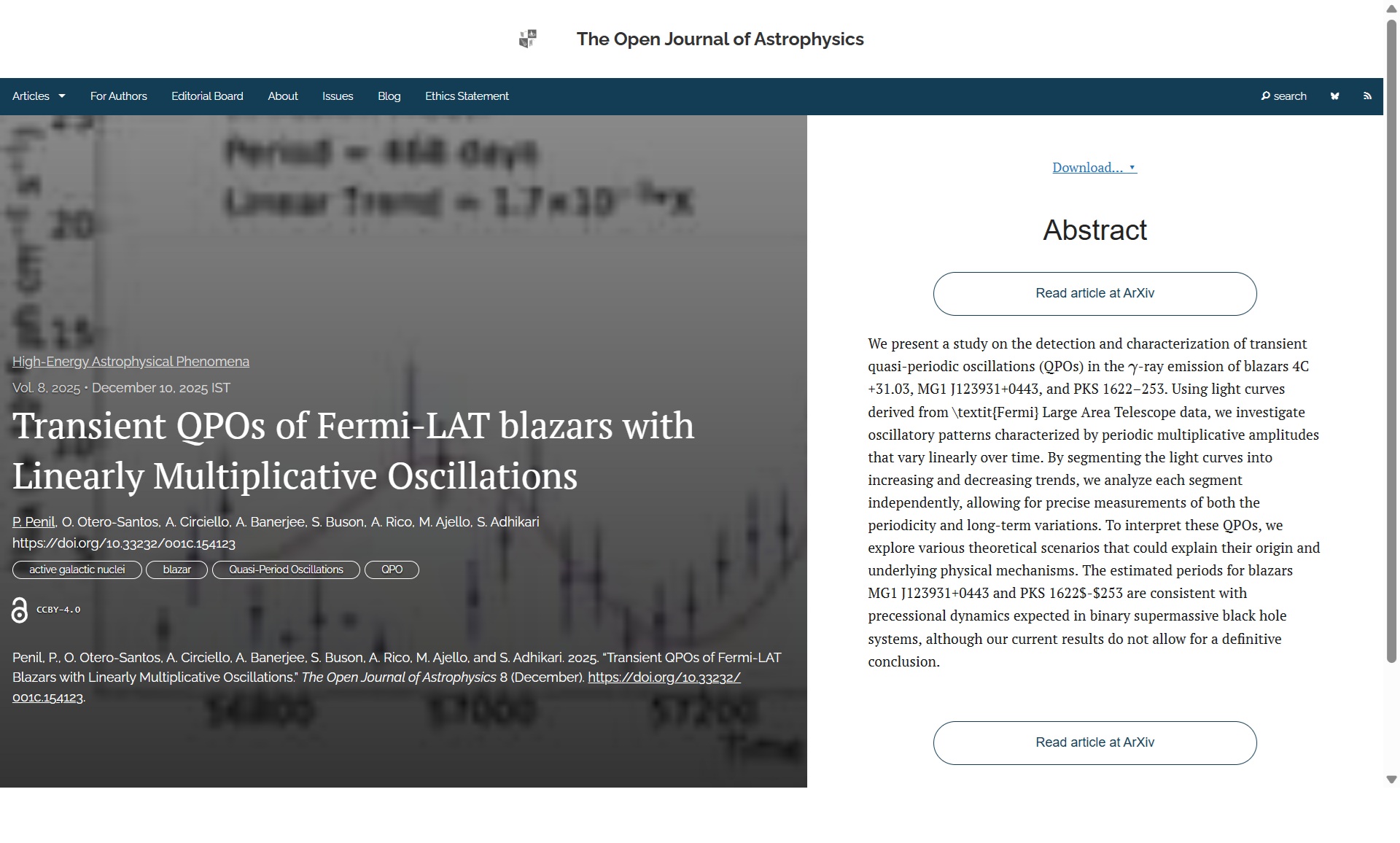
The fourth article of the week is “Transient QPOs of Fermi-LAT blazars with Linearly Multiplicative Oscillations” by P. Penil (Clemson University, USA) and 7 others based in the USA, Italy and Germany. This was published on Thursday 10th December in the folder High-Energy Astrophysical Phenomena. This paper presents an investigation of patterns of quasi-periodic oscillations in observed blazar systems characterized by periodic multiplicative amplitudes including both the periodicities and long-term variations. The overlay is here:
You can find the official published version on arXiv here. The Fediverse announcement follows:
New Publication at the Open Journal of Astrophysics: "Transient QPOs of Fermi-LAT blazars with Linearly Multiplicative Oscillations" by P. Penil (Clemson University, USA) and 7 others based in the USA, Italy and Germany
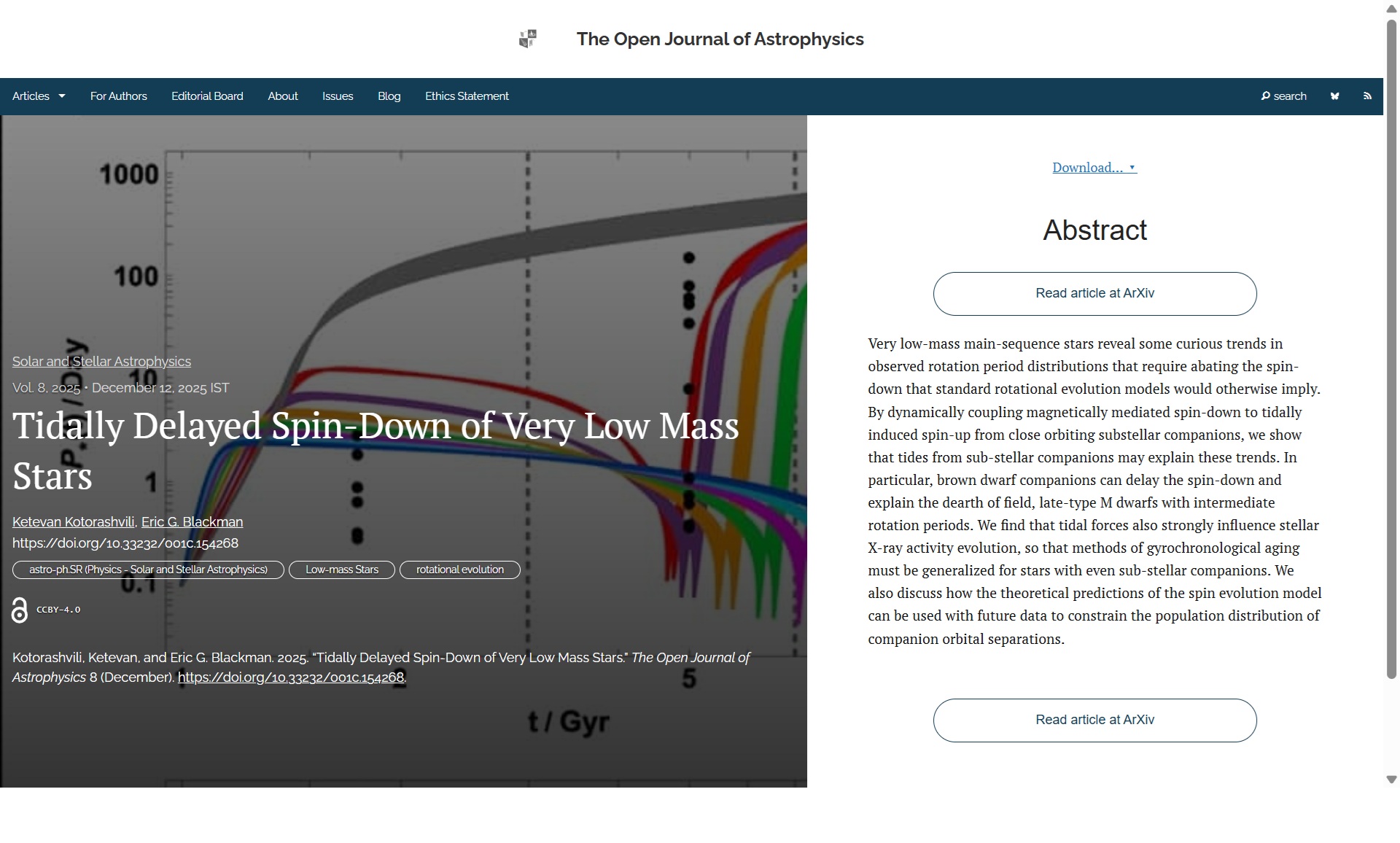
The last paper for this week is “Tidally Delayed Spin-Down of Very Low Mass Stars” by Ketevan Kotorashvili and Eric G. Blackman (U. Rochester, USA). This was published on Friday 12th December (yesterday) in the folder Solar and Stellar Astrophysics. It discusses the effect of tides from sub-stellar companions on rotational evolution of very low-mass stars, suggesting that these may explain the dearth of field, late-type M dwarfs with intermediate rotation periods.
The overlay is here:
You can find the officially-accepted version on arXiv here, and the Mastodon announcement is here:
New Publication at the Open Journal of Astrophysics: "Tidally Delayed Spin-Down of Very Low Mass Stars" by Ketevan Kotorashvili and Eric G. Blackman (U. Rochester, USA)
And that concludes the update for this week. I will do another of these regular announcements next Saturday, which will be the last such update for 2025. Will we make it past 200 for the year? Tune in next week to find out!
Once again it’s time for the usual Saturday morning update of the week’s new papers at the Open Journal of Astrophysics. Since the last update we have published a further six papers, which brings the number in Volume 8 (2025) up to 190, and the total so far published by OJAp up to 425. I blogged about the significance of the latter figure here.
New Publication at the Open Journal of Astrophysics: "The galaxy-IGM connection in THESAN: observability and information content of the galaxy-Lyman-alpha cross-correlation at z>6" by Enrico Garaldi (U. Tokyo, Japan), Verena Bellscheidt (Tech. U. Munich, Germany), Aaron Smith (U. Texas Austin, USA) and Rahul Kannan (York U. Canada)
New Publication at the Open Journal of Astrophysics: "A Less Terrifying Universe? Mundanity as an Explanation for the Fermi Paradox" by Robin H.D. Corbet (U. Maryland, USA)
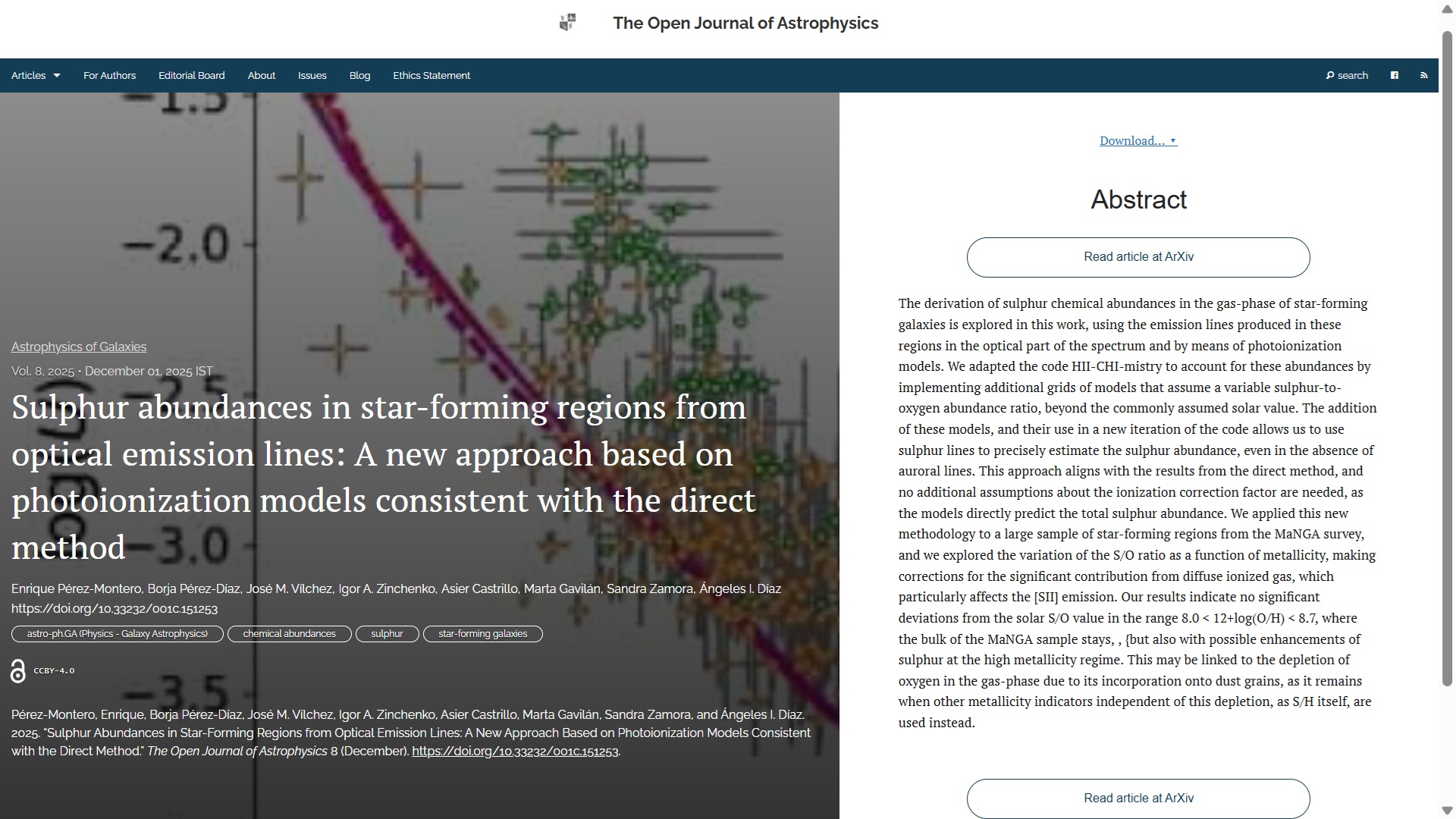
New Publication at the Open Journal of Astrophysics: "Sulphur abundances in star-forming regions from optical emission lines: A new approach based on photoionization models consistent with the direct method" by Enrique Pérez-Montero, Borja Pérez-Díaz, & José M. Vílchez ( (Instituto de Astrofísica de Andalucía, Spain), Igor A. Zinchenko (LMU, Germany), Asier Castrillo, Marta Gavilán, Sandra Zamora & Ángeles I. Díaz (Universidad Autonoma de Madrid , Spain)
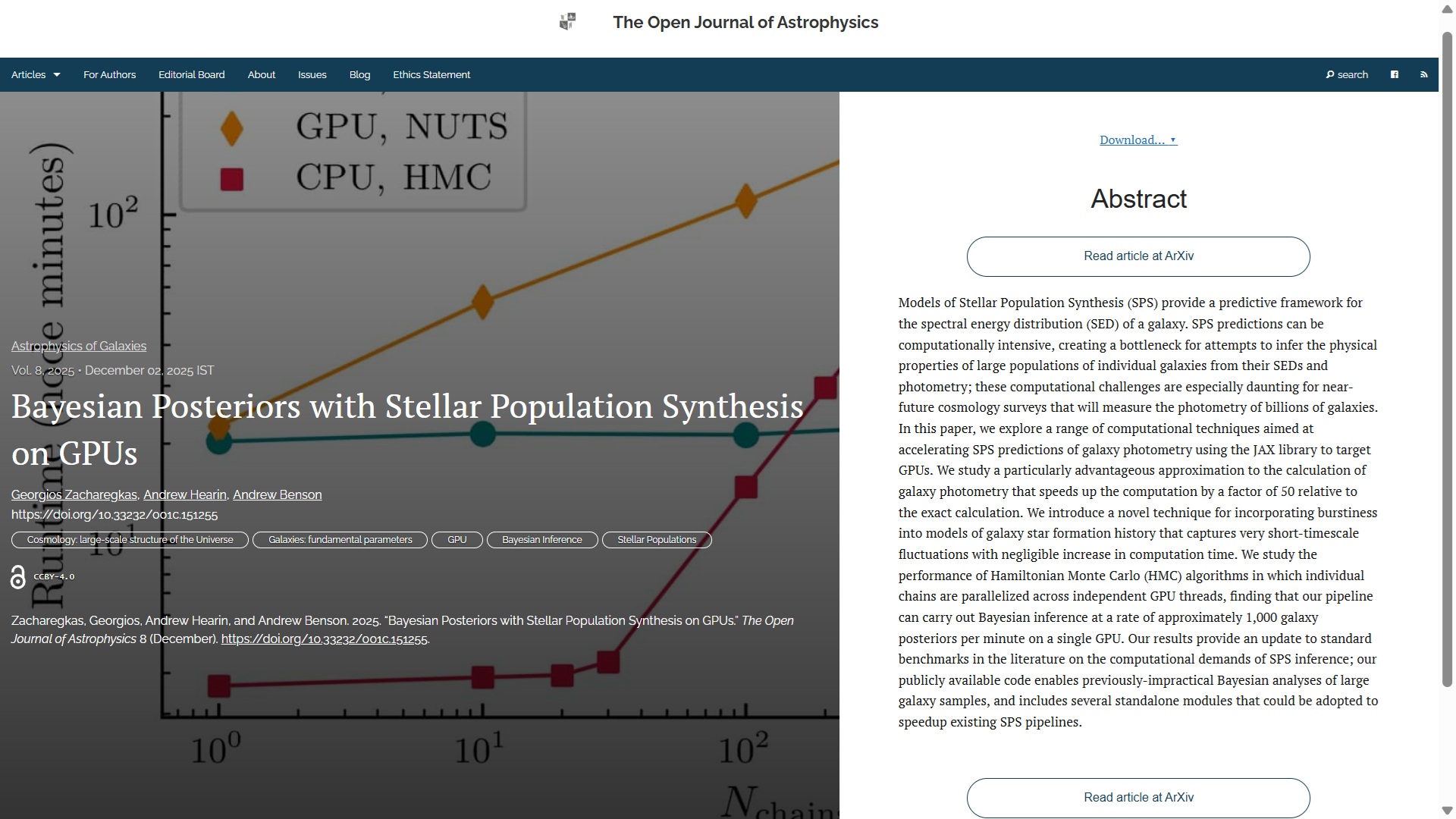
The fourth article of the week is “Bayesian Posteriors with Stellar Population Synthesis on GPUs” by Georgios Zacharegkas & Andrew Hearin (Argonne National Laboratory, USA) and Andrew Benson (Carnegie Observatories, USA). This is an exploration of a range of computational techniques aimed at accelerating Stellar Population Synthesis predictions of galaxy photometry using the JAX library to target GPUs (Graphics Processing Units, in case you didn’t know). This paper was published on Tuesday December 2nd 2025 in the folder Astrophysics of Galaxies.
The overlay is here:
You can find the official published version on arXiv here. The Fediverse announcement follows:
New Publication at the Open Journal of Astrophysics: "Bayesian Posteriors with Stellar Population Synthesis on GPUs" by Georgios Zacharegkas & Andrew Hearin (Argonne National Laboratory, USA) and Andrew Benson (Carnegie Observatories, USA)
Next one up is “IAEmu: Learning Galaxy Intrinsic Alignment Correlations” by Sneh Pandya Yuanyuan Yang, Nicholas Van Alfen, Jonathan Blazek and Robin Walters (Northeastern University, Boston, USA). This presents a neural-network-based emulator that predicts the galaxy position-position, position-orientation, and orientation-orientation, correlation functions and their uncertainties using mock catalogs based on the halo occupation distribution (HOD) framework. It was published on December 2nd 2025 in the folder Cosmology and Nongalactic Astrophysics. The overlay is here:
The official accepted version can be found on arXiv here. The Mastodon announcement is here:
New Publication at the Open Journal of Astrophysics: "IAEmu: Learning Galaxy Intrinsic Alignment Correlations" by Sneh Pandya Yuanyuan Yang, Nicholas Van Alfen, Jonathan Blazek and Robin Walters (Northeastern University, Boston, USA)
The last paper for this weel is “Unraveling the Nature of the Nuclear Transient AT2020adpi” by Paarmita Pandey (Ohio State University, USA) and a team of 15 others based in the USA, UK and Australia. This was published on Thursday December 4th 2025 in the folder High-Energy Astrophysical Phenomena. It is an investigation into a particular transient event AT2020adpi and a discussion of whether it is an extreme example of AGN variability or a Tidal Disruption Event (TDE). The overlay is here:
You can find the officially-accepted version on arXiv here, and the Mastodon announcement is here:
New Publication at the Open Journal of Astrophysics: "Unraveling the Nature of the Nuclear Transient AT2020adpi" by Paarmita Pandey (Ohio State University, USA) and 15 others based in the USA, UK and Australia
It’s Saturday morning again, so it’s time again for an update of papers published at the Open Journal of Astrophysics. Since the last update we have published six new papers, which brings the number in Volume 8 (2025) up to 98, and the total so far published by OJAp up to 333. I expect we’ll pass the century for this year sometime next week.
The papers published this week, with their overlays, are as follows. You can click on the images of the overlays to make them larger should you wish to do so.
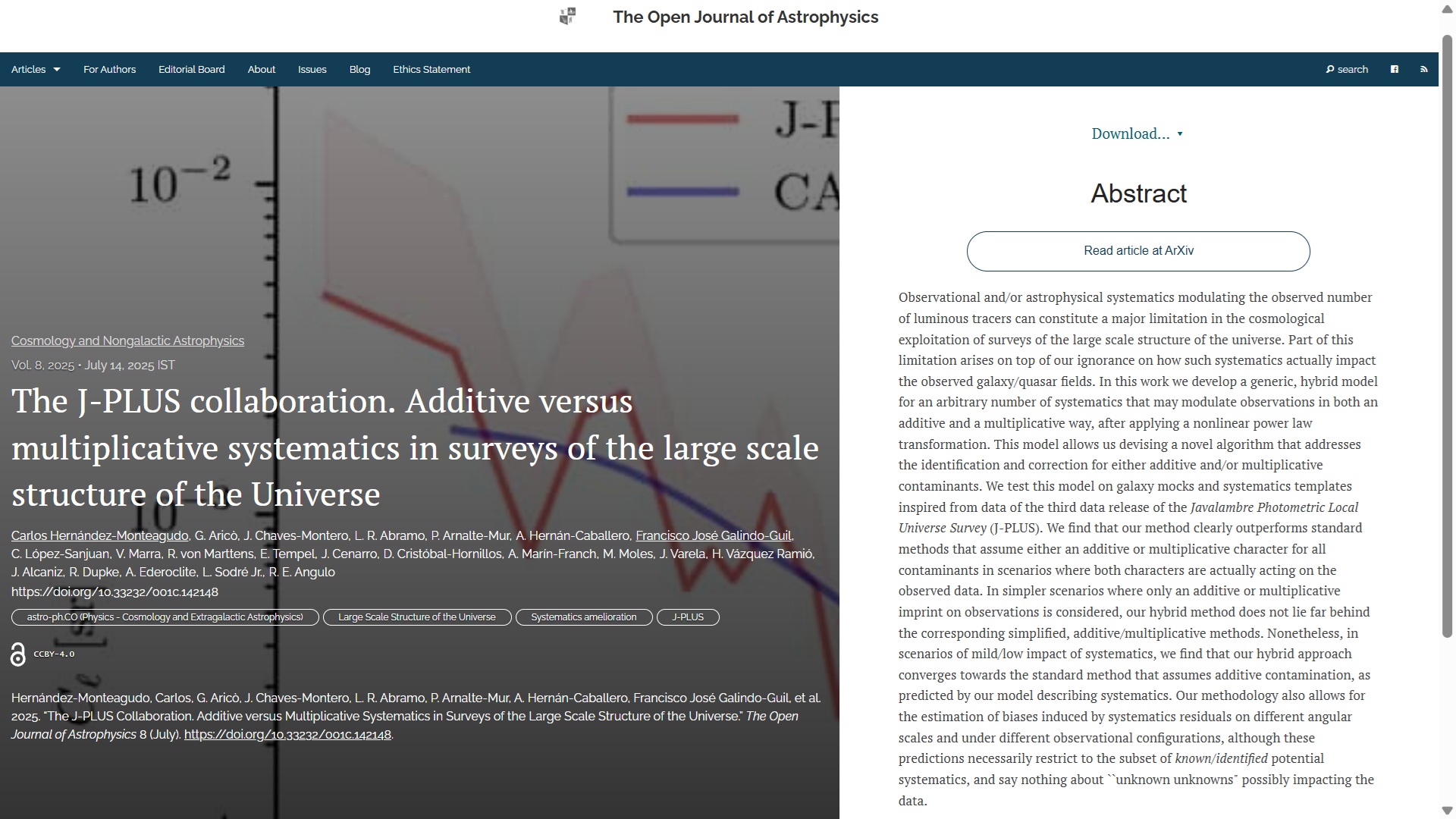
The first paper to report is “Reconstructing Galaxy Cluster Mass Maps using Score-based Generative Modeling” by Alan Hsu (Harvard), Matthew Ho (CMU), Joyce Lin (U. Wisconsin-Madison), Carleen Markey (CMU), Michelle Ntampaka (STScI), Hy Trac (CMU) & Barnabás Póczos (CMU), all based in the USA. This paper was published on 14th July 2025 in the folder Cosmology and NonGalactic Astrophysics. It presents a diffusion-based generativbe AI model for reconstructing density profiles for galaxy clusters from observational data.
The overlay is here:
The officially-accepted version can be found on arXiv here.
You can find the officially accepted version of this paper on arXiv here.
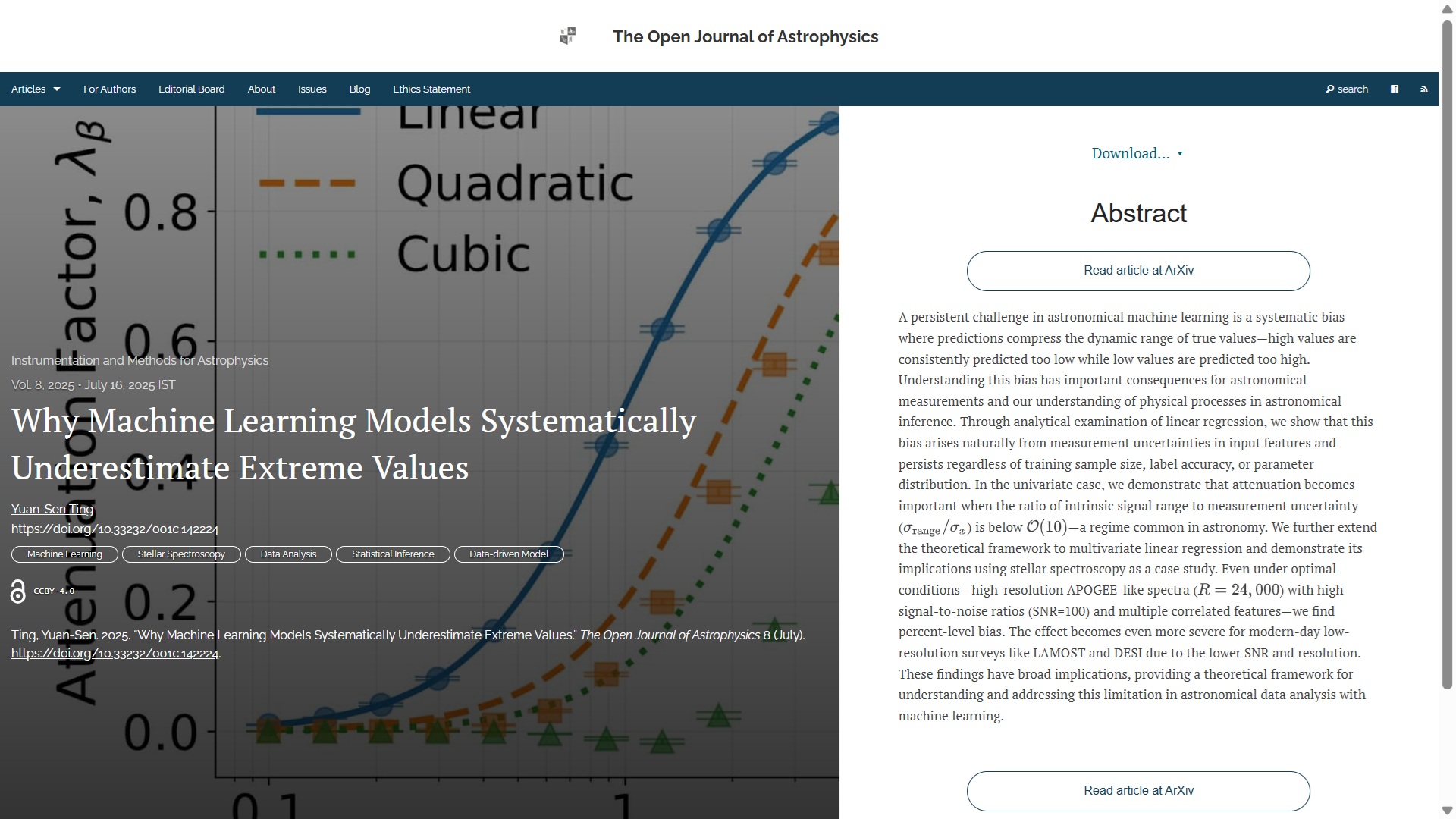
The fourth paper this week is “Why Machine Learning Models Systematically Underestimate Extreme Values” by Yuan-Sen Ting (Ohio State University). This one was published on July 16th in the folder marked Instrumentation and Methods for Astrophysics. This paper presents a theoretical framework for understanding and addressing a bias that suppresses the dynamic range of variables in applications of machine learning to astronomical data analysis. Here is the overlay:
You can find the officially accepted version of this paper on arXiv here.
The penultimate article for this week is “Bridging Machine Learning and Cosmological Simulations: Using Neural Operators to emulate Chemical Evolution” by Pelle van de Bor, John Brennan & John A. Regan (Maynooth University) and Jonathan Mackey (Dublin Institute for Advanced Studies), all based in Ireland. This paper uses machine learning, in the form of neural operators, to emulate the Grackle method of solving non-equilibrium chemistry equations in cosmological hydrodynamic simulations and was published on 16th July also in the folder Instrumentation and Methods for Astrophysics. The overlay is here:
The final, accepted version of the paper is on arXiv here.
The last article published this week is “Astronomical Cardiology: A Search For Heartbeat Stars Using Gaia and TESS” by Jowen Callahan, D. M. Rowan, C. S. Kochanek and K. Z. Stanek (all of Ohio State University, USA). This paper presents a study of a sample of 112 new spectroscopic binaries called hearbeat stars (because their light curves resemble electrocardiagrams). It was published on 16th July 2025 in the folder marked Solar and Stellar Astrophysics. The overlay is here:
You can find the officially-accepted version on arXiv here.
And that’s all the papers for this week. I’ll do another update next Saturday.
It’s Satuday morning once again, and time for another update of papers published at the Open Journal of Astrophysics. Since the last update we have published two papers, which brings the number in Volume 8 (2025) up to 44 and the total so far published by OJAp up to 279.
It’s Saturday morning, so once again it’s time for an update of activity at the Open Journal of Astrophysics. This week we have published another batch of four papers, the same number as last week, which takes the count in Volume 7 (2024) up to 64 and the total published altogether by OJAp up to 179.
Before announcing the week’s papers I’ll add three other updates you might find interesting:
When I looked at NASA/ADS this morning to help construct this post I saw that papers published in OJAp have now garnered over 2500 citations between them;
Last week we received a significant (unsolicited) cash donation from a higher education institution based in Europe to help with our work in Diamond Open Access. If any other organizations or individuals would like to do similar then please contact me!
Now, in chronological order, the four papers published this week, with their overlays, are as follows. You can click on the images of the overlays to make them larger should you wish to do so.
First one up is: “Widespread disruption of resonant chains during protoplanetary disk dispersal by Bradley M S Hansen (UCLA), Tze-Yeung Yu (UCLA) and Yasuhiro Hasegawa (JPL), all based in California, USA. The paper presents a discussion of the effect of a dispersing protoplanetary disk on the evolution of low-mass planets around a Solar mass star. It was published on 21st July 2024 and is in the folder marked Earth and Planetary Astrophysics.
Here is a screen grab of the overlay, which includes the abstract:
You can find the officially accepted version of the paper on the arXiv here.
The second paper to announce is “Using A One-Class SVM To Optimize Transit Detection” by Jakob Roche of the University of South Florida, also in the USA (but not in California). This articles discusses the advantages of One-Class Support Vector Machines (SVMs) over Convolutional Neural Networks (CNN) in the context of exoplanet detection. Its in the folder called Instrumentation and Methods for Astrophysics and was published on 25th July 2024.
You can see the overlay here:
The accepted version of this paper can be found on the arXiv here.
The next paper, also published on 25th July 2024, is in the folder marked High-Energy Astrophysical Phenomena. Its primary classification on arXiv is General Relativity and Quantum Cosmology (gr-qc), but it is cross-listed on astro-ph so we considered it for publication and had it refereed, with favourable results. It is entitled “What no one has seen before: gravitational waveforms from warp drive collapse” and is by Katy Clough (QMUL, UK), Tim Dietrich (Potsdam, Germany) and Sebastian Khan (Cardiff, UK). Looking at the title of this paper you might be tempted to dismiss it on the grounds that warp drives are the stuff of science fiction (which they are), but this paper is really a rigorous technical study of the dynamical evolution and stability of spacetimes that violate the null energy condition, inspired by the idea of a warp drive.
Here is the overlay:
You can find the full text for this one on the arXiv here.
Last, published on 26th July 2024, we have a paper with the title “A study of gamma-ray emission from OJ 287 using Fermi-LAT from 2015-2023” by Vibhavasu Pasumarti and Shantanu Desai of the Indian Institute of Technology, Hyderabad, India. It is an investigation of the properties of gamma-ray emission from OJ287 (a BL Lac object) using the Fermi Large Area Telescope (LAT). This one is also in the folder marked High-Energy Astrophysical Phenomena; here is the overlay
You can find the officially accepted version of this paper on the arXiv here.
That’s all for this week. Stay tuned for another update next week.
The views presented here are personal and not necessarily those of my employer (or anyone else for that matter).
Feel free to comment on any of the posts on this blog but comments may be moderated; anonymous comments and any considered by me to be vexatious and/or abusive and/or defamatory will not be accepted. I do not necessarily endorse, support, sanction, encourage, verify or agree with the opinions or statements of any information or other content in the comments on this site and do not in any way guarantee their accuracy or reliability.