Archive for Albert Einstein

Einstein’s First Lecture in Britain

Posted in Biographical, History, The Universe and Stuff with tags , on September 12, 2025 by telescoper

Tidying a few things up ahead of the start of term I discovered this old clipping, yellowed with age, and decided to scan it before it disintegrates entirely:

It is from the (then) Manchester Guardian which is now known as the Grauniad. The article is dated 1st October 1921, which implies that the talk must have been on the afternoon of Friday 30th September 1921. However, the University of Manchester website states that the talk was on June 9th 1921. During his visit, Einstein was awarded an Honorary Doctorate of Science by the University of Manchester, which is recorded here as having been presented on June 8th, so it appears the Guardian piece was published some time after the event. As usual, Einstein gave his lecture – to a packed house – entirely in German, as he did when he lectured in Nottingham almost a decade later.

Einstein was already famous by 1921 – largely thanks to the 1919 Eclipse results (see, e.g., here) – but it was still before he won his Nobel Prize (in 1922).

Anyway, the text down the right-hand side of the Guardian piece can be found here; it’s well worth reading!

The Universe Keeper

Posted in Maynooth, The Universe and Stuff with tags , , , , , , on February 28, 2025 by telescoper

Interested in learning a little bit about the ideas behind string theory? Here’s a short video that tries to explain the basics in a thought-provoking way. It features three main characters: The Universe Keeper Renata, inspired by Russian-American physicist Renata Kallosh, the quizzical Wolfie, inspired by the Austrian Nobel laureate Wolfgang Pauli, and the inquisitive Albie, inspired by Albert Einstein.

See what you make of it…

(One of the creators of this video is my PhD student Kay Lehnert, who has just given a departmental seminar in which he mentioned the video.)

Newton’s Opticks and a Query about the Bending of Light

Posted in History, The Universe and Stuff with tags , , , , on December 5, 2024 by telescoper

The story of the famous 1919 expeditions to measure the bending of light by the Sun as a test of general relativity has featured many times on this blog (e.g. here). I ahve also written elsewhere about it, e.g. here. One way this is often presented is whether the measurements preferred the “Einstein” prediction or one consistent with “Newton”, there being a famous factor of two between the two.

In fact the earliest published calculation of the deflection of light by the Sun was not by Isaac Newton but by Johann Georg von Soldner (Uber die Ablenkung eines Lichstrals von seiner geradlinigen Bewegung, durch die Attraktion eines Weltk¨orpers, and welchem er nahe vorbei geht. Berliner Astronomisches Jahrbuch, 1801: 161-172). This calculation does use Newtonian theory, but as far as I know there is no record tof any calculation of this sort by Newton himself.

There is, however, something very tantalizing in Newton’s 1704 book Opticks, published almost 20 years after his Principia outlined the laws of mechanics and of universal gravitation. Opticks which (unlike the Principia) was written in English, ends with a series of rhetorical questions called “Queries” which present speculative ideas about light and its interactions with matter. The first of these reads:

Query 1. Do not Bodies act upon Light at a distance, and by their action bend its Rays; and is not this action (caeteris paribus) strongest at the least distance?

This looks very much like a speculation about the bending of light by gravitation. But if that’s what it is, he could have done exactly what Soldner did about a century later. Why then did he never publish the result and why was it never found among his unpublished papers?

I’ve spoken to several people about this and there are three main ideas. One is that Newton actual did the Soldner calculation, and that the manuscript was accidentally destroyed in a fire caused by his dog, Diamond. The other is that he just never got round to it, which seems unlikely because it’s not a difficult calculation and Newton lived over 20 years after the publication of the Opticks. The third possibility is that Query 1 wasn’t about gravity at all. If it had been, wouldn’t he have used the word and wouldn’t he have mentioned the inverse-square law specifically? Perhaps what he had in mind was some kind of refraction. This interpretation is consistent with other Queries where he talks about the “aetherial Medium” through which he supposed light to propagate being distorted by the presence of massive bodies and thus causing refraction. For example, from Query 21,

Is not this Medium much rarer within the dense Bodies of the Sun, Stars, Planets and Comets, than in the empty celestial Spaces between them?

I suppose we’ll never know what Newton had in mind. I am split between the first and third explanations above.

It’s worth mentioning that some of the other Queries are very prescient. Take Query 5, for example:

Do not Bodies and Light act mutually upon one another; that is to say, Bodies upon Light in emitting, reflecting, refracting and inflecting it, and Light upon Bodies for heating them, and putting their parts into a vibrating motion wherein heat consists?

Clever chap, Newton!

The Special Beards of Relativity

Posted in Beards, History, The Universe and Stuff with tags , , , , , on December 7, 2022 by telescoper

I’ve recently moved on to the part about Special Relativity in my module on Mechanics and Special Relativity and this afternoon I’m going to talk about the Lorentz-Fitzgerald contraction or, as it’s properly called here in Ireland, the Fitzgerald-Lorentz contraction.

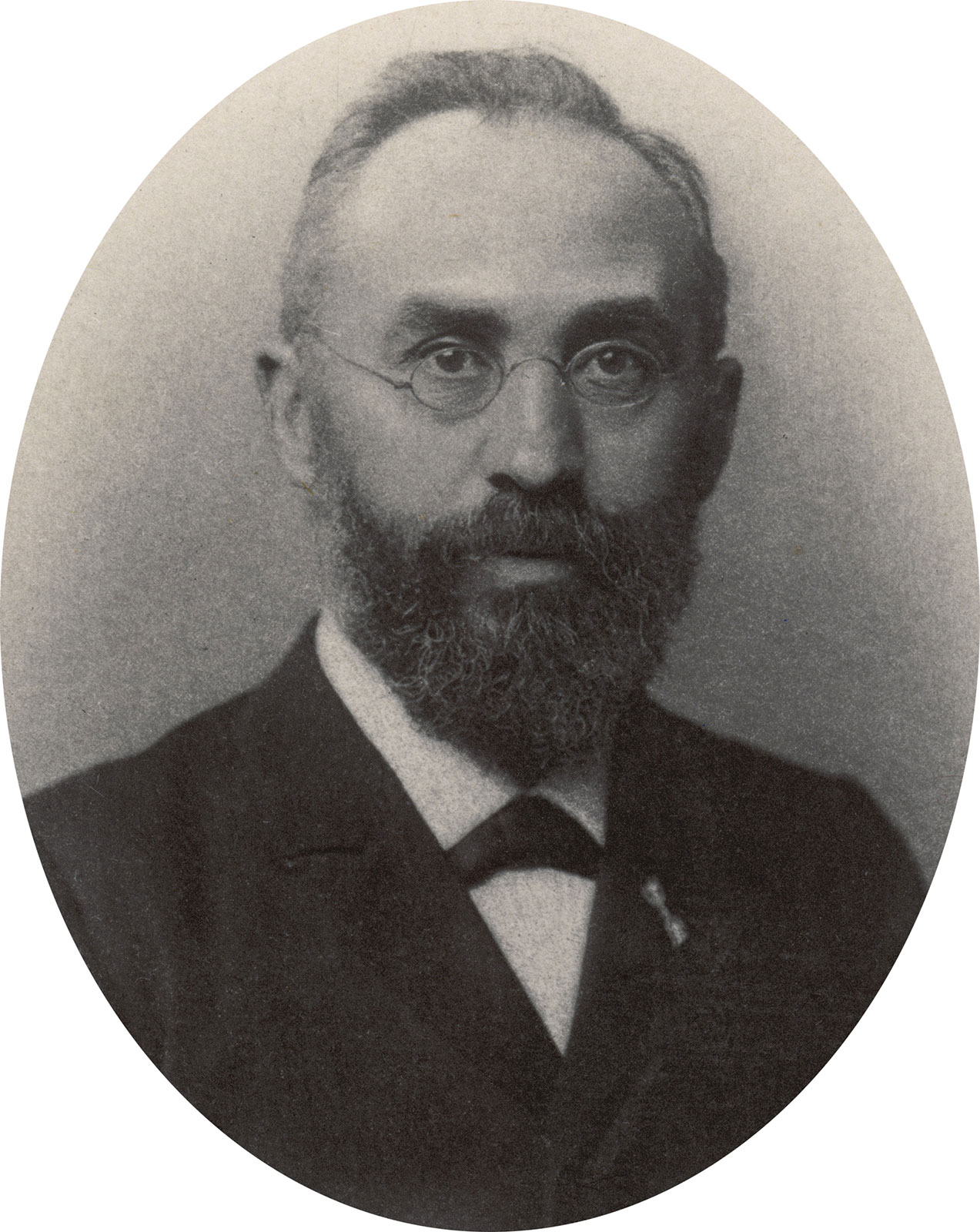
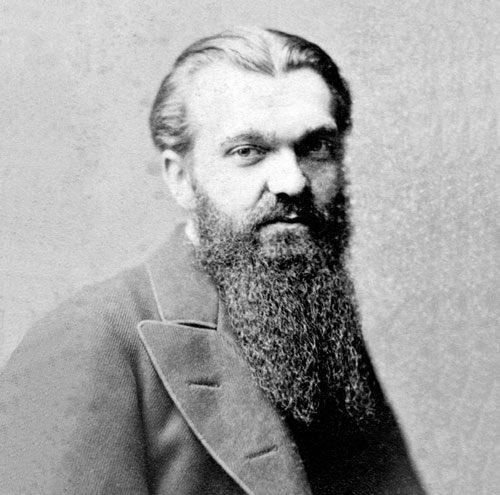
The first thing to point out is that the physicists George Francis Fitzgerald and Hendrik Lorentz, though of different nationality (the former Irish, the latter Dutch), both had fine beards:
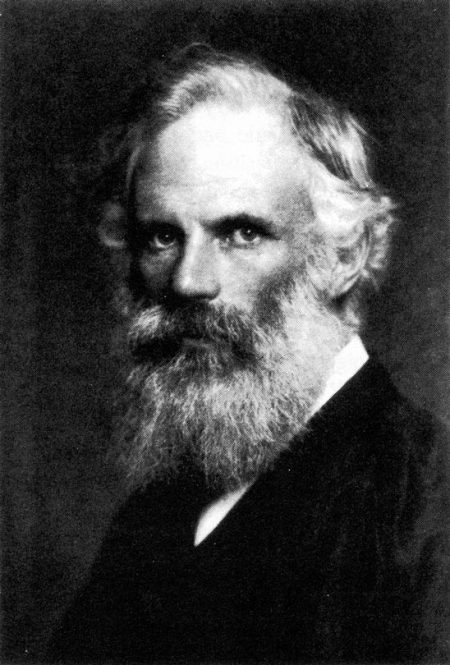
One of the interesting things you find if you read about the history of physics just before Albert Einstein introduced his theory of special relativity in 1905 was how many people seemed to be on the verge of getting the idea around about the same time. Fitzgerald and Lorentz were two who were almost there; Poincaré was another. It was as if special relativity was `in the air’ at the time. It did, however, take a special genius like Einstein to crystallize all that thinking into a definite theory.

Special relativity is fun to teach, not least because it throws up interesting yet informative paradoxes (i.e. apparent logical contradictions) arising from  that you can use to start a discussion. They’re not really logical contradictions, of course. They just challenge `common sense’ notions, which is a good thing to do to get people thinking.

Anyway, I thought I’d mention one of my favorite such paradoxes arising from a simple Gedankenerfahrung (thought experiment) here.

Imagine you are in a railway carriage moving along a track at constant speed relative to the track. The carriage is dark, but at the centre of the carriage is a flash bulb. At one end (say the front) of the carriage is a portrait of Lorentz and at the other (say the back) a portrait of Fitzgerald; the pictures are equidistant from the bulb and next to each portrait is a clock.The two clocks are synchronized in the rest frame of the carriage.

At a particular time the flash bulb goes off, illuminating both portraits and both clocks for an instant.

It is an essential postulate of special relativity that the speed of light is the same to observers in any inertial frame, so that an observer at rest in the centre of the carriage sees both portraits illuminated simultaneously as indicated by the adjacent clocks. This is because the symmetry of the situation means that light has to travel the same distance to each portrait and back.

Now suppose we view the action from the point of view of a different inertial observer, at rest by the trackside rather than on the train, who is positioned right next to the centre of the carriage as the flash goes off. The light flash travels with the same speed in the second observer’s frame, but this observer sees* the back of the carriage moving towards the light signal and the front moving away. The result is therefore that this observer sees the two portraits light up at different times. In this case the portrait of Fitzgerald is lit up before the portrait of Lorentz.

Had the train been going in the opposite direction, Lorentz would have appeared before Fitzgerald. That just shows that whether its Lorentz-Fitzgerald contraction or Fitzgerald-Lorentz contraction is just a matter of your frame of reference…

But that’s not the paradoxical thing. The paradox is although the two portraits appear at different times to the trackside observer, the clocks nevertheless display the same time….

*You have to use your imagination a bit here, as the train has to be travelling at a decent fraction of the speed of light. It’s certainly not an Irish train.

Lorentz-Fitzgerald or Fitzgerald-Lorentz?

Posted in Beards, History, The Universe and Stuff with tags , , , , on December 9, 2020 by telescoper

I’ve recently moved on to the part about Special Relativity in my module on Mechanics and Special Relativity and this afternoon I’m going to talk about the Lorentz-Fitzgerald contraction or, as it’s properly called here in Ireland, the Fitzgerald-Lorentz contraction.

The first thing to point out is that the physicists George Francis Fitzgerald and Hendrik Lorentz, though of different nationality (the former Irish, the latter Dutch), both had fine beards:

George Francis Fitzgerald (1851-1901)

Hendrik Lorentz (1853-1928)

One of the interesting things you find if you read about the history of physics just before Albert Einstein introduced his theory of special relativity in 1905 was how many people seemed to be on the verge of getting the idea around about the same time. Fitzgerald and Lorentz were two who were almost there; Poincaré was another. It was as if special relativity was `in the air’ at the time. It did, however, take a special genius like Einstein to crystallize all that thinking into a definite theory.

Special relativity is fun to teach, not least because it throws up interesting yet informative paradoxes (i.e. apparent logical contradictions) arising from  that you can use to start a discussion. They’re not really logical contradictions, of course. They just challenge `common sense’ notions, which is a good thing to do to get people thinking.

Anyway, I thought I’d mention one of my favorite such paradoxes arising from a simple Gedankenerfahrung (thought experiment) here.

Imagine you are in a railway carriage moving along a track at constant speed relative to the track. The carriage is dark, but at the centre of the carriage is a flash bulb. At one end (say the front) of the carriage is a portrait of Lorentz and at the other (say the back) a portrait of Fitzgerald; the pictures are equidistant from the bulb and next to each portrait is a clock.The two clocks are synchronized in the rest frame of the carriage.

At a particular time the flash bulb goes off, illuminating both portraits and both clocks for an instant.

It is an essential postulate of special relativity that the speed of light is the same to observers in any inertial frame, so that an observer at rest in the centre of the carriage sees both portraits illuminated simultaneously as indicated by the adjacent clocks. This is because the symmetry of the situation means that light has to travel the same distance to each portrait and back.

Now suppose we view the action from the point of view of a different inertial observer, at rest by the trackside rather than on the train, who is positioned right next to the centre of the carriage as the flash goes off. The light flash travels with the same speed in the second observer’s frame, but this observer sees* the back of the carriage moving towards the light signal and the front moving away. The result is therefore that this observer sees the two portraits light up at different times. In this case the portrait of Fitzgerald is lit up before the portrait of Lorentz.

Had the train been going in the opposite direction, Lorentz would have appeared before Fitzgerald. That just shows that whether its Lorentz-Fitzgerald contraction or Fitzgerald-Lorentz contraction is just a matter of your frame of reference…

But that’s not the paradoxical thing. The paradox is although the two portraits appear at different times to the trackside observer, the clocks still appear show the same time….

*You have to use your imagination a bit here, as the train has to be travelling at a decent fraction of the speed of light. It’s certainly not an Irish train.
Clifford’s `Space-Theory of Matter’

Posted in Beards, History, mathematics, The Universe and Stuff with tags , , , on February 26, 2020 by telescoper

Well, here’s another thing I didn’t know until I was informed by Twitter.

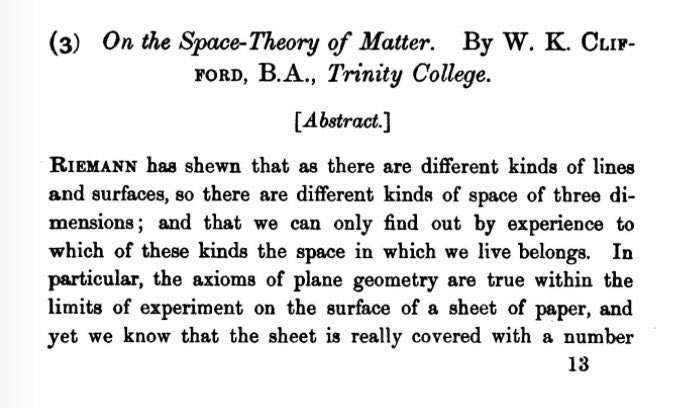
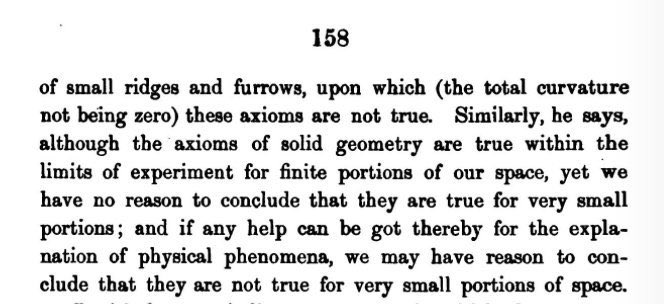
Way back in 1876 –  forty years before Einstein presented his Theory of General Relativity – the mathematician W.K. Clifford (who is most famous nowadays for the Clifford Algebra) presented a short paper in the Proceedings of the Cambridge Philosophical Society in which he speculated that space might be described by Riemannian rather than Euclidean Geometry.

Here are a couple of excerpts:

and

The paper does not contain any actual equations, and his concentration on small scales rather than large was misguided, but it is quite remarkable that he was thinking about such matters such a long time ago!

Unfortunately Clifford died very young, in 1879, at the age of 33, tuberculosis. Had he lived longer he might have been able to develop these ideas a bit further.

As a postscript I should mention that Clifford had an impressive beard.

The Eddington Eclipse Expeditions and Astronomy Ireland

Posted in History, Talks and Reviews, The Universe and Stuff with tags , , , , , , on December 10, 2019 by telescoper

After a full shift during the day at Maynooth University, yesterday evening I made my way into Dublin to give a talk to a very large audience in the famous Schrödinger Lecture Theatre in Trinity College, Dublin, an event organized by Astronomy Ireland. I have given a number of talks on the topic of the 1919 Eclipse Expeditions during this centenary year, but I think this one had the biggest audience! We adjourned to a local pub for a drink afterwards before I dashed off to get the last train back to Maynooth.

Here are the slides I used during the talk:

This time there was an important addition to my usual talk, courtesy of Professor Peter Gallagher of DIAS. He brought along the actual 4″ object glass used in the expedition to Sobral (Brazil) in 1919. I have previously only shown a picture of it. The appearance of the actual lens drew a spontaneous round of applause from the audience, and I have to admit it was a remarkable feeling to hold a little piece of history in my hand!

Obviously I was careful not to drop this item. It is on permanent display in Dunsink Observatory, by the way, if you want to see it yourself. I hope it made its way back here safely!

After the talk was over I was chatting to a couple of members of the audience when Peter Gallagher took this nice picture actually through the lens:

Picture Credit: Peter Gallagher

I look rather old in this picture. Obviously a trick of the lens.

The Funeral of Lorentz

Posted in History, The Universe and Stuff with tags , , on December 6, 2019 by telescoper

In a post a couple of days ago I mentioned the Dutch physicist Hendrik Lorentz, whose work helped establish the foundations of the theory of special relativity.

Hendrik Lorentz (1853-1928)

Doing a quick google about Lorentz I came across this remarkable silent footage of his funeral in 1928 in the town of Haarlem in the Netherlands.

from the Wikipedia page of Lorentz:

The funeral took place at Haarlem at noon on Friday, February 10. At the stroke of twelve the State telegraph and telephone services of Holland were suspended for three minutes as a revered tribute to the greatest man the Netherlands has produced in our time. It was attended by many colleagues and distinguished physicists from foreign countries. The President, Sir Ernest Rutherford, represented the Royal Society and made an appreciative oration by the graveside.

The footage of the funeral procession shows a lead carriage followed by ten mourners, followed by a carriage with the coffin, followed in turn by at least four more carriages, passing by a crowd at the Grote Markt, Haarlem from the Zijlstraat to the Smedestraat, and then back again through the Grote Houtstraat towards the Barteljorisstraat, on the way to the “Algemene Begraafplaats” at the Kleverlaan (northern Haarlem cemetery).
Einstein later gave a eulogy at a memorial service at Leiden University.

It was clearly a very grand affair which demonstrates high regard in which Lorentz was held not only by physicists but by the wider public.


The Relativity of Beards

Posted in Beards, History, The Universe and Stuff with tags , , , , on December 4, 2019 by telescoper

In my first-year module on Mechanics and Special Relativity, I’ve just moved on to the part about Special Relativity and this afternoon I’m going to talk about the Lorentz-Fitzgerald contraction or, as it’s properly called here in Ireland, the Fitzgerald-Lorentz contraction.

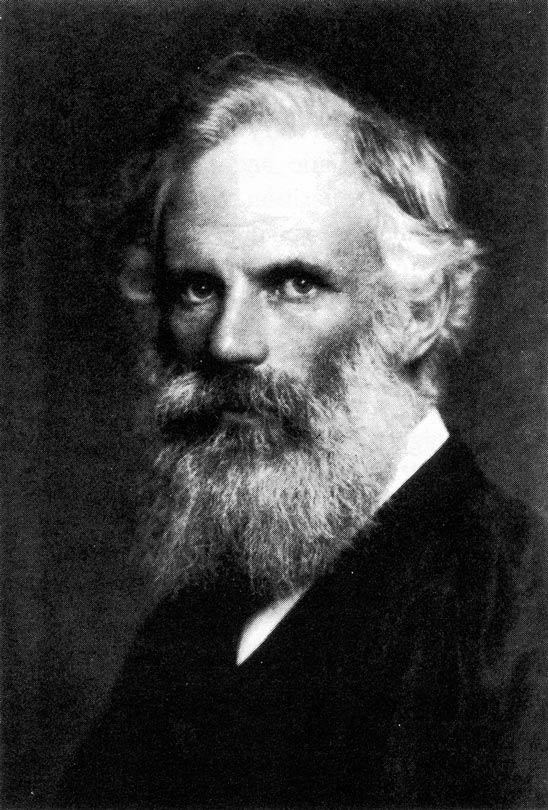
The first thing to point out is that the physicists George Francis Fitzgerald and Hendrik Lorentz, though of different nationality (the former Irish, the latter Dutch), both had fine beards:

George Francis Fitzgerald (1851-1901)

Hendrik Lorentz (1853-1928)

One of the interesting things you find if you read about the history of physics just before Albert Einstein introduced his theory of special relativity in 1905 was how many people seemed to be on the verge of getting the idea around about the same time. Fitzgerald and Lorentz were two were almost there; Poincaré was another. It was like special relativity was `in the air’ at the time. It did, however, take a special genius like Einstein to crystallize all that thinking into a definite theory.

Special relativity is fun to teach, not least because it throws up interesting yet informative paradoxes (i.e. apparent logical contradictions) arising from  that you can use to start a discussion. They’re not actually paradoxes really logical contradictions, of course. They just challenge `common sense’ notions, which is a good thing to do to get people thinking.

Anyway, I thought I’d mention one of my favorite such paradoxes arising from a simple Gedankenerfahrung (thought experiment) here.

Imagine you are in a railway carriage moving along a track at constant speed relative to the track. The carriage is dark, but at the centre of the carriage is a flash bulb. At one end (say the front) of the carriage is a portrait of Lorentz and at the other (say the back) a portrait of Fitzgerald; the pictures are equidistant from the bulb and next to each portrait is a clock.The two clocks are synchronized in the rest frame of the carriage.

At a particular time the flash bulb goes off, illuminating both portraits and both clocks for an instant.

It is an essential postulate of special relativity that the speed of light is the same to observers in any inertial frame, so that an observer at rest in the centre of the carriage sees both portraits illuminated simultaneously as indicated by the adjacent clocks. This is because the symmetry of the situation means that light has to travel the same distance to each portrait and back.

Now suppose we view the action from the point of view of a different inertial observer, at rest by the trackside rather than on the train, who is positioned right next to the centre of the carriage as the flash goes off. The flight flash travels with the same speed in the second observer’s frame, but this observer sees* the back of the carriage moving towards the light signal and the front moving away. The result is therefore that this observer sees the two portraits light up at different times. In this case the portrait of Fitzgerald is lit up before the portrait of Lorentz.

Had the train been going in the opposite direction, Lorentz would have appeared before Fitzgerald. That just shows that whether its Lorentz-Fitzgerald contraction or Fitzgerald-Lorentz contraction is just a matter of your frame of reference…

But that’s not the paradoxical thing. The paradox is although the two portraits appear at different times to the trackside observer, the clocks still appear show the same time….


*You have to use your imagination a bit here, as the train has to be travelling at a decent fraction of the speed of light. It’s certainly not an Irish train.


Lights all askew in the Heavens – the 1919 Eclipse Expeditions (Updated)

Posted in History, Talks and Reviews, The Universe and Stuff with tags , , , , , on June 3, 2019 by telescoper

Here is a video of my talk at the Open Meeting of the Royal Astronomical Society on April 12 2019. Was it really so long ago?

You can find the slides here: