Archive for Anton Webern

Webern, Strauss and Mendelssohn at the NCH

Posted in Biographical, Music with tags , , , , , , , , , , on April 29, 2023 by telescoper

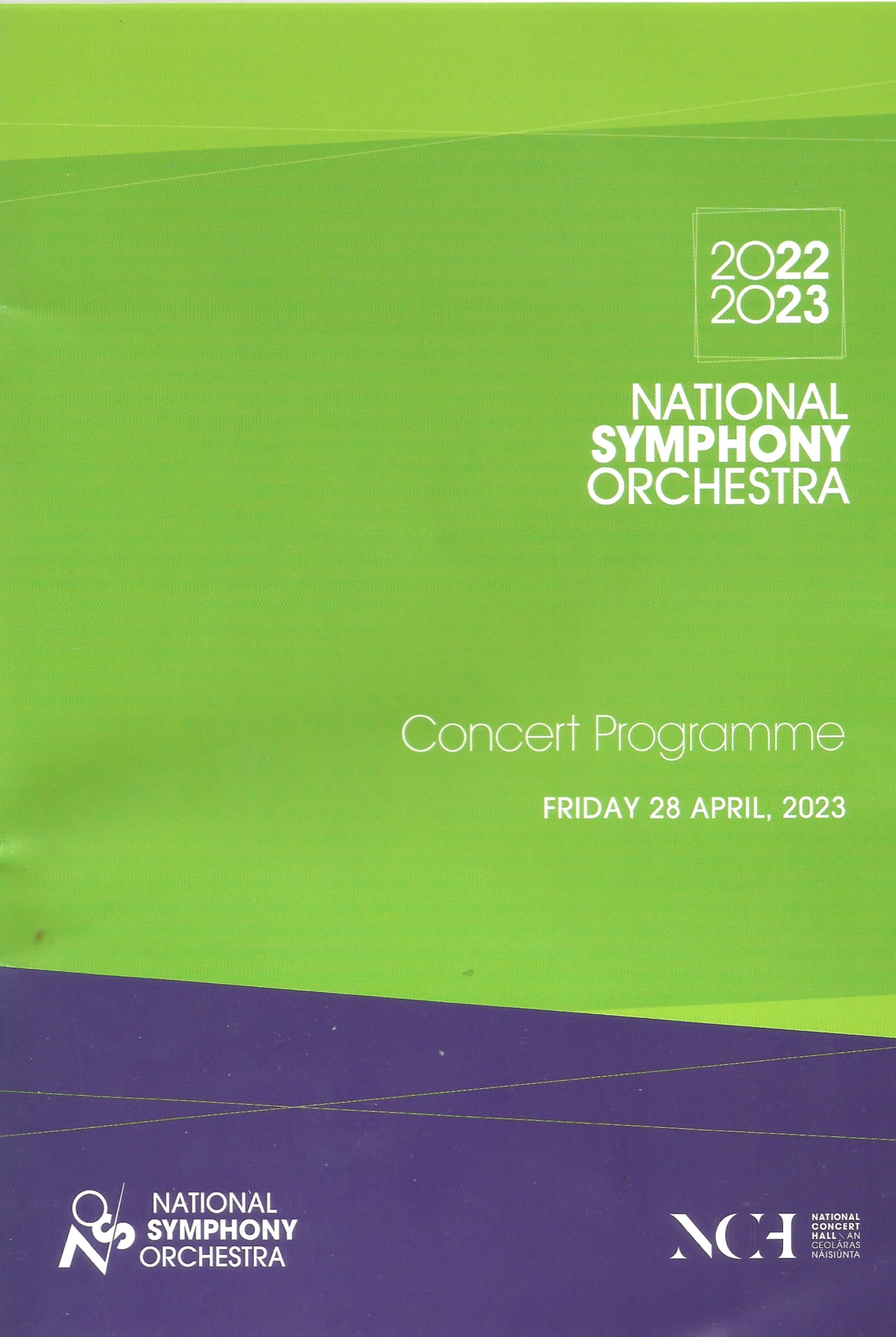
Looking back through my old blog posts, I find that the last time I went to a concert at the National Concert Hall was 10th February 2023. Owing to pressure of work I’ve had neither the time nor the energy to make the trip into Dublin since then, but last night I finally managed to get there for the excellent programme shown above, which was also broadcast live on RTÉ Lyric FM.

On this occasion the National Symphony Orchestra was conducted by Ruth Reinhardt, who last conducted the Orchestra during the pandemic in one of those weird occasions for which most of the musicians were masked, as was she. Anyway, for tonight’s performance she was unmasked long with the rest of the band.

Anton Webern’s Passacaglia (his Opus 1) was a new one on me. It’s not in the 12-tone style he adopted later as a member of the 2nd Viennese School, and can properly be regarded as a (very) late Romantic piece. It’s an intriguing variation of the Passacaglia form (originally a stately dance in triple time built on a bass theme) in that it’s not really a dance and it’s not in triple time, but it is introduced by a theme of eight notes played pizzicato on the strings, which is then followed by a set of variations. The piece only runs about 12 minutes but it packs a lot in. I found it very absorbing and enjoyed it enormously.

The Four Last Songs were published after his death, so Richard Strauss never heard them performed. The very first time they were performed was in 1950 at the Royal Albert Hall, by the London Philharmonia. One can only imagine what it must have been like for the orchestra making this music live for the very first time.  Apparently the first time any of them had seen the score was when they turned up for the rehearsal. I’m sure they knew as soon as they started playing that it was a masterpiece.

Last night we heard these songs sung by Amanda Majeski, who arrived on stage resplendent in a black evening gown. I was somewhat surprised to see her using a score for this performance. I would have thought that this was such a standard component of the repertoire that all sopranos would know all the songs off by heart. Perhaps it was just nerves, but I thought the first song, Frühling, lacked warmth but as the concert went on Amanda Majeski got into her stride and by the time she got to Im Abendrot (my favourite) she reached the right level of intensity.

I must single out the leader of the National Symphony Orchestra Elaine Clark for her gorgeous playing of the lovely violin solo in the third song, Beim Schlafengehen. I don’t mind admitting that it brought a tear to my eye.

Incidentally, as far as I know the Four Last Songs were not specifically intended to be performed together as they inevitably are these days. Although the last is my favourite, I think the first three (all based on poems by Herman Hesse) have much more in common with each other than Im Abendrot (which is a poem by Joseph von Eichendorff).

After the wine break we had Symphony No. 3 (“Scottish”) by Felix Mendelssohn. Inspired by a visit to Scotland in 1829 – the first movement was actually composed that year in Edinburgh – it wasn’t completed until over a decade later and should probably be No. 5, but who’s counting? It’s a piece on four movements, with little or no break between them. The first movement starts with a slow theme, like a hymn, but then becomes much more reminiscent of the Hebrides Overture composed in 1830. The landscape of the other three movements is very varied, sometimes cheery, sometimes lush, sometimes tempestuous. The final movement Allegro Vivacissimo has a marking guerriro (“warlike”), which in parts it is, but it also has calmer and more reflective passages before the rumbustious finale.

I always enjoy watching the musicians in these concerts, and could see last night that they were all enjoying themselves hugely. Well done to Ruth Reinhardt and the National Symphony Orchestra for an excellent performance. The hall was by no means full, which was a shame, but the concert was warmly appreciated by those of us there in the audience and no doubt by those listening on the radio.

Now there’s only a month or so to the finale of this concert season so I must try to make the most of the few remaining performances before the summer break…

Breaking Free

Posted in Art, Music with tags , , , , , , on January 6, 2017 by telescoper

I’ve been enjoy a series of fascinating programmes about music from the Second Viennese School (chiefly Arnold Schoenberg, Alban Berg and Anton Webern) on BBC Radio 3 this week gathered under the umbrella title of Breaking Free. In the period from roughly 1903 to 1925 these composers finally abandoned the traditional forms of tonality that late Romantic composers such as Gustav Mahler had struggled with in their later work. Aside from its obvious emotional intensity, one of the reasons I find music from this period absolutely absorbing because it was written in a period of highly turbulent transition; you get such a strong sense of new possibilities being opened up when you listen to some of the pioneering works. Some of them are also extremely beautiful. I often hear people say that they they think atonal music sounds ugly, but I disagree. The same people would probably agree that birdsong is beautiful, and most of that is entirely atonal..

The only problem is that I’ve now got a very long list of recordings to buy, as I don’t have any CDs or downloads of some very important pieces. I’m going to be a but poorer financially as a consequence of this educational experience, but hopefully enriched in a cultural sense.

The “breaking free” in this period wasn’t confined to music – revolutionary change was underway in other artistic fields, including painting. Last night I was listening to one of the programmes in the Breaking Free series and it inspired me to have a look in some of my art books for something appropriate to post from the time (if not the location) of the 2nd Viennese School. I decided on this, wan abstract painting by Wassily Kandinsky called Composition VII which was painted in 1913.

composition-vii-1913

The Orchestra of Welsh National Opera

Posted in Music with tags , , , , , , , , on October 30, 2010 by telescoper

Another Friday evening, another concert at St David’s Hall. This time it was the Orchestra of Welsh National Opera, performing a very mixed programme of pieces (by Rachmaninov, Ravel, Webern and Stravinsky). We’ve been hosting a former PDRA of mine, Chiaki Hikage (now at Princeton) and his wife Mihoko for a week so I invited them along. Chiaki gave a seminar on Friday afternoon at which he endured the usual bombardment of questions from Leonid Grishchuk, so I thought he would need some relaxation afterwards.  I even managed to get front-row seats. It turned out to be a wonderful evening of twentieth century classical music, full of excitement colour and dramatic contrasts.

First up was The Isle of the Dead, Op. 29 by Sergei Rachmaninov,  inspired by a painting of the same name by Arnold Böcklin and written around 1909. The rhythms of the opening passage evoke the motion of a boat moving across the sea to the island, from which point the piece develops among a cloud of increasingly dense harmonic layers into a dark atmosphere full of foreboding. It’s a piece that many probably find a bit melodramatic, but I found it both accessible and fascinating.  In fact it struck me that it wouldn’t be out of place as the soundtrack for a horror movie!

After that we had a short break while the stage crew wheeled in the old Steinway for the second piece, the Piano Concerto in G by Maurice Ravel. This is a relatively late piece by Ravel, written around 1930. Its three movements form a sort of sandwich, with the first and third up tempo, jazzy in style and very Gershwinesque. The second, adagio, movement is very different: longer lyrical and tender, although I still detected a jazz influence in the walking bass of the left hand figures during the nocturne passages. The piece was played in sparkling fashion by Jean-Philippe Collard. We were so close that we could hear him humming along as he played. Apparently that bothers some people, but not me. I suppose that’s because so many jazz pianists behave a similar way, as did Glenn Gould.

Anyway, after a glass of wine at the interval it was time for something completely different, the Six Pieces for Orchestra, Op. 6, by Anton Webern. This is a suite of short, intense, atonal pieces, sort of orchestral aphorisms, that embrace a huge range of musical ideas. Although  sometimes a bit cryptic, I found these pieces in their own way at least as evocative as the Rachmaninov we heard earlier. The disorientating atonality of the compositions gives them an edgy restlessness, which I found very absorbing. If they were to be used in a film soundtrack it would definitely have to be  a psychological thriller or  film noir.

The last work was probably the most familiar, The Firebird Suite (No. 2, 1919 version) by Igor Stravinsky from the ballet of the same name. This consists of five pieces, again of varied tempo and colour, ending in an exhilirating finale.

Overall it was a hugely enjoyable evening, with all parts of the orchestra tested to the limits and emerging with flying colours. I’d like to put in a special word for the percussionists, though. Perhaps because my Dad used to play the drums I always feel they don’t get the credit they deserve standing there at the back. In particular, during the Webern and Stravinsky works, the percussionists – especially the tympanist – had an awful lot to do, and did it absolutely superbly. However, all parts of the orchestra played their parts equally well under the baton of Lothar Koenigs. This orchestra has had a few problems recently so it was a relief to find them on such good form.

The St David’s Hall was only about two-thirds full, but the audience was thoroughly appreciative – especially for the outstanding performance of the Ravel Piano Concerto. I’m going to get hold of a recording of it by Jean-Philippe Collard as soon as I can!

P.S. Our front row tickets only cost £22 each. Amazing.


Share/Bookmark